Overview
Disagreement about evidence is a critical concept within LSAT Logical Reasoning that tests a student's ability to identify when two speakers dispute not the ultimate conclusion, but rather the facts, data, or observations that support their respective positions. This topic appears frequently on the LSAT, particularly in Point at Issue and Disagreement questions, where test-takers must pinpoint the precise nature of a dispute between two speakers. Unlike disagreements about conclusions or principles, disagreements about evidence focus on the foundational information that speakers use to build their arguments.
Understanding this concept is essential for LSAT success because it requires sophisticated analytical skills: students must distinguish between different layers of argumentation—the evidence layer versus the conclusion layer—and recognize when speakers are talking past each other by accepting different facts rather than drawing different inferences from the same facts. This skill directly translates to higher performance on Point at Issue questions, which typically appear 2-3 times per Logical Reasoning section and can significantly impact overall scores.
Within the broader landscape of logical reasoning, disagreement about evidence connects to fundamental argument analysis skills. While other question types may ask students to strengthen, weaken, or identify assumptions in arguments, disagreement questions require precise mapping of what each speaker commits to versus what they leave unstated. Mastering this topic builds the foundation for understanding how arguments are constructed from the ground up and prepares students for more complex reasoning tasks throughout the LSAT.
Learning Objectives
- [ ] Identify how Disagreement about evidence appears in LSAT questions
- [ ] Explain the reasoning pattern behind Disagreement about evidence
- [ ] Apply Disagreement about evidence to solve LSAT-style problems accurately
- [ ] Distinguish between disagreements about evidence versus disagreements about conclusions or principles
- [ ] Recognize when two speakers accept the same evidence but draw different conclusions
- [ ] Evaluate answer choices by applying the "committed to disagreeing" test
- [ ] Analyze complex dialogues to map each speaker's evidentiary commitments
Prerequisites
- Basic argument structure: Understanding premises, conclusions, and how evidence supports claims is essential because disagreement about evidence requires identifying which components of an argument are being disputed
- Logical indicators: Familiarity with conclusion indicators ("therefore," "thus") and premise indicators ("because," "since") helps distinguish evidence from conclusions in speaker dialogues
- Point at Issue question format: Basic exposure to how LSAT presents two-speaker dialogues ensures students can navigate the question structure efficiently
- Commitment versus implication: Understanding what a speaker explicitly commits to versus what might be inferred helps avoid overreading positions in disagreement questions
Why This Topic Matters
In real-world contexts, disagreements about evidence are ubiquitous in legal reasoning, scientific debates, policy discussions, and everyday arguments. Lawyers must identify whether opposing counsel disputes the facts of a case or merely the legal conclusions drawn from agreed-upon facts. Scientists may accept the same experimental data but disagree about what those data demonstrate. Recognizing these distinctions prevents wasted effort arguing past one another and focuses debate on the actual point of contention.
On the LST, disagreement about evidence appears in approximately 15-20% of Point at Issue questions, making it a high-yield topic for score improvement. These questions typically present two speakers (often named individuals like "Alex" and "Jordan") who make statements about a topic, and students must identify what they disagree about. The LSAT specifically tests whether students can distinguish between:
- Disagreements about what the facts are (evidence disagreements)
- Disagreements about what follows from agreed-upon facts (inference disagreements)
- Disagreements about underlying principles or values
Common manifestations include dialogues where Speaker A cites certain studies or observations while Speaker B cites different studies or observations, or where one speaker questions the reliability, relevance, or interpretation of evidence the other speaker presents. The LSAT rewards students who can precisely identify the evidentiary dispute without overextending to claims neither speaker makes.
Core Concepts
What Constitutes Evidence in LSAT Arguments
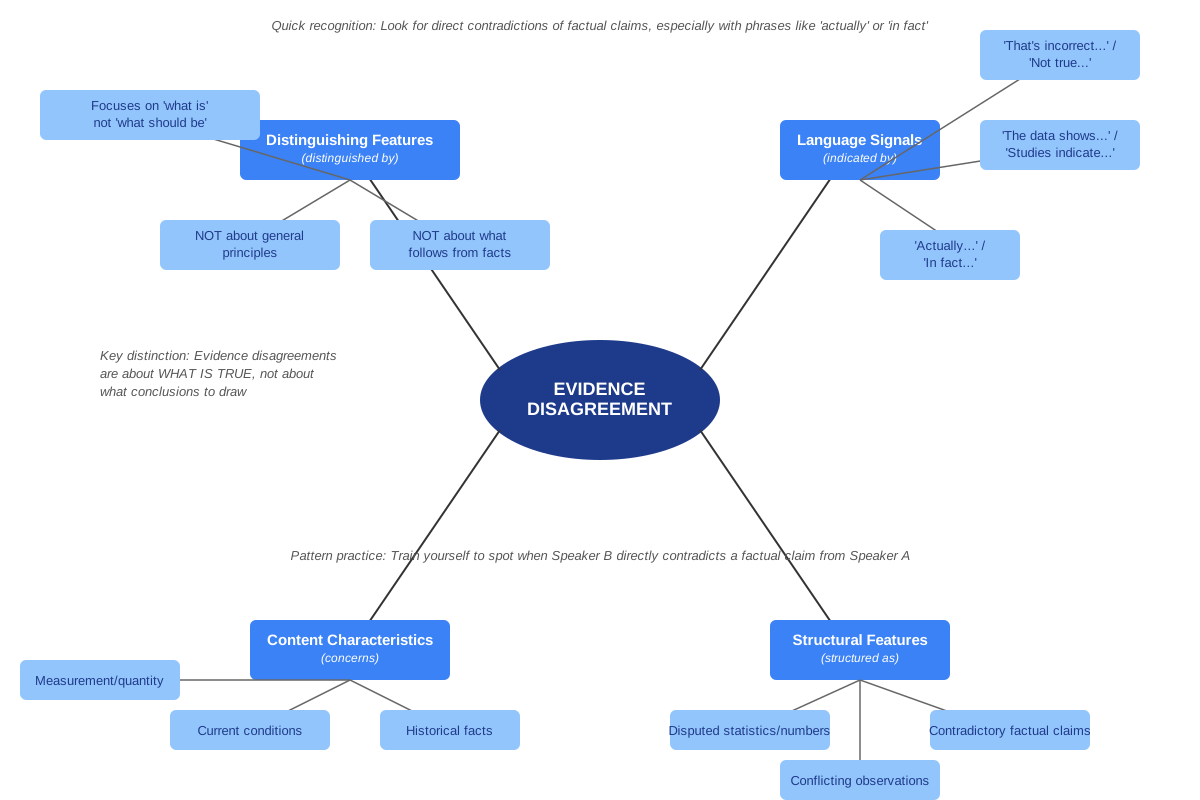
Evidence in logical reasoning refers to the factual claims, observations, data, studies, or testimony that speakers use to support their conclusions. Evidence forms the foundational layer of an argument—the "raw material" from which inferences are drawn. On the LSAT, evidence can take many forms:
- Statistical data ("Studies show that 60% of participants...")
- Expert testimony ("Economists agree that...")
- Historical facts ("The policy was implemented in 1995...")
- Observational claims ("The building shows signs of structural damage...")
- Experimental results ("The treatment group showed improvement...")
Understanding what counts as evidence versus conclusion is crucial because disagreement about evidence specifically involves disputes at this foundational level, not about what follows from the evidence.
The Structure of Evidence Disagreements
When two speakers disagree about evidence, they dispute the factual foundation of the discussion rather than the logical inferences or conclusions. This creates a specific pattern:
Speaker A: Presents Evidence Set X → Draws Conclusion Y
Speaker B: Presents Evidence Set Z (contradicting or questioning X) → May draw Conclusion W
The key feature is that the disagreement centers on whether X or Z represents the accurate factual picture. Speaker B might:
- Contradict the evidence directly: "Actually, studies show the opposite..."
- Question the reliability of evidence: "Those studies were methodologically flawed..."
- Present alternative evidence: "Other research demonstrates a different pattern..."
- Dispute the relevance of evidence: "That data doesn't actually apply to this situation..."
Distinguishing Evidence Disagreements from Other Disagreement Types
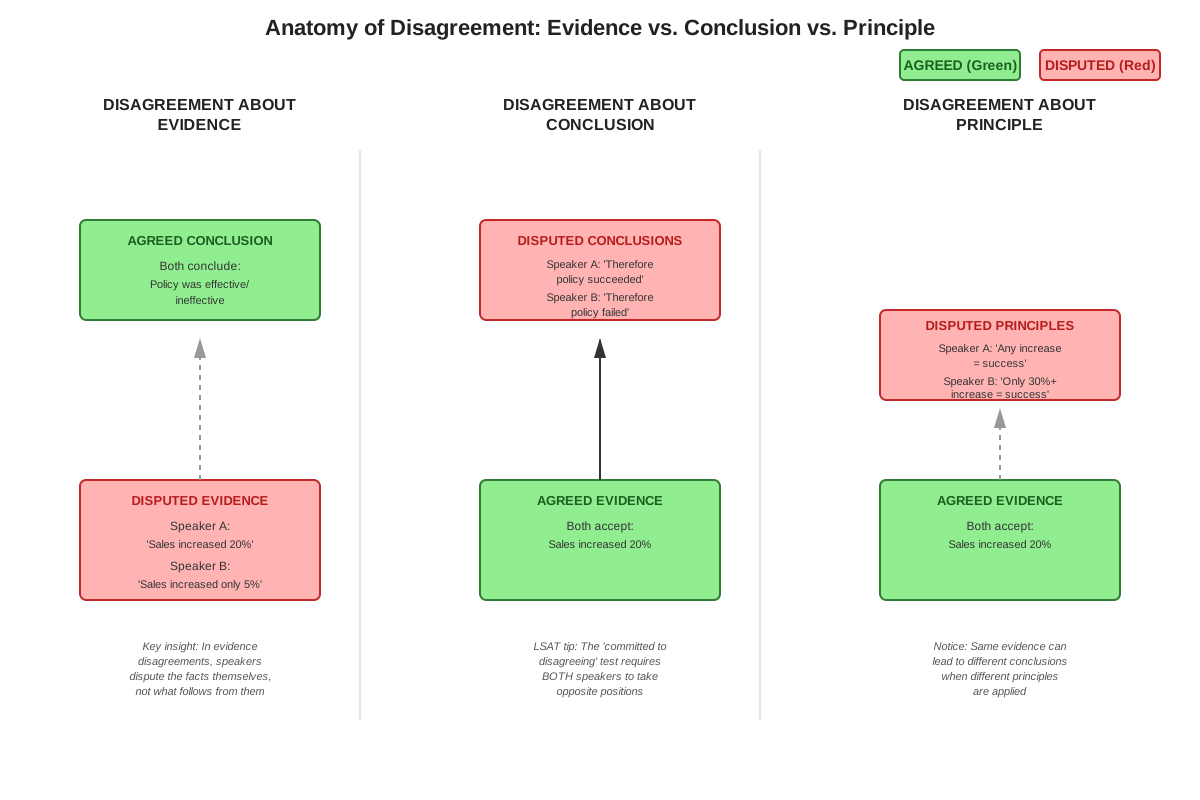
The LSAT tests whether students can differentiate between three primary disagreement types:
| Disagreement Type | What's Disputed | Example Pattern |
|---|---|---|
| Evidence | The facts, data, or observations themselves | A: "Crime rates increased." B: "No, crime rates decreased." |
| Inference/Conclusion | What follows from agreed-upon facts | A: "Crime rates increased, so we need more police." B: "Crime rates increased, but we need social programs instead." |
| Principle | The underlying values or rules | A: "We should prioritize efficiency." B: "We should prioritize equity." |
In evidence disagreements, speakers cannot both be right about the factual claims—the evidence is either accurate or it isn't. In inference disagreements, both speakers might accept the same evidence but draw different conclusions from it.
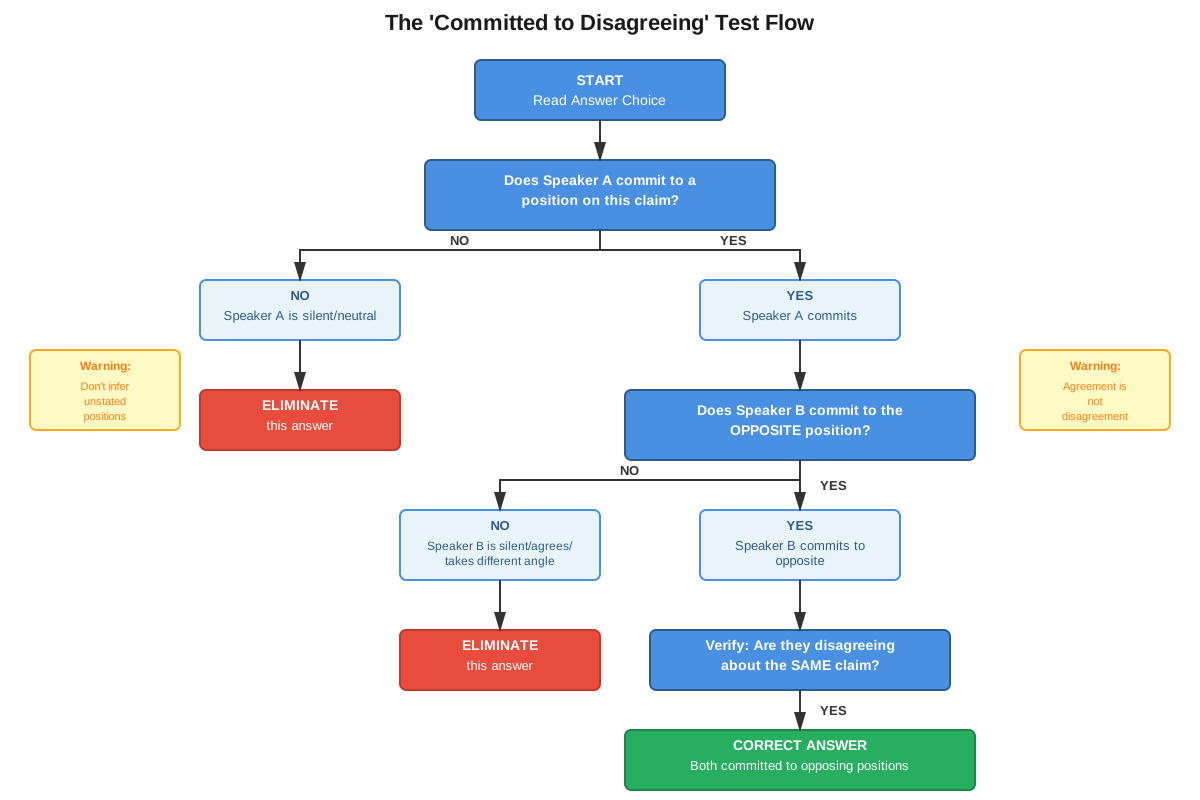
The "Committed to Disagreeing" Test
A critical analytical tool for lsat disagreement about evidence questions is the "committed to disagreeing" test. For an answer choice to correctly identify a disagreement, both speakers must be committed to opposing positions on that specific claim. This means:
- Speaker A must have a clear position (explicit or necessarily implied) on the claim
- Speaker B must have the opposite position on that same claim
- Both positions must be definite, not merely possible or suggested
For evidence disagreements specifically, apply this test to factual claims:
- Does Speaker A commit to a particular factual claim?
- Does Speaker B explicitly deny or contradict that factual claim?
- Or does Speaker B present contradictory evidence that cannot be reconciled with A's evidence?
Common Evidence Disagreement Patterns on the LSAT
The LSAT recycles several recognizable patterns for evidence disagreements:
Pattern 1: Competing Studies
Speaker A cites research supporting position X; Speaker B cites different research supporting the opposite. The disagreement is about which body of evidence is accurate or more reliable.
Pattern 2: Factual Contradiction
Speaker A makes a factual claim; Speaker B directly denies it with a contrary factual claim.
Pattern 3: Reliability Challenge
Speaker A presents evidence; Speaker B questions whether that evidence is trustworthy, accurate, or properly gathered.
Pattern 4: Scope Dispute
Speaker A presents evidence about domain X; Speaker B claims the evidence doesn't actually cover domain X or applies to domain Y instead.
What Evidence Disagreements Are NOT
Understanding what doesn't constitute an evidence disagreement is equally important:
- Not a disagreement if only one speaker addresses the claim: If Speaker A mentions a fact and Speaker B simply doesn't discuss it, there's no disagreement
- Not an evidence disagreement if they dispute what the evidence means: If both accept the same data but interpret it differently, that's an inference disagreement
- Not a disagreement if positions are compatible: If Speaker A says "some studies show X" and Speaker B says "other studies show Y," they might both be right—no necessary disagreement exists unless they claim their evidence is comprehensive or exclusive
Implicit versus Explicit Evidence Commitments
Sometimes speakers don't explicitly state their evidentiary position but are necessarily committed to it based on their argument. For example:
Speaker A: "The new medication is effective because clinical trials showed 80% improvement rates."
Speaker A is explicitly committed to the evidence that clinical trials showed 80% improvement. But Speaker A is also implicitly committed to the claim that these trials were legitimate and properly conducted—otherwise the argument fails.
Speaker B: "The clinical trials were poorly designed and their results are unreliable."
Speaker B explicitly challenges the reliability of the evidence, creating a disagreement about whether the trial results constitute valid evidence. This is a disagreement about evidence even though Speaker B doesn't necessarily dispute the numerical results themselves—the dispute is about whether those numbers represent reliable evidence.
Concept Relationships
The concept of disagreement about evidence sits at the intersection of several fundamental logical reasoning skills. At its foundation, it requires argument structure analysis → which enables identification of → evidence versus conclusion distinction → which then allows recognition of → disagreement about evidence specifically.
This topic connects directly to Point at Issue and Disagreement questions more broadly, serving as one specific type of disagreement students must recognize. While the broader category includes disagreements about conclusions, principles, and predictions, evidence disagreements represent the most foundational level—disputes about the facts themselves rather than what follows from them.
The relationship flows hierarchically:
Argument Analysis (prerequisite skill)
↓
Evidence Identification (component skill)
↓
Disagreement Recognition (application skill)
↓
Evidence Disagreement Specifically (specialized application)
↓
Correct Answer Selection (test performance)
Understanding evidence disagreements also connects to assumption questions because when speakers disagree about evidence, they often make different assumptions about what constitutes reliable or relevant evidence. Similarly, this topic relates to strengthen/weaken questions since evidence that strengthens one position often contradicts evidence supporting the opposing position.
High-Yield Facts
⭐ Evidence disagreements involve disputes about factual claims, data, or observations—not about what conclusions follow from agreed-upon facts
⭐ Both speakers must be committed to opposing positions on a specific factual claim for a genuine evidence disagreement to exist
⭐ If Speaker A presents evidence and Speaker B simply ignores it or discusses something else, there is no disagreement
⭐ Challenging the reliability, methodology, or relevance of evidence constitutes an evidence disagreement
⭐ Evidence disagreements appear in approximately 15-20% of Point at Issue questions on the LSAT
- When speakers cite different studies or data sets that contradict each other, this typically indicates an evidence disagreement
- An implicit commitment to an evidentiary claim (necessary for the argument to work) can create a disagreement just as much as an explicit statement
- Compatible claims do not constitute disagreements—both speakers could be correct if their claims don't actually contradict
- Evidence disagreements are mutually exclusive: if one speaker's factual claim is true, the other's contradictory claim must be false
- The LSAT often includes wrong answer choices that describe disagreements about conclusions when the actual disagreement is about evidence, or vice versa
Quick check — test yourself on Disagreement about evidence so far.
Try Flashcards →Common Misconceptions
Misconception: If two speakers reach different conclusions, they must disagree about the evidence supporting those conclusions.
Correction: Speakers can accept identical evidence but draw different conclusions from it. The disagreement would then be about inference or interpretation, not about the evidence itself. Evidence disagreements require dispute about the factual claims, not merely about what those facts demonstrate.
Misconception: When Speaker B questions Speaker A's evidence, they disagree about the conclusion.
Correction: Questioning evidence quality, reliability, or relevance constitutes a disagreement about evidence, not conclusions. If Speaker B says "your study was flawed," the dispute is about whether valid evidence exists, which is an evidentiary disagreement.
Misconception: If Speaker A mentions a fact and Speaker B doesn't address it, they disagree about that fact.
Correction: Disagreement requires both speakers to take opposing positions. Silence or failure to address a claim doesn't constitute disagreement. Speaker B must actively deny, contradict, or present incompatible evidence to create a genuine disagreement.
Misconception: All Point at Issue questions involve disagreements about evidence.
Correction: Point at Issue questions test various disagreement types including conclusions, principles, predictions, and evidence. Students must identify which type of disagreement is present in each specific question. Evidence disagreements are common but not universal.
Misconception: If speakers cite different sources, they automatically disagree about evidence.
Correction: Different sources can provide compatible information. A disagreement exists only when the evidence from these sources contradicts or when one speaker challenges the validity of the other's sources. Citing different studies about different aspects of a topic doesn't necessarily create disagreement.
Misconception: Disagreeing about what evidence means is the same as disagreeing about the evidence itself.
Correction: Interpretation disagreements are distinct from evidence disagreements. If both speakers accept that "sales increased 20%" but disagree about whether this indicates success or merely market growth, they disagree about interpretation, not about the factual claim that sales increased 20%.
Worked Examples
Example 1: Identifying Evidence Disagreement
Dialogue:
Marcus: The city's new recycling program has been highly successful. Participation rates have increased by 35% since the program launched, and the amount of waste sent to landfills has decreased significantly.
Yuki: I disagree. While participation rates may have increased, the actual amount of material being recycled has remained essentially flat. The decrease in landfill waste is primarily due to the new composting initiative, not the recycling program.
Question: Marcus and Yuki disagree about whether:
(A) the recycling program has been successful
(B) participation rates in the recycling program have increased
(C) the recycling program is responsible for the decrease in landfill waste
(D) composting initiatives are more effective than recycling programs
(E) the amount of material being recycled has increased
Analysis:
Let's apply the "committed to disagreeing" test to each answer choice:
(A) This is a conclusion disagreement, not an evidence disagreement. Marcus concludes the program is successful; Yuki disagrees with this conclusion. However, the question asks what they disagree about, and we need to identify the specific point of contention.
(B) Marcus explicitly states participation rates increased by 35%. Yuki says "while participation rates may have increased"—this is a concession, not a disagreement. Yuki accepts this evidence. No disagreement here.
(C) Marcus claims the waste decrease is due to the recycling program (implied by presenting it as evidence of success). Yuki explicitly states the decrease is "primarily due to the new composting initiative, not the recycling program." This is a clear evidence disagreement—they dispute what caused the observed decrease in landfill waste.
(D) Yuki never claims composting is more effective generally; only that it caused this specific decrease. Marcus doesn't address composting at all. No disagreement.
(E) Marcus implies the amount recycled increased (by citing increased participation as evidence of success). Yuki explicitly states "the actual amount of material being recycled has remained essentially flat." This is also an evidence disagreement—they dispute the factual claim about recycling amounts.
Correct Answer: (C) is the best answer because it identifies the most direct evidence disagreement. While (E) also represents an evidence disagreement, (C) more precisely captures the causal claim they dispute—what evidence explains the landfill waste decrease. This is a disagreement about which facts account for an observed phenomenon.
Learning Objective Connection: This example demonstrates how to identify disagreement about evidence by distinguishing factual disputes from conclusion disputes and applying the commitment test.
Example 2: Evidence Disagreement versus Inference Disagreement
Dialogue:
Dr. Chen: The archaeological evidence clearly indicates that the ancient settlement was abandoned suddenly. We found cooking pots still containing food residue, tools left in mid-use, and no evidence of gradual population decline.
Dr. Patel: The settlement may have been abandoned suddenly, but the evidence you cite doesn't clearly indicate this. Cooking pots with residue could have been left by the final departing families over several months, and tools are often abandoned when they break. The absence of evidence for gradual decline isn't evidence of sudden abandonment.
Question: The dialogue provides the most support for the claim that Dr. Chen and Dr. Patel disagree about whether:
(A) the settlement was abandoned suddenly
(B) cooking pots containing food residue were found at the site
(C) the archaeological findings prove sudden abandonment
(D) tools were left at the settlement site
(E) there is evidence of gradual population decline
Analysis:
This example is trickier because it tests the boundary between evidence and inference disagreements.
(A) Dr. Chen concludes sudden abandonment occurred. Dr. Patel says it "may have been abandoned suddenly"—this is not a disagreement about whether it happened, but about whether the evidence proves it. Not the main disagreement.
(B) Dr. Chen states this; Dr. Patel doesn't dispute it but rather reinterprets what it means. No evidence disagreement.
(C) This is the key. Dr. Chen claims the evidence "clearly indicates" sudden abandonment—meaning the evidence is sufficient proof. Dr. Patel explicitly denies this: "the evidence you cite doesn't clearly indicate this." They disagree about whether the cited evidence actually demonstrates what Dr. Chen claims. This is a disagreement about what the evidence shows—which is technically about the evidentiary value or probative force of the findings.
(D) Dr. Chen mentions tools; Dr. Patel doesn't dispute their presence but offers an alternative explanation. No evidence disagreement about whether tools were found.
(E) Dr. Chen notes absence of evidence for gradual decline. Dr. Patel agrees there's no such evidence but disputes what this absence proves. No disagreement about the evidence itself.
Correct Answer: (C) This is subtle—they don't disagree about what physical evidence exists, but rather about whether that evidence constitutes proof of the conclusion. This represents a disagreement about the evidentiary significance of agreed-upon facts, which straddles the line between evidence and inference disagreement. The LSAT would likely frame this as an evidence disagreement because it concerns what the evidence demonstrates rather than what logical conclusion to draw from accepted evidence.
Learning Objective Connection: This example shows the sophisticated distinction between disagreeing about what evidence exists versus what that evidence proves, helping students recognize the boundaries of evidence disagreements.
Exam Strategy
Approaching Evidence Disagreement Questions
When encountering a Point at Issue question that might involve evidence disagreement, follow this systematic approach:
Step 1: Read both speakers carefully and map their commitments
Create a mental or written list of what each speaker explicitly states or necessarily implies. Focus on factual claims, data, studies, or observations.
Step 2: Identify the topic of disagreement
What subject are both speakers addressing? Evidence disagreements require both speakers to discuss the same factual domain.
Step 3: Apply the commitment test to each answer choice
For each option, ask: "Is Speaker A committed to this claim? Is Speaker B committed to the opposite? Are these commitments definite, not merely possible?"
Step 4: Distinguish evidence from conclusion
If an answer choice describes a conclusion or principle rather than a factual claim, eliminate it if you're looking for an evidence disagreement.
Trigger Words and Phrases
Watch for these linguistic markers that often signal evidence disagreements:
Direct contradiction markers:
- "Actually, the data shows..."
- "That's incorrect; studies demonstrate..."
- "No, the facts are..."
- "On the contrary, evidence indicates..."
Reliability challenge markers:
- "Those studies were flawed..."
- "The methodology was inadequate..."
- "That evidence is unreliable because..."
- "The data doesn't actually show..."
Alternative evidence markers:
- "Other research demonstrates..."
- "More recent studies have found..."
- "Additional evidence suggests..."
- "The actual statistics reveal..."
Scope dispute markers:
- "That evidence doesn't apply to..."
- "The data concerns X, not Y..."
- "Those findings are limited to..."
Process of Elimination Tips
Eliminate answer choices where:
- Only one speaker addresses the claim: If Speaker B never discusses the topic in the answer choice, it cannot be a disagreement
- Both speakers could be right: If the claims are compatible (e.g., "some studies show X" and "other studies show Y"), there's no necessary disagreement
- The answer describes a conclusion rather than evidence: Look for answer choices that describe what follows from facts rather than the facts themselves
- Neither speaker is definitely committed: Phrases like "might," "possibly," or "could" in a speaker's statement often mean they're not committed to a definite position
- The answer is too broad or too narrow: The disagreement should match the scope of what both speakers actually discuss
Time Allocation
Point at Issue questions, including those testing evidence disagreements, should take approximately 1:00-1:30 minutes. Allocate time as follows:
- 20-30 seconds: Read and understand both speakers' positions
- 10-15 seconds: Identify the likely point of disagreement
- 30-45 seconds: Evaluate answer choices using the commitment test
- 5-10 seconds: Confirm your answer and move on
If you find yourself spending more than 90 seconds, mark the question and return to it if time permits. Evidence disagreement questions reward careful analysis but shouldn't consume excessive time.
Exam Tip: The correct answer to an evidence disagreement question will often feel "smaller" or more specific than wrong answers that describe broad conclusion disagreements. Don't be afraid to select an answer that identifies a narrow factual dispute—that precision is often what the LSAT rewards.
Memory Techniques
The FACT Acronym
Remember what constitutes an evidence disagreement using FACT:
Factual claims (not conclusions)
Actually disputed (both speakers committed to opposite positions)
Contradictory (positions cannot both be true)
Testable (about observable or verifiable matters)
The "Two Witnesses" Visualization
Imagine two witnesses testifying in court about what they observed. Evidence disagreements are like witnesses giving contradictory testimony about what happened: "The light was red" versus "The light was green." They're not disagreeing about what the law says or what should happen—they're disagreeing about the facts. This mental image helps distinguish evidence disagreements from other types.
The Three-Layer Argument Model
Visualize arguments as having three layers:
TOP LAYER: Conclusions (what follows)
MIDDLE LAYER: Inferences (how we get there)
BOTTOM LAYER: Evidence (the facts)
Evidence disagreements occur at the BOTTOM LAYER. When speakers dispute something at this layer, they're fighting about the foundation, not the building constructed on top. This spatial metaphor helps categorize disagreements quickly.
The "Both Must Bite" Rule
For a genuine disagreement, both speakers must "bite" on the same claim—one saying yes, the other saying no. If only one speaker bites (addresses the claim), there's no disagreement. This memorable phrase helps apply the commitment test quickly.
Summary
Disagreement about evidence represents a fundamental category of dispute in LSAT Logical Reasoning, focusing on conflicts about factual claims, data, observations, or the reliability and relevance of such information. Unlike disagreements about conclusions or principles, evidence disagreements occur at the foundational level of arguments—speakers dispute what the facts are, not what follows from agreed-upon facts. Successfully identifying these disagreements requires applying the "committed to disagreeing" test: both speakers must take definite, opposing positions on the same factual claim. Common patterns include competing studies, direct factual contradictions, reliability challenges, and scope disputes. The LSAT tests this concept frequently in Point at Issue questions, rewarding students who can precisely distinguish between evidence-level disputes and other disagreement types. Mastery requires careful reading to map each speaker's commitments, systematic application of the commitment test to answer choices, and recognition of trigger words that signal evidentiary disputes. This skill is essential not only for Point at Issue questions but also for understanding argument structure throughout the Logical Reasoning section.
Key Takeaways
- Disagreement about evidence involves disputes about factual claims, data, or observations—not about conclusions or inferences drawn from agreed-upon facts
- Both speakers must be committed to opposing positions on a specific claim for a genuine disagreement to exist; silence or failure to address a topic doesn't constitute disagreement
- Evidence disagreements are mutually exclusive: if one speaker's factual claim is true, the contradictory claim must be false
- Common patterns include competing studies, direct factual contradictions, reliability challenges, and disputes about the scope or relevance of evidence
- Apply the "committed to disagreeing" test systematically to each answer choice, eliminating options where only one speaker addresses the claim or where both positions could be true
- Watch for trigger words like "actually," "those studies were flawed," "the data shows the opposite," and "that evidence doesn't apply" that signal evidence disagreements
- Evidence disagreements appear in approximately 15-20% of Point at Issue questions and represent high-yield opportunities for score improvement
Related Topics
Disagreement about Conclusions: While evidence disagreements focus on factual disputes, conclusion disagreements involve speakers who accept the same evidence but draw different inferences. Mastering evidence disagreements provides the foundation for distinguishing these closely related question types.
Disagreement about Principles: Some Point at Issue questions test whether students can identify disputes about underlying values or rules rather than facts or conclusions. Understanding evidence disagreements helps clarify what principles are not—they're not factual claims.
Assumption Questions: When speakers disagree about evidence, they often make different assumptions about what constitutes reliable or relevant evidence. The skills developed in analyzing evidence disagreements transfer directly to identifying assumptions.
Strengthen and Weaken Questions: Evidence that strengthens one position often contradicts evidence supporting an opposing view. Understanding evidence disagreements helps recognize how new evidence affects arguments.
Method of Reasoning Questions: These questions sometimes ask how one speaker responds to another, and "challenging the evidence" is a common correct answer type that builds on understanding evidence disagreements.
Practice CTA
Now that you've mastered the core concepts of disagreement about evidence, it's time to put your knowledge into action. Attempt the practice questions designed specifically for this topic, focusing on applying the "committed to disagreeing" test and distinguishing evidence disagreements from other dispute types. Use the flashcards to reinforce trigger words and common patterns. Remember: evidence disagreements appear frequently on the LSAT, and each question you master brings you closer to your target score. The precision you develop in identifying these disagreements will serve you throughout the Logical Reasoning section and beyond. You've built the foundation—now build your confidence through deliberate practice!
Sign up free to keep reading
Create a free AnvayaPrep account to finish this LSAT guide on Disagreement about evidence — plus flashcards and practice questions.