Overview
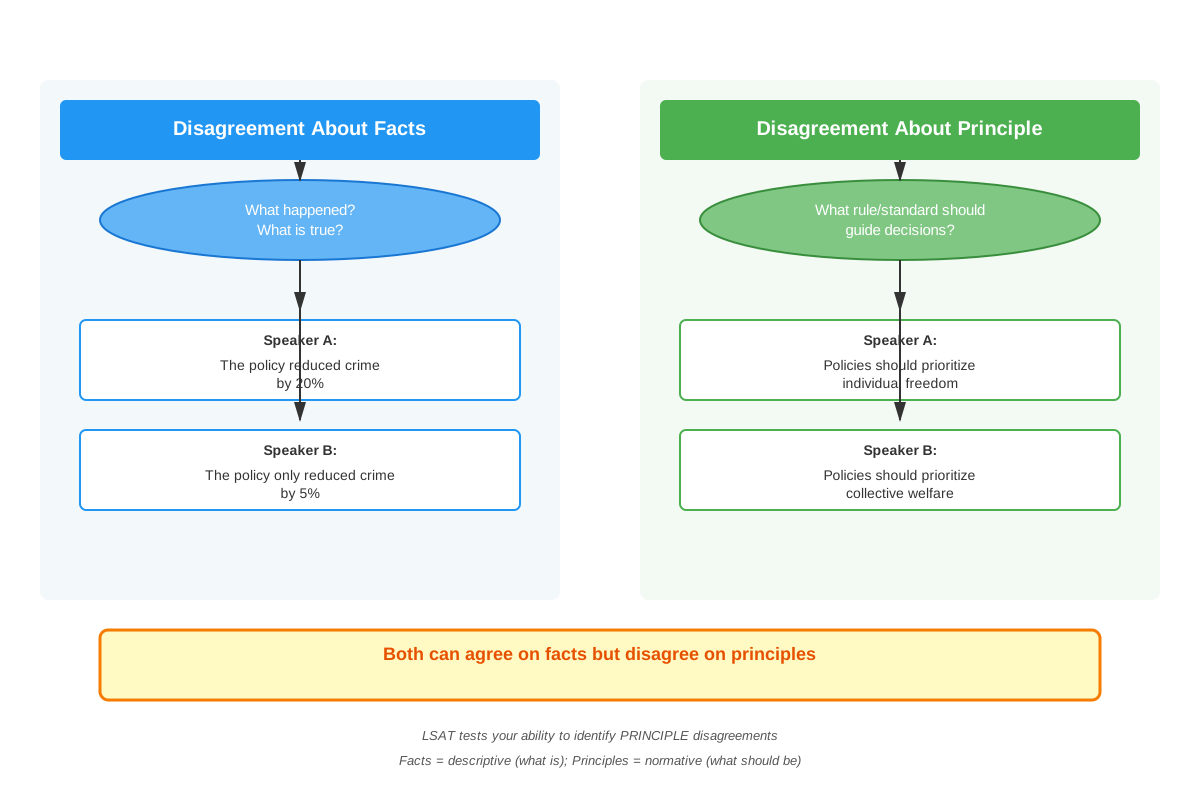
Disagreement about principle questions represent a sophisticated category within LSAT Logical Reasoning that tests a student's ability to identify the fundamental philosophical or ethical commitments underlying two speakers' positions. Unlike simple factual disagreements where two people dispute what happened or what the data shows, these questions require recognizing when speakers clash over underlying rules, standards, or values that guide their reasoning. This distinction is crucial: two people might agree on all the facts yet still disagree because they apply different principles to interpret those facts.
Understanding disagreement about principle is essential for LSAT success because these questions appear regularly in the Logical Reasoning sections and demand a nuanced reading skill that extends beyond surface-level comprehension. Students must learn to distinguish between what speakers explicitly state and the deeper normative commitments that drive their conclusions. This skill directly impacts performance on point at issue and disagreement questions, which consistently appear multiple times per exam and can significantly influence overall scores.
Within the broader landscape of Logical Reasoning, disagreement about principle questions connect to several critical competencies: identifying assumptions, recognizing argument structure, and understanding how general rules apply to specific cases. Mastering this topic strengthens analytical reading skills that benefit performance across all Logical Reasoning question types, from strengthening and weakening arguments to identifying flaws and drawing inferences. The ability to extract underlying principles from arguments is foundational to legal reasoning itself, making this topic particularly relevant to the skills law schools seek to develop.
Learning Objectives
- [ ] Identify how Disagreement about principle appears in LSAT questions
- [ ] Explain the reasoning pattern behind Disagreement about principle
- [ ] Apply Disagreement about principle to solve LSAT-style problems accurately
- [ ] Distinguish between disagreements about principle and disagreements about facts or application
- [ ] Recognize the specific language patterns that signal principle-based disagreements
- [ ] Evaluate answer choices by testing whether both speakers would actually disagree about the stated principle
Prerequisites
- Basic argument structure recognition: Understanding premises, conclusions, and how they connect is necessary to identify the principles underlying arguments rather than just their surface claims.
- Distinction between facts and values: Recognizing the difference between descriptive statements (what is) and normative statements (what should be) enables identification of principle-based reasoning.
- Familiarity with conditional reasoning: Many principles take the form of conditional statements (if X, then Y), so comfort with this logical structure aids in extracting underlying rules.
- Experience with Point at Issue questions: Disagreement about principle is a specialized subset of these questions, so understanding the general format provides essential context.
Why This Topic Matters
Disagreement about principle questions test a fundamental skill in legal reasoning: the ability to identify the rules, standards, and values that guide decision-making. In legal practice, attorneys must constantly discern the principles underlying judicial opinions, statutes, and opposing arguments. The LSAT uses these questions to assess whether candidates can move beyond surface-level reading to understand the normative frameworks that structure reasoning.
These questions typically appear 2-4 times per LSAT exam across the two Logical Reasoning sections, making them a high-frequency question type that significantly impacts scores. They most commonly appear with question stems like "On the basis of their statements, Alex and Bailey are committed to disagreeing about which one of the following principles?" or "The dialogue provides the most support for the claim that the two speakers disagree over whether..." When the question specifically asks about principles, rules, or standards rather than facts or specific applications, test-takers face a disagreement about principle question.
In real-world applications, the ability to identify principle-based disagreements enables more productive debates and clearer thinking. When people talk past each other, they often disagree about underlying principles while mistakenly believing they disagree about facts. Recognizing this distinction allows for more targeted discussion of the actual point of contention. For law students and attorneys, this skill becomes essential when distinguishing cases, arguing for different interpretations of statutes, or advocating for policy changes based on competing values.
Core Concepts
What Constitutes a Principle
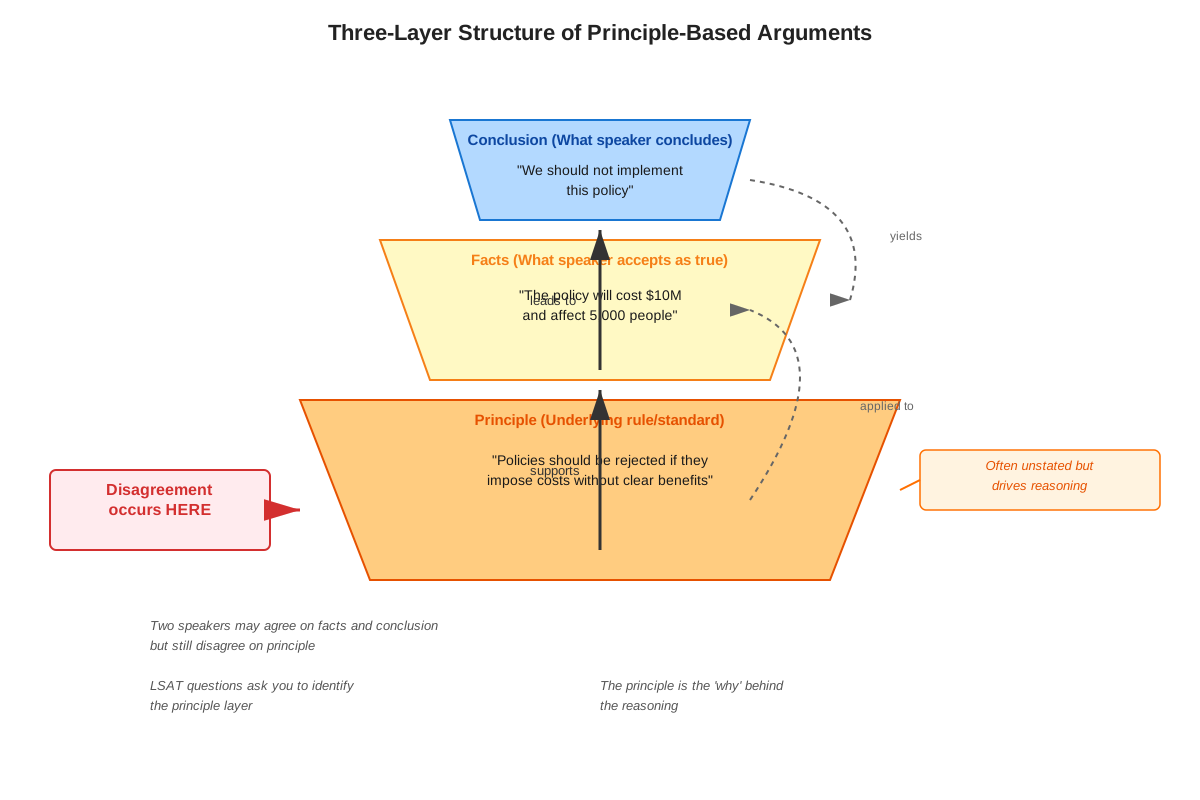
A principle in LSAT Logical Reasoning is a general rule, standard, or value judgment that guides reasoning about specific cases. Principles typically take the form of universal or near-universal statements about what should be done, what is right or wrong, or what criteria should govern decisions. For example, "People should always prioritize honesty over politeness" is a principle, while "Sarah told the truth yesterday" is a fact. Principles operate at a higher level of abstraction than specific factual claims and provide the framework for evaluating particular situations.
Principles can be expressed in various forms:
- Conditional rules: "If an action harms others, then it is morally wrong"
- Categorical imperatives: "Artistic expression should never be censored"
- Comparative standards: "Economic efficiency matters more than equal distribution"
- Procedural rules: "Decisions affecting a group should require unanimous consent"
The key characteristic distinguishing principles from other types of statements is their generalizability—they apply across multiple situations rather than describing a single instance.
Disagreement About Principle vs. Other Disagreements
Understanding disagreement about principle requires distinguishing it from other types of disagreement that appear on the LSAT. This distinction is critical because wrong answer choices often present disagreements of the wrong type.
| Type of Disagreement | Characteristics | Example |
|---|---|---|
| Disagreement about facts | Dispute over what is true in the world; empirical claims | Alex: "The policy reduced crime by 20%." Bailey: "The policy had no effect on crime rates." |
| Disagreement about application | Agree on the principle but disagree whether it applies to a specific case | Both agree lying is wrong, but disagree whether withholding information counts as lying |
| Disagreement about principle | Dispute over the underlying rule, standard, or value that should guide reasoning | Alex: "Efficiency should determine policy." Bailey: "Fairness should determine policy." |
| Disagreement about prediction | Dispute over what will happen in the future | Alex: "The law will reduce pollution." Bailey: "The law will increase pollution." |
In lsat disagreement about principle questions, both speakers might agree on all the facts yet still reach opposite conclusions because they apply different underlying standards. This is the hallmark of principle-based disagreement: the conflict exists at the level of values or rules, not at the level of empirical reality.
Identifying Implicit Principles
Most disagreement about principle questions require identifying implicit principles—the unstated rules or values that must underlie a speaker's position. Speakers rarely announce "My principle is X." Instead, they make specific claims or recommendations, and test-takers must infer what general principle would justify that position.
The process of extracting implicit principles involves:
- Identify the speaker's conclusion: What is the person arguing for or against?
- Examine the reasoning: What reasons does the speaker provide?
- Ask what rule would connect the reasoning to the conclusion: What general principle would make this reasoning relevant?
- Generalize appropriately: The principle should be broad enough to cover similar cases but not so broad it becomes meaningless
For example, if a speaker argues "We shouldn't build the factory because it will harm the local ecosystem," the implicit principle might be "Economic development should not proceed when it causes environmental harm" or more broadly "Environmental protection should take priority over economic growth."
The Commitment Test
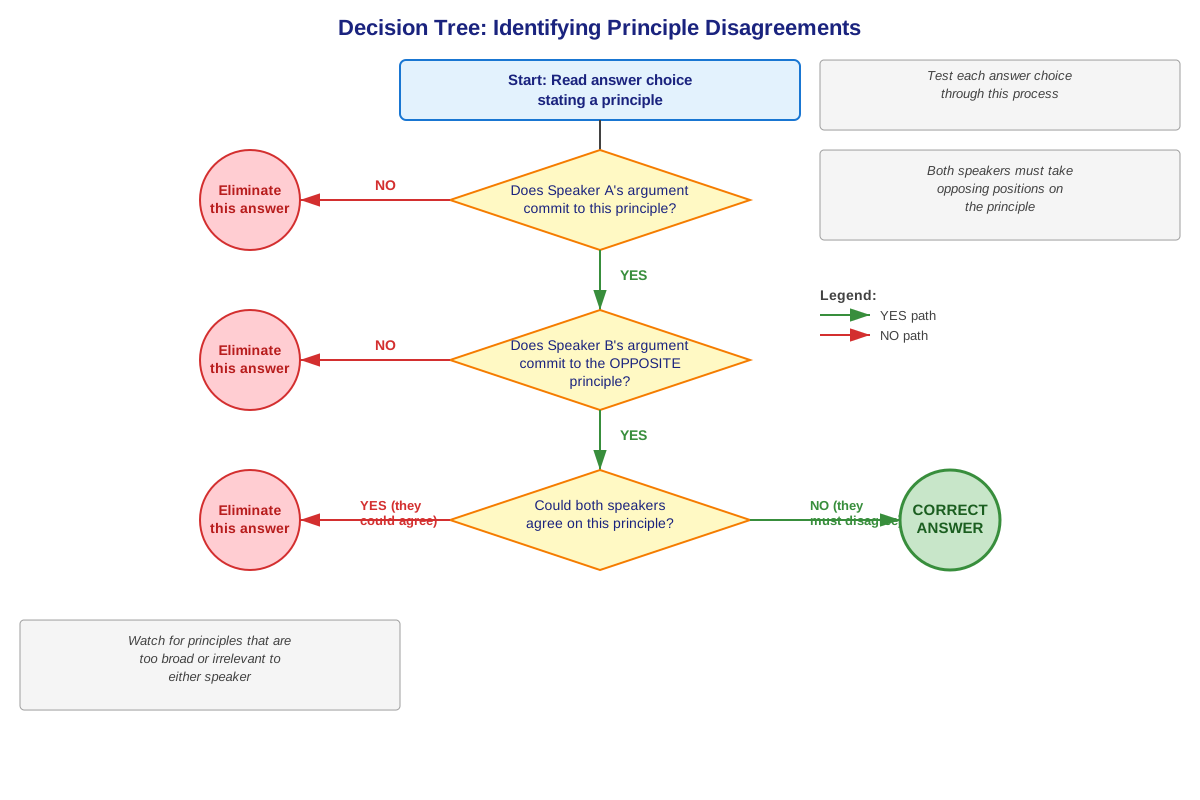
A crucial concept for solving disagreement about principle questions is the commitment test: both speakers must be committed to taking opposite positions on the principle stated in the answer choice. This means:
- Speaker A's statements must commit them to accepting or rejecting the principle
- Speaker B's statements must commit them to the opposite position
- If either speaker could consistently hold their stated position while being neutral about the principle, it's not the right answer
The commitment test eliminates many wrong answers. Consider a principle like "Companies should maximize profits." If Speaker A argues for environmental regulations and Speaker B argues against them, they might disagree about this principle—but only if Speaker A's position actually commits them to rejecting profit maximization as the primary goal. If Speaker A could consistently support regulations while still believing in profit maximization (perhaps arguing regulations are profitable long-term), then this isn't their point of disagreement.
Scope and Precision in Principles
Answer choices in disagreement about principle questions vary in their scope (how broadly they apply) and precision (how specifically they're stated). The correct answer must match the scope and precision of what the speakers actually commit themselves to through their statements.
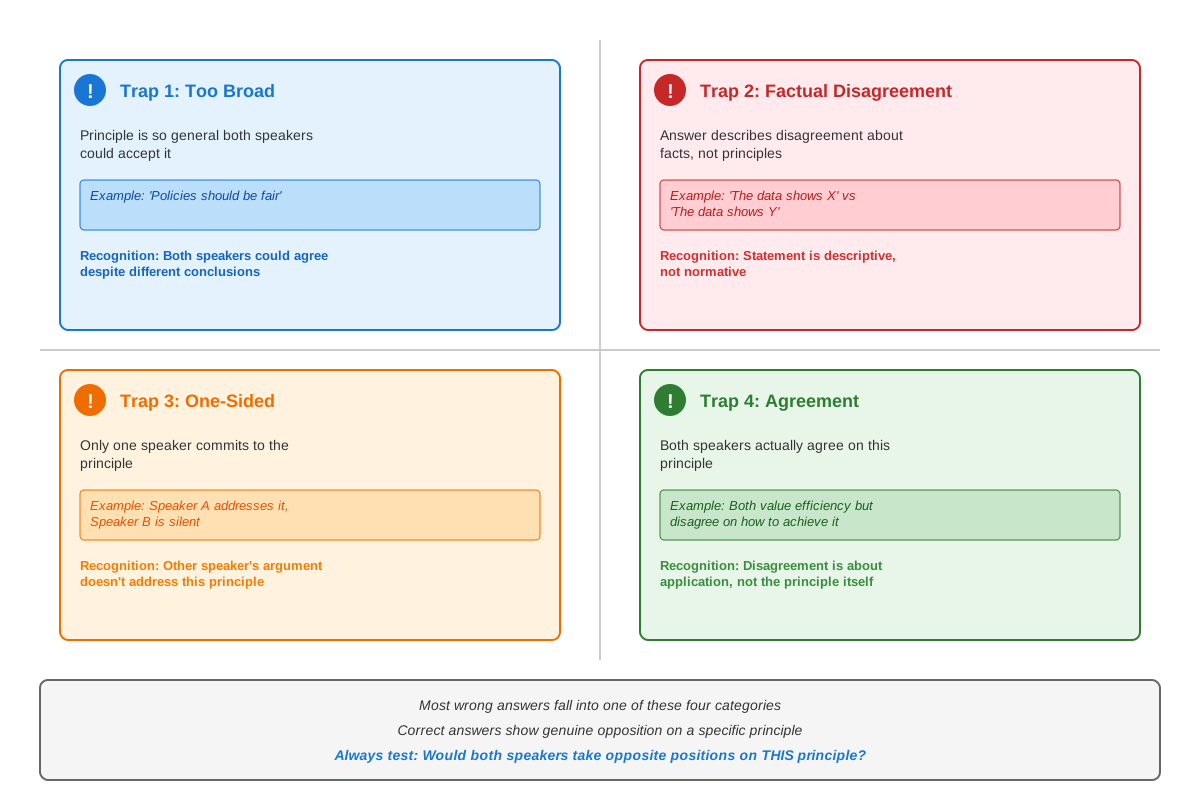
Common scope issues include:
- Too broad: A principle that extends far beyond what the speakers discuss (e.g., claiming they disagree about "whether consequences matter in ethics" when they only discuss one specific policy)
- Too narrow: A principle so specific it only covers the exact case discussed, not functioning as a generalizable rule
- Wrong domain: A principle about a different subject matter than what the speakers address
The correct answer typically generalizes one level beyond the specific case discussed. If speakers debate whether to ban a specific pesticide, the principle might concern when environmental risks justify regulatory bans, not just that specific pesticide, but also not all government regulation generally.
Concept Relationships
The concepts within disagreement about principle questions form an interconnected system. Understanding what constitutes a principle provides the foundation for recognizing when speakers disagree at the principle level rather than about facts or applications. This recognition depends on the ability to identify implicit principles by working backward from speakers' conclusions to the general rules that would justify them. Once candidate principles are identified, the commitment test determines whether both speakers actually take opposite positions on that principle. Throughout this process, attention to scope and precision ensures the principle matches what speakers actually commit to rather than overgeneralizing or undergeneralizing their positions.
These concepts connect to prerequisite knowledge in important ways. The distinction between facts and values underlies the difference between factual disagreements and principle disagreements. Conditional reasoning skills enable recognition of principles stated as if-then rules. Understanding argument structure allows identification of the gap between premises and conclusions that principles fill.
The relationship map flows as follows:
Argument Structure Recognition → enables → Identifying Speaker Conclusions → leads to → Extracting Implicit Principles → which are evaluated using → The Commitment Test → while checking → Scope and Precision → to determine → Whether Disagreement About Principle Exists
This topic also connects forward to other Logical Reasoning skills. The ability to identify principles strengthens performance on Necessary Assumption questions (which often involve principle-level assumptions), Parallel Reasoning questions (which require matching argument structures at the principle level), and Strengthen/Weaken questions (where principles often serve as strengthening or weakening premises).
High-Yield Facts
⭐ Disagreement about principle questions ask about underlying rules or values, not about facts or specific applications—both speakers might agree on all facts yet disagree about principles.
⭐ Both speakers must be committed to opposite positions on the principle in the correct answer—if either speaker could be neutral, it's wrong.
⭐ Most principles in these questions are implicit rather than explicitly stated—test-takers must infer the general rule from specific claims.
⭐ The correct principle typically generalizes one level beyond the specific case discussed—not too broad, not too narrow.
⭐ Wrong answers often present factual disagreements disguised as principle disagreements—always verify the disagreement is about "should" or "ought," not "is" or "was."
- Principles can be conditional (if-then), categorical (always/never), comparative (more/less important), or procedural (how decisions should be made).
- The commitment test requires checking whether each speaker's actual statements logically commit them to a position on the principle, not whether they would likely agree.
- Scope errors are the most common wrong answer type—principles that are too broad, too narrow, or in the wrong domain.
- Speakers can disagree about principle even when they reach the same conclusion if they get there via different underlying rules.
- Question stems that ask about "principles," "standards," "rules," or "criteria" signal disagreement about principle questions.
- The principle in the correct answer must be something both speakers would recognize as relevant to their debate, even if they disagree about it.
- Disagreement about application (whether a principle applies to a case) is different from disagreement about principle (whether the principle itself is correct).
- Principles in LSAT questions are typically normative (about what should be) rather than descriptive (about what is).
- Both speakers must address the principle either explicitly or implicitly—if only one speaker's position relates to the principle, it's not a point of disagreement.
- The correct answer often uses more abstract or general language than the speakers use, requiring translation from specific to general.
Quick check — test yourself on Disagreement about principle so far.
Try Flashcards →Common Misconceptions
Misconception: If two speakers reach opposite conclusions, they must disagree about principle.
Correction: Speakers can reach opposite conclusions while agreeing on principles but disagreeing about facts. For example, both might agree "policies that reduce crime should be implemented," but disagree about whether a specific policy reduces crime. This is factual disagreement, not principle disagreement.
Misconception: The correct answer must use the same words or terminology the speakers use.
Correction: The correct principle is typically stated more abstractly than the speakers' specific claims. If speakers debate a specific environmental regulation, the principle might be stated in terms of "when economic costs justify environmental protection" using different vocabulary than the speakers employed.
Misconception: If a speaker doesn't explicitly reject a principle, they're not committed to disagreeing about it.
Correction: Commitment can be implicit. If a speaker's position would be inconsistent with accepting a principle, they're committed to rejecting it even without explicitly saying so. The test is logical commitment, not explicit statement.
Misconception: Disagreement about principle means speakers disagree about everything.
Correction: Speakers can agree on many facts, values, and even some principles while disagreeing about one specific principle. The question asks for the principle they disagree about, not whether they disagree about all principles.
Misconception: The principle must be something both speakers would accept as a valid principle.
Correction: The speakers disagree about whether the principle is correct or should be applied. One speaker is committed to accepting it, the other to rejecting it. They don't both need to think it's a good principle—that's the point of their disagreement.
Misconception: Longer, more complex answer choices are more likely to be correct because they're more sophisticated.
Correction: Complexity often indicates scope problems or irrelevant details. The correct answer should be precisely scoped to what both speakers commit to, which may be stated simply and directly.
Misconception: If both speakers mention a concept, they must disagree about principles related to that concept.
Correction: Both speakers might mention "economic growth" while actually disagreeing about environmental protection principles. The topic they discuss isn't necessarily the principle they disagree about.
Worked Examples
Example 1: Environmental Policy Debate
Passage:
Alex: The proposed wetland protection law should not be implemented. While protecting wetlands has environmental value, the economic costs to developers and the resulting job losses make this regulation too burdensome for our community to bear right now.
Bailey: I disagree. The wetland protection law should definitely be implemented. These wetlands provide essential ecosystem services that benefit the entire region, and we have a responsibility to preserve them for future generations regardless of short-term economic considerations.
Question: Alex and Bailey are committed to disagreeing about which one of the following principles?
Answer Choices:
(A) Wetland ecosystems provide valuable services to regional communities.
(B) Economic costs should be considered when evaluating environmental regulations.
(C) Environmental protection should take priority over economic development when the two conflict.
(D) Future generations have a right to inherit a healthy natural environment.
(E) The proposed wetland protection law would impose costs on developers.
Analysis:
First, identify what each speaker concludes:
- Alex: The law should NOT be implemented
- Bailey: The law SHOULD be implemented
Next, extract the implicit principles from their reasoning:
Alex acknowledges environmental value but argues economic costs make the regulation "too burdensome." This reveals a principle that economic considerations can outweigh environmental protection—when costs are high enough, environmental regulations should not proceed.
Bailey argues for implementation "regardless of short-term economic considerations," explicitly stating that environmental responsibility takes priority over economic factors.
Now apply the commitment test to each answer:
(A) Factual agreement, not principle disagreement. Alex explicitly states wetlands have "environmental value," and Bailey emphasizes their importance. Both agree on this fact. Eliminated.
(B) Not a point of disagreement. Alex clearly considers economic costs (that's his main argument). But Bailey doesn't reject considering economic costs—she just concludes they don't outweigh environmental concerns in this case. She could consistently believe economic costs should be considered while still supporting the regulation. Eliminated.
(C) This is the disagreement. Alex's position commits him to rejecting this principle—he believes economic development concerns should outweigh environmental protection in this case. Bailey's position commits her to accepting this principle—she explicitly says environmental responsibility matters "regardless of" economic considerations. Both speakers are committed to opposite positions. This is correct.
(D) Bailey might accept this, but Alex's position doesn't commit him to rejecting it. Alex could believe future generations have rights while still thinking this particular regulation is too costly. He doesn't address future generations at all. Eliminated.
(E) Factual agreement, not principle. Both speakers would likely agree the law imposes costs on developers—that's a factual claim about the law's effects, not a principle about what should guide decisions. Eliminated.
Key Takeaway: The correct answer (C) captures the fundamental value conflict: when environmental and economic concerns clash, which should prevail? Alex and Bailey take opposite positions on this principle, even though they might agree on many related facts.
Example 2: Journalistic Ethics
Passage:
Jordan: The newspaper was right to publish the leaked documents about the mayor's financial dealings. The public has a right to know about potential corruption among elected officials, and journalists have a duty to expose such information even when it was obtained through questionable means.
Morgan: The newspaper should not have published those documents. Regardless of their content, publishing materials that were illegally obtained undermines the rule of law. Journalists should not benefit from illegal acts, as doing so encourages future illegal leaks.
Question: The dialogue provides the most support for the claim that Jordan and Morgan disagree over whether:
Answer Choices:
(A) the documents were obtained through illegal means
(B) the mayor engaged in financial impropriety
(C) the public interest in exposing potential corruption can justify publishing illegally obtained materials
(D) journalists have professional duties that guide their decisions about what to publish
(E) publishing the documents will encourage future illegal leaks
Analysis:
Identify conclusions:
- Jordan: Publishing was RIGHT
- Morgan: Publishing was WRONG (should not have published)
Extract principles from reasoning:
Jordan's principle: Public's right to know about corruption justifies publication "even when [information] was obtained through questionable means." This commits Jordan to a principle that public interest can override concerns about how information was obtained.
Morgan's principle: Publishing illegally obtained materials "undermines the rule of law" and journalists "should not benefit from illegal acts." This commits Morgan to a principle that the illegal nature of obtaining information makes it wrong to publish, regardless of public interest.
Apply commitment test:
(A) Factual agreement. Jordan says the means were "questionable," and Morgan says the documents were "illegally obtained." They might disagree on the exact characterization, but this is about facts (how documents were obtained), not principles (what should guide publication decisions). Eliminated.
(B) Not addressed by both speakers. Jordan mentions "potential corruption," but Morgan never addresses whether corruption actually occurred. Morgan's argument works regardless of whether the mayor did anything wrong. Morgan isn't committed to any position on this factual question. Eliminated.
(C) This is the principle disagreement. Jordan is committed to accepting this principle—that's exactly what "even when obtained through questionable means" conveys. Morgan is committed to rejecting this principle—she argues that illegal obtaining makes publication wrong "regardless of their content" (which would include corruption exposure). Both speakers take opposite positions on whether public interest can justify this. This is correct.
(D) Not a disagreement. Both speakers likely accept that journalists have professional duties. Jordan appeals to journalists' "duty to expose" information, and Morgan discusses what journalists "should not" do. They disagree about what those duties require, not whether duties exist. Eliminated.
(E) Factual prediction, not principle. Morgan claims publishing will encourage future leaks (a prediction about consequences), but Jordan doesn't address this. Even if Jordan agreed with this prediction, he might still think publication is justified. This is about predicted effects, not about the principle that should guide decisions. Eliminated.
Key Takeaway: The correct answer (C) identifies the principle-level conflict: Can the value of exposing corruption override concerns about illegal information-gathering? This is a classic clash between competing values (transparency vs. rule of law), not a disagreement about facts or predictions.
Exam Strategy
When approaching disagreement about principle questions on the LSAT, follow this systematic process:
Step 1: Identify the question type. Look for stems containing "principle," "standard," "rule," or "criterion." Phrases like "committed to disagreeing about which principle" or "disagree over whether" signal these questions.
Step 2: Read for conclusions first. Quickly identify what each speaker concludes or recommends. Do they reach opposite conclusions, or do they agree on the outcome but for different reasons? Both patterns can indicate principle disagreement.
Step 3: Extract the implicit principles. For each speaker, ask: "What general rule would make this person's reasoning work?" Move from their specific claims to the broader principle that would justify those claims. Write these principles in your own words in the margin if time permits.
Step 4: Predict the disagreement. Before looking at answer choices, articulate to yourself what principle the speakers disagree about. This prediction helps you recognize the correct answer and avoid traps.
Step 5: Apply the commitment test rigorously. For each answer choice, ask two questions:
- Is Speaker A committed to accepting or rejecting this principle based on their statements?
- Is Speaker B committed to the opposite position?
If the answer to either question is "no" or "unclear," eliminate that choice.
Step 6: Watch for scope traps. The most common wrong answers are too broad (extending beyond what speakers discuss), too narrow (merely restating the specific case), or in the wrong domain (about a different topic than what speakers actually disagree about).
Trigger words and phrases to watch for:
In question stems:
- "principle"
- "standard"
- "committed to disagreeing"
- "disagree over whether"
- "rule"
- "criterion"
In passages signaling principle-based reasoning:
- "should" / "ought to" / "must"
- "regardless of"
- "even when"
- "always" / "never"
- "more important than"
- "takes priority over"
- "justified in"
Process of elimination tips:
Eliminate answers that:
- State factual claims both speakers would agree on
- Present predictions about consequences rather than principles about what should be done
- Describe disagreements about whether a principle applies to the specific case (application) rather than whether the principle itself is correct
- Could be true of one speaker but aren't addressed by the other speaker at all
- Are so broad they extend far beyond the speakers' actual discussion
- Are so narrow they just restate the specific case without generalizing to a principle
Time allocation advice:
Disagreement about principle questions typically require 60-90 seconds. They demand careful reading but shouldn't consume excessive time. Spend:
- 20-30 seconds reading the passage and identifying conclusions
- 10-15 seconds predicting the principle disagreement
- 30-45 seconds evaluating answer choices with the commitment test
If you find yourself spending more than 90 seconds, you may be overthinking. Return to the basics: What does each speaker conclude? What principle would justify that conclusion? Which answer captures opposite positions on that principle?
Memory Techniques
The PRINCIPLE Acronym for Identifying Disagreements:
Position: What does each speaker conclude?
Reasoning: What reasons do they give?
Implicit rules: What principle would connect their reasoning to conclusion?
Normative language: Look for "should," "ought," "must"
Commitment test: Are both speakers committed to opposite positions?
Ignore facts: Focus on values and rules, not empirical claims
Precision check: Is the scope right—not too broad or narrow?
Level up: Generalize one level beyond the specific case
Eliminate mismatches: Remove answers where either speaker could be neutral
Visualization Strategy:
Picture disagreement about principle as two people standing on different mountains (representing different foundational values) looking at the same valley below (the specific case). They might see the same facts in the valley, but their different vantage points (principles) lead them to opposite conclusions about what should be done. The question asks you to identify which mountains they're standing on, not what they see in the valley.
The "Should vs. Is" Mnemonic:
Remember: SHOULD = PRINCIPLE, IS = FACT
When evaluating answers, mentally tag each one:
- If it's about what "is" or "was" → probably factual disagreement → eliminate
- If it's about what "should" or "ought" → possibly principle disagreement → test further
The Commitment Checklist:
For each answer choice, physically or mentally check off:
- [ ] Speaker A would accept this principle (or reject it)
- [ ] Speaker B would take the opposite position
- [ ] Both speakers address this topic (directly or by implication)
- [ ] The principle is general enough to apply beyond this case
- [ ] The principle isn't so broad it covers everything
Only if all five boxes check should you select that answer.
Summary
Disagreement about principle questions test the ability to identify when two speakers clash over underlying rules, values, or standards rather than over facts or specific applications. These questions require moving beyond surface-level reading to extract the implicit principles that justify each speaker's position. The key skill is distinguishing principle disagreements from factual disagreements, application disagreements, and prediction disagreements. Success depends on applying the commitment test: both speakers must be committed to opposite positions on the principle stated in the correct answer. Common traps include answers that are too broad or narrow in scope, that present factual rather than normative disagreements, or that only one speaker addresses. The correct answer typically generalizes one level beyond the specific case discussed, capturing the fundamental value or rule conflict that drives the speakers to opposite conclusions. Mastering this question type requires careful attention to normative language ("should," "ought," "must"), systematic extraction of implicit principles from explicit claims, and rigorous testing of whether both speakers actually commit to opposite positions on candidate principles.
Key Takeaways
- Disagreement about principle involves conflict over underlying rules or values, not facts—speakers might agree on all empirical claims yet disagree about principles
- Both speakers must be committed to opposite positions on the principle in the correct answer; if either could be neutral, it's wrong
- Most principles are implicit and must be inferred by asking what general rule would justify each speaker's specific claims
- The correct principle typically generalizes one level beyond the specific case—not too broad (covering everything) or too narrow (just restating the case)
- Apply the commitment test systematically: verify that each speaker's actual statements logically commit them to accepting or rejecting the principle
- Watch for scope traps, factual disagreements disguised as principle disagreements, and application disagreements (whether a principle applies) versus principle disagreements (whether the principle is correct)
- Normative language like "should," "ought," "regardless of," and "takes priority over" signals principle-based reasoning
Related Topics
Necessary Assumption Questions: Understanding disagreement about principle strengthens performance on necessary assumption questions because both require identifying the implicit principles that connect premises to conclusions. Many necessary assumptions are principle-level claims.
Parallel Reasoning Questions: These questions require matching argument structures, which often involves identifying the principle underlying each argument and finding another argument based on the same principle.
Strengthen and Weaken Questions: Principles frequently serve as strengthening or weakening premises. Recognizing principle-based reasoning helps identify which answer choices operate at the right level of abstraction.
Method of Reasoning Questions: Some method of reasoning questions ask about how speakers respond to each other, including whether they challenge underlying principles versus challenging facts or applications.
Role of Statement Questions: These questions sometimes ask about statements that express principles or general rules, requiring the same skill of distinguishing principles from specific claims.
Mastering disagreement about principle provides a foundation for these related question types by developing the core skill of moving between specific claims and general principles—a skill central to legal reasoning and LSAT success.
Practice CTA
Now that you understand the core concepts behind disagreement about principle questions, it's time to apply this knowledge. Work through the practice questions to test your ability to identify implicit principles, apply the commitment test, and distinguish principle disagreements from other types of disagreement. Pay special attention to questions where you're tempted by wrong answers—these reveal opportunities to refine your understanding of scope and commitment. Use the flashcards to reinforce the key distinctions and trigger words that signal principle-based reasoning. Remember: this question type rewards systematic thinking and careful analysis. With practice, you'll develop the instinct to quickly identify the underlying principles driving each speaker's position and confidently select the correct answer. Your investment in mastering this topic will pay dividends across multiple Logical Reasoning question types.
Sign up free to keep reading
Create a free AnvayaPrep account to finish this LSAT guide on Disagreement about principle — plus flashcards and practice questions.