Overview
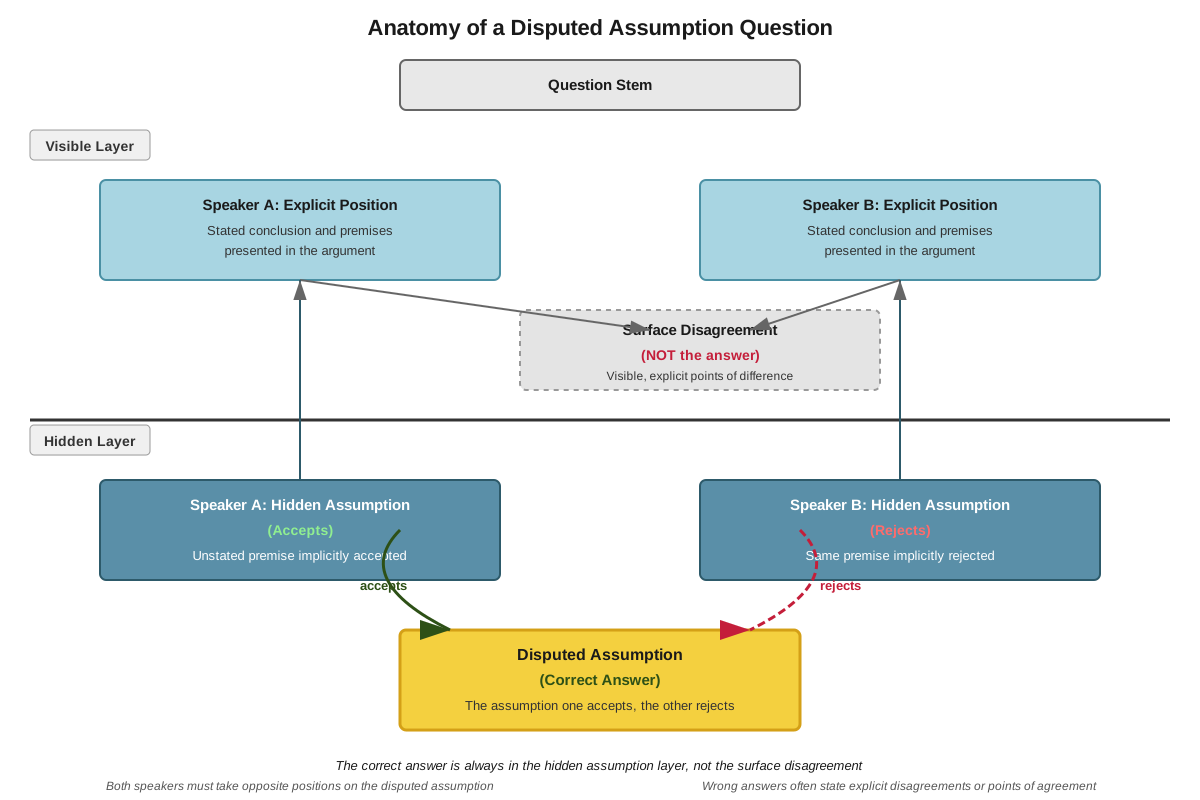
Disputed assumption questions represent a sophisticated category within LSAT Logical Reasoning that tests a student's ability to identify unstated premises that two speakers disagree about. Unlike straightforward point at issue and disagreement questions that ask what two parties explicitly disagree about, disputed assumption questions require test-takers to dig deeper into the logical foundations of each argument to find the implicit belief that drives their disagreement. These questions typically present two speakers who appear to disagree on a surface level, but the correct answer identifies the underlying assumption that one speaker accepts and the other rejects.
Understanding disputed assumptions is essential for LSAT success because these questions appear regularly in the Logical Reasoning sections and demand a nuanced understanding of argument structure. Students must recognize that arguments rest not only on stated premises but also on hidden assumptions—unstated beliefs that bridge the gap between evidence and conclusion. When two speakers disagree, they often do so because they hold incompatible assumptions about fundamental aspects of the issue at hand, even if they never explicitly state these assumptions.
This topic sits at the intersection of several critical Logical Reasoning skills: identifying assumptions, analyzing argument structure, and recognizing points of disagreement. Mastering disputed assumptions strengthens overall logical reasoning ability because it requires synthesizing multiple analytical skills simultaneously. Students who excel at these questions demonstrate advanced critical thinking—they can extract implicit content from arguments, compare logical structures, and identify precisely where two lines of reasoning diverge at the foundational level.
Learning Objectives
- [ ] Identify how Disputed assumption appears in LSAT questions
- [ ] Explain the reasoning pattern behind Disputed assumption
- [ ] Apply Disputed assumption to solve LSAT-style problems accurately
- [ ] Distinguish between explicit disagreements and disputed assumptions
- [ ] Evaluate answer choices by testing whether both speakers would take opposing positions on the statement
- [ ] Recognize common patterns in how assumptions underlie apparent disagreements
- [ ] Eliminate answer choices that represent points of agreement or irrelevant statements
Prerequisites
- Basic argument structure: Understanding premises, conclusions, and how they connect is essential because disputed assumption questions require analyzing the logical foundation of two separate arguments simultaneously.
- Assumption identification: Students must be able to recognize unstated premises in single arguments before identifying which assumptions are disputed between two speakers.
- Point at issue questions: Familiarity with identifying explicit disagreements provides the foundation for recognizing implicit disagreements at the assumption level.
- Conditional reasoning: Many disputed assumptions involve conditional relationships, so understanding sufficient and necessary conditions helps identify what speakers implicitly accept or reject.
Why This Topic Matters
Disputed assumption questions test one of the most sophisticated reasoning skills required for legal thinking: the ability to identify unstated premises that drive disagreements. In legal practice, attorneys must constantly recognize the implicit assumptions underlying opposing arguments to effectively challenge them or find common ground. This skill translates directly to law school case analysis, where understanding the assumptions behind judicial reasoning is crucial.
On the LSAT, disputed assumption questions appear with moderate frequency—typically 1-3 questions per test across both Logical Reasoning sections. While less common than standard assumption questions, they carry significant weight because they're often among the more difficult questions that separate high scorers from average performers. These questions typically appear in the medium-to-difficult range and serve as excellent discriminators of analytical ability.
Disputed assumption questions most commonly appear in dialogue format, presenting two speakers (often named individuals like "Alex" and "Jordan") who make statements about a topic. The question stem typically asks: "Alex and Jordan disagree over whether..." or "The dialogue provides the most support for the claim that Alex and Jordan disagree about which one of the following?" Less commonly, these questions may present two separate arguments without explicit dialogue format but still ask about an underlying disagreement in assumptions.
Core Concepts
Understanding Disputed Assumptions
A disputed assumption is an unstated premise that one speaker's argument depends upon while the other speaker's argument implicitly or explicitly rejects. Unlike explicit disagreements where speakers directly contradict each other's stated claims, disputed assumptions operate at a deeper logical level. The speakers may never mention the assumption directly, yet their arguments reveal incompatible beliefs about this underlying premise.
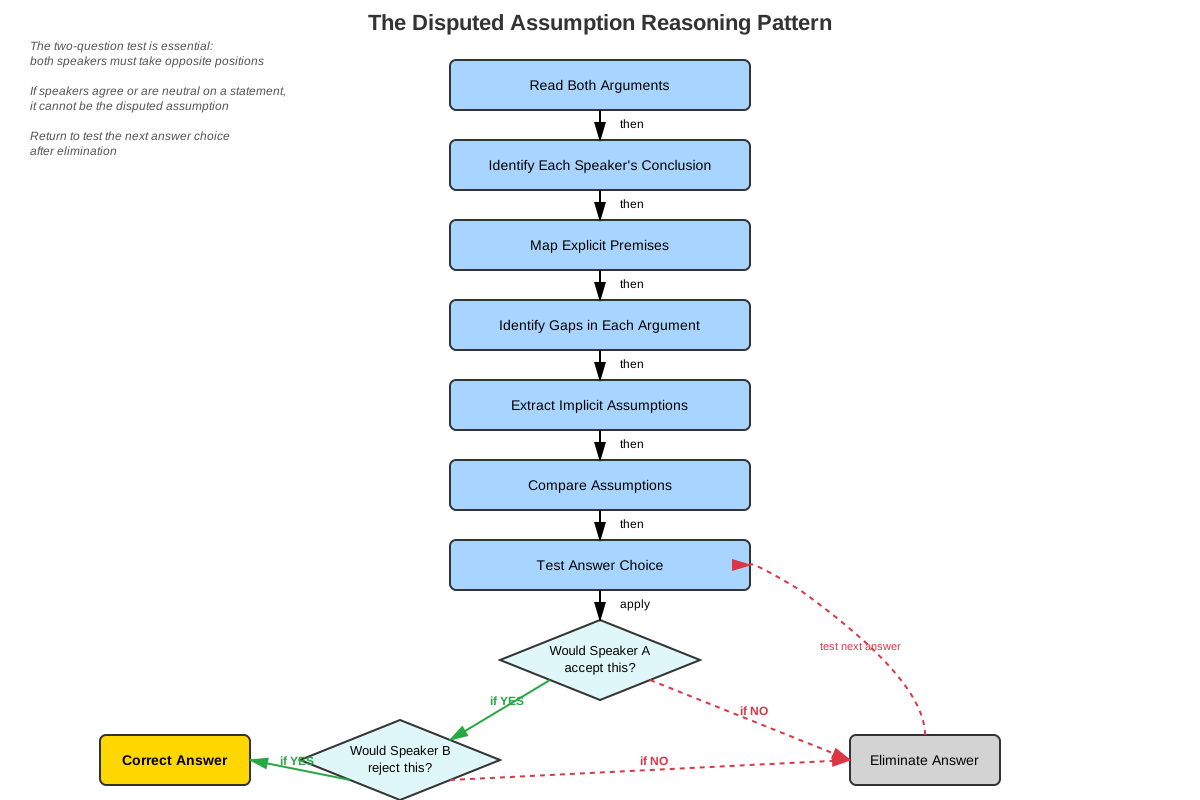
To identify a disputed assumption, students must perform several analytical steps simultaneously. First, analyze each speaker's argument independently to identify what assumptions each relies upon. Second, compare these assumptions to find points where they conflict. Third, verify that one speaker would agree with the statement while the other would disagree—this is the crucial test that distinguishes correct answers from attractive distractors.
The Commitment Test
The most reliable method for evaluating disputed assumption answer choices is the commitment test. For an answer choice to be correct, it must satisfy two conditions:
- One speaker's argument commits them to agreeing with the statement
- The other speaker's argument commits them to disagreeing with the statement
If both speakers would agree, both would disagree, or either speaker's position is indeterminate, the answer choice is incorrect. This test requires careful analysis because the LSAT often includes trap answers where both speakers might agree or where one speaker simply hasn't taken a position.
Explicit vs. Implicit Disagreement
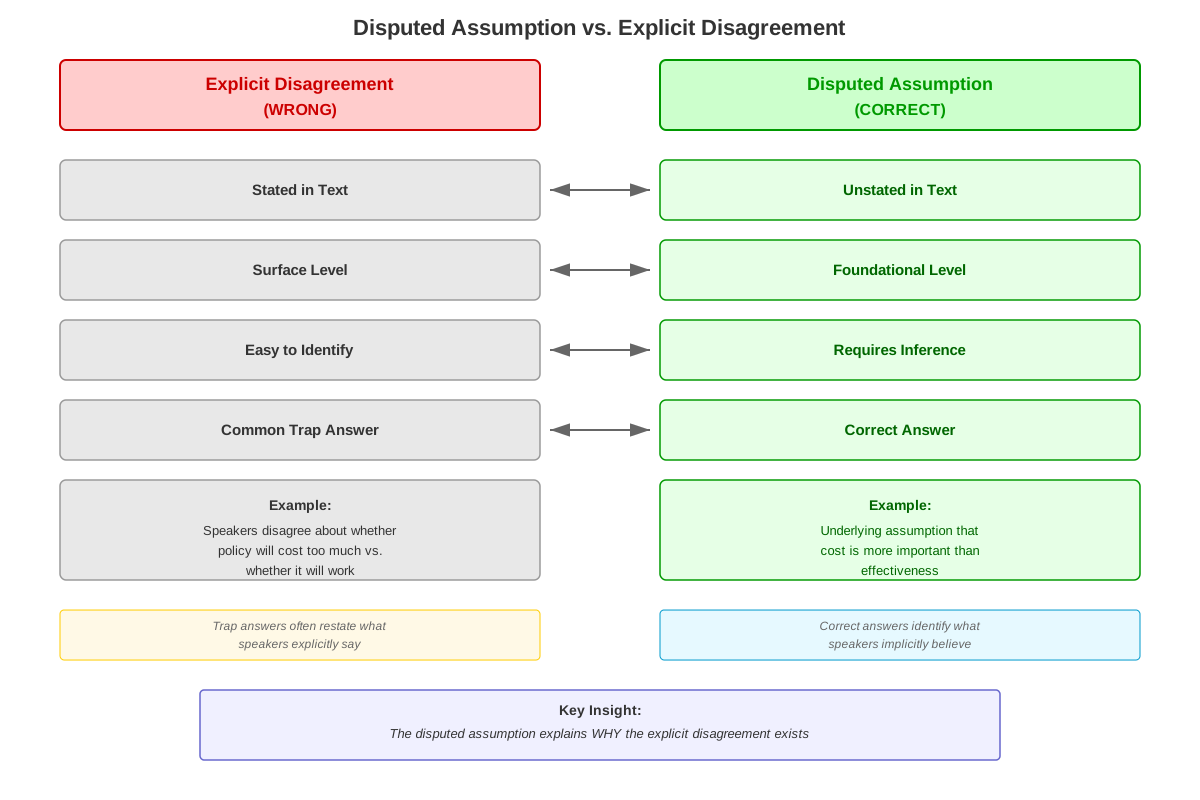
Understanding the distinction between explicit and implicit disagreement is crucial for disputed assumption questions:
| Explicit Disagreement | Implicit Disagreement (Disputed Assumption) |
|---|---|
| Speakers directly contradict each other's stated claims | Speakers hold incompatible unstated premises |
| The disagreement is on the surface of the arguments | The disagreement underlies the arguments |
| Easier to identify through direct comparison | Requires inference and assumption identification |
| Common in basic point-at-issue questions | Characteristic of disputed assumption questions |
Common Patterns in Disputed Assumptions
Several recurring patterns appear in LSAT disputed assumption questions:
Causal vs. Correlational Assumptions: One speaker assumes a causal relationship while the other assumes only correlation or rejects causation entirely. For example, one speaker might assume that increased ice cream sales cause higher crime rates, while another assumes they're merely correlated through a common cause (hot weather).
Scope Assumptions: Speakers disagree about the scope or extent of a principle. One might assume a rule applies universally while the other assumes it has exceptions or limited application.
Value Assumptions: One speaker assumes certain values or priorities while the other operates under different value assumptions. For instance, one might assume economic efficiency is paramount while another assumes environmental protection takes precedence.
Definitional Assumptions: Speakers may use the same terms but implicitly define them differently, leading to disagreement about what qualifies as an instance of a concept.
Analyzing Argument Structure for Assumptions
To identify disputed assumptions effectively, students must analyze each argument's structure:
- Identify the conclusion: What is each speaker trying to prove?
- Identify stated premises: What evidence does each speaker explicitly provide?
- Identify the logical gap: What unstated premise would connect the evidence to the conclusion?
- Compare assumptions: Where do these unstated premises conflict?
This systematic approach prevents students from being distracted by surface-level disagreements and helps them focus on the foundational assumptions driving each argument.
The Role of Necessary Assumptions
Disputed assumptions are typically necessary assumptions—beliefs that must be true for the argument to work. When evaluating whether a speaker is committed to an assumption, ask: "If this assumption were false, would the speaker's argument fall apart?" If yes, the speaker is committed to that assumption. If the speaker's argument would remain intact regardless of whether the assumption is true or false, the speaker isn't committed to it.
Negation Technique Application
The negation technique, useful for standard assumption questions, can be adapted for disputed assumptions. Negate the answer choice and ask: "Would this negation destroy one speaker's argument while supporting or being consistent with the other's?" If so, the original statement likely represents a disputed assumption.
Concept Relationships
The concept of disputed assumptions builds directly on fundamental assumption identification skills. Assumption identification → enables recognition of → disputed assumptions because students must first be able to find individual assumptions before comparing them across arguments. Similarly, point at issue and disagreement questions → provide foundation for → disputed assumption questions by establishing the skill of identifying where speakers diverge, though disputed assumptions require deeper analysis.
Within the topic itself, concepts connect sequentially: Understanding what constitutes a disputed assumption → leads to → applying the commitment test → which enables → distinguishing explicit from implicit disagreement → resulting in → accurate answer selection. The commitment test serves as the central analytical tool that connects theoretical understanding to practical application.
Disputed assumptions also connect forward to more advanced Logical Reasoning skills. Mastering this topic strengthens performance on strengthen/weaken questions because recognizing assumptions helps identify what would support or undermine arguments. It also enhances parallel reasoning skills because comparing argument structures requires the same analytical abilities used in identifying disputed assumptions.
High-Yield Facts
⭐ A disputed assumption is an unstated premise that one speaker accepts and the other rejects, not an explicit claim either speaker makes.
⭐ The commitment test requires that one speaker's argument commits them to agreeing with the statement while the other's commits them to disagreeing—if both would agree or both would disagree, it's not the disputed assumption.
⭐ Disputed assumption questions typically appear in dialogue format with two named speakers presenting contrasting viewpoints.
⭐ The correct answer to a disputed assumption question often addresses the fundamental reason why the speakers reach different conclusions, not just a surface-level difference.
⭐ If a speaker's argument would work equally well whether an assumption is true or false, that speaker is not committed to that assumption.
- Disputed assumption questions test the ability to identify implicit disagreements, which is more sophisticated than identifying explicit disagreements.
- Common wrong answers include statements both speakers would agree with, statements neither speaker has taken a position on, or explicit disagreements rather than underlying assumptions.
- Many disputed assumptions involve disagreements about causal relationships, scope of principles, or definitional issues.
- The LSAT frequently includes trap answers that address related topics but don't represent genuine points of disagreement between the speakers.
- Disputed assumption questions often appear in the medium-to-difficult range and serve as discriminators between high scorers and average performers.
Quick check — test yourself on Disputed assumption so far.
Try Flashcards →Common Misconceptions
Misconception: The disputed assumption must be something both speakers explicitly mention in their arguments. → Correction: Disputed assumptions are by definition unstated—they're implicit premises that underlie the arguments. If both speakers explicitly mention something, it's an explicit disagreement, not a disputed assumption.
Misconception: If one speaker would agree with a statement, and the other speaker doesn't mention it, that statement is a disputed assumption. → Correction: For a genuine disputed assumption, the other speaker's argument must commit them to disagreeing with the statement. Silence or lack of commitment doesn't constitute disagreement.
Misconception: The disputed assumption is always the main point of disagreement between the speakers. → Correction: The disputed assumption is the underlying premise that drives the disagreement, which may be more fundamental than the surface-level point of disagreement. The speakers might explicitly disagree about a conclusion while implicitly disagreeing about an assumption.
Misconception: Disputed assumption questions are just harder versions of point-at-issue questions. → Correction: While related, these question types test different skills. Point-at-issue questions identify explicit disagreements about stated claims, while disputed assumption questions identify implicit disagreements about unstated premises.
Misconception: The correct answer will be something that sounds important or relevant to the topic. → Correction: Relevance alone doesn't make something a disputed assumption. The answer must specifically be something one speaker's argument requires to be true while the other's requires to be false. Many trap answers are relevant but not genuinely disputed.
Misconception: If both speakers discuss the same topic, they must disagree about assumptions related to that topic. → Correction: Speakers can discuss the same topic while sharing many assumptions and disagreeing only about specific unstated premises. The disputed assumption is the precise point where their foundational beliefs diverge.
Worked Examples
Example 1: Environmental Policy Dialogue
Passage:
Maya: The new environmental regulations will harm the economy because they impose significant costs on businesses. When businesses face higher costs, they reduce hiring and investment, leading to economic slowdown.
James: The new environmental regulations will benefit the economy because they will create new jobs in environmental compliance and green technology sectors. Economic growth comes from innovation and new industries.
Question: Maya and James disagree over whether which one of the following is true?
Answer Choices:
A) The new environmental regulations impose costs on businesses
B) Economic considerations should influence environmental policy
C) The economic costs of environmental regulations outweigh their economic benefits
D) Environmental compliance creates some new jobs
E) Innovation contributes to economic growth
Analysis:
First, identify each speaker's conclusion and reasoning:
- Maya's conclusion: Regulations will harm the economy
- Maya's reasoning: Costs → reduced hiring/investment → slowdown
- James's conclusion: Regulations will benefit the economy
- James's reasoning: New jobs in compliance/green tech → growth through innovation
Now apply the commitment test to each answer:
Choice A: Would Maya agree? Yes—she explicitly states regulations impose costs. Would James disagree? No—he doesn't deny costs exist; he just argues benefits outweigh them. Both could agree. Eliminate.
Choice B: Would Maya agree? Her argument assumes economic considerations matter. Would James disagree? No—his argument also considers economic factors. Both agree. Eliminate.
Choice C: Would Maya agree? Yes—her entire argument assumes costs exceed benefits. Would James disagree? Yes—his argument assumes benefits (new jobs, innovation) exceed costs. This is the disputed assumption.
Choice D: Would Maya agree? She doesn't address this. Would James agree? Yes. Maya's position is indeterminate. Eliminate.
Choice E: Would Maya agree? She doesn't deny this. Would James agree? Yes, explicitly. Both could agree. Eliminate.
Correct Answer: C
This example illustrates how the disputed assumption often concerns the fundamental evaluative judgment underlying the disagreement—here, whether costs outweigh benefits or vice versa. Neither speaker explicitly states this comparison, but their arguments commit them to opposite positions on it.
Example 2: Educational Technology
Passage:
Professor Chen: Online learning platforms cannot replace traditional classroom instruction because effective education requires real-time interaction between students and teachers. The immediate feedback and dynamic discussion possible in physical classrooms are essential for deep learning.
Professor Williams: Online learning platforms can effectively replace traditional classroom instruction for many subjects. Video conferencing technology now enables real-time interaction, and asynchronous discussion forums often produce more thoughtful exchanges than in-person discussions where students have less time to formulate responses.
Question: The dialogue most strongly supports the claim that Professor Chen and Professor Williams disagree about whether:
Answer Choices:
A) Real-time interaction between students and teachers is valuable
B) Online platforms can provide the type of interaction necessary for effective education
C) Traditional classrooms always produce better educational outcomes than online learning
D) Video conferencing technology enables some form of real-time interaction
E) Students need time to formulate thoughtful responses
Analysis:
Identify the core disagreement:
- Chen's position: Online cannot replace traditional because it lacks necessary interaction
- Williams's position: Online can replace traditional because it provides adequate interaction
Apply the commitment test:
Choice A: Would Chen agree? Yes—he emphasizes interaction's importance. Would Williams disagree? No—he also values interaction and argues online provides it. Both agree interaction is valuable. Eliminate.
Choice B: Would Chen agree? No—his argument assumes online cannot provide necessary interaction. Would Williams agree? Yes—his argument assumes online can provide necessary interaction. This is the disputed assumption.
Choice C: Would Chen agree? His argument suggests traditional is necessary but doesn't claim it's always better in every case. Too strong. Would Williams agree? No. Chen's commitment is uncertain. Eliminate.
Choice D: Would Chen agree? He might concede this while still arguing it's insufficient. Would Williams agree? Yes, explicitly. Both could agree. Eliminate.
Choice E: Would Chen agree? He doesn't address this. Would Williams agree? Yes. Chen's position is indeterminate. Eliminate.
Correct Answer: B
This example demonstrates how disputed assumptions often concern whether something can satisfy a requirement both speakers agree is important. Both professors agree interaction matters; they disagree about whether online platforms can provide adequate interaction.
Exam Strategy
When approaching disputed assumption questions on the LSAT, follow this systematic process:
Step 1: Identify the question type. Look for stems asking what the speakers "disagree about whether" or what their "dialogue most strongly supports they disagree about." These phrases signal disputed assumption questions.
Step 2: Analyze each argument separately. Before comparing, understand what each speaker concludes and what assumptions their reasoning requires. Write brief notes identifying each speaker's main point and the gap in their reasoning.
Step 3: Predict the disputed assumption. Before looking at answer choices, try to articulate what fundamental belief drives their disagreement. This prediction helps avoid attractive distractors.
Step 4: Apply the commitment test rigorously. For each answer choice, explicitly ask: "Would Speaker A's argument commit them to agreeing or disagreeing with this? Would Speaker B's argument commit them to the opposite position?" If the answer isn't clearly "yes" to both questions, eliminate the choice.
Trigger words and phrases to watch for:
- "Disagree about whether"
- "Disagree over whether"
- "Committed to disagreeing about"
- "Dialogue provides most support for the claim that they disagree"
Process-of-elimination tips:
Eliminate answer choices where:
- Both speakers would agree (very common trap)
- Both speakers would disagree (rare but possible)
- One speaker hasn't taken a position (their argument works regardless of whether the statement is true)
- The statement represents an explicit claim rather than an unstated assumption
- The statement is too extreme or uses absolute language neither speaker commits to
Time allocation: Disputed assumption questions typically require 90-120 seconds. Don't rush the commitment test—spending an extra 15 seconds carefully evaluating each answer choice prevents careless errors. However, if you find yourself spending more than 2 minutes, mark the question and return to it if time permits.
Exam Tip: The correct answer to a disputed assumption question will often feel less "obvious" than wrong answers that state explicit disagreements. Trust the commitment test over your intuition about what "seems" like the main disagreement.
Memory Techniques
COMMIT Acronym for the commitment test:
- Check each speaker separately
- Opposite positions required
- Must be unstated (assumption, not explicit claim)
- Make sure argument depends on it
- Indeterminate positions eliminate the choice
- Test by negation if uncertain
Visualization Strategy: Picture two buildings (representing the two arguments) with visible structures (explicit claims) and foundations (assumptions). The disputed assumption is where the foundations point in opposite directions, even though the visible structures might look similar.
The "Would/Wouldn't" Technique: For each answer choice, create a simple chart:
Statement: [Answer choice]
Speaker A: Would agree / Would disagree / Indeterminate
Speaker B: Would agree / Would disagree / Indeterminate
Only if you have "Would agree" for one and "Would disagree" for the other is it correct.
Mnemonic for Common Traps: "BEAR" helps remember what to avoid:
- Both agree (most common trap)
- Explicit claims (not assumptions)
- Absolute language (too extreme)
- Relevant but not disputed (sounds good but fails commitment test)
Summary
Disputed assumption questions test the sophisticated ability to identify unstated premises that drive disagreements between speakers. Unlike point-at-issue questions that focus on explicit disagreements, these questions require students to analyze the logical foundations of arguments to find where speakers hold incompatible implicit beliefs. The key to mastering these questions is the commitment test: the correct answer must be something one speaker's argument commits them to accepting while the other's commits them to rejecting. Common patterns include disagreements about causal relationships, scope of principles, and evaluative judgments. Success requires systematic analysis of each argument's structure, careful identification of assumptions, and rigorous testing of answer choices to avoid traps where both speakers would agree or where positions are indeterminate. These questions appear regularly on the LSAT and serve as important discriminators of analytical ability, making them high-value targets for focused preparation.
Key Takeaways
- Disputed assumptions are unstated premises that one speaker accepts and the other rejects, not explicit claims either speaker makes
- The commitment test is essential: one speaker must be committed to agreeing with the statement while the other is committed to disagreeing
- Common wrong answers include statements both speakers would agree with or statements where one speaker's position is indeterminate
- Analyze each argument separately before comparing to identify what assumptions each requires
- Disputed assumptions often concern fundamental issues like whether costs outweigh benefits, whether something can satisfy a requirement, or whether a causal relationship exists
- These questions typically appear in dialogue format and test deeper analytical skills than basic point-at-issue questions
- Trust the systematic commitment test over intuition about what "seems" like the main disagreement
Related Topics
Standard Assumption Questions: After mastering disputed assumptions, students should ensure they have strong skills in identifying assumptions in single arguments, as this forms the foundation for comparing assumptions across multiple arguments.
Strengthen and Weaken Questions: Understanding disputed assumptions enhances performance on these questions because recognizing what assumptions arguments depend on helps identify what would support or undermine them.
Method of Reasoning Questions: These questions ask how arguments proceed, and understanding assumptions is crucial for analyzing argumentative structure and technique.
Parallel Reasoning Questions: The skill of comparing argument structures developed through disputed assumption questions directly applies to identifying parallel reasoning patterns.
Principle Questions: Many principle questions involve identifying underlying assumptions about what rules or values govern situations, connecting closely to the assumption-identification skills developed here.
Practice CTA
Now that you understand the core concepts and strategies for disputed assumption questions, it's time to put your knowledge into practice. Work through the practice questions carefully, applying the commitment test to each answer choice and analyzing the argument structure systematically. Remember that these questions reward careful, methodical analysis over quick intuition. Review the flashcards to reinforce key concepts and patterns. With focused practice, you'll develop the sophisticated analytical skills that disputed assumption questions demand—skills that will serve you throughout the LSAT and in legal reasoning more broadly. Each practice question is an opportunity to refine your technique and build confidence for test day.
Sign up free to keep reading
Create a free AnvayaPrep account to finish this LSAT guide on Disputed assumption — plus flashcards and practice questions.