Overview
Disputed causal claim questions represent a critical category within LSAT Logical Reasoning, specifically under the broader umbrella of Point at Issue and Disagreement questions. These questions test a student's ability to identify the precise point of contention between two speakers when they disagree about whether one event or condition causes another. Unlike simple disagreement questions where speakers may differ on factual matters, disputed causal claim questions specifically focus on disagreements about causal relationships—whether X causes Y, whether Y causes X, or whether there's any causal relationship at all.
The LSAT frequently tests causal reasoning because it mirrors the analytical thinking required in legal practice. Attorneys must constantly evaluate competing explanations for events, distinguish correlation from causation, and identify the exact nature of disagreements between parties. When two speakers present different views on causation, test-takers must parse their arguments carefully to determine whether they're actually disagreeing about the causal mechanism, the direction of causation, the existence of a causal relationship, or perhaps not disagreeing at all.
Mastering lsat disputed causal claim questions requires understanding not just what each speaker says, but what logical commitments their statements entail. This topic connects intimately with other logical reasoning skills including assumption identification, argument structure analysis, and conditional reasoning. Students who excel at these questions demonstrate the ability to distinguish between what is explicitly stated and what is logically implied—a foundational skill for success across all LSAT Logical Reasoning question types.
Learning Objectives
- [ ] Identify how Disputed causal claim appears in LSAT questions
- [ ] Explain the reasoning pattern behind Disputed causal claim
- [ ] Apply Disputed causal claim to solve LSAT-style problems accurately
- [ ] Distinguish between genuine causal disagreements and mere differences in emphasis or scope
- [ ] Recognize the various forms causal disagreements can take (direction, existence, mechanism, strength)
- [ ] Evaluate answer choices by testing whether both speakers would have opposing views on the statement
- [ ] Identify when speakers are discussing correlation versus causation and how this affects their disagreement
Prerequisites
- Basic causal reasoning: Understanding the difference between correlation and causation is essential because disputed causal claims often hinge on whether a relationship is merely correlational or truly causal.
- Argument structure analysis: Recognizing premises, conclusions, and supporting evidence allows students to identify what each speaker is actually claiming about causal relationships.
- Conditional logic fundamentals: Many causal claims can be analyzed using conditional reasoning frameworks, helping to clarify the logical relationships speakers are asserting.
- Point at Issue question format: Familiarity with how disagreement questions are structured and what makes an answer choice correct provides the foundation for this specialized subset.
Why This Topic Matters
Causal reasoning pervades legal thinking and appears throughout the LSAT. Attorneys must regularly evaluate competing causal theories—did the defendant's action cause the plaintiff's injury? Did a policy change cause improved outcomes? Disputed causal claim questions directly assess this analytical capacity.
On the LSAT, causal disagreements appear in approximately 10-15% of Logical Reasoning questions across both sections. They manifest most commonly as Point at Issue questions (where you must identify what two speakers disagree about) but also appear in Disagreement Method questions and occasionally in Strengthen/Weaken contexts where understanding the causal dispute helps identify relevant evidence.
These questions typically present two speakers with brief arguments. The first speaker asserts or implies a causal relationship. The second speaker responds, either challenging the causal claim directly, proposing an alternative causal explanation, reversing the direction of causation, or denying that a causal relationship exists at all. The test-taker must identify the precise nature of their disagreement from five answer choices, four of which will either mischaracterize the disagreement or present issues on which the speakers don't actually have opposing views.
Core Concepts
Understanding Causal Claims
A causal claim asserts that one phenomenon (the cause) brings about or produces another phenomenon (the effect). In logical reasoning, causal claims go beyond mere correlation—they assert that one thing actually makes another thing happen. On the LSAT, causal claims appear in various forms:
- Direct causation: "X causes Y"
- Causal contribution: "X is one factor that causes Y"
- Necessary causation: "Without X, Y would not occur"
- Sufficient causation: "X alone is enough to produce Y"
Recognizing these different formulations is crucial because speakers may disagree about the strength, direction, or existence of causal relationships while using different language to express their positions.
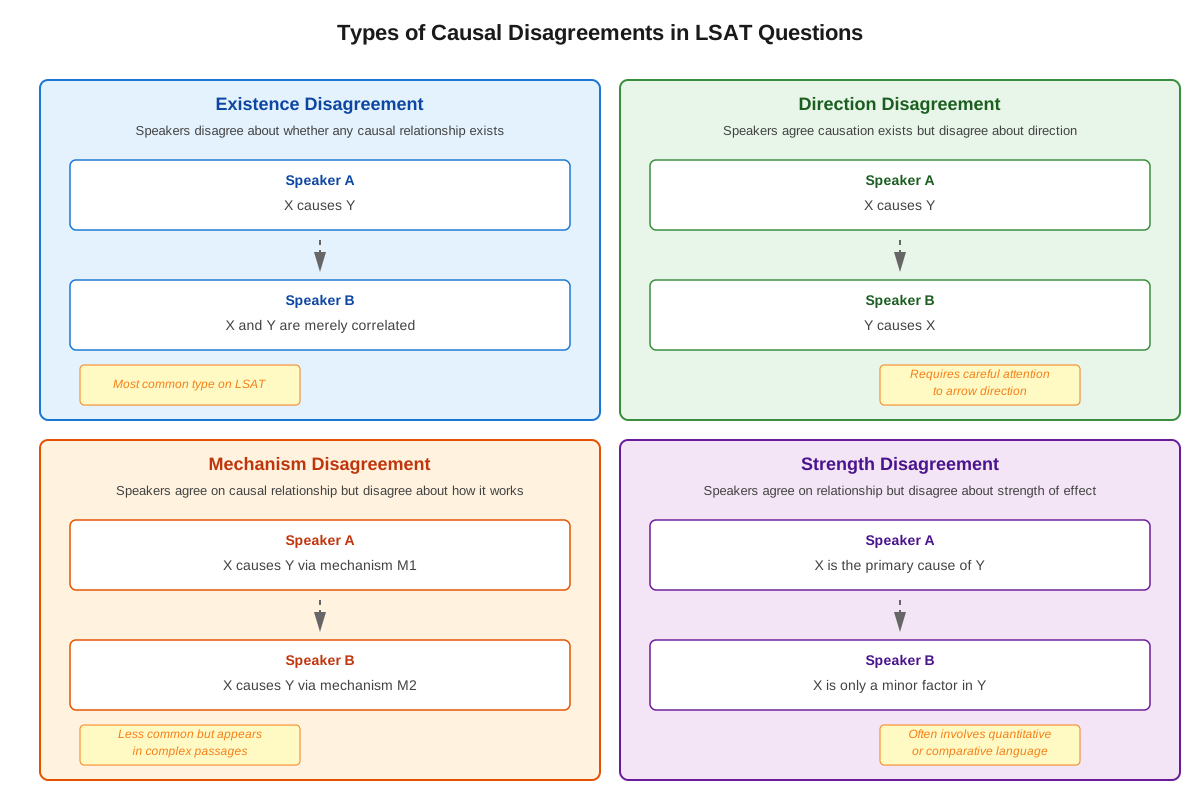
Types of Causal Disagreements
Disputed causal claim questions can involve several distinct types of disagreement:
| Type of Disagreement | Description | Example |
|---|---|---|
| Existence | Whether any causal relationship exists at all | Speaker A: "Caffeine causes insomnia." Speaker B: "The correlation is coincidental; caffeine doesn't cause insomnia." |
| Direction | Which phenomenon is the cause and which is the effect | Speaker A: "Stress causes poor sleep." Speaker B: "Poor sleep causes stress." |
| Mechanism | How the causal relationship operates | Speaker A: "Exercise improves mood by releasing endorphins." Speaker B: "Exercise improves mood by providing social interaction." |
| Strength | Whether the cause is sufficient, necessary, or merely contributory | Speaker A: "Poverty alone causes crime." Speaker B: "Poverty contributes to crime but doesn't solely cause it." |
| Alternative causes | Whether a different factor is the true cause | Speaker A: "The new policy caused sales to increase." Speaker B: "Market conditions, not the policy, caused the increase." |
Identifying Disputed Causal Claims in Questions
Point at issue and disagreement questions involving causation typically follow predictable patterns. The question stem will ask something like:
- "The dialogue provides the most support for the claim that the two speakers disagree about whether..."
- "On the basis of their statements, the speakers are committed to disagreeing about which one of the following?"
- "The point at issue between the two speakers is..."
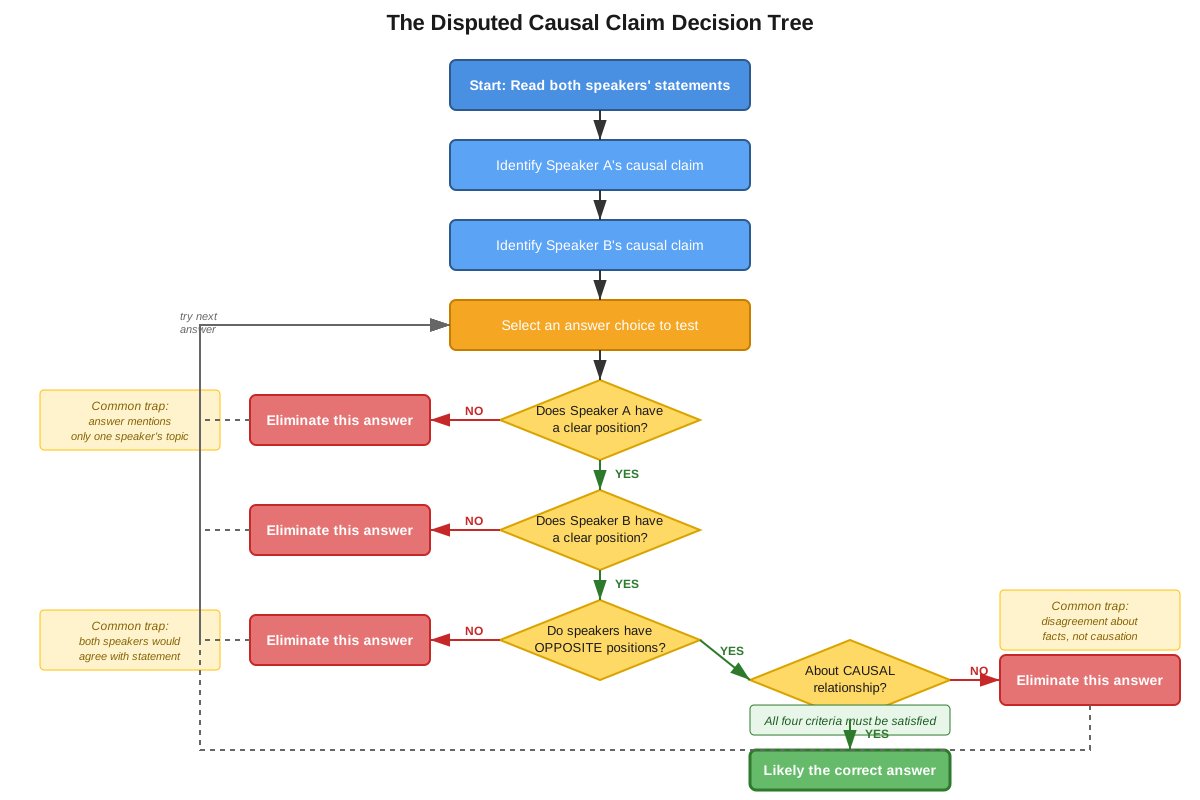
When causal reasoning is involved, the correct answer will precisely capture the causal disagreement. Wrong answers often:
- State something only one speaker addressed
- Present an issue both speakers would agree on
- Mischaracterize the nature of the causal claim
- Go beyond what the speakers are logically committed to
The Logical Commitment Test
To determine whether speakers genuinely disagree on a causal claim, apply the logical commitment test: Would Speaker A answer "yes" to the statement while Speaker B answers "no" (or vice versa)? Both speakers must be committed to opposing positions on the statement for it to represent their disagreement.
This test is crucial because speakers may seem to disagree when they're actually discussing different aspects of an issue. For example, if Speaker A says "Smoking causes lung cancer" and Speaker B says "Genetics also plays a role in lung cancer," they're not necessarily disagreeing about whether smoking causes lung cancer—Speaker B might fully agree with that claim while adding additional information.
Implicit vs. Explicit Causal Claims
On the LSAT, causal claims may be stated explicitly ("X causes Y") or implied through language that suggests causation:
- "X leads to Y"
- "X results in Y"
- "X is responsible for Y"
- "Y occurs because of X"
- "X brings about Y"
- "X produces Y"
- "Y is due to X"
Additionally, speakers may imply causal claims through their reasoning structure. If a speaker argues that implementing policy X will achieve outcome Y, they're implicitly claiming that X causes Y. Recognizing these implicit causal claims is essential for identifying the true point of disagreement.
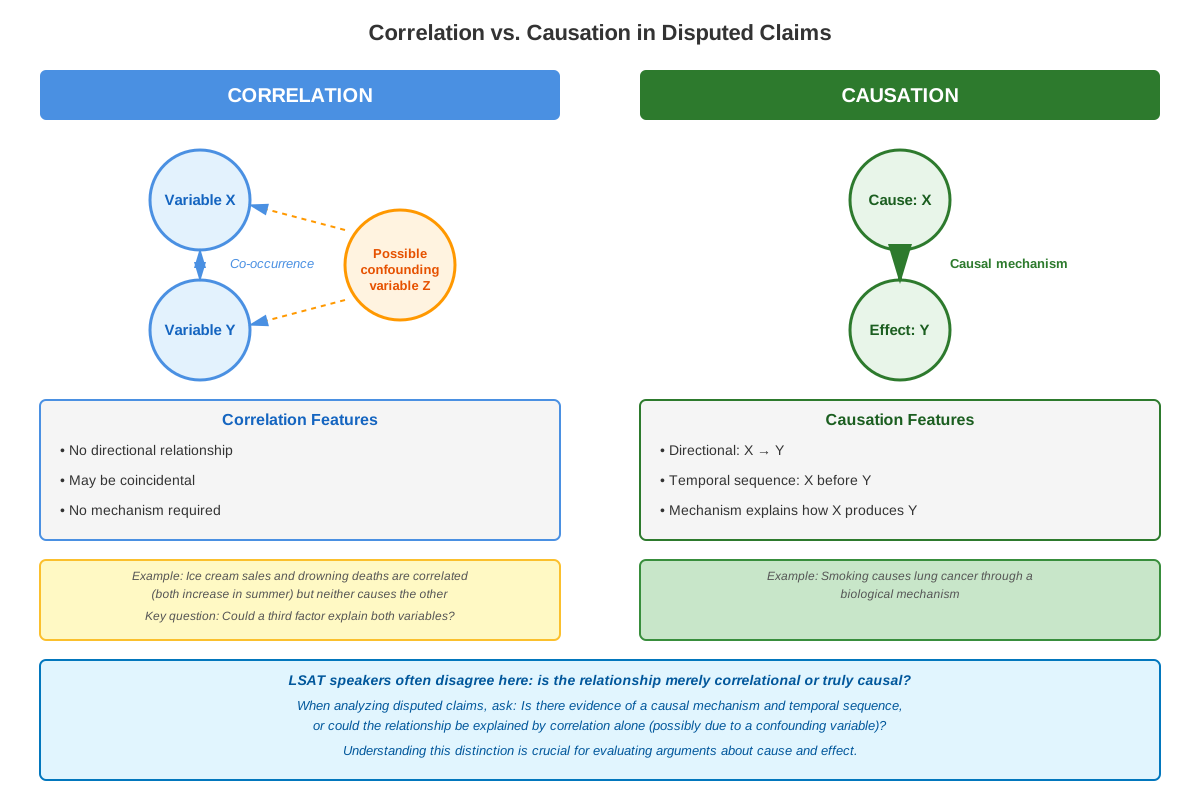
Correlation vs. Causation Disputes
A particularly common form of disputed causal claim involves one speaker asserting causation while another argues that the relationship is merely correlational. This disagreement is fundamental:
- Correlation: Two phenomena occur together or in sequence, but one doesn't necessarily cause the other
- Causation: One phenomenon actually produces or brings about the other
Speaker A might observe that X and Y occur together and conclude X causes Y. Speaker B might accept that X and Y correlate but deny the causal relationship, perhaps suggesting:
- Reverse causation (Y actually causes X)
- A common cause (Z causes both X and Y)
- Coincidence (the correlation is accidental)
- Confounding variables (other factors explain the relationship)
Concept Relationships
The concepts within disputed causal claim questions form an interconnected analytical framework. At the foundation lies basic causal reasoning—understanding what causation means and how it differs from correlation. This foundation supports identification of causal claims, both explicit and implicit, which in turn enables classification of disagreement types (existence, direction, mechanism, strength, or alternative causes).
The logical commitment test serves as the primary analytical tool, connecting the abstract understanding of disagreement to the practical task of evaluating answer choices. This test requires applying argument structure analysis to determine what each speaker is actually committed to claiming, not just what they explicitly state.
The relationship map flows as follows:
Causal Reasoning Fundamentals → Recognition of Causal Language → Identification of Speaker Positions → Classification of Disagreement Type → Application of Logical Commitment Test → Elimination of Wrong Answers → Selection of Correct Answer
This topic connects to prerequisite knowledge of conditional reasoning because causal claims often have conditional structures (if X, then Y). It also relates to assumption identification because speakers often assume causal relationships without explicitly stating them. Furthermore, disputed causal claims appear in Strengthen/Weaken questions, where understanding the causal disagreement helps identify which evidence would support or undermine each position.
High-Yield Facts
⭐ A genuine disputed causal claim requires both speakers to be committed to opposing positions on whether a specific causal relationship exists.
⭐ The most common wrong answers in these questions present issues that only one speaker addresses or that both speakers would agree on.
⭐ Speakers can disagree about causation in five primary ways: existence, direction, mechanism, strength, and alternative causes.
⭐ The logical commitment test—asking whether each speaker would answer yes/no to a statement—is the most reliable method for identifying the true point of disagreement.
⭐ Implicit causal claims (suggested through reasoning structure or causal language) are just as valid as explicit causal claims for determining disagreement.
- Correlation does not equal causation, and many disputed causal claim questions hinge on this distinction.
- When one speaker proposes a causal relationship and another offers an alternative explanation, they disagree about what causes the effect, not necessarily whether the effect exists.
- Speakers may agree on the existence of a correlation while disagreeing about whether it represents causation.
- The correct answer must capture what both speakers are logically committed to, not just what they explicitly state.
- Causal disagreements often involve temporal relationships—speakers may disagree about which phenomenon came first and therefore which could cause the other.
Quick check — test yourself on Disputed causal claim so far.
Try Flashcards →Common Misconceptions
Misconception: If two speakers discuss the same topic, they must disagree about something related to that topic.
Correction: Speakers can discuss the same topic while actually agreeing on the fundamental issues or simply addressing different aspects without genuine disagreement. A disputed causal claim requires opposing positions on a specific causal relationship.
Misconception: When Speaker B responds to Speaker A, they automatically disagree with Speaker A's main point.
Correction: Speaker B might be adding information, qualifying Speaker A's claim, or discussing a related but distinct issue. Genuine disagreement requires that the speakers hold incompatible positions on the same claim.
Misconception: If Speaker A says "X causes Y" and Speaker B says "Z causes Y," they disagree about whether X causes Y.
Correction: Speaker B might fully agree that X causes Y while also believing Z causes Y. They would only disagree if Speaker B's position implies that X does NOT cause Y (for example, if B argues Z is the ONLY cause).
Misconception: The correct answer must use the exact same words or phrases that appear in the speakers' statements.
Correction: The correct answer often paraphrases or abstracts the causal relationship, capturing the logical content of the disagreement rather than repeating specific language.
Misconception: Disputed causal claim questions always involve scientific or technical causation.
Correction: These questions can involve any domain—social phenomena, policy effects, historical events, psychological causes, or everyday situations. The logical structure of causal disagreement remains the same regardless of content.
Worked Examples
Example 1: Direction of Causation Disagreement
Passage:
Speaker A: Studies show that people who exercise regularly report higher levels of happiness. Clearly, physical activity causes improved mood and greater life satisfaction.
Speaker B: That's not quite right. People who are already happy and satisfied with their lives have more energy and motivation to exercise regularly. Happiness leads to exercise, not the other way around.
Question: The speakers disagree about whether:
(A) Regular exercise is correlated with higher levels of happiness
(B) Physical activity causes improved mood
(C) Happy people have more energy than unhappy people
(D) Studies accurately measure the relationship between exercise and happiness
(E) Life satisfaction is an important component of overall well-being
Analysis:
Let's apply the logical commitment test to each answer choice:
(A) Regular exercise is correlated with higher levels of happiness
- Speaker A: Would agree (explicitly states this correlation exists)
- Speaker B: Would agree (accepts the correlation but disputes the causal direction)
- Both agree → Not the disagreement
(B) Physical activity causes improved mood
- Speaker A: Would agree (explicitly claims this causal relationship)
- Speaker B: Would disagree (argues the causation runs in the opposite direction)
- Opposing positions → This is the disagreement
(C) Happy people have more energy than unhappy people
- Speaker A: No commitment either way
- Speaker B: Implies agreement
- Only one speaker addresses this → Not the disagreement
(D) Studies accurately measure the relationship between exercise and happiness
- Speaker A: Implicitly accepts the studies
- Speaker B: Also accepts the studies (uses them to support the reverse causal claim)
- Both agree → Not the disagreement
(E) Life satisfaction is an important component of overall well-being
- Neither speaker addresses this broader philosophical question
- Not the disagreement
Correct Answer: (B)
This example illustrates a direction of causation disagreement. Both speakers accept that exercise and happiness are related, but they disagree about which causes which. Speaker A claims exercise causes happiness; Speaker B claims happiness causes exercise. This is a classic disputed causal claim pattern on the LSAT.
Example 2: Existence of Causation Disagreement
Passage:
Speaker A: The recent increase in coffee shop openings in our downtown area has clearly caused the rise in foot traffic we've observed. More coffee shops mean more people visiting the area.
Speaker B: I don't think the coffee shops caused the increased foot traffic. Rather, entrepreneurs opened coffee shops because they noticed foot traffic was already increasing due to the new residential developments. The coffee shops are responding to increased traffic, not causing it.
Question: The dialogue most strongly supports the claim that the speakers disagree about:
(A) Whether foot traffic in the downtown area has increased recently
(B) Whether new residential developments have been built in the area
(C) Whether the opening of coffee shops caused increased foot traffic
(D) Whether entrepreneurs make business decisions based on observed trends
(E) Whether coffee shops are profitable businesses in downtown areas
Analysis:
(A) Whether foot traffic in the downtown area has increased recently
- Speaker A: Agrees (mentions "rise in foot traffic we've observed")
- Speaker B: Agrees (acknowledges "foot traffic was already increasing")
- Both agree → Not the disagreement
(B) Whether new residential developments have been built in the area
- Speaker A: No mention or commitment
- Speaker B: States this as fact
- Only one speaker addresses → Not the disagreement
(C) Whether the opening of coffee shops caused increased foot traffic
- Speaker A: Agrees (explicitly claims this causal relationship)
- Speaker B: Disagrees (argues coffee shops responded to, rather than caused, increased traffic)
- Opposing positions → This is the disagreement
(D) Whether entrepreneurs make business decisions based on observed trends
- Speaker A: No commitment
- Speaker B: Agrees (this is part of B's explanation)
- Only one speaker addresses → Not the disagreement
(E) Whether coffee shops are profitable businesses in downtown areas
- Neither speaker addresses profitability
- Not the disagreement
Correct Answer: (C)
This example demonstrates an existence of causation disagreement combined with alternative cause reasoning. Speaker A asserts a causal relationship (coffee shops → foot traffic). Speaker B denies this causal relationship and proposes an alternative explanation (residential developments → foot traffic → coffee shops). The key insight is that Speaker B doesn't just add information; B explicitly rejects A's causal claim with "I don't think the coffee shops caused the increased foot traffic."
Exam Strategy
When approaching lsat disputed causal claim questions, follow this systematic process:
Step 1: Identify the causal claim(s)
Read each speaker's statement and underline or mentally note any causal language. Look for explicit causal verbs (causes, leads to, results in, produces) and implicit causal reasoning (if X, then Y; X will achieve Y; X is responsible for Y).
Step 2: Classify the disagreement type
Determine whether the speakers disagree about:
- Whether a causal relationship exists at all
- The direction of causation
- The mechanism of causation
- The strength or nature of causation
- What the true cause is (alternative causes)
Step 3: Predict the answer
Before looking at answer choices, articulate in your own words what the speakers disagree about. This prediction serves as an anchor, preventing you from being swayed by attractive wrong answers.
Step 4: Apply the logical commitment test
For each answer choice, ask: "Would Speaker A say yes to this while Speaker B says no (or vice versa)?" Eliminate any choice where:
- Both speakers would agree
- Only one speaker addresses the issue
- Neither speaker is committed to a position
Step 5: Watch for scope shifts
Wrong answers often shift the scope by:
- Making the claim broader than what speakers discussed
- Introducing new elements neither speaker mentioned
- Focusing on peripheral details rather than the central disagreement
Exam Tip: The word "whether" in answer choices is your friend. It signals that you need to test if speakers would answer yes/no differently. If both would answer the same way, eliminate that choice immediately.
Trigger words and phrases to watch for:
In the passage:
- "Causes," "leads to," "results in," "produces," "brings about"
- "Because," "due to," "as a result of," "stems from"
- "However," "but," "actually," "rather" (signals disagreement)
- "Not X, but Y" (signals alternative cause)
In answer choices:
- "Whether" (sets up the yes/no test)
- "Caused," "responsible for," "brought about"
- "The reason for," "what explains"
Time allocation advice:
Disputed causal claim questions typically require 1:15-1:45 to complete accurately. Allocate:
- 30-40 seconds: Reading and understanding both speakers' positions
- 10-15 seconds: Predicting the disagreement
- 30-60 seconds: Evaluating answer choices using the logical commitment test
- 10-15 seconds: Confirming your answer
Don't rush these questions. The time invested in carefully applying the logical commitment test prevents costly errors and saves time by avoiding the need to reconsider.
Memory Techniques
CADET Mnemonic for types of causal disagreements:
- Causation existence (does a causal relationship exist?)
- Alternative causes (what is the real cause?)
- Direction (which way does causation flow?)
- Explanation/mechanism (how does the cause produce the effect?)
- Type/strength (sufficient, necessary, or contributory?)
The "Yes/No Test" Visualization:
Picture two judges sitting at a bench. For each answer choice, imagine asking both judges the question. If one judge's gavel comes down on "YES" while the other's comes down on "NO," you've found the disagreement. If both gavels come down on the same side, eliminate that choice.
Correlation vs. Causation Reminder:
"Correlation is Coincidence until proven otherwise; Causation requires Connection." This alliterative phrase helps remember that correlation alone doesn't establish causation—a common theme in disputed causal claims.
The Arrow Test:
When reading passages, draw mental arrows showing causal direction:
- Speaker A: Exercise → Happiness
- Speaker B: Happiness → Exercise
If the arrows point in different directions, you have a direction disagreement. If one speaker has an arrow and the other has an X through it, you have an existence disagreement.
Summary
Disputed causal claim questions test the ability to identify precise disagreements about causal relationships between two speakers. These questions appear frequently in LSAT Logical Reasoning sections and require careful analysis of what each speaker explicitly states and implicitly commits to regarding causation. The five main types of causal disagreements—existence, direction, mechanism, strength, and alternative causes—provide a framework for classifying disputes. Success on these questions depends on applying the logical commitment test: determining whether both speakers would take opposing positions on a given statement. Common wrong answers present issues only one speaker addresses or that both speakers would agree on. Mastering disputed causal claims requires distinguishing correlation from causation, recognizing implicit causal language, and systematically evaluating answer choices against what each speaker is logically committed to claiming. This skill is fundamental not only for Point at Issue questions but also for understanding argument structure throughout the LSAT.
Key Takeaways
- Disputed causal claim questions require identifying the specific causal relationship about which two speakers hold opposing views
- Apply the logical commitment test to every answer choice: both speakers must be committed to opposite positions (yes/no) for it to be the correct answer
- The five types of causal disagreements (existence, direction, mechanism, strength, alternative causes) provide a systematic framework for analysis
- Implicit causal claims—suggested through reasoning structure or causal language—are just as important as explicit causal statements
- Wrong answers typically present issues only one speaker addresses, issues both speakers agree on, or scope shifts beyond what speakers discussed
- Distinguishing correlation from causation is central to many disputed causal claim questions
- Careful reading and systematic evaluation prevent the most common errors on these high-value questions
Related Topics
Causal Reasoning in Strengthen/Weaken Questions: Understanding disputed causal claims provides the foundation for identifying evidence that would support or undermine causal arguments. Mastering this topic enables more sophisticated analysis of how additional information affects causal reasoning.
Necessary vs. Sufficient Assumptions: Many causal claims rest on assumptions about necessary or sufficient conditions. Exploring this relationship deepens understanding of what causal arguments require to be valid.
Correlation and Causation Fallacies: A detailed study of common errors in causal reasoning—including confusing correlation with causation, reverse causation, and common cause fallacies—builds on the foundation established in disputed causal claims.
Method of Reasoning Questions: Some Method of Reasoning questions ask how one speaker responds to another's causal claim. Understanding disputed causal claims helps identify these response patterns accurately.
Parallel Reasoning with Causal Arguments: Recognizing the structure of causal disagreements enables better performance on Parallel Reasoning questions that involve causal claims.
Practice CTA
Now that you've mastered the core concepts of disputed causal claims, it's time to put your knowledge into action. Work through the practice questions to reinforce your understanding and build the pattern recognition that leads to consistent success on test day. Use the flashcards to internalize the key concepts and trigger words that signal causal disagreements. Remember: every practice question you complete strengthens your ability to quickly and accurately identify the precise point of disagreement between speakers. Your investment in deliberate practice now will pay dividends in points on test day. You've got this!
Sign up free to keep reading
Create a free AnvayaPrep account to finish this LSAT guide on Disputed causal claim — plus flashcards and practice questions.