Overview
Disputed prediction is a specialized question type within LSAT Logical Reasoning that falls under the broader category of point at issue and disagreement questions. In these questions, two speakers present conflicting views about what will happen in the future, what should be done, or what the consequences of a particular action might be. The test-taker must identify the precise point of disagreement between the two parties, focusing specifically on their divergent predictions or forecasts.
This topic is essential for the LSAT because it tests a fundamental skill required for legal reasoning: the ability to identify exactly where two parties disagree. In legal practice, attorneys must pinpoint the specific issues in dispute to frame arguments effectively, and judges must identify the precise legal questions at stake. On the LSAT, disputed prediction questions appear regularly in the Logical Reasoning sections, typically 2-4 times per test, making them a high-yield area for focused study. These questions require careful reading and precise thinking—skills that distinguish top scorers from average performers.
Within the broader landscape of LSAT disputed prediction patterns, this topic connects closely to other disagreement question types, argument analysis, and conditional reasoning. Unlike simple factual disagreements about present or past events, disputed predictions require students to recognize disagreements about future states, hypothetical outcomes, or projected consequences. Mastering this topic strengthens overall analytical reading skills and prepares students for the nuanced disagreements they'll encounter throughout the LSAT and in legal practice.
Learning Objectives
- [ ] Identify how disputed prediction appears in LSAT questions
- [ ] Explain the reasoning pattern behind disputed prediction
- [ ] Apply disputed prediction to solve LSAT-style problems accurately
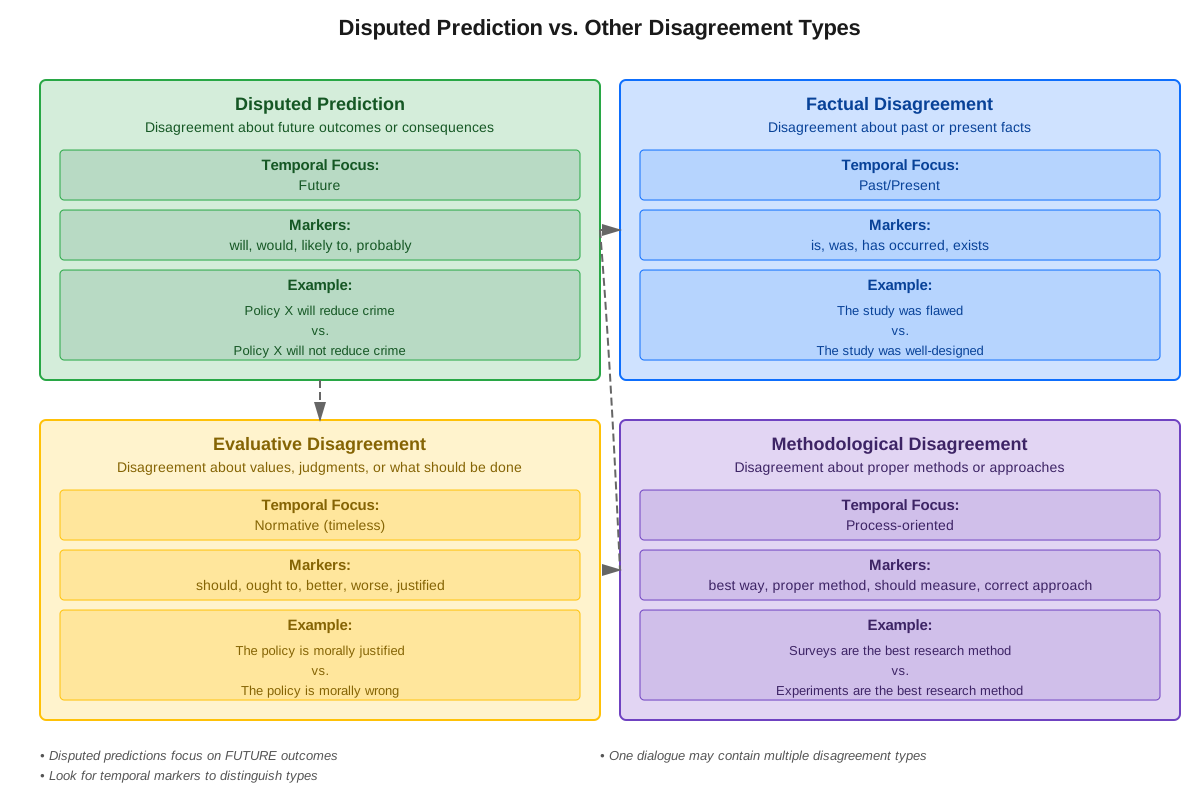
- [ ] Distinguish between disputed predictions and other types of disagreements (factual, evaluative, methodological)
- [ ] Recognize common wrong answer patterns in disputed prediction questions
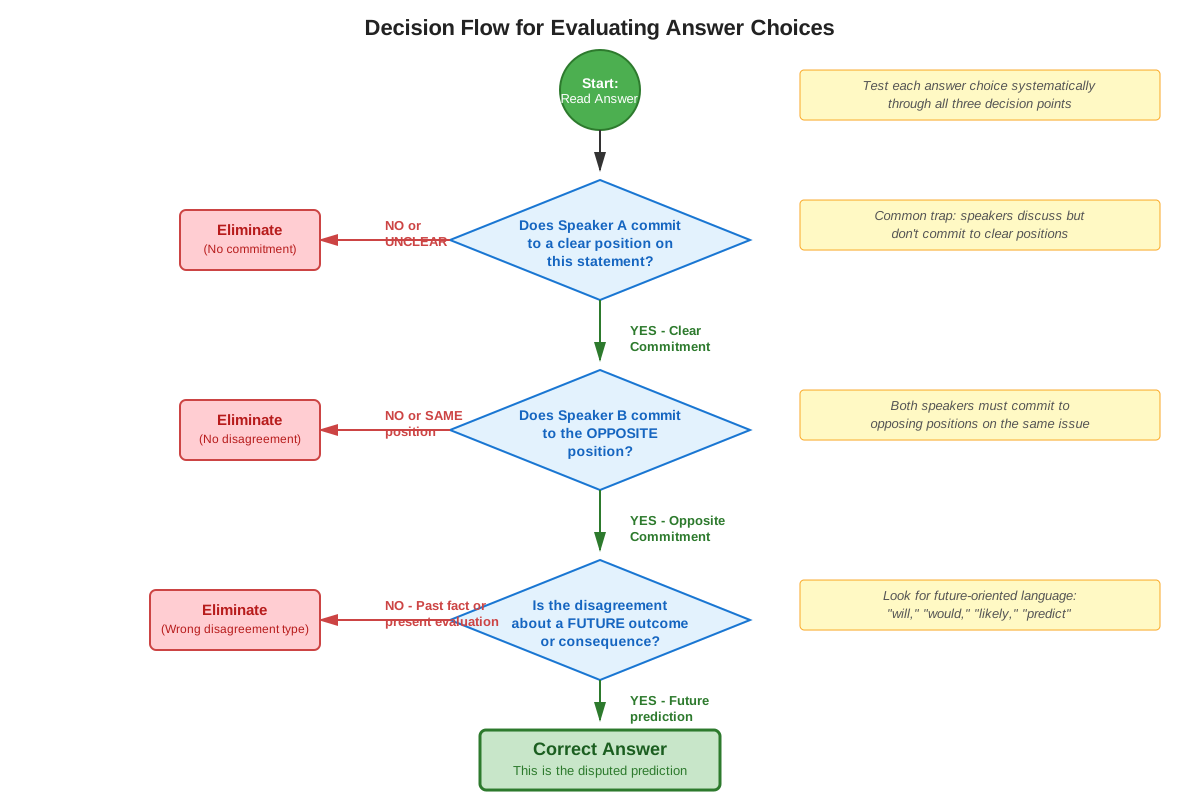
- [ ] Evaluate answer choices by testing whether both speakers would commit to opposing positions on the statement
Prerequisites
- Basic argument structure: Understanding premises, conclusions, and how claims function within arguments is necessary because disputed prediction questions require identifying specific claims within each speaker's position
- Conditional reasoning fundamentals: Recognizing if-then relationships helps because predictions often involve conditional statements about future outcomes
- Point at Issue question format: Familiarity with the general structure of disagreement questions provides the foundation for understanding this specialized subtype
- Careful reading skills: The ability to distinguish between what speakers explicitly state versus what they imply is crucial for avoiding trap answers
Why This Topic Matters
In real-world legal contexts, attorneys constantly engage with disputed predictions. When arguing about whether a proposed regulation will reduce pollution, whether a contract term will lead to specific outcomes, or whether a defendant's actions will result in particular consequences, lawyers must identify precisely where expert witnesses, opposing counsel, or parties disagree about future events. This skill translates directly to appellate briefs, oral arguments, and settlement negotiations.
On the LSAT, disputed prediction questions appear with significant frequency—typically 2-4 questions per test across both Logical Reasoning sections. These questions usually appear in the "point at issue" or "point of disagreement" format, asking test-takers to identify what the two speakers are committed to disagreeing about. The questions test reading precision and logical analysis simultaneously, making them excellent discriminators between score ranges. Students scoring in the 160+ range typically answer these questions correctly 85-90% of the time, while those in lower ranges often fall for trap answers that identify points of mere difference rather than actual disagreement.
Common manifestations in exam passages include: debates between experts about whether a policy will achieve its intended effect; discussions between researchers about what future studies will reveal; arguments between stakeholders about whether a proposed action will produce beneficial or harmful outcomes; and exchanges between theorists about what consequences will follow from accepting a particular principle. The LSAT frequently uses scientific, policy, and business contexts for these disagreements, requiring students to navigate technical content while maintaining focus on the logical structure of the dispute.
Core Concepts
The Nature of Disputed Predictions
A disputed prediction occurs when two speakers make incompatible claims about future events, outcomes, or consequences. Unlike disagreements about current facts or past events, these disputes center on what will happen, what would happen under certain conditions, or what outcomes will result from specific actions. The key characteristic is temporal: both speakers are making claims about states of affairs that have not yet occurred or are hypothetical in nature.
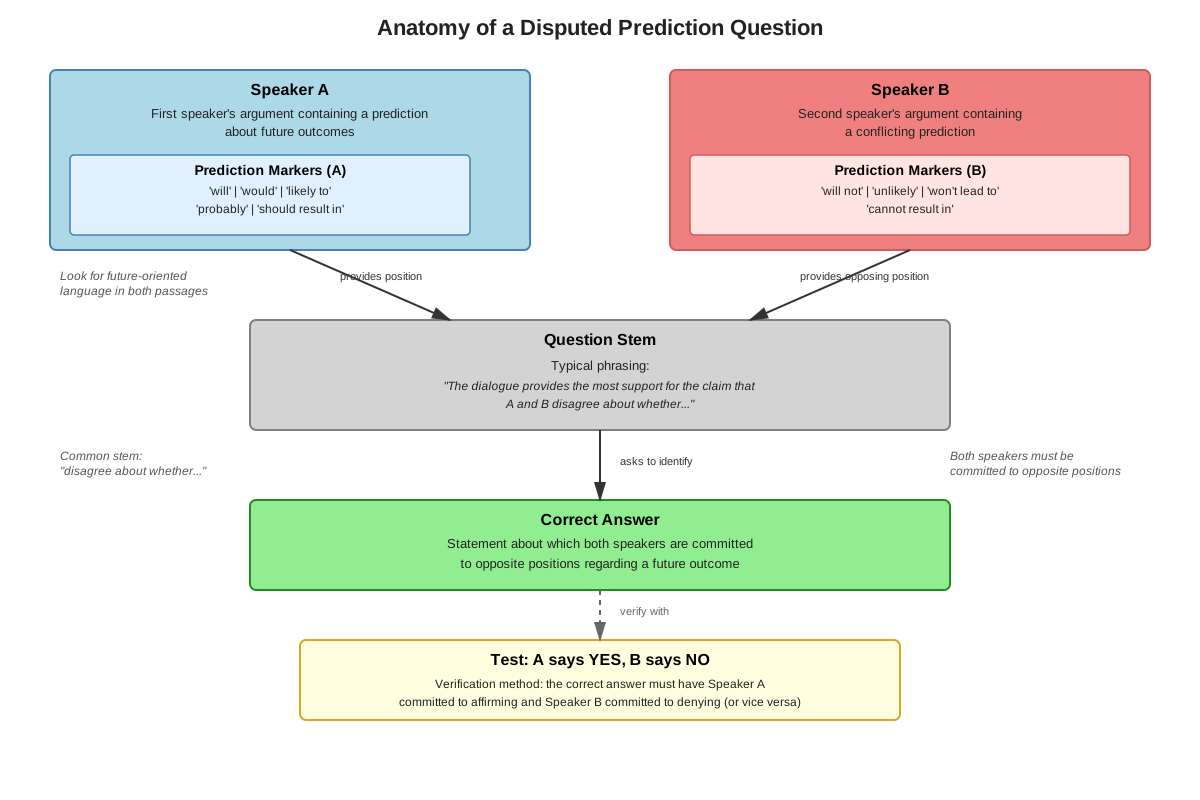
The logical structure requires that both speakers be committed to opposing positions. Speaker A must assert or clearly imply that outcome X will occur (or is likely to occur), while Speaker B must assert or clearly imply that outcome X will not occur (or that outcome Y, incompatible with X, will occur instead). This creates a genuine disagreement where both parties cannot be correct simultaneously.
Components of a Disputed Prediction Question
Every disputed prediction question contains several essential elements:
- Two distinct speakers: Usually labeled "Speaker A" and "Speaker B," or given names like "Economist" and "Sociologist"
- Predictive claims: Statements about future or hypothetical outcomes embedded within each speaker's argument
- The question stem: Typically asks "Speaker A and Speaker B disagree about whether..." or "The dialogue provides the most support for the claim that Speaker A and Speaker B disagree over..."
- Answer choices: Five options, only one of which represents a genuine point of disagreement about a prediction
Identifying Genuine Disagreement vs. Mere Difference
This distinction is crucial for success on these questions. A genuine disagreement exists when:
- Speaker A is committed to affirming a claim
- Speaker B is committed to denying that same claim (or affirming its opposite)
- Both commitments are explicit or clearly implied by their statements
A mere difference exists when:
- One speaker addresses a topic the other doesn't mention
- Both speakers could theoretically agree with a statement (even if one didn't explicitly say so)
- The speakers emphasize different aspects without contradicting each other
| Genuine Disagreement | Mere Difference |
|---|---|
| A: "The policy will reduce crime" / B: "The policy will not reduce crime" | A: "The policy will reduce crime" / B: "The policy is expensive" |
| Both commit to opposite positions | Different topics; no contradiction |
| Cannot both be correct | Could both be correct |
| Testable as disputed prediction | Not a point of disagreement |
The Commitment Test
To determine whether an answer choice represents a genuine disputed prediction, apply the commitment test:
- Test Speaker A: Would Speaker A agree with this statement, disagree with it, or have no clear position? Mark the response.
- Test Speaker B: Would Speaker B agree with this statement, disagree with it, or have no clear position? Mark the response.
- Compare: Only if one speaker would clearly agree and the other would clearly disagree does the statement represent a genuine point of disagreement.
If either speaker would have "no clear position" on the statement, it cannot be the correct answer, even if the other speaker has a strong view. The LSAT requires that both parties be committed to opposing positions.
Types of Predictive Claims
Disputed predictions on the LSAT typically involve several categories of future-oriented claims:
Causal predictions: Claims about whether action X will cause outcome Y
- Example: "Implementing this training program will improve employee performance"
Effectiveness predictions: Claims about whether a method or policy will achieve its intended goal
- Example: "The new regulation will successfully reduce carbon emissions"
Comparative predictions: Claims about whether one outcome will be greater than, less than, or equal to another
- Example: "The benefits of the policy will outweigh its costs"
Conditional predictions: Claims about what will happen if certain conditions are met
- Example: "If the company adopts this strategy, it will increase market share"
Probability predictions: Claims about the likelihood of future events
- Example: "Further research is likely to confirm this hypothesis"
Common Wrong Answer Patterns
Understanding why wrong answers are wrong is as important as recognizing correct answers. Disputed prediction questions feature predictable wrong answer types:
The One-Sided Statement: An answer choice that only one speaker addresses, while the other is silent on the matter. Even if Speaker A strongly believes X, if Speaker B never addresses X, there's no disagreement.
The Compatible Positions: An answer choice presenting claims that both speakers could accept simultaneously. For example, if Speaker A says "The policy will reduce pollution" and Speaker B says "The policy will be expensive," both could be true—there's no disagreement.
The Overgeneralization: An answer choice that goes beyond what either speaker actually committed to, often using extreme language like "always," "never," or "only."
The Premise vs. Conclusion Confusion: An answer choice identifying something both speakers agree on (often a shared premise) rather than what they disagree about.
The Irrelevant Detail: An answer choice focusing on a minor point or background information rather than the central predictive disagreement.
Concept Relationships
The disputed prediction concept sits at the intersection of several logical reasoning skills. It builds directly on point at issue and disagreement fundamentals, applying those principles specifically to future-oriented claims. The relationship flows as follows:
General disagreement identification → Disputed prediction → Specific prediction analysis
Within disputed prediction questions, the core concepts connect hierarchically:
- Recognizing predictive language enables identification of future-oriented claims
- Applying the commitment test determines whether both speakers take opposing positions
- Distinguishing genuine disagreement from mere difference eliminates wrong answers
- Understanding prediction types helps anticipate what the disagreement might concern
This topic also connects to conditional reasoning because many predictions take the form "If X, then Y will occur." When speakers disagree about such predictions, students must carefully track what each speaker commits to regarding the conditional relationship.
Additionally, disputed prediction relates to argument structure analysis because identifying what each speaker predicts requires understanding their overall argument—distinguishing premises from conclusions, and explicit claims from implied commitments.
The skill of identifying disputed predictions transfers to other LSAT question types, particularly strengthen/weaken questions (where understanding what outcome is predicted helps identify relevant evidence) and assumption questions (where predictions often rest on unstated assumptions about future events).
High-Yield Facts
⭐ A disputed prediction requires both speakers to commit to opposing positions about a future or hypothetical outcome—if one speaker is silent on the matter, there is no disagreement.
⭐ The correct answer must be something Speaker A would agree with and Speaker B would disagree with (or vice versa)—both commitments must be clear from the text.
⭐ Mere differences in emphasis, topic, or approach do not constitute disagreements; both speakers could potentially be correct about different aspects of an issue.
⭐ Predictive language includes: "will," "will not," "would," "would not," "is likely to," "probably," "should," "is expected to," and similar future-oriented terms.
⭐ Wrong answers often present statements that only one speaker addresses, making them one-sided rather than disputed.
- Disputed predictions differ from factual disagreements in that they concern what has not yet occurred rather than what is currently or was previously true.
- The commitment test is the most reliable method for evaluating answer choices: test each speaker's position independently, then compare.
- Speakers can disagree about predictions even when they agree about current facts or past events—the disagreement concerns future implications.
- Conditional predictions ("If X, then Y") are frequently disputed, with speakers disagreeing about whether the consequent will follow from the antecedent.
- The LSAT often includes answer choices that both speakers would agree with, testing whether students can distinguish shared premises from disputed conclusions.
- Extreme language in answer choices ("always," "never," "impossible," "certain") should trigger careful checking—speakers rarely commit to such absolute predictions.
- Background information and context provided before the speakers' statements often contains shared assumptions, not points of disagreement.
- The correct answer will typically use language that closely mirrors the predictive claims made by both speakers, though it may paraphrase rather than quote directly.
Quick check — test yourself on Disputed prediction so far.
Try Flashcards →Common Misconceptions
Misconception: If two speakers discuss different aspects of a topic, they disagree about that topic.
Correction: Disagreement requires opposing positions on the same claim. Speakers can discuss different aspects of a topic while having compatible, non-contradictory views. For example, one speaker praising a policy's environmental benefits and another criticizing its economic costs are not disagreeing—both claims could be true simultaneously.
Misconception: If Speaker A makes a prediction and Speaker B doesn't mention it, they disagree about that prediction.
Correction: Silence is not disagreement. For a disputed prediction to exist, Speaker B must explicitly or implicitly commit to a position contrary to Speaker A's prediction. If Speaker B simply doesn't address the topic, there's no way to determine disagreement.
Misconception: Strong language or emotional tone indicates the point of disagreement.
Correction: The intensity with which speakers express their views doesn't determine what they disagree about. A speaker might passionately discuss a point both speakers agree on, while calmly mentioning the actual point of dispute. Focus on logical commitments, not rhetorical emphasis.
Misconception: The longest or most complex answer choice is usually correct because disputed predictions are sophisticated.
Correction: Correct answers are often straightforward statements that clearly capture the opposing predictions. Complex answer choices frequently introduce irrelevant details or overgeneralizations that neither speaker committed to. Simplicity and precision typically characterize correct answers.
Misconception: If an answer choice seems related to both speakers' arguments, it must be the point of disagreement.
Correction: Relevance alone doesn't establish disagreement. An answer choice might address a topic both speakers discuss while still not representing opposing commitments. Apply the commitment test: would one speaker agree and the other disagree with this specific statement?
Misconception: Speakers must use identical or very similar words to be disagreeing about the same prediction.
Correction: The LSAT often paraphrases speakers' positions in the correct answer. Speakers might use different terminology while making opposing predictions about the same outcome. Focus on the substance of the prediction, not the exact wording.
Worked Examples
Example 1: Environmental Policy Dispute
Passage:
Environmentalist: The proposed carbon tax will significantly reduce greenhouse gas emissions over the next decade. Companies will respond to the financial incentive by investing in cleaner technologies and reducing their carbon footprint. Historical data from similar policies in other countries supports this prediction.
Economist: While companies may make some adjustments, the carbon tax will not achieve significant emissions reductions. The tax rate is too low to change corporate behavior meaningfully, and companies will simply pass the costs to consumers rather than investing in expensive new technologies.
Question: The environmentalist and the economist disagree over whether:
(A) Carbon taxes have been implemented in other countries
(B) The proposed carbon tax will significantly reduce greenhouse gas emissions
(C) Companies should invest in cleaner technologies
(D) The carbon tax rate could be set higher
(E) Consumers will face higher costs due to the carbon tax
Analysis:
Let's apply the commitment test to each answer choice:
(A) Carbon taxes have been implemented in other countries
- Environmentalist: Agrees (explicitly mentions "similar policies in other countries")
- Economist: No clear position stated
- Result: Not a disagreement (one-sided)
(B) The proposed carbon tax will significantly reduce greenhouse gas emissions
- Environmentalist: Agrees (explicitly predicts "will significantly reduce greenhouse gas emissions")
- Economist: Disagrees (explicitly states "will not achieve significant emissions reductions")
- Result: Clear disagreement about a prediction ✓
(C) Companies should invest in cleaner technologies
- Environmentalist: Implies agreement (positive about such investment)
- Economist: No clear position on whether they should (only predicts they won't)
- Result: Not a clear disagreement (normative vs. predictive)
(D) The carbon tax rate could be set higher
- Environmentalist: No clear position
- Economist: Implies agreement (mentions "tax rate is too low")
- Result: Not a disagreement (one-sided)
(E) Consumers will face higher costs due to the carbon tax
- Environmentalist: No clear position
- Economist: Agrees (predicts companies will "pass the costs to consumers")
- Result: Not a disagreement (one-sided)
Correct Answer: (B)
This is a classic disputed prediction. Both speakers explicitly commit to opposing positions about the same future outcome: whether the carbon tax will significantly reduce emissions. The environmentalist predicts it will; the economist predicts it will not. This is precisely what disputed prediction questions test.
Example 2: Educational Technology Debate
Passage:
Principal: Implementing one-to-one tablet programs in elementary schools will improve student literacy rates. Interactive reading applications engage students more effectively than traditional textbooks, and early exposure to technology prepares students for future academic success.
Teacher: One-to-one tablet programs may have some benefits, but they will not improve literacy rates. Students at this age need hands-on experiences with physical books to develop proper reading skills. The technology serves as a distraction rather than an educational tool for young learners.
Question: The principal and the teacher disagree about whether:
(A) Interactive reading applications exist for tablets
(B) Elementary school students need to develop reading skills
(C) One-to-one tablet programs will improve student literacy rates
(D) Technology will play a role in students' future education
(E) Traditional textbooks have been used in elementary education
Analysis:
(A) Interactive reading applications exist for tablets
- Principal: Agrees (mentions them explicitly)
- Teacher: No position stated (doesn't dispute their existence)
- Result: Not a disagreement
(B) Elementary school students need to develop reading skills
- Principal: Agrees (goal is improving literacy)
- Teacher: Agrees (emphasizes importance of "proper reading skills")
- Result: Not a disagreement (shared premise)
(C) One-to-one tablet programs will improve student literacy rates
- Principal: Agrees (explicitly predicts this outcome)
- Teacher: Disagrees (explicitly states "will not improve literacy rates")
- Result: Clear disagreement about a prediction ✓
(D) Technology will play a role in students' future education
- Principal: Agrees (mentions "prepares students for future academic success")
- Teacher: No clear position (focuses on current elementary education)
- Result: Not a clear disagreement
(E) Traditional textbooks have been used in elementary education
- Principal: Implies agreement (contrasts with them)
- Teacher: Agrees (mentions "physical books")
- Result: Not a disagreement (shared background fact)
Correct Answer: (C)
This example demonstrates how speakers can agree on many points (the importance of literacy, the existence of technology) while disagreeing specifically about a prediction. The disputed prediction is narrow and precise: will the tablet program improve literacy rates? The principal predicts yes; the teacher predicts no. Notice how answer choice (B) is a trap—both speakers care about reading skills, but they don't disagree about whether students need them. They disagree about whether tablets will help develop them.
Exam Strategy
When approaching disputed prediction questions on the LSAT, implement this systematic process:
Step 1: Identify the question type (5-10 seconds)
Look for stems asking about disagreement, dispute, or what speakers "disagree over whether." The word "whether" is a strong signal for disputed prediction questions.
Step 2: Read actively for predictions (30-45 seconds)
As you read each speaker's statement, underline or mentally note any claims about future outcomes, consequences, or hypothetical scenarios. Pay special attention to words like "will," "will not," "would," "is likely to," and "should."
Step 3: Identify the core disagreement before looking at answers (10-15 seconds)
Before reading answer choices, articulate to yourself what you think the speakers disagree about. This pre-formulation helps you recognize the correct answer and avoid traps.
Step 4: Apply the commitment test to each answer (30-45 seconds)
For each answer choice, quickly determine: Would Speaker A agree, disagree, or have no position? Would Speaker B agree, disagree, or have no position? Eliminate any choice where either speaker lacks a clear commitment.
Step 5: Verify the correct answer (10-15 seconds)
Before selecting your answer, double-check that both speakers would take opposite positions on the statement. Read the relevant portions of each speaker's argument to confirm.
Exam Tip: If you're stuck between two answers, look for the one-sided trap. Often, one answer choice will be something only one speaker addresses. The correct answer must be something both speakers have committed to opposing views about.
Trigger words and phrases to watch for:
In the passage:
- "will/will not"
- "is likely to/is unlikely to"
- "should/should not" (when predicting outcomes)
- "would/would not"
- "expect/do not expect"
- "probably/probably not"
In answer choices:
- "whether" (introducing the disputed claim)
- Future tense verbs
- Modal verbs indicating prediction
Process-of-elimination strategy:
- First pass: Eliminate obviously one-sided answers (where only one speaker has a position)
- Second pass: Eliminate answers where both speakers would agree
- Third pass: Between remaining choices, select the one that most directly captures opposing predictions
Time allocation:
- Disputed prediction questions should take 1:15-1:30 minutes total
- Don't spend more than 2 minutes on any single question
- If you're uncertain after applying the commitment test once, make your best choice and move on
- These questions reward careful reading more than extended deliberation
Exam Tip: Wrong answers often focus on background information, shared premises, or topics only one speaker addresses. The correct answer will almost always directly relate to the main predictive claim each speaker makes.
Memory Techniques
The COMMIT Acronym for evaluating answer choices:
- Check both speakers
- Opposing positions required
- Must be explicit or clearly implied
- Mere difference doesn't count
- Identify predictive language
- Test each answer systematically
Visualization Strategy: Picture a courtroom where two attorneys are arguing about what will happen if a particular action is taken. One attorney stands and says "This will happen," while the other stands and says "No, that will NOT happen." This image reinforces that both parties must commit to opposite positions about the same future outcome.
The "Both Commit" Mnemonic: Before selecting an answer, mentally say "Both commit" and verify that both speakers commit to opposing positions. If you can't confidently say both speakers commit to opposite views, it's not the answer.
The Future Focus Reminder: Disputed predictions are about the FUTURE or HYPOTHETICAL. If an answer choice is about present facts or past events, it's likely wrong. Remember: "Disputed predictions = Future friction."
The Silence Eliminator: Create a mental rule: "Silence = Eliminate." If one speaker is silent on a topic, immediately eliminate that answer choice. This simple rule eliminates 40-60% of wrong answers quickly.
Summary
Disputed prediction questions test the ability to identify precise points of disagreement between two speakers about future or hypothetical outcomes. Success requires distinguishing genuine disagreements—where both speakers commit to opposing positions—from mere differences in emphasis or topic. The commitment test provides a systematic method: determine whether each speaker would agree, disagree, or have no position on each answer choice, then select the only option where one speaker would agree and the other would disagree. Common traps include one-sided statements (where only one speaker addresses the topic), compatible positions (where both speakers could be correct), and shared premises (where both speakers agree). Mastering this question type requires careful reading of predictive language, precise logical analysis, and disciplined application of the commitment test. These questions appear 2-4 times per LSAT and represent high-yield opportunities for score improvement, as they follow predictable patterns and reward systematic approaches. The key is recognizing that disagreement requires both parties to take opposing stances on the same claim about what will happen, not merely discussing different aspects of a situation.
Key Takeaways
- Disputed predictions require both speakers to commit to opposing positions about a future or hypothetical outcome—silence from one speaker means no disagreement exists
- Apply the commitment test systematically: determine each speaker's position (agree/disagree/no position) on each answer choice, then select the only option showing opposite commitments
- Predictive language signals disputed predictions: "will," "will not," "would," "is likely to," "should," and similar future-oriented terms
- Distinguish genuine disagreements from mere differences—speakers can discuss different aspects of a topic without contradicting each other
- Wrong answers typically fall into predictable categories: one-sided statements, compatible positions, overgeneralizations, shared premises, and irrelevant details
- Pre-formulate the disagreement before reading answer choices to avoid being misled by attractive but incorrect options
- These questions reward precision over speed—take time to verify both speakers' commitments before selecting an answer
Related Topics
Point at Issue (General): The broader category of disagreement questions, including disputes about facts, values, and methods, not just predictions. Mastering disputed predictions provides a foundation for handling all point-at-issue question types.
Conditional Reasoning in Arguments: Many disputed predictions involve conditional statements ("If X, then Y will occur"). Understanding conditional logic helps identify exactly what speakers predict will follow from specific conditions.
Strengthen and Weaken Questions: Recognizing what outcome an argument predicts is essential for identifying evidence that would make that prediction more or less likely. Disputed prediction skills transfer directly to these question types.
Assumption Questions: Predictions often rest on unstated assumptions about future events or causal relationships. Identifying what speakers predict helps reveal the assumptions underlying their arguments.
Method of Reasoning Questions: Understanding how speakers use predictions in their arguments—as conclusions, as premises, or as hypothetical scenarios—connects to analyzing argumentative methods more broadly.
Practice CTA
Now that you've mastered the core concepts of disputed prediction, it's time to put your knowledge into practice. Work through the practice questions systematically, applying the commitment test to each answer choice. Pay special attention to identifying predictive language and distinguishing genuine disagreements from mere differences. Review the flashcards to reinforce high-yield facts and common wrong answer patterns. Remember: these questions reward careful, systematic analysis more than speed. With focused practice, you'll develop the precision needed to consistently identify disputed predictions and earn these high-yield points on test day. You've built the foundation—now strengthen it through deliberate practice!
Sign up free to keep reading
Create a free AnvayaPrep account to finish this LSAT guide on Disputed prediction — plus flashcards and practice questions.