Overview
Disputed value judgment questions represent a critical category within LSAT Logical Reasoning sections, specifically under the broader umbrella of point at issue and disagreement questions. These questions require test-takers to identify when two speakers disagree specifically about a normative claim—a statement about what should be, what is right or wrong, what is better or worse, or what has value or lacks it. Unlike factual disagreements where speakers dispute what is the case, disputed value judgments center on evaluative or prescriptive claims that involve moral, aesthetic, practical, or policy-based assessments.
Understanding disputed value judgments is essential for LSAT success because these questions test a fundamental skill in legal reasoning: distinguishing between descriptive claims (statements of fact) and normative claims (statements of value or prescription). Lawyers must constantly navigate disagreements about what the law should be, what outcomes are just, and what policies serve the public good. The LSAT assesses whether test-takers can precisely identify the exact point of normative disagreement between two parties, filtering out areas of agreement and factual disputes to isolate the specific value judgment at stake.
Within the broader landscape of Logical Reasoning, disputed value judgment questions connect to several key competencies. They require careful reading comprehension to track each speaker's position, logical analysis to distinguish different types of claims, and precise reasoning to match the disagreement to answer choices. These questions often appear alongside other disagreement question types, including disputes over factual claims, disputes over the application of principles, and disputes over the interpretation of evidence. Mastering disputed value judgments strengthens overall performance on Point at Issue questions and builds skills transferable to Strengthen/Weaken and Principle questions.
Learning Objectives
- [ ] Identify how Disputed value judgment appears in LSAT questions
- [ ] Explain the reasoning pattern behind Disputed value judgment
- [ ] Apply Disputed value judgment to solve LSAT-style problems accurately
- [ ] Distinguish between value judgments and factual claims in argumentative passages
- [ ] Recognize common indicators and trigger language that signal value-based disagreements
- [ ] Evaluate answer choices to eliminate options that mischaracterize the nature or scope of the disagreement
- [ ] Analyze complex passages where speakers agree on facts but disagree on their normative implications
Prerequisites
- Basic argument structure: Understanding premises, conclusions, and how claims support one another is essential because disputed value judgment questions require identifying which specific claim is contested.
- Distinction between facts and opinions: Recognizing the difference between descriptive statements (what is) and evaluative statements (what should be) forms the foundation for identifying value judgments.
- Point at Issue question format: Familiarity with how disagreement questions are structured and what they ask helps students efficiently approach disputed value judgment variants.
- Conditional reasoning basics: Some value judgments involve conditional prescriptions ("If X, then we should Y"), requiring comfort with conditional logic.
Why This Topic Matters
Disputed value judgment questions appear regularly on the LSAT, typically comprising 2-4 questions per test across both Logical Reasoning sections. These questions test a skill absolutely central to legal practice: identifying the precise point of normative disagreement in legal disputes. Attorneys must constantly distinguish between agreed-upon facts and contested value judgments when arguing cases, negotiating settlements, or advising clients on policy matters.
In real-world legal contexts, many disputes hinge not on factual disagreements but on competing value systems or policy priorities. For example, parties might agree on all the facts of a contract dispute but disagree about what constitutes "fair dealing" or "reasonable notice." Similarly, constitutional debates often involve shared factual understanding but profound disagreement about what rights should be protected or how competing values should be balanced.
On the LSAT, disputed value judgment questions most commonly appear in the following formats:
- Point at Issue questions asking "Which one of the following most accurately expresses a point of disagreement between A and B?"
- Commitment questions asking "A and B disagree over whether..."
- Dialogue-based questions where two speakers present contrasting positions on a policy, ethical principle, or evaluative standard
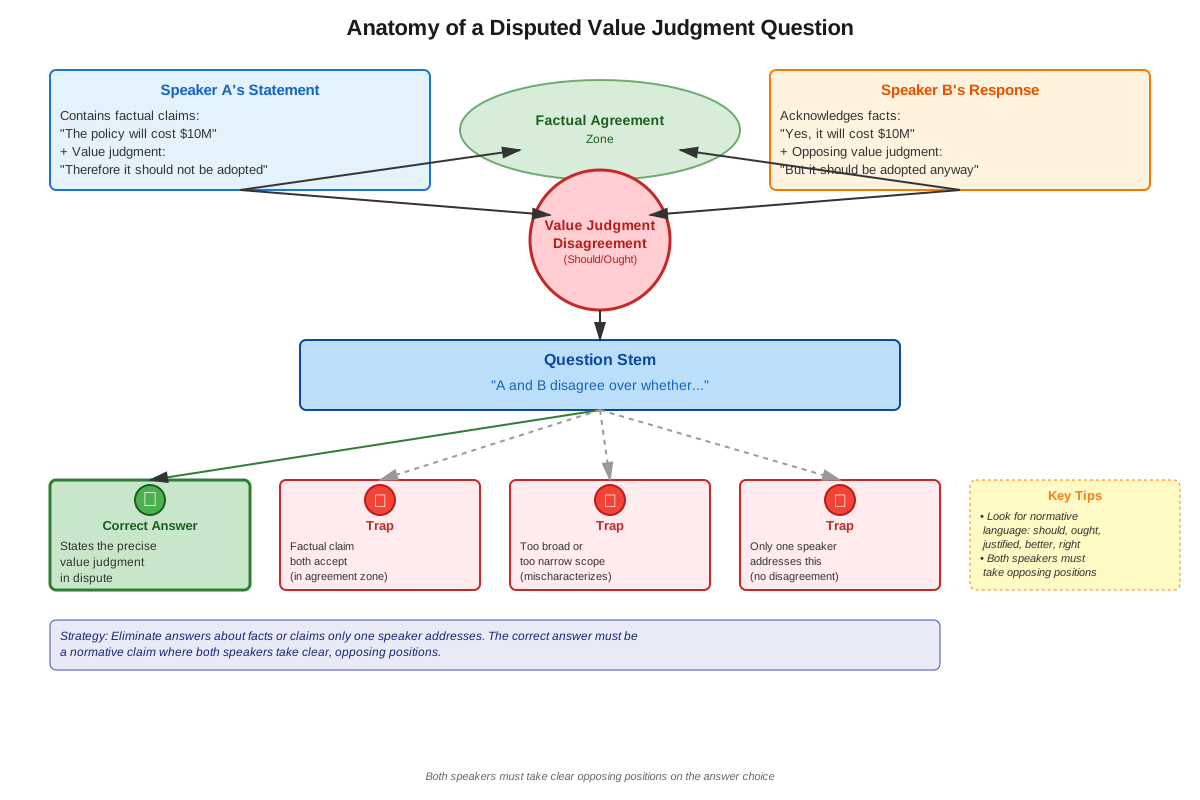
These questions typically feature two speakers (often named individuals like "Keisha" and "Ramon") who present brief arguments. The correct answer identifies a normative claim that one speaker affirms and the other denies or rejects. Incorrect answers often present factual claims, claims only one speaker addresses, or claims both speakers would accept.
Core Concepts
What Constitutes a Value Judgment
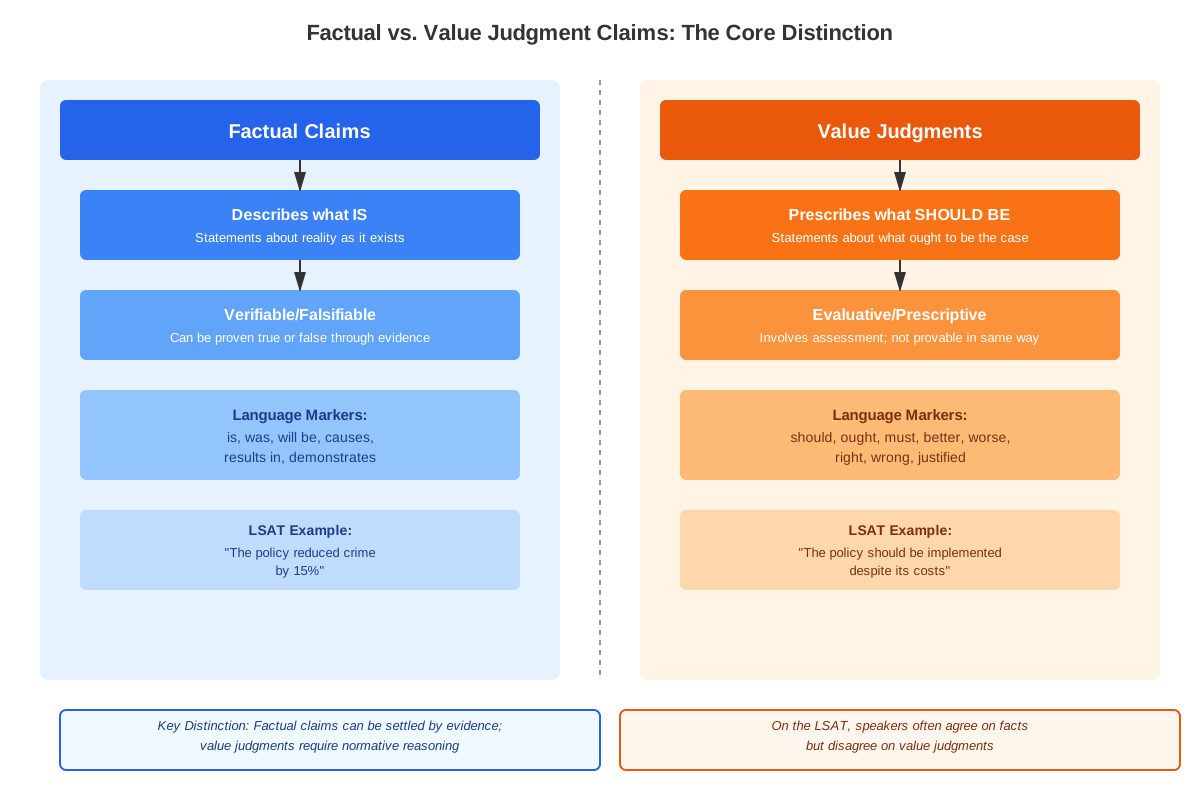
A value judgment is a normative claim that expresses an evaluation, prescription, or assessment rather than a purely factual description. Value judgments involve terms like "should," "ought," "must," "better," "worse," "right," "wrong," "justified," "unjustified," "good," "bad," "fair," "unfair," "desirable," or "undesirable." These judgments reflect priorities, principles, standards, or goals rather than objective states of affairs.
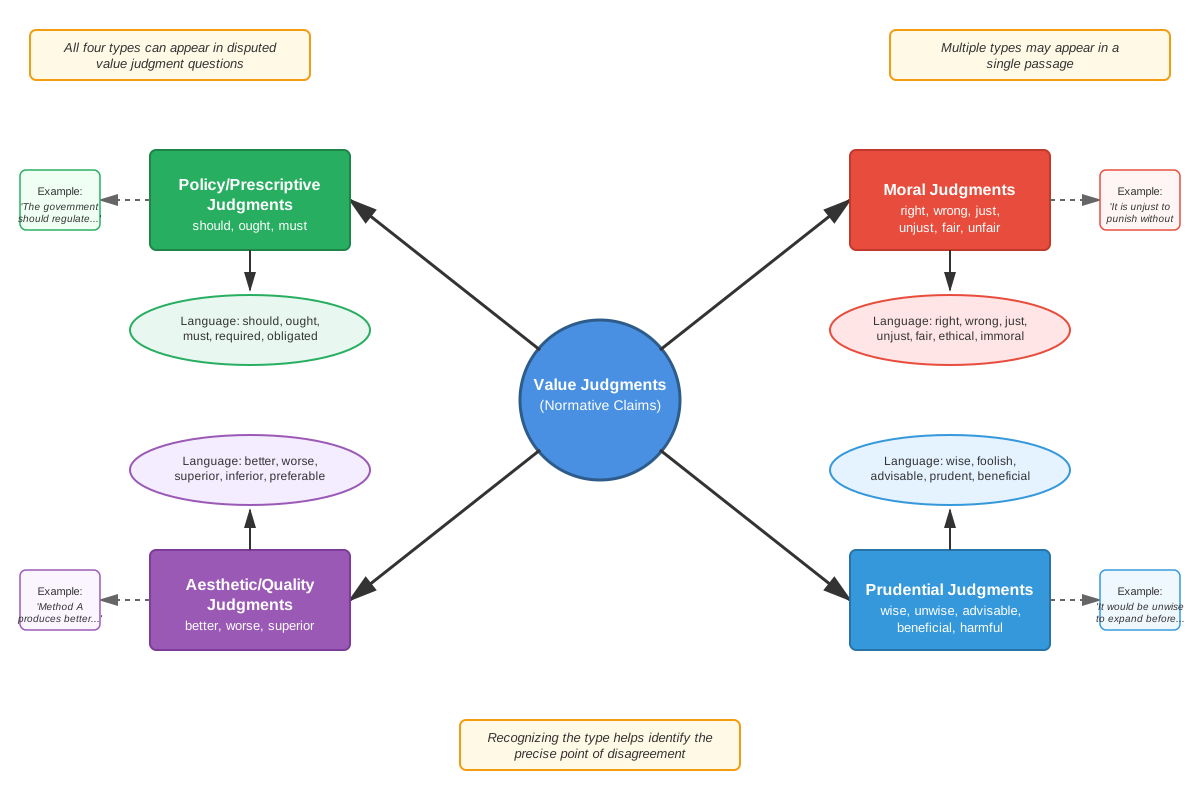
Value judgments can be categorized into several types:
- Moral judgments: Claims about ethical rightness or wrongness ("It is wrong to break promises")
- Aesthetic judgments: Claims about beauty, taste, or artistic merit ("Modern architecture is superior to classical styles")
- Prudential judgments: Claims about what is wise, beneficial, or in one's interest ("People should save for retirement")
- Policy judgments: Claims about what laws, rules, or practices should be adopted ("The government should regulate social media")
The key distinguishing feature is that value judgments cannot be verified through empirical observation alone—they require acceptance of underlying values, principles, or standards.
Disputed vs. Undisputed Value Judgments
A disputed value judgment occurs when two speakers take opposing positions on a normative claim. For a value judgment to be genuinely disputed in LSAT terms, the following conditions must be met:
- One speaker must affirm the judgment: The speaker explicitly states or clearly implies that something should be done, is better, is right, etc.
- The other speaker must deny or reject it: The second speaker explicitly states or clearly implies the opposite position
- Both speakers must address the same specific judgment: The disagreement must be about the identical normative claim, not merely related claims
Consider this example:
Speaker A: "Companies should prioritize employee welfare over short-term profits because long-term success depends on worker satisfaction."
Speaker B: "While employee welfare matters, companies' primary obligation is to maximize shareholder value, as shareholders bear the financial risk."
The disputed value judgment here is: "Companies should prioritize employee welfare over short-term profits." Speaker A affirms this; Speaker B denies it (by asserting a competing priority).
Distinguishing Value Judgments from Factual Claims
The most critical skill for these questions is distinguishing normative claims from descriptive ones. Consider these contrasts:
| Factual Claim | Value Judgment |
|---|---|
| "Unemployment increased by 2% last year" | "The government should implement policies to reduce unemployment" |
| "This policy will cost $10 million" | "This policy is too expensive to justify" |
| "Most people prefer option A" | "Option A is the better choice" |
| "The law permits this action" | "The law should permit this action" |
| "This outcome benefits group X" | "This outcome is fair to group X" |
Factual claims can be true or false based on evidence; value judgments can be supported or opposed based on principles and priorities, but they involve normative commitments beyond pure facts.
Implicit Value Judgments
LSAT passages often express value judgments implicitly rather than with explicit "should" statements. Students must recognize normative claims embedded in:
- Recommendations: "The best approach is..." (implies "We should adopt this approach")
- Criticisms: "This policy is misguided" (implies "This policy should not be adopted")
- Evaluative descriptions: "This outcome is unacceptable" (implies "We should avoid this outcome")
- Comparative assessments: "X is more important than Y" (implies "We should prioritize X over Y")
The Structure of Disputed Value Judgment Questions
These questions typically follow a predictable structure:
- Setup: Two speakers are introduced, often by name
- First speaker's position: A brief argument presenting a normative claim
- Second speaker's response: A contrasting position that disagrees with some aspect of the first speaker's argument
- Question stem: Asks what the speakers disagree about
- Answer choices: Five options, only one of which accurately captures a disputed value judgment
The correct answer must satisfy the Commitment Test: One speaker must be committed to affirming the claim, and the other must be committed to denying it. If both speakers would accept the claim, or if only one speaker addresses it, the answer is incorrect.
Common Patterns in Disputed Value Judgments
Several recurring patterns appear in LSAT disputed value judgment questions:
Priority Disputes: Speakers agree that multiple values matter but disagree about which should take precedence (e.g., "privacy vs. security," "individual rights vs. collective welfare")
Threshold Disputes: Speakers agree on a general principle but disagree about when it applies or how much is enough (e.g., "what constitutes 'sufficient' evidence," "when regulation becomes 'excessive'")
Principle Application Disputes: Speakers agree on abstract principles but disagree about whether those principles support a specific policy or action
Means-End Disputes: Speakers agree on a goal but disagree about whether a particular method is appropriate or effective for achieving it
Concept Relationships
The concept of disputed value judgment connects to several related logical reasoning skills. At the foundation, distinguishing factual claims from value judgments enables identification of normative disagreements. This distinction then feeds into the broader skill of identifying points at issue, which encompasses factual disputes, interpretive disputes, and value disputes.
Within the category of value judgments, understanding implicit normative claims builds upon recognizing explicit ones. Students must first master identifying obvious "should" statements before tackling passages where value judgments are embedded in recommendations, criticisms, or evaluative language.
The relationship map flows as follows:
Basic Argument Structure → Claim Identification → Fact vs. Value Distinction → Explicit Value Judgments → Implicit Value Judgments → Disputed Value Judgments → Point at Issue Questions
Additionally, disputed value judgment skills connect laterally to Principle questions (which often involve applying normative standards) and Strengthen/Weaken questions (where understanding what's being claimed helps identify relevant support or objections). The precision required to identify exactly what's disputed also strengthens performance on Must Be True and Most Strongly Supported questions, which require careful tracking of commitments.
High-Yield Facts
⭐ A disputed value judgment requires one speaker to affirm and the other to deny the same normative claim—if only one speaker addresses a claim, it's not disputed.
⭐ Value judgments involve normative terms like "should," "ought," "better," "worse," "right," "wrong," "justified," or "fair"—these signal evaluative rather than factual claims.
⭐ The correct answer to a disputed value judgment question must pass the Commitment Test—you should be able to point to where each speaker commits to opposing positions.
⭐ Speakers can agree on all facts but still have a disputed value judgment—normative disagreements often persist despite factual consensus.
⭐ Implicit value judgments appear in recommendations, criticisms, and evaluative descriptions—not all normative claims use explicit "should" language.
- Value judgments cannot be verified by empirical observation alone—they require acceptance of underlying principles or standards.
- Wrong answers often present claims that both speakers would accept or that only one speaker addresses.
- Priority disputes (disagreeing about which value matters more) are among the most common types of disputed value judgments on the LSAT.
- A speaker's reasoning or evidence for a position is distinct from the position itself—the disputed judgment is the conclusion, not the supporting premises.
- Conditional value judgments ("If X, then we should Y") can be disputed either by denying the conditional relationship or by denying that X obtains.
Quick check — test yourself on Disputed value judgment so far.
Try Flashcards →Common Misconceptions
Misconception: If two speakers disagree about anything, they have a disputed value judgment.
Correction: Speakers can disagree about facts, interpretations, or predictions without disputing value judgments. A disputed value judgment specifically requires disagreement about a normative claim—what should be, what's better, what's right, etc.
Misconception: A value judgment must use the word "should" or "ought."
Correction: Value judgments can be expressed through recommendations ("the best approach is..."), criticisms ("this policy is misguided"), evaluative descriptions ("this outcome is unacceptable"), or comparative assessments ("X is more important than Y"). The normative content, not specific trigger words, defines a value judgment.
Misconception: If speakers give different reasons for their positions, those different reasons constitute the disputed value judgment.
Correction: The disputed judgment is the conclusion or position itself, not the premises or reasoning supporting it. Speakers might offer different evidence or reasoning while actually agreeing on the ultimate normative claim, or they might use similar reasoning to reach opposite conclusions.
Misconception: Any claim about what's "good" or "bad" is automatically a value judgment.
Correction: Context matters. "This medicine is good for treating infections" is primarily a factual claim about efficacy, while "This is a good policy" is a value judgment. The former can be verified empirically; the latter requires normative assessment.
Misconception: If one speaker doesn't explicitly mention a claim, they can't be committed to denying it.
Correction: Speakers can be committed to denying claims through clear implication. If Speaker A says "X is the most important factor" and Speaker B says "Y is the most important factor," Speaker B is committed to denying that X is the most important factor, even without explicitly saying so.
Misconception: Disputed value judgments are always about major ethical or political issues.
Correction: Value judgments on the LSAT can involve mundane matters like business practices, educational methods, or consumer choices. Any normative claim—from "companies should disclose pricing information" to "this teaching method is superior"—can be the subject of a disputed value judgment question.
Worked Examples
Example 1: Classic Priority Dispute
Passage:
Keisha: The city should invest in expanding public transportation rather than building new highways. Public transit reduces traffic congestion, lowers carbon emissions, and provides mobility for residents who cannot afford cars. These environmental and equity benefits outweigh the convenience that new highways might offer some drivers.
Ramon: While public transportation has benefits, the city's priority should be improving highway infrastructure. Most residents commute by car, and deteriorating highways cause safety hazards and economic losses from delayed commerce. We should focus resources where they'll benefit the most people most directly.
Question: Keisha and Ramon disagree over whether
Answer Choices:
(A) public transportation reduces traffic congestion
(B) most residents currently commute by car
(C) the city should prioritize expanding public transportation over building new highways
(D) deteriorating highways cause safety hazards
(E) public transportation provides mobility for residents who cannot afford cars
Analysis:
First, identify each speaker's normative position:
- Keisha's value judgment: The city should invest in expanding public transportation rather than building new highways (she prioritizes transit over highways)
- Ramon's value judgment: The city's priority should be improving highway infrastructure (he prioritizes highways over transit)
Now apply the Commitment Test to each answer:
(A) Factual claim: Keisha affirms this, but Ramon never denies it. He doesn't dispute that public transit reduces congestion; he just thinks highways should be prioritized anyway. Not disputed.
(B) Factual claim: Ramon affirms this, but Keisha never addresses it. She doesn't dispute the current commuting patterns. Not disputed.
(C) Value judgment: Keisha clearly affirms that the city should prioritize public transportation over highways. Ramon clearly denies this by asserting the opposite priority. This is disputed.
(D) Factual claim: Ramon affirms this, but Keisha never addresses highway safety. Not disputed.
(E) Factual claim: Keisha affirms this, but Ramon never denies it. He doesn't dispute the mobility benefits of transit. Not disputed.
Correct Answer: (C)
This example illustrates a classic priority dispute where speakers agree on various facts (transit has benefits, highways have problems) but disagree about which investment should take precedence—a pure value judgment about resource allocation.
Example 2: Implicit Value Judgment
Passage:
Dr. Martinez: The new standardized curriculum is misguided. While consistency across schools sounds appealing, education works best when teachers can adapt their methods to their students' specific needs and learning styles. Rigid standardization will harm student outcomes by preventing this necessary flexibility.
Dr. Patel: The criticism of standardization overlooks its primary benefit. When all students follow the same curriculum, we ensure educational equity—every student, regardless of which school they attend, receives instruction in the same essential content. This consistency is more important than the flexibility Dr. Martinez values.
Question: Dr. Martinez and Dr. Patel disagree over whether
Answer Choices:
(A) the new curriculum provides consistency across schools
(B) teachers currently adapt their methods to students' needs
(C) ensuring all students receive the same essential content is more important than allowing teachers flexibility to adapt to individual students
(D) rigid standardization will harm student outcomes
(E) educational equity is a worthwhile goal
Analysis:
Identify the implicit value judgments:
- Dr. Martinez's position: The standardized curriculum is "misguided" (implicit: should not be adopted). Education "works best" when teachers have flexibility (implicit: we should prioritize flexibility).
- Dr. Patel's position: Ensuring educational equity through consistency "is more important than" the flexibility Dr. Martinez values (explicit value judgment about priorities).
Apply the Commitment Test:
(A) Factual claim: Both speakers seem to agree the curriculum provides consistency. Dr. Martinez says "consistency across schools sounds appealing," and Dr. Patel affirms it ensures students receive the same content. Not disputed.
(B) Factual claim: Dr. Martinez suggests teachers currently can adapt methods (and should continue to), but Dr. Patel doesn't address current practices. Not clearly disputed.
(C) Value judgment: Dr. Patel explicitly affirms this priority (consistency/equity over flexibility). Dr. Martinez denies it by arguing that flexibility is necessary and standardization is misguided—he clearly prioritizes flexibility over rigid consistency. This is disputed.
(D) Factual/predictive claim: Dr. Martinez predicts this harm, but Dr. Patel doesn't directly address whether harm will occur. He might disagree with the prediction, or he might think the harm is outweighed by equity benefits. Not clearly disputed as stated.
(E) Value judgment: Both speakers likely agree equity is worthwhile. Dr. Martinez doesn't oppose equity as a goal; he disputes whether standardization achieves it or whether it's worth the cost to flexibility. Not disputed.
Correct Answer: (C)
This example shows how value judgments can be implicit (Dr. Martinez's criticism implies the curriculum shouldn't be adopted) and how the disputed judgment often involves competing priorities rather than absolute positions (both might value equity and flexibility, but they disagree about which matters more).
Exam Strategy
When approaching disputed value judgment questions on the LSAT, follow this systematic process:
Step 1: Identify the question type. Look for stems asking "disagree over whether," "point of disagreement," or "which one of the following is a claim that A and B disagree about." These signal point at issue questions that may involve disputed value judgments.
Step 2: Read actively for normative claims. As you read each speaker, underline or mentally note any "should" statements, recommendations, criticisms, or evaluative language. Ask yourself: "What is this speaker saying ought to be done or what's better/worse?"
Step 3: Distinguish facts from values. When you identify a claim, immediately classify it: Is this a statement about what is (fact) or what should be (value)? This prevents wasting time on answer choices about factual disputes.
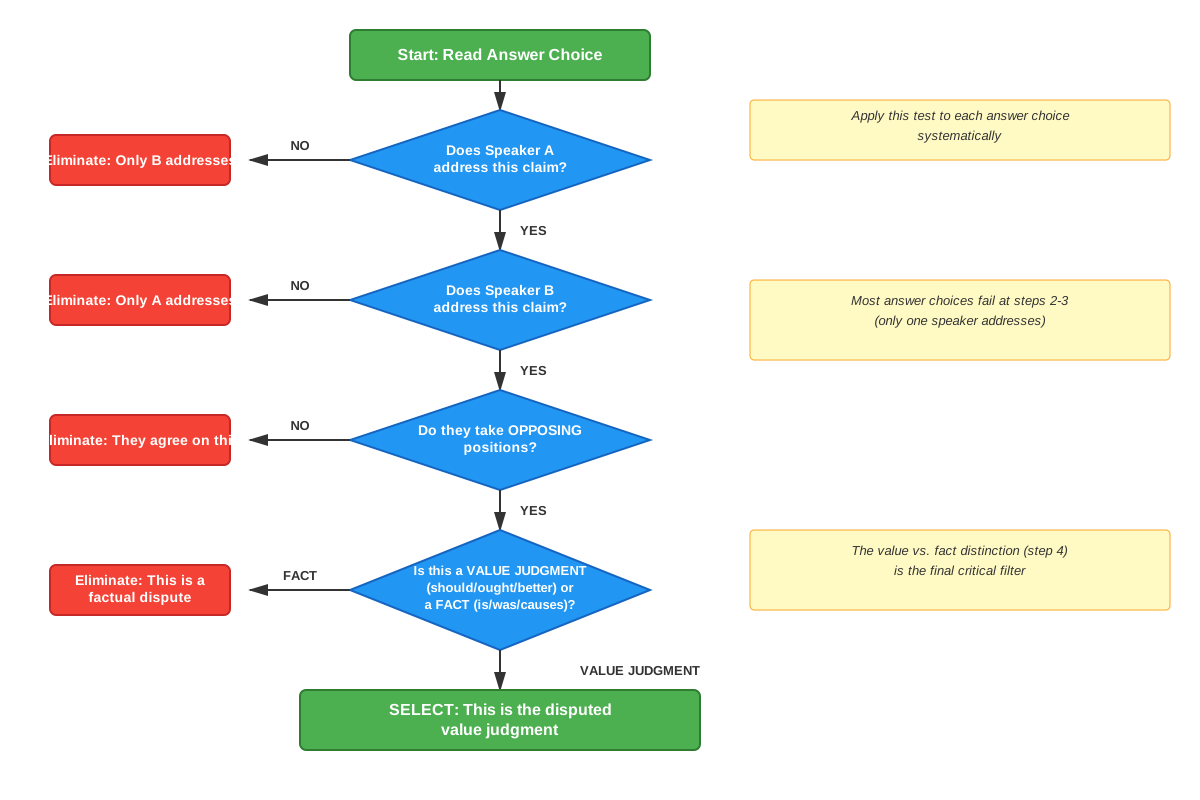
Step 4: Apply the Commitment Test rigorously. For each answer choice, ask two questions:
- Would Speaker A affirm or deny this claim?
- Would Speaker B affirm or deny this claim?
If both would affirm, both would deny, or only one addresses it, eliminate the answer.
Step 5: Watch for scope mismatches. Wrong answers often present claims that are too broad, too narrow, or slightly different from what's actually disputed. The correct answer must capture the precise point of disagreement.
Exam Tip: Trigger phrases that signal value judgments include "should," "ought to," "must," "the best approach," "more important," "justified," "appropriate," "preferable," "advisable," "worthwhile," and "desirable." Train yourself to flag these automatically.
Exam Tip: When speakers agree on facts but reach different conclusions, the dispute almost certainly involves a value judgment about how to interpret or respond to those facts.
Time allocation: Spend approximately 1:15-1:30 on disputed value judgment questions. They require careful reading but shouldn't demand extensive diagramming or complex logical analysis. If you're spending more than 90 seconds, you may be overthinking—return to the basic Commitment Test.
Process of elimination strategy:
- First pass: Eliminate purely factual claims (often 2-3 answers)
- Second pass: Eliminate claims only one speaker addresses (often 1-2 answers)
- Final selection: Choose the value judgment both speakers clearly address with opposing positions
Memory Techniques
The "SHOULD Test" Mnemonic: When evaluating whether a claim is a value judgment, ask if it involves:
- Standards (moral, aesthetic, practical)
- How things ought to be
- Obligations or recommendations
- Underlying principles or values
- Laudatory or critical assessments
- Desirability or preferability
The "Two-Way Street" Visualization: Picture a disputed value judgment as a two-way street with speakers traveling in opposite directions. If both speakers are on the same side of the street (both affirm or both deny), it's not disputed. If only one speaker is on the street (only one addresses the claim), it's not disputed. Only when speakers are traveling toward each other from opposite directions (one affirms, one denies) do you have a genuine dispute.
The "FACT vs. FAIR" Acronym:
- FACT: Falsifiable, Actual, Confirmable, Testable (descriptive claims)
- FAIR: Favorable, Advisable, Ideal, Right (normative claims)
If a claim fits FACT, it's not a value judgment. If it fits FAIR, it likely is.
Priority Pyramid: Visualize competing values as a pyramid. When speakers disagree about priorities, they're arguing about which value belongs at the top of the pyramid. Both might accept that multiple values matter (the pyramid has multiple levels), but they dispute the ranking.
Summary
Disputed value judgment questions test the ability to identify when two speakers disagree about a normative claim—a statement about what should be, what's better, or what's right, rather than what factually is. These questions appear regularly on the LSAT and require distinguishing evaluative claims from factual ones, recognizing both explicit and implicit value judgments, and applying the Commitment Test to verify that one speaker affirms and the other denies the same specific normative claim. Success depends on careful reading to track each speaker's position, systematic elimination of factual claims and claims only one speaker addresses, and precision in matching the disagreement to answer choices. The most common patterns involve priority disputes (which value matters more), threshold disputes (when a principle applies), and means-end disputes (whether a method is appropriate). Mastering disputed value judgments strengthens overall performance on Point at Issue questions and builds transferable skills for analyzing normative reasoning throughout the Logical Reasoning section.
Key Takeaways
- Disputed value judgments involve normative claims (what should be, what's better) where one speaker affirms and the other denies the same specific claim
- The Commitment Test is essential: verify that both speakers address the claim with opposing positions—if only one speaker addresses it or both agree, it's not disputed
- Value judgments can be implicit: look for recommendations, criticisms, evaluative descriptions, and comparative assessments, not just explicit "should" statements
- Distinguish facts from values systematically: factual claims describe what is and can be verified empirically; value judgments prescribe what should be and require normative principles
- Priority disputes are extremely common: speakers often agree multiple values matter but disagree about which should take precedence
- Wrong answers typically present factual claims, claims only one speaker addresses, or claims both speakers would accept—eliminate these systematically
- Precision matters: the correct answer must capture the exact point of normative disagreement, not a related or broader claim
Related Topics
Factual Disagreements: Understanding how speakers can dispute empirical claims rather than value judgments helps distinguish different types of Point at Issue questions and sharpens the fact-value distinction.
Principle Questions: Many Principle questions involve identifying or applying normative standards, building directly on the ability to recognize value judgments and understand how they function in arguments.
Method of Reasoning Questions: Recognizing when an argument proceeds from factual premises to normative conclusions (or vice versa) requires the same fact-value distinction central to disputed value judgment questions.
Strengthen and Weaken Questions: Understanding what normative claim an argument makes helps identify what kind of evidence would support or undermine it, particularly in policy and recommendation arguments.
Parallel Reasoning Questions: Some parallel reasoning questions involve matching normative structures, requiring recognition of value judgments and their logical relationships to supporting premises.
Practice CTA
Now that you've mastered the core concepts of disputed value judgments, it's time to put your knowledge into action. Work through the practice questions to reinforce your ability to identify normative claims, distinguish them from factual disputes, and apply the Commitment Test with precision. Use the flashcards to drill the key distinctions and trigger phrases until recognizing value judgments becomes automatic. Remember: every practice question you complete builds the pattern recognition and analytical speed you need to excel on test day. You've built a strong foundation—now strengthen it through deliberate practice!
Sign up free to keep reading
Create a free AnvayaPrep account to finish this LSAT guide on Disputed value judgment — plus flashcards and practice questions.