Overview
Identifying direct contradiction is a foundational skill in LSAT Logical Reasoning that requires test-takers to recognize when two speakers explicitly disagree on a specific claim or proposition. This topic falls within the broader category of Point at Issue and Disagreement questions, which ask students to pinpoint the precise area where two arguments or speakers take opposing positions. Unlike questions that ask about general disagreement or different perspectives, direct contradiction questions demand precision: the correct answer must identify a statement where one speaker would say "yes" and the other would definitively say "no."
Mastering this skill is essential for LSAT success because it tests core analytical abilities that permeate the entire exam. The ability to identify direct contradictions requires careful reading comprehension, precise logical analysis, and the discipline to avoid making unwarranted inferences. These questions appear regularly in the Logical Reasoning sections and demand that students distinguish between what speakers explicitly commit to versus what they merely suggest or leave open. A direct contradiction exists only when both speakers have made clear, opposing commitments on the same proposition—not when they simply emphasize different aspects of an issue or fail to address the same points.
Within the broader landscape of logical reasoning, identifying direct contradiction connects to multiple question types and analytical skills. It shares common ground with assumption identification, inference questions, and argument structure analysis. However, it requires a unique precision: students must avoid the temptation to infer unstated positions or to identify mere differences in emphasis as contradictions. This topic serves as a gateway to more complex disagreement analysis and strengthens the fundamental skill of tracking exactly what an argument does and does not claim—a competency that proves invaluable across all LSAT question types.
Learning Objectives
- [ ] Identify how Identifying direct contradiction appears in LSAT questions
- [ ] Explain the reasoning pattern behind Identifying direct contradiction
- [ ] Apply Identifying direct contradiction to solve LSAT-style problems accurately
- [ ] Distinguish between direct contradictions and mere differences in emphasis or scope
- [ ] Evaluate answer choices by testing whether both speakers have made explicit commitments on the stated proposition
- [ ] Recognize common trap answers that present topics discussed by both speakers without actual contradiction
- [ ] Demonstrate the ability to paraphrase speakers' positions to reveal underlying contradictions
Prerequisites
- Basic argument structure recognition: Understanding premises, conclusions, and how claims relate to one another is essential for identifying what each speaker actually asserts versus what they imply or leave unstated.
- Conditional reasoning fundamentals: Many contradictions involve opposing claims about necessary or sufficient conditions, requiring comfort with "if-then" statements and their logical relationships.
- Inference versus explicit statement distinction: Students must recognize the difference between what an argument directly states and what might be inferred, as contradictions require explicit commitments from both parties.
- Scope analysis: Understanding the boundaries of what an argument addresses helps identify when speakers are actually discussing the same proposition versus related but distinct claims.
Why This Topic Matters
In real-world contexts, the ability to identify direct contradictions is fundamental to legal reasoning, policy debates, and any situation requiring precise analysis of opposing positions. Lawyers must pinpoint exact areas of disagreement between parties, judges must identify which factual or legal claims are actually in dispute, and effective argumentation requires understanding precisely where one's position conflicts with opposing views. This skill prevents wasted effort addressing points of agreement or tangential issues while ensuring that genuine points of contention receive proper attention.
On the LSAT, Point at Issue and direct contradiction questions appear with notable frequency, typically comprising 2-4 questions per Logical Reasoning section. These questions usually present two speakers (often named individuals like "Alex" and "Barbara" or "Critic" and "Supporter") who make brief arguments, followed by a question stem asking what they disagree about or which statement they would disagree over. The question stems typically include phrases like "the dialogue provides the most support for the claim that Alex and Barbara disagree about whether," "Alex and Barbara disagree over," or "the statements above provide the most support for holding that the two speakers disagree about which one of the following."
These questions commonly appear in several formats: classic two-speaker dialogues where each person makes a brief argument; paired passages where two critics or commentators respond to the same situation; and occasionally, questions asking which statement one speaker would agree with but the other would reject. The LSAT tests this skill because it requires the precise analytical thinking essential for legal reasoning—the ability to identify exactly what is and is not in dispute, without adding assumptions or confusing related but distinct propositions.
Core Concepts
The Definition of Direct Contradiction
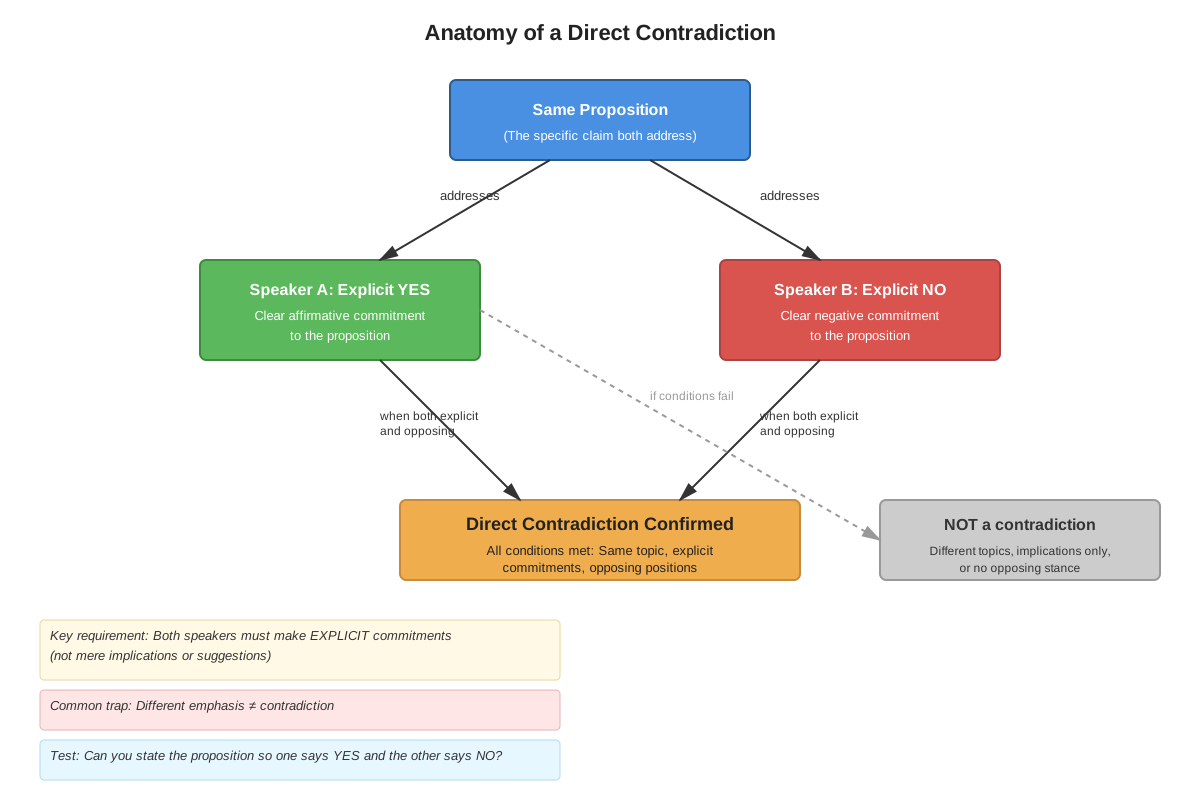
A direct contradiction exists when two speakers take explicitly opposing positions on the same proposition such that if one speaker's position is true, the other's must be false. This requires three essential elements: (1) both speakers must have made clear commitments on the proposition in question, (2) their positions must be logically incompatible, and (3) the proposition must be stated at the same level of specificity and scope for both speakers. The key word here is "explicit"—both speakers must have actually committed to their positions through their statements, not merely implied them or left them open to interpretation.
Consider this distinction: if Speaker A says "All dogs are loyal" and Speaker B says "Some dogs are not loyal," they directly contradict each other on whether all dogs possess loyalty. However, if Speaker A says "Dogs make excellent pets" and Speaker B says "Cats are better companions than dogs," they have not directly contradicted each other because Speaker A never claimed dogs are better than cats—only that dogs are excellent. This illustrates how lsat identifying direct contradiction requires precision about what each speaker has actually asserted.
The Test for Direct Contradiction
To determine whether a direct contradiction exists, apply this two-part test: (1) Would Speaker A answer "yes" to the proposition while Speaker B would answer "no" (or vice versa)? (2) Have both speakers made statements that commit them to these opposing answers? This test prevents common errors where students identify topics both speakers discuss without confirming actual opposition. The proposition must be formulated such that agreement is impossible—both speakers cannot consistently hold their stated positions if they both accepted or both rejected the proposition.
For example, if the proposition is "Economic growth always benefits the working class," and Speaker A argues that recent economic growth has harmed workers while Speaker B argues that economic growth generally helps workers, there is NO direct contradiction. Speaker A has committed to a position about recent growth (specific instance), while Speaker B discusses general trends. Neither has explicitly committed to a position on whether growth "always" benefits workers. This demonstrates why careful attention to scope, quantifiers (all, some, most, always, never), and specificity is crucial.
Explicit Commitment versus Implication
The distinction between explicit commitment and mere implication represents perhaps the most important concept in identifying direct contradiction. An explicit commitment is a position the speaker has clearly stated or that follows necessarily from their stated premises. An implication is something that might be suggested, could be inferred, or seems consistent with the speaker's position but hasn't been directly asserted. LSAT identifying direct contradiction questions test whether students can maintain this distinction under pressure.
Consider this example: Speaker A says "The new policy will reduce crime in wealthy neighborhoods." Speaker B says "The new policy will not reduce overall crime rates." Do they contradict each other? No—Speaker A has committed only to a claim about wealthy neighborhoods specifically, while Speaker B addresses overall rates. Speaker A's position is entirely consistent with overall rates not declining (if crime increases elsewhere). Students often incorrectly identify this as a contradiction because both speakers discuss crime reduction, but they haven't made opposing claims about the same proposition.
Scope and Specificity Matching
For a direct contradiction to exist, both speakers must address the same proposition at the same level of scope and specificity. This means matching on several dimensions: temporal scope (always vs. sometimes vs. in this instance), quantitative scope (all vs. most vs. some), subject scope (this specific thing vs. this category of things), and conditional scope (will happen vs. might happen vs. could happen). Mismatches on any of these dimensions typically mean no direct contradiction exists.
| Dimension | Speaker A | Speaker B | Contradiction? |
|---|---|---|---|
| Temporal | "This policy always fails" | "This policy sometimes succeeds" | YES - directly opposing claims about whether the policy ever succeeds |
| Quantitative | "Most voters support this" | "Some voters oppose this" | NO - both can be true simultaneously |
| Subject | "This novel is poorly written" | "This author's other works are excellent" | NO - different subjects (this novel vs. other works) |
| Conditional | "This will cause problems" | "This might not cause problems" | NO - certainty vs. possibility; both could be true |
The Role of Logical Relationships
Understanding logical relationships helps identify contradictions that might not appear obvious at first glance. If Speaker A asserts a conditional statement "If X, then Y" and Speaker B asserts "X can occur without Y," they directly contradict each other. Similarly, if Speaker A claims "Only qualified candidates were hired" and Speaker B claims "At least one unqualified candidate was hired," they contradict each other because Speaker B's claim directly negates Speaker A's universal statement.
These logical contradictions require translating speakers' positions into their logical structure. A speaker who says "You cannot have economic growth without environmental damage" has committed to the position that environmental damage is necessary for economic growth. A speaker who responds "Some countries have achieved growth while protecting their environment" has directly contradicted this necessity claim. Recognizing these structural contradictions is essential for point at issue and disagreement questions.
Common Trap Patterns
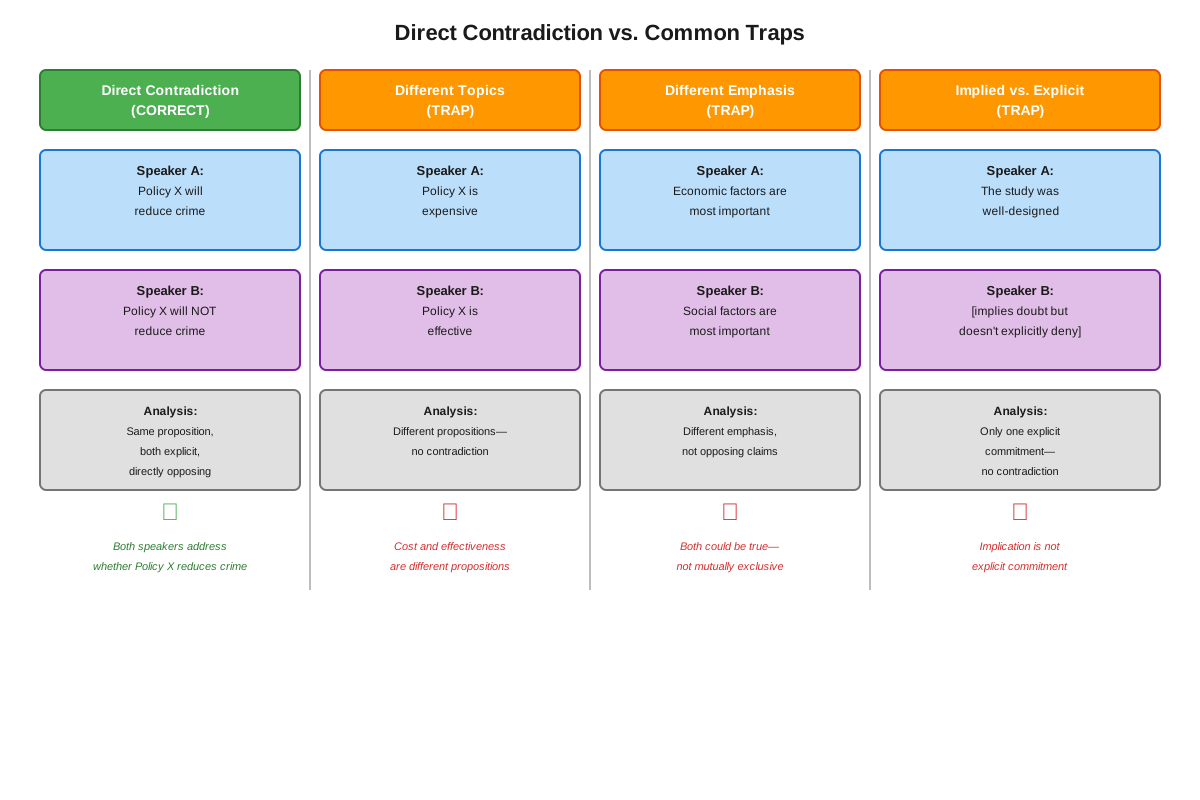
LSAT test-makers consistently employ specific trap patterns in wrong answer choices. The most common is the "both-discuss-but-don't-contradict" trap, where an answer choice presents a topic both speakers address without them taking opposing positions. Another frequent trap is the "one-speaker-silent" pattern, where an answer presents a proposition one speaker clearly addresses but the other never commits to any position on. A third trap is the "different-aspects" pattern, where speakers discuss related but distinct aspects of an issue, creating the illusion of contradiction.
For instance, if Speaker A discusses the economic benefits of a policy and Speaker B discusses its social costs, an answer choice stating "whether the policy has any benefits" would be a trap—Speaker B never denied benefits exist, only raised concerns about costs. Similarly, if Speaker A argues a theory is well-supported by evidence and Speaker B argues the theory has troubling implications, they haven't contradicted each other about evidentiary support—Speaker B might agree the evidence supports the theory while still finding its implications troubling.
Concept Relationships
The concepts within identifying direct contradiction form a hierarchical relationship where each builds upon the previous. The foundation is understanding what constitutes a direct contradiction (opposing positions on the same proposition) → which requires distinguishing explicit commitments from implications → which demands careful attention to scope and specificity matching → which enables recognition of logical relationships between statements → all of which together allow identification and avoidance of common trap patterns.
This topic connects directly to prerequisite knowledge of argument structure because identifying contradictions requires first understanding what each speaker has actually argued. It relates to conditional reasoning because many contradictions involve opposing claims about necessary or sufficient conditions. The skill also connects forward to more complex disagreement analysis, such as identifying underlying assumptions that drive disagreements or recognizing when speakers use the same terms with different meanings.
The relationship map flows as follows: Basic argument comprehension → Identifying explicit claims → Matching scope and specificity → Testing for logical opposition → Confirming both speakers have committed → Identifying direct contradiction. Each step is necessary; skipping any step increases the likelihood of selecting trap answers that present topics of discussion rather than genuine contradictions.
High-Yield Facts
⭐ A direct contradiction requires both speakers to have made explicit commitments to opposing positions on the same proposition—if one speaker is silent or uncommitted on the proposition, no contradiction exists.
⭐ The correct answer to a Point at Issue question must be something one speaker would agree with and the other would disagree with—both speakers must have clear, opposing positions.
⭐ Scope mismatches (all vs. some, always vs. sometimes, this instance vs. general cases) typically indicate no direct contradiction exists, even if speakers discuss related topics.
⭐ If both speakers could consistently hold their stated positions while both accepting or both rejecting a proposition, that proposition is not a point of direct contradiction.
⭐ The most common wrong answers present topics both speakers discuss without them taking genuinely opposing positions on those topics.
- Quantifier words (all, most, some, none, always, never, sometimes) are crucial for determining whether statements actually contradict each other.
- A speaker who emphasizes one aspect of an issue while another speaker emphasizes a different aspect has not necessarily contradicted the first speaker.
- Conditional statements ("if X then Y") contradict claims that X can occur without Y or that Y can occur without X (depending on the conditional's direction).
- A speaker's failure to mention something is not the same as denying it—silence does not constitute a position for contradiction purposes.
- Contradictions can exist even when speakers use different words, as long as they're making opposing claims about the same underlying proposition.
- The correct answer often requires paraphrasing or abstracting from the specific language speakers use to identify the underlying proposition they disagree about.
- Time pressure often causes students to select answers where both speakers discuss a topic rather than confirming they take opposing positions on a specific claim.
Quick check — test yourself on Identifying direct contradiction so far.
Try Flashcards →Common Misconceptions
Misconception: If two speakers discuss the same topic, they must disagree about something related to that topic. → Correction: Speakers can discuss the same topic while making compatible claims about different aspects of it. Direct contradiction requires opposing positions on the same specific proposition, not merely discussion of related subjects.
Misconception: If one speaker makes a positive claim and another makes a negative claim about related matters, they contradict each other. → Correction: The claims must be about the same proposition at the same level of specificity. "This policy will help the economy" and "This policy will harm the environment" are not contradictory—both could be true simultaneously.
Misconception: A speaker who doesn't mention something must disagree with claims about it. → Correction: Silence or failure to address a point does not constitute disagreement. For a contradiction to exist, both speakers must have made explicit commitments to opposing positions, not merely failed to mention the same things.
Misconception: If one speaker seems more positive and another more negative about something, they must disagree about its overall value. → Correction: Tone or emphasis differences don't necessarily indicate contradiction. One speaker might acknowledge benefits while another acknowledges drawbacks, with both positions being entirely compatible.
Misconception: Strong language or certainty from speakers indicates they're contradicting each other. → Correction: The strength of speakers' convictions is irrelevant to whether their positions actually contradict. Two speakers can both be absolutely certain while making entirely compatible claims about different aspects of an issue.
Misconception: If an answer choice seems related to the main point of both arguments, it must be what they disagree about. → Correction: The main points of arguments can be entirely compatible even when they address the same general subject. The correct answer must identify a specific proposition where the speakers have taken logically incompatible positions.
Worked Examples
Example 1: Classic Two-Speaker Dialogue
Passage:
Keisha: The city's new traffic management system has been highly effective. Since its implementation, average commute times have decreased by 15%, and traffic accidents have declined significantly.
Marcus: I disagree that the system has been effective. While commute times may have improved, the system has created dangerous conditions on residential streets as drivers seek alternate routes to avoid the main thoroughfares.
Question: Keisha and Marcus disagree over whether:
(A) the traffic management system has reduced average commute times
(B) the traffic management system has been effective
(C) traffic accidents have declined since the system's implementation
(D) drivers are using residential streets more frequently
(E) the system has created any problems
Analysis:
Let's apply our systematic approach to each answer choice:
(A) Does this represent a direct contradiction? Test: Would Keisha say "yes" and Marcus say "no"? Keisha explicitly states commute times decreased by 15%. Marcus says "while commute times may have improved"—he's actually conceding or at least not denying this point. Both speakers could agree that commute times have decreased. No contradiction.
(B) Does this represent a direct contradiction? Keisha explicitly states the system "has been highly effective." Marcus explicitly states "I disagree that the system has been effective." This is a direct contradiction—Keisha would say "yes, it's been effective" and Marcus would say "no, it hasn't been effective." Both have made clear commitments to opposing positions on this exact proposition. This is the answer.
(C) Keisha states accidents have declined. Marcus never addresses accident statistics—he discusses dangerous conditions on residential streets but doesn't commit to a position on whether overall accidents have declined. Since Marcus hasn't made an explicit commitment on this proposition, there's no direct contradiction. No contradiction.
(D) Marcus suggests drivers are using residential streets more. Keisha never addresses this point at all. Since Keisha hasn't committed to any position on residential street usage, there's no contradiction. No contradiction.
(E) This is too vague and represents a scope mismatch. Marcus has identified specific problems (dangerous conditions on residential streets), but Keisha hasn't claimed the system has created "no problems" or "zero problems"—she's claimed it's been effective overall. A system can be effective while still creating some problems. No contradiction.
Answer: (B)
Key Lesson: Notice how Marcus's explicit statement "I disagree that the system has been effective" directly signals the contradiction. However, students must still verify that Keisha actually made a claim about effectiveness (she did) and that Marcus isn't merely emphasizing different aspects while accepting Keisha's overall effectiveness claim (he's not—he explicitly rejects it).
Example 2: Subtle Logical Contradiction
Passage:
Economist: The recent tax reform will stimulate economic growth because it reduces the tax burden on businesses, and reduced business taxes always lead to increased investment and job creation.
Critic: The economist's prediction is unfounded. History shows several instances where business tax reductions failed to produce the promised investment and job creation, particularly when businesses faced weak consumer demand.
Question: The economist and the critic disagree over whether:
(A) the recent tax reform reduces the tax burden on businesses
(B) reduced business taxes can ever lead to increased investment
(C) consumer demand affects business investment decisions
(D) reduced business taxes always lead to increased investment and job creation
(E) the recent tax reform will stimulate economic growth
Analysis:
(A) The economist states the reform "reduces the tax burden on businesses." The critic never addresses whether the reform actually reduces business taxes—the critic accepts this premise and challenges what will result from it. No contradiction.
(B) The economist claims reduced taxes always lead to increased investment. The critic provides counterexamples where tax reductions "failed to produce" investment, but this doesn't mean they can "never" lead to investment—only that they don't "always" do so. The critic is arguing against "always," not against "ever." This is close but not quite right. No direct contradiction on this specific proposition.
(C) The critic mentions consumer demand as a factor. The economist doesn't address consumer demand at all—neither affirming nor denying its relevance. Since the economist hasn't committed to a position on this, there's no contradiction. No contradiction.
(D) The economist explicitly states that "reduced business taxes always lead to increased investment and job creation." The critic provides historical counterexamples where "business tax reductions failed to produce the promised investment and job creation." By providing instances where the outcome didn't occur, the critic is directly contradicting the "always" claim. If something doesn't always happen, then there are exceptions—which is exactly what the critic is asserting. This is the answer.
(E) The economist predicts the reform will stimulate growth. The critic says the prediction is "unfounded" but doesn't explicitly state the reform will NOT stimulate growth—only that the economist's reasoning doesn't adequately support the prediction. "Unfounded" means lacking adequate justification, not necessarily false. The critic might believe the prediction could turn out true for other reasons or might be uncertain. No clear contradiction.
Answer: (D)
Key Lesson: This example demonstrates how contradictions can involve logical relationships rather than identical phrasing. The economist's "always" claim is directly contradicted by the critic's counterexamples, even though the critic never uses the word "always." Students must recognize that providing exceptions to a universal claim constitutes a direct contradiction of that claim.
Exam Strategy
When approaching point at issue and disagreement questions on the LSAT, follow this systematic process:
Step 1: Read both speakers' arguments carefully, noting explicit claims. As you read, mentally mark or underline the specific claims each speaker makes. Distinguish between what they assert directly versus what they merely suggest or use as background information.
Step 2: Identify the question stem type. Common stems include "disagree about whether," "disagree over," or "would disagree about which one of the following." These all require finding a direct contradiction, but slight variations in wording can affect how you evaluate answers.
Step 3: Before looking at answer choices, predict the disagreement. Often, one speaker will explicitly respond to or reject something the other said. Identifying this in advance helps you recognize the correct answer and avoid traps.
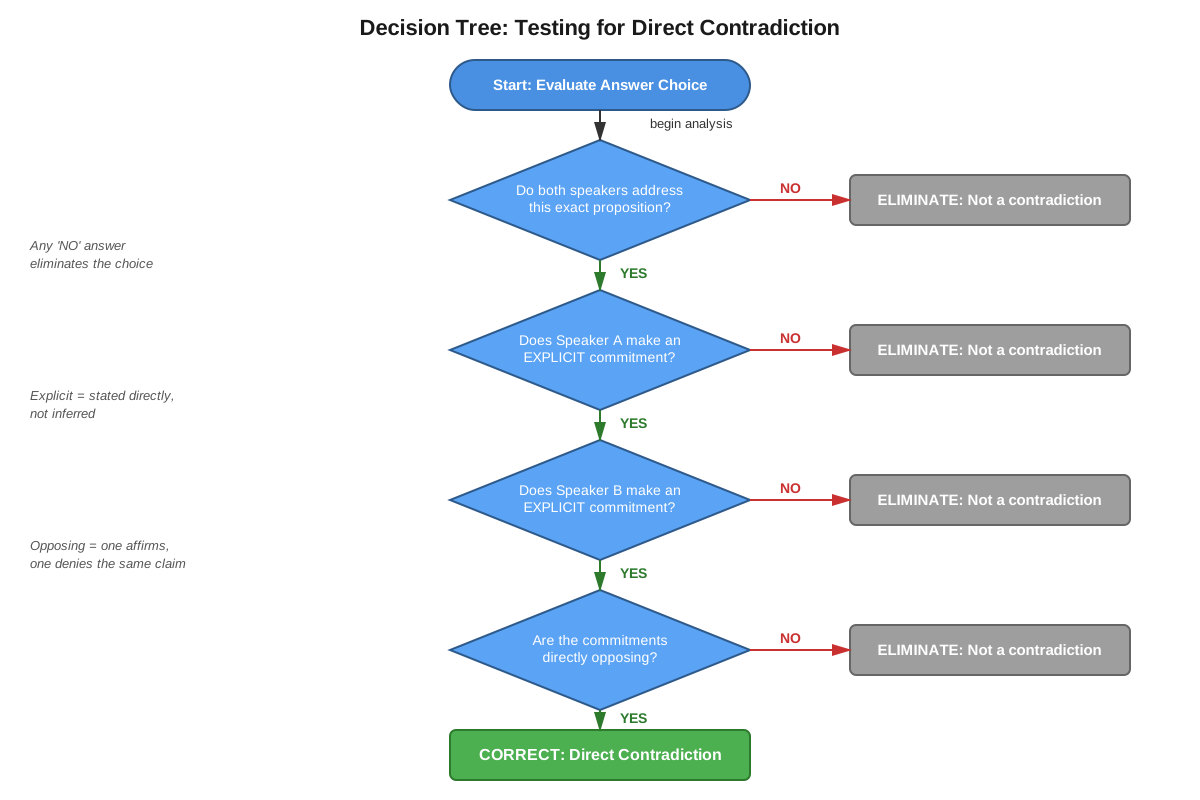
Step 4: Apply the two-question test to each answer choice:
- Question 1: Has Speaker A made an explicit commitment on this proposition? (Would they answer "yes" or "no"?)
- Question 2: Has Speaker B made an explicit commitment on this proposition? (Would they answer the opposite?)
Step 5: Eliminate answers where either speaker is silent or uncommitted. This eliminates the majority of wrong answers. If you can't point to specific text showing a speaker's commitment, that answer is wrong.
Trigger words and phrases to watch for:
- Agreement indicators: "I agree that," "as X correctly notes," "X is right that" (these signal points of agreement, not contradiction)
- Explicit disagreement markers: "I disagree," "contrary to," "however," "but" (these often signal where contradiction occurs)
- Scope limiters: "all," "some," "most," "always," "never," "sometimes," "in this case," "generally" (these define the scope of claims)
- Certainty markers: "will," "must," "might," "could," "possibly" (these affect whether claims actually contradict)
Process-of-elimination strategy:
First, eliminate any answer where you cannot find explicit textual support for both speakers having positions. This typically eliminates 2-3 answers immediately. Second, eliminate answers where both speakers could consistently hold their stated positions while both accepting or both rejecting the proposition. Third, among remaining answers, choose the one where the opposition is most direct and requires the least inference.
Time allocation:
These questions typically require 60-90 seconds. Spend 30-40 seconds on the initial read, 10-15 seconds predicting the disagreement, and 20-30 seconds evaluating answer choices. If you find yourself spending more than 90 seconds, you're likely over-thinking or making unwarranted inferences. Return to the text and focus only on explicit commitments.
Exam Tip: When stuck between two answers, write out what each speaker would say about the proposition: "Speaker A would say YES because [quote]" and "Speaker B would say NO because [quote]." If you can't complete both statements with actual quotes or clear logical implications, that answer is wrong.
Memory Techniques
The SCOPE Acronym for checking contradictions:
- Same proposition (not just same topic)
- Commitments from both speakers (explicit, not implied)
- Opposing positions (yes vs. no, not just different emphases)
- Precise matching (same level of specificity and generality)
- Eliminate silence (if one speaker hasn't addressed it, no contradiction)
The "Yes/No Test" Visualization:
Picture a simple table with three columns: Proposition | Speaker A | Speaker B. For each answer choice, mentally fill in whether each speaker would say "Yes," "No," or "Silent/Uncommitted." The correct answer is the only one where you have "Yes" and "No" (in either order) with no "Silent/Uncommitted" entries.
The "Both Could Be Right" Elimination Rule:
Create a mental habit: for each answer choice, ask "Could both speakers' actual statements be true if this proposition were true? Could both be true if this proposition were false?" If the answer to either question is "yes," eliminate that choice. True contradictions mean the speakers cannot both be right.
The Quotation Challenge:
For the answer you're considering, challenge yourself to point to specific text (even if just paraphrased) showing each speaker's commitment. If you can't do this for both speakers, you don't have a contradiction. This prevents the common error of inferring positions speakers haven't actually taken.
Summary
Identifying direct contradiction on the LSAT requires precision in determining when two speakers have made explicitly opposing commitments on the same proposition. This skill demands careful attention to what speakers actually assert versus what they imply, strict matching of scope and specificity, and disciplined avoidance of inferring positions speakers haven't taken. The core principle is simple: a direct contradiction exists only when one speaker would answer "yes" to a proposition while the other would answer "no," and both have made clear commitments that require these opposing answers. Success on these questions comes from systematically testing whether both speakers have addressed the proposition in question and whether their positions are genuinely incompatible rather than merely different in emphasis or focus. Students must resist the temptation to select answers simply because both speakers discuss related topics, instead confirming that genuine logical opposition exists on a specific claim. Mastering this skill strengthens overall logical reasoning ability and provides a foundation for more complex argument analysis throughout the LSAT.
Key Takeaways
- Direct contradiction requires explicit commitments from both speakers to opposing positions on the same proposition—silence or failure to address a point does not constitute disagreement
- The correct answer must pass the "yes/no test": one speaker would say yes and the other would say no to the exact same proposition
- Scope and specificity must match precisely—contradictions about "all" versus "some" or "this instance" versus "general cases" typically indicate wrong answers
- The most common trap answers present topics both speakers discuss without them actually taking opposing positions on those topics
- Apply systematic elimination: remove answers where either speaker hasn't committed, where both could agree, or where scope mismatches exist
- Focus on what speakers explicitly state or what necessarily follows from their statements, not on what seems implied or suggested by their tone
- Trigger words indicating scope (all, some, always, never) and certainty (will, might, must, could) are crucial for determining whether genuine contradiction exists
Related Topics
Identifying Assumptions in Arguments: Understanding what speakers assume but don't state helps distinguish between explicit commitments (which can contradict) and unstated premises (which typically don't create contradictions unless explicitly addressed by the other speaker). Mastering direct contradiction provides a foundation for recognizing when speakers make different assumptions.
Method of Reasoning Questions: These questions ask how an argument proceeds or how one speaker responds to another. Identifying direct contradiction helps recognize when a speaker's method involves directly denying a claim versus offering alternative explanations or raising different considerations.
Strengthen and Weaken Questions: Understanding what speakers have actually committed to helps identify what would strengthen or weaken their positions. The precision required for identifying contradictions transfers directly to evaluating what's relevant to an argument.
Parallel Reasoning: Recognizing the logical structure of contradictions (universal claims vs. counterexamples, conditional statements vs. exceptions) helps identify parallel logical relationships in different contexts.
Practice CTA
Now that you've mastered the core concepts of identifying direct contradiction, it's time to put your knowledge into practice. Work through the practice questions systematically, applying the SCOPE acronym and the yes/no test to each answer choice. Remember that these questions reward precision and discipline—resist the urge to make inferences beyond what speakers explicitly commit to. Each practice question you complete strengthens your ability to recognize genuine contradictions and avoid common traps. The flashcards will help reinforce the key distinctions and trigger words that appear repeatedly on the LSAT. Consistent practice with these materials will build the automatic recognition patterns that lead to quick, confident answers on test day. You've got this!
Sign up free to keep reading
Create a free AnvayaPrep account to finish this LSAT guide on Identifying direct contradiction — plus flashcards and practice questions.