Overview
Point at issue traps represent one of the most sophisticated challenge categories within LSAT Logical Reasoning sections, specifically within point at issue and disagreement questions. These traps are deliberately constructed wrong answer choices that appear correct on first glance but fail to meet the precise requirements of identifying what two speakers actually disagree about. Understanding these traps is crucial because point at issue questions appear regularly on every LSAT administration, and the test makers have refined these deceptive answer choices over decades to exploit common reasoning errors that even strong test-takers make under time pressure.
The fundamental challenge of point at issue questions lies in their precision requirement: the correct answer must identify a statement that one speaker would agree with and the other would disagree with, based solely on what each has explicitly stated or what can be directly inferred from their statements. The traps exploit the natural human tendency to make assumptions, to read between the lines, or to select answers that seem topically relevant even when they don't meet the technical requirements. These questions test not just reading comprehension but also the ability to distinguish between what is stated, what is implied, and what is merely related to the discussion.
Within the broader landscape of Logical Reasoning, point at issue questions connect to fundamental skills in argument analysis, inference recognition, and precise textual interpretation. They share DNA with assumption questions (requiring careful attention to logical gaps), strengthen/weaken questions (demanding understanding of what each speaker's position commits them to), and inference questions (testing what can and cannot be concluded from given statements). Mastering point at issue traps builds transferable skills that enhance performance across multiple Logical Reasoning question types.
Learning Objectives
- [ ] Identify how Point at issue traps appears in LSAT questions
- [ ] Explain the reasoning pattern behind Point at issue traps
- [ ] Apply Point at issue traps to solve LSAT-style problems accurately
- [ ] Distinguish between genuine points of disagreement and mere topical overlap
- [ ] Evaluate answer choices using the "agreement test" to eliminate trap answers
- [ ] Recognize the five most common trap patterns and their distinguishing features
- [ ] Predict likely trap answers before reading the answer choices based on passage content
Prerequisites
- Basic argument structure identification: Understanding premises, conclusions, and how claims relate to one another is essential because point at issue questions require parsing two separate arguments and identifying where they conflict.
- Inference skills: The ability to determine what must be true, could be true, and cannot be true based on given statements is necessary because disagreement points sometimes require recognizing what each speaker is committed to, even if not explicitly stated.
- Conditional reasoning fundamentals: Understanding sufficient and necessary conditions helps identify when speakers actually disagree about conditional relationships versus merely discussing related topics.
- Scope recognition: The ability to identify the precise boundaries of what an argument addresses is critical because many traps involve statements that fall outside what one or both speakers have actually discussed.
Why This Topic Matters
Point at issue questions appear with remarkable consistency on the LSAT, typically comprising 2-4 questions per Logical Reasoning section, which translates to approximately 4-8 questions per complete LSAT administration. Given that the Logical Reasoning sections constitute roughly 50% of the scored LSAT, and that point at issue questions are among the most frequently missed question types even by high-scoring test-takers, mastering these traps can directly translate to multiple additional correct answers and a meaningful score increase.
In real-world legal practice, the ability to identify precise points of disagreement is foundational to effective advocacy, negotiation, and judicial reasoning. Attorneys must constantly distinguish between genuine disputes and mere differences in emphasis or terminology. Contract negotiations, appellate briefs, and oral arguments all require the precise identification of what parties actually disagree about versus what they might agree on despite appearing to be in conflict. The LSAT tests this skill because it predicts success in legal analysis.
On the exam, point at issue questions typically appear in a standard format: two speakers (often named Speaker A and Speaker B, or given names like "Politician" and "Journalist") present brief arguments, followed by a question stem asking "The dialogue provides the most support for the claim that the two speakers disagree about which one of the following?" or similar variations. The trap answers are carefully constructed to seem relevant and to use language from the passage while failing the technical test of representing a genuine disagreement.
Core Concepts
Understanding Genuine Disagreement
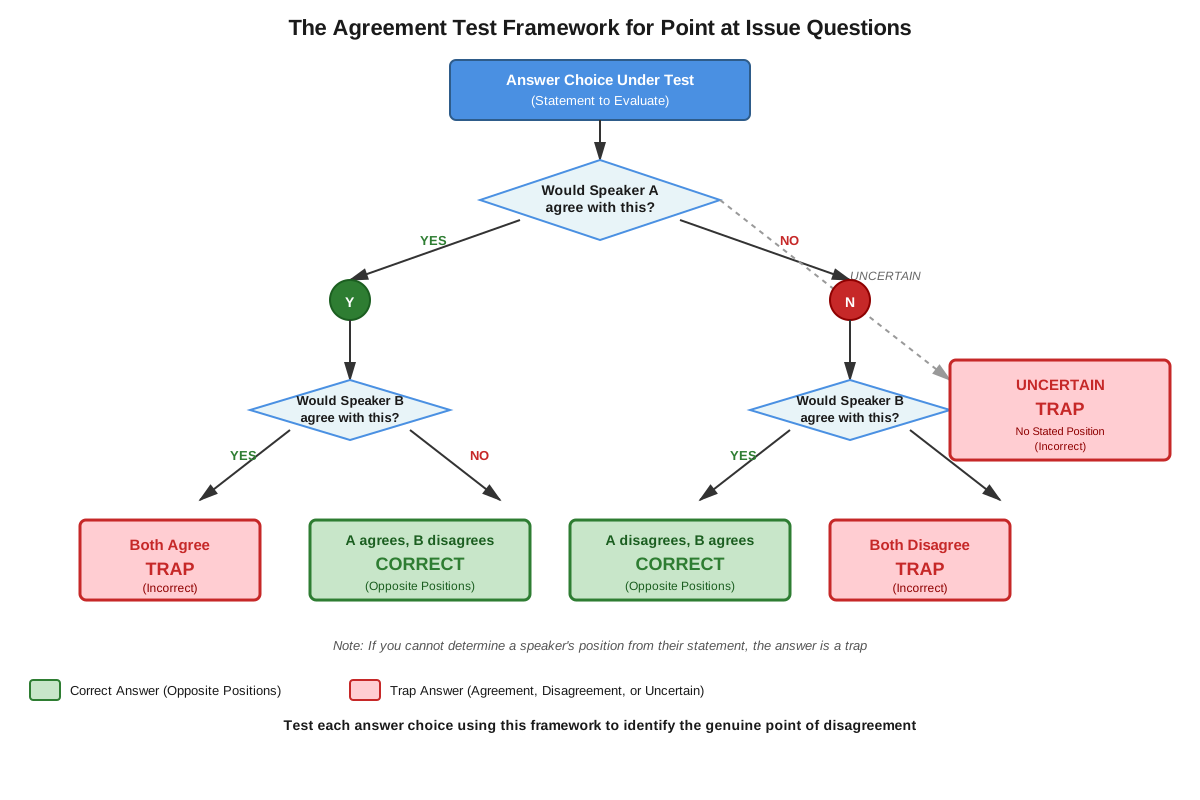
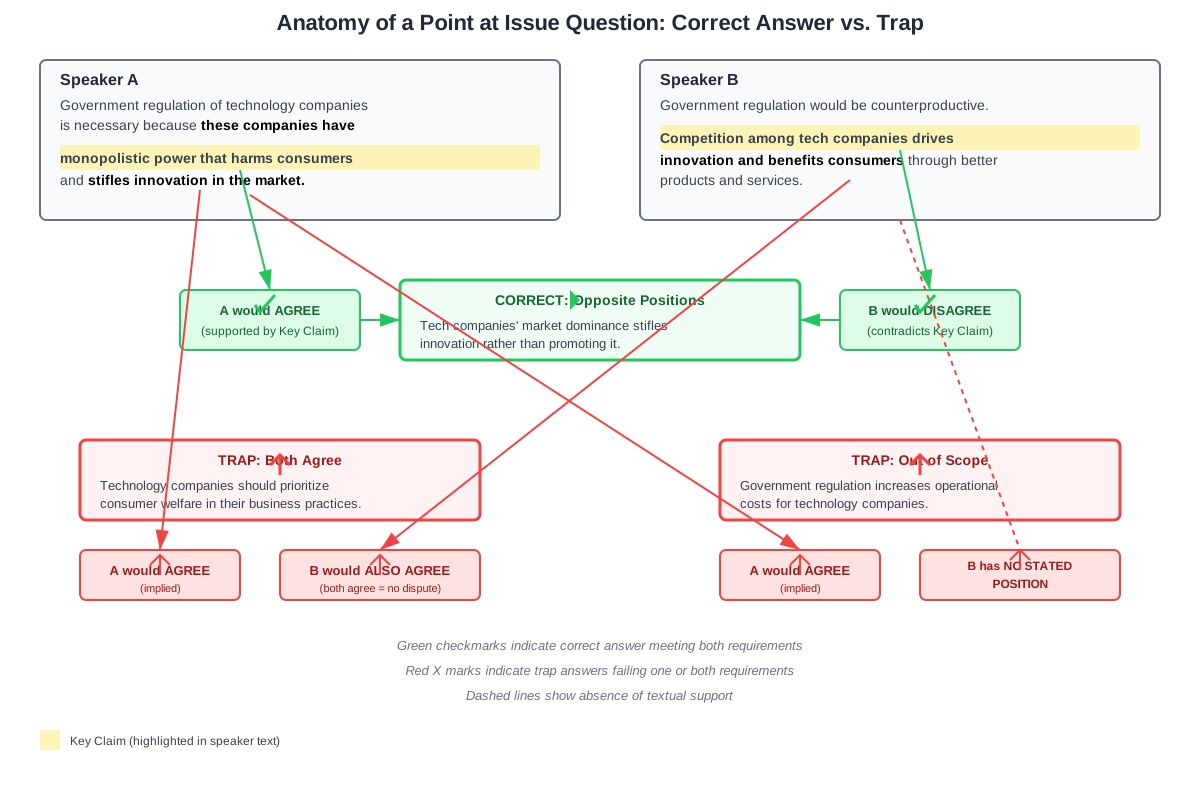
A genuine point of disagreement exists when one speaker would affirm a statement and the other would deny it. This is the foundational principle that all point at issue questions test. The correct answer must pass what can be called the "agreement test": if you asked Speaker A whether the statement is true, they would say "yes" (or their argument commits them to "yes"), and if you asked Speaker B the same question, they would say "no" (or their argument commits them to "no"), or vice versa.
This requirement is more stringent than many test-takers initially recognize. It is insufficient for the speakers to discuss related topics, to emphasize different aspects of an issue, or even to reach different conclusions if those conclusions don't directly contradict each other. The disagreement must be about the truth value of a specific claim.
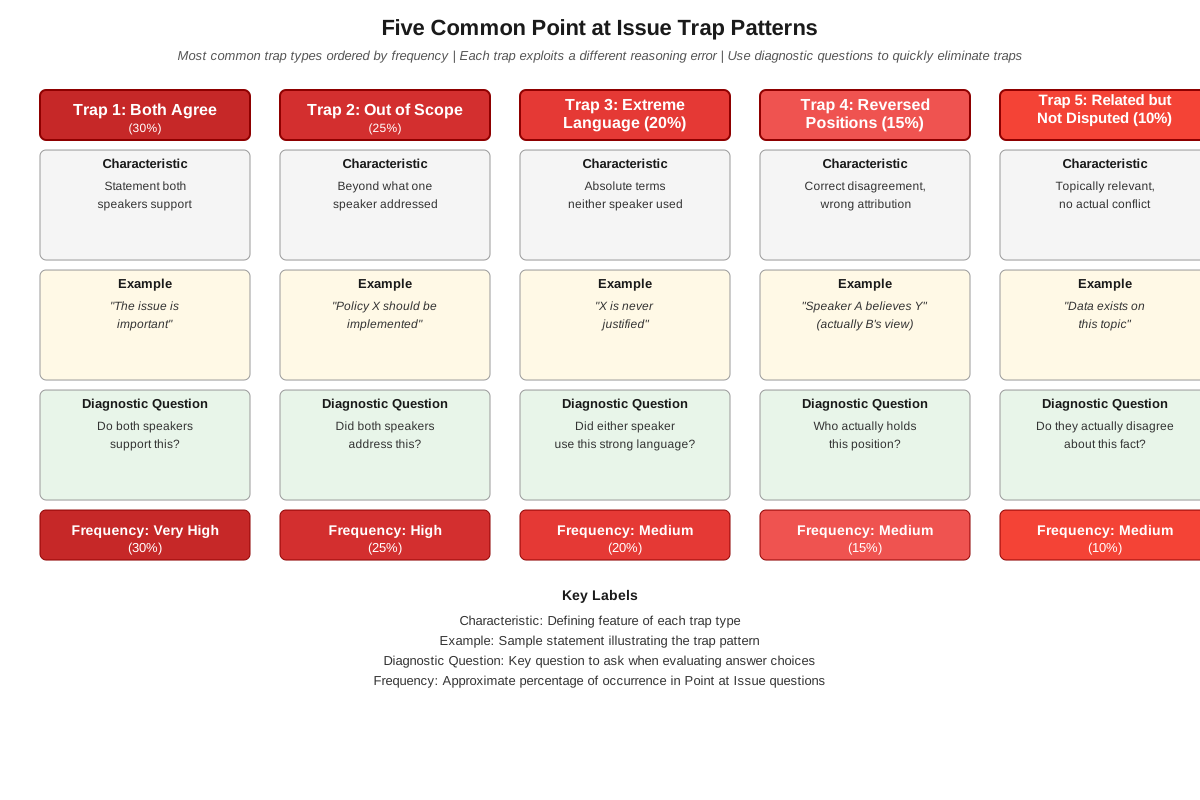
The Five Primary Point at Issue Traps
Trap 1: Topical Overlap Without Disagreement
This is the most common point at issue trap on the LSAT. These answer choices present statements that both speakers discuss or that relate to the topic under discussion, but neither speaker actually takes a position on the specific claim presented. The trap exploits the test-taker's recognition of familiar terms and concepts from the passage.
Example pattern: If Speaker A discusses the benefits of solar energy and Speaker B discusses the costs of solar energy, a trap answer might state "Solar energy is an important topic for policymakers." Both speakers might agree with this statement—they're both discussing solar energy, after all—so there's no disagreement, even though solar energy is clearly the topic both address.
Trap 2: One Speaker Silent
These traps present statements that one speaker clearly agrees or disagrees with, but the other speaker has said nothing that allows us to determine their position. The trap relies on test-takers making assumptions about what the silent speaker would likely believe based on the general thrust of their argument.
Example pattern: Speaker A argues that "increasing teacher salaries will improve education outcomes," while Speaker B argues that "smaller class sizes will improve education outcomes." A trap answer might state "Increased funding for schools is necessary." Speaker A's position might commit them to agreeing with this, but Speaker B has said nothing about funding—they've only discussed class sizes, which could potentially be achieved through reallocation rather than increased funding.
Trap 3: Degree or Emphasis Differences
These sophisticated traps present genuine differences in what the speakers emphasize or the degree to which they support something, but not actual disagreement about truth values. Both speakers might agree with the statement, just with different levels of enthusiasm or different priorities.
Example pattern: Speaker A: "Climate change is the most urgent problem facing humanity." Speaker B: "While climate change is serious, economic inequality poses equally significant challenges." A trap answer might state "Climate change is a serious problem." Both speakers would agree with this statement; they disagree about whether it's the most urgent problem, not about whether it's serious.
Trap 4: Scope Mismatch
These traps present statements that are broader or narrower than what one or both speakers have actually addressed. A speaker might make a claim about a specific instance or category, but the trap answer generalizes beyond what they've committed to, or vice versa.
Example pattern: Speaker A discusses how "this particular medication has dangerous side effects," while Speaker B argues "this medication's benefits outweigh its risks for most patients." A trap answer might state "All medications have side effects." Neither speaker has taken a position on all medications—they're discussing one specific medication.
Trap 5: Conclusion Confusion
These traps present the speakers' different conclusions or recommendations without identifying the underlying factual or logical disagreement that generates those different conclusions. While the speakers do reach different conclusions, they might agree on the specific factual claim presented in the answer choice.
Example pattern: Speaker A concludes "we should ban plastic bags," while Speaker B concludes "we should tax plastic bags instead." A trap answer might state "Plastic bag use should be reduced." Both speakers would likely agree with this general goal; they disagree about the method, not about whether reduction is desirable.
The Agreement Test Methodology
To systematically eliminate trap answers and identify correct answers, apply this three-step process:
- Isolate the claim: Read the answer choice and identify the specific proposition it asserts.
- Test Speaker A: Based solely on what Speaker A has stated or what their argument necessarily commits them to, would they agree or disagree with this claim? If you cannot determine their position, eliminate this answer.
- Test Speaker B: Based solely on what Speaker B has stated or what their argument necessarily commits them to, would they agree or disagree with this claim? If you cannot determine their position, eliminate this answer.
- Compare positions: If both speakers' positions can be determined and they are opposite (one agrees, one disagrees), this is likely the correct answer. If both would agree, both would disagree, or either position is indeterminate, this is a trap.
Commitment vs. Statement
A crucial distinction in point at issue questions is between what speakers explicitly state and what their arguments commit them to. A speaker is committed to a claim if that claim must be true for their argument to work, even if they never explicitly state it. However, the LSAT requires strong, logical commitment—not merely what the speaker would probably believe or what would be consistent with their position.
For example, if a speaker argues "We should increase the minimum wage because doing so will reduce poverty," they are committed to the claim that "Increasing the minimum wage will reduce poverty" even if they never state this as a separate sentence. However, they are not necessarily committed to "Reducing poverty is the most important policy goal" even though this might be consistent with their argument.
Concept Relationships
The core concepts within point at issue traps form a hierarchical relationship structure. At the foundation lies genuine disagreement, which requires understanding the agreement test. This foundational concept supports recognition of all five trap types, as each trap type represents a specific way that answer choices fail to meet the genuine disagreement standard.
The five trap types themselves exist in a relationship of increasing sophistication: Topical overlap traps are the most basic, exploiting simple pattern recognition. One speaker silent traps require the additional error of assumption-making. Degree/emphasis traps demand failure to recognize that agreement on a basic claim doesn't preclude disagreement on a more specific version. Scope mismatch traps exploit imprecise reading and generalization errors. Conclusion confusion traps represent the most sophisticated error, conflating different logical levels of an argument.
These concepts connect back to prerequisite knowledge in specific ways: The agreement test methodology directly applies inference skills (determining what each speaker is committed to). Recognizing scope mismatch traps requires the scope recognition skills developed in other question types. Understanding commitment versus statement draws on argument structure identification skills.
Looking forward, mastery of point at issue traps enhances performance on parallel reasoning questions (which also require precise identification of argument structure), method of reasoning questions (which test understanding of what an argument actually does versus what it discusses), and even reading comprehension questions that ask about author agreement or disagreement.
Relationship map: Genuine Disagreement (foundation) → Agreement Test (methodology) → Five Trap Types (specific failure modes) → Systematic Elimination (application) → Correct Answer Identification (outcome)
High-Yield Facts
⭐ The correct answer to a point at issue question must be a statement that one speaker would affirm and the other would deny based on what they've said or what their arguments commit them to.
⭐ If you cannot determine one speaker's position on an answer choice based on what they've stated, that answer choice is wrong—even if the other speaker clearly takes a position.
⭐ Topical overlap is the most common trap: just because both speakers discuss a topic doesn't mean they disagree about any specific claim regarding that topic.
⭐ Speakers can reach different conclusions while agreeing on underlying facts; the disagreement must be about a specific factual or logical claim, not just about what action to take.
⭐ The correct answer often uses different language than what appears in the passage, while trap answers frequently use exact phrases from the passage to create false familiarity.
- Degree differences (most important vs. important) do not constitute disagreement about the basic claim (that something is important).
- A speaker is only committed to claims that must be true for their argument to work, not to claims that would merely be consistent with their position.
- Wrong answers often present claims that both speakers would agree with, making them consensus statements rather than disagreement points.
- The question stem's exact wording matters: "disagree about whether" requires a yes/no disagreement, while "disagree about" can include disagreement about explanations or reasons.
- Scope precision is critical: disagreement about "some" members of a category is not the same as disagreement about "all" members.
- Time pressure increases susceptibility to traps; the most commonly selected wrong answer is typically the topical overlap trap.
- Speakers can disagree about a claim even if they never directly address it, as long as their arguments commit them to opposite positions.
- If an answer choice requires you to assume what a speaker would "probably" think rather than what they must think, it's wrong.
Quick check — test yourself on Point at issue traps so far.
Try Flashcards →Common Misconceptions
Misconception: If both speakers discuss the same topic, they must disagree about something related to that topic that appears in the answer choices.
Correction: Speakers can discuss the same topic while agreeing on many specific claims about it. They might emphasize different aspects, reach different conclusions, or have different concerns while still agreeing on the particular factual claim presented in an answer choice. The correct answer must identify a specific point of disagreement, not just topical overlap.
Misconception: If one speaker would clearly agree with an answer choice, and that answer choice seems to contradict the other speaker's general position, it must be the point of disagreement.
Correction: The second speaker must actually be committed to disagreeing with the specific claim, not just hold a general position that seems opposed. Many trap answers exploit the difference between what seems inconsistent with a speaker's position and what they're actually committed to denying.
Misconception: The correct answer will use the same terminology and phrases that appear in the passage.
Correction: The LSAT frequently phrases correct answers using different language than what appears in the passage, requiring test-takers to recognize logical equivalence. Meanwhile, trap answers often quote directly from the passage to create false familiarity and recognition.
Misconception: If speakers reach different conclusions, they must disagree about the facts underlying those conclusions.
Correction: Speakers can agree on all relevant facts but disagree about what action to take, what priority to assign, or how to interpret those facts. Conversely, they might reach similar conclusions based on different factual premises. The disagreement must be about the specific claim in the answer choice.
Misconception: Strong test-takers should be able to identify the point of disagreement before looking at the answer choices.
Correction: While speakers may disagree about multiple things, the correct answer often identifies a disagreement that isn't the most obvious or prominent one. The answer choices are part of the question, and the correct answer might identify a disagreement that requires careful analysis to recognize.
Misconception: If you can construct a scenario where both speakers might agree with an answer choice, that answer choice is wrong.
Correction: The test is not about possible scenarios but about what the speakers' actual arguments commit them to. If Speaker A's argument commits them to affirming a claim and Speaker B's argument commits them to denying it, the answer is correct even if you could imagine alternative scenarios where they might agree.
Worked Examples
Example 1: Classic Topical Overlap Trap
Passage:
Economist: The recent increase in the minimum wage will lead to job losses in the retail sector because employers will reduce staff to offset higher labor costs.
Labor Advocate: The minimum wage increase will actually stimulate the economy because workers will have more money to spend, increasing demand for retail goods and services.
Question: The dialogue provides the most support for the claim that the economist and the labor advocate disagree about which one of the following?
Answer Choices:
A) Whether the minimum wage was recently increased
B) Whether the minimum wage increase will benefit the economy overall
C) Whether retail employers face higher labor costs after the minimum wage increase
D) Whether workers will have more money to spend after the minimum wage increase
E) Whether the minimum wage should have been increased
Analysis:
Let's apply the agreement test to each answer:
Choice A: This is a factual claim about whether an increase occurred. Both speakers treat the increase as a fact (they both say "the recent increase" or "the minimum wage increase"), so both would agree this is true. Trap type: Topical overlap—they're both discussing the minimum wage increase, but they agree it happened. Eliminate.
Choice B: The economist argues the increase will lead to job losses (a negative economic outcome), while the labor advocate argues it will stimulate the economy (a positive outcome). The economist would disagree that it will "benefit the economy overall," while the labor advocate would agree. This is a genuine disagreement. Keep as strong contender.
Choice C: Both speakers would agree with this. The economist explicitly mentions "higher labor costs," and the labor advocate doesn't dispute this—they just argue that increased consumer spending will offset it. Trap type: One speaker silent/implicit agreement. Eliminate.
Choice D: The labor advocate explicitly states this ("workers will have more money to spend"), but what about the economist? The economist doesn't address what happens to workers' spending money—they only discuss employer behavior. We cannot determine the economist's position on this claim. Trap type: One speaker silent. Eliminate.
Choice E: This is about what should have happened (a normative claim), but neither speaker addresses whether the increase was a good policy decision in principle. The economist predicts negative consequences, and the labor advocate predicts positive ones, but neither explicitly states whether the increase should or shouldn't have occurred. We cannot determine either position with certainty. Trap type: Scope mismatch—moving from predicted consequences to normative judgment. Eliminate.
Correct Answer: B
This example illustrates how trap answers exploit topical familiarity (A), unstated positions (D), implicit agreements (C), and scope shifts (E), while the correct answer identifies a clear disagreement about a specific claim that both speakers' arguments commit them to positions on.
Example 2: Degree Difference Trap
Passage:
Scientist: The newly discovered exoplanet shows signs of having liquid water, which is essential for life as we know it. This makes it one of the most promising candidates for finding extraterrestrial life.
Astronomer: While liquid water is certainly important, the exoplanet's distance from Earth makes detailed study extremely difficult. Several closer planets with liquid water should be prioritized for investigation.
Question: The scientist and the astronomer disagree about whether:
Answer Choices:
A) Liquid water is essential for life as we know it
B) The newly discovered exoplanet shows signs of having liquid water
C) The newly discovered exoplanet should be prioritized for investigation
D) Liquid water is important for the search for extraterrestrial life
E) Detailed study of distant exoplanets is possible
Analysis:
Choice A: The scientist explicitly states this. The astronomer says liquid water is "certainly important" but doesn't address whether it's "essential." However, calling something "certainly important" doesn't contradict calling it "essential"—these could both be true. The astronomer hasn't denied essentiality. Trap type: Degree difference. Eliminate.
Choice B: Both speakers treat this as a given fact. The astronomer says "while liquid water" (accepting the premise) and doesn't dispute the signs. Trap type: Topical overlap/implicit agreement. Eliminate.
Choice C: The scientist calls it "one of the most promising candidates," which suggests it should be investigated with high priority. The astronomer explicitly argues that "closer planets... should be prioritized," which means this planet should not be prioritized. Clear disagreement: scientist would say yes to prioritizing this planet, astronomer would say no. Keep as strong contender.
Choice D: The scientist clearly thinks it's important (makes planets "promising candidates"). The astronomer calls it "certainly important." Both agree. Trap type: Degree difference—they might disagree about how important or whether it's the most important factor, but they agree it's important. Eliminate.
Choice E: The astronomer states that distance "makes detailed study extremely difficult," not impossible. "Extremely difficult" doesn't mean "not possible." The scientist doesn't address the difficulty of study at all. Trap type: One speaker silent + scope mismatch. Eliminate.
Correct Answer: C
This example demonstrates how degree differences (A, D) and scope precision (E) create traps, while the correct answer identifies a clear disagreement about priorities that both speakers' arguments commit them to opposite positions on.
Exam Strategy
Pre-Reading Strategy
Before reading the answer choices, quickly identify what each speaker's main point is and note any obvious areas where they seem to be in tension. However, don't commit to a specific prediction of the disagreement—the correct answer often identifies a less obvious point of disagreement than the main thrust of the arguments suggests.
Trigger Words and Phrases
Watch for these question stem variations, which all indicate point at issue questions:
- "disagree about whether"
- "disagree over"
- "point at issue between"
- "committed to disagreeing about"
- "dispute concerns"
In the answer choices, be especially cautious of:
- Exact quotes from the passage (often trap answers)
- Extreme language (all, none, only, must) when speakers used moderate language
- Normative claims (should, ought, must) when speakers made only descriptive claims
- General statements when speakers discussed specific instances
Systematic Elimination Process
- First pass—eliminate "one speaker silent" traps: Quickly scan each answer and eliminate any where you cannot determine one speaker's position. This typically eliminates 2-3 answers immediately.
- Second pass—apply the agreement test: For remaining answers, explicitly ask "Would Speaker A agree?" and "Would Speaker B agree?" If both would agree or both would disagree, eliminate.
- Final verification: For your selected answer, verify that the disagreement is genuine by articulating why Speaker A would say "yes" and Speaker B would say "no" (or vice versa) based on what they've stated or what their arguments commit them to.
Time Allocation
Point at issue questions should take approximately 1:15-1:30 minutes. They're typically shorter passages than other Logical Reasoning questions, but the answer choice evaluation requires careful analysis. If you find yourself spending more than 2 minutes, you're likely overthinking—return to the basic agreement test and eliminate answers where you cannot clearly determine both positions.
Common Timing Traps
Don't spend excessive time trying to find the "main" disagreement before reading answers. Don't re-read the passage multiple times—the information needed is there on first read. Don't construct elaborate scenarios about what speakers might believe beyond what they've stated.
Memory Techniques
The STOPS Acronym for Trap Types
Silent Speaker (one speaker hasn't taken a position)
Topical (both discuss the topic but don't disagree on the specific claim)
Overlap in agreement (both would agree with the statement)
Priority/degree (they differ in emphasis but agree on the basic claim)
Scope shift (answer is broader or narrower than what speakers addressed)
The "Yes/No Test" Visualization
Visualize a simple table for each answer choice:
| Statement | Speaker A | Speaker B |
|---|---|---|
| [Answer choice] | YES or NO? | YES or NO? |
If you can't fill in both boxes with confidence, eliminate. If both boxes say YES or both say NO, eliminate. Only if one says YES and one says NO is it correct.
The "Commitment Chain" Technique
For complex arguments, trace the commitment chain: "Speaker A says X, which means they're committed to Y, which means they must agree with Z." This helps identify what speakers are committed to beyond their explicit statements. However, each link must be logically necessary, not just probable.
The "Quote Test" Mnemonic
Remember: "Quotes Usually Indicate Traps, Especially when Seemingly True"—answer choices that quote directly from the passage are often traps designed to exploit recognition rather than genuine disagreement identification.
Summary
Point at issue traps represent sophisticated wrong answer choices designed to exploit common reasoning errors in identifying genuine disagreements between speakers. The fundamental principle is that correct answers must identify statements that one speaker would affirm and the other would deny based on what they've stated or what their arguments commit them to. The five primary trap types—topical overlap, one speaker silent, degree differences, scope mismatches, and conclusion confusion—each exploit specific reasoning vulnerabilities. Mastering these questions requires systematic application of the agreement test: determining each speaker's position on the specific claim in the answer choice and verifying that those positions are opposite. Success depends on distinguishing between what speakers explicitly state, what their arguments commit them to, and what they merely might believe or what would be consistent with their positions. The correct answer often uses different language than the passage and may identify a less obvious disagreement than the main thrust of the arguments suggests, while trap answers frequently quote directly from the passage and present claims that both speakers would actually agree with despite appearing to be in conflict.
Key Takeaways
- The correct answer must pass the agreement test: one speaker would say "yes" and the other would say "no" to the specific claim presented
- Topical overlap is the most common trap—both speakers discussing a topic doesn't mean they disagree about specific claims regarding that topic
- If you cannot determine one speaker's position on an answer choice, eliminate it immediately regardless of how clear the other speaker's position is
- Speakers are committed only to claims that must be true for their arguments to work, not to claims that would merely be consistent with their positions
- Degree and emphasis differences don't constitute disagreement about basic claims—agreeing something is important while disagreeing about whether it's most important means agreeing it's important
- Correct answers often use different language than the passage, while traps frequently quote directly to create false recognition
- Systematic elimination using the agreement test is more reliable than trying to predict the disagreement before reading answer choices
Related Topics
Assumption Questions: Point at issue questions share with assumption questions the requirement to identify what arguments are committed to beyond explicit statements. Mastering point at issue traps enhances ability to recognize necessary assumptions versus sufficient ones.
Inference Questions: The skills developed in determining what speakers are committed to directly transfer to inference questions, which ask what must be true based on given statements. Both question types require distinguishing between what is stated, what is implied, and what is merely possible.
Parallel Reasoning Questions: These questions require identifying structural similarities between arguments, which builds on the same precision in argument analysis that point at issue questions demand. Understanding commitment versus statement is crucial for both.
Method of Reasoning Questions: These ask how an argument proceeds or what technique it uses, requiring the same careful distinction between what an argument does versus what it discusses that point at issue questions test.
Strengthen/Weaken Questions: Identifying points of disagreement helps recognize what would strengthen or weaken each speaker's position, as the disagreement point often indicates the vulnerable assumption in each argument.
Practice CTA
Now that you've mastered the core concepts and trap patterns in point at issue questions, it's time to apply this knowledge to actual LSAT-style problems. The practice questions and flashcards will reinforce your ability to quickly identify trap answers and systematically apply the agreement test under timed conditions. Remember: these questions are highly learnable—the trap patterns repeat across tests, and systematic application of the strategies you've learned will translate directly into correct answers on test day. Each practice question you work through builds the pattern recognition and analytical reflexes that separate good scores from great scores. You've built the foundation; now build the speed and confidence through deliberate practice.
Sign up free to keep reading
Create a free AnvayaPrep account to finish this LSAT guide on Point at issue traps — plus flashcards and practice questions.