Overview
Scope in disagreement questions represents a critical analytical skill tested extensively in the LSAT's Logical Reasoning section, specifically within Point at Issue and Disagreement question types. These questions require test-takers to identify the precise boundaries of what two speakers actually disagree about—not what they might disagree about, or what seems related to their discussion, but the exact proposition over which their positions conflict. The challenge lies in distinguishing between genuine points of disagreement and mere differences in emphasis, related but separate claims, or statements that only appear to conflict on the surface.
Understanding scope in these questions is essential because the LSAT deliberately constructs wrong answer choices that fall outside the boundaries of what both speakers have actually addressed. A common trap involves selecting an answer that one speaker discusses extensively while the other remains silent on the matter, or choosing a statement that relates to the general topic but doesn't capture the specific point of contention. Mastering scope analysis enables test-takers to eliminate these attractive distractors and identify the precise intersection where the two speakers' positions genuinely conflict.
This topic connects fundamentally to broader logical reasoning skills including argument analysis, claim identification, and logical scope determination. Success with scope in disagreement questions builds directly on the ability to parse complex arguments, identify explicit versus implicit claims, and recognize the logical boundaries of what has actually been stated versus what might be inferred. These skills transfer across multiple Logical Reasoning question types, making scope analysis a high-yield investment for overall LSAT performance improvement.
Learning Objectives
- [ ] Identify how Scope in disagreement questions appears in LSAT questions
- [ ] Explain the reasoning pattern behind Scope in disagreement questions
- [ ] Apply Scope in disagreement questions to solve LSAT-style problems accurately
- [ ] Distinguish between genuine disagreements and mere differences in topic emphasis
- [ ] Evaluate answer choices by applying the "both speakers must commit" test
- [ ] Recognize common scope violations in distractor answer choices
- [ ] Construct mental maps of each speaker's explicit commitments before evaluating answers
Prerequisites
- Basic argument structure identification: Understanding premises, conclusions, and supporting evidence is necessary to parse what each speaker actually claims in disagreement passages.
- Distinction between explicit and implicit claims: Recognizing what speakers directly state versus what might be inferred prevents scope errors when identifying disagreement points.
- Familiarity with LSAT question stems: Understanding how the LSAT phrases disagreement questions ("most likely to disagree about," "point at issue") helps identify when scope analysis is required.
- Conditional reasoning fundamentals: Many disagreement questions involve speakers taking opposite positions on conditional relationships, requiring basic conditional logic comprehension.
Why This Topic Matters
Scope in disagreement questions appears with remarkable frequency on the LSAT, typically comprising 2-4 questions per Logical Reasoning section. Given that each LSAT includes two Logical Reasoning sections, test-takers can expect to encounter 4-8 scope-focused disagreement questions on any given exam administration. This frequency, combined with the medium difficulty rating, makes these questions prime targets for score improvement—they're common enough to significantly impact overall performance yet accessible enough that systematic preparation yields reliable results.
In real-world applications, the analytical skills developed through mastering scope in disagreement questions translate directly to legal practice. Attorneys must constantly identify the precise points of contention between parties, distinguish between genuine disputes and peripheral issues, and avoid wasting time on matters where no actual disagreement exists. Contract negotiations, appellate arguments, and settlement discussions all require the ability to pinpoint exactly what parties disagree about versus what they merely discuss from different angles.
On the LSAT, these questions typically appear in several formats: classic "point at issue" questions asking what the speakers are "committed to disagreeing about," questions asking which statement "most accurately expresses a point of disagreement," and questions identifying propositions that "one speaker would agree with while the other would disagree with." The passages themselves usually present two speakers (often named individuals like "Alex" and "Jordan") who discuss a topic with apparently conflicting viewpoints, though the actual point of disagreement may be narrower than the overall topic suggests.
Core Concepts
Defining Scope in Disagreement Questions
Scope in disagreement questions refers to the precise boundaries of what two speakers have actually committed to opposing positions about. The fundamental principle is that a genuine disagreement requires both speakers to have taken a definite stance—whether explicit or clearly implied—on the same specific proposition, with those stances being incompatible. This differs from situations where speakers discuss related topics, emphasize different aspects of an issue, or simply fail to address the same specific claims.
The lsat scope in disagreement questions framework requires three essential elements for a valid answer:
- Both speakers must address the proposition: Each speaker must have made a claim, either directly or through clear logical implication, about the specific matter in question
- The positions must be incompatible: One speaker must affirm what the other denies, or they must take mutually exclusive positions
- The proposition must be sufficiently specific: The disagreement must be about a particular claim, not merely a general topic area
The "Both Speakers Commit" Test
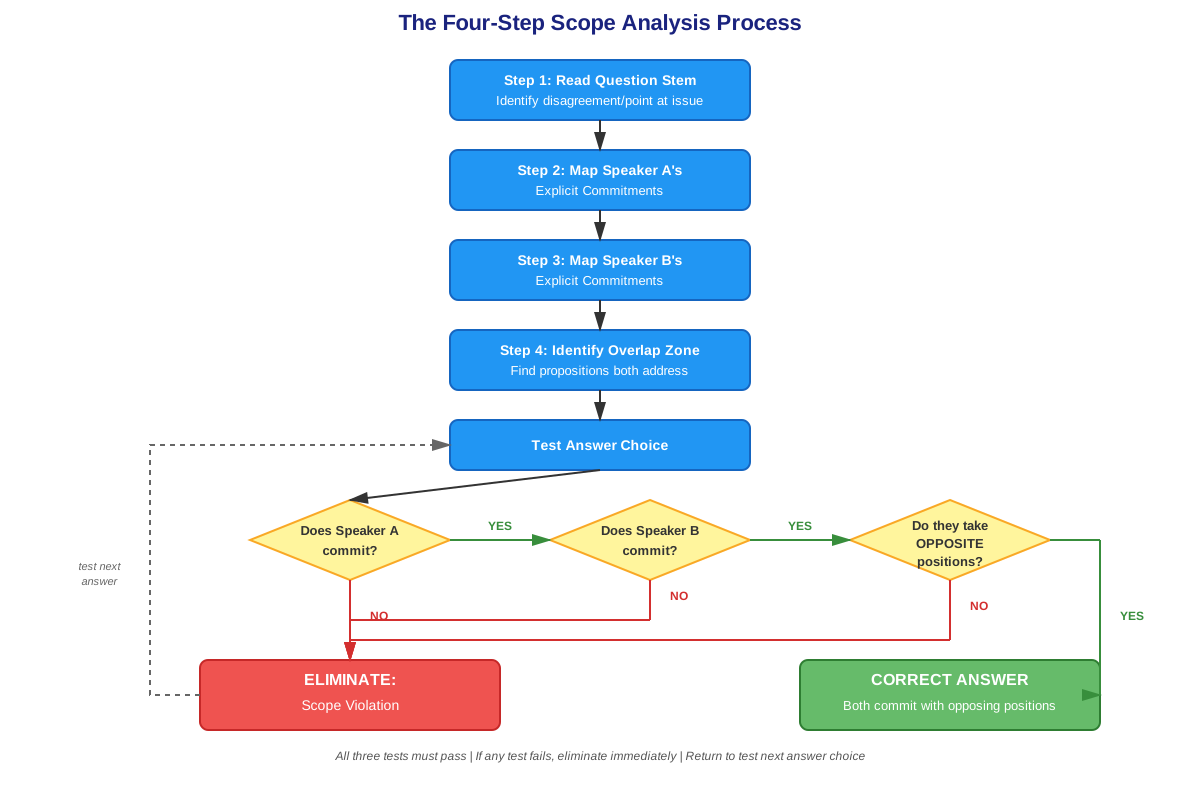
The most reliable technique for evaluating answer choices in scope disagreement questions is the "both speakers commit" test. This systematic approach involves examining each answer choice by asking two questions:
- Has Speaker A taken a clear position (affirmative or negative) on this specific claim?
- Has Speaker B taken the opposite position on this same specific claim?
Only when both questions receive affirmative answers does a genuine disagreement exist. This test eliminates the most common category of wrong answers: propositions that one speaker addresses while the other remains silent. Consider this example:
Speaker A: "The new traffic regulations will reduce accidents because they lower speed limits in residential areas."
Speaker B: "The new traffic regulations are too expensive to implement effectively."
These speakers discuss the same general topic (new traffic regulations) but don't actually disagree about any specific proposition. Speaker A addresses accident reduction; Speaker B addresses implementation costs. Neither takes a position on what the other discusses.
Explicit Versus Implicit Commitments
Understanding what counts as a speaker's "position" requires distinguishing between explicit commitments (directly stated claims) and implicit commitments (positions necessarily entailed by what the speaker says). The LSAT accepts both types, but implicit commitments must follow necessarily from the speaker's statements, not merely be consistent with them or probable given them.
For example, if a speaker says "All effective teachers inspire curiosity in their students," this explicitly commits the speaker to the claim stated, but also implicitly commits them to the position that "A teacher who doesn't inspire curiosity is not effective" (the contrapositive). However, it does not commit them to claims like "Inspiring curiosity is sufficient for effective teaching" or "Most teachers inspire curiosity"—these might be consistent with the statement but aren't logically entailed.
Common Scope Violations in Wrong Answers
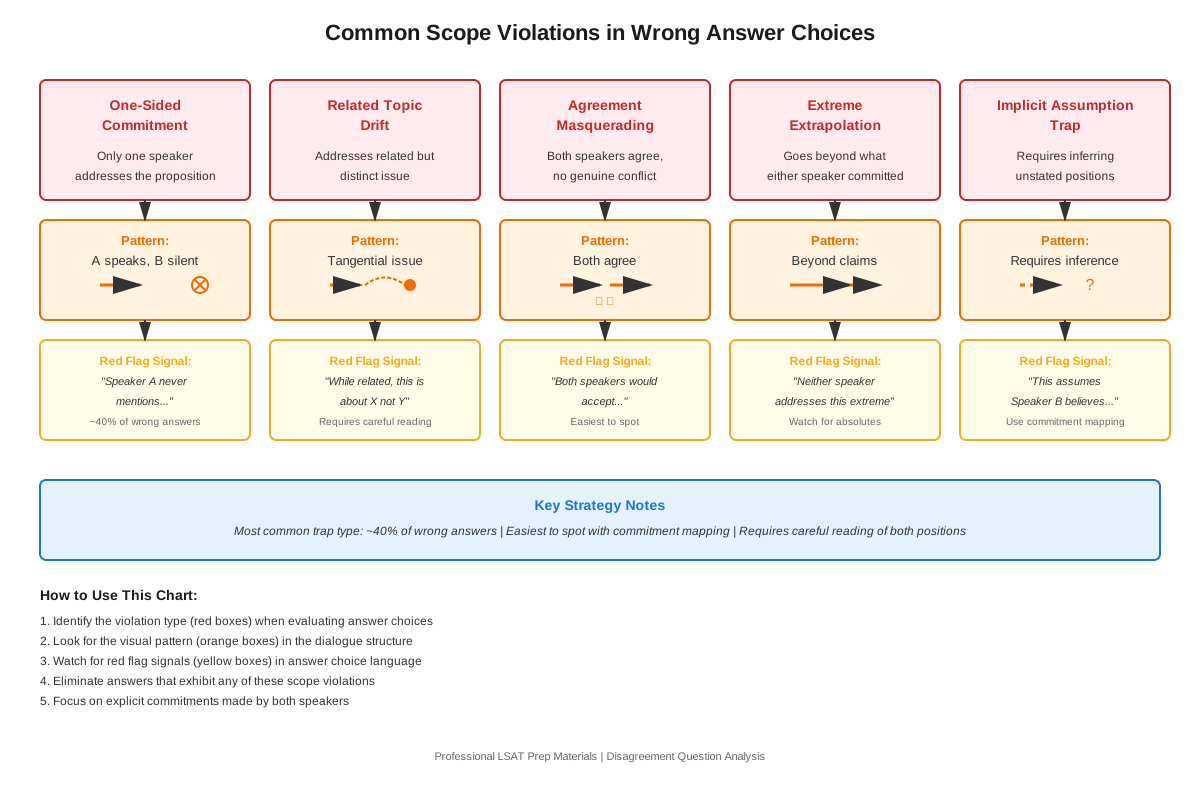
The LSAT constructs wrong answers that violate scope in predictable patterns:
| Scope Violation Type | Description | Example Pattern |
|---|---|---|
| One-sided claim | Only one speaker addresses the proposition | Speaker A discusses X; Speaker B never mentions X; answer choice concerns X |
| Related but distinct | Speakers discuss related topics but not the same specific claim | Speaker A discusses causes; Speaker B discusses effects; answer choice conflates them |
| Too broad | Answer choice encompasses more than what speakers specifically address | Speakers disagree about one policy aspect; answer choice claims disagreement about entire policy |
| Too narrow | Answer choice focuses on a detail neither speaker specifically addresses | Speakers discuss general principle; answer choice concerns specific implementation detail |
| Degree versus kind | Speakers differ in emphasis but don't take opposing positions | Both agree X is important; one emphasizes it more; answer claims disagreement about whether X matters |
The Scope Boundary Principle
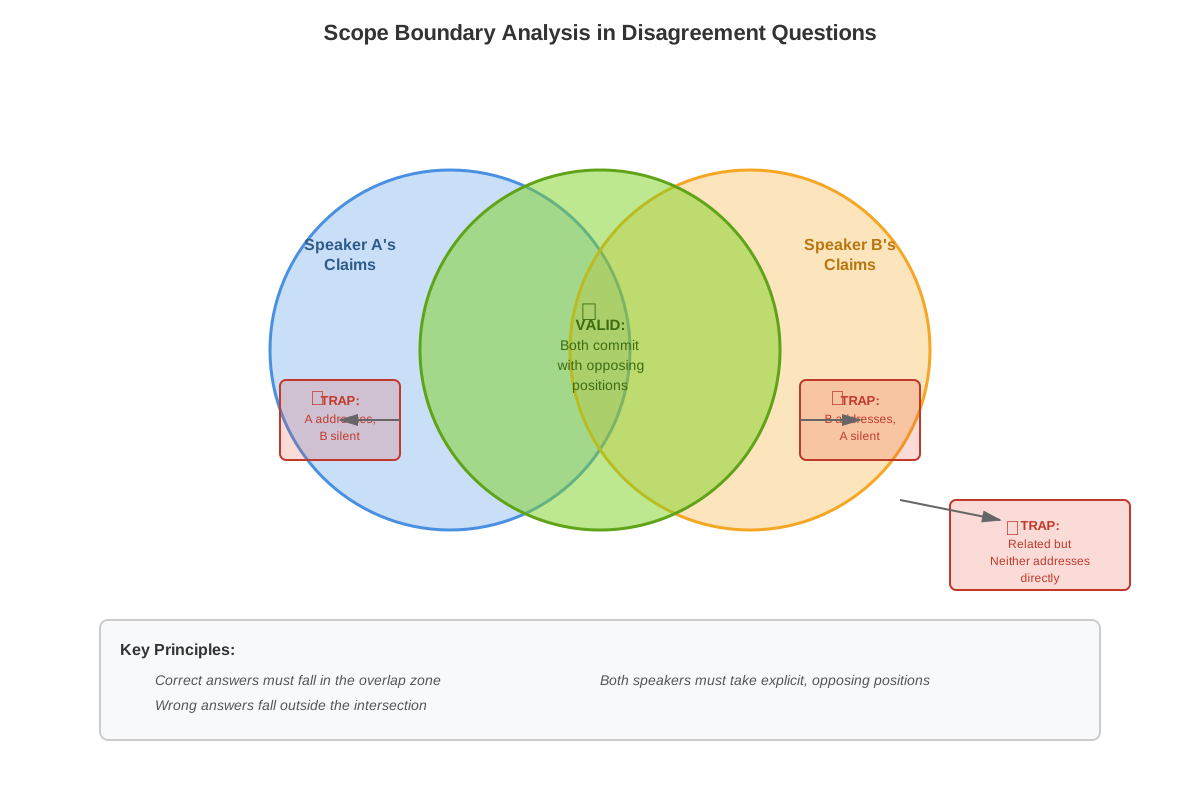
The scope boundary principle states that the correct answer to a disagreement question must fall entirely within the intersection of what both speakers have addressed. Visualize this as a Venn diagram: Speaker A's commitments form one circle, Speaker B's commitments form another, and the correct answer must lie in the overlapping region where both circles intersect. Wrong answers typically fall into one of three zones:
- Outside both circles: Topics neither speaker addresses
- Only in Speaker A's circle: Claims only Speaker A discusses
- Only in Speaker B's circle: Claims only Speaker B discusses
Recognizing Disagreement Question Stems
Point at issue and disagreement questions appear with characteristic question stems that signal the need for scope analysis:
- "Which one of the following most accurately expresses the point at issue between A and B?"
- "A and B are committed to disagreeing about which one of the following?"
- "The dialogue provides the most support for the claim that A and B disagree about whether..."
- "On the basis of their statements, A and B are committed to disagreeing about..."
The phrase "committed to disagreeing" is particularly important—it signals that implicit commitments count, but only those that necessarily follow from what the speakers say.
Concept Relationships
The concepts within scope in disagreement questions form a hierarchical analytical framework. At the foundation lies the "both speakers commit" test, which serves as the primary filtering mechanism for all answer choices. This test depends on accurately identifying explicit versus implicit commitments, which in turn requires strong argument analysis skills. Once commitments are identified, the scope boundary principle determines whether a potential disagreement falls within the intersection of both speakers' positions.
These concepts connect directly to prerequisite knowledge of argument structure—identifying what speakers actually claim requires parsing premises from conclusions and recognizing supporting evidence. The distinction between explicit and implicit commitments builds on conditional reasoning skills, as many implicit commitments involve contrapositive relationships or necessary implications.
The relationship map flows as follows:
Argument Structure Analysis → Identify Explicit Commitments → Derive Implicit Commitments → Apply "Both Speakers Commit" Test → Check Scope Boundaries → Eliminate Scope Violations → Select Correct Answer
This topic also connects forward to other Logical Reasoning question types. The scope analysis skills developed here transfer directly to Strengthen/Weaken questions (identifying what's within the argument's scope to strengthen or weaken), Assumption questions (recognizing gaps between what's stated and what's concluded), and Flaw questions (identifying scope shifts as logical errors).
High-Yield Facts
⭐ A genuine disagreement requires both speakers to take incompatible positions on the same specific proposition—silence from one speaker means no disagreement exists on that point.
⭐ The most common wrong answer type involves a claim that only one speaker addresses while the other remains silent on the matter.
⭐ Implicit commitments count as positions, but only when they necessarily follow from what the speaker says, not merely when they're consistent with it.
⭐ If both speakers agree on a proposition (even if they emphasize it differently), no disagreement exists regarding that proposition.
⭐ The correct answer must be sufficiently specific—disagreement about a general topic doesn't mean disagreement about every specific claim within that topic.
- Wrong answers often present claims that are too broad, encompassing more than what the speakers specifically addressed in their statements.
- Speakers can discuss the same general subject while disagreeing about nothing specific—topic overlap doesn't guarantee disagreement.
- The phrase "committed to disagreeing" in question stems signals that both explicit and necessary implicit commitments are fair game.
- Degree differences (one speaker emphasizing something more than another) don't constitute disagreements unless they involve incompatible positions.
- Temporal scope matters: if speakers discuss different time periods or scenarios, they may not be disagreeing even if their claims seem contradictory.
- Conditional statements create implicit commitments to their contrapositives, which can form the basis for disagreements even when not explicitly stated.
- The correct answer often involves a more fundamental or abstract principle than the specific examples the speakers discuss.
Quick check — test yourself on Scope in disagreement questions so far.
Try Flashcards →Common Misconceptions
Misconception: If two speakers discuss the same topic and seem to have different perspectives, they must disagree about everything related to that topic.
Correction: Speakers can discuss the same general topic while only disagreeing about specific propositions within that topic. The LSAT requires identifying the precise point of disagreement, not assuming disagreement across all related matters. Many wrong answers exploit this by presenting topic-related claims that one or both speakers never actually address.
Misconception: If a speaker doesn't explicitly mention something, they have no position on it and therefore can't disagree about it.
Correction: Speakers can have implicit commitments that necessarily follow from what they do say. If Speaker A says "All X are Y" and Speaker B says "Some X are not Y," they disagree about whether all X are Y even if neither uses that exact phrase. However, the commitment must be logically necessary, not merely probable or consistent.
Misconception: When both speakers discuss causes and effects, they automatically disagree about the causal relationship.
Correction: Discussing different aspects of causation doesn't create disagreement. Speaker A might discuss what causes X while Speaker B discusses what X causes, without any incompatibility. Genuine disagreement requires opposing positions on the same causal claim—for example, one affirming and the other denying that A causes B.
Misconception: If one speaker strongly emphasizes something while the other barely mentions it, they disagree about its importance.
Correction: Difference in emphasis doesn't constitute disagreement unless the speakers take incompatible positions. If Speaker A says "X is very important" and Speaker B simply doesn't discuss X's importance, no disagreement exists. Even if Speaker B says "Y is important" without mentioning X, this doesn't mean B thinks X is unimportant—B simply hasn't committed to a position on X's importance.
Misconception: The correct answer will always involve the main conclusion of each speaker's argument.
Correction: Disagreements can occur at any level of the arguments—premises, intermediate conclusions, or main conclusions. Sometimes speakers reach similar conclusions through different reasoning and disagree about a premise or supporting claim. The LSAT tests whether you can identify the specific point of conflict regardless of where it appears in the argumentative structure.
Misconception: Complex or technical-sounding answer choices are more likely to be correct because they seem sophisticated.
Correction: The LSAT often uses complex language in wrong answers to disguise scope violations. A sophisticated-sounding answer choice that only one speaker addresses is still wrong. The correct answer's validity depends on whether both speakers commit to opposing positions, not on how impressive the language sounds.
Worked Examples
Example 1: Classic Scope Violation
Passage:
Keisha: The city's decision to install speed cameras at major intersections will significantly reduce traffic accidents. Studies show that drivers slow down when they know cameras are monitoring their speed, and lower speeds directly correlate with fewer collisions.
Marcus: The speed camera program is unlikely to generate the revenue the city projects. Many drivers will simply avoid the monitored intersections, choosing alternate routes instead, which means fewer tickets will be issued than the city anticipates.
Question: Keisha and Marcus are committed to disagreeing about which one of the following?
Answer Choices:
(A) Whether the speed camera program will reduce traffic accidents
(B) Whether drivers will change their behavior in response to speed cameras
(C) Whether the city's primary motivation for installing cameras is safety or revenue
(D) Whether the speed camera program will generate the projected revenue
(E) Whether speed cameras are an appropriate method of traffic enforcement
Analysis:
Applying the "both speakers commit" test systematically:
(A) Whether the speed camera program will reduce traffic accidents
- Keisha's position: YES—explicitly states cameras "will significantly reduce traffic accidents"
- Marcus's position: NO COMMITMENT—Marcus never addresses accident reduction; he only discusses revenue
- Verdict: WRONG—fails the both speakers commit test
(B) Whether drivers will change their behavior in response to speed cameras
- Keisha's position: YES—states "drivers slow down when they know cameras are monitoring"
- Marcus's position: YES—states "drivers will simply avoid the monitored intersections"
- Verdict: WRONG—both agree drivers will change behavior; they disagree about HOW drivers will change behavior, but not WHETHER they will
(C) Whether the city's primary motivation for installing cameras is safety or revenue
- Keisha's position: NO COMMITMENT—discusses safety effects but never addresses city's motivation
- Marcus's position: NO COMMITMENT—discusses revenue projections but never addresses primary motivation
- Verdict: WRONG—neither speaker commits to a position on this
(D) Whether the speed camera program will generate the projected revenue
- Keisha's position: NO COMMITMENT—never discusses revenue at all
- Marcus's position: NO—explicitly states program is "unlikely to generate the revenue the city projects"
- Verdict: WRONG—only Marcus addresses this; Keisha is silent on revenue
(E) Whether speed cameras are an appropriate method of traffic enforcement
- Keisha's position: NO COMMITMENT—discusses effectiveness but not appropriateness
- Marcus's position: NO COMMITMENT—discusses revenue but not appropriateness
- Verdict: WRONG—neither commits to a position on appropriateness
Correct Answer: None of the above would be correct in a real LSAT question, but this example illustrates how wrong answers violate scope. In an actual LSAT question, there would be a correct answer. The key lesson: (A) is the most tempting wrong answer because it relates to Keisha's main point, but Marcus never addresses accident reduction, so no disagreement exists on that specific proposition.
Example 2: Identifying Implicit Commitments
Passage:
Dr. Alvarez: The recent decline in honeybee populations is primarily caused by pesticide use in agricultural areas. When farmers apply neonicotinoid pesticides to crops, these chemicals accumulate in the pollen that bees collect, eventually killing the bees or impairing their ability to navigate back to their hives.
Dr. Chen: The decline in honeybee populations cannot be attributed to a single cause. While pesticides may play a role, habitat loss, disease, and parasites are equally important factors. No single intervention will solve the problem—we need a comprehensive approach addressing all contributing factors.
Question: The dialogue provides the most support for the claim that Dr. Alvarez and Dr. Chen disagree about whether:
Answer Choices:
(A) neonicotinoid pesticides harm honeybees
(B) the decline in honeybee populations has multiple contributing factors
(C) habitat loss affects honeybee populations
(D) pesticide use is the primary cause of honeybee population decline
(E) a comprehensive approach is needed to address honeybee decline
Analysis:
(A) neonicotinoid pesticides harm honeybees
- Dr. Alvarez: YES—explicitly describes how these pesticides kill bees or impair navigation
- Dr. Chen: NO COMMITMENT—acknowledges "pesticides may play a role" but doesn't specifically address whether neonicotinoids harm bees
- Verdict: WRONG—Dr. Chen's statement is consistent with pesticides harming bees; "may play a role" doesn't deny harm
(B) the decline in honeybee populations has multiple contributing factors
- Dr. Alvarez: IMPLICIT NO—by stating the decline is "primarily caused by pesticide use," Alvarez implies pesticides are the dominant factor, though this doesn't necessarily deny other factors exist
- Dr. Chen: YES—explicitly states "cannot be attributed to a single cause" and lists multiple factors
- Verdict: POSSIBLY—but Alvarez saying "primarily caused by X" doesn't necessarily mean other factors don't exist, just that X is most important
(C) habitat loss affects honeybee populations
- Dr. Alvarez: NO COMMITMENT—never mentions habitat loss
- Dr. Chen: YES—lists habitat loss as an important factor
- Verdict: WRONG—only Dr. Chen addresses this
(D) pesticide use is the primary cause of honeybee population decline
- Dr. Alvarez: YES—explicitly states decline is "primarily caused by pesticide use"
- Dr. Chen: IMPLICIT NO—by stating the decline "cannot be attributed to a single cause" and that multiple factors are "equally important," Chen necessarily denies that any single factor (including pesticides) is primary
- Verdict: CORRECT—both speakers commit to opposing positions on this specific claim
(E) a comprehensive approach is needed to address honeybee decline
- Dr. Alvarez: NO COMMITMENT—discusses causes but not solutions
- Dr. Chen: YES—explicitly states "we need a comprehensive approach"
- Verdict: WRONG—only Dr. Chen addresses what approach is needed
Correct Answer: (D)
This example demonstrates how implicit commitments work. Dr. Chen never explicitly says "pesticide use is NOT the primary cause," but by asserting that multiple factors are "equally important" and that the problem "cannot be attributed to a single cause," Chen necessarily commits to denying that pesticides are the primary cause. This implicit commitment creates a genuine disagreement with Dr. Alvarez's explicit claim.
Exam Strategy
When approaching lsat scope in disagreement questions, implement this systematic process:
Step 1: Read actively for commitments (30-45 seconds)
As you read each speaker's statement, mentally note or physically mark what specific claims each speaker makes. Don't just absorb the general topic—identify precise propositions. Ask yourself: "What exactly is this speaker claiming is true or false?"
Step 2: Predict the disagreement (15-20 seconds)
Before looking at answer choices, try to articulate in your own words what the speakers disagree about. This prediction serves as an anchor, helping you recognize the correct answer and avoid attractive distractors. Even if your prediction isn't perfectly worded, the mental exercise focuses your attention on genuine points of conflict.
Step 3: Apply the "both speakers commit" test rigorously (10-15 seconds per answer)
For each answer choice, explicitly ask: "Did Speaker A take a position on this?" and "Did Speaker B take the opposite position?" If the answer to either question is "no" or "unclear," eliminate that choice immediately. This test alone eliminates 60-80% of wrong answers.
Step 4: Watch for trigger words indicating scope violations
Wrong answers often contain these red flags:
- "The main purpose/goal" - speakers may not address purposes or goals
- "Should" or "ought" - prescriptive claims when speakers only made descriptive claims
- "Most important factor" - ranking claims when speakers didn't establish rankings
- "Only" or "solely" - extreme scope when speakers made more moderate claims
- "Always" or "never" - universal scope when speakers addressed specific cases
Step 5: Verify implicit commitments carefully
When an answer choice seems to involve an implicit commitment, verify that the commitment necessarily follows from what the speaker said. Ask: "Must the speaker believe this given what they stated, or is it merely consistent with what they stated?" Only necessary implications count.
Time allocation: Spend approximately 1:30-2:00 minutes total on disagreement questions. They're typically more straightforward than other Logical Reasoning question types once you've mastered scope analysis, so don't overthink them. If you're spending more than 2 minutes, you're likely overcomplicating the analysis—return to the basic "both speakers commit" test.
Exam Tip: If you're stuck between two answers, check which speaker's position is clearer for each option. The correct answer typically involves clear commitments from both speakers, while wrong answers often involve a clear commitment from one speaker and an ambiguous or absent commitment from the other.
Memory Techniques
The "BOTH" Mnemonic for evaluating answer choices:
- Both speakers must address it
- Opposing positions required
- Too broad or narrow? Check scope
- Has each speaker committed (explicitly or implicitly)?
The "Traffic Light" Visualization:
Imagine each answer choice as a traffic light with two bulbs (one per speaker):
- Green bulb: Speaker has taken a clear position
- Red bulb: Speaker is silent or ambiguous
- Correct answer: Both bulbs green, but showing opposite signals (one "go," one "stop")
- Wrong answer: At least one red bulb, or both green but showing the same signal
The "Venn Diagram" Mental Image:
Visualize two overlapping circles representing each speaker's commitments. The correct answer must fall in the overlapping region. As you read each speaker, mentally populate their circle with commitments. When evaluating answers, ask: "Does this fall in the overlap?"
The "Silence is Not Disagreement" Mantra:
Repeat this phrase when tempted by answers where only one speaker has addressed the topic. If you find yourself thinking "Well, Speaker A would probably disagree with this," stop—"probably" means no commitment exists.
Acronym for Common Scope Violations - "ROBBED":
- Related but distinct topics
- One-sided claims
- Broader than what's discussed
- Both agree (no actual disagreement)
- Emphasis differences (not position differences)
- Degree versus kind confusion
Summary
Mastering scope in disagreement questions requires understanding that genuine disagreements demand both speakers take incompatible positions on the same specific proposition. The LSAT constructs wrong answers that violate this scope requirement in predictable ways: presenting claims only one speaker addresses, offering propositions too broad or narrow relative to what speakers discussed, or confusing topic overlap with actual disagreement. Success depends on systematically applying the "both speakers commit" test to each answer choice, distinguishing explicit from implicit commitments while ensuring implicit commitments necessarily follow from stated positions, and recognizing that silence from one speaker eliminates any potential disagreement on that point. The scope boundary principle—that correct answers must fall within the intersection of both speakers' commitments—provides a reliable framework for eliminating distractors and identifying genuine points of conflict. These analytical skills transfer broadly across Logical Reasoning question types and form essential foundations for legal reasoning.
Key Takeaways
- Both speakers must take clear positions (explicit or necessarily implied) on the same specific proposition for a genuine disagreement to exist—one speaker's silence means no disagreement on that point
- The "both speakers commit" test is the most reliable tool for eliminating wrong answers; systematically verify that each speaker has committed to opposing positions before selecting an answer
- Implicit commitments count but only when they necessarily follow from what speakers say, not when they're merely consistent with or probable given their statements
- Topic overlap doesn't equal disagreement; speakers can discuss the same general subject while disagreeing about nothing specific, or disagreeing only about narrow propositions within that topic
- Common scope violations include one-sided claims, related but distinct topics, propositions too broad or narrow, and emphasis differences mistaken for position differences
- Predict the disagreement before examining answer choices to anchor your analysis and avoid being swayed by sophisticated-sounding distractors
- Time efficiency comes from systematic application of the scope analysis framework rather than intuitive judgment about what "seems" like a disagreement
Related Topics
Assumption Questions: Mastering scope in disagreement questions develops the ability to identify what falls within versus outside an argument's scope, which directly applies to recognizing gaps between premises and conclusions that assumptions must fill.
Strengthen/Weaken Questions: Understanding scope boundaries helps identify which answer choices actually affect the argument versus which introduce irrelevant information outside the argument's scope.
Method of Reasoning Questions: The analytical skills for parsing what speakers commit to in disagreement questions transfer to identifying the logical structure and reasoning patterns in single-speaker arguments.
Parallel Reasoning Questions: Recognizing the scope of claims and commitments enables accurate matching of argument structures by ensuring parallel arguments make commitments of similar scope and specificity.
Flaw Questions: Many logical flaws involve scope shifts—moving from narrow premises to broad conclusions or vice versa—making scope analysis skills directly applicable to flaw identification.
Practice CTA
Now that you've mastered the conceptual framework for scope in disagreement questions, it's time to cement your understanding through active practice. Attempt the practice questions associated with this topic, applying the "both speakers commit" test systematically to each answer choice. As you work through problems, focus on identifying the specific scope violations in wrong answers—this active analysis builds pattern recognition that makes these questions increasingly automatic. Review the flashcards to reinforce high-yield facts and common scope violation types. Remember: these questions are highly learnable through systematic practice, and they appear frequently enough on the LSAT that mastery here translates directly to score improvement. Your investment in understanding scope analysis will pay dividends across multiple Logical Reasoning question types!
Sign up free to keep reading
Create a free AnvayaPrep account to finish this LSAT guide on Scope in disagreement questions — plus flashcards and practice questions.