Overview
Speaker response analysis is a critical skill within LSAT Logical Reasoning that requires test-takers to evaluate how one speaker responds to another's argument or statement. This topic falls under the broader category of point at issue and disagreement questions, which test the ability to identify what two speakers are actually debating and how their positions relate to one another. Unlike simpler disagreement questions that merely ask what two parties dispute, speaker response analysis demands deeper understanding of argumentative moves, rhetorical strategies, and the logical relationships between claims.
On the LSAT, lsat speaker response analysis questions typically present a dialogue between two speakers where the second speaker responds to the first in a specific way—perhaps by challenging an assumption, offering a counterexample, questioning evidence, or reinterpreting a claim. The test-taker must identify the precise nature of this response, which requires careful attention to logical structure rather than surface-level content. These questions assess whether students can distinguish between different types of argumentative moves: Is Speaker B refuting Speaker A's conclusion, questioning their evidence, pointing out a logical flaw, or merely offering an alternative explanation?
This topic connects intimately to other logical reasoning skills including argument structure analysis, assumption identification, and flaw recognition. Mastering speaker response analysis strengthens overall LSAT performance because it develops the meta-cognitive skill of analyzing how arguments interact—a competency that underlies many question types across the Logical Reasoning section. The ability to precisely characterize how one claim responds to another is foundational for legal reasoning, making this a high-value skill both for test performance and future legal practice.
Learning Objectives
- [ ] Identify how Speaker response analysis appears in LSAT questions
- [ ] Explain the reasoning pattern behind Speaker response analysis
- [ ] Apply Speaker response analysis to solve LSAT-style problems accurately
- [ ] Distinguish between different types of speaker responses (refutation, qualification, alternative explanation, etc.)
- [ ] Recognize common wrong answer patterns in speaker response questions
- [ ] Evaluate the logical relationship between two speakers' positions with precision
Prerequisites
- Basic argument structure: Understanding premises, conclusions, and how they connect is essential because speaker response analysis requires identifying which component of an argument is being addressed.
- Assumption identification: Recognizing unstated assumptions helps identify when a second speaker is challenging what the first speaker takes for granted.
- Logical reasoning question types: Familiarity with standard LSAT question formats provides context for how speaker response questions fit into the broader test structure.
- Critical reading skills: The ability to parse complex sentences and identify main points ensures accurate comprehension of both speakers' positions before analyzing their relationship.
Why This Topic Matters
Speaker response analysis represents a sophisticated form of argumentative reasoning that extends beyond simple agreement or disagreement. In legal practice, attorneys must constantly evaluate how opposing counsel's arguments respond to their own positions, making this skill directly applicable to professional competency. The ability to precisely characterize argumentative moves—distinguishing between a direct refutation, a challenge to underlying assumptions, or an alternative interpretation—is fundamental to effective advocacy and judicial reasoning.
On the LSAT, speaker response questions appear with notable frequency, typically comprising 2-4 questions per test across both Logical Reasoning sections. These questions most commonly appear in two formats: "Speaker B responds to Speaker A by..." and "The dialogue provides the most support for the claim that Speaker A and Speaker B disagree about whether..." While the latter is more straightforward disagreement identification, the former requires the sophisticated analysis this guide addresses. According to LSAT data patterns, approximately 15-20% of Logical Reasoning questions involve some form of speaker interaction or dialogue analysis.
These questions appear in passages where two speakers present contrasting views on topics ranging from scientific theories to policy recommendations to philosophical positions. The LSAT favors scenarios where the second speaker's response is subtle rather than obvious—perhaps addressing an implicit assumption rather than directly contradicting the conclusion, or offering a competing explanation rather than simply disagreeing. This design tests whether students can move beyond surface-level comprehension to analyze the logical mechanics of argumentative exchange.
Core Concepts
Understanding Speaker Response Types
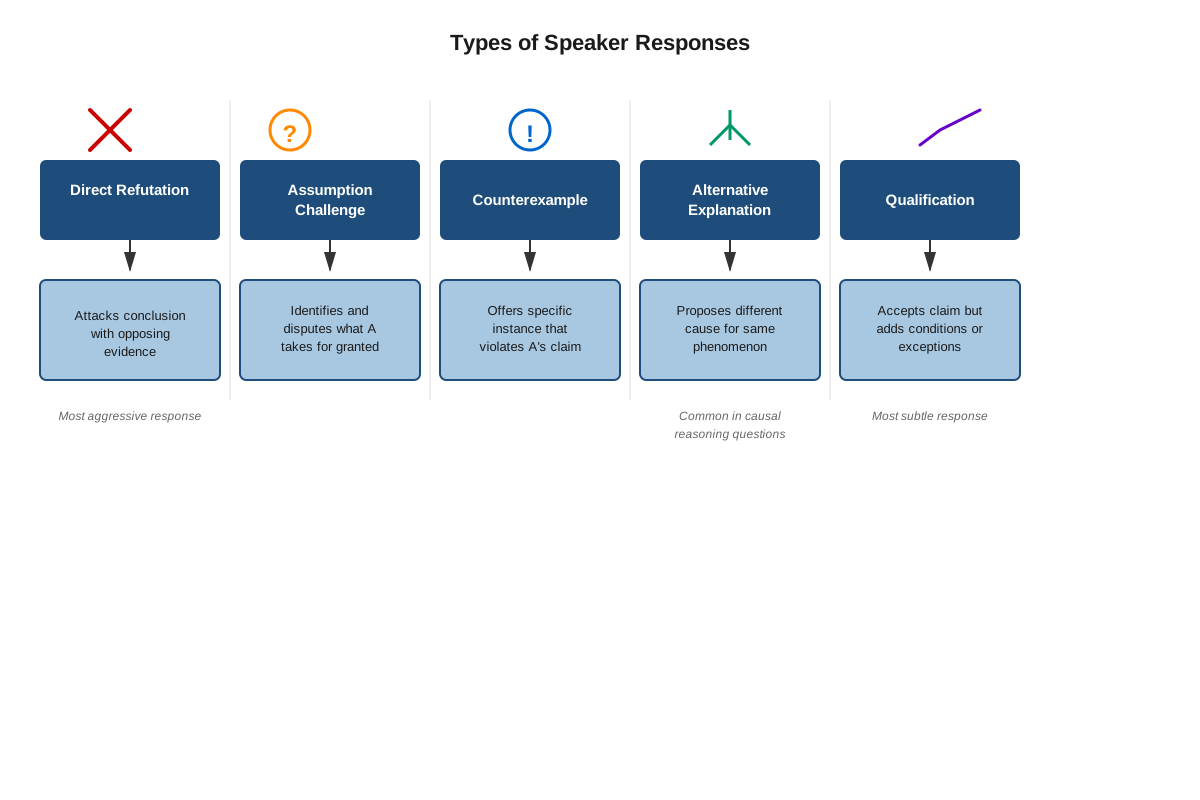
Speaker response analysis requires recognizing that not all responses are created equal. When Speaker B responds to Speaker A, several distinct logical moves are possible, each with different implications for the relationship between their positions. The LSAT tests whether students can distinguish these response types with precision.
Direct refutation occurs when Speaker B explicitly denies Speaker A's conclusion or main claim. This is the most straightforward response type, where B directly contradicts what A asserts. For example, if Speaker A claims "All mammals are warm-blooded," and Speaker B responds "That's incorrect—some mammals are cold-blooded," this constitutes direct refutation.
Assumption challenging represents a more sophisticated response where Speaker B doesn't necessarily deny A's conclusion but questions an unstated premise upon which A's argument depends. If Speaker A argues "We should increase funding for public schools because education improves economic outcomes," Speaker B might respond "But that assumes the additional funding would actually improve educational quality, which isn't guaranteed." Here, B challenges an implicit assumption rather than the stated conclusion.
Alternative explanation occurs when Speaker B accepts the phenomenon or data that Speaker A presents but offers a different causal account or interpretation. This response type acknowledges common ground while disputing the reasoning. For instance, if Speaker A says "Crime rates dropped after we increased police presence, so the increased presence caused the reduction," Speaker B might respond "The crime reduction could equally be explained by improved economic conditions during that period."
Counterexample provision involves Speaker B offering a specific case that contradicts a general claim made by Speaker A. This response type is particularly common when Speaker A makes universal or categorical statements. If A claims "No successful businesses operate without detailed strategic plans," B might respond "Actually, several highly successful startups have grown organically without formal strategic planning."
Identifying the Target of Response
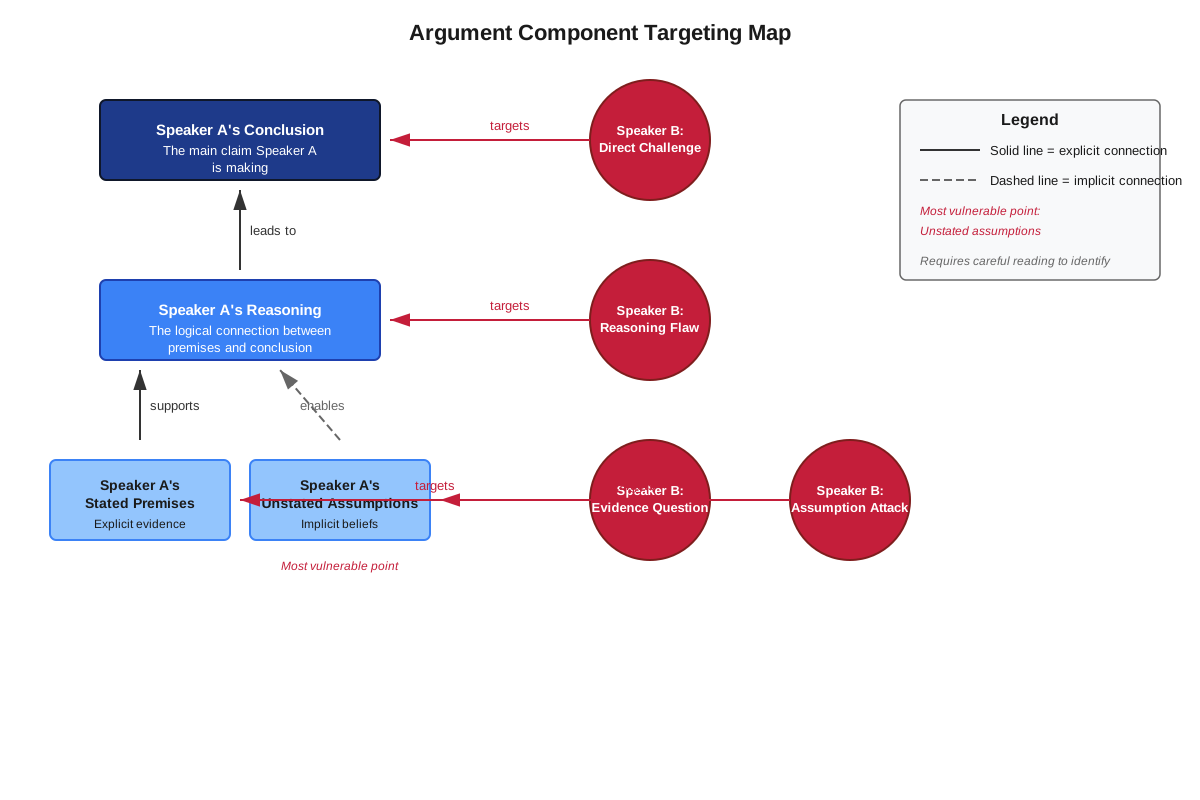
A crucial aspect of lsat speaker response analysis involves determining exactly which element of Speaker A's argument Speaker B addresses. Arguments contain multiple components—evidence, reasoning, assumptions, and conclusions—and Speaker B might target any of these elements.
When Speaker B targets evidence, the response questions the factual basis or data that Speaker A relies upon. This might involve disputing the accuracy of statistics, questioning the reliability of sources, or suggesting the evidence is incomplete. For example: "Your study only surveyed urban residents, so it can't support conclusions about the general population."
When Speaker B targets reasoning, the response identifies a logical flaw in how Speaker A moves from premises to conclusion. This doesn't necessarily dispute the facts but challenges whether the conclusion follows from them. Example: "Even if sales increased after the advertising campaign, you can't conclude the campaign caused the increase without ruling out other factors."
When Speaker B targets assumptions, the response makes explicit something Speaker A left unstated and questions its validity. This is among the most sophisticated response types because it requires recognizing what isn't explicitly said. Example: "You're assuming that correlation implies causation, but there could be a third factor causing both phenomena."
When Speaker B targets the conclusion, the response directly disputes the main claim or offers a contradictory conclusion based on the same or different evidence. Example: "I disagree—the policy will actually harm the economy rather than help it."
Analyzing Logical Relationships
Understanding the logical relationship between speakers requires mapping how their positions interact. The relationship might be one of complete opposition, partial overlap with specific disagreement, or agreement on facts with disagreement on interpretation.
Complete opposition exists when the speakers hold contradictory positions that cannot both be true. If Speaker A claims "The policy will succeed" and Speaker B claims "The policy will fail," they are in complete opposition regarding the policy's outcome.
Partial disagreement occurs when speakers agree on some elements but dispute others. They might agree on the facts but disagree on their significance, or agree on goals but disagree on methods. This relationship is more nuanced and frequently tested on the LSAT because it requires careful analysis to identify the precise point of divergence.
Methodological disagreement involves speakers disputing how to approach a question or what evidence is relevant, even if they don't directly contradict each other's conclusions. For example, one speaker might favor empirical data while another emphasizes theoretical considerations.
Response Strength and Scope
Not all responses carry equal logical force, and the LSAT tests whether students can evaluate response strength. A strong response directly undermines the core of Speaker A's argument, while a weak response might only address peripheral issues or raise minor objections.
Scope matching is critical—Speaker B's response should address the same scope as Speaker A's claim. If Speaker A makes a universal claim ("All X are Y"), an effective response must address that universal scope, not merely show that "Some X are Y." Conversely, if A makes a limited claim, B's response should match that limitation rather than attacking a broader claim A never made.
Concept Relationships
The concepts within speaker response analysis form an interconnected system where understanding one element enhances comprehension of others. The relationship flows as follows:
Understanding Speaker Response Types → enables → Identifying the Target of Response: Recognizing whether a response is a refutation, assumption challenge, or alternative explanation helps pinpoint which component of the original argument is being addressed.
Identifying the Target of Response → enables → Analyzing Logical Relationships: Once the target is clear, the overall relationship between speakers' positions becomes apparent—whether they're in complete opposition, partial disagreement, or methodological dispute.
Analyzing Logical Relationships → enables → Evaluating Response Strength and Scope: Understanding the relationship allows assessment of whether the response effectively addresses the original argument with appropriate scope and force.
These concepts connect to prerequisite knowledge of argument structure because speaker response analysis essentially involves analyzing how two argument structures interact. The skill of assumption identification directly feeds into recognizing assumption-challenging responses. The broader category of point at issue and disagreement questions provides the context in which speaker response analysis operates—these are specialized disagreement questions requiring more sophisticated analysis.
This topic also connects forward to advanced logical reasoning skills like parallel reasoning (recognizing similar argumentative structures) and method of reasoning questions (identifying how an argument proceeds), as these all involve meta-level analysis of argumentative moves rather than just content evaluation.
High-Yield Facts
⭐ Speaker response questions typically ask "Speaker B responds to Speaker A by..." followed by answer choices describing different types of argumentative moves.
⭐ The most common wrong answers in speaker response questions describe what Speaker B does in general rather than how B specifically responds to A.
⭐ When Speaker B offers an alternative explanation, B typically accepts A's data or phenomenon but disputes the causal account or interpretation.
⭐ Assumption-challenging responses don't necessarily contradict the conclusion—they question whether the conclusion follows from the premises.
⭐ The correct answer must describe the logical relationship between the speakers, not merely summarize what each speaker says independently.
- Speaker response questions require identifying the specific component of Speaker A's argument that Speaker B addresses (evidence, reasoning, assumption, or conclusion).
- Counterexample responses typically target universal or categorical claims by showing a case where the general rule doesn't apply.
- Methodological disagreements involve disputes about approach or what counts as relevant evidence, not necessarily about conclusions.
- Scope mismatches between a claim and its response are a common source of logical weakness that the LSAT tests.
- Direct refutations are less common in difficult LSAT questions than subtle responses like assumption challenges or alternative explanations.
- The phrase "responds to Speaker A by" signals that the answer must describe a relationship, not just Speaker B's independent position.
- When speakers agree on facts but disagree on interpretation, the point of disagreement is the interpretation, not the facts themselves.
- Effective speaker response analysis requires reading both speakers' statements carefully before evaluating their relationship.
Quick check — test yourself on Speaker response analysis so far.
Try Flashcards →Common Misconceptions
Misconception: Speaker B disagrees with Speaker A whenever they present different information or perspectives.
Correction: Disagreement requires actual conflict between positions. Speakers can present different information while being compatible or complementary. True disagreement means their positions cannot both be correct, or they dispute the same specific claim.
Misconception: The correct answer should summarize what Speaker B says in their statement.
Correction: The correct answer must describe how Speaker B's statement relates to or responds to Speaker A's statement. A summary of B's position that ignores the relationship to A is incorrect, even if it accurately describes B's view.
Misconception: When Speaker B offers an alternative explanation, B is disagreeing with Speaker A's facts.
Correction: Alternative explanations typically accept the same facts or phenomena but propose different causal accounts or interpretations. The disagreement is about explanation, not about what happened.
Misconception: Challenging an assumption is the same as identifying a logical flaw.
Correction: While related, these are distinct. Challenging an assumption questions whether an unstated premise is true. Identifying a flaw points out that the reasoning doesn't work even if all premises (stated and unstated) were true. An assumption challenge says "your hidden premise might be false"; a flaw identification says "your logic doesn't work."
Misconception: If Speaker B doesn't explicitly say "I disagree" or "that's wrong," then B isn't refuting A.
Correction: Refutation can be implicit. If Speaker B makes a claim that logically contradicts Speaker A's position, that constitutes refutation regardless of the language used. The LSAT tests logical relationships, not just explicit disagreement markers.
Misconception: The longer or more complex response is more likely to be correct.
Correction: LSAT answer choices are designed to be equally plausible in length and complexity. The correct answer is determined by logical accuracy, not sophistication of language. Simple, direct answers can be correct for complex speaker interactions.
Misconception: Speaker response questions are just asking what the speakers disagree about.
Correction: While related to disagreement questions, speaker response questions specifically ask how one speaker responds to another—the type of argumentative move made. This requires more sophisticated analysis than simply identifying a point of disagreement.
Worked Examples
Example 1: Alternative Explanation Response
Dialogue:
Speaker A: The city's new traffic cameras have been highly effective. Since their installation six months ago, traffic accidents at monitored intersections have decreased by 30%. Clearly, the cameras are making drivers more cautious.
Speaker B: The accident reduction might not be due to the cameras. The city also launched a major road repair program at those intersections around the same time, which improved visibility and road conditions.
Question: Speaker B responds to Speaker A by:
(A) Questioning the accuracy of the accident statistics cited by Speaker A
(B) Offering an alternative explanation for the phenomenon Speaker A describes
(C) Challenging Speaker A's assumption that traffic cameras can influence driver behavior
(D) Providing evidence that contradicts Speaker A's claim about accident reduction
(E) Arguing that the traffic cameras have actually increased accidents rather than decreased them
Analysis:
First, identify what Speaker A claims: The cameras caused a 30% reduction in accidents by making drivers more cautious. This is a causal argument: cameras → cautious driving → fewer accidents.
Next, identify what Speaker B does: B doesn't dispute the 30% reduction (the phenomenon) but suggests the road repair program, not the cameras, might be the cause. B accepts the data but proposes a different causal explanation.
Evaluate each answer:
(A) Incorrect: B doesn't question whether accidents actually decreased by 30%. B accepts this statistic and offers an alternative explanation for it.
(B) Correct: This precisely describes B's response. B accepts the phenomenon (accident reduction) but offers an alternative cause (road repairs rather than cameras).
(C) Incorrect: B doesn't challenge whether cameras can influence behavior in general. B specifically suggests that in this case, something else (road repairs) explains the reduction.
(D) Incorrect: B doesn't contradict the claim about accident reduction. B agrees accidents decreased but disputes what caused the decrease.
(E) Incorrect: B never claims cameras increased accidents. B suggests the reduction might be due to road repairs, not that cameras had a negative effect.
Key Takeaway: When a speaker accepts the facts or phenomenon but proposes a different cause or interpretation, they're offering an alternative explanation. This is distinct from disputing the facts themselves or directly refuting the conclusion.
Example 2: Assumption Challenge Response
Dialogue:
Speaker A: Companies should require employees to work from the office rather than remotely. When employees work in the same physical space, they collaborate more effectively, leading to better outcomes for the company.
Speaker B: That reasoning assumes that physical proximity is necessary for effective collaboration. However, with modern communication technology, remote teams can collaborate just as effectively as in-person teams.
Question: Speaker B responds to Speaker A by:
(A) Providing evidence that remote work produces better outcomes than office work
(B) Challenging an assumption underlying Speaker A's argument
(C) Offering an alternative explanation for why companies prefer office work
(D) Questioning whether effective collaboration actually leads to better company outcomes
(E) Arguing that employee preference should outweigh company needs
Analysis:
Identify Speaker A's argument structure:
- Premise: Physical proximity → better collaboration
- Premise: Better collaboration → better outcomes
- Conclusion: Companies should require office work
Identify what Speaker B does: B makes explicit an assumption in A's argument (that physical proximity is necessary for effective collaboration) and then challenges it by suggesting modern technology enables effective remote collaboration.
Evaluate each answer:
(A) Incorrect: B doesn't provide evidence that remote work is better, only that it can be "just as effective." B isn't claiming superiority of remote work, just questioning whether proximity is necessary.
(B) Correct: B explicitly identifies an assumption ("That reasoning assumes...") and challenges it by suggesting the assumption might be false given modern technology.
(C) Incorrect: B doesn't explain why companies prefer office work. B challenges whether the reasoning for preferring it is sound.
(D) Incorrect: B doesn't question the link between collaboration and outcomes. B accepts that effective collaboration matters but disputes whether physical proximity is necessary for it.
(E) Incorrect: B never mentions employee preference. The response focuses entirely on whether physical proximity is necessary for effective collaboration.
Key Takeaway: Assumption-challenging responses have a distinctive structure: they identify something the original argument takes for granted (often using language like "assumes" or "presupposes") and then question whether that unstated premise is true. This differs from directly refuting the conclusion or disputing stated premises.
Exam Strategy
When approaching speaker response questions on the LSAT, employ a systematic process that ensures accuracy while managing time effectively.
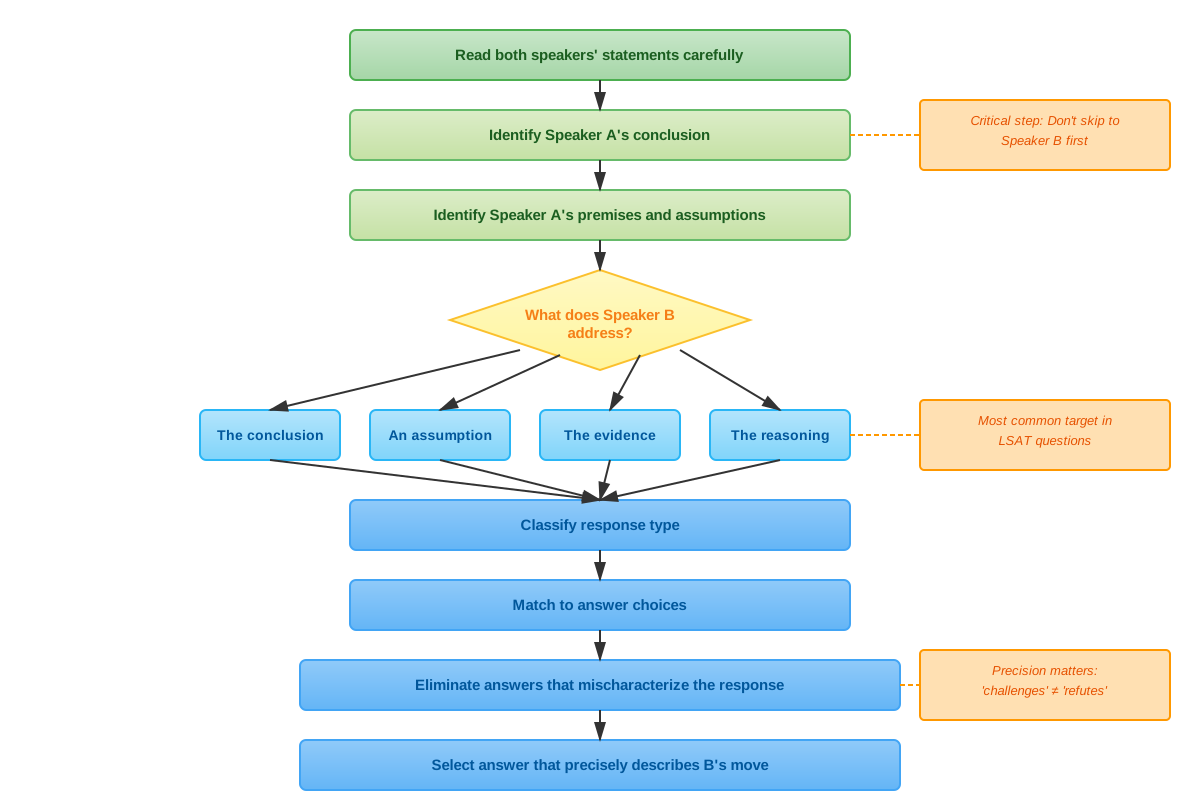
Step 1: Read Speaker A completely and identify the argument structure. Before even looking at Speaker B, understand what A is claiming and how the argument is constructed. Identify the conclusion, premises, and any apparent assumptions. This takes 15-20 seconds but prevents misunderstanding the interaction.
Step 2: Read Speaker B and immediately ask: "What is B doing in relation to A?" Don't just comprehend B's statement in isolation. Actively think about how it connects to A's argument. Is B disputing a fact, challenging reasoning, offering an alternative, or something else?
Step 3: Predict the answer before looking at choices. Formulate in your own words what B is doing. For example: "B is offering a different explanation for the same facts" or "B is challenging A's assumption that X leads to Y." This prediction serves as an anchor when evaluating answer choices.
Trigger words and phrases to watch for:
- "Responds to Speaker A by..." — signals you must describe the relationship, not just B's position
- "Assumes," "presupposes," "takes for granted" — indicates assumption-related responses
- "However," "but," "alternatively" — signals the type of response (contrast, alternative, etc.)
- "Might," "could," "possibly" — often appears in alternative explanation responses
- "Overlooks," "fails to consider" — suggests B is pointing out something A missed
Process-of-elimination strategy:
Eliminate answers that describe what Speaker B says without reference to Speaker A. If an answer choice could be true even if Speaker A hadn't spoken, it's wrong. The correct answer must describe a relationship.
Eliminate answers that mischaracterize what Speaker A claimed. If an answer says B refutes A's claim that "all X are Y" but A only claimed "some X are Y," the answer is wrong regardless of what B actually said.
Eliminate answers that describe a stronger or weaker response than B actually makes. If B offers an alternative explanation, an answer saying B "refutes" or "disproves" A is too strong. If B directly contradicts A, an answer saying B "raises a question about" A is too weak.
Time allocation:
Speaker response questions typically require 60-90 seconds. Spend approximately:
- 20 seconds reading and analyzing both speakers
- 10 seconds predicting the answer
- 30-40 seconds evaluating answer choices
- 10 seconds confirming your selection
If you find yourself spending more than 90 seconds, you may be overthinking. Return to the basic question: How does B's statement relate to A's statement?
Exam Tip: The most common trap answers describe what Speaker B believes or argues in general, rather than how B specifically responds to A. Always ask: "Does this answer describe a relationship between the speakers, or just one speaker's position?"
Memory Techniques
RACE Acronym for Response Types:
- Refutation: Directly contradicts the conclusion
- Alternative: Offers different explanation for same facts
- Challenge: Questions assumptions or reasoning
- Example: Provides counterexample to general claim
Visualization Strategy:
Picture Speaker A building a bridge from premises to conclusion. Speaker B can:
- Knock down the bridge (refutation)
- Show a different bridge to the same destination (alternative explanation)
- Point out the bridge rests on unstable ground (assumption challenge)
- Show a place where the bridge doesn't reach (counterexample)
This spatial metaphor helps distinguish response types quickly during the exam.
The "Target Practice" Mnemonic:
Remember that Speaker B's response targets one of four elements, using the acronym EARC:
- Evidence: Questions the facts or data
- Assumptions: Challenges unstated premises
- Reasoning: Identifies logical flaws
- Conclusion: Directly disputes the main claim
Relationship Recognition Phrase:
When reading Speaker B, mentally insert: "In response to what A said, B is..." This forces your brain to think relationally rather than just comprehending B's statement in isolation.
The Scope-Match Check:
Remember "Same scope, same hope" — the correct answer describing B's response should match the scope of what A actually claimed. If A says "some," B's response should address "some," not "all."
Summary
Speaker response analysis is a sophisticated LSAT skill requiring test-takers to identify precisely how one speaker responds to another's argument. Unlike simple disagreement identification, this skill demands recognition of specific argumentative moves: direct refutation, assumption challenging, alternative explanation, or counterexample provision. Success requires systematic analysis of both speakers' positions, identification of which component of the first argument the second speaker targets (evidence, reasoning, assumptions, or conclusion), and accurate characterization of the logical relationship between positions. The LSAT tests this skill through questions asking "Speaker B responds to Speaker A by..." where wrong answers typically describe Speaker B's position in isolation rather than the relationship between speakers. Mastery requires distinguishing between accepting facts while disputing interpretation, challenging unstated assumptions versus identifying logical flaws, and recognizing when speakers have partial rather than complete disagreement. This skill is high-yield for LSAT success and directly applicable to legal reasoning, where precisely characterizing how arguments interact is fundamental to effective advocacy.
Key Takeaways
- Speaker response questions require identifying the relationship between speakers, not just summarizing what each speaker says independently
- The four main response types are refutation, alternative explanation, assumption challenge, and counterexample provision—each with distinct logical characteristics
- The correct answer must describe how Speaker B specifically responds to Speaker A's argument, not what B believes in general
- Alternative explanations accept the same facts or phenomena but propose different causal accounts or interpretations
- Assumption-challenging responses question unstated premises without necessarily contradicting the stated conclusion
- Always identify which component of Speaker A's argument (evidence, reasoning, assumptions, or conclusion) Speaker B targets
- Scope matching is critical—the response should address the same scope (universal, particular, etc.) as the original claim
Related Topics
Method of Reasoning Questions: These questions ask how an argument proceeds or what argumentative technique it employs. Mastering speaker response analysis provides the foundation for recognizing argumentative methods because both require meta-level analysis of how arguments work rather than just what they claim.
Parallel Reasoning Questions: These require identifying arguments with similar logical structures. The skill of analyzing how arguments are constructed, developed through speaker response analysis, directly enables recognition of parallel structures.
Flaw Questions: Identifying logical flaws requires recognizing when reasoning doesn't support its conclusion. Speaker response analysis often involves one speaker pointing out the other's flaw, making these skills complementary.
Assumption Questions: Since assumption-challenging is a major type of speaker response, mastering assumption identification enhances speaker response analysis and vice versa. These skills reinforce each other.
Strengthen/Weaken Questions: Understanding how one claim responds to another helps identify what would strengthen or weaken an argument, as these questions essentially ask what additional information would support or undermine a position.
Practice CTA
Now that you've mastered the core concepts of speaker response analysis, it's time to apply this knowledge to actual LSAT-style questions. The practice questions and flashcards will reinforce your ability to quickly identify response types, distinguish between different argumentative moves, and avoid common trap answers. Remember: speaker response analysis is a skill that improves dramatically with deliberate practice. Each question you work through strengthens your ability to analyze argumentative relationships with the precision the LSAT demands. Approach the practice materials systematically, using the strategies outlined in this guide, and you'll see measurable improvement in both accuracy and speed. You've built the foundation—now it's time to construct mastery through application!
Sign up free to keep reading
Create a free AnvayaPrep account to finish this LSAT guide on Speaker response analysis — plus flashcards and practice questions.