Overview
In LSAT Logical Reasoning sections, speaker two argument questions present a dialogue between two speakers where the second speaker responds to the first speaker's position. These questions test the ability to analyze how Speaker Two engages with Speaker One's argument—whether through direct contradiction, offering an alternative explanation, challenging an assumption, or providing counterevidence. Understanding the lsat speaker two argument structure is crucial because approximately 10-15% of Logical Reasoning questions involve two-speaker dialogues, making this a high-frequency question type that can significantly impact overall performance.
The speaker two argument format appears most commonly in point at issue and disagreement questions, but also surfaces in Method of Reasoning, Strengthen/Weaken, and Assumption questions. The key skill involves identifying precisely what Speaker Two is doing in response to Speaker One—not just what they're saying, but how their reasoning functions within the dialogue structure. This requires careful attention to logical structure, argumentative moves, and the specific relationship between the two positions presented.
Mastering speaker two arguments connects directly to broader logical reasoning competencies including argument analysis, identifying conclusions versus premises, recognizing reasoning patterns, and understanding how arguments can be challenged or supported. This topic serves as a bridge between basic argument structure analysis and more complex multi-layered reasoning tasks that appear throughout the LSAT. Success with these questions demonstrates the ability to track multiple perspectives simultaneously while maintaining clarity about how those perspectives interact—a skill essential for law school and legal practice.
Learning Objectives
- [ ] Identify how Speaker two argument appears in LSAT questions
- [ ] Explain the reasoning pattern behind Speaker two argument
- [ ] Apply Speaker two argument to solve LSAT-style problems accurately
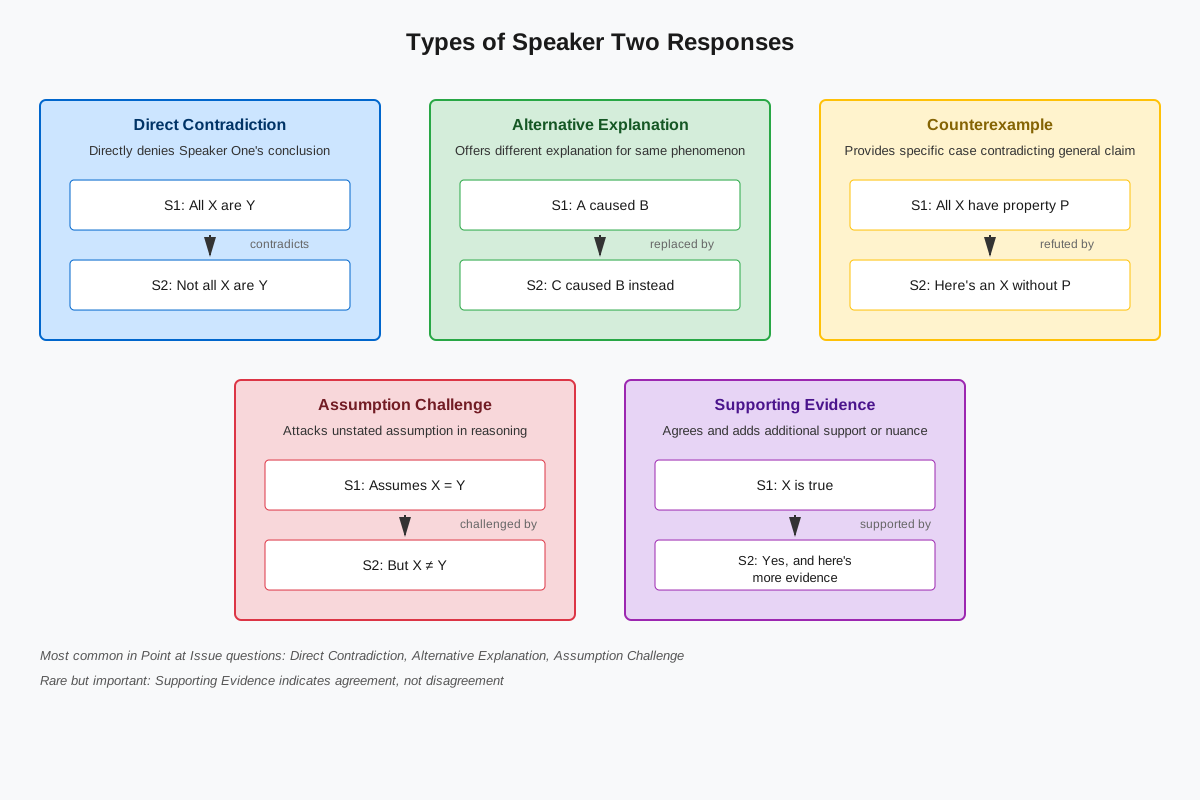
- [ ] Distinguish between different types of responses Speaker Two can make (contradiction, alternative explanation, counterexample, etc.)
- [ ] Recognize the specific point of disagreement between two speakers when one exists
- [ ] Evaluate whether two speakers actually disagree or merely discuss different aspects of an issue
- [ ] Predict correct answer choices based on the relationship between Speaker One and Speaker Two's positions
Prerequisites
- Basic argument structure: Understanding premises, conclusions, and how they connect is essential because speaker two arguments require tracking two complete argument structures simultaneously
- Assumption identification: Recognizing unstated assumptions helps identify what Speaker Two challenges when they target the logical gap in Speaker One's reasoning
- Conditional reasoning: Many speaker dialogues involve conditional statements, and understanding how these work enables proper analysis of whether speakers truly disagree
- Conclusion identification: Distinguishing main conclusions from subsidiary points is necessary to determine whether speakers disagree on the central claim or peripheral issues
Why This Topic Matters
Speaker two argument questions appear with remarkable consistency on every LSAT administration, typically comprising 3-5 questions per test across both Logical Reasoning sections. This frequency makes the topic one of the highest-yield areas for focused study. These questions test multiple competencies simultaneously: reading comprehension, logical analysis, and the ability to distinguish between different types of argumentative relationships. Students who master this topic often see immediate score improvements because the question types follow predictable patterns once the underlying structure becomes clear.
In legal practice, attorneys constantly engage with opposing arguments, judicial opinions that disagree with their position, and multi-party negotiations where different stakeholders hold conflicting views. The ability to precisely identify points of agreement and disagreement, understand how one argument responds to another, and recognize when parties are actually talking past each other rather than genuinely disagreeing represents a core lawyering skill. The LSAT tests this skill through speaker two argument questions because it directly predicts success in legal analysis.
Common manifestations in LSAT passages include: Point at Issue questions asking what the speakers disagree about; Method of Reasoning questions asking how Speaker Two responds to Speaker One; Strengthen/Weaken questions where Speaker Two's statement affects Speaker One's argument; and Assumption questions where Speaker Two's response reveals an assumption in Speaker One's reasoning. The dialogue format may be explicit (with "Speaker One:" and "Speaker Two:" labels) or implicit (where one person makes a statement and another responds within a single passage).
Core Concepts
The Structure of Two-Speaker Dialogues
A speaker two argument follows a consistent structural pattern: Speaker One presents a position (claim, argument, or explanation), and Speaker Two responds to that position in some way. The critical analytical task involves identifying the precise nature of Speaker Two's response. Not all responses constitute disagreements—Speaker Two might agree with Speaker One while adding information, or might discuss a related but distinct issue without actually contradicting Speaker One's position.
The dialogue structure typically includes:
- Speaker One's conclusion (what they're claiming)
- Speaker One's supporting evidence or reasoning
- Speaker Two's response (which may target the conclusion, the evidence, the reasoning, or introduce new considerations)
- The logical relationship between the two positions
Understanding this structure requires reading actively for the argumentative function of each statement, not just the content. Two speakers can use similar words while making fundamentally different points, or use different words while actually agreeing on the substance.
Types of Speaker Two Responses
Speaker Two can respond to Speaker One in several distinct ways, each creating a different logical relationship:
Direct Contradiction: Speaker Two explicitly denies Speaker One's conclusion. Example: Speaker One claims "All corporate mergers reduce competition," while Speaker Two responds "Some corporate mergers actually increase competition by creating stronger competitors to dominant firms."
Challenging an Assumption: Speaker Two accepts Speaker One's explicit premises but denies an unstated assumption necessary for the argument to work. Example: Speaker One argues "The new policy will reduce costs, so we should implement it," assuming cost reduction is the only relevant factor. Speaker Two responds "But the policy will also reduce service quality, which matters more to our customers than cost savings."
Offering an Alternative Explanation: Speaker Two doesn't deny Speaker One's observations but proposes a different explanation for the same phenomenon. Example: Speaker One says "Sales increased after the advertising campaign, so the campaign was effective." Speaker Two responds "Sales increased because our competitor went out of business that same month."
Providing a Counterexample: Speaker Two offers a specific instance that contradicts Speaker One's general claim. Example: Speaker One states "No mammals lay eggs." Speaker Two responds "Platypuses are mammals that lay eggs."
Questioning Evidence: Speaker Two challenges the reliability, relevance, or interpretation of Speaker One's supporting evidence without necessarily denying the conclusion. Example: Speaker One cites a study showing correlation between variables. Speaker Two points out methodological flaws in that study.
Introducing a Distinction: Speaker Two accepts Speaker One's claim in some cases but argues it doesn't apply universally by drawing a relevant distinction. Example: Speaker One claims "Government regulation always reduces economic efficiency." Speaker Two responds "That may be true for competitive markets, but in natural monopolies, regulation can actually improve efficiency."
Identifying the Point of Disagreement
Point at issue and disagreement questions specifically ask what two speakers disagree about. The correct answer must satisfy two criteria:
- Speaker One and Speaker Two must hold opposite positions on the statement: If the correct answer is "The new policy will be effective," then Speaker One must believe it will be effective while Speaker Two believes it won't be (or vice versa).
- Both speakers must have expressed a position on the statement: If Speaker One never addresses whether the policy is affordable, then "The policy is affordable" cannot be the point of disagreement, even if Speaker Two discusses affordability.
Common wrong answer patterns include:
- Statements only one speaker addresses
- Statements both speakers would agree with
- Statements that are too broad or too narrow relative to what the speakers actually discuss
- Statements that confuse the speakers' positions
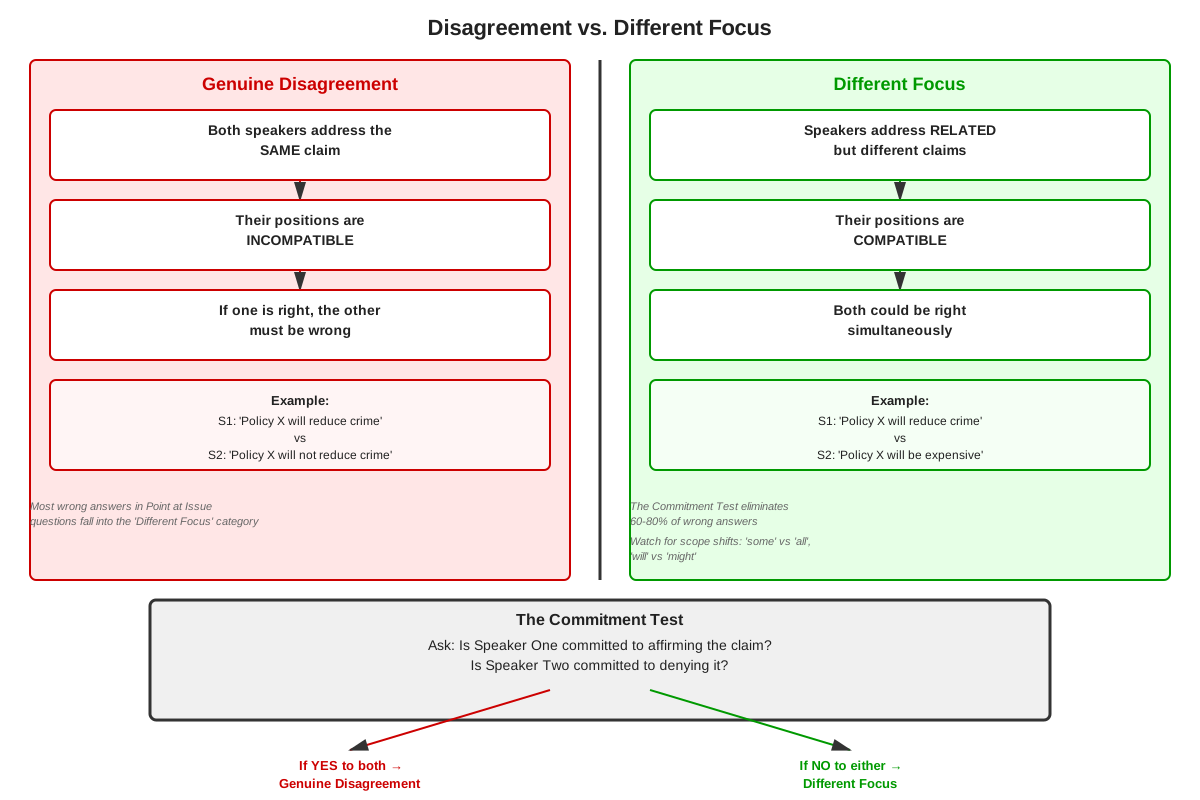
The Commitment Test
To determine whether a statement represents a genuine point of disagreement, apply the commitment test: Based on what each speaker said, would they be committed to answering "yes" or "no" to the statement? If Speaker One would say "yes" and Speaker Two would say "no" (or vice versa), and both would have a definite answer, then it's a point of disagreement.
For example, if Speaker One argues "We should build the new highway because it will reduce traffic congestion" and Speaker Two responds "But the environmental damage outweighs any traffic benefits," they disagree about whether to build the highway, but they don't necessarily disagree about whether it would reduce congestion—Speaker Two might accept that claim while still opposing the project.
Distinguishing Disagreement from Talking Past Each Other
Not all dialogues involve genuine disagreement. Sometimes speakers discuss different aspects of an issue without their positions actually conflicting. Speaker One might discuss economic factors while Speaker Two discusses ethical factors, with both potentially being correct within their respective domains. The LSAT tests the ability to recognize when speakers are "talking past each other" versus genuinely contradicting each other.
Consider: Speaker One says "The museum should extend its hours because many people work during current visiting hours." Speaker Two says "The museum should focus on improving its collection quality." These speakers have different priorities, but they don't necessarily disagree—both proposals could be implemented simultaneously. They're not contradicting each other; they're simply emphasizing different considerations.
Method of Reasoning in Speaker Two Arguments
When questions ask how Speaker Two responds to Speaker One, the correct answer describes the logical function of Speaker Two's response, not just its content. Common correct answer patterns include:
- "Challenges an assumption on which Speaker One's argument depends"
- "Provides evidence that contradicts Speaker One's conclusion"
- "Offers an alternative explanation for the phenomenon Speaker One describes"
- "Points out that Speaker One's evidence is consistent with a different conclusion"
- "Questions the relevance of Speaker One's evidence to the conclusion drawn"
- "Argues that Speaker One has overlooked an important consideration"
These answers focus on the argumentative move Speaker Two makes, the structural relationship between the arguments, rather than the specific subject matter being discussed.
Concept Relationships
The speaker two argument concept integrates multiple foundational logical reasoning skills. At its base, it requires argument structure analysis → which enables identification of each speaker's conclusion and premises → which then allows comparison of the two positions → leading to recognition of the specific point of disagreement or the method of response.
The relationship to point at issue and disagreement questions is direct: these questions explicitly test whether students can identify what two speakers disagree about. However, speaker two arguments also connect to assumption questions (Speaker Two often challenges Speaker One's assumptions), strengthen/weaken questions (Speaker Two's statement may strengthen or weaken Speaker One's position), and method of reasoning questions (asking how Speaker Two responds).
Understanding conditional reasoning enhances speaker two argument analysis because speakers often disagree about conditional relationships. For example, Speaker One might claim "If we implement the policy, costs will decrease," while Speaker Two argues "Even if we implement the policy, costs won't decrease because of other factors." Recognizing the conditional structure clarifies the precise point of disagreement.
The concept also connects forward to more complex multi-argument passages and parallel reasoning questions, where tracking multiple argumentative positions becomes even more demanding. Mastery of two-speaker dialogues builds the cognitive capacity to handle these more complex question types.
High-Yield Facts
⭐ Speaker Two must actually address Speaker One's argument—if Speaker Two discusses a completely different topic, they're not disagreeing, just changing the subject
⭐ The point of disagreement must be something both speakers have taken a position on—if only one speaker addresses an issue, it cannot be the point of disagreement
⭐ Agreement on premises doesn't mean agreement on conclusion—speakers can accept the same facts but draw different conclusions
⭐ Speaker Two can challenge an argument without offering an alternative—pointing out a flaw doesn't require providing a better explanation
⭐ Disagreement about what should be done doesn't necessarily mean disagreement about facts—speakers can agree on all factual matters but disagree on policy due to different values
- Speaker Two responses that offer alternative explanations don't necessarily deny Speaker One's explanation is possible, just that it's the only or best explanation
- When Speaker Two provides a counterexample, they're typically challenging a universal claim made by Speaker One
- Speakers can disagree about the significance or relevance of a fact without disagreeing about whether the fact is true
- The correct answer to a point of disagreement question will often be more specific than the general topic and more general than a minor detail
- Method of reasoning answers focus on logical structure, not content—the same method can apply to arguments about completely different subjects
Quick check — test yourself on Speaker two argument so far.
Try Flashcards →Common Misconceptions
Misconception: If two speakers discuss the same topic, they must disagree about something.
Correction: Speakers can discuss the same topic while making compatible points about different aspects. Speaker One might discuss economic benefits while Speaker Two discusses implementation challenges, with both being correct and not contradicting each other.
Misconception: Speaker Two always disagrees with Speaker One in these dialogues.
Correction: While many LSAT dialogues involve disagreement, Speaker Two might agree with Speaker One while adding nuance, providing additional support, or discussing a related issue. The question stem will indicate what relationship to look for.
Misconception: If Speaker Two doesn't explicitly say "I disagree" or "That's wrong," they're not disagreeing.
Correction: Disagreement can be implicit. If Speaker One claims "X causes Y" and Speaker Two says "Actually, Z causes Y," they're disagreeing about causation even without explicit disagreement language.
Misconception: The point of disagreement is always about the main conclusion of Speaker One's argument.
Correction: Speakers might agree on the conclusion but disagree about the reasoning, evidence, or a subsidiary claim. For example, both might agree a policy should be implemented but disagree about why it should be implemented.
Misconception: Longer, more detailed answer choices are more likely to be correct in point of disagreement questions.
Correction: Correct answers are often concise and precisely capture the specific point of disagreement. Longer answers frequently include extraneous details that go beyond what both speakers actually addressed.
Misconception: If Speaker Two challenges Speaker One's reasoning, they must disagree with Speaker One's conclusion.
Correction: Speaker Two can point out flawed reasoning while still accepting the conclusion (perhaps for different reasons) or remaining agnostic about the conclusion. Challenging the argument structure doesn't automatically mean denying the conclusion.
Worked Examples
Example 1: Point of Disagreement Question
Passage:
Speaker One: The city should ban plastic bags because they harm marine life. Studies show that sea turtles often mistake plastic bags for jellyfish and eat them, which can be fatal.
Speaker Two: Banning plastic bags won't solve the problem of marine pollution. Most plastic in the ocean comes from fishing nets and industrial waste, not shopping bags.
Question: Speaker One and Speaker Two disagree about whether:
(A) Plastic bags harm marine life
(B) A ban on plastic bags would significantly reduce harm to marine life
(C) Sea turtles mistake plastic bags for jellyfish
(D) Most ocean plastic comes from fishing nets
(E) The city should implement environmental regulations
Analysis:
First, identify what each speaker is committed to:
Speaker One's position:
- Conclusion: The city should ban plastic bags
- Reason: They harm marine life (specifically sea turtles)
- Implicit assumption: Banning plastic bags would reduce this harm
Speaker Two's position:
- Conclusion: Banning plastic bags won't solve marine pollution
- Reason: Most plastic comes from other sources
- Implicit claim: Therefore, a bag ban wouldn't significantly help
Now apply the commitment test to each answer:
(A) Would Speaker One say plastic bags harm marine life? YES (explicitly stated). Would Speaker Two say they don't harm marine life? NO—Speaker Two never denies this; they just say bags aren't the main source of ocean plastic. Not the disagreement.
(B) Would Speaker One say a ban would significantly reduce harm to marine life? YES (this is the implicit assumption behind their argument). Would Speaker Two say a ban wouldn't significantly reduce harm? YES (this is their explicit point—the ban "won't solve the problem"). This is the disagreement.
(C) Would Speaker One say sea turtles mistake bags for jellyfish? YES. Would Speaker Two deny this? NO—they never address this specific claim. Not the disagreement.
(D) Would Speaker One say most ocean plastic comes from fishing nets? Unknown—they never address the source of most ocean plastic. Not the disagreement.
(E) Would Speaker One support environmental regulations? Probably yes. Would Speaker Two oppose all environmental regulations? Unknown—they only oppose this specific bag ban. Too broad; not the disagreement.
Correct Answer: (B)
The disagreement centers on whether banning plastic bags would be effective at reducing marine harm, not on whether plastic bags cause any harm at all.
Example 2: Method of Reasoning Question
Passage:
Speaker One: Employee productivity has increased 15% since we installed the new software system. Clearly, the software has made our workers more efficient.
Speaker Two: But productivity also increased 15% at our competitor's company during the same period, and they didn't install any new software. The increase is probably due to seasonal factors affecting the entire industry.
Question: Speaker Two responds to Speaker One by:
(A) Denying that employee productivity has increased
(B) Providing evidence that the software actually decreased productivity
(C) Offering an alternative explanation for the observed increase in productivity
(D) Arguing that productivity increases are unimportant to company success
(E) Demonstrating that the software system was poorly designed
Analysis:
First, identify the structure of each argument:
Speaker One:
- Evidence: Productivity increased 15% after software installation
- Conclusion: The software caused the increase
- Reasoning pattern: Post hoc correlation (after this, therefore because of this)
Speaker Two:
- Evidence: A company without the software had the same increase
- Conclusion: The increase is probably due to seasonal factors
- Logical function: Challenges the causal inference by showing the effect occurs without the supposed cause
Now evaluate each answer choice:
(A) Does Speaker Two deny productivity increased? NO—they accept the 15% increase as fact. Incorrect.
(B) Does Speaker Two provide evidence of decreased productivity? NO—they discuss a different company's increase. Incorrect.
(C) Does Speaker Two offer an alternative explanation? YES—they propose seasonal factors instead of the software as the cause of the increase. They accept the phenomenon (increased productivity) but challenge Speaker One's explanation for it. Correct.
(D) Does Speaker Two argue productivity increases don't matter? NO—they never discuss the importance of productivity. Incorrect.
(E) Does Speaker Two demonstrate poor software design? NO—they never discuss the software's design quality. Incorrect.
Correct Answer: (C)
Speaker Two's logical move is to offer an alternative explanation. They use the competitor's experience as evidence that the same effect occurred without the supposed cause, suggesting a different explanation (seasonal factors) accounts for the observation better than Speaker One's explanation (the software).
Exam Strategy
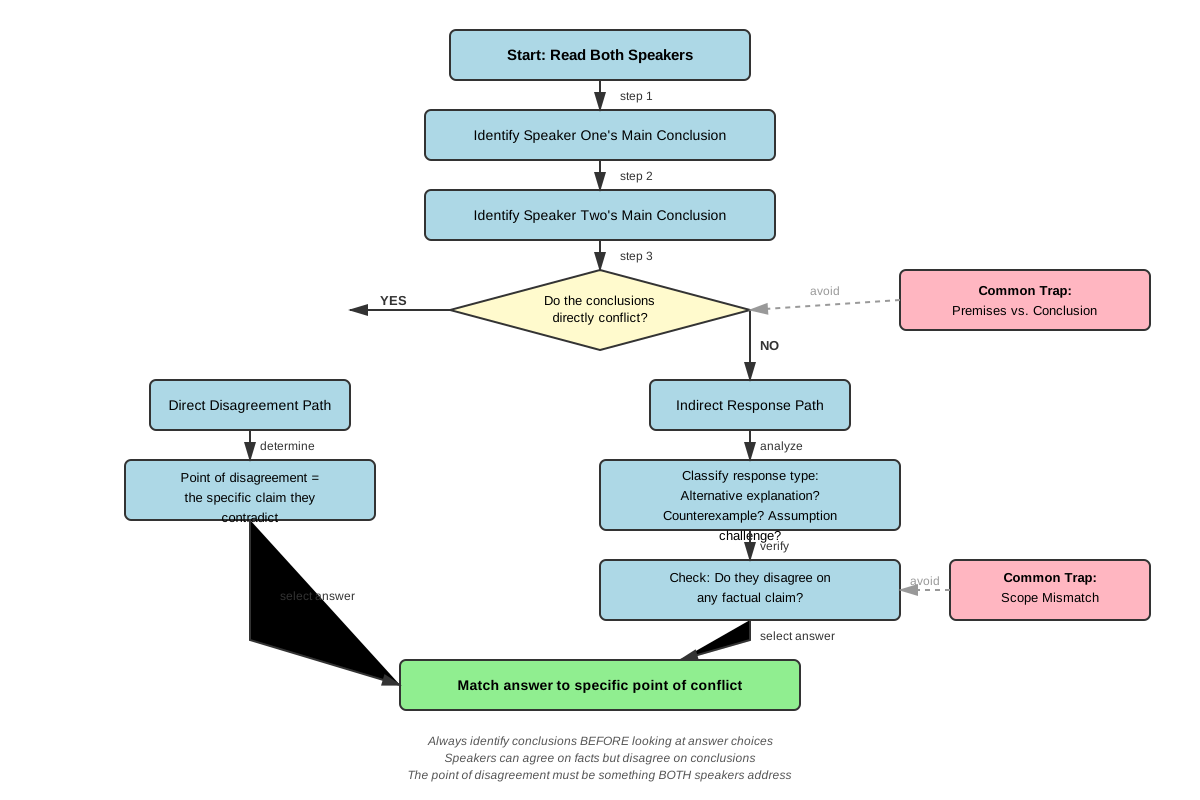
When approaching speaker two argument questions, follow this systematic process:
Step 1: Read Speaker One's argument carefully and identify:
- The main conclusion
- The supporting premises
- Any assumptions connecting premises to conclusion
Step 2: Before reading Speaker Two, predict possible responses:
- Could Speaker Two deny the conclusion?
- Could they challenge an assumption?
- Could they question the evidence?
- Could they offer an alternative explanation?
Step 3: Read Speaker Two's response and categorize it:
- What is Speaker Two's main point?
- How does it relate to Speaker One's argument?
- Does it directly contradict, challenge assumptions, or introduce new considerations?
Step 4: For Point of Disagreement questions, apply the commitment test:
- Would Speaker One answer "yes" or "no" to this statement?
- Would Speaker Two answer the opposite?
- Did both speakers actually address this issue?
Trigger words and phrases to watch for:
In Speaker Two's response:
- "But..." (signals contradiction or challenge)
- "However..." (introduces contrasting point)
- "Actually..." (suggests correction of Speaker One)
- "That may be true, but..." (partial agreement followed by disagreement)
- "The real issue is..." (redirects focus)
- "What you're overlooking is..." (points out omission)
In question stems:
- "Disagree about whether" → Point of disagreement question
- "Responds to Speaker One by" → Method of reasoning question
- "Committed to disagreeing about" → Point of disagreement with commitment test
- "Vulnerable to criticism on the grounds that" → Often involves what Speaker Two points out
Process of elimination tips:
For Point of Disagreement questions, eliminate answers where:
- Only one speaker addresses the issue
- Both speakers would agree
- The statement is too broad or too narrow
- The statement confuses which speaker holds which position
For Method of Reasoning questions, eliminate answers that:
- Describe content rather than logical function
- Attribute actions Speaker Two didn't perform
- Mischaracterize the relationship between the arguments
- Focus on irrelevant aspects of the response
Time allocation:
Spend 15-20 seconds identifying each speaker's main point before looking at answer choices. This upfront investment prevents confusion and reduces the need to re-read. These questions typically take 60-90 seconds total—slightly longer than average due to the two-argument structure.
Memory Techniques
CACAO - Types of Speaker Two responses:
- Contradict the conclusion
- Assumption challenge
- Counterexample provided
- Alternative explanation offered
- Overlook something important (Speaker One did)
The "Both Must Commit" Rule for disagreement questions:
Visualize two people shaking hands—both hands must be extended (both speakers must have a position) for the handshake (disagreement) to occur. If only one hand is extended, there's no connection.
The Function vs. Content Distinction:
For method of reasoning questions, remember: Function describes How, Content describes What.
- Function = How Speaker Two responds (the logical move)
- Content = What Speaker Two discusses (the subject matter)
The LSAT asks about function, not content.
The "Same Facts, Different Conclusions" Scenario:
Picture two people looking at the same photograph but describing different things they see. They're both looking at the same image (agreeing on facts) but focusing on different elements (disagreeing on significance or conclusion). This helps remember that speakers can agree on all factual premises while still disagreeing.
STAR - What makes a strong Point of Disagreement answer:
- Specific enough to capture the actual disagreement
- Testable with the commitment test (both speakers have clear positions)
- Actually addressed by both speakers
- Relevant to the core of their exchange (not peripheral details)
Summary
Speaker two argument questions test the ability to analyze dialogues where one speaker responds to another's position. Success requires identifying what each speaker concludes, how they support their conclusions, and the precise relationship between their positions. The most common question types ask either what the speakers disagree about (point of disagreement) or how Speaker Two responds to Speaker One (method of reasoning). For disagreement questions, both speakers must have taken a position on the statement in question, and those positions must be opposite. For method questions, the answer describes the logical function of Speaker Two's response, not merely its content. Common Speaker Two responses include direct contradiction, challenging assumptions, offering alternative explanations, providing counterexamples, and questioning evidence. The key analytical skill involves distinguishing genuine disagreement from situations where speakers discuss different aspects of an issue without their positions actually conflicting. Mastery requires careful attention to what each speaker explicitly states, what they're committed to based on their reasoning, and the structural relationship between the two arguments rather than just their surface-level content.
Key Takeaways
- Speaker two argument questions appear 3-5 times per LSAT and are highly predictable once you understand the underlying patterns
- For point of disagreement questions, apply the commitment test: both speakers must have opposite positions on the statement
- Speaker Two can respond in multiple ways—direct contradiction is just one option; alternative explanations and assumption challenges are equally common
- Method of reasoning answers describe logical function (how Speaker Two responds), not content (what they discuss)
- Speakers can agree on all facts while disagreeing on conclusions, or discuss the same topic without actually contradicting each other
- The correct answer to disagreement questions is often more specific than the general topic but more general than minor details
- Reading actively for argumentative structure rather than just content dramatically improves accuracy on these questions
Related Topics
Assumption Questions: Understanding speaker two arguments enhances assumption question skills because Speaker Two often challenges Speaker One's unstated assumptions. Mastering how to identify what Speaker Two targets helps recognize assumptions in single-argument passages.
Strengthen and Weaken Questions: Many strengthen/weaken questions present information that functions like a Speaker Two response—either supporting or undermining the original argument. The analytical skills developed here transfer directly to evaluating how new information affects arguments.
Method of Reasoning Questions: While this guide covers method of reasoning in two-speaker contexts, single-argument method of reasoning questions use similar analytical frameworks. Understanding how to describe argumentative moves in dialogues builds capacity for analyzing reasoning patterns generally.
Parallel Reasoning Questions: These questions require identifying structural similarities between arguments. The ability to abstract from content to logical function—essential for speaker two arguments—is the same skill parallel reasoning questions test.
Necessary Assumption Questions: When Speaker Two challenges Speaker One's reasoning, they often target necessary assumptions. Practicing speaker two arguments develops the ability to spot logical gaps that necessary assumptions must fill.
Practice CTA
Now that you understand the structure and strategy behind speaker two argument questions, it's time to apply these concepts to actual LSAT questions. Work through the practice questions associated with this topic, paying special attention to identifying the type of response Speaker Two makes and applying the commitment test for disagreement questions. As you practice, focus on the process—identifying each speaker's conclusion, categorizing Speaker Two's response, and eliminating wrong answers systematically—rather than rushing to an answer. These questions become significantly easier with practice once you recognize the patterns. Challenge yourself with the flashcards to reinforce the key concepts and response types. Remember: speaker two arguments are one of the most learnable question types on the LSAT because they follow predictable structures. Your investment in mastering this topic will pay immediate dividends in your Logical Reasoning score.
Sign up free to keep reading
Create a free AnvayaPrep account to finish this LSAT guide on Speaker two argument — plus flashcards and practice questions.