Overview
Principle application traps represent one of the most challenging and frequently tested elements within LSAT Logical Reasoning sections. These traps are deliberate distractors embedded in answer choices that appear to correctly apply a principle but actually fail to do so upon careful analysis. Understanding these traps is essential because principle questions constitute approximately 10-15% of all Logical Reasoning questions, and the ability to identify misapplications separates high scorers from average performers.
The LSAT tests principle application in two primary directions: applying a general principle to a specific situation, or identifying a general principle that governs a specific situation. LSAT principle application traps exploit common reasoning errors, including scope mismatches, conditional logic reversals, necessary versus sufficient condition confusion, and subtle term shifts. These traps are designed to catch test-takers who recognize superficial similarities between the principle and the application scenario but fail to verify that every element of the principle is satisfied or that the logical structure remains intact.
Mastering principle application traps connects directly to broader Logical Reasoning skills including conditional reasoning, argument structure analysis, and precise language interpretation. This topic builds upon foundational skills in identifying premises and conclusions, understanding formal logic, and recognizing argument patterns. Success with principle questions requires not just understanding what a principle says, but also recognizing what it does NOT say—the boundaries and limitations that define its proper application. This precision in logical analysis is exactly what the LSAT measures and what law schools value in prospective students.
Learning Objectives
- [ ] Identify how principle application traps appear in LSAT questions
- [ ] Explain the reasoning pattern behind principle application traps
- [ ] Apply principle application traps to solve LSAT-style problems accurately
- [ ] Distinguish between valid and invalid applications of conditional principles
- [ ] Recognize scope shifts between principles and their purported applications
- [ ] Evaluate whether all necessary conditions of a principle are satisfied in a given scenario
- [ ] Identify term substitutions that invalidate principle applications
Prerequisites
- Conditional Logic Fundamentals: Understanding "if-then" statements, sufficient and necessary conditions, contrapositives, and logical equivalences is essential because principles are frequently expressed as conditional statements.
- Argument Structure Analysis: The ability to identify premises, conclusions, and reasoning patterns enables students to map principles onto specific situations accurately.
- Formal Logic Notation: Familiarity with symbolic representation of logical relationships helps visualize the structure of principles and test their application systematically.
- Scope Recognition: Understanding how to identify the boundaries of claims and arguments is crucial for detecting when an application extends beyond a principle's proper domain.
Why This Topic Matters
Principle application questions test a fundamental legal reasoning skill: the ability to apply general rules to specific cases. This mirrors the core work of legal practice, where attorneys must determine whether statutes, regulations, or precedents apply to particular factual situations. The LSAT uses principle questions to assess whether candidates can think with the precision and rigor required in legal analysis.
On the LSAT, principle questions appear in both Logical Reasoning sections, typically comprising 6-8 questions per test (approximately 10-15% of all Logical Reasoning questions). These questions carry significant weight because they test multiple skills simultaneously: reading comprehension, logical analysis, and attention to detail. Students who master principle application traps often see score improvements of 2-4 points in Logical Reasoning sections.
Principle questions commonly appear in several formats: "Which one of the following principles, if valid, most helps to justify the reasoning above?", "The situation described above most closely conforms to which one of the following principles?", or "Which one of the following judgments conforms to the principle stated above?" Each format presents opportunities for trap answers that seem correct but contain subtle logical flaws. The most common traps involve scope mismatches (the principle is broader or narrower than the application), conditional logic errors (confusing sufficient and necessary conditions), and term shifts (substituting similar but non-equivalent concepts).
Core Concepts
Understanding Principle Questions
A principle in LSAT terminology is a general rule, policy, or standard that governs behavior, judgment, or reasoning. Principles operate at a higher level of abstraction than specific arguments or situations. For example, "People should not be held responsible for consequences they could not have foreseen" is a principle, while "John should not be blamed for the accident because he could not have predicted the other driver would run the red light" is an application of that principle to a specific case.
Principle questions test whether students can accurately map the abstract structure of a principle onto concrete situations or vice versa. This requires identifying the essential elements of the principle, understanding their logical relationships, and verifying that these elements and relationships are preserved in the application.
The Anatomy of Principle Application Traps
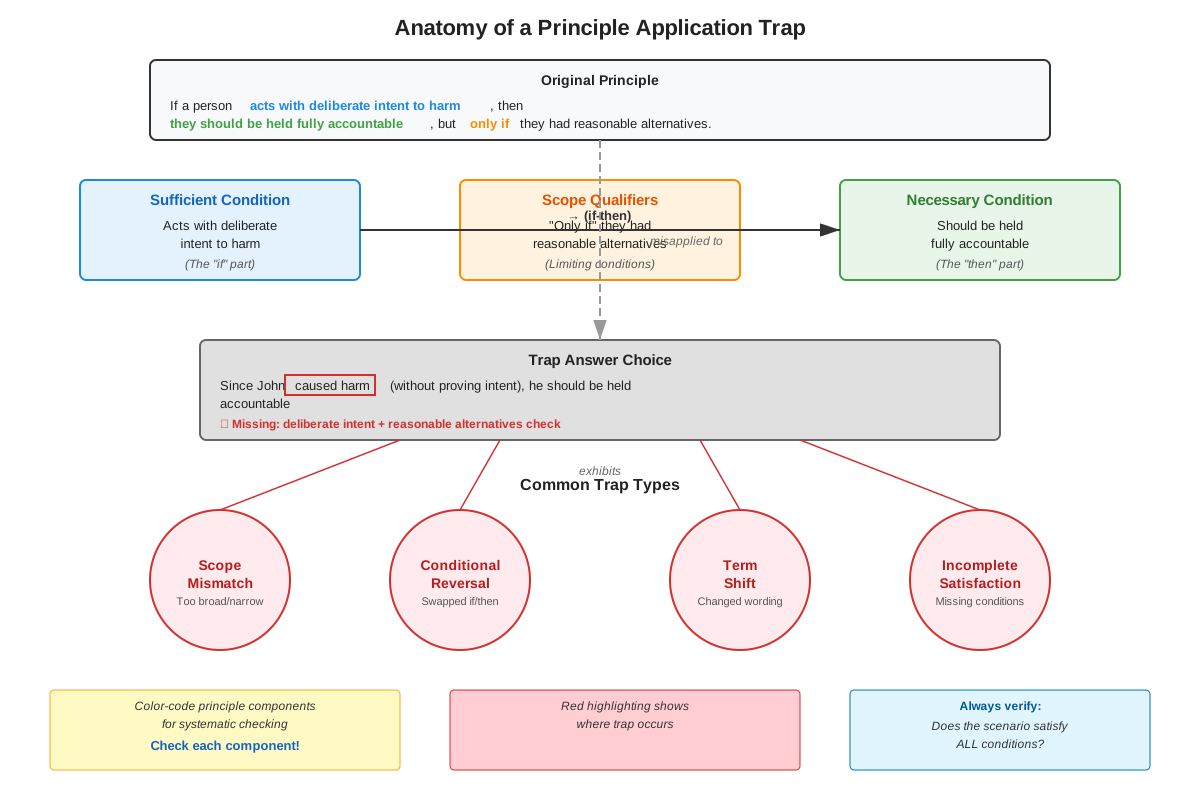
Principle application traps are incorrect answer choices that appear to apply a principle correctly but actually violate the principle's logical structure, scope, or specific requirements. These traps succeed because they share surface-level similarities with correct applications while containing critical logical flaws. Understanding the common types of traps is essential for avoiding them.
Scope Mismatch Traps
Scope mismatch traps occur when an answer choice applies a principle to a situation that falls outside the principle's domain. The principle might specify conditions or limitations that the application ignores.
Example: If a principle states "Artists who create works primarily for commercial gain sacrifice artistic integrity," a trap answer might apply this to an artist who creates works for both commercial and artistic reasons. The principle specifies "primarily for commercial gain," but the trap extends it to any commercial involvement.
| Principle Element | Trap Application | Why It Fails |
|---|---|---|
| "Primarily for commercial gain" | "Any commercial involvement" | Extends beyond specified scope |
| "Artists" | "All creative professionals" | Broadens the category improperly |
| "Sacrifice artistic integrity" | "Compromise artistic vision" | Substitutes a related but distinct concept |
Conditional Logic Reversal Traps
These traps confuse the direction of conditional relationships. A principle might state "If X, then Y," but the trap treats it as "If Y, then X" or assumes that "If not X, then not Y."
Example: Principle: "If a policy reduces overall welfare, it should be rejected." A trap might suggest that because a policy should be rejected, it must reduce overall welfare. This reverses the conditional logic—the principle tells us what follows from reducing welfare, not what must be true if a policy should be rejected.
Necessary vs. Sufficient Condition Confusion
Principles often specify sufficient conditions (conditions that guarantee an outcome) or necessary conditions (conditions that must be present for an outcome). Traps confuse these, treating sufficient conditions as necessary or vice versa.
Example: Principle: "To be considered a great leader, one must demonstrate both vision and integrity." This establishes necessary conditions—both are required. A trap might present someone with vision and integrity and conclude they ARE a great leader, treating necessary conditions as sufficient.
Term Shift Traps
Term shift traps substitute similar-sounding or conceptually related terms for the precise language used in the principle. These substitutions may seem reasonable but actually change the meaning in ways that invalidate the application.
Example: A principle about "intentional deception" might be misapplied to a case of "negligent misrepresentation." While both involve false information, intentional deception requires deliberate intent, while negligent misrepresentation does not. The term shift invalidates the application.
Incomplete Satisfaction Traps
These traps apply a principle to a situation that satisfies some but not all of the principle's requirements. The answer choice highlights the satisfied conditions while ignoring or downplaying the unsatisfied ones.
Example: Principle: "A contract is voidable if it was entered into under duress AND the party under duress had no reasonable alternative." A trap might apply this to a situation with duress but where reasonable alternatives existed, focusing only on the duress element.
Recognizing Valid Applications
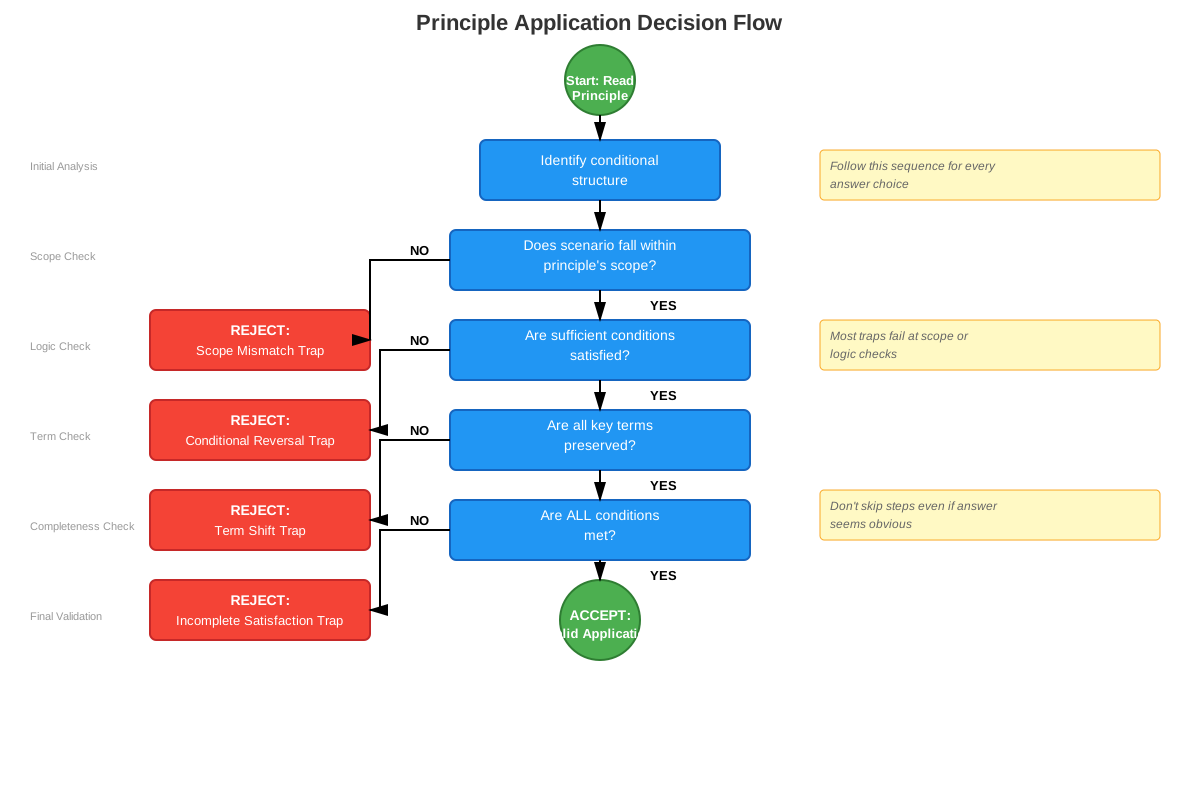
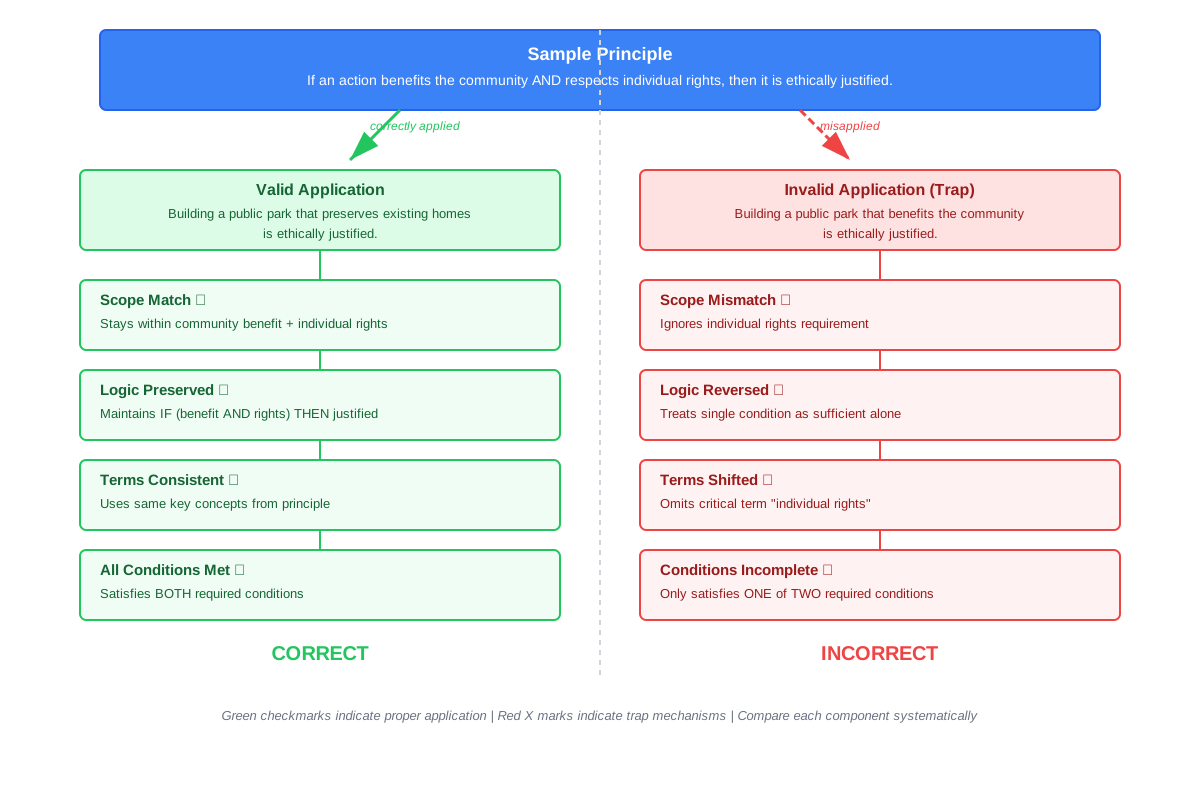
Valid principle applications preserve the logical structure of the principle, respect its scope limitations, satisfy all specified conditions, and maintain precise terminology. When evaluating whether an application is valid, systematically check:
- Structural alignment: Does the logical form match (conditional, causal, comparative)?
- Complete satisfaction: Are ALL conditions specified in the principle met?
- Scope compliance: Does the situation fall within the principle's specified domain?
- Term precision: Are the exact concepts from the principle present, not just similar ones?
- Directional accuracy: If conditional, is the direction of inference correct?
Concept Relationships
The concepts within principle application traps are hierarchically related. At the foundation lies conditional logic understanding, which enables recognition of the logical structure of principles. This foundation supports scope analysis, the ability to determine what situations a principle covers. Both conditional logic and scope analysis feed into term precision, the skill of distinguishing between genuinely equivalent concepts and merely similar ones.
These three elements—conditional logic, scope, and term precision—combine to enable complete satisfaction verification, the process of checking whether all elements of a principle are present in an application. Finally, all these skills integrate into trap recognition, the ability to quickly identify which type of flaw an incorrect answer contains.
The relationship flows: Conditional Logic Mastery → Scope Boundaries → Term Precision → Complete Satisfaction Checking → Trap Identification → Correct Answer Selection
This topic connects to prerequisite knowledge of argument structure because principles function as general premises that, when combined with specific facts, yield conclusions. It also connects to formal logic because many principles are best understood through symbolic representation. Looking forward, mastery of principle application traps enhances performance on parallel reasoning questions, method of reasoning questions, and even reading comprehension questions that involve applying legal principles to cases.
High-Yield Facts
- ⭐ Principle application traps most commonly involve scope mismatches where the application extends beyond the principle's specified domain
- ⭐ Conditional logic reversals are the second most common trap type, confusing "if X then Y" with "if Y then X"
- ⭐ Necessary conditions must ALL be satisfied; sufficient conditions need only one to be satisfied
- ⭐ Term shifts often involve substituting broader categories for specific terms or vice versa
- ⭐ The correct answer to a principle application question will satisfy EVERY element of the principle without exception
- Principles expressed with "only if" establish necessary conditions, not sufficient ones
- Words like "primarily," "solely," "mainly," and "exclusively" create scope limitations that trap answers often ignore
- Trap answers frequently satisfy the "spirit" of a principle while violating its precise logical requirements
- Multiple principles may seem relevant to a situation, but only one will have all its conditions satisfied
- Principle questions reward slow, methodical checking over quick pattern recognition
- Comparative principles ("more than," "less than") require explicit comparison in valid applications
- Principles with multiple sufficient conditions (X OR Y → Z) are satisfied if ANY condition is met
- Principles with multiple necessary conditions (Z → X AND Y) require ALL conditions for the outcome
Quick check — test yourself on Principle application traps so far.
Try Flashcards →Common Misconceptions
Misconception: If an answer choice captures the general idea or spirit of a principle, it's a valid application.
Correction: Valid applications must satisfy the precise logical structure and all specific conditions of the principle. The LSAT tests logical precision, not general thematic similarity. An answer that seems philosophically aligned with a principle but fails to meet its exact requirements is incorrect.
Misconception: Principles with "if-then" structure work in both directions.
Correction: Conditional statements are directional. "If X then Y" does NOT mean "If Y then X." The only valid reversal is the contrapositive: "If not Y, then not X." Trap answers frequently exploit this by reversing the conditional without taking the contrapositive.
Misconception: Satisfying most of a principle's conditions is sufficient for valid application.
Correction: ALL conditions specified in a principle must be satisfied for valid application. If a principle requires three conditions and an application satisfies only two, the application fails completely. Partial satisfaction is not sufficient.
Misconception: Similar or related terms can be substituted for the exact terms used in a principle.
Correction: The LSAT requires precise terminology. "Intentional" and "deliberate" might seem interchangeable, but if the principle uses one term, the application must involve that exact concept. Term shifts, even to closely related concepts, invalidate applications.
Misconception: If a principle applies to a category, it automatically applies to all members or subcategories.
Correction: Scope must be verified carefully. A principle about "professionals" doesn't necessarily apply to "doctors" unless doctors clearly fall within the principle's definition of professionals. Similarly, a principle about "artists" may not apply to "commercial designers" depending on how the principle defines its terms.
Misconception: Necessary conditions guarantee an outcome if satisfied.
Correction: Necessary conditions are required for an outcome but don't guarantee it. They must be present, but additional factors may also be required. Only sufficient conditions guarantee outcomes. Confusing these leads to invalid applications.
Worked Examples
Example 1: Conditional Logic Trap
Principle: "If a scientific theory makes predictions that are repeatedly contradicted by experimental evidence, the theory should be revised or abandoned."
Question: Which of the following situations conforms to the principle above?
Answer Choice A: The Steady State theory of cosmology was abandoned after observations contradicted its predictions about the universe's expansion.
Answer Choice B: Einstein's theory of relativity should be revised because some quantum mechanical phenomena seem inconsistent with it.
Answer Choice C: A psychological theory that has made accurate predictions for decades is being revised to account for new cultural contexts.
Analysis:
Let's break down the principle's structure:
- Sufficient condition: Predictions repeatedly contradicted by experimental evidence
- Necessary condition: Theory should be revised or abandoned
- Logical form: If (repeated contradictions), then (revise or abandon)
Evaluating Answer Choice A:
- Were predictions made? Yes (predictions about universe's expansion)
- Were they contradicted? Yes (by observations)
- Were they repeatedly contradicted? The answer states observations contradicted predictions, implying multiple instances
- Was the theory revised or abandoned? Yes (abandoned)
- Verdict: This satisfies all conditions. The sufficient condition is met (repeated contradictions), and the necessary outcome occurred (abandonment).
Evaluating Answer Choice B:
- Were predictions repeatedly contradicted? The choice says phenomena "seem inconsistent," which is weaker than "repeatedly contradicted by experimental evidence"
- This is a term shift trap: "seem inconsistent" ≠ "repeatedly contradicted by experimental evidence"
- Additionally, this states the theory "should be" revised (prescriptive) rather than describing an actual revision
- Verdict: This fails on multiple grounds—insufficient evidence of repeated contradiction and no actual revision/abandonment described.
Evaluating Answer Choice C:
- Were predictions repeatedly contradicted? No—the theory made "accurate predictions"
- Is the theory being revised? Yes
- Verdict: This is a conditional logic reversal trap. The principle tells us what should happen IF predictions are contradicted. It does NOT say theories should ONLY be revised when predictions are contradicted. This situation involves revision without the triggering condition, which doesn't conform to the principle.
Correct Answer: A
Key Lesson: This example demonstrates how trap answers exploit conditional logic confusion (C) and term shifts (B). The correct answer (A) satisfies both the sufficient condition and demonstrates the prescribed outcome.
Example 2: Scope and Complete Satisfaction Trap
Principle: "A journalist acts unethically if she publishes information that she knows to be false AND the publication of that information causes significant harm to an identifiable individual."
Question: The principle above, if valid, most helps to justify which of the following judgments?
Answer Choice A: A journalist who published a false story that damaged a corporation's reputation acted unethically.
Answer Choice B: A journalist who published information she believed to be true, which later proved false and harmed an individual, did not act unethically.
Answer Choice C: A journalist who knowingly published false information that caused minor embarrassment to a public figure acted unethically.
Analysis:
Let's identify the principle's requirements:
- The person is a journalist
- She publishes information
- She KNOWS the information is false (epistemic requirement)
- The information IS false (factual requirement)
- Publication causes SIGNIFICANT harm (magnitude requirement)
- Harm is to an IDENTIFIABLE INDIVIDUAL (scope of harm)
Note: This principle uses "AND," meaning ALL conditions must be satisfied.
Evaluating Answer Choice A:
- Journalist? Yes
- Published information? Yes
- Knew it was false? Yes (stated)
- Was false? Yes (stated)
- Caused significant harm? Possibly (damaged reputation)
- To an identifiable individual? NO—to a corporation
- Verdict: This is a scope mismatch trap. The principle specifies "identifiable individual," but this involves a corporation. Corporations are not individuals in this context. This answer fails condition 6.
Evaluating Answer Choice B:
- Journalist? Yes
- Published information? Yes
- Knew it was false? NO—she believed it to be true
- Was false? Yes (later proved false)
- Caused harm? Yes (to an individual)
- Verdict: This satisfies most conditions but critically fails condition 3 (knowledge of falsity). The answer correctly concludes the journalist did NOT act unethically, which aligns with the principle—since not all conditions are met, the principle doesn't establish unethical conduct. This is a valid application showing when the principle does NOT apply.
Evaluating Answer Choice C:
- Journalist? Yes
- Published information? Yes
- Knew it was false? Yes (knowingly published false information)
- Was false? Yes (implied)
- Caused significant harm? NO—caused "minor embarrassment"
- To an identifiable individual? Yes (public figure is still an individual)
- Verdict: This is an incomplete satisfaction trap. The principle requires "significant harm," but this describes "minor embarrassment." The magnitude requirement is not met. This answer fails condition 5.
Correct Answer: B
Key Lesson: This example shows how the LSAT tests whether students can recognize when a principle does NOT apply (because conditions aren't met) as well as when it does apply. Trap answers A and C each fail one critical condition while satisfying others, testing whether students check ALL requirements.
Exam Strategy
Systematic Approach to Principle Questions
- Read the principle first and map its structure: Before looking at answer choices, identify whether the principle is conditional, comparative, prescriptive, or descriptive. Note all conditions, qualifiers, and scope limitations.
- Identify the logical form: Convert complex principles into simpler logical notation if helpful. For example, "Only policies that benefit the majority should be implemented" becomes: Implement → Benefits majority.
- Create a checklist: For complex principles with multiple conditions, literally list each requirement. As you evaluate answer choices, check off each satisfied condition.
- Watch for trigger words:
- Scope limiters: "only," "solely," "exclusively," "primarily," "mainly"
- Conditional indicators: "if," "when," "whenever," "only if," "unless"
- Quantifiers: "all," "some," "most," "none," "any"
- Magnitude terms: "significant," "substantial," "minor," "negligible"
- Eliminate systematically: Don't just look for the right answer; actively eliminate wrong answers by identifying which specific condition each fails to satisfy.
Time Management
Exam Tip: Principle questions often require more time than other Logical Reasoning questions because they demand careful verification of multiple conditions. Budget 90-120 seconds for complex principle questions rather than the standard 60-90 seconds.
Common Trap Patterns to Recognize Quickly
- "Close enough" answers: These satisfy the spirit but not the letter of the principle. Eliminate immediately.
- Reversed conditionals: If you see an answer that seems to flip the principle's direction, verify the contrapositive before selecting.
- Scope creep: Answers that extend the principle to related but distinct categories are almost always wrong.
- Partial satisfaction: Answers that trumpet the conditions they DO satisfy while quietly failing others are designed to trap rushed test-takers.
Process of Elimination Tactics
When stuck between two answers:
- List the principle's conditions side by side with each answer's facts
- Identify the FIRST condition that differs between the answers
- Determine which answer satisfies that condition correctly
- If both satisfy it, move to the next distinguishing condition
Memory Techniques
The SCOPE Acronym for Checking Applications
Structure: Does the logical structure match (conditional, causal, etc.)?
Conditions: Are ALL conditions satisfied completely?
Outcome: Does the prescribed outcome occur?
Precision: Are terms used precisely, not just similarly?
Extent: Does the situation fall within the principle's scope?
Visualization Strategy
Picture principles as templates with specific-shaped holes. Valid applications are puzzle pieces that fit perfectly into every hole. Trap answers are pieces that fit MOST holes but have one edge that doesn't match. Train yourself to check every edge before selecting an answer.
The "All or Nothing" Rule
For principles with multiple necessary conditions (connected by "AND"), remember: All Necessary Details must be satisfied—AND means ALL. If even one condition fails, the entire application fails.
Conditional Direction Reminder
Use the mnemonic "Sufficient Starts the Sentence" to remember that in "If X then Y" statements, X (the sufficient condition) typically comes first. The necessary condition (Y) follows. This helps prevent reversal errors.
Summary
Principle application traps represent a critical testing mechanism on the LSAT that separates careful, precise reasoners from those who rely on general impressions. These traps exploit common logical errors including scope mismatches, conditional logic reversals, confusion between necessary and sufficient conditions, term shifts, and incomplete satisfaction of requirements. Success requires systematic verification that every element of a principle is satisfied in its application, attention to precise terminology, and understanding of conditional logic structures. The most dangerous traps are those that satisfy most conditions while failing one critical requirement, or those that capture the general spirit of a principle while violating its specific logical structure. Students must resist the temptation to select answers that "seem right" and instead methodically verify each condition. Mastering principle application traps improves performance not only on principle questions but across all Logical Reasoning question types by developing the precision and rigor that the LSAT rewards.
Key Takeaways
- Principle application traps are incorrect answers that appear valid but violate the principle's logical structure, scope, or specific requirements
- ALL conditions in a principle must be satisfied for valid application—partial satisfaction is insufficient
- Conditional logic reversals are among the most common traps; always verify the direction of inference
- Scope mismatches occur when applications extend beyond the principle's specified domain or category
- Term shifts substitute similar but non-equivalent concepts, invalidating the application
- Necessary conditions must be present but don't guarantee outcomes; sufficient conditions do guarantee outcomes
- Systematic checking using a structured approach (like SCOPE) prevents trap answers from succeeding
Related Topics
Parallel Reasoning Questions: These questions require identifying arguments with identical logical structures, building directly on the structural analysis skills developed through principle application work. Mastering principle traps enhances parallel reasoning performance by strengthening pattern recognition abilities.
Sufficient Assumption Questions: These ask for assumptions that, if true, would make an argument valid. Understanding how principles apply to situations helps identify what additional information would bridge gaps in reasoning.
Necessary Assumption Questions: These require identifying assumptions that must be true for an argument to work. The skill of checking whether all conditions are satisfied transfers directly to evaluating whether necessary assumptions are present.
Flaw Questions: Many flawed arguments misapply principles or general rules to specific cases. Recognizing principle application traps helps identify these flaws more quickly.
Method of Reasoning Questions: These ask how arguments proceed or what techniques they employ. Understanding principle application provides vocabulary and concepts for describing argumentative methods.
Practice CTA
Now that you understand the mechanics of principle application traps and the strategies for avoiding them, it's time to put this knowledge into practice. Work through the practice questions associated with this topic, paying special attention to identifying which type of trap each incorrect answer represents. Use the SCOPE checklist systematically on each question until the verification process becomes automatic. Remember: every expert LSAT test-taker was once where you are now, learning to spot these traps. The difference between good and great performance is consistent, deliberate practice. Challenge yourself with the flashcards to reinforce the key concepts, and return to the worked examples whenever you need to refresh your understanding of the systematic approach. You're building the precise reasoning skills that will serve you not just on test day, but throughout your legal career.
Sign up free to keep reading
Create a free AnvayaPrep account to finish this LSAT guide on Principle application traps — plus flashcards and practice questions.