Overview
Principle conflict questions represent a sophisticated category within LSAT Logical Reasoning that tests a student's ability to identify when two general rules or standards cannot both be satisfied simultaneously in a given situation. These questions require examinees to recognize that applying one principle would lead to a conclusion that contradicts what another principle would require. Unlike straightforward principle questions that ask students to apply a single rule to a specific case, principle conflict questions demand higher-order analytical thinking by requiring students to juggle multiple normative standards and identify their incompatibility.
Understanding principle conflict is essential for LSAT success because these questions appear regularly in the Logical Reasoning sections and test core skills that permeate the entire exam: the ability to extract general rules from specific situations, apply abstract principles to concrete cases, and recognize logical inconsistencies. Mastery of this question type demonstrates the kind of analytical reasoning that law schools value—the capacity to navigate situations where multiple legal standards, ethical guidelines, or policy considerations pull in different directions.
Within the broader landscape of LSAT principle conflict questions and logical reasoning more generally, principle conflict sits at the intersection of several critical skills. It builds upon basic principle identification and application while adding the complexity of comparative analysis. Students must not only understand what each principle requires independently but also recognize how their requirements clash when applied to the same scenario. This topic connects directly to assumption questions, strengthen/weaken questions, and paradox questions, as all require identifying relationships between different claims or standards.
Learning Objectives
- [ ] Identify how Principle conflict appears in LSAT questions
- [ ] Explain the reasoning pattern behind Principle conflict
- [ ] Apply Principle conflict to solve LSAT-style problems accurately
- [ ] Distinguish between genuine principle conflicts and apparent contradictions that can be resolved
- [ ] Evaluate answer choices by testing whether each principle truly conflicts with another in the given scenario
- [ ] Construct clear explanations of why two principles cannot both be satisfied simultaneously
Prerequisites
- Basic understanding of principles and rules: Principle conflict questions assume students can identify general rules or standards stated in abstract terms, which is necessary before determining whether principles clash.
- Conditional reasoning skills: Many principles are expressed as conditional statements (if-then relationships), and recognizing conflicts often requires understanding what each conditional requires.
- Ability to apply abstract concepts to concrete situations: Students must translate general principles into specific applications to see where conflicts emerge.
- Familiarity with standard principle question types: Understanding how basic principle-application and principle-identification questions work provides the foundation for the more complex conflict analysis.
Why This Topic Matters
Principle conflict questions matter profoundly both for LSAT performance and for legal reasoning more broadly. In legal practice, attorneys constantly navigate situations where multiple laws, precedents, ethical rules, or policy considerations point in different directions. A contract clause might conflict with a statutory requirement; one constitutional principle might clash with another; competing ethical duties might pull a lawyer in opposite directions. The ability to identify and articulate these conflicts is fundamental to legal analysis.
On the LSAT, principle conflict questions appear with notable frequency across Logical Reasoning sections. While exact statistics vary by test administration, students can expect to encounter 1-3 principle conflict questions per exam, making this a high-yield topic that warrants dedicated study time. These questions typically appear in several formats: they may ask which answer choice identifies a conflict between principles stated in the stimulus, which scenario illustrates a conflict between two given principles, or which principle conflicts with one already stated.
The exam commonly presents principle conflicts in contexts involving ethical dilemmas, policy decisions, legal standards, and everyday moral reasoning. A typical question might describe a situation where a principle of fairness conflicts with a principle of efficiency, or where respecting individual autonomy clashes with promoting collective welfare. The LSAT favors scenarios where reasonable people might disagree about which principle should take precedence, testing whether students can identify the conflict itself rather than resolve it in favor of one side.
Core Concepts
Defining Principle Conflict
A principle conflict occurs when two or more general rules, standards, or guidelines cannot both be fully satisfied in a particular situation. The conflict is genuine when following one principle necessarily means violating another—there is no way to honor both simultaneously given the circumstances. This differs from principles that are merely different or that apply to different domains; conflicting principles actively compete for application to the same case.
For a conflict to exist, several conditions must be met. First, both principles must actually apply to the situation at hand—they must be relevant to the case under consideration. Second, the principles must make incompatible demands or lead to contradictory conclusions. Third, the conflict must be inherent in the principles themselves when applied to this situation, not merely a result of limited resources or practical constraints that could theoretically be overcome.
Structure of Principle Conflict Questions
LSAT principle conflict questions follow several common structural patterns. The most frequent format presents a scenario or argument in the stimulus, then asks which answer choice identifies a conflict between principles, or which principle conflicts with one stated in the passage. Another common structure provides two principles in the stimulus and asks which scenario illustrates their conflict.
The question stems typically use language such as:
- "The principles above conflict most in their application to which one of the following situations?"
- "Which one of the following principles, if valid, most conflicts with the principle stated above?"
- "The reasoning above conforms to which one of the following principles but violates which other principle?"
Understanding these structural patterns helps students quickly identify what the question demands and how to approach the answer choices systematically.
Types of Principles That Conflict
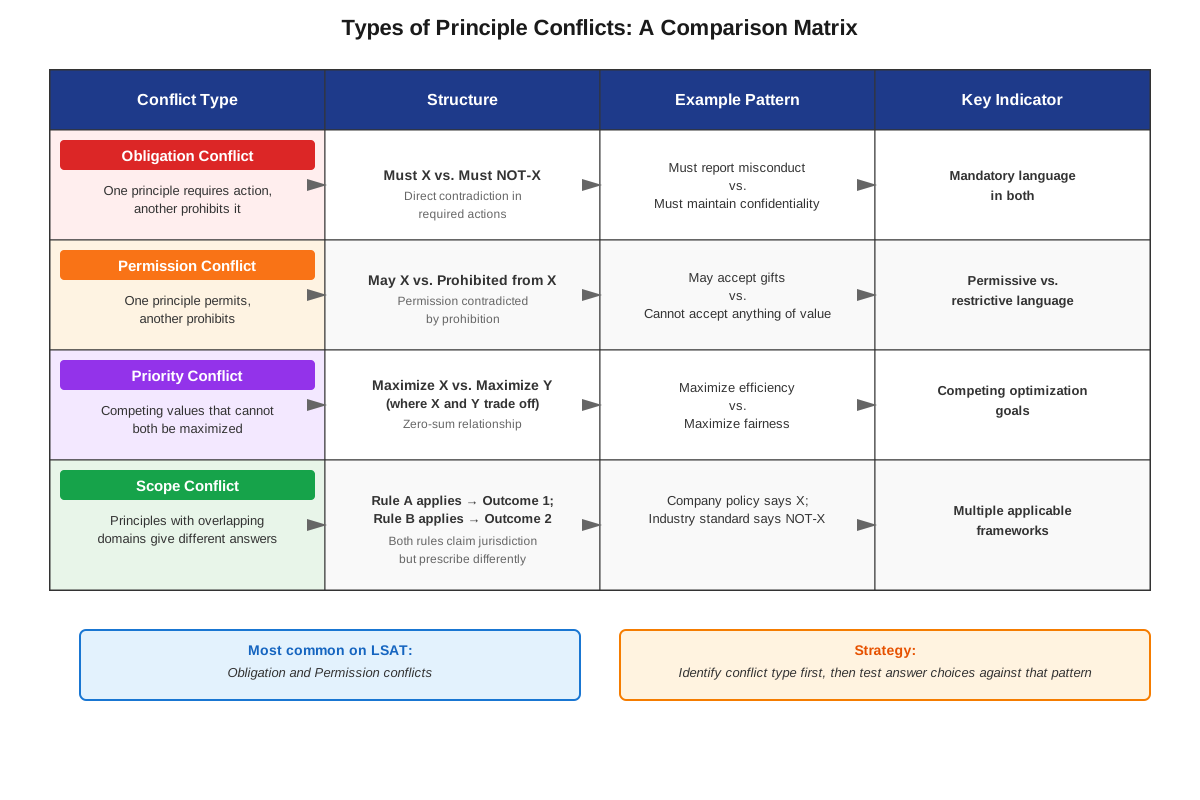
Principles that appear in conflict questions span several categories, each with characteristic features:
| Principle Type | Characteristics | Common Conflicts |
|---|---|---|
| Moral/Ethical | Prescribe right conduct, use normative language | Autonomy vs. beneficence; justice vs. mercy |
| Procedural | Specify how processes should work | Efficiency vs. thoroughness; speed vs. accuracy |
| Policy-based | Aim at achieving social goals | Individual rights vs. collective welfare |
| Epistemic | Concern knowledge and belief formation | Skepticism vs. trust; caution vs. decisiveness |
| Legal | Formal rules and standards | Strict liability vs. intent requirements |
Recognizing which type of principle is at stake helps predict what kinds of conflicts might arise and what the answer choices might involve.
The Anatomy of a Conflict
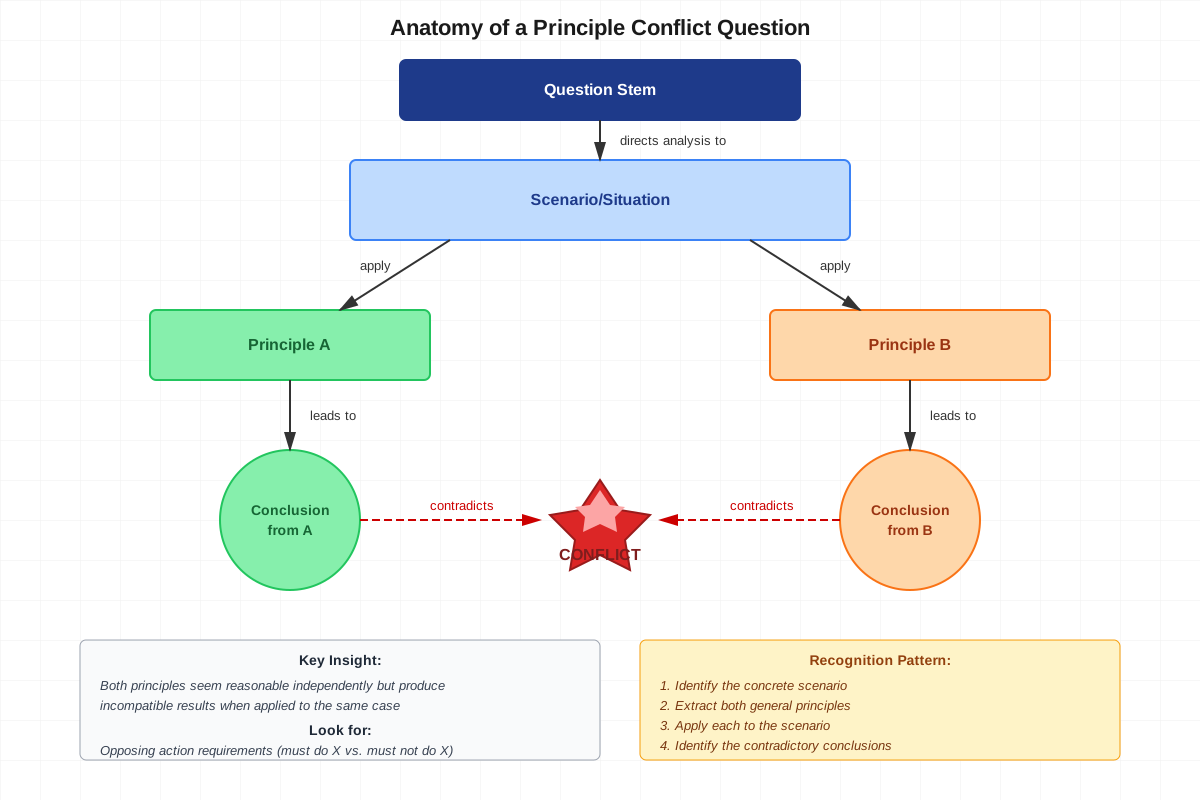
When two principles conflict, the conflict has a specific logical structure. Principle A requires action X (or forbids action Y), while Principle B requires action Y (or forbids action X) in the same situation. The conflict is sharpest when the principles are stated categorically—without exceptions or qualifications—because then there is no room for balancing or compromise.
Consider this structure:
- Principle A states: "One should always [do X] when [condition C] holds"
- Principle B states: "One should never [do X] when [condition D] holds"
- A situation arises where both conditions C and D are satisfied
- Therefore, Principle A requires doing X while Principle B forbids doing X
- This creates an irresolvable conflict
The LSAT tests whether students can trace this logical pathway and identify when it genuinely occurs versus when principles merely seem to conflict but actually address different aspects of a situation.
Distinguishing Real from Apparent Conflicts
Not every case where two principles seem to clash represents a genuine conflict. Several situations create the appearance of conflict without the reality:
Scope differences: Two principles might apply to different domains or different aspects of a situation. A principle about professional conduct and a principle about personal relationships might both be relevant to a scenario but not actually conflict if they govern different dimensions of the decision.
Temporal distinctions: One principle might govern what should be done before a certain point, while another governs what should be done after. These principles complement rather than conflict with each other.
Hierarchical relationships: Some principles are more general while others are more specific. A specific principle might carve out an exception to a general one without truly conflicting—the specific principle simply defines the scope of the general one more precisely.
Practical versus logical conflicts: Limited resources might make it impossible to fully implement two principles, but this represents a practical constraint rather than a logical conflict between the principles themselves. True principle conflicts exist even in worlds of unlimited resources.
Resolving Versus Identifying Conflicts
A crucial distinction for LSAT purposes: principle conflict questions almost never ask students to resolve the conflict by determining which principle should prevail. Instead, they test whether students can identify that a conflict exists. The exam assesses analytical skills—recognizing incompatibility—rather than normative judgment about which principle is more important.
This means the correct answer to a principle conflict question will demonstrate that two principles cannot both be satisfied, not argue that one principle outweighs the other. Students who try to resolve conflicts by deciding which principle "wins" often select wrong answers that miss the point of the question.
Concept Relationships
The concepts within principle conflict questions form an interconnected web. At the foundation lies principle identification—recognizing general rules or standards in the first place. This leads to principle application, determining what a principle requires in a specific situation. When multiple principles apply to the same situation, students must perform comparative analysis, examining what each principle demands. This comparative analysis reveals whether the principles make compatible or incompatible demands. When demands are incompatible, a genuine conflict exists, which must be distinguished from apparent conflicts that can be resolved through scope analysis or other means.
These concepts connect to prerequisite knowledge in several ways. Conditional reasoning underlies many principles, as they often take the form "if X, then Y should occur." Understanding sufficient and necessary conditions helps determine what principles require. Argument structure knowledge helps students parse complex stimuli where multiple principles interact. Assumption identification skills transfer directly, as recognizing what must be true for a conflict to exist parallels recognizing what must be true for an argument to work.
The relationship map flows as follows:
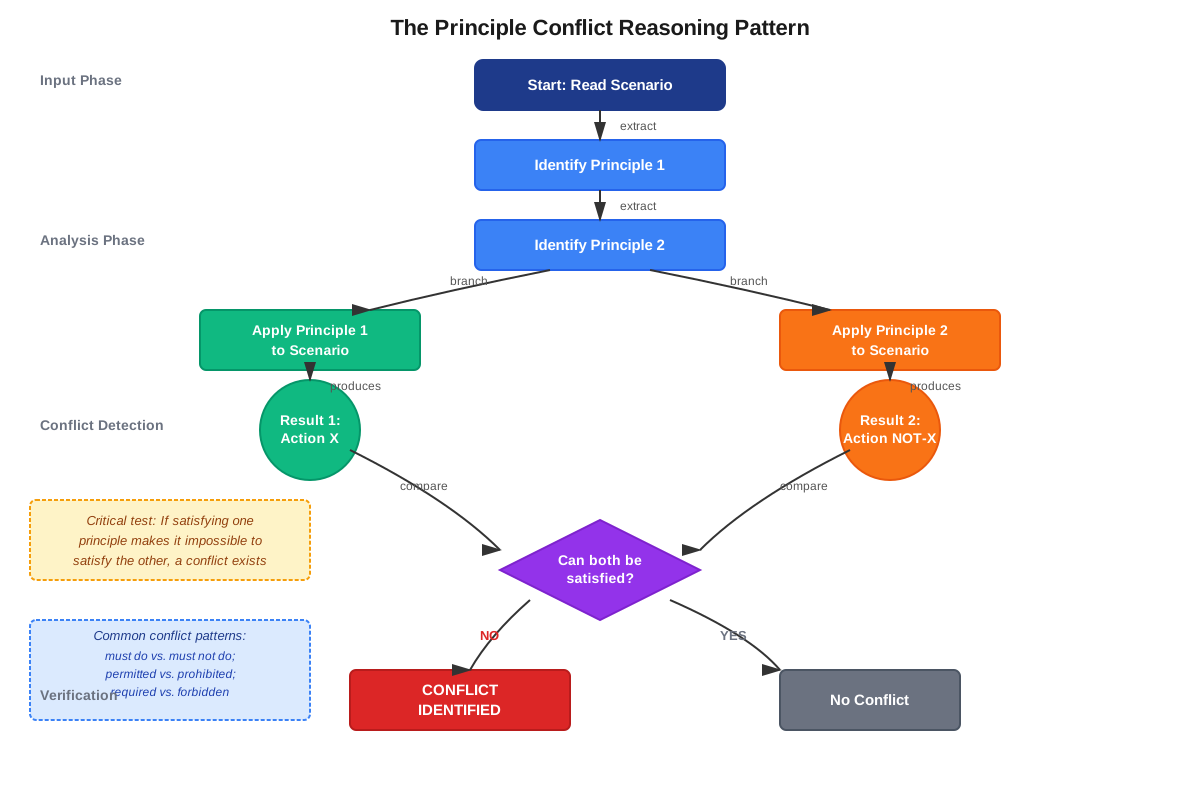
Principle Identification → Principle Application → Multiple Principles Applied to Same Case → Comparative Analysis of Requirements → Compatibility Assessment → Conflict Identification → Distinguishing Genuine from Apparent Conflicts
This topic also connects forward to more advanced logical reasoning skills. Understanding principle conflicts enhances performance on paradox questions (which often involve apparent conflicts between facts or principles), strengthen/weaken questions (where introducing a conflicting principle can weaken an argument), and parallel reasoning questions (where matching the structure of conflicting principles requires recognizing that structure).
High-Yield Facts
⭐ A genuine principle conflict requires that both principles apply to the same situation and make incompatible demands that cannot both be satisfied.
⭐ Principle conflict questions test identification of conflicts, not resolution of which principle should prevail.
⭐ The most common wrong answers in principle conflict questions present principles that are merely different rather than genuinely conflicting.
⭐ Two principles conflict only if following one necessarily means violating the other in the given circumstances.
⭐ Scope differences between principles often explain why apparent conflicts are not genuine conflicts.
- Principle conflict questions appear 1-3 times per LSAT exam, making them high-yield for focused study.
- Categorical principles (those stated without exceptions) create sharper conflicts than qualified principles.
- Temporal distinctions can resolve apparent conflicts when principles govern different time periods.
- Hierarchical relationships between general and specific principles do not constitute conflicts.
- Practical resource limitations do not create logical principle conflicts.
- The correct answer must demonstrate incompatibility, not merely difference or tension.
- Wrong answers often confuse "difficult to satisfy both" with "impossible to satisfy both."
- Ethical dilemmas provide common contexts for principle conflict questions on the LSAT.
- Identifying what each principle requires independently is the essential first step before assessing conflict.
- Principle conflicts can exist even when both principles are valid and important.
Quick check — test yourself on Principle conflict so far.
Try Flashcards →Common Misconceptions
Misconception: Two principles conflict whenever they are different or address the same general topic.
Correction: Principles conflict only when they make incompatible demands in a specific situation. Principles can be different, even contradictory in the abstract, without conflicting in application if they govern different aspects of a situation or different circumstances.
Misconception: A principle conflict question asks which principle is more important or should be followed.
Correction: LSAT principle conflict questions test whether students can identify that a conflict exists, not resolve which principle should prevail. The correct answer demonstrates incompatibility, not superiority of one principle over another.
Misconception: If it would be difficult or costly to satisfy both principles, they conflict.
Correction: Practical difficulties or resource constraints do not constitute logical conflicts. Two principles genuinely conflict only when satisfying one logically requires violating the other, regardless of practical considerations.
Misconception: Principles stated at different levels of generality automatically conflict.
Correction: A more specific principle often simply defines the scope or application of a more general principle without conflicting with it. Hierarchical relationships between principles are normal and do not indicate conflict.
Misconception: The correct answer to a principle conflict question will present two principles that seem equally valid or reasonable.
Correction: While conflicting principles may both be reasonable, the key criterion is incompatibility of demands, not equal validity. The correct answer must show that both principles cannot be satisfied simultaneously in the given situation.
Misconception: Temporal sequence creates principle conflicts when one principle governs earlier actions and another governs later actions.
Correction: Principles that apply at different times typically complement rather than conflict with each other. A genuine conflict requires that both principles apply to the same decision point or action.
Misconception: If following one principle makes it harder to follow another, they conflict.
Correction: Making something harder is not the same as making it impossible. Conflict requires that following one principle necessarily means violating the other, not merely that it creates challenges for following the other.
Worked Examples
Example 1: Identifying a Principle Conflict
Question Stimulus:
"A journalist should always protect the confidentiality of sources who provide information on the condition of anonymity. However, a journalist should never withhold information from law enforcement when that information could prevent serious harm to others. A source has provided a journalist with information about a planned crime, requesting anonymity."
Question: Which one of the following best describes the conflict illustrated above?
Answer Choices:
(A) The principle of protecting source confidentiality conflicts with the principle of preventing harm when a source reveals information about planned criminal activity.
(B) The principle of protecting sources conflicts with the principle of obeying the law in all circumstances.
(C) Journalists face difficult decisions when sources provide information about crimes.
(D) The principle of confidentiality applies only when sources provide information about past events, not future crimes.
(E) Law enforcement needs conflict with journalistic ethics in cases involving anonymous sources.
Step-by-Step Solution:
First, identify the two principles explicitly stated:
- Principle 1: Protect confidentiality of anonymous sources (always)
- Principle 2: Never withhold information from law enforcement when it could prevent serious harm
Second, identify the specific situation where both principles apply:
- A source has provided information about a planned crime
- The source requested anonymity
- The information could prevent serious harm (the planned crime)
Third, determine what each principle requires:
- Principle 1 requires: Maintain the source's anonymity (don't share information with law enforcement)
- Principle 2 requires: Share the information with law enforcement (to prevent harm)
Fourth, assess whether these requirements are compatible:
- The journalist cannot both share the information with law enforcement AND maintain complete confidentiality
- Following Principle 1 means violating Principle 2
- Following Principle 2 means violating Principle 1
- This is a genuine conflict
Fifth, evaluate the answer choices:
(A) Correctly identifies both principles and explains that they conflict in this specific situation. This matches our analysis.
(B) Introduces a principle about "obeying the law in all circumstances" that wasn't stated in the stimulus. This is a distortion.
(C) Merely describes the situation as "difficult" without identifying the specific conflicting principles. This is too vague and doesn't identify a conflict.
(D) Attempts to resolve the conflict by limiting the scope of confidentiality, but the question asks us to identify the conflict, not resolve it. Additionally, this limitation wasn't stated in the stimulus.
(E) Too vague—doesn't specify which principles conflict or how they conflict in this situation.
Correct Answer: (A)
Connection to Learning Objectives: This example demonstrates how to identify principle conflict in LSAT questions by systematically determining what each principle requires and whether those requirements are compatible.
Example 2: Distinguishing Genuine from Apparent Conflict
Question Stimulus:
"A company should maximize shareholder value by pursuing profitable opportunities. A company should also treat its employees fairly by providing safe working conditions and reasonable compensation. The Acme Corporation faces a decision about whether to invest in expensive safety equipment that would reduce profits but improve worker safety."
Question: Do the principles stated above conflict in their application to Acme Corporation's decision?
Analysis:
At first glance, this might seem like a clear conflict: maximizing shareholder value (profits) versus treating employees fairly (safety). However, careful analysis reveals this is an apparent rather than genuine conflict.
Step 1: Identify what each principle requires:
- Principle 1: Maximize shareholder value by pursuing profitable opportunities
- Principle 2: Treat employees fairly by providing safe working conditions and reasonable compensation
Step 2: Examine the scope of each principle:
- Principle 1 requires pursuing profitable opportunities, but doesn't require pursuing EVERY profitable opportunity or maximizing short-term profits at all costs
- Principle 2 requires providing safe working conditions, which might include the expensive safety equipment
Step 3: Assess compatibility:
- Providing safe working conditions (Principle 2) doesn't necessarily conflict with maximizing shareholder value (Principle 1)
- Long-term shareholder value might actually be enhanced by fair treatment of employees (reduced turnover, better productivity, avoiding lawsuits)
- The principles operate at different levels: Principle 2 sets a constraint (minimum safety standards) while Principle 1 sets an objective (maximize value within constraints)
Step 4: Identify the real issue:
- The apparent conflict arises from resource limitations (the equipment is expensive) and short-term versus long-term thinking
- This is a practical challenge about how to implement both principles, not a logical conflict between them
- A genuine conflict would require that treating employees fairly necessarily means failing to maximize shareholder value, but that's not established here
Conclusion: This is an apparent conflict, not a genuine one. The principles can both be satisfied—the company can provide safe working conditions while pursuing profitable opportunities. The challenge is practical (balancing costs and benefits) rather than logical (incompatible requirements).
Connection to Learning Objectives: This example illustrates the reasoning pattern behind principle conflict analysis and demonstrates how to distinguish genuine conflicts from situations where principles merely create practical challenges.
Exam Strategy
When approaching principle conflict questions on the LSAT, employ a systematic strategy that maximizes accuracy while managing time effectively.
Step 1: Identify the Question Type (5-10 seconds)
Watch for trigger phrases: "conflict," "inconsistent with," "violates," "cannot both be satisfied," "incompatible with." These signal a principle conflict question requiring identification of incompatibility rather than application of a single principle.
Step 2: Extract the Principles (20-30 seconds)
Carefully identify each principle stated in the stimulus. Underline or mentally note them. Pay attention to:
- Categorical language ("always," "never," "all," "no") versus qualified language ("usually," "generally," "often")
- The scope of each principle (what situations does it govern?)
- What each principle requires, permits, or forbids
Step 3: Identify the Situation (10-15 seconds)
Determine the specific scenario where the principles might conflict. Note all relevant features of the situation that trigger the application of each principle.
Step 4: Determine What Each Principle Requires (20-30 seconds)
For each principle, work out what it demands in this specific situation. Be precise: does it require action X, forbid action Y, or permit either? Write brief notes if helpful.
Step 5: Assess Compatibility (15-20 seconds)
Ask: Can both requirements be satisfied simultaneously? If following Principle A necessarily means violating Principle B, a genuine conflict exists. If both can be satisfied (even if difficult), no genuine conflict exists.
Step 6: Evaluate Answer Choices Systematically (30-45 seconds)
For each answer choice, test whether it accurately identifies a genuine conflict. Eliminate choices that:
- Introduce principles not stated in the stimulus
- Describe principles as merely different rather than conflicting
- Confuse practical difficulties with logical conflicts
- Misstate what the principles require
- Attempt to resolve rather than identify the conflict
Exam Tip: The most common trap answers present principles that are different or that create practical challenges, but not genuine logical conflicts. Always ask: "Must following one principle violate the other, or could both be satisfied?"
Time Allocation: Allocate approximately 90-120 seconds for principle conflict questions. They require careful analysis but shouldn't consume excessive time. If stuck after 90 seconds, make your best guess and move on—these questions can be time traps if you overthink them.
Process of Elimination Strategies:
- Eliminate answers that introduce new principles not mentioned in the stimulus
- Eliminate answers that describe difficulty or tension without demonstrating impossibility
- Eliminate answers that resolve conflicts rather than identifying them
- Eliminate answers that confuse scope differences with genuine conflicts
- Keep answers that show one principle requiring what another forbids in the same situation
Common Trigger Words in Correct Answers:
- "Cannot both be satisfied"
- "Requires... while forbidding..."
- "Demands... but prohibits..."
- "Conflicts with"
- "Incompatible with"
Red Flags in Wrong Answers:
- "Difficult to reconcile" (suggests practical challenge, not logical conflict)
- "Seems to contradict" (suggests apparent rather than genuine conflict)
- "Should prioritize" (attempts resolution rather than identification)
- "Generally conflicts" (hedging suggests not a genuine conflict)
Memory Techniques
The CRISP Acronym for analyzing principle conflicts:
- Conflict requires incompatibility, not mere difference
- Requirements of each principle must be identified precisely
- Identify, don't resolve—the question asks whether conflict exists, not which principle wins
- Scope differences often explain apparent conflicts
- Practical difficulties don't equal logical conflicts
The "Both-or-Neither" Test: Visualize a decision tree. If you can follow a path where both principles are satisfied, no genuine conflict exists. If every path violates at least one principle, a genuine conflict exists. Imagine the principles as gates you must pass through—if you can't pass through both simultaneously, they conflict.
The Venn Diagram Visualization: Picture two circles representing the requirements of each principle. If the circles overlap (some actions satisfy both), no conflict in that overlap zone. If the circles are completely separate or one excludes the other, conflict exists. This visual helps distinguish scope differences from genuine conflicts.
The "Necessarily Violates" Phrase: When evaluating whether principles conflict, always insert the phrase "necessarily violates." Complete this sentence: "Following Principle A necessarily violates Principle B because..." If you can't complete it convincingly, there's no genuine conflict.
The Three-Column Method: When working through complex problems, create three mental columns:
- What Principle A requires
- What Principle B requires
- Whether these can both be satisfied
This structured approach prevents confusion and ensures systematic analysis.
Summary
Principle conflict questions test a sophisticated analytical skill: recognizing when two general rules or standards cannot both be satisfied in a specific situation. These questions require students to identify principles, determine what each requires in a given scenario, and assess whether those requirements are compatible. A genuine conflict exists only when following one principle necessarily means violating another—not merely when principles are different, create practical challenges, or apply to different aspects of a situation. The LSAT tests identification of conflicts rather than their resolution, meaning correct answers demonstrate incompatibility rather than arguing which principle should prevail. Success requires distinguishing genuine conflicts from apparent ones by carefully analyzing scope, temporal application, and hierarchical relationships between principles. Common traps include confusing practical difficulties with logical conflicts, introducing principles not stated in the stimulus, and attempting to resolve rather than identify conflicts. Mastery of this question type enhances performance across Logical Reasoning by strengthening skills in principle application, comparative analysis, and recognition of logical relationships.
Key Takeaways
- Principle conflict questions test identification of incompatibility, not resolution of which principle should prevail—focus on whether both principles can be satisfied, not which is more important.
- Genuine conflicts require that following one principle necessarily violates another in the same situation—practical difficulties or resource constraints don't constitute logical conflicts.
- The most common wrong answers present principles that are merely different rather than genuinely conflicting—always verify that the requirements are truly incompatible.
- Scope analysis often reveals that apparent conflicts are not genuine—principles may govern different aspects of a situation, different time periods, or different levels of generality.
- Systematic analysis prevents errors: identify each principle, determine what it requires, assess compatibility, and only then evaluate answer choices.
- Categorical principles create sharper conflicts than qualified ones—watch for absolute language like "always" and "never" versus hedged language like "usually" or "generally."
- Time management is crucial—allocate 90-120 seconds per question and avoid the trap of overthinking these analytically demanding questions.
Related Topics
Principle Application Questions: These questions ask students to apply a single principle to various scenarios or identify which principle justifies a particular action. Mastering principle conflict builds on basic principle application skills by adding the complexity of multiple competing principles.
Parallel Reasoning with Principles: Some parallel reasoning questions involve matching the structure of arguments that invoke conflicting principles. Understanding principle conflict helps recognize when two arguments share the same pattern of competing standards.
Strengthen and Weaken Questions Involving Principles: Arguments can be strengthened by showing that relevant principles support the conclusion or weakened by introducing conflicting principles. Principle conflict analysis enhances performance on these questions.
Paradox Questions: Many paradox questions involve apparent conflicts between facts or between principles and outcomes. The analytical skills developed for principle conflict questions transfer directly to paradox resolution.
Method of Reasoning Questions: Some method of reasoning questions ask students to identify when an argument appeals to conflicting principles or when it resolves an apparent conflict. Understanding principle conflict structure helps recognize these patterns.
Practice CTA
Now that you've mastered the core concepts of principle conflict, it's time to cement your understanding through active practice. Attempt the practice questions designed for this topic, focusing on applying the systematic approach outlined in the exam strategy section. Use the flashcards to reinforce high-yield facts and test your ability to distinguish genuine from apparent conflicts. Remember: principle conflict questions reward careful, methodical analysis over quick intuition. Each practice question you work through strengthens your analytical muscles and builds the pattern recognition that leads to confident, accurate performance on test day. You've built the foundation—now apply it!
Sign up free to keep reading
Create a free AnvayaPrep account to finish this LSAT guide on Principle conflict — plus flashcards and practice questions.