Overview
Principle consistency is a critical reasoning skill tested extensively on the LSAT Logical Reasoning section. This concept requires test-takers to identify, apply, and evaluate general rules or standards across different scenarios. Unlike other principle questions that ask you to derive a principle from a specific case or apply a principle to a new situation, principle consistency questions specifically test whether the same underlying rule or standard is being applied uniformly across multiple contexts.
The LSAT frequently presents arguments where someone applies a principle in one situation but fails to apply it consistently in another, or where you must determine whether two different judgments reflect the same underlying principle. Mastering lsat principle consistency is essential because these questions appear regularly on every LSAT administration and directly test your ability to recognize logical patterns—a core skill that law schools value highly. These questions typically appear as "parallel reasoning" questions, "principle application" questions, or questions asking you to identify which scenario follows the same reasoning pattern.
Understanding principle consistency connects to broader logical reasoning skills including argument structure analysis, conditional reasoning, and analogical reasoning. When you master this topic, you strengthen your ability to identify the abstract logical structure underlying specific arguments—a skill that transfers to virtually every other Logical Reasoning question type. This topic serves as a bridge between understanding individual arguments and recognizing patterns across multiple arguments, making it foundational for achieving a top LSAT score.
Learning Objectives
- [ ] Identify how Principle consistency appears in LSAT questions
- [ ] Explain the reasoning pattern behind Principle consistency
- [ ] Apply Principle consistency to solve LSAT-style problems accurately
- [ ] Distinguish between consistent and inconsistent applications of the same principle
- [ ] Abstract general principles from specific factual scenarios
- [ ] Evaluate whether two different situations invoke the same underlying rule or standard
- [ ] Recognize when superficial similarities mask underlying logical differences
Prerequisites
- Basic argument structure: Understanding premises, conclusions, and how they connect is essential because principle consistency questions require identifying the logical skeleton beneath specific facts
- Conditional reasoning fundamentals: Recognizing if-then relationships helps identify when principles are being applied consistently across scenarios
- Analogical reasoning basics: The ability to compare situations and identify relevant similarities versus differences underlies all principle consistency work
- Sufficient and necessary conditions: Many principles are structured as conditional statements, so understanding these relationships is crucial for determining consistent application
Why This Topic Matters
Principle consistency questions test a fundamental lawyering skill: the ability to apply legal rules and precedents uniformly across different cases. In legal practice, attorneys must determine whether a principle established in one case applies to a new situation, and judges must ensure they apply legal standards consistently. The LSAT tests this skill because it directly predicts success in legal reasoning.
On the LSAT, principle consistency appears in approximately 15-20% of Logical Reasoning questions, making it one of the highest-yield topics to master. These questions appear in several formats: "Which one of the following judgments conforms to the principle illustrated above?", "The reasoning in which one of the following is most similar to that in the argument above?", "Which one of the following principles, if valid, most helps to justify the reasoning above?", and "The flawed reasoning in the argument above is most similar to that in which one of the following?"
Common manifestations include parallel reasoning questions (which explicitly test whether two arguments follow the same logical pattern), principle application questions (which require applying a stated principle to new scenarios), and principle identification questions (which ask you to extract the principle that would justify or explain a given judgment). Understanding principle consistency also helps with flaw questions, as many arguments fail precisely because they apply a principle inconsistently.
Core Concepts
What Is Principle Consistency?
Principle consistency refers to the uniform application of a general rule, standard, or criterion across different specific situations. A principle is consistent when it treats relevantly similar cases the same way and treats relevantly different cases differently. The key challenge in LSAT questions is determining which features of a situation are "relevant" according to the principle being applied.
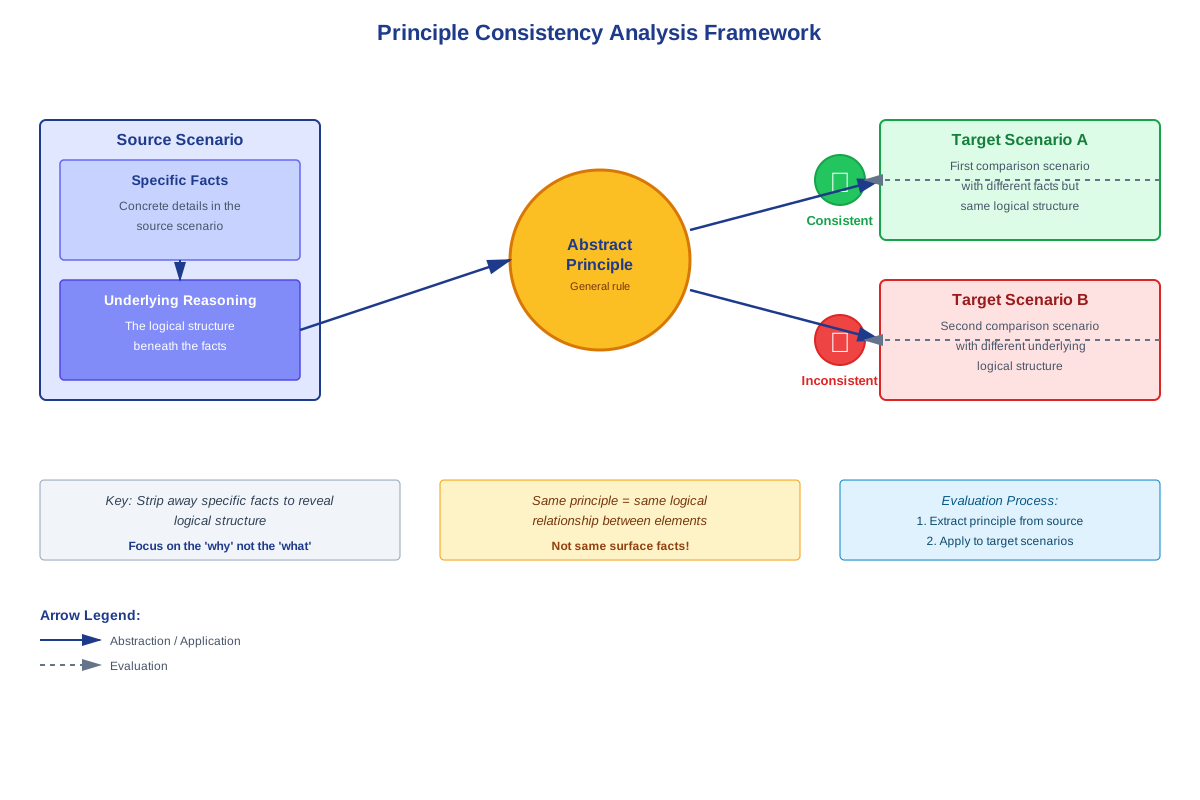
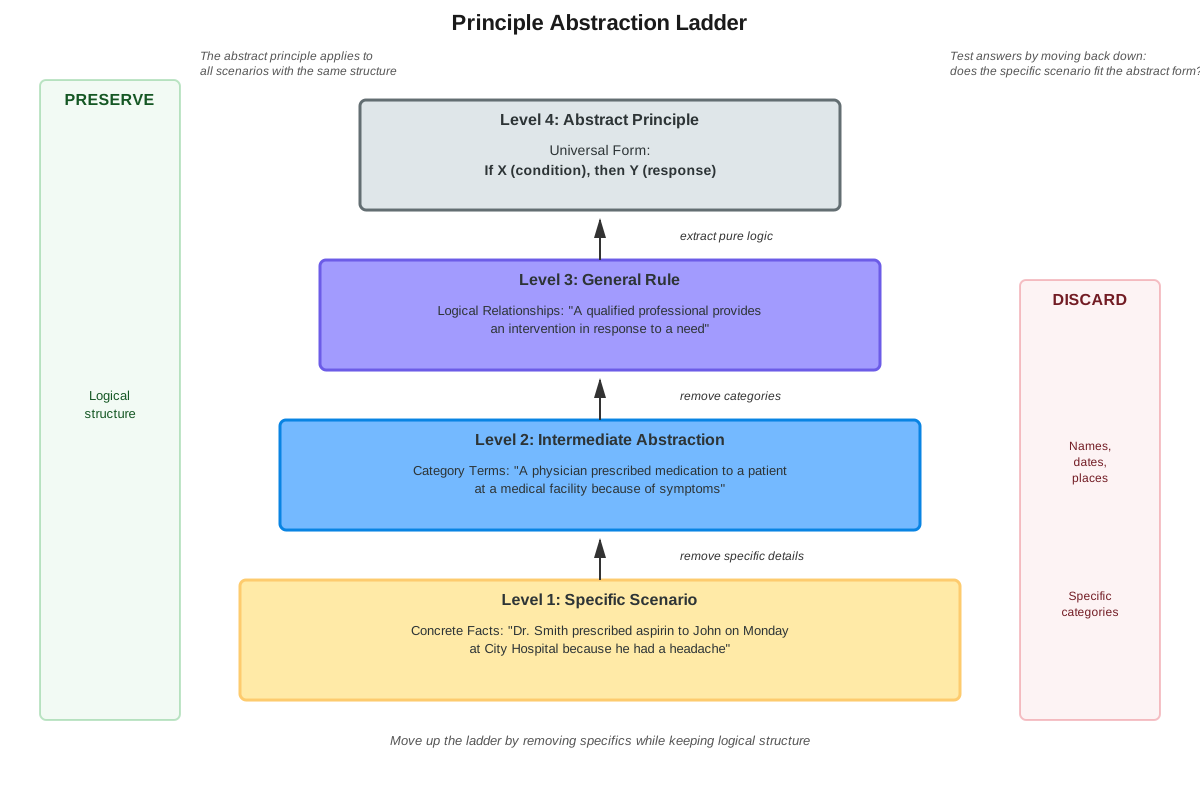
At its core, principle consistency requires two skills: abstraction (identifying the general rule underlying a specific judgment) and application (determining whether that rule applies to a new scenario). The LSAT tests whether you can strip away irrelevant surface details to identify the logical structure that actually drives the reasoning.
The Anatomy of a Principle
Principles on the LSAT typically have three components:
- Trigger conditions: The circumstances under which the principle applies
- Action or judgment: What should be done or concluded when conditions are met
- Underlying rationale: The reason or value that justifies the principle
For example, consider: "When a company's actions harm the environment, the company should be required to pay for remediation, because those who cause damage should bear the costs of repair."
- Trigger: Company actions harm environment
- Action: Company should pay for remediation
- Rationale: Causers of damage should bear repair costs
Identifying Relevant vs. Irrelevant Features
The most challenging aspect of principle consistency is determining which features matter. The LSAT deliberately includes distracting details that seem important but are logically irrelevant to the principle.
Relevant features are those that the principle explicitly or implicitly depends on. If changing a feature would change the judgment according to the principle, that feature is relevant.
Irrelevant features are contextual details that don't affect whether the principle applies. These might include specific names, locations, exact dollar amounts (when the principle concerns relative amounts), or particular subject matter (when the principle applies across domains).
Types of Principle Consistency Questions
| Question Type | What It Tests | Key Strategy |
|---|---|---|
| Parallel Reasoning | Whether two arguments share the same logical structure | Abstract both arguments to their logical form; match structure, not content |
| Principle Application | Whether a stated principle applies to a new scenario | Identify trigger conditions; check if new scenario meets them |
| Principle Identification | Which general rule justifies a specific judgment | Work backward from judgment to find the rule that would support it |
| Consistency Evaluation | Whether someone applies their own principle consistently | Check if the same standard is used in both situations |
The Abstraction Process
To determine principle consistency, follow this systematic abstraction process:
- Identify the judgment or conclusion: What decision or evaluation is being made?
- Identify the facts that support it: What specific circumstances led to this judgment?
- Determine the logical relationship: How do the facts connect to the judgment?
- Formulate the general principle: What rule would make this reasoning valid?
- Test the principle: Does it apply consistently to the comparison scenario?
Common Principle Structures
Principles on the LSAT often follow predictable logical patterns:
- Conditional principles: "If X, then Y" (e.g., "If an action benefits society, it should be encouraged")
- Comparative principles: "More X requires more Y" (e.g., "Greater responsibility requires greater accountability")
- Proportionality principles: "X should be proportional to Y" (e.g., "Punishment should fit the crime")
- Fairness principles: "Similar cases should be treated similarly" (e.g., "Equal work deserves equal pay")
- Causal responsibility principles: "Those who cause X should address Y" (e.g., "Polluters should pay for cleanup")
Matching Logical Structure
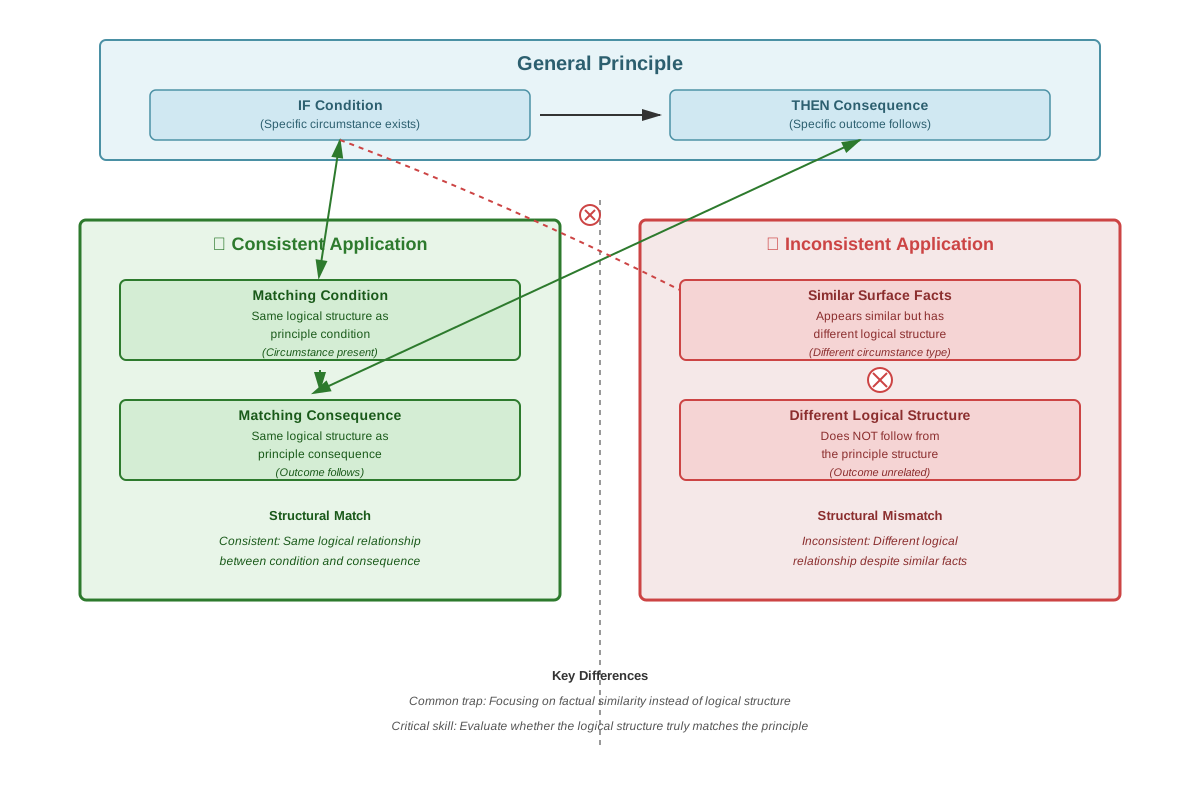
When evaluating whether two scenarios follow the same principle, you must match their logical structure, not their surface content. Consider these two arguments:
Argument 1: "This medication should be approved because it effectively treats the disease and has minimal side effects."
Argument 2: "This textbook should be adopted because it covers the required material comprehensively and is affordable."
These share the same structure: "X should be chosen because it satisfies criterion A and criterion B." The specific subject matter (medication vs. textbook) is irrelevant to the logical pattern.
Recognizing Inconsistent Application
Principle inconsistency occurs when:
- The same principle is applied in one case but not another relevantly similar case
- Different standards are used for situations that should be treated the same
- A principle is applied selectively based on irrelevant features
- The scope of a principle is arbitrarily limited without justification
For example, if someone argues "We shouldn't ban plastic bags because banning things restricts freedom" but also supports banning fireworks, they're applying the freedom principle inconsistently—unless they can identify a relevant difference between the cases.
Concept Relationships
The concepts within principle consistency build hierarchically. Abstraction is the foundational skill that enables everything else—you cannot evaluate consistency without first identifying the principle. Once you can abstract principles, you can then perform application (testing whether a principle applies to new scenarios) and comparison (determining whether two scenarios invoke the same principle).
Principle consistency connects directly to conditional reasoning because many principles are structured as conditional statements. Understanding sufficient and necessary conditions helps you determine whether trigger conditions are met. It also connects to argument structure analysis because identifying a principle requires recognizing how premises support conclusions.
The relationship map flows as follows:
Argument Structure → enables → Abstraction → enables → Principle Identification → enables → Consistency Evaluation
Conditional Reasoning → supports → Principle Application → feeds into → Consistency Evaluation
Analogical Reasoning → underlies → Comparison of Scenarios → determines → Consistency Evaluation
Understanding principle consistency also enhances performance on flaw questions (many flaws involve inconsistent application), strengthen/weaken questions (principles can strengthen or weaken arguments), and assumption questions (principles often function as unstated assumptions).
High-Yield Facts
⭐ Principle consistency requires matching logical structure, not surface content—the specific subject matter is almost always irrelevant.
⭐ The most common trap is focusing on irrelevant similarities—just because two scenarios share some features doesn't mean they follow the same principle.
⭐ Conditional principles require exact matching of trigger conditions—if the trigger isn't met, the principle doesn't apply, regardless of other similarities.
⭐ When abstracting a principle, focus on the relationship between facts and judgment—not just the facts themselves.
⭐ Inconsistent application is a logical flaw—if someone applies a principle selectively without justification, their reasoning is flawed.
- Principles can be stated explicitly or must be inferred from the reasoning pattern.
- The scope of a principle matters—a principle about "all employees" differs from one about "full-time employees."
- Proportionality matters in comparative principles—"more X requires more Y" is different from "X requires Y."
- Negative applications count—if a principle says "X should happen," it implies "without X, it shouldn't happen."
- Multiple principles can apply to the same situation—the question is which one the argument actually relies on.
- Exceptions to principles must be justified by relevant differences—arbitrary exceptions indicate inconsistency.
- The strength of a principle matters—"X should always lead to Y" is stronger than "X typically leads to Y."
- Principles can conflict—recognizing when two valid principles point in different directions is important.
- The underlying rationale helps identify the principle's scope—understanding why a principle exists clarifies when it applies.
- Parallel reasoning questions are essentially principle consistency questions in disguise—they test whether two arguments follow the same logical pattern.
Common Misconceptions
Misconception: If two scenarios share any common features, they follow the same principle.
Correction: Only features that are logically relevant to the principle matter. Two scenarios can share many surface similarities while following completely different logical patterns. Focus on the relationship between facts and conclusions, not the facts themselves.
Misconception: Principle consistency means the same conclusion must be reached in both scenarios.
Correction: Consistent application of a principle can lead to different conclusions if the relevant facts differ. The principle is consistent if it's applied using the same criteria, even if those criteria are met in one case but not another.
Misconception: More complex or detailed principles are more likely to be correct.
Correction: The LSAT rewards the simplest principle that accurately captures the reasoning. Overly specific principles that include irrelevant details are usually wrong. The correct principle is typically more abstract and general.
Misconception: If a principle works in the original scenario, it must be the right principle.
Correction: Multiple principles might justify the original judgment. The correct answer is the one that also applies consistently to the comparison scenario or that the argument actually relies on. Always test principles against all relevant scenarios.
Misconception: Parallel reasoning questions require finding arguments about the same topic.
Correction: Parallel reasoning questions specifically test whether you can ignore content and focus on structure. The correct answer will almost always be about a completely different topic—that's the point. If an answer choice discusses the same subject matter, it's likely a trap.
Misconception: Principles must be explicitly stated to be identified.
Correction: Most LSAT principle questions require you to infer the principle from the reasoning pattern. The principle is the unstated rule that would make the argument valid or that explains why a particular judgment was made.
Misconception: Emotional or ethical similarity indicates the same principle.
Correction: Two scenarios might feel similar or invoke similar values while following different logical principles. The LSAT tests logical structure, not moral intuition. Always abstract to the logical form.
Quick check — test yourself on Principle consistency so far.
Try Flashcards →Worked Examples
Example 1: Parallel Reasoning
Original Argument: "The city should not build the new stadium using public funds. While the stadium would create some jobs, the primary beneficiaries would be the team owners, who are private individuals. Public funds should only be used for projects that primarily benefit the public."
Question: Which of the following exhibits reasoning most similar to that above?
Answer Choices:
(A) The government should not subsidize the arts because, although art enriches culture, most people don't visit museums regularly.
(B) The university should not use tuition money to renovate the president's residence because, although the residence hosts some university events, the primary beneficiary is the president, who is a private individual, and tuition money should only be used for projects that primarily benefit students.
(C) The company should not expand into new markets because, while expansion might increase revenue, it would primarily benefit shareholders rather than employees.
(D) The town should not approve the development because, although it would increase tax revenue, it would primarily benefit the developer, and developments should only be approved if they benefit the town.
Step-by-Step Solution:
- Abstract the original argument's structure:
- Premise 1: Action X would have some positive effect Y
- Premise 2: However, the primary beneficiary would be private individual/entity Z
- Premise 3: Resource R should only be used for projects that primarily benefit group G
- Conclusion: Therefore, resource R should not be used for action X
- Identify the key logical features:
- Acknowledges a benefit but dismisses it as insufficient
- Focuses on who the PRIMARY beneficiary is
- Applies a principle about proper use of a specific resource
- The resource and the primary beneficiary group must match (public funds → public benefit)
- Evaluate each answer:
(A) Structure: Government shouldn't subsidize arts because most people don't visit museums.
- Missing: No mention of primary beneficiaries
- Missing: No principle about resource allocation
- Flaw: Focuses on frequency of use, not primary benefit
- Verdict: Incorrect structure
(B) Structure: University shouldn't use tuition money for president's residence because primary beneficiary is president (private individual), and tuition money should only benefit students.
- ✓ Acknowledges some benefit (hosts university events)
- ✓ Identifies primary beneficiary as private individual
- ✓ States principle about proper use of specific resource
- ✓ Resource and beneficiary group match (tuition → students)
- Verdict: Perfect structural match
(C) Structure: Company shouldn't expand because it benefits shareholders rather than employees.
- Missing: No principle about resource allocation
- Missing: No specific resource being discussed
- Flaw: Just states who benefits, doesn't invoke a principle about proper use
- Verdict: Incomplete structure
(D) Structure: Town shouldn't approve development because it benefits developer, and developments should benefit the town.
- ✓ Identifies primary beneficiary
- ✓ States a principle
- Problem: The resource isn't clearly specified (approval isn't a resource like funds)
- Problem: The principle is about developments generally, not about proper use of a specific resource
- Verdict: Close but imperfect match
Answer: (B)
Connection to Learning Objectives: This example demonstrates how to identify principle consistency in parallel reasoning questions by abstracting the logical structure and matching it precisely, ignoring content differences.
Example 2: Principle Application
Stated Principle: "A professional has a duty to refuse a client's request if fulfilling that request would require the professional to violate established ethical guidelines of their profession, even if the request is legal and the client would benefit from it."
Scenario: Dr. Martinez, a physician, has a patient who requests a prescription for antibiotics to prevent infection during an upcoming trip, even though the patient has no current infection. Prescribing antibiotics without a diagnosed infection violates medical guidelines designed to prevent antibiotic resistance.
Question: Does the principle require Dr. Martinez to refuse the request?
Step-by-Step Analysis:
- Identify the principle's components:
- Trigger condition 1: Professional receives client request
- Trigger condition 2: Fulfilling request would violate professional ethical guidelines
- Specified non-factors: Request is legal (doesn't matter)
- Specified non-factors: Client would benefit (doesn't matter)
- Required action: Professional must refuse
- Map the scenario to the principle:
- Is Dr. Martinez a professional? Yes (physician)
- Did Dr. Martinez receive a client request? Yes (patient requested prescription)
- Would fulfilling it violate professional ethical guidelines? Yes (violates medical guidelines on antibiotic prescribing)
- Is the request legal? Yes (but the principle says this doesn't matter)
- Would the client benefit? Possibly (might prevent infection, but the principle says this doesn't matter)
- Apply the principle:
All trigger conditions are met. The principle explicitly states that legality and client benefit don't override the duty to refuse when ethical guidelines would be violated.
- Evaluate potential objections:
- "But the patient might benefit" → The principle explicitly addresses this: benefit doesn't override ethical guidelines
- "But it's legal" → The principle explicitly addresses this: legality doesn't override ethical guidelines
- "But it's a minor violation" → The principle doesn't distinguish between major and minor violations
Conclusion: Yes, the principle requires Dr. Martinez to refuse the request. All trigger conditions are satisfied, and the specified non-factors (legality and benefit) are present but explicitly don't override the duty to refuse.
Connection to Learning Objectives: This example demonstrates how to apply a stated principle to a new scenario by carefully identifying trigger conditions, recognizing specified non-factors, and avoiding the temptation to import considerations the principle doesn't include.
Exam Strategy
Approaching Principle Consistency Questions
Step 1: Identify the question type. Look for keywords: "principle," "reasoning most similar," "conforms to the same principle," "parallel," "illustrates the same proposition." Each type requires slightly different handling, but all test principle consistency.
Step 2: Abstract before you evaluate. For the original argument or scenario, write down the logical structure in your scratch space using variables (X, Y, Z) rather than specific content. This prevents content-based distraction.
Step 3: Identify what matters. Determine which features are logically relevant to the principle. Ask: "If I changed this feature, would the judgment change according to the principle?"
Step 4: Predict the pattern. Before looking at answer choices, articulate what the correct answer must include. For parallel reasoning, predict the structure. For principle application, predict what features the new scenario must have.
Trigger Words and Phrases
Watch for these question stems:
- "The pattern of reasoning in which one of the following is most similar to that in the argument above?"
- "Which one of the following judgments conforms to the principle illustrated above?"
- "The flawed reasoning in the argument above is most similar to that in which one of the following?"
- "Which one of the following principles, if valid, most helps to justify the reasoning?"
- "The reasoning above most closely conforms to which one of the following principles?"
In answer choices, watch for:
- Conditional language ("if," "when," "whenever," "only if")
- Comparative language ("more," "less," "greater," "primary")
- Scope indicators ("all," "some," "most," "only")
- Causal language ("because," "results in," "leads to")
Process of Elimination Tips
Eliminate answers that:
- Match content but not structure (the most common trap)
- Include irrelevant features from the original as if they matter
- Have different logical relationships between premises and conclusion
- Apply the principle too broadly or too narrowly
- Introduce new considerations not present in the original principle
- Reverse the direction of reasoning (e.g., if the original goes from specific to general, the answer must too)
Keep answers that:
- Match the abstract logical structure even with completely different content
- Preserve the same type of reasoning (conditional, comparative, causal, etc.)
- Include all logically necessary components
- Maintain the same scope and strength of claims
Time Allocation
Principle consistency questions, especially parallel reasoning, are often time-consuming. Budget approximately:
- 30-45 seconds: Reading and abstracting the original argument
- 15-20 seconds per answer choice: Evaluating structure
- Total: 2-2.5 minutes for most principle questions
If you find yourself spending more than 3 minutes, you're likely getting lost in content rather than focusing on structure. Reset by re-abstracting the original argument.
Exam Tip: On parallel reasoning questions, if you're stuck between two answers, check the conclusion type. If the original concludes with a recommendation ("should do X"), the correct answer must also conclude with a recommendation, not a prediction or explanation.
Memory Techniques
The MATCH Acronym
For evaluating principle consistency, remember MATCH:
- Map the structure (abstract to logical form)
- Analyze trigger conditions (what must be present?)
- Test relevant features (what actually matters?)
- Compare relationships (how do facts connect to conclusions?)
- Hold content constant (ignore surface differences)
The "Skeleton" Visualization
Imagine each argument as a skeleton. The bones are the logical structure; the flesh is the specific content. Principle consistency questions ask whether two skeletons have the same shape—the flesh is irrelevant. When evaluating answers, visualize stripping away all the flesh to see if the bones match.
The Three-Part Principle Formula
Most principles follow this pattern: WHEN [trigger conditions] THEN [action/judgment] BECAUSE [rationale]
Memorize this formula and fill it in for every principle you encounter. If you can't fill in all three parts, you haven't fully understood the principle.
The "Swap Test"
To determine if a feature is relevant, use the swap test: Mentally swap that feature for something different. If the principle would lead to a different judgment, the feature is relevant. If the judgment stays the same, the feature is irrelevant.
For example, if a principle says "Companies that pollute should pay fines," swap "companies" for "individuals." Does the principle still apply? If yes, then the specific identity as a company is irrelevant—what matters is the polluting action.
Summary
Principle consistency is the uniform application of general rules across different scenarios, requiring test-takers to abstract logical structures from specific content and evaluate whether the same underlying reasoning pattern applies. Success on these questions depends on distinguishing relevant features (those the principle depends on) from irrelevant surface details (contextual information that doesn't affect the principle's application). The core skill is abstraction—identifying the logical skeleton beneath the factual flesh—followed by careful comparison of structures rather than content. Principle consistency appears in multiple question types including parallel reasoning, principle application, and principle identification, collectively representing 15-20% of Logical Reasoning questions. The most common error is matching content rather than structure, while the key to success is systematically abstracting arguments to their logical form using variables rather than specific terms. Understanding principle consistency strengthens performance across all Logical Reasoning question types because it develops the fundamental skill of recognizing logical patterns independent of subject matter.
Key Takeaways
- Principle consistency requires matching logical structure, not content—the specific subject matter is almost always a distraction designed to trap test-takers who focus on surface similarities.
- Abstraction is the foundational skill—you must identify the general rule underlying specific judgments before you can evaluate whether it's being applied consistently.
- Relevant features are those the principle depends on—use the swap test to determine whether changing a feature would change the judgment according to the principle.
- Conditional principles require exact matching of trigger conditions—if the conditions aren't met, the principle doesn't apply, regardless of other similarities.
- The MATCH process provides a systematic approach: Map structure, Analyze triggers, Test features, Compare relationships, Hold content constant.
- Parallel reasoning questions test the same skill as other principle questions—they all require recognizing when the same logical pattern appears in different contexts.
- Time management is crucial—abstract quickly, evaluate systematically, and don't get lost in content details that don't affect the logical structure.
Related Topics
Conditional Reasoning: Many principles are structured as conditional statements, so deepening your understanding of sufficient and necessary conditions will enhance your ability to identify and apply principles consistently. Mastering conditional logic provides the foundation for recognizing when trigger conditions are met.
Argument Structure and Diagramming: The ability to break down arguments into premises and conclusions and diagram their relationships directly supports principle abstraction. Strong argument structure skills make identifying the logical skeleton much faster.
Flaw Questions: Many logical flaws involve inconsistent application of principles or faulty analogies. Understanding principle consistency helps you recognize when an argument applies a standard selectively or draws inappropriate comparisons.
Strengthen and Weaken Questions: Principles often function as strengtheners (when they support an argument's reasoning) or weakeners (when they undermine it). Recognizing principles helps you predict what would strengthen or weaken arguments.
Assumption Questions: Principles frequently appear as unstated assumptions that bridge premises to conclusions. Identifying the principle an argument relies on is often the key to finding its necessary assumption.
Practice CTA
Now that you understand the core concepts of principle consistency, it's time to apply this knowledge to actual LSAT questions. The practice questions and flashcards will help you develop the pattern recognition and abstraction skills that separate good LSAT scores from great ones. Remember: principle consistency is a skill that improves dramatically with deliberate practice. Each question you work through strengthens your ability to see through surface content to the underlying logical structure. Start with the practice questions, focusing on articulating the principle in your own words before evaluating answer choices. You've built the foundation—now it's time to build the skill through application. Your ability to master this high-yield topic will directly translate to points on test day.
Sign up free to keep reading
Create a free AnvayaPrep account to finish this LSAT guide on Principle consistency — plus flashcards and practice questions.