Overview
Principle necessary assumption questions represent a sophisticated hybrid question type on the LSAT that combines two fundamental skills tested in Logical Reasoning: understanding necessary assumptions and applying general principles to specific situations. These questions ask test-takers to identify a broad, abstract rule or principle that must be true for an argument to hold, rather than simply finding a missing factual premise. This question type typically appears 2-3 times per LSAT exam and requires students to think at a higher level of abstraction than standard necessary assumption questions.
The challenge of principle necessary assumption questions lies in their dual nature. Students must first identify what assumption the argument depends upon—what unstated premise bridges the gap between evidence and conclusion. Then, they must recognize this assumption in its most general, principle-based form. Rather than accepting an answer that merely fills the logical gap with specific facts, test-takers must select the answer choice that expresses a universal rule or standard that, when applied to the argument's specific circumstances, makes the reasoning valid. This requires both precise logical analysis and the ability to move fluidly between concrete examples and abstract principles.
Within the broader landscape of LSAT principle questions, this question type sits at the intersection of assumption family questions and principle application questions. Mastering principle necessary assumptions builds directly on skills from standard necessary assumption questions while preparing students for the full range of principle-based reasoning that appears throughout the Logical Reasoning section. Success with these questions demonstrates sophisticated analytical thinking—the ability to extract general rules from specific cases and recognize when an argument implicitly relies on a broader standard of reasoning.
Learning Objectives
- [ ] Identify how Principle necessary assumption appears in LSAT questions
- [ ] Explain the reasoning pattern behind Principle necessary assumption
- [ ] Apply Principle necessary assumption to solve LSAT-style problems accurately
- [ ] Distinguish between principle necessary assumptions and standard necessary assumptions
- [ ] Evaluate answer choices by testing whether they express sufficiently general principles
- [ ] Recognize common principle structures that appear in correct answers
- [ ] Apply the negation test to principle-based answer choices effectively
Prerequisites
- Standard Necessary Assumption Questions: Understanding how to identify gaps between premises and conclusions is fundamental, as principle necessary assumptions build directly on this skill by requiring the gap to be filled with a general rule rather than a specific fact.
- Conditional Reasoning: Recognizing sufficient and necessary conditions helps students understand how principles function as rules that govern when certain conclusions can be drawn from certain evidence.
- Argument Structure Analysis: The ability to identify premises, conclusions, and intermediate steps is essential because principle necessary assumptions require precise understanding of where the logical gap exists before finding the principle that bridges it.
- Basic Principle Questions: Familiarity with how principles function as general rules that apply across multiple situations provides the foundation for recognizing when an assumption must take the form of a broader principle.
Why This Topic Matters
Principle necessary assumption questions test one of the most sophisticated reasoning skills required for legal thinking: the ability to identify the implicit rules and standards that underlie specific arguments. In legal practice, attorneys constantly work between particular cases and general principles, recognizing when a specific argument depends on accepting a broader legal standard or rule. This question type directly mirrors the analytical reasoning required in law school case analysis and legal argumentation.
On the LSAT, principle necessary assumption questions typically appear 2-3 times per exam, accounting for approximately 4-6% of all Logical Reasoning questions. While this frequency might seem modest, these questions are considered medium-to-high difficulty, meaning they often serve as differentiators between good and excellent scores. Students who master this question type gain a significant competitive advantage, as many test-takers struggle with the abstraction required to move from specific arguments to general principles.
These questions most commonly appear in arguments involving ethical reasoning, policy recommendations, causal explanations, and evaluative judgments. The LSAT frequently presents arguments where someone makes a specific recommendation or judgment, and the correct answer identifies the general principle or standard that must be accepted for that specific judgment to be justified. Question stems typically include phrases like "Which one of the following principles is assumed by the argument?" or "The argument depends on assuming which one of the following principles?" This explicit language signals that test-takers must think in terms of general rules rather than specific facts.
Core Concepts
Understanding Principle Necessary Assumptions
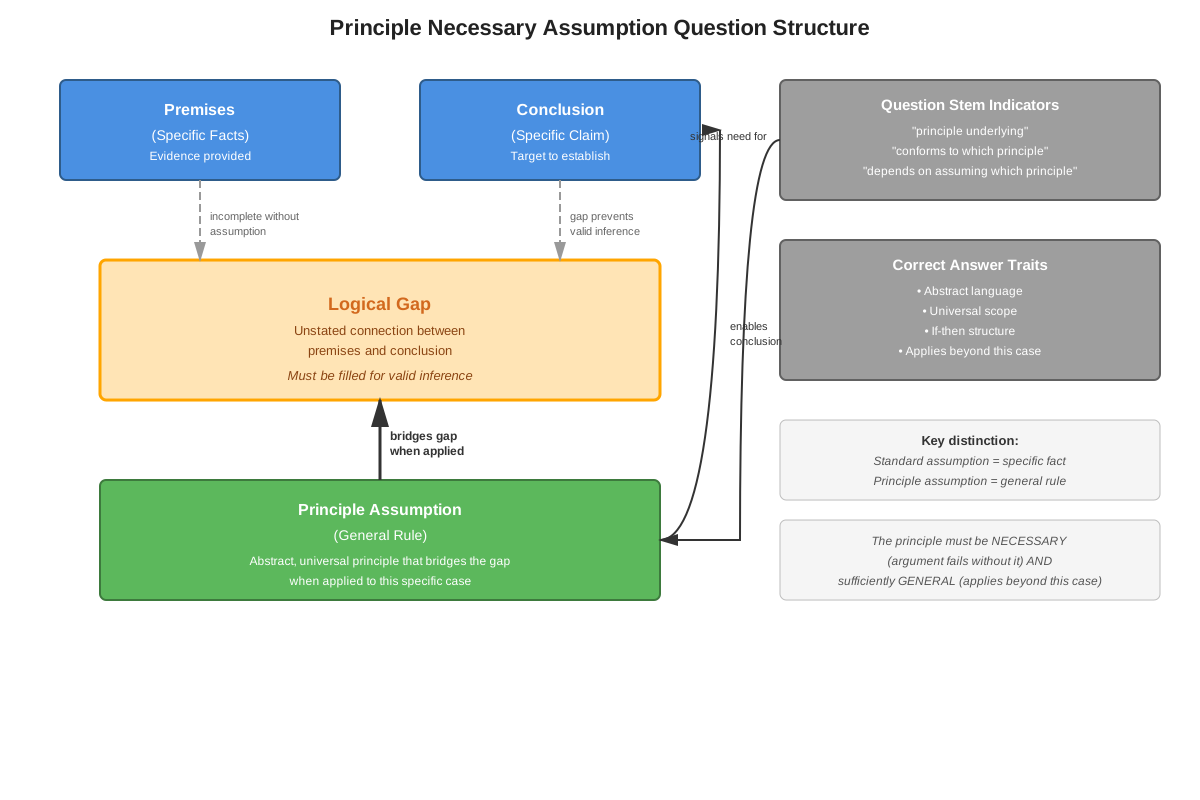
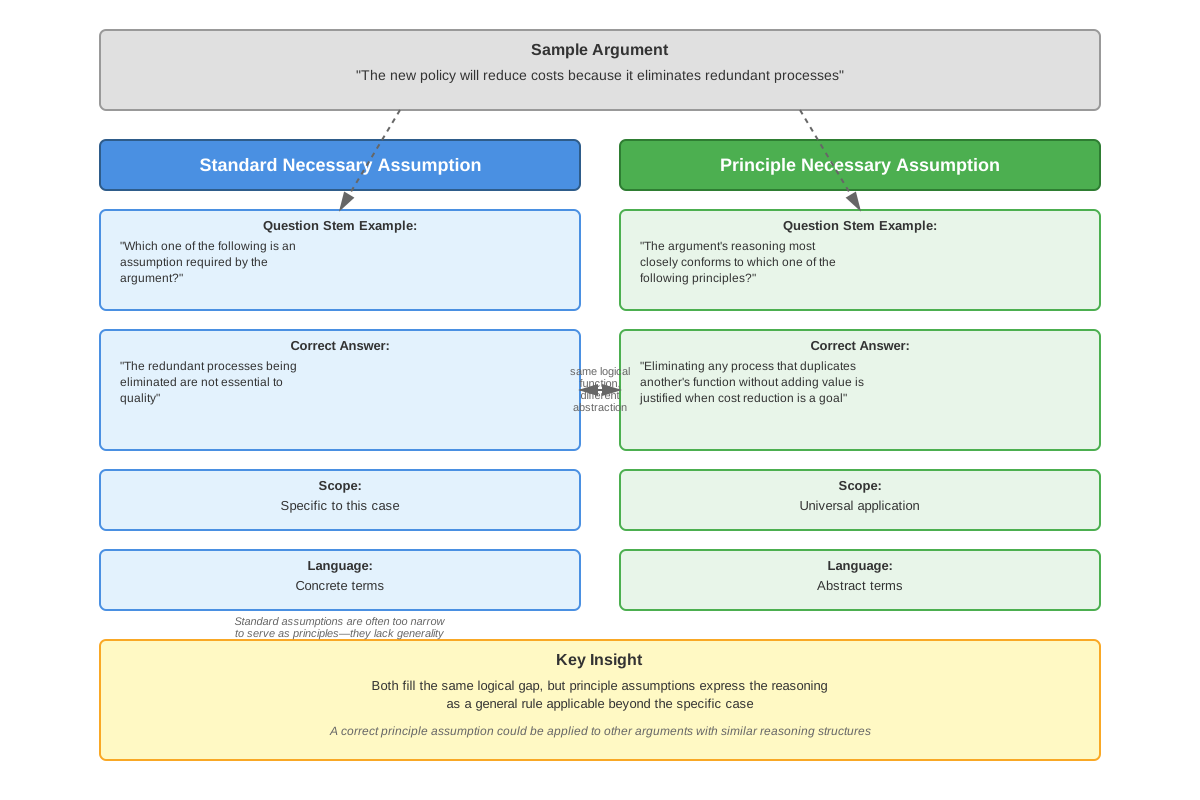
A principle necessary assumption is a general rule, standard, or guideline that an argument must accept as true for its reasoning to be valid. Unlike standard necessary assumptions that might fill logical gaps with specific facts or claims, principle necessary assumptions operate at a higher level of abstraction. They express universal or broadly applicable rules that, when applied to the specific situation in the argument, make the conclusion follow from the premises.
The key distinction lies in generality and scope. Consider an argument concluding that "Company X should not expand into Market Y because it lacks expertise in that market." A standard necessary assumption might be "Lacking expertise in a market makes expansion risky for Company X." A principle necessary assumption would be more general: "Companies should not expand into markets where they lack expertise" or "Businesses should avoid undertaking ventures in areas where they lack relevant expertise." The principle version applies not just to Company X and Market Y, but to any similar situation.
The Structure of Principle-Based Arguments
Arguments that require principle necessary assumptions typically follow a recognizable pattern. They present a specific situation with particular facts, then draw a conclusion that involves a judgment, recommendation, or evaluation. The gap between premises and conclusion exists at the level of general standards—the argument implicitly relies on accepting a broader rule that justifies applying the specific facts to reach the specific conclusion.
The logical structure can be mapped as follows:
- Specific Premises: Facts about a particular situation, person, or case
- Implicit Principle: An unstated general rule or standard (the necessary assumption)
- Application: The principle applied to the specific situation
- Specific Conclusion: A judgment, recommendation, or evaluation about the particular case
For example: "The museum should not accept the donation because it comes from a questionable source" relies on a principle like "Institutions should not accept donations from questionable sources" or more broadly, "Organizations should avoid associations that might compromise their integrity."
Identifying Principle Gaps in Arguments
The first step in solving principle necessary assumption questions is recognizing where the principle gap exists. This requires careful analysis of the argument's logical structure. Look for conclusions that make evaluative judgments (should/should not, right/wrong, justified/unjustified) or recommendations based on specific facts. The gap typically exists between descriptive premises (what is the case) and prescriptive conclusions (what should be done or how something should be evaluated).
Common indicators of principle gaps include:
- Shifts from factual descriptions to value judgments
- Conclusions containing normative language (ought, should, must, right, wrong)
- Recommendations based on specific circumstances
- Evaluations that apply standards not explicitly stated in the premises
- Arguments that move from "X has property Y" to "X should/should not do Z"
Characteristics of Correct Principle Answers
Correct answers to principle necessary assumption questions share several key characteristics. First, they express genuinely general rules that could apply beyond the specific case in the argument. Second, they are necessary—the argument truly depends on them, which can be verified through the negation test. Third, they are sufficient in scope to bridge the logical gap without being overly broad or introducing irrelevant new considerations.
| Feature | Correct Principle Answer | Incorrect Answer |
|---|---|---|
| Generality | Applies to broad category of cases | Too specific to the argument's exact facts |
| Necessity | Argument fails if principle is negated | Argument can succeed without it |
| Scope | Covers the relevant gap precisely | Too broad or introduces new issues |
| Abstraction Level | Expresses a rule or standard | States a specific fact or prediction |
Applying the Negation Test to Principles
The negation test remains the most reliable method for confirming necessary assumptions, including principle necessary assumptions. To apply it: negate the principle in the answer choice, then determine whether the argument's conclusion can still be properly drawn from its premises. If negating the principle causes the argument to fall apart, the principle is necessary. If the argument can still work, the principle is not necessary.
For principle questions, negation requires careful attention to the scope of the principle. Negating "Companies should avoid markets where they lack expertise" yields "Companies need not avoid markets where they lack expertise" or "It is acceptable for companies to enter markets where they lack expertise." If this negation destroys the argument's reasoning, the principle is necessary.
Common Principle Structures
Certain principle structures appear repeatedly in correct answers:
- Conditional Principles: "If X has property Y, then X should/should not do Z"
- Comparative Principles: "X should be treated similarly to Y when they share relevant characteristic Z"
- Priority Principles: "Consideration X should take precedence over consideration Y"
- Exclusionary Principles: "X should not be done when condition Y is present"
- Requirement Principles: "X should only be done when condition Y is met"
Recognizing these structures helps test-takers quickly identify answer choices that have the right form to function as principles, even before evaluating their specific content.
Distinguishing from Standard Necessary Assumptions
The critical skill in principle necessary assumption questions is distinguishing them from standard necessary assumptions. Both question types ask what the argument must assume, but they differ in the level of abstraction required in the answer. Standard necessary assumption answers might state specific facts, predictions, or claims about the particular case. Principle necessary assumption answers must express general rules.
Consider this argument: "Sarah should not be hired as a pilot because she has poor vision." A standard necessary assumption might be "Poor vision impairs piloting ability" or "Sarah's vision cannot be corrected." A principle necessary assumption would be "People with poor vision should not be hired as pilots" or more generally, "Individuals should not be hired for positions requiring abilities they lack."
Concept Relationships
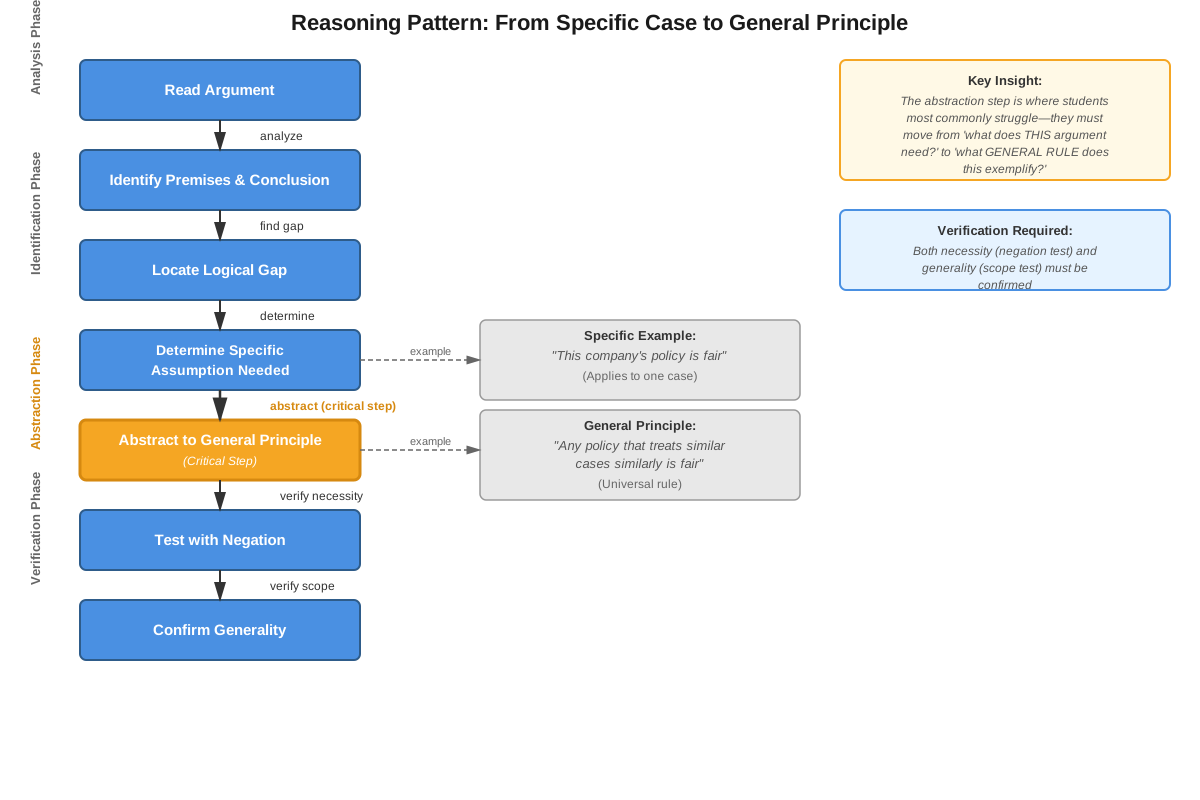
The concepts within principle necessary assumption questions form a hierarchical relationship. At the foundation lies argument structure analysis—identifying premises and conclusions. This enables gap identification, recognizing where the argument makes an inferential leap. Gap identification leads to assumption recognition, understanding what must be true for the conclusion to follow. Finally, principle abstraction transforms the specific assumption into a general rule.
These concepts connect directly to prerequisite knowledge. Standard necessary assumption skills provide the foundation for identifying what the argument needs, while principle questions more broadly provide the framework for thinking in terms of general rules. The synthesis of these two areas creates the unique challenge of principle necessary assumption questions.
Looking forward, mastering principle necessary assumptions prepares students for principle application questions (where a principle is given and must be applied), parallel reasoning questions (which require recognizing abstract logical structures), and method of reasoning questions (which ask students to describe argumentative strategies at an abstract level). The skill of moving between specific cases and general principles proves valuable across multiple question types.
The relationship map flows as follows:
Argument Analysis → Gap Identification → Assumption Recognition → Principle Abstraction → Answer Evaluation → Negation Test Confirmation
High-Yield Facts
⭐ Principle necessary assumption questions require answers that express general rules, not specific facts about the particular case in the argument.
⭐ The negation test works for principle assumptions: if negating the principle destroys the argument, the principle is necessary.
⭐ Correct answers must be both sufficiently general (applying beyond the specific case) and sufficiently narrow (not introducing irrelevant new considerations).
⭐ Question stems explicitly use the word "principle" to signal that answers must be abstract rules rather than specific claims.
⭐ The logical gap in these arguments typically exists between descriptive premises and prescriptive/evaluative conclusions.
- Principle necessary assumptions often involve normative language: should, ought, must, right, wrong, justified, appropriate.
- Common wrong answers are too specific, essentially restating the argument's conclusion rather than expressing a general principle.
- Another common trap answer type is principles that are too broad, introducing considerations not relevant to the argument's reasoning.
- Arguments requiring principle assumptions frequently involve ethical judgments, policy recommendations, or evaluative standards.
- The correct principle, when applied to the argument's specific facts, must make the conclusion follow logically from the premises.
- Principle necessary assumptions differ from principle application questions, where the principle is given in the stimulus rather than in the answer choices.
- Many principle necessary assumption questions can be solved by asking: "What general rule would justify this specific conclusion?"
Quick check — test yourself on Principle necessary assumption so far.
Try Flashcards →Common Misconceptions
Misconception: Any assumption that helps the argument is a correct answer to a principle necessary assumption question.
Correction: The assumption must be both necessary (required for the argument to work) and expressed as a general principle (applicable beyond the specific case). Many assumptions might help or strengthen an argument without being necessary, and many necessary assumptions might not be stated at a sufficiently general level to qualify as principles.
Misconception: The correct answer should closely match the specific language and details of the argument.
Correction: Correct principle answers operate at a higher level of abstraction than the argument itself. They should capture the general rule underlying the specific case, which means they will necessarily use more general terms than the argument's specific details. An argument about "hiring Sarah as a pilot" requires a principle about "hiring people for positions" or "employment decisions," not a principle specifically about Sarah.
Misconception: If an answer choice is true or reasonable, it must be the correct answer.
Correction: The correct answer must be necessary for the specific argument presented, not merely true or reasonable in general. Many principle statements might be perfectly valid rules that the test-taker agrees with, but if the argument doesn't depend on them, they're incorrect answers. Always apply the negation test to verify necessity.
Misconception: Principle necessary assumptions are the same as sufficient assumptions.
Correction: A necessary assumption is required for the argument to work (without it, the argument fails), while a sufficient assumption would guarantee the conclusion (with it, the argument definitely succeeds). Principle necessary assumptions identify what must be accepted, not what would be enough to prove the conclusion. The argument might need additional assumptions beyond the principle to be fully valid.
Misconception: The most general answer choice is always correct.
Correction: While correct answers must be general enough to function as principles, they must also be specific enough to actually bridge the gap in the argument. Overly broad principles that introduce irrelevant considerations or apply to situations far beyond the argument's scope are common wrong answers. The correct principle should be appropriately scoped to the type of reasoning in the argument.
Misconception: Principle necessary assumption questions are just harder versions of regular necessary assumption questions.
Correction: These questions require a qualitatively different skill—abstraction—not just more difficult logical analysis. Students must recognize the same logical gaps as in standard assumption questions but then identify the general rule underlying the specific assumption needed. This requires thinking at two levels simultaneously: the specific argument and the abstract principle.
Worked Examples
Example 1: Environmental Policy Argument
Argument: "The city council should not approve the new factory because it would increase air pollution in an area that already exceeds federal air quality standards. While the factory would create jobs, the health risks to residents are too significant."
Question: Which one of the following principles is assumed by the argument?
Answer Choices:
(A) Job creation should never be prioritized over environmental concerns.
(B) Cities should not approve projects that would worsen existing violations of federal standards.
(C) Air pollution poses serious health risks to urban residents.
(D) Economic benefits cannot justify increased health risks.
(E) Federal air quality standards should be strictly enforced.
Analysis:
First, identify the argument structure:
- Premise: The factory would increase air pollution in an area already exceeding federal standards
- Premise: The factory would create jobs
- Premise: Health risks to residents are significant
- Conclusion: The city council should not approve the factory
The gap exists between the descriptive facts (pollution would increase, area already exceeds standards, jobs would be created) and the prescriptive conclusion (should not approve). The argument acknowledges the job creation benefit but concludes against approval, implying a principle about when projects should be rejected.
Evaluating each choice:
(A) This is too extreme and too broad. The argument doesn't require that jobs should "never" be prioritized over environmental concerns—only that in this specific type of situation (worsening existing violations), they shouldn't be. The negation test confirms this: if job creation could sometimes be prioritized over environmental concerns, the argument could still work in this case where there's already a violation.
(B) This is the correct answer. It expresses a general principle (cities should not approve projects that worsen existing violations) that, when applied to this specific case, justifies the conclusion. Apply the negation test: "Cities may approve projects that worsen existing violations of federal standards." If this were true, the argument falls apart—the fact that the area already exceeds standards and the factory would make it worse would no longer support the conclusion that approval should be denied.
(C) This is a factual claim, not a principle. It doesn't express a rule about what should or should not be done. It's also already essentially stated in the premises (health risks are significant), so it's not an assumption.
(D) This is too broad. The argument doesn't require that economic benefits can never justify health risks in general—only that in this specific type of situation, they don't. Many situations might exist where economic benefits could justify some health risks, but the argument can still work.
(E) This is about enforcement of standards, but the argument is about whether to approve a project that would worsen a violation. The argument doesn't depend on any claim about how strictly standards should be enforced—it depends on whether projects that worsen violations should be approved.
Key Takeaway: The correct answer (B) is general enough to apply beyond this specific factory and city, but specific enough to capture the actual reasoning: the combination of an existing violation and a project that would worsen it is what drives the conclusion.
Example 2: Academic Integrity Argument
Argument: "Professor Martinez was wrong to give Chen a failing grade for plagiarism. While Chen did use several sentences from a source without proper citation, this was Chen's first offense, and Chen immediately acknowledged the mistake when confronted. The university's academic integrity policy states that first-time offenders who show genuine remorse should receive a warning rather than a failing grade."
Question: The argument's reasoning depends on assuming which one of the following principles?
Answer Choices:
(A) Students should not receive failing grades for first-time plagiarism offenses.
(B) Professors should follow university policies when determining penalties for academic misconduct.
(C) Acknowledging a mistake demonstrates genuine remorse.
(D) Plagiarism is less serious when it involves only a few sentences.
(E) Academic penalties should be proportionate to the severity of the offense.
Analysis:
Argument structure:
- Premise: Chen plagiarized (used sentences without citation)
- Premise: This was Chen's first offense
- Premise: Chen acknowledged the mistake when confronted
- Premise: University policy says first-time offenders showing genuine remorse should get warnings, not failing grades
- Conclusion: Professor Martinez was wrong to give Chen a failing grade
The argument moves from facts about Chen's case and the university policy to a conclusion that the professor was wrong. What principle bridges this gap?
Evaluating each choice:
(A) This is too narrow and doesn't capture the full reasoning. The argument doesn't just rely on it being a first offense—it also relies on Chen showing remorse and on the university policy. This answer ignores the policy aspect entirely.
(B) This is the correct answer. The argument concludes the professor was wrong specifically because the professor didn't follow the university policy. The principle that professors should follow university policies when determining penalties is necessary for this reasoning. Negation test: "Professors need not follow university policies when determining penalties." If this were true, the argument completely falls apart—the existence of the policy would be irrelevant to whether the professor was wrong.
(C) This is a necessary assumption but not a principle. It's a specific factual claim about Chen's case (that acknowledging the mistake shows genuine remorse), which is needed to establish that Chen meets the policy's criteria. However, it's not expressed as a general rule about what should or should not be done.
(D) This is not assumed by the argument. The argument never suggests that the amount of plagiarism matters—it focuses on the first-offense status and the remorse shown. The argument would work the same way regardless of how much was plagiarized.
(E) This is too vague and doesn't capture the specific reasoning. While the argument might be consistent with this principle, it doesn't depend on it. The argument's reasoning is specifically about following the stated policy, not about proportionality in general.
Key Takeaway: The correct answer (B) identifies the general principle (following institutional policies) that underlies the specific reasoning (this professor should have followed this university's policy in this case).
Exam Strategy
When approaching principle necessary assumption questions on the LSAT, begin by carefully reading the question stem to confirm it's asking for a principle that the argument assumes, not a principle that the argument illustrates or applies. The word "principle" combined with "assumes," "depends on assuming," or "requires assuming" signals this question type.
Step-by-step approach:
- Identify the conclusion and premises clearly: Underline or mentally note the argument's conclusion and main supporting premises. Pay special attention to normative language (should, ought, must, right, wrong).
- Locate the logical gap: Identify where the argument makes an inferential leap, particularly from descriptive facts to prescriptive conclusions or evaluative judgments.
- Articulate the gap as a principle: Before looking at answer choices, try to state in your own words what general rule the argument seems to rely on. This prediction helps you recognize the correct answer and avoid traps.
- Evaluate answer choices for appropriate generality: Eliminate choices that are too specific (essentially restating the argument's facts) or too broad (introducing irrelevant considerations or extreme positions).
- Apply the negation test to remaining choices: For choices that seem plausible, negate them and determine whether the argument can still work. The correct answer, when negated, will destroy the argument.
Trigger words and phrases to watch for:
- Question stems: "principle assumed," "depends on assuming which principle," "reasoning requires which principle"
- In arguments: should/should not, ought/ought not, right/wrong, justified/unjustified, appropriate/inappropriate
- Shifts from "is" to "ought" or from facts to recommendations
Process of elimination tips:
- Quickly eliminate answers that state specific facts rather than general rules
- Eliminate principles that are too extreme (using "never," "always," "only" when the argument doesn't require such absoluteness)
- Eliminate principles that introduce new concepts not relevant to the argument's reasoning
- Be suspicious of answers that you strongly agree with but that don't specifically bridge the argument's gap
Time allocation: These questions typically require 1.5-2 minutes. Don't rush the initial argument analysis—spending 30-40 seconds understanding the structure saves time by making answer evaluation more efficient. If stuck between two choices, the negation test usually takes only 15-20 seconds per choice and provides definitive answers.
Memory Techniques
PRINCIPLE Acronym for evaluating answer choices:
- Prescriptive (expresses what should/shouldn't be done)
- Relevant (addresses the actual gap in reasoning)
- Independent (not already stated in premises)
- Necessary (argument fails without it)
- Comprehensive (covers the full scope of the gap)
- Inferential (bridges premises to conclusion)
- Properly general (applies beyond the specific case)
- Logical (makes sense when applied)
- Essential (verified by negation test)
Visualization strategy: Picture the argument as a bridge with the premises on one side and the conclusion on the other. The principle is the supporting structure underneath that makes the bridge stable. If the principle is removed (negated), the bridge collapses. This image helps remember that principles support the reasoning structure itself, not just add additional facts.
The "Zoom Out" technique: When evaluating whether an answer choice is appropriately general, imagine zooming out from the specific case like a camera pulling back. The correct principle should still be visible and applicable when you've zoomed out to see many similar cases, but it shouldn't be so zoomed out that you've lost sight of the relevant features of the argument.
Mnemonic for common wrong answer types: "STEVE" helps remember what to avoid:
- Specific facts (not general principles)
- Too extreme (never/always when not required)
- Extraneous concepts (introducing irrelevant new ideas)
- Vague generalities (too broad to bridge the specific gap)
- Extra help (sufficient assumptions that do more than necessary)
Summary
Principle necessary assumption questions require test-takers to identify general rules or standards that arguments implicitly rely upon to reach their conclusions. These questions combine the logical gap analysis skills from standard necessary assumption questions with the abstraction skills from principle questions, creating a sophisticated reasoning challenge. The key to success lies in recognizing that correct answers must be both genuinely necessary (the argument fails without them, as verified by the negation test) and appropriately general (expressing rules that apply beyond the specific case while remaining relevant to the argument's actual reasoning). Common pitfalls include selecting answers that are too specific (merely restating the argument's facts), too broad (introducing irrelevant considerations), or helpful but not necessary (sufficient assumptions or strengtheners). The most effective approach involves carefully analyzing the argument's structure to identify where it moves from descriptive premises to prescriptive or evaluative conclusions, articulating the implicit principle before reviewing answer choices, and systematically applying the negation test to verify necessity. Mastering this question type requires practice moving fluidly between concrete cases and abstract principles—a skill that proves valuable throughout the Logical Reasoning section and in legal reasoning more broadly.
Key Takeaways
- Principle necessary assumption questions ask for general rules that arguments must accept, not specific facts about particular cases
- The correct answer must pass the negation test: when negated, it causes the argument to fail
- Look for gaps between descriptive premises and prescriptive/evaluative conclusions as the location where principles are needed
- Correct answers are appropriately general—broad enough to function as principles but specific enough to bridge the actual gap
- Common wrong answers include principles that are too specific, too broad, too extreme, or that introduce irrelevant new considerations
- Articulating the needed principle in your own words before reviewing answer choices improves accuracy and efficiency
- The same logical analysis skills from standard necessary assumption questions apply, but answers must be expressed at a higher level of abstraction
Related Topics
Standard Necessary Assumption Questions: These form the foundation for principle necessary assumptions. After mastering principle necessary assumptions, reviewing standard assumption questions helps reinforce the distinction between specific and principle-based assumptions, deepening understanding of both question types.
Principle Application Questions: These questions provide a principle in the stimulus and ask which situation it applies to or what it supports. Mastering principle necessary assumptions (finding the principle) prepares students for principle application questions (using the principle), as both require understanding how general rules relate to specific cases.
Sufficient Assumption Questions: Understanding the difference between necessary and sufficient assumptions becomes even more important with principle questions. Sufficient assumption questions ask for principles that would guarantee the conclusion, while principle necessary assumption questions ask for principles the argument depends on.
Strengthen and Weaken Questions: Many strengthen questions involve adding principles that support an argument, while weaken questions might involve showing that an argument relies on a questionable principle. The skills developed in principle necessary assumption questions transfer directly to these question types.
Parallel Reasoning Questions: These questions require recognizing abstract logical structures, similar to how principle necessary assumption questions require abstracting from specific cases to general rules. Both question types develop the ability to think about arguments at multiple levels of abstraction simultaneously.
Practice CTA
Now that you've mastered the core concepts of principle necessary assumption questions, it's time to put your knowledge into practice. Work through the practice questions to apply the strategies you've learned, paying special attention to distinguishing appropriately general principles from answers that are too specific or too broad. Use the flashcards to reinforce the key distinctions and common patterns you'll encounter on test day. Remember: these questions reward careful analysis and systematic application of the negation test. With focused practice, you'll develop the confidence to tackle even the most challenging principle necessary assumption questions efficiently and accurately. Your ability to think in terms of general principles will serve you not only on the LSAT but throughout your legal education and career.
Sign up free to keep reading
Create a free AnvayaPrep account to finish this LSAT guide on Principle necessary assumption — plus flashcards and practice questions.