Overview
Principle question prephrasing is a critical strategic skill in LSAT Logical Reasoning that involves predicting the correct answer before examining the answer choices. This technique requires test-takers to identify the underlying rule, standard, or generalization that governs a specific situation presented in the stimulus. On the LSAT, principle questions ask students to either identify a broad principle that justifies a particular argument or apply a general principle to a specific case. Prephrasing—the act of formulating your own answer prediction—dramatically increases accuracy and speed by providing a clear target before confronting potentially confusing answer choices.
The importance of prephrasing for principle questions cannot be overstated. These questions frequently appear on every LSAT administration, typically comprising 10-15% of all Logical Reasoning questions. Without prephrasing, test-takers often fall prey to attractive wrong answers that sound plausible but fail to capture the essential logical relationship between the specific case and the general rule. By developing a strong prephrase, students create a mental filter that allows them to quickly eliminate incorrect options and confidently select the credited response.
Within the broader landscape of LSAT Logical Reasoning, principle question prephrasing connects intimately with argument structure analysis, conditional reasoning, and sufficient/necessary condition identification. Mastering this skill enhances performance not only on explicit principle questions but also on strengthen, weaken, and assumption questions, where understanding the underlying principles of arguments proves essential. The ability to abstract from specific details to general rules represents a fundamental legal reasoning skill that the LSAT tests extensively.
Learning Objectives
- [ ] Identify how Principle question prephrasing appears in LSAT questions
- [ ] Explain the reasoning pattern behind Principle question prephrasing
- [ ] Apply Principle question prephrasing to solve LSAT-style problems accurately
- [ ] Distinguish between "principle supports reasoning" and "conforms to principle" question types
- [ ] Generate effective prephrases by abstracting specific details into general rules
- [ ] Evaluate answer choices efficiently using prephrased predictions
- [ ] Recognize common principle question stems and their strategic implications
Prerequisites
- Argument structure identification: Understanding premises, conclusions, and reasoning patterns is essential because principle questions require recognizing how specific cases relate to general rules
- Conditional reasoning fundamentals: Familiarity with if-then relationships helps identify the logical structure underlying principles
- Basic logical reasoning question types: Knowledge of how LSAT questions function provides context for understanding principle questions as a distinct category
- Abstract reasoning skills: The ability to move between specific examples and general concepts forms the foundation of principle question analysis
Why This Topic Matters
Principle questions represent one of the most intellectually demanding question types on the LSAT because they require dual-level thinking: understanding both the specific situation and the abstract rule that governs it. In legal practice, attorneys constantly apply general legal principles to specific factual scenarios and derive broader rules from particular cases—precisely the skills these questions assess. The LSAT tests this reasoning pattern because it directly predicts success in law school case analysis and legal writing.
Statistically, principle questions appear with remarkable consistency across LSAT administrations. Each Logical Reasoning section typically contains 2-4 principle questions, meaning test-takers will encounter 4-8 such questions per exam. These questions carry the same weight as any other Logical Reasoning question, but their complexity means they often consume more time. Students who master prephrasing can reduce time spent per question by 30-45 seconds while simultaneously improving accuracy rates from typical baseline performance of 50-60% to 80-90% or higher.
Common manifestations include questions asking which principle "most helps to justify" a conclusion, which principle the reasoning "conforms to," or which specific situation "illustrates" a stated principle. The LSAT also presents hybrid questions where principle identification combines with other reasoning tasks like strengthening or parallel reasoning. Recognizing these patterns and developing systematic prephrasing strategies transforms principle questions from time-consuming puzzles into manageable, high-yield opportunities.
Core Concepts
Understanding Principle Questions
A principle in LSAT terminology refers to a general rule, standard, policy, or proposition that applies broadly across multiple situations. Unlike the specific facts of a particular argument, principles operate at a higher level of abstraction. For example, "Companies should prioritize employee safety over profit margins" represents a principle, while "Acme Corp reduced safety inspections to save money" describes a specific situation. Principle questions test the ability to navigate between these levels of abstraction.
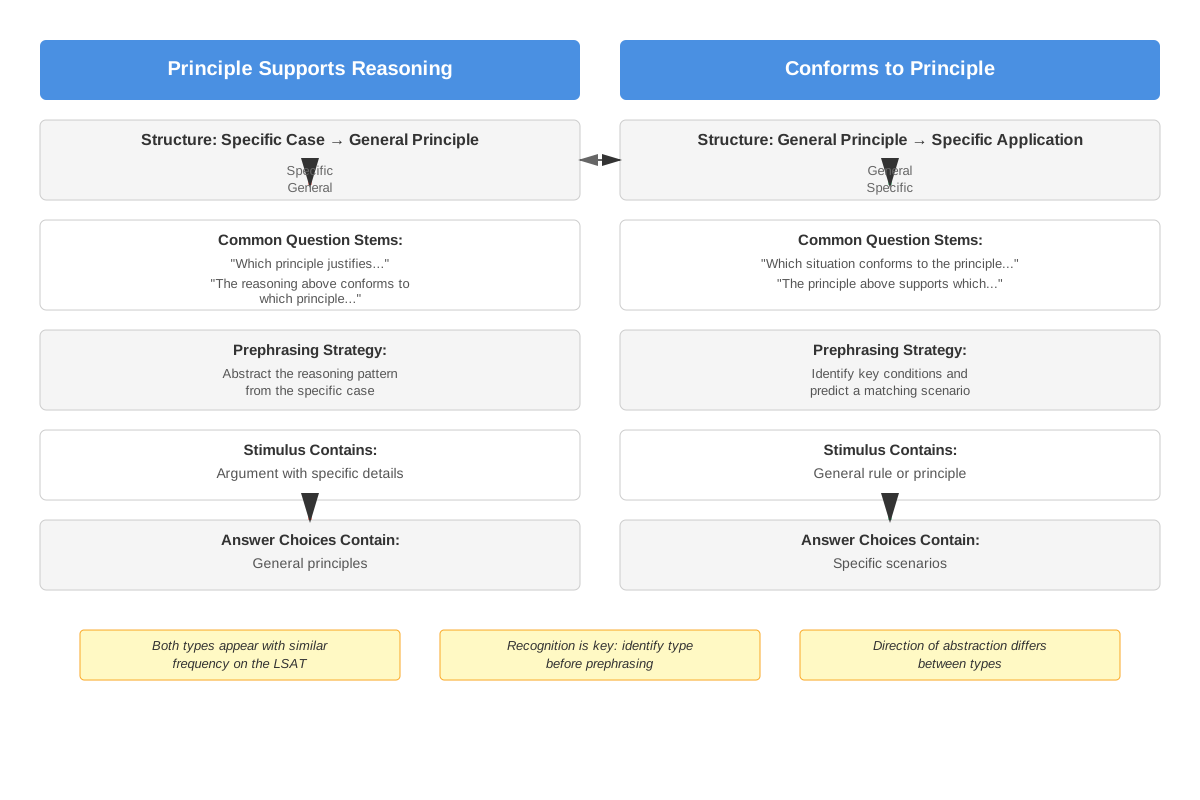
The LSAT presents two primary principle question formats. "Principle supports reasoning" questions provide a specific argument and ask which general principle, if valid, would justify the reasoning. "Conforms to principle" questions (also called "application" questions) present a general principle and ask which specific situation exemplifies or follows that principle. Both formats require prephrasing, but the direction of reasoning differs fundamentally.
The Prephrasing Process
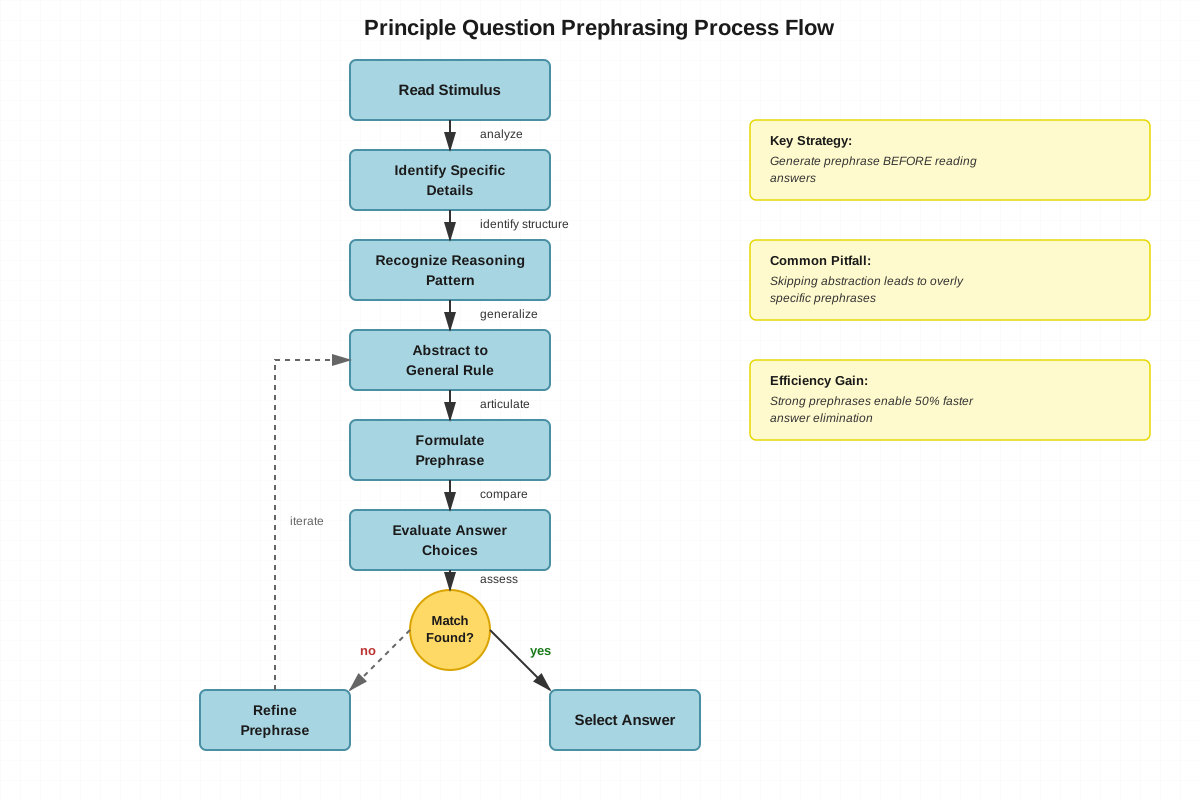
Lsat principle question prephrasing follows a systematic four-step process:
- Identify the question type: Recognize whether the question asks for a principle that supports given reasoning or a situation that conforms to a stated principle
- Analyze the stimulus structure: Break down the argument or principle into its component parts, identifying key terms, relationships, and logical connections
- Abstract to the appropriate level: For "supports reasoning" questions, generalize from specific details to broader categories; for "conforms to principle" questions, look for specific applications of general rules
- Formulate a prediction: Create a clear, concise statement of what the correct answer must accomplish
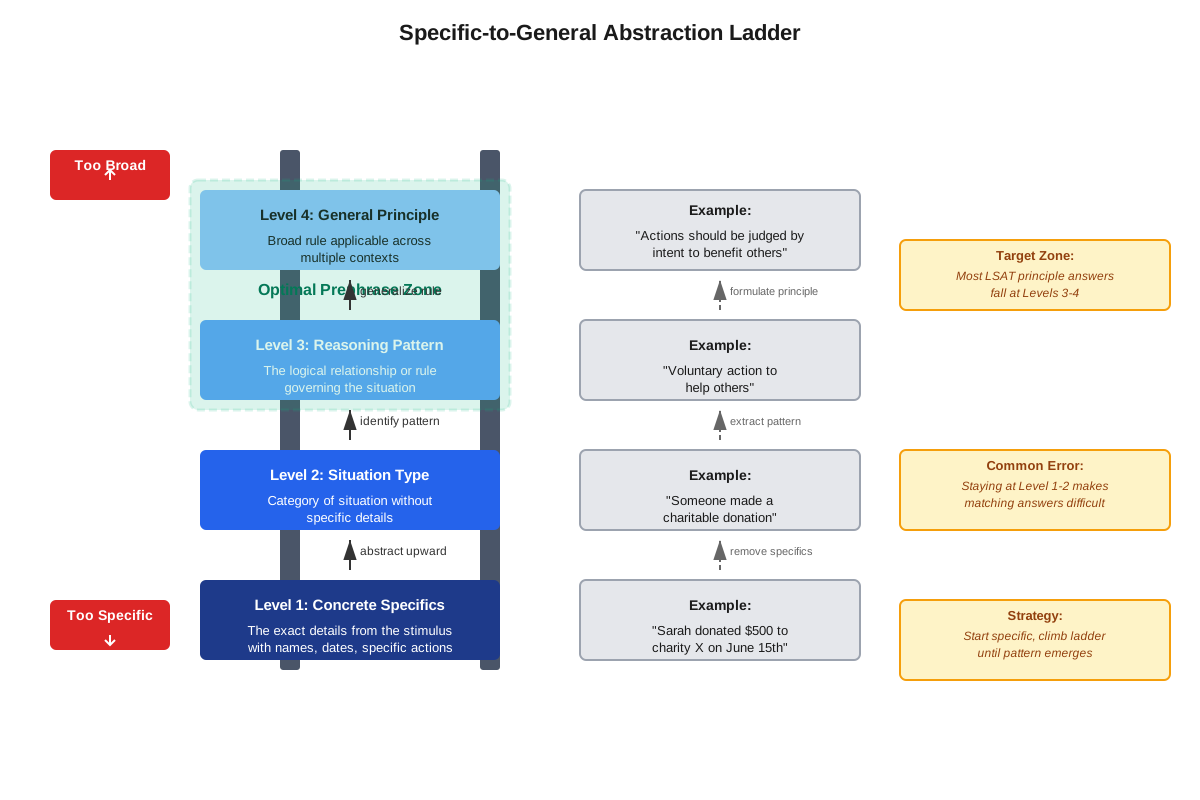
The abstraction step proves most challenging for many students. Effective abstraction requires identifying which specific details matter logically and which serve merely as context. Consider this example: "The museum should not accept the donation because the donor made money through unethical business practices." The specific details (museum, donation, unethical business practices) must be abstracted to general categories (institutions, benefits, problematic sources) to generate an effective prephrase like: "Organizations should reject benefits from sources that conflict with their values."
Recognizing Principle Question Stems
Principle questions announce themselves through distinctive language patterns. Common stems include:
| Question Type | Typical Stem Language |
|---|---|
| Principle Supports | "Which principle most helps to justify the reasoning?" |
| Principle Supports | "The argument's reasoning most closely conforms to which principle?" |
| Principle Supports | "Which principle, if valid, most supports the conclusion?" |
| Conforms to Principle | "Which situation best illustrates the principle above?" |
| Conforms to Principle | "The principle stated above, if valid, most helps to justify which action?" |
| Parallel Principle | "Which argument is most similar in its reasoning to the argument above?" |
Recognizing these stems immediately triggers the prephrasing protocol. The word "principle" itself serves as the primary trigger, but phrases like "general rule," "policy," or "standard" indicate the same question type.
Structural Elements of Effective Prephrases
Strong prephrases for principle questions share several characteristics:
- Appropriate generality: Neither too specific (merely restating the stimulus) nor too broad (applying to situations beyond the scope)
- Logical completeness: Capturing all essential elements of the reasoning relationship
- Conditional structure: Often expressible as "If X, then Y" or "When X occurs, Y should follow"
- Clear scope indicators: Identifying whether the principle applies universally ("always"), generally ("typically"), or conditionally ("when certain conditions obtain")
For example, given an argument that "The city council should approve the park renovation because surveys show 70% of residents support it," an effective prephrase might be: "Government bodies should implement policies that have majority public support." This prephrase maintains appropriate generality (not limited to city councils or parks), captures the logical relationship (public support → policy implementation), and provides clear guidance for evaluating answer choices.
Common Principle Patterns
Certain principle structures appear repeatedly on the LSAT:
Ethical principles: Rules about right action, fairness, or moral obligation (e.g., "People should not benefit from their own wrongdoing")
Practical principles: Guidelines for effective action or decision-making (e.g., "Organizations should allocate resources to their most cost-effective uses")
Epistemic principles: Rules about knowledge, evidence, or justified belief (e.g., "Claims should be accepted only when supported by adequate evidence")
Comparative principles: Standards for choosing between alternatives (e.g., "When two policies achieve the same goal, the less expensive should be preferred")
Recognizing these patterns helps generate prephrases more quickly because each pattern suggests typical logical structures and scope limitations.
Abstraction Techniques
Moving from specific to general requires systematic substitution of concrete terms with category labels:
- Replace proper names with role descriptions (Dr. Smith → medical professionals)
- Replace specific objects with functional categories (smartphones → communication devices)
- Replace particular actions with action types (filing a lawsuit → seeking legal remedies)
- Replace specific outcomes with outcome categories (increased profits → improved financial performance)
The key judgment involves determining the appropriate level of abstraction. Too specific, and the principle won't match answer choices; too general, and it will fail to capture the logical relationship. The correct level typically emerges from asking: "What feature of this specific situation makes the conclusion follow from the premises?"
Concept Relationships
The prephrasing process for principle questions builds directly on fundamental argument analysis skills. Argument structure identification → enables → recognition of reasoning patterns → which facilitates → abstraction to general principles → leading to → effective prephrasing. This chain demonstrates how principle question prephrasing integrates multiple Logical Reasoning competencies.
Within principle questions themselves, the relationship between question type and prephrasing strategy proves crucial. "Principle supports reasoning" questions require bottom-up abstraction (specific → general), while "conforms to principle" questions demand top-down application (general → specific). Both processes, however, rely on the same core skill: understanding the logical relationship between different levels of abstraction.
Principle question prephrasing also connects to conditional reasoning because many principles take conditional form. Understanding sufficient and necessary conditions helps identify which elements of a principle must be present for it to apply. Additionally, principle questions relate to assumption questions because the principle that justifies reasoning often functions as an unstated assumption. Mastering prephrasing for principle questions thus enhances performance on assumption questions and vice versa.
The relationship extends to strengthen and weaken questions as well. A principle that supports reasoning strengthens an argument, while a principle that contradicts reasoning weakens it. The prephrasing skills developed for principle questions transfer directly to these question types, creating efficiency gains across multiple Logical Reasoning categories.
High-Yield Facts
⭐ Principle questions appear 4-8 times per LSAT, making them one of the most frequent specialized question types in Logical Reasoning sections.
⭐ Effective prephrasing reduces average time per principle question by 30-45 seconds while improving accuracy by 20-30 percentage points.
⭐ The correct answer to a "principle supports reasoning" question must be sufficient to justify the conclusion, not merely relevant or supportive.
⭐ Abstraction to the appropriate level is the most common prephrasing error—too specific and the prephrase won't match answers; too general and it won't distinguish between choices.
⭐ Principle questions test the same reasoning skills required for legal case analysis, making them highly predictive of law school success.
- Wrong answers to principle questions often fail by being too broad, too narrow, or by reversing the logical relationship in the stimulus.
- Many principle questions can be solved by identifying the gap between premises and conclusion, then prephrasing a principle that bridges that gap.
- The word "should" appears frequently in both principle question stems and correct answers, signaling normative or prescriptive principles.
- Conditional reasoning skills directly enhance principle question performance because many principles take "if-then" form.
- Principle questions reward careful reading of scope limitations—words like "always," "never," "typically," and "sometimes" often determine correctness.
- The LSAT occasionally presents principle questions that combine with other question types, such as "parallel principle" or "principle-strengthen" hybrids.
- Effective prephrasing for principle questions requires identifying not just what happened, but why the reasoning moves from premises to conclusion.
Quick check — test yourself on Principle question prephrasing so far.
Try Flashcards →Common Misconceptions
Misconception: Prephrasing means predicting the exact wording of the correct answer.
Correction: Prephrasing involves capturing the logical content and structure of the correct answer, not its precise language. The correct answer may use completely different words while expressing the same principle.
Misconception: The correct principle must mention the same specific subjects as the stimulus (e.g., if the stimulus discusses doctors, the principle must mention doctors).
Correction: Correct principles operate at a higher level of abstraction. A stimulus about doctors might be justified by a principle about "professionals" or "experts" more generally. The principle should capture the relevant category, not the specific instance.
Misconception: Longer, more detailed answer choices are more likely to be correct because they're more comprehensive.
Correction: The LSAT frequently uses length and complexity to disguise wrong answers. Correct principles are often elegantly simple, capturing the essential logical relationship without extraneous detail.
Misconception: If an answer choice is true or reasonable, it's likely correct.
Correction: Correct answers must specifically justify the reasoning in the stimulus or conform to the stated principle. Many wrong answers present plausible principles that simply don't match the logical structure of the argument.
Misconception: Prephrasing takes too much time and slows down performance.
Correction: While prephrasing requires initial time investment (typically 15-30 seconds), it dramatically accelerates answer choice evaluation and reduces the likelihood of falling for attractive wrong answers, resulting in net time savings.
Misconception: "Conforms to principle" questions are easier than "principle supports reasoning" questions.
Correction: Both question types present similar difficulty levels; they simply require different reasoning directions. Success depends on recognizing the question type and applying the appropriate prephrasing strategy.
Worked Examples
Example 1: Principle Supports Reasoning
Stimulus: "The newspaper should not have published the photographs of the crime scene. Although the photographs were newsworthy and the public has a right to information, publishing them caused unnecessary distress to the victim's family."
Question Stem: "Which one of the following principles, if valid, most helps to justify the reasoning above?"
Step 1 - Identify question type: This is a "principle supports reasoning" question, requiring abstraction from the specific case to a general rule.
Step 2 - Analyze structure:
- Conclusion: The newspaper should not have published the photographs
- Premise 1: The photographs were newsworthy
- Premise 2: The public has a right to information
- Premise 3 (key): Publishing caused unnecessary distress to the victim's family
- Reasoning pattern: Despite factors favoring publication, harm to affected parties outweighs those factors
Step 3 - Abstract to appropriate level:
- "Newspaper" → media organizations / publishers
- "Photographs" → information / content
- "Newsworthy" → legitimate public interest
- "Victim's family" → affected parties / those harmed
- "Unnecessary distress" → preventable harm
Step 4 - Formulate prephrase: "When publishing information would cause significant harm to affected parties, media organizations should refrain from publishing even if the information is newsworthy."
Evaluating answer choices: The correct answer will capture the relationship between potential harm and the decision not to publish, acknowledging but ultimately overriding the newsworthiness consideration. Wrong answers might focus solely on newsworthiness, ignore the harm element, or reverse the priority relationship.
Connection to learning objectives: This example demonstrates how to identify principle question prephrasing in LSAT questions (objective 1), explains the reasoning pattern of balancing competing considerations with harm prevention taking priority (objective 2), and shows the application process for solving the problem (objective 3).
Example 2: Conforms to Principle
Stimulus: "A professional has an obligation to refuse work when accepting it would require violating the professional's ethical standards, even if refusing the work results in financial loss."
Question Stem: "Which one of the following judgments most closely conforms to the principle stated above?"
Step 1 - Identify question type: This is a "conforms to principle" question, requiring identification of a specific situation that exemplifies the general rule.
Step 2 - Analyze the principle structure:
- Subject: Professionals
- Obligation: Must refuse work
- Condition: When accepting would require violating ethical standards
- Consequence acknowledged: May result in financial loss
- Priority: Ethics over financial considerations
Step 3 - Identify essential elements for conforming situation:
- Must involve a professional (or analogous role with ethical standards)
- Must present a choice about accepting/refusing work or similar opportunity
- Must involve potential ethical violation if accepted
- Must involve financial cost for refusing
- Must show the person refusing despite financial cost
Step 4 - Formulate prephrase: "Look for a situation where someone with professional ethical standards turns down an opportunity that would compromise those standards, even though refusing costs them money."
Evaluating answer choices: The correct answer will include all essential elements. Common wrong answers might: (1) show someone refusing work but without ethical considerations, (2) show ethical concerns but no financial consequence, (3) show someone accepting problematic work rather than refusing it, or (4) involve non-professionals in situations where ethical standards don't clearly apply.
Connection to learning objectives: This example illustrates the distinct reasoning pattern for "conforms to principle" questions (objective 2), demonstrates how to distinguish between question types (objective 4), and shows how to generate effective prephrases by identifying essential principle elements (objective 5).
Exam Strategy
Approaching Principle Questions Systematically
When encountering a principle question, implement this strategic sequence:
- Read the question stem first to determine whether you're looking for a principle that supports reasoning or a situation that conforms to a principle
- Read the stimulus actively, identifying the argument structure or principle components
- Invest 15-30 seconds in prephrasing before examining answer choices
- Evaluate answer choices against your prephrase, not against each other
- Use process of elimination aggressively, removing answers that fail to match your prephrase's logical structure
Trigger Words and Phrases
Watch for these high-value signals in question stems:
- "Principle" (primary trigger)
- "Most helps to justify"
- "Conforms to"
- "Illustrates"
- "General rule"
- "Policy"
- "Standard"
In answer choices, pay special attention to:
- Scope indicators: "always," "never," "typically," "sometimes," "most"
- Conditional markers: "if," "when," "whenever," "only if"
- Normative language: "should," "ought," "must," "required"
- Comparative terms: "more important than," "outweighs," "takes priority over"
Process of Elimination Tips
Eliminate answer choices that:
- Operate at the wrong level of abstraction (too specific or too broad)
- Reverse the logical relationship in the stimulus (e.g., if the stimulus says "prioritize X over Y," eliminate answers saying "prioritize Y over X")
- Introduce irrelevant considerations not present in the stimulus reasoning
- Fail to address the gap between premises and conclusion
- Use extreme language ("always," "never") when the stimulus reasoning is more moderate
Exam Tip: If you're torn between two answer choices, return to your prephrase. The answer that more closely matches your prephrased logical structure is almost always correct.
Time Allocation
Principle questions typically require 1:30-2:00 minutes for strong test-takers:
- 20-30 seconds: Reading and understanding the stimulus
- 15-30 seconds: Prephrasing
- 30-45 seconds: Evaluating answer choices
- 15-20 seconds: Confirming the selection
If a principle question exceeds 2:30 minutes, consider marking it for review and moving forward. The time investment in prephrasing pays dividends in faster, more confident answer choice evaluation.
Memory Techniques
The PASA Method for Prephrasing
Parse the argument structure
Abstract to general categories
State the logical relationship
Anticipate the answer
This acronym provides a memorable sequence for systematic prephrasing.
Visualization Strategy: The Abstraction Ladder
Imagine a ladder with three rungs:
- Bottom rung: Specific details from the stimulus (Dr. Smith, the hospital, the surgery)
- Middle rung: Appropriate abstraction level for principles (medical professionals, healthcare institutions, medical procedures)
- Top rung: Over-abstraction that's too general (people, organizations, actions)
Visualize climbing from the bottom to the middle rung—not all the way to the top. This mental image helps calibrate abstraction level.
The "If-Then-Therefore" Framework
Many principles can be mentally reformulated as:
- If [condition from premises]
- Then [principle application]
- Therefore [conclusion]
This framework helps organize complex reasoning and generates clear prephrases.
Mnemonic for Common Wrong Answer Types
BINGO identifies frequent wrong answer patterns:
- Broad (too general)
- Irrelevant (introduces new considerations)
- Narrow (too specific)
- Gap-missing (doesn't bridge premises to conclusion)
- Opposite (reverses the logical relationship)
Summary
Principle question prephrasing represents an essential LSAT Logical Reasoning skill that involves predicting the correct answer before evaluating answer choices. The technique requires understanding two primary question types: "principle supports reasoning" questions that demand abstracting from specific cases to general rules, and "conforms to principle" questions that require identifying specific applications of stated principles. Effective prephrasing follows a systematic process: identifying question type, analyzing stimulus structure, abstracting to the appropriate level, and formulating a clear prediction. The most critical skill involves calibrating abstraction—generalizing enough to match answer choice language while maintaining sufficient specificity to capture the logical relationship. Principle questions appear 4-8 times per LSAT and reward systematic prephrasing with significant time savings and accuracy improvements. Success requires recognizing distinctive question stems, understanding common principle patterns, avoiding misconceptions about answer prediction, and implementing strategic process-of-elimination techniques. Mastering this skill enhances performance across multiple Logical Reasoning question types while developing the abstract reasoning abilities essential for legal analysis.
Key Takeaways
- Principle question prephrasing dramatically improves both speed and accuracy by providing a clear target before examining potentially confusing answer choices
- The two main question types—"principle supports reasoning" and "conforms to principle"—require opposite reasoning directions but both benefit from systematic prephrasing
- Appropriate abstraction level is the most critical prephrasing skill: too specific and the prephrase won't match answers; too broad and it won't distinguish between choices
- Effective prephrases capture logical relationships, not just content: focus on how premises connect to conclusions, not merely what the argument discusses
- Invest 15-30 seconds in prephrasing before evaluating answer choices: this upfront time investment yields significant returns in faster, more confident answer selection
- Wrong answers typically fail by being too broad, too narrow, introducing irrelevant considerations, or reversing logical relationships: use your prephrase to eliminate systematically
- Principle question skills transfer to multiple other Logical Reasoning question types, including assumption, strengthen, weaken, and parallel reasoning questions
Related Topics
Assumption Questions: Understanding unstated premises that connect evidence to conclusions builds directly on principle question skills, as the justifying principle often functions as an assumption. Mastering principle prephrasing enhances assumption identification.
Strengthen and Weaken Questions: These question types often involve principles that support or undermine reasoning. The abstraction and prephrasing skills developed for principle questions transfer directly to strengthen/weaken analysis.
Parallel Reasoning Questions: Identifying arguments with similar logical structures requires the same abstraction skills used in principle questions. Both question types demand recognizing patterns across different content.
Conditional Reasoning: Many principles take conditional form ("If X, then Y"), making conditional reasoning skills essential for principle question success. Advancing to complex conditional logic deepens principle question mastery.
Argument Structure and Diagramming: Enhanced ability to break down complex arguments into component parts improves prephrasing accuracy and speed across all question types, including principles.
Practice CTA
Now that you understand the systematic approach to principle question prephrasing, it's time to apply these strategies to actual LSAT questions. The practice questions and flashcards will help solidify your understanding of abstraction levels, question type recognition, and strategic prephrasing. Remember: prephrasing is a skill that improves dramatically with deliberate practice. Each question you work through strengthens your ability to quickly identify logical relationships and predict correct answers. Approach the practice materials with the same systematic process outlined in this guide, and you'll see measurable improvement in both accuracy and confidence. Your investment in mastering this high-yield skill will pay dividends across multiple Logical Reasoning question types and contribute significantly to your overall LSAT score.
Sign up free to keep reading
Create a free AnvayaPrep account to finish this LSAT guide on Principle question prephrasing — plus flashcards and practice questions.