Overview
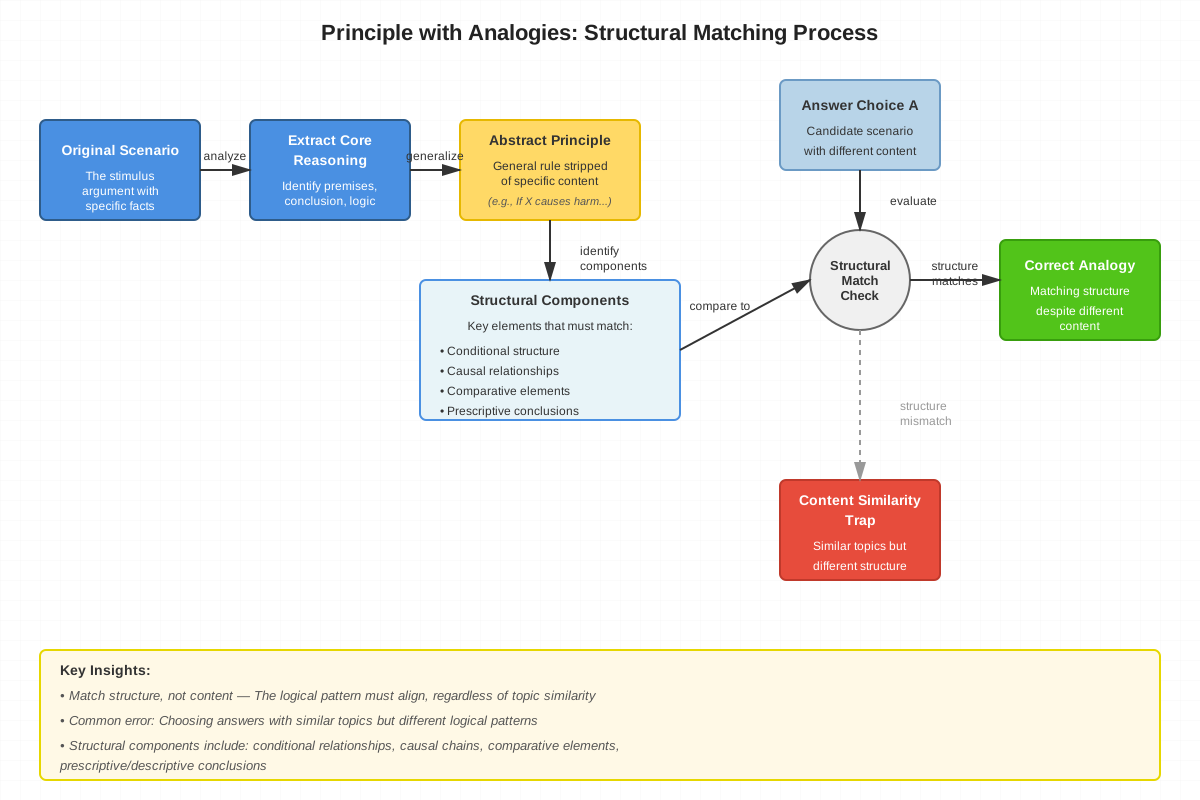
Principle with analogies represents one of the most sophisticated and frequently tested question types within LSAT Logical Reasoning sections. These questions require test-takers to identify an underlying principle from one scenario and then recognize how that same principle applies to an analogous situation. Unlike straightforward principle questions that ask students to identify or apply a rule directly, principle with analogies questions demand an additional layer of abstraction: students must extract the general rule from a specific context, then match it to a structurally similar but contextually different scenario.
The LSAT tests this skill because it mirrors the fundamental reasoning lawyers employ daily—recognizing how legal precedents apply to new cases, even when surface details differ dramatically. A Supreme Court decision about property rights might establish a principle that applies equally to intellectual property, physical assets, or digital content. The ability to see past superficial differences and identify structural similarities in reasoning patterns is essential for legal analysis. On the LSAT, these questions typically present an argument or scenario, then ask which answer choice "most closely conforms to the principle illustrated above" or "is most similar in its reasoning to the argument above."
Within the broader landscape of principle questions on the LSAT, principle with analogies questions occupy a middle ground between pure principle identification and complex parallel reasoning questions. They require the pattern recognition skills developed through studying argument structure, the abstraction abilities honed by principle application questions, and the comparative analysis demanded by parallel reasoning questions. Mastering this question type strengthens overall logical reasoning abilities and significantly improves performance across multiple question categories.
Learning Objectives
- [ ] Identify how Principle with analogies appears in LSAT questions
- [ ] Explain the reasoning pattern behind Principle with analogies
- [ ] Apply Principle with analogies to solve LSAT-style problems accurately
- [ ] Abstract general principles from specific factual scenarios with precision
- [ ] Distinguish between superficial similarities and structural parallels in arguments
- [ ] Evaluate answer choices by matching logical structure rather than content similarity
- [ ] Recognize common trap answers that share content but differ in logical structure
Prerequisites
- Basic argument structure: Understanding premises, conclusions, and how they connect is essential because principle with analogies questions require identifying the logical skeleton beneath surface content
- Conditional reasoning: Familiarity with if-then statements and their contrapositives helps recognize when principles involve conditional relationships that must be matched in analogous scenarios
- Argument patterns: Knowledge of common reasoning structures (causal, comparative, prescriptive) enables faster recognition of which structural elements must align between the original and analogous situations
- Standard principle questions: Experience with identifying and applying principles provides the foundation for the more complex task of matching principles across different contexts
Why This Topic Matters
Principle with analogies questions appear with remarkable consistency on the LSAT, typically comprising 2-4 questions per Logical Reasoning section, which translates to approximately 8-16% of all Logical Reasoning questions on any given test. This frequency, combined with the medium-to-high difficulty level of these questions, makes them a high-value target for focused preparation. Students who master this question type can reliably secure points that separate competitive scores from exceptional ones.
Beyond test performance, the reasoning skills developed through principle with analogies practice have direct real-world applications in legal practice. Attorneys constantly engage in analogical reasoning when arguing that a precedent case should (or should not) apply to their client's situation. The ability to articulate why two situations are structurally similar despite surface differences—or why apparent similarities mask crucial structural distinctions—is fundamental to persuasive legal argument. Law school case method instruction relies heavily on this same skill, making early mastery valuable for future academic success.
On the LSAT, principle with analogies questions most commonly appear with question stems such as: "Which one of the following judgments conforms most closely to the principle illustrated above?", "The pattern of reasoning in which one of the following is most similar to that in the argument above?", "Which one of the following arguments is most similar in its reasoning to the argument above?", or "The principle underlying the argument above is most similar to the principle underlying which one of the following?" These questions may draw from any content area—ethics, law, science, business, or everyday situations—emphasizing that the LSAT tests reasoning structure, not specialized knowledge.
Core Concepts
The Nature of Principles in LSAT Context
A principle on the LSAT is a general rule or standard that governs how we should reason about or act in certain types of situations. Principles operate at a higher level of abstraction than the specific facts of any individual case. For example, the specific fact "Sarah should return the borrowed book because she promised to" contains an implicit principle: "People should fulfill their promises." The principle strips away the particular details (Sarah, the book) and captures the underlying rule that could apply to countless situations.
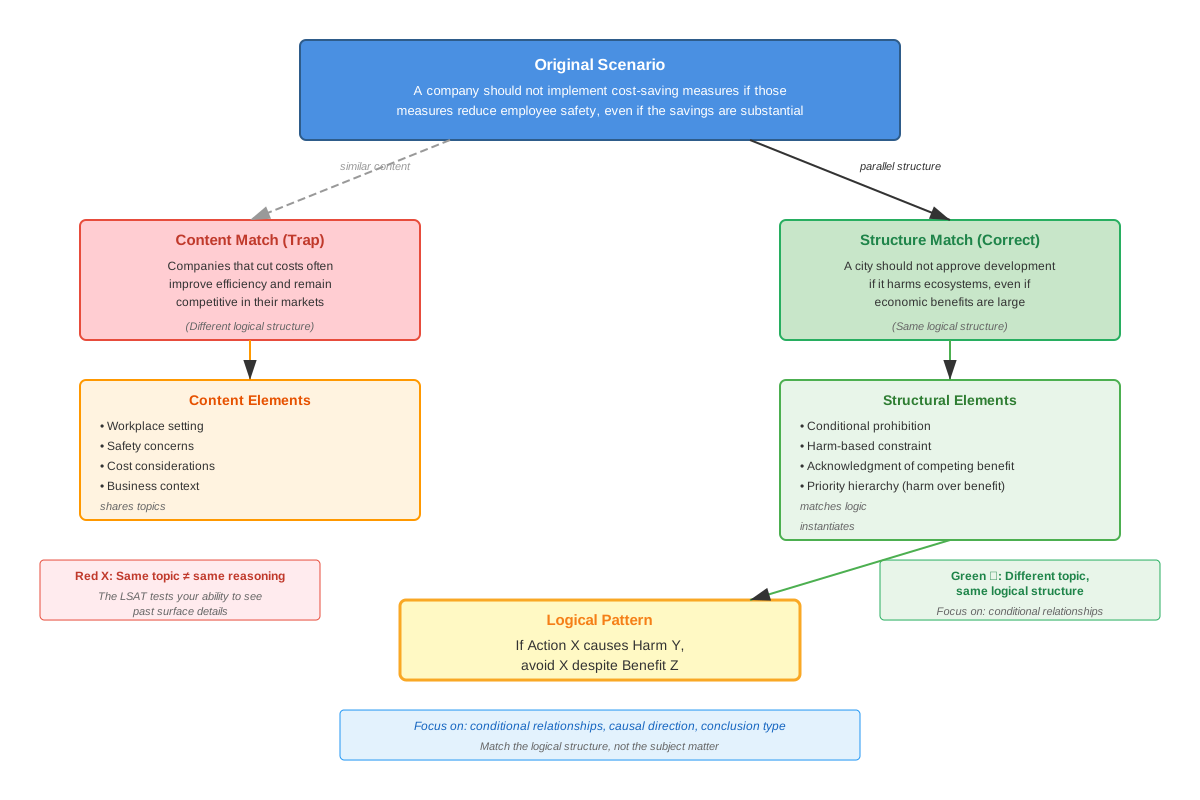
In principle with analogies questions, the LSAT provides one scenario that illustrates a principle, then asks which answer choice demonstrates the same principle in action. The key challenge is that the correct answer will almost never share content with the original scenario—it won't be about the same people, objects, or situations. Instead, it will share the same logical structure and underlying rule.
Structural vs. Superficial Similarity
The fundamental skill in principle with analogies questions is distinguishing between structural similarity and superficial similarity. Superficial similarity involves shared content: both scenarios discuss contracts, or both involve animals, or both mention financial obligations. Structural similarity involves shared logical relationships: both scenarios reason from obligation to action, or both apply a general rule to a specific exception, or both weigh competing values using the same priority system.
Consider this principle: "When two goals conflict and both cannot be achieved, one should pursue the goal that benefits more people." A structurally similar scenario might involve choosing between two medical treatments, two business strategies, or two educational policies—the content doesn't matter. What matters is that the reasoning follows the same pattern: identify conflicting goals, determine which benefits more people, choose that option. A superficially similar but structurally different scenario might discuss benefiting people but use different reasoning, such as "choose the option that benefits people most intensely" or "choose the option that benefits people most permanently."
The Abstraction Process
Successfully matching principles requires a systematic abstraction process:
- Identify the specific elements in the original scenario (actors, actions, objects, outcomes)
- Determine the relationships between these elements (causal, conditional, comparative, prescriptive)
- Abstract to general categories (replace "doctor" with "professional," "patient" with "client," "medical treatment" with "professional service")
- Articulate the principle as a general rule using these abstract categories
- Apply the abstracted principle to evaluate each answer choice
For example, if the original argument states: "The museum curator should not accept the donated painting because it was stolen from its rightful owner," the abstraction process yields: "A professional (curator) should not accept an item (painting) for their institution (museum) when accepting it would perpetuate an injustice (theft)." The general principle might be: "One should not benefit from or facilitate the continuation of wrongdoing."
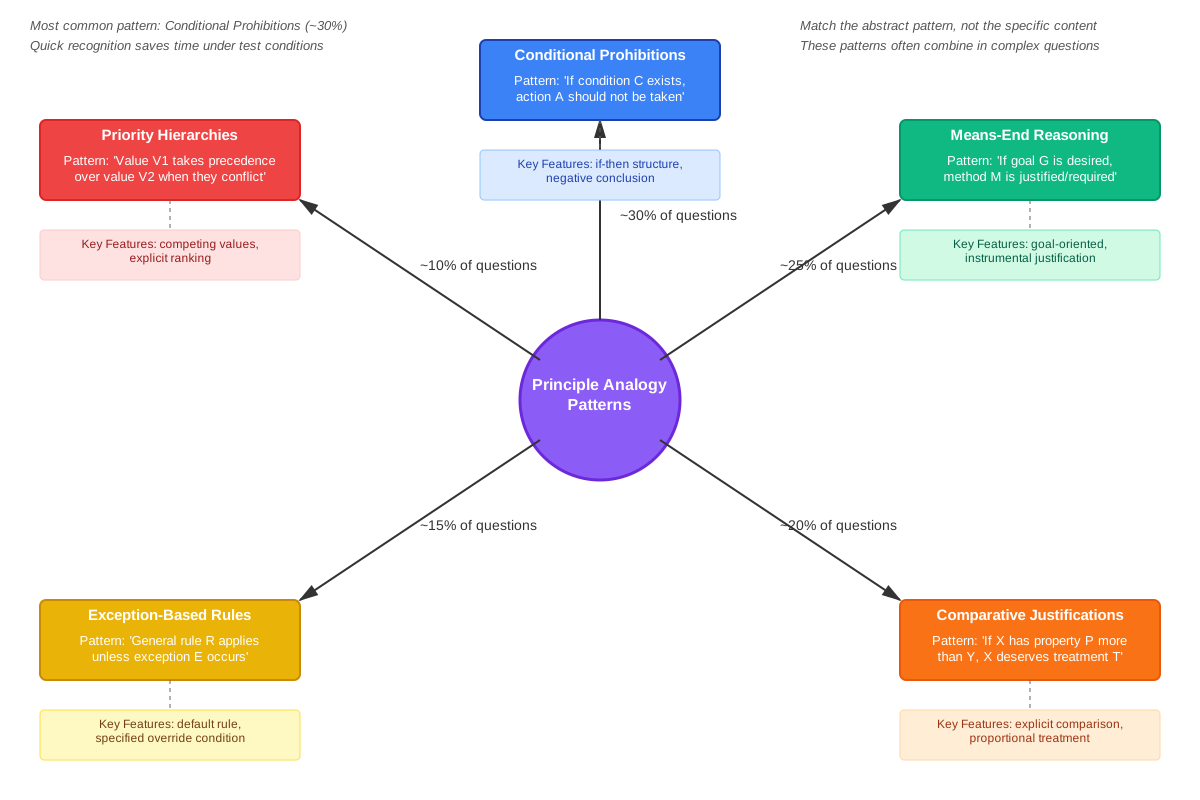
Common Principle Structures
Certain logical structures appear repeatedly in principle with analogies questions:
| Principle Structure | Pattern | Example |
|---|---|---|
| Conditional obligation | If X, then one should Y | If you make a promise, you should keep it |
| Competing values | When A and B conflict, prioritize A | When efficiency and fairness conflict, prioritize fairness |
| Means-ends reasoning | Goal G justifies action A only if condition C | Economic development justifies environmental impact only if alternatives are exhausted |
| Exception to general rule | Generally X, but not when Y | Generally respect privacy, but not when public safety is threatened |
| Proportionality | Response R should match degree of D | Punishment should match severity of offense |
Recognizing these structures quickly allows for more efficient evaluation of answer choices.
The Role of Necessary and Sufficient Conditions
Many principles involve conditional reasoning, where certain conditions are necessary or sufficient for an outcome or obligation. When a principle states "One should do X only if Y," Y is a necessary condition for the obligation to do X. When a principle states "Whenever Y occurs, one should do X," Y is a sufficient condition for the obligation. Matching principles requires preserving these conditional relationships.
For instance, if the original principle establishes that expert testimony is admissible only if the expert has relevant credentials (necessary condition), the analogous scenario must also involve something being acceptable only if a necessary condition is met—not something being acceptable whenever a sufficient condition is present. This distinction frequently separates correct answers from attractive distractors.
Scope Matching
The scope of a principle—how broadly or narrowly it applies—must match between the original and analogous scenarios. A principle about "all professionals" is broader than one about "medical professionals specifically." A principle about "any form of deception" is broader than one about "explicit lies." When evaluating answer choices, the scope of the principle must align with the original, even as the content changes.
Common scope elements to track include:
- Universality (all, most, some, none)
- Certainty (must, should, may, might)
- Conditionality (always, usually, sometimes, never)
- Strength of obligation (required, recommended, permitted, forbidden)
Concept Relationships
The concepts within principle with analogies questions form an interconnected reasoning chain. The abstraction process serves as the foundation, enabling students to move from specific scenarios to general principles. This abstraction depends on understanding structural versus superficial similarity, which determines whether two scenarios truly share a principle or merely share content. Both of these concepts rely on recognizing common principle structures, which provide templates for quickly categorizing the type of reasoning involved.
Conditional reasoning and scope matching operate as precision tools that refine the abstraction process. Once a general principle structure is identified, conditional reasoning helps specify the exact logical relationships that must be preserved, while scope matching ensures the breadth of application remains consistent. Together, these elements create a systematic approach: identify structure → abstract to principle → match scope and conditions → evaluate analogies.
This topic connects to prerequisite knowledge of argument structure by building on the ability to identify premises and conclusions, then adding the requirement to see how those structural elements instantiate general principles. It extends conditional reasoning skills by applying them not just within single arguments but across multiple scenarios. It relates to parallel reasoning questions by sharing the focus on structural similarity, though principle with analogies questions emphasize the underlying rule rather than the complete argument form.
The relationship map flows as follows: Basic Argument Structure → Principle Identification → Principle Abstraction → Structural Analysis → Analogical Matching → Answer Evaluation. Each stage depends on the previous one, and weakness at any stage compromises performance on these questions.
High-Yield Facts
⭐ Principle with analogies questions test structural similarity, not content similarity—the correct answer will almost never discuss the same subject matter as the stimulus.
⭐ The abstraction level must match exactly—if the original principle is about "professionals," an answer about "doctors specifically" is too narrow, while one about "all people" is too broad.
⭐ Conditional relationships must be preserved—if the original uses "only if" (necessary condition), the correct answer must also use a necessary condition, not a sufficient condition.
⭐ The direction of reasoning must match—if the original moves from obligation to action, the answer must also move from obligation to action, not from action to justification.
⭐ Competing values must maintain the same priority—if the original prioritizes fairness over efficiency, the answer must prioritize the analogous value in the same way.
- The number of elements in the principle must match—if the original involves three factors (actor, action, circumstance), the answer should also involve three corresponding factors.
- Exceptions in the original principle must have corresponding exceptions in the answer—if the original states a general rule with one exception, the answer should follow the same pattern.
- The strength of modal language must align—"must" in the original requires "must" in the answer, not "should" or "may."
- Causal principles require causal structure in answers—if the original establishes that X causes Y, the answer must also involve a causal relationship, not merely correlation or sequence.
- Negative principles (what one should not do) must match with negative principles in answers, not positive prescriptions.
- Temporal relationships matter—if the original principle involves sequence (first X, then Y), the answer must preserve that sequential structure.
- The basis for judgment must be the same—if the original judges actions by their consequences, the answer must also use consequentialist reasoning, not deontological or virtue-based reasoning.
Quick check — test yourself on Principle with analogies so far.
Try Flashcards →Common Misconceptions
Misconception: The correct answer will discuss similar content or subject matter to the original scenario.
Correction: Principle with analogies questions deliberately use different content in the correct answer. The LSAT tests whether you can recognize the same logical structure in a completely different context. Answers that share content with the stimulus are often attractive distractors designed to trap students who focus on superficial rather than structural similarity.
Misconception: If an answer choice reaches the same conclusion as the original argument, it must be correct.
Correction: The conclusion's content is irrelevant; what matters is how that conclusion is reached. Two arguments can both conclude "Action X is wrong" but for entirely different reasons using different principles. The reasoning structure and underlying principle must match, regardless of whether the conclusions happen to align.
Misconception: Longer, more complex answer choices are more likely to be correct because they seem more sophisticated.
Correction: Length and complexity are neutral factors. The LSAT includes both simple and complex correct answers. Some students avoid simple answers assuming they're "too obvious," while others avoid complex answers assuming they're "trying too hard." Evaluate each answer solely on whether its logical structure matches the original principle.
Misconception: The correct answer must include all the same elements as the original scenario.
Correction: The correct answer must include analogous elements that play the same structural role, but the number and type of elements can vary as long as the relationships between them match. An original scenario with three actors might correspond to an answer with two actors if the relevant relationship is preserved.
Misconception: Principle with analogies questions are just like parallel reasoning questions.
Correction: While both question types involve structural matching, principle with analogies questions focus specifically on identifying and matching the underlying rule or standard, often at a higher level of abstraction. Parallel reasoning questions match the complete argument structure including premises, reasoning, and conclusion. Principle with analogies questions may match only the core principle without requiring identical argument structure.
Misconception: The correct answer will feel intuitively similar to the original scenario.
Correction: Intuition based on content familiarity often misleads on these questions. The correct answer may feel quite different because it discusses unfamiliar content. Successful test-takers override intuitive reactions and rely on systematic structural analysis.
Worked Examples
Example 1: Ethical Obligation Principle
Stimulus: "A journalist should not publish information obtained through illegal means, even if that information is newsworthy and the public has an interest in knowing it. The obligation to respect the law takes precedence over the value of informing the public when these two considerations conflict."
Question: Which one of the following judgments most closely conforms to the principle illustrated above?
Answer Choices:
(A) A historian should not cite sources that cannot be verified, even if those sources provide valuable insights into historical events.
(B) A lawyer should not use evidence obtained through illegal searches, even if that evidence would prove the client's innocence.
(C) A scientist should not publish research results that might be misused, even if the research itself was conducted properly.
(D) A teacher should not share student information with parents if the student has requested confidentiality.
(E) A doctor should not prescribe medication that is expensive, even if it is the most effective treatment available.
Step 1: Identify the specific elements
- Actor: journalist
- Action: publishing information
- Source: illegally obtained information
- Competing values: legal obligation vs. public interest
- Resolution: legal obligation takes precedence
Step 2: Abstract to general principle
"A professional should not use materials/information obtained through improper means to achieve their professional goals, even when those goals are valuable. The obligation to respect proper procedures takes precedence over achieving beneficial outcomes when these conflict."
Step 3: Evaluate each answer
(A) This involves verification standards, not the conflict between proper procedures and valuable outcomes. The sources aren't obtained through improper means; they simply can't be verified. Structurally different.
(B) This matches perfectly: lawyer (professional) should not use (action) illegally obtained evidence (improper means) even if it would prove innocence (valuable outcome). The obligation to respect legal procedures takes precedence over the beneficial outcome. Structural match.
(C) This involves potential misuse of properly conducted research. The research itself wasn't obtained improperly; the concern is about future consequences. Structurally different.
(D) This involves confidentiality, not a conflict between proper procedures and beneficial outcomes. Structurally different.
(E) This involves cost considerations, not improper means of obtaining something. Structurally different.
Correct Answer: (B)
The key insight is that both scenarios involve a professional who has access to something obtained through improper/illegal means that would serve a valuable purpose, but the obligation to respect proper procedures takes precedence. The content is completely different (journalism vs. law, publishing vs. using evidence, public interest vs. client innocence), but the logical structure is identical.
Example 2: Proportionality Principle
Stimulus: "The city council's decision to impose severe parking restrictions in the downtown area is unjustified. While reducing traffic congestion is a legitimate goal, the restrictions go far beyond what is necessary to achieve that goal, causing significant hardship for local businesses and residents."
Question: The reasoning in which one of the following is most similar to the reasoning in the argument above?
Answer Choices:
(A) The school's decision to require uniforms is unjustified because it violates students' freedom of expression, even though promoting equality among students is a legitimate goal.
(B) The company's decision to monitor all employee emails is unjustified because, although preventing data leaks is a legitimate goal, the monitoring is more extensive than necessary and invades employee privacy.
(C) The government's decision to raise taxes is unjustified because it will harm economic growth, despite the need to fund public services.
(D) The hospital's decision to restrict visiting hours is unjustified because families should be able to visit patients whenever they want.
(E) The library's decision to charge late fees is unjustified because many patrons cannot afford to pay them.
Step 1: Identify the reasoning structure
- Premise 1: An action was taken (parking restrictions)
- Premise 2: The goal is legitimate (reducing congestion)
- Premise 3: The action exceeds what's necessary to achieve the goal
- Premise 4: The excessive action causes harm (hardship)
- Conclusion: The action is unjustified
Step 2: Abstract the principle
"An action is unjustified when, despite serving a legitimate goal, it goes beyond what is necessary to achieve that goal and thereby causes additional harm."
This is a proportionality principle: the means must be proportionate to the ends.
Step 3: Evaluate each answer
(A) This argues the action is unjustified because it violates a right, not because it's disproportionate to the goal. It doesn't claim the uniform requirement exceeds what's necessary. Structurally different.
(B) This matches: monitoring (action) serves a legitimate goal (preventing leaks), but is more extensive than necessary (disproportionate), and causes harm (privacy invasion). Structural match.
(C) This argues the action is unjustified because of harmful consequences, but doesn't establish that the tax increase exceeds what's necessary to fund services. Structurally different.
(D) This argues the action is unjustified based on a competing right (families' access), not based on proportionality. Structurally different.
(E) This argues the action is unjustified because of its impact on some people, not because it's disproportionate to its goal. Structurally different.
Correct Answer: (B)
Both arguments acknowledge a legitimate goal, then argue the action is unjustified not because the goal is wrong, but because the means employed are disproportionate—they go beyond what's necessary and thereby cause additional harm. This proportionality reasoning structure distinguishes these arguments from those that simply weigh costs against benefits or assert rights violations.
Exam Strategy
Trigger Words and Question Stems
Watch for these question stems that signal principle with analogies questions:
- "conforms most closely to the principle illustrated"
- "most similar in its reasoning"
- "pattern of reasoning... most similar"
- "principle underlying... most similar to the principle underlying"
- "judgment most closely parallels"
These phrases indicate you need to match logical structure across different contexts.
Systematic Approach
- Read the stimulus actively (30-45 seconds): Identify the principle before looking at answers. Write a brief abstraction if time permits.
- Predict the structure (10-15 seconds): Before reading answers, articulate what structural elements must appear in the correct answer.
- Eliminate aggressively (60-90 seconds): Most wrong answers will fail on one clear structural mismatch. Eliminate as soon as you identify the mismatch rather than reading the entire answer.
- Compare remaining choices (20-30 seconds): If multiple answers seem possible, identify the specific structural element that differs between them.
Exam Tip: On principle with analogies questions, wrong answers typically fail in one of three ways: (1) they share content but not structure, (2) they reverse a key relationship (sufficient vs. necessary, cause vs. effect), or (3) they match part of the structure but miss a crucial element. Identifying which type of error appears in each wrong answer speeds elimination.
Process of Elimination Strategies
- Eliminate content matches first: If an answer discusses the same subject matter as the stimulus, it's likely wrong. The LSAT rarely makes the correct answer that obvious.
- Check conditional direction: If the stimulus uses "only if," eliminate any answer using "if" or "whenever" without "only."
- Verify scope alignment: Eliminate answers that are broader or narrower than the original principle.
- Count elements: If the original principle involves a three-way comparison, eliminate answers with only two-way comparisons.
- Match modal strength: Eliminate answers using "must" if the original uses "should," or vice versa.
Time Allocation
Principle with analogies questions typically require 90-120 seconds—slightly longer than average for Logical Reasoning questions. The additional time investment is worthwhile because these questions have high accuracy potential once you identify the correct structure. Don't rush the abstraction phase; 15 seconds spent clearly identifying the principle saves 30 seconds of confused answer evaluation.
If you're running short on time, principle with analogies questions are reasonable candidates for educated guessing because you can often eliminate 2-3 answers quickly based on obvious structural mismatches, giving you good odds even without complete analysis.
Memory Techniques
The STRUCTURE Acronym
Use STRUCTURE to remember the key elements to match:
- Scope: Does the breadth of application match?
- Type: Is it the same category of principle (conditional, comparative, prescriptive)?
- Relationships: Do the logical connections between elements align?
- Underlying rule: Can you state the general principle in abstract terms?
- Conditions: Are necessary and sufficient conditions preserved?
- Temporal sequence: Does any time-based ordering match?
- Universality: Do quantifiers (all, some, none) align?
- Reasoning direction: Does the logic flow the same way?
- Elements: Do analogous components play the same roles?
Visualization Strategy
Picture the original scenario as a diagram with labeled boxes and arrows showing relationships. For example, a principle about "If X, then Y should do Z" becomes:
[Condition X] → [Actor Y] → [Action Z]Then visualize each answer choice using the same diagram structure. The correct answer will have the same number of boxes and arrows pointing in the same directions, even though the labels inside the boxes are different.
The Content-Structure Split
Remember this mantra: "Same structure, different content; same content, different structure." The correct answer will have the same structure with different content. Wrong answers often have the same content with different structure. This simple rule helps override the intuitive pull toward content similarity.
The Abstraction Ladder
Visualize moving up a ladder from specific to general:
- Bottom rung: Specific facts (Sarah, book, promise)
- Middle rung: Category terms (person, object, commitment)
- Top rung: Abstract principle (fulfill obligations)
The correct answer will be at the same height on the ladder—same level of abstraction—but on a different ladder (different content area).
Summary
Principle with analogies questions require identifying an underlying rule or standard from one scenario and recognizing how that same principle applies to a structurally similar but contextually different situation. Success depends on distinguishing structural similarity from superficial content similarity—the correct answer will almost never discuss the same subject matter as the original but will follow the same logical pattern. The systematic approach involves abstracting the specific scenario to a general principle, identifying key structural elements (conditional relationships, scope, competing values, reasoning direction), and matching those elements across different contexts. Common wrong answers either share content without matching structure, reverse key logical relationships, or match only part of the required structure. These questions appear frequently on the LSAT (2-4 per section) and test reasoning skills fundamental to legal analysis: recognizing how precedents apply to new cases despite surface differences. Mastery requires practice moving fluidly between specific scenarios and abstract principles, evaluating logical structure independent of content, and systematically checking that all structural elements align between the original and analogous situations.
Key Takeaways
- Principle with analogies questions test structural matching, not content similarity—expect the correct answer to discuss completely different subject matter while following the same logical pattern
- Systematic abstraction is essential: identify specific elements, determine their relationships, abstract to general categories, articulate the principle, then apply it to evaluate answers
- Preserve all structural elements: conditional relationships (necessary vs. sufficient), scope (breadth of application), modal strength (must vs. should), reasoning direction, and the number of elements must all align
- Common wrong answer types include: content matches without structural similarity, reversed logical relationships, and partial structural matches that miss crucial elements
- Invest time in the abstraction phase—15 seconds clearly identifying the principle saves 30+ seconds of confused answer evaluation and dramatically improves accuracy
- Override intuition based on content familiarity—the correct answer may feel unfamiliar because it discusses different content; rely on systematic structural analysis rather than intuitive similarity
- These questions appear frequently (8-16% of Logical Reasoning) and are high-value targets because they're highly learnable through deliberate practice of the abstraction and matching process
Related Topics
Parallel Reasoning Questions: These questions also require matching logical structure across different scenarios but focus on complete argument structure rather than just the underlying principle. Mastering principle with analogies provides excellent preparation for parallel reasoning questions.
Principle Application Questions: These questions provide a general principle and ask which specific scenario it applies to—essentially the reverse of principle with analogies. Understanding how principles abstract from specific cases helps with both question types.
Necessary and Sufficient Conditions: Many principles involve conditional reasoning, making deep understanding of necessary and sufficient conditions crucial for precisely matching principles across scenarios.
Argument Structure and Diagramming: The ability to diagram arguments and identify their logical skeleton underlies success with principle with analogies questions, as both require seeing past surface content to underlying structure.
Flaw Questions with Analogies: Some flaw questions ask which scenario exhibits the same flawed reasoning pattern, combining flaw identification with analogical matching—an advanced application of principle with analogies skills.
Practice CTA
Now that you understand the core concepts and strategies for principle with analogies questions, it's time to put your knowledge into action. Work through the practice questions systematically, applying the abstraction process and structural matching techniques covered in this guide. Use the flashcards to reinforce key concepts and common principle structures until recognizing them becomes automatic. Remember: principle with analogies questions are highly learnable—consistent practice with focused attention on structure over content will transform these questions from challenging to reliable point-scorers. Each practice question you analyze strengthens your ability to see past surface details and recognize the underlying logical patterns that the LSAT rewards. You've built the foundation; now build the skill through deliberate practice.
Sign up free to keep reading
Create a free AnvayaPrep account to finish this LSAT guide on Principle with analogies — plus flashcards and practice questions.