Overview
Specific case to general principle questions represent one of the most intellectually demanding and frequently tested question types within LSAT Logical Reasoning sections. These questions require test-takers to analyze a concrete scenario—often involving a particular action, decision, or judgment—and then identify or formulate the broader abstract rule or principle that would justify or explain that specific instance. This reasoning pattern moves from the particular to the universal, demanding both analytical precision and conceptual abstraction.
Understanding this question type is essential for LSAT success because it appears regularly across both Logical Reasoning sections, typically accounting for 3-5 questions per test. These questions assess a fundamental legal reasoning skill: the ability to extract governing principles from case facts, which mirrors how attorneys identify applicable legal doctrines from precedent cases. The LSAT tests this skill because legal practice constantly requires lawyers to recognize which general rules apply to specific client situations and to articulate the principles underlying judicial decisions.
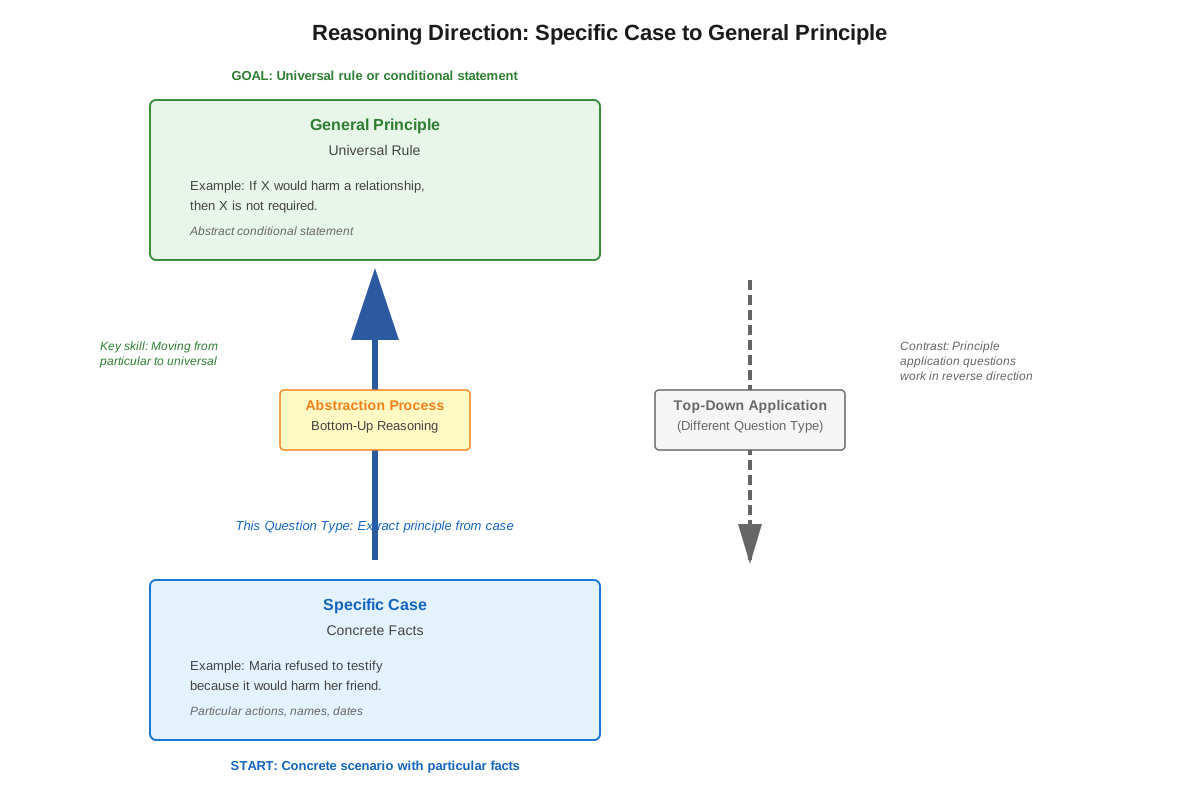
Within the broader landscape of principle questions, the specific-case-to-general-principle pattern represents the "bottom-up" approach to legal reasoning. While some principle questions ask test-takers to apply a given principle to a new situation (top-down reasoning), these questions reverse the direction: they present the outcome first and ask which principle best explains or justifies it. This question type connects closely to other Logical Reasoning skills including assumption identification, sufficient assumption questions, and justify-the-conclusion questions, but it uniquely emphasizes the abstraction and generalization process that transforms concrete facts into universal rules.
Learning Objectives
- [ ] Identify how specific case to general principle appears in LSAT questions
- [ ] Explain the reasoning pattern behind specific case to general principle
- [ ] Apply specific case to general principle to solve LSAT-style problems accurately
- [ ] Distinguish between principles that are too narrow, too broad, or appropriately matched to the specific case
- [ ] Evaluate answer choices by testing whether the general principle necessarily supports the specific judgment or action described
- [ ] Recognize common distractors that introduce irrelevant considerations or reverse the logical relationship
- [ ] Construct general principles from specific cases using proper scope and conditional logic
Prerequisites
- Basic conditional logic: Understanding "if-then" relationships is essential because principles are typically expressed as conditional statements that govern when certain actions are justified or required.
- Argument structure recognition: The ability to identify premises, conclusions, and reasoning patterns helps distinguish the specific case (the conclusion or action taken) from the supporting considerations (which hint at the underlying principle).
- Sufficient vs. necessary conditions: Recognizing the difference between what must be true for a principle to apply versus what guarantees an outcome is critical for evaluating whether a principle adequately justifies a specific case.
- Scope analysis: Understanding how to assess whether a statement is too broad, too narrow, or appropriately targeted is fundamental to matching principles with cases.
Why This Topic Matters
The lsat specific case to general principle question type directly mirrors a core competency in legal reasoning: the ability to articulate the rule of law that governs a particular situation. In legal practice, attorneys constantly extract principles from judicial opinions, statutes, and precedents to apply them to new client matters. Law school instruction emphasizes this skill through the case method, where students must identify the holding and reasoning of each case—essentially extracting general principles from specific judicial decisions.
On the LSAT, specific-case-to-general-principle questions typically appear 3-5 times per test, distributed across both Logical Reasoning sections. They most commonly appear with question stems such as "Which one of the following principles most helps to justify the reasoning above?" or "The situation described above most closely conforms to which one of the following generalizations?" These questions carry significant weight because they test multiple skills simultaneously: reading comprehension, logical analysis, abstraction ability, and precision in matching scope.
In exam passages, this topic appears in various contexts: ethical dilemmas requiring moral principles, business decisions requiring policy justifications, scientific methodology requiring epistemic principles, and legal or quasi-legal scenarios requiring rules of conduct. The specific cases presented are typically 2-4 sentences describing a particular action, decision, or judgment, often with some reasoning provided. The challenge lies in identifying which general principle, among five plausible options, best captures the reasoning that would justify or explain the specific case without being too narrow (applying only to that case) or too broad (justifying actions beyond what the case supports).
Core Concepts
The Reasoning Pattern: From Particular to Universal
The fundamental reasoning pattern in specific case to general principle questions involves inductive generalization—moving from a specific instance to a broader rule. The stimulus presents a concrete scenario where someone takes an action, makes a decision, or renders a judgment. The test-taker must identify the abstract principle that would make that specific action reasonable, justified, or correct.
This pattern differs from deductive reasoning, where a general rule is applied to reach a specific conclusion. Instead, the specific case serves as evidence or an example of a broader principle in action. The correct answer will articulate a general rule that:
- Applies to the specific case (the case must be an instance of the principle)
- Justifies or explains the action/decision in the specific case
- Maintains appropriate scope (neither too narrow nor too broad)
- Captures the relevant reasoning that distinguishes this case from others
Identifying Specific-Case-to-General-Principle Questions
These questions appear with distinctive question stems that signal the reasoning direction. Common formulations include:
- "Which one of the following principles most helps to justify the reasoning above?"
- "The situation described above most closely conforms to which one of the following generalizations?"
- "Which one of the following principles, if valid, most helps to justify the judgment described above?"
- "The reasoning above most closely conforms to which one of the following propositions?"
- "Which one of the following principles is best illustrated by the situation described above?"
The key linguistic markers are words like "principle," "generalization," "proposition," or "rule" combined with phrases indicating that the answer choice should explain, justify, or conform to the specific case presented in the stimulus.
The Structure of Principles
General principles in LSAT questions typically take the form of conditional statements or normative rules. Understanding their structure is essential for matching them to specific cases.
Conditional principles follow an if-then structure:
- "If [condition], then [action is justified/required/prohibited]"
- Example: "If a policy benefits the majority while harming no one, then it should be implemented"
Normative principles express what ought to be done under certain circumstances:
- "[Action] is justified when [circumstances]"
- Example: "Breaking a promise is justified when keeping it would cause significant harm"
Comparative principles establish priorities or rankings:
- "[Value A] should take precedence over [Value B] when [condition]"
- Example: "Public safety should take precedence over individual convenience when lives are at risk"
Scope Matching: The Critical Skill
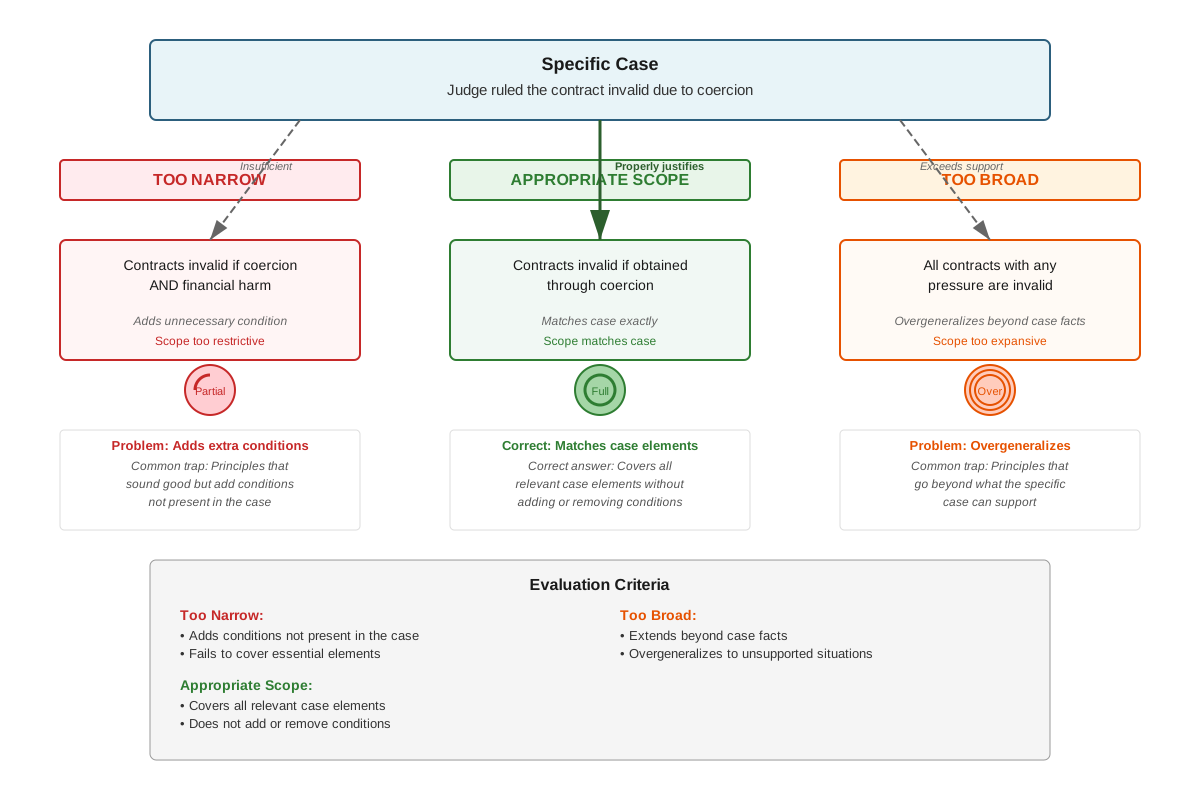
The most challenging aspect of specific-case-to-general-principle questions is scope matching—ensuring the principle is neither too narrow nor too broad. This requires careful analysis of three dimensions:
| Dimension | Too Narrow | Appropriate Scope | Too Broad |
|---|---|---|---|
| Subject matter | Applies only to the exact scenario | Applies to the relevant category | Applies to unrelated situations |
| Conditions | Includes unnecessary specific details | Captures essential features | Omits important limiting conditions |
| Conclusion | Justifies only this precise action | Justifies this type of action | Justifies actions beyond what's supported |
For example, if the specific case involves a teacher giving a student extra time on an exam because the student has a documented learning disability, consider these principles:
- Too narrow: "Teachers should give students with dyslexia extra time on reading comprehension exams" (too specific about the disability and exam type)
- Appropriate scope: "Accommodations should be provided when they compensate for documented disadvantages without giving unfair advantages"
- Too broad: "Teachers should help students whenever possible" (doesn't capture the limiting conditions)
The Justification Relationship
A principle justifies a specific case when the case satisfies the principle's conditions and the principle's conclusion supports the action taken. This creates a sufficient condition relationship: if the principle is true and its conditions are met, then the action is justified.
To verify this relationship:
- Identify the action/decision in the specific case
- Identify the circumstances/reasoning provided
- Check whether the principle's conditions match the circumstances
- Verify that the principle's conclusion supports the action
The principle must make the specific action reasonable given the circumstances, not merely consistent with it. A principle that could apply but doesn't explain why this action was taken in these circumstances is insufficient.
Common Principle Categories on the LSAT
LSAT questions draw principles from several recurring domains:
Ethical principles: Rules about right and wrong conduct, fairness, honesty, and moral obligations
- Example: "Deception is justified only when it prevents greater harm"
Epistemic principles: Rules about knowledge, belief justification, and evidence
- Example: "A claim should be accepted only when supported by adequate evidence"
Policy principles: Rules about institutional decisions, resource allocation, and collective action
- Example: "Policies should maximize overall benefit while respecting individual rights"
Professional principles: Rules governing role-specific obligations and standards
- Example: "Professionals should prioritize client interests except when doing so would violate legal or ethical standards"
Concept Relationships
The specific-case-to-general-principle reasoning pattern connects to multiple other Logical Reasoning concepts through shared analytical skills and logical structures. Understanding these relationships strengthens overall LSAT performance.
Relationship to Assumption Questions: Both question types require identifying unstated connections in arguments. In assumption questions, test-takers find the missing link between premise and conclusion. In specific-case-to-general-principle questions, test-takers identify the broader rule that would bridge the specific circumstances to the action taken. The principle often functions as a generalized assumption—if the argument assumes this specific connection, what general rule would make that assumption valid?
Relationship to Sufficient Assumption Questions: These are closely related but directionally opposite. Sufficient assumption questions provide a specific conclusion and ask what would guarantee it. Specific-case-to-general-principle questions provide a specific case and ask what general rule would justify it. Both require understanding conditional logic and sufficiency relationships.
Relationship to Parallel Reasoning: Both require abstraction—identifying the underlying logical structure separate from specific content. The skill of recognizing that "teacher/student/accommodation" is an instance of "authority figure/dependent party/special provision" is the same abstraction skill used in parallel reasoning questions.
Relationship to Strengthen/Weaken Questions: A principle that justifies a specific case would strengthen an argument defending that action. Understanding what principles support specific cases helps identify strengtheners in other question types.
Conceptual Flow: Specific case → Identify relevant features → Abstract to general categories → Formulate conditional rule → Test scope → Verify justification relationship → Select principle
High-Yield Facts
⭐ Specific-case-to-general-principle questions ask you to identify the broader rule that would justify or explain a particular action or decision described in the stimulus.
⭐ The correct principle must have appropriate scope—neither too narrow (applying only to the exact scenario) nor too broad (justifying actions beyond what the case supports).
⭐ Principles typically take the form of conditional statements: "If [conditions], then [action is justified/required/prohibited]."
⭐ The specific case must satisfy the principle's conditions, and the principle's conclusion must support the action taken—this creates a sufficient condition relationship.
⭐ Common question stems include "most helps to justify," "most closely conforms to," and "best illustrated by."
- Wrong answers often introduce considerations not present in the specific case or fail to justify the particular action taken.
- The principle should capture what makes this action appropriate in these circumstances, not merely what makes it permissible.
- Principles that reverse the logic (making the action a condition rather than a conclusion) are common distractors.
- The correct principle will match the specific case in all relevant dimensions: subject matter, conditions, and conclusion type.
- Test each answer choice by asking: "If this principle is true, does it make the specific action reasonable given the circumstances?"
- Principles involving "only," "never," or "always" require careful scrutiny—they often create scope problems.
- The stimulus may provide reasoning or justification for the action—the principle should generalize this reasoning, not introduce new considerations.
- Multiple principles might technically apply to a case, but the correct answer will be the one that most directly and completely justifies the specific action.
- Abstraction is key: replace specific terms (names, particular objects) with general categories (people, items of that type) to identify the principle's structure.
- Time pressure makes scope errors common—always verify that the principle isn't too broad by considering whether it would justify actions beyond what the case supports.
Common Misconceptions
Misconception: Any principle that could apply to the situation is correct. → Correction: The principle must not only apply but must specifically justify or explain the action taken. A principle might be consistent with the case without actually supporting the decision made.
Misconception: The correct principle should include all the specific details from the case. → Correction: Principles should be appropriately general, capturing the relevant features while abstracting away irrelevant specifics. Including too many particular details makes the principle too narrow.
Misconception: If the principle is true and the case is true, that's sufficient for the principle to be correct. → Correction: The principle must create a justification relationship—the case must be an instance where the principle's conditions are met and its conclusion supports the action. Mere consistency isn't enough.
Misconception: The principle with the strongest or most absolute language is usually correct. → Correction: Absolute language ("always," "never," "only") often creates scope problems, making principles too broad or too restrictive. The correct principle matches the specific case's nuance.
Misconception: The correct principle will use the same terminology as the stimulus. → Correction: Correct principles often use more abstract or general language. "Teacher" might become "authority figure," "exam" might become "evaluation," etc. The logical relationship matters more than word choice.
Misconception: Longer, more complex principles are more likely to be correct because they're more precise. → Correction: Length doesn't correlate with correctness. Sometimes the correct principle is the simplest one that captures the essential justification. Complexity can introduce irrelevant conditions that make the principle inapplicable.
Misconception: The principle should address every element mentioned in the stimulus. → Correction: The principle should address the elements relevant to justifying the action. Background information or context that doesn't bear on the decision's justification need not appear in the principle.
Quick check — test yourself on Specific case to general principle so far.
Try Flashcards →Worked Examples
Example 1: The Museum Curator Decision
Stimulus: A museum curator decided not to acquire a painting for the museum's collection, even though the painting was offered at a reasonable price and was of high artistic quality. The curator's decision was based on the fact that the museum already owned several works by the same artist, and acquiring this painting would not significantly enhance the diversity of the collection.
Question: Which one of the following principles most helps to justify the curator's decision?
Answer Choices:
(A) Museums should acquire works of art only when doing so would enhance the diversity of their collections.
(B) Museums should not acquire additional works by artists already well represented in their collections unless the works are exceptional.
(C) When resources are limited, museums should prioritize diversity over acquiring additional works of high quality.
(D) Museums should acquire works of art whenever they are offered at reasonable prices.
(E) The artistic quality of a work should be the primary consideration in acquisition decisions.
Analysis:
First, identify the specific case: The curator declined to acquire a painting despite its reasonable price and high quality, because the museum already owned several works by the same artist and acquiring it wouldn't enhance diversity.
The action to justify: Not acquiring the painting
The relevant circumstances:
- Reasonable price (mentioned but not the basis for decision)
- High artistic quality (mentioned but not the basis for decision)
- Museum already owns several works by same artist
- Acquiring it wouldn't enhance diversity
The reasoning: Diversity considerations outweighed price and quality in this instance.
Now evaluate each principle:
(A) "Museums should acquire works of art only when doing so would enhance diversity."
This is too strong. It makes diversity enhancement a necessary condition for any acquisition. The stimulus doesn't support such an absolute rule—it only shows that in this case, lack of diversity enhancement justified declining the acquisition. This principle would prohibit acquiring any work that doesn't enhance diversity, which goes beyond what the case supports. Eliminate.
(B) "Museums should not acquire additional works by artists already well represented in their collections unless the works are exceptional."
This captures the key elements: (1) artist already well represented, (2) general rule against acquiring more works by that artist, (3) exception for exceptional works. The stimulus indicates the painting was "high quality" but doesn't suggest it was exceptional enough to override the diversity concern. This principle justifies declining the acquisition. Strong contender.
(C) "When resources are limited, museums should prioritize diversity over acquiring additional works of high quality."
This introduces "limited resources," which isn't mentioned in the stimulus. While this might be true in reality, the principle should justify the decision based on the reasoning actually provided. The curator's decision was based on diversity and redundancy, not resource limitations. Eliminate.
(D) "Museums should acquire works of art whenever they are offered at reasonable prices."
This contradicts the curator's decision—it would require acquiring the painting. Eliminate.
(E) "The artistic quality of a work should be the primary consideration in acquisition decisions."
This also contradicts the decision, as the curator declined a high-quality work based on diversity considerations. Eliminate.
Correct Answer: (B)
This principle appropriately justifies the curator's decision by establishing that redundancy (works by already well-represented artists) is a valid reason to decline acquisition unless the work is exceptional. The scope is appropriate—it applies to the relevant category (works by already-represented artists) without being too narrow (specific to this painting) or too broad (all acquisition decisions).
Example 2: The Journalist's Source
Stimulus: A journalist refused to reveal the identity of a confidential source, even when ordered to do so by a court. The journalist argued that revealing the source's identity would make it impossible to obtain information from confidential sources in the future, and that the public interest in having access to information from such sources outweighs the court's need for the information in this particular case.
Question: The journalist's reasoning most closely conforms to which one of the following principles?
Answer Choices:
(A) Journalists should never reveal confidential sources under any circumstances.
(B) The public interest should always take precedence over legal obligations.
(C) Professional obligations may justifiably override legal requirements when complying would undermine the profession's ability to serve the public interest.
(D) Courts should not order journalists to reveal confidential sources.
(E) Protecting confidential sources is more important than any single legal case.
Analysis:
Identify the specific case: The journalist refused to reveal a source despite a court order.
The reasoning provided:
- Revealing would prevent future source cooperation
- Public interest in access to information from confidential sources
- This public interest outweighs the court's need in this case
The journalist is balancing competing considerations: legal obligation (court order) versus professional function (maintaining source confidentiality to serve public interest).
Evaluate each principle:
(A) "Journalists should never reveal confidential sources under any circumstances."
This is too absolute. The journalist's reasoning involves a balancing test (public interest in source protection outweighs court's need "in this particular case"), not an absolute prohibition. The phrase "in this particular case" suggests the journalist acknowledges that different circumstances might yield different results. Eliminate.
(B) "The public interest should always take precedence over legal obligations."
Again, too absolute and too broad. This would apply to all situations involving public interest and legal obligations, far beyond journalism and source protection. The journalist's reasoning is more specific to the professional context. Eliminate.
(C) "Professional obligations may justifiably override legal requirements when complying would undermine the profession's ability to serve the public interest."
This captures the structure of the journalist's reasoning:
- Professional obligation (protecting sources)
- Legal requirement (court order)
- Justification for overriding legal requirement (complying would undermine ability to serve public interest by preventing future source cooperation)
The scope is appropriate—it applies to professional contexts where serving the public interest is at stake, without being too narrow (specific to journalism) or too broad (all conflicts between obligations). Strong contender.
(D) "Courts should not order journalists to reveal confidential sources."
This addresses what courts should do, not what journalists are justified in doing. The question asks for the principle underlying the journalist's action, not a principle about court behavior. Eliminate.
(E) "Protecting confidential sources is more important than any single legal case."
This is closer but still too absolute ("any single legal case") and doesn't capture the full reasoning about undermining future public interest. It also doesn't generalize beyond the specific context. Eliminate.
Correct Answer: (C)
This principle best captures the journalist's reasoning pattern: a professional obligation may override a legal requirement when compliance would undermine the profession's public interest function. The principle is appropriately general (applying to professional contexts, not just journalism) while maintaining the specific logical structure of the journalist's argument (balancing professional duty against legal obligation based on public interest consequences).
Exam Strategy
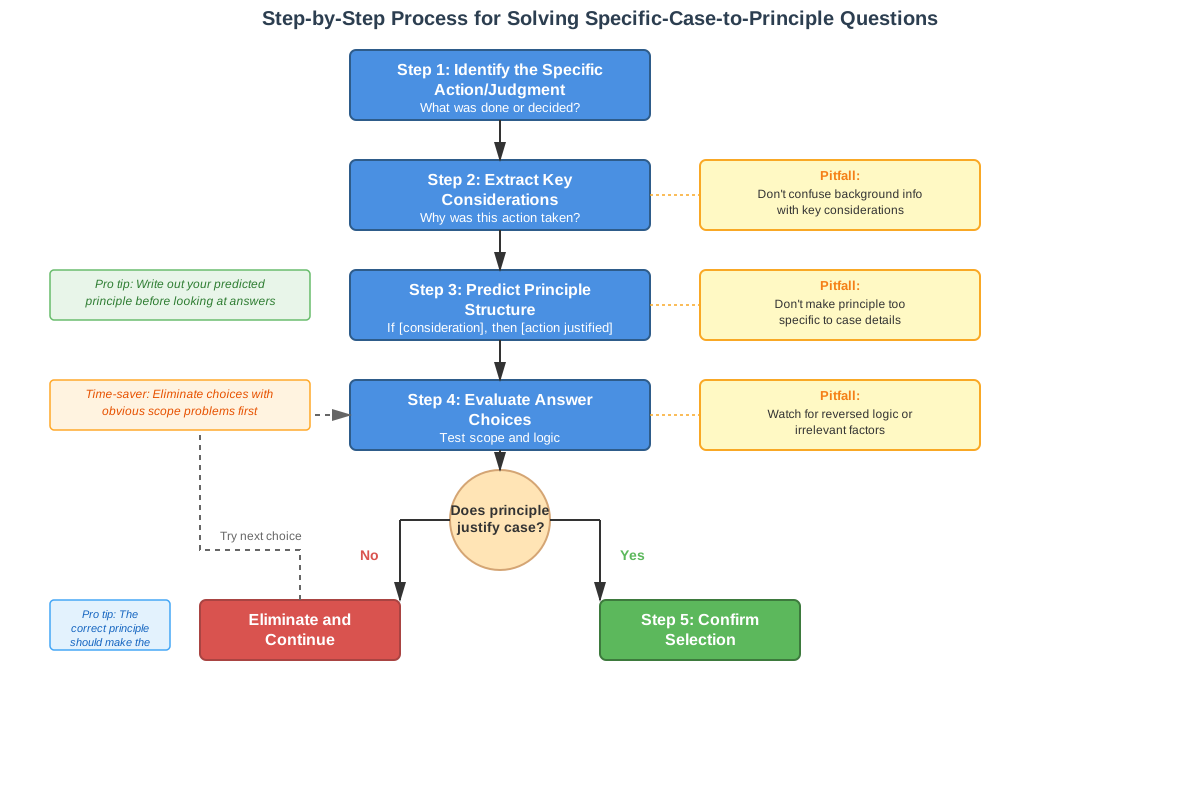
Systematic Approach to Specific-Case-to-General-Principle Questions
Step 1: Identify the question type (5-10 seconds)
Look for trigger phrases: "principle most helps to justify," "most closely conforms to," "best illustrated by." Recognize that you're moving from specific to general.
Step 2: Analyze the specific case (20-30 seconds)
- Identify the action or decision taken
- Note the circumstances or context
- Identify any reasoning provided for the action
- Distinguish relevant features from background information
Step 3: Predict the principle structure (10-15 seconds)
Before looking at answer choices, mentally formulate: "If [these circumstances], then [this type of action] is justified because [this consideration]." This prediction helps you recognize the correct answer and avoid distractors.
Step 4: Evaluate answer choices systematically (30-45 seconds)
For each choice, ask three questions:
- Does the case satisfy the principle's conditions? (If not, eliminate)
- Does the principle's conclusion support the action taken? (If not, eliminate)
- Is the scope appropriate? (Not too narrow or too broad)
Trigger Words and Phrases
In question stems:
- "principle most helps to justify" → Find what makes the action reasonable
- "most closely conforms to" → Find what rule the case exemplifies
- "best illustrated by" → Find what general rule this case demonstrates
- "reasoning above most closely conforms to" → Match the logical structure
In answer choices indicating scope problems:
- "always," "never," "only," "all" → Check for over-breadth
- "in this type of situation" → May be too narrow
- Specific terminology from stimulus → May be too narrow
- Very general terms unrelated to stimulus → May be too broad
In answer choices indicating logical structure:
- "when," "if," "whenever" → Conditional structure (check if conditions match)
- "should," "ought," "justified" → Normative conclusion (check if it supports the action)
- "unless," "except" → Exception clauses (verify they apply correctly)
Process-of-Elimination Strategy
First pass—eliminate clear mismatches:
- Principles that would justify the opposite action
- Principles whose conditions aren't met by the case
- Principles that introduce considerations absent from the stimulus
Second pass—eliminate scope problems:
- Too narrow: Includes unnecessary specific details from the case
- Too broad: Would justify actions beyond what the case supports
- Test breadth by asking: "Would this principle justify other actions not supported by the reasoning?"
Final selection—verify the justification relationship:
- The case must be a clear instance of the principle
- The principle must make the action reasonable, not merely consistent
- The principle should capture the reasoning that distinguishes this case
Time Allocation
- Total time per question: 1:20-1:30 (80-90 seconds)
- Reading and analyzing stimulus: 30-35 seconds
- Predicting principle structure: 10-15 seconds
- Evaluating answer choices: 35-45 seconds
- Final verification: 5-10 seconds
If stuck between two choices, focus on scope: the correct answer will match the case's level of generality without extending beyond what the reasoning supports.
Exam Tip: When two principles both seem to justify the action, choose the one that more directly captures the reasoning provided in the stimulus. The correct answer will feel like a natural generalization of the specific case's logic, not an alternative justification.
Memory Techniques
The SCOPES Acronym
Use SCOPES to remember the key elements of evaluating principles:
- Specific case: What action was taken?
- Conditions: What circumstances are relevant?
- Outcome: What does the principle conclude?
- Principle structure: Is it conditional, normative, or comparative?
- Extent: Is the scope too narrow or too broad?
- Support: Does it justify the action based on the reasoning given?
The Abstraction Ladder Visualization
Visualize a ladder with three rungs:
Top rung (too broad): "People should help others" → Applies to everything, loses specificity
Middle rung (appropriate): "Professionals should prioritize client interests when doing so doesn't violate ethical standards" → Captures relevant category and conditions
Bottom rung (too narrow): "Dr. Smith should prioritize Patient Jones's interests on Tuesday" → Too specific to the exact case
The correct principle sits on the middle rung—general enough to apply beyond this case, specific enough to capture what makes this case distinctive.
The "If-Then-Because" Formula
Remember that principles typically follow this structure:
IF [circumstances/conditions are met]
THEN [action is justified/required/prohibited]
BECAUSE [underlying value or consideration]
When analyzing the specific case, identify each component:
- IF: What circumstances were present?
- THEN: What action was taken?
- BECAUSE: What reasoning was provided?
The correct principle will generalize all three components appropriately.
The Goldilocks Principle
Remember the fairy tale: one principle is too narrow (too specific), one is too broad (too general), and one is just right (appropriate scope). This reminds you that scope matching is often the deciding factor between answer choices.
Summary
Specific-case-to-general-principle questions require test-takers to identify the broader rule that would justify or explain a particular action or decision described in the stimulus. This reasoning pattern moves from the concrete to the abstract, testing the ability to extract universal principles from specific instances—a fundamental skill in legal reasoning. Success on these questions depends on three core competencies: accurately analyzing the specific case to identify the action taken and the reasoning provided; understanding principle structure, particularly conditional and normative statements; and evaluating scope to ensure the principle is neither too narrow (applying only to the exact scenario) nor too broad (justifying actions beyond what the case supports). The correct principle must create a justification relationship where the case satisfies the principle's conditions and the principle's conclusion supports the action taken. Common pitfalls include selecting principles that introduce considerations absent from the stimulus, choosing principles with inappropriate scope, and confusing consistency with justification. Systematic evaluation using the SCOPES framework—analyzing the Specific case, Conditions, Outcome, Principle structure, Extent, and Support—provides a reliable method for identifying correct answers within the time constraints of the LSAT.
Key Takeaways
- Specific-case-to-general-principle questions ask you to identify the broader rule that justifies a particular action, moving from concrete to abstract.
- The correct principle must have appropriate scope—general enough to apply beyond the specific case but specific enough to capture what makes the action justified in these circumstances.
- Principles create a justification relationship: the case must satisfy the principle's conditions, and the principle's conclusion must support the action taken.
- Analyze the specific case systematically by identifying the action, circumstances, and reasoning before evaluating answer choices.
- Common wrong answers include principles that are too narrow (overly specific), too broad (justify too much), or introduce considerations not present in the stimulus.
- Use the "If-Then-Because" structure to understand principle logic: IF [conditions], THEN [action justified], BECAUSE [underlying consideration].
- Scope errors are the most common reason for incorrect answers—always verify that the principle doesn't extend beyond what the case's reasoning supports.
Related Topics
Principle Application Questions: The inverse of specific-case-to-general-principle questions, these provide a general principle and ask which specific case it applies to or supports. Mastering specific-to-general reasoning strengthens your ability to work in the opposite direction.
Sufficient Assumption Questions: These questions require identifying what would guarantee a conclusion, similar to finding what principle would justify an action. The logical structure of sufficiency relationships applies to both question types.
Parallel Reasoning Questions: Both question types require abstraction—identifying logical structure separate from specific content. The skill of generalizing from specific cases transfers directly to recognizing parallel argument structures.
Necessary Assumption Questions: Understanding what must be true for an argument to work helps identify the principles underlying specific cases, as principles often function as generalized assumptions.
Strengthen and Weaken Questions: Principles that justify specific cases would strengthen arguments defending those actions. Understanding principle-case relationships enhances your ability to evaluate argument support.
Practice CTA
Now that you've mastered the conceptual framework for specific-case-to-general-principle questions, it's time to apply these strategies to actual LSAT problems. Work through the practice questions systematically, using the SCOPES framework to evaluate each answer choice. Pay special attention to scope matching—this is where most students struggle initially, but with practice, you'll develop an intuition for the appropriate level of generality. Review the flashcards to reinforce the key distinctions between principles that are too narrow, too broad, and appropriately scoped. Remember: these questions test a learnable skill, not innate ability. Each practice question you complete strengthens your pattern recognition and analytical precision. You're building the exact reasoning skills that law school and legal practice demand. Stay focused, trust the process, and watch your accuracy improve with deliberate practice.
Sign up free to keep reading
Create a free AnvayaPrep account to finish this LSAT guide on Specific case to general principle — plus flashcards and practice questions.