Overview
Cannot be true question stems represent a critical category within LSAT logical reasoning that tests a student's ability to identify statements that are incompatible with the information presented in a stimulus. These questions require test-takers to recognize what must be false given the constraints, facts, or logical relationships established in the passage. Unlike "must be true" questions that ask for necessary inferences, cannot be true questions demand that students identify statements that directly contradict or are logically impossible given the stimulus.
Mastering LSAT cannot be true question stems is essential because these questions appear regularly on every LSAT administration and test fundamental skills in logical analysis, constraint recognition, and deductive reasoning. These questions often appear deceptively similar to other question types, making question stem recognition a crucial skill. Students who misidentify a cannot be true question as a different type will apply the wrong strategy and likely select an incorrect answer. The ability to quickly and accurately recognize these stems saves valuable time and prevents costly errors.
Within the broader landscape of Logical Reasoning, cannot be true questions connect directly to formal logic, conditional reasoning, and inference questions. They require students to understand the logical space created by the stimulus—what is possible, what is necessary, and what is impossible. This question type bridges the gap between pure inference questions and assumption questions, as students must fully comprehend the logical structure of an argument or set of facts to determine what cannot exist within that framework.
Learning Objectives
- [ ] Identify how Cannot be true question stems appears in LSAT questions
- [ ] Explain the reasoning pattern behind Cannot be true question stems
- [ ] Apply Cannot be true question stems to solve LSAT-style problems accurately
- [ ] Distinguish cannot be true questions from similar question types (must be true, could be true, must be false)
- [ ] Recognize the various phrasings and linguistic variations used in cannot be true stems
- [ ] Develop a systematic approach to eliminating wrong answers in cannot be true questions
- [ ] Identify the logical constraints in stimuli that make certain statements impossible
Prerequisites
- Basic formal logic: Understanding of logical operators (and, or, if-then) is necessary because cannot be true questions often involve evaluating logical relationships and contradictions
- Conditional reasoning: Familiarity with sufficient and necessary conditions helps identify when answer choices violate established logical rules
- Inference fundamentals: Knowledge of what can be validly concluded from given information provides the foundation for recognizing what cannot be concluded
- Argument structure: Understanding premises and conclusions enables students to identify which elements create constraints that make certain statements impossible
- Negation: Ability to understand logical negation is crucial since "cannot be true" is equivalent to "must be false"
Why This Topic Matters
Cannot be true questions test one of the most practical reasoning skills: the ability to recognize impossibilities and contradictions. In legal practice, attorneys must identify when testimony contradicts established facts, when proposed interpretations violate statutory language, or when arguments contain internal inconsistencies. This same skill applies to business analysis, scientific reasoning, and everyday decision-making where recognizing what cannot work is as important as identifying what can.
On the LSAT, cannot be true questions typically appear 2-4 times per Logical Reasoning section, making them a high-frequency question type that students cannot afford to miss. These questions often appear in the medium-to-difficult range, with test-makers using subtle language variations and complex logical structures to challenge even well-prepared students. The LSAC specifically designs these questions to test whether students can work with constraints and recognize logical impossibilities—skills directly relevant to legal reasoning.
These questions commonly appear in several contexts: after stimuli presenting multiple constraints or rules (where certain combinations become impossible), following arguments with strong conditional statements (where violating those conditions creates impossibilities), and after factual passages that establish clear boundaries (where certain claims would exceed those boundaries). Test-makers frequently use these questions with stimuli involving scheduling, ordering, or categorical relationships where the logical space is clearly defined and certain options are definitively ruled out.
Core Concepts
Definition and Logical Structure
A cannot be true question stem asks test-takers to identify an answer choice that is logically incompatible with the information in the stimulus. This means the correct answer must be false given what the passage states. Logically, "cannot be true" is equivalent to "must be false"—these are simply different ways of expressing the same logical relationship. When a statement cannot be true, it means that accepting both the stimulus and that statement would create a logical contradiction.
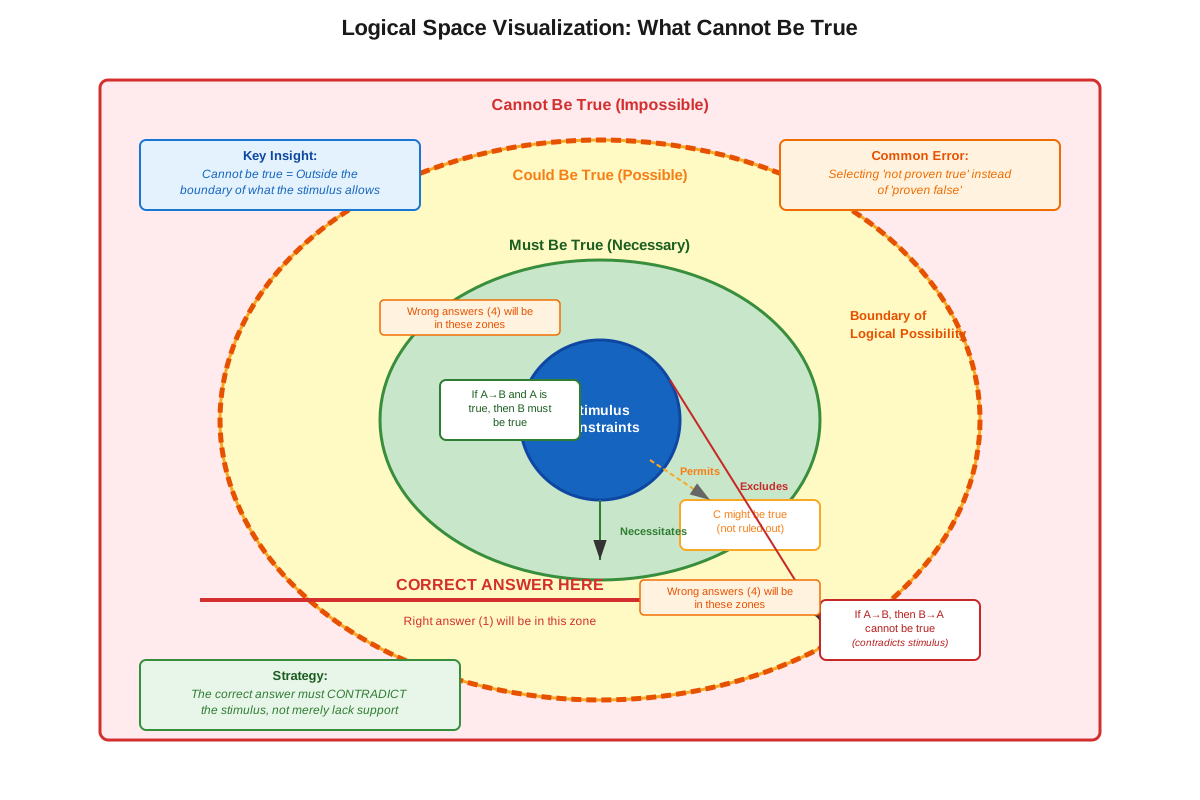
The logical structure operates on the principle of consistency. The stimulus establishes a set of facts, rules, or logical relationships that create a defined logical space. Within this space, some statements are necessarily true, some are possibly true, and some are impossible. Cannot be true questions ask students to identify statements that fall outside the possible range—statements that would require violating the established constraints.
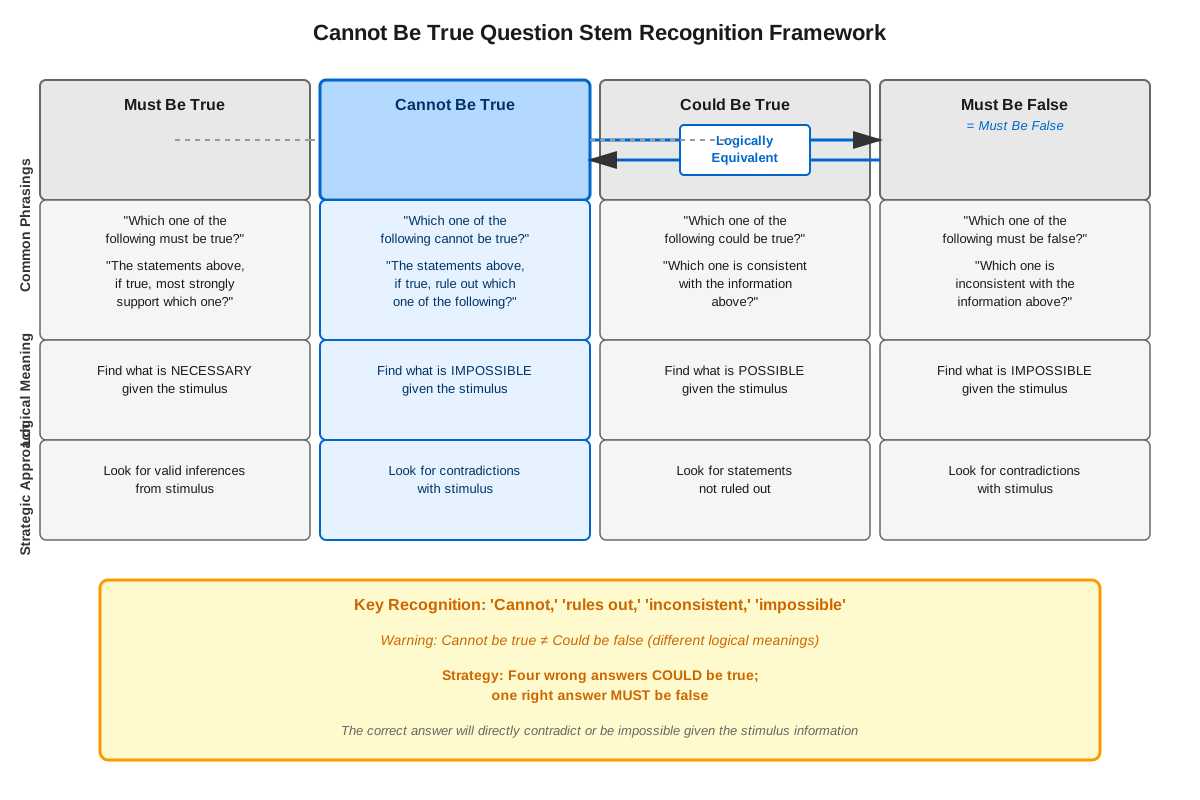
Common Phrasings and Variations
Cannot be true question stems appear in multiple linguistic forms, and recognizing all variations is crucial for proper question stem recognition. The most common phrasings include:
- "Which one of the following cannot be true?"
- "Which one of the following must be false?"
- "The statements above, if true, rule out which one of the following?"
- "If the statements above are true, which one of the following CANNOT be true?"
- "The information above most strongly supports the claim that which one of the following is NOT true?"
- "Which one of the following is inconsistent with the information above?"
- "Which one of the following is impossible given the statements above?"
The key identifying features include negative language ("cannot," "must be false," "not true"), language of exclusion ("rule out," "inconsistent"), and language of impossibility ("impossible"). Students must train themselves to recognize these variations instantly, as the LSAT deliberately uses different phrasings to test whether students truly understand what the question asks.
The Reasoning Pattern
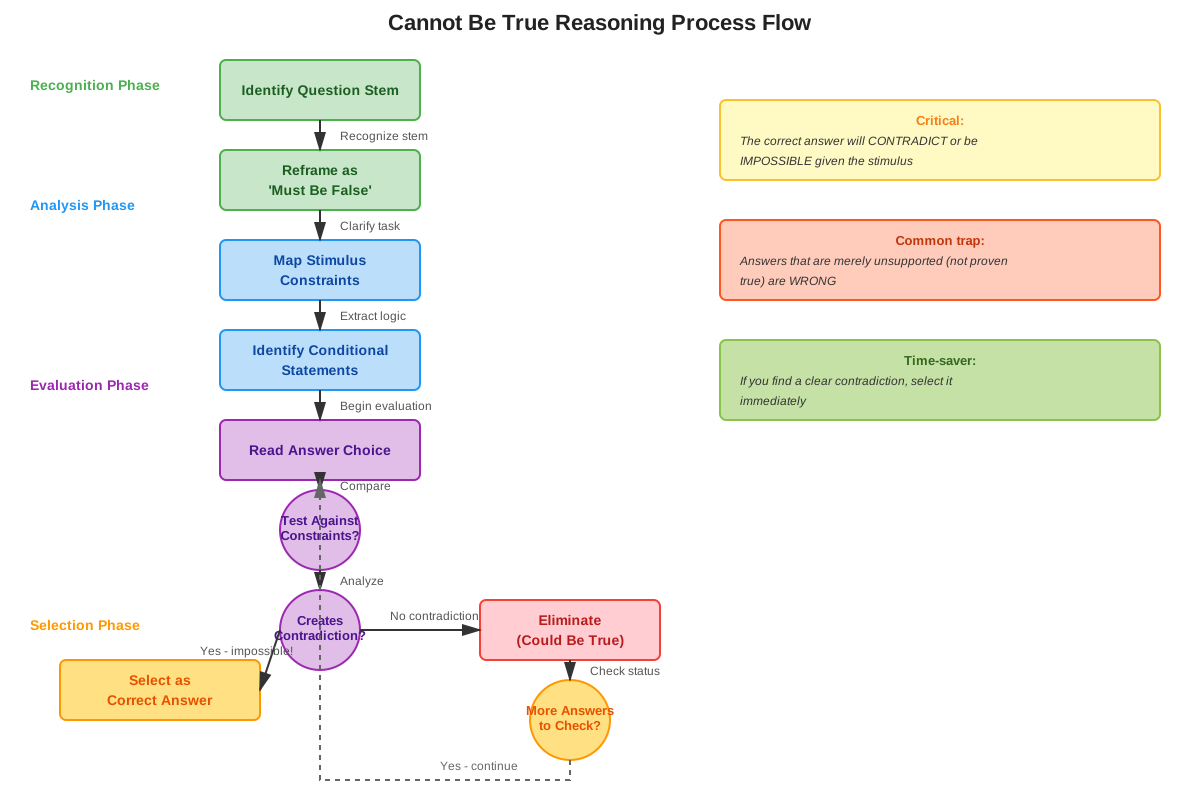
The reasoning pattern for cannot be true questions follows a specific logical sequence:
- Establish the constraints: Identify all facts, rules, and logical relationships in the stimulus that create boundaries on what is possible
- Understand the logical space: Determine what range of possibilities exists given these constraints
- Test each answer choice: Evaluate whether each answer choice can coexist with the stimulus without creating a contradiction
- Identify the impossibility: Select the answer that violates the established constraints
This pattern differs fundamentally from must be true questions. In must be true questions, students look for what necessarily follows from the stimulus. In cannot be true questions, students look for what necessarily does not follow—what is excluded by the stimulus. The correct answer to a cannot be true question would, if added to the stimulus, create a logical impossibility or direct contradiction.
Types of Constraints That Create Impossibilities
Cannot be true questions rely on various types of constraints in the stimulus:
| Constraint Type | How It Creates Impossibilities | Example |
|---|---|---|
| Conditional statements | Violating the necessary condition or affirming the sufficient while denying the necessary | "If elected, she will resign" makes "elected but didn't resign" impossible |
| Quantitative limits | Exceeding stated numerical boundaries | "Fewer than 10 attended" makes "12 attended" impossible |
| Categorical exclusions | Placing something in a category it's explicitly excluded from | "No mammals lay eggs" makes "platypuses are mammals that lay eggs" impossible (though factually wrong, this shows the logical structure) |
| Temporal constraints | Violating time-based orderings or limitations | "Event A occurred before Event B" makes "Event B occurred before Event A" impossible |
| Mutual exclusivity | Claiming both of two mutually exclusive options | "Either X or Y, but not both" makes "both X and Y" impossible |
Relationship to Other Question Types
Cannot be true questions exist within a family of inference-based questions that test logical relationships:
- Must be true: What necessarily follows (the correct answer is guaranteed by the stimulus)
- Could be true: What is possible (the correct answer is consistent with the stimulus)
- Cannot be true: What is impossible (the correct answer contradicts the stimulus)
- Must be false: Logically identical to cannot be true, just different phrasing
Understanding these relationships helps students avoid confusion. The critical distinction is between necessity and possibility. Must be true questions ask for necessity; cannot be true questions ask for impossibility; could be true questions ask for mere possibility. Students often confuse these categories, selecting answers that could be false when the question asks for what cannot be true, or selecting answers that are merely unlikely when the question demands logical impossibility.
The Role of Formal Logic
Many cannot be true questions involve formal logical structures, particularly conditional statements. When a stimulus establishes "If A, then B," this creates clear impossibilities: "A and not-B" cannot be true. Students must recognize how conditional statements, their contrapositives, and their negations create logical boundaries.
Similarly, quantified statements create impossibilities. "All X are Y" makes "some X is not Y" impossible. "No X are Y" makes "some X is Y" impossible. "Some X are Y" makes "no X are Y" impossible. These formal relationships provide the logical foundation for many cannot be true questions.
Concept Relationships
The concepts within cannot be true questions form an interconnected logical framework. Question stem recognition serves as the entry point—students must first correctly identify that they're dealing with a cannot be true question. This recognition triggers the appropriate reasoning pattern, which involves identifying constraints in the stimulus. These constraints emerge from various sources: conditional statements, quantitative limits, categorical boundaries, and temporal orderings.
The reasoning pattern connects directly to formal logic principles, as students must apply rules of inference, contradiction, and consistency. Understanding what makes a statement impossible requires grasping the logical space created by the stimulus—the range of possibilities that remain consistent with the given information. This logical space concept bridges to related question types: must be true questions ask for what's necessary within this space, while could be true questions ask for what's possible.
The relationship map flows as follows:
Question Stem Recognition → identifies → Cannot Be True Question Type → triggers → Constraint Identification → enables → Logical Space Analysis → produces → Impossibility Detection → leads to → Correct Answer Selection
This topic also connects backward to prerequisite knowledge. Conditional reasoning provides the tools for understanding how if-then statements create impossibilities. Basic formal logic supplies the framework for recognizing contradictions. Inference fundamentals establish the baseline understanding of what follows from given information, which extends naturally to understanding what cannot follow.
High-Yield Facts
⭐ Cannot be true and must be false are logically equivalent—they ask for the same thing using different language
⭐ The correct answer to a cannot be true question, if added to the stimulus, would create a logical contradiction
⭐ Cannot be true questions typically appear 2-4 times per Logical Reasoning section on the LSAT
⭐ Common stem phrasings include "cannot be true," "must be false," "rule out," "inconsistent with," and "impossible"
⭐ The reasoning pattern requires identifying constraints in the stimulus that create logical boundaries
- Wrong answers in cannot be true questions are often statements that could be true or even must be true
- Conditional statements in the stimulus frequently create the impossibilities tested in these questions
- Quantitative limits ("at least," "at most," "fewer than") often establish boundaries that certain answers violate
- Cannot be true questions differ from must be true questions in that they ask for exclusion rather than necessity
- Temporal constraints and ordering relationships commonly appear in stimuli for cannot be true questions
- The correct answer is the only one that cannot coexist with the stimulus without contradiction
- Students should look for answer choices that directly violate stated rules or exceed established limits
- Categorical exclusions ("no X are Y") create clear impossibilities that test-makers exploit
- Cannot be true questions often appear with stimuli containing multiple constraints or rules
- The logical space created by the stimulus determines what is possible, necessary, and impossible
Quick check — test yourself on Cannot be true question stems so far.
Try Flashcards →Common Misconceptions
Misconception: Cannot be true means "probably false" or "unlikely to be true"
Correction: Cannot be true means logically impossible—it must be false given the stimulus. The correct answer isn't merely improbable; it's impossible. Students must distinguish between practical unlikelihood and logical impossibility.
Misconception: If an answer choice isn't explicitly mentioned in the stimulus, it cannot be the correct answer
Correction: The correct answer may involve concepts not directly stated but logically excluded by what is stated. The impossibility arises from logical relationships, not just explicit statements. For example, if the stimulus says "all attendees were adults," then "some attendees were children" is impossible even though children weren't explicitly mentioned.
Misconception: Cannot be true questions and must be true questions use opposite reasoning strategies
Correction: While these questions ask for different things, both require careful analysis of what the stimulus establishes. The strategy isn't opposite; it's parallel but focused on different ends of the logical spectrum (impossibility vs. necessity).
Misconception: The correct answer will always directly contradict a specific sentence in the stimulus
Correction: The impossibility may arise from the combination of multiple statements or from logical implications rather than direct contradiction of a single sentence. Students must consider the entire logical structure, not just individual sentences.
Misconception: "Cannot be true" and "not necessarily true" mean the same thing
Correction: These are fundamentally different. "Cannot be true" means impossible (must be false). "Not necessarily true" means possibly false but also possibly true. This confusion leads students to select answers that merely lack support rather than answers that are actually impossible.
Misconception: In cannot be true questions, extreme or absolute answer choices are more likely to be correct
Correction: While extreme statements are sometimes easier to disprove, the correct answer is determined by logical impossibility, not by the strength of language. Moderate statements can be impossible, and extreme statements can be possible, depending on the stimulus.
Misconception: If four answer choices could be true, the remaining one must be the correct answer
Correction: While this is often the case, students should verify that the selected answer actually cannot be true rather than simply eliminating others. The goal is to identify impossibility, not just to find the odd one out.
Worked Examples
Example 1: Conditional Constraint
Stimulus: "Every member of the committee voted for the proposal. The proposal required unanimous support to pass. If the proposal passed, the budget would be increased."
Question Stem: "If the statements above are true, which one of the following cannot be true?"
Answer Choices:
(A) The budget was increased
(B) Some committee members were absent
(C) The proposal received strong support
(D) The committee met last week
(E) The budget remained unchanged
Analysis:
Step 1: Identify the constraints
- Every member voted for the proposal (universal support)
- Unanimous support required for passage (conditional: if pass → unanimous)
- If passed → budget increased (conditional: pass → budget increase)
Step 2: Trace the logical chain
Since every member voted for it, there was unanimous support. Since there was unanimous support and that's what's required, the proposal passed. Since the proposal passed, the budget was increased.
Step 3: Evaluate each answer
- (A) Must be true based on our chain of reasoning—not impossible
- (B) Cannot be true! If every member voted for it, no members were absent (you can't vote if absent)
- (C) Could be true—consistent with the stimulus
- (D) Could be true—no temporal constraint prevents this
- (E) Cannot be true based on our reasoning, but let's verify against (B)
Step 4: Compare (B) and (E)
Both seem impossible. However, (B) is more directly impossible: "every member voted" logically excludes absent members. (E) follows from a chain of inference. The LSAT typically makes the most direct impossibility the correct answer.
Correct Answer: (B)
Connection to Learning Objectives: This example demonstrates how to identify constraints (conditional statements), apply the reasoning pattern (trace logical implications), and recognize what cannot be true (absent members when all voted).
Example 2: Quantitative Constraint
Stimulus: "The museum acquired fewer than 15 paintings last year. Of these paintings, at least 8 were from European artists. No painting was acquired from both a European artist and an Asian artist."
Question Stem: "Which one of the following must be false?"
Answer Choices:
(A) The museum acquired exactly 10 paintings from European artists
(B) The museum acquired 5 paintings from Asian artists
(C) The museum acquired 14 paintings total last year
(D) The museum acquired 8 paintings from European artists and 7 from Asian artists
(E) All paintings acquired were from either European or Asian artists
Analysis:
Step 1: Identify constraints
- Total paintings < 15 (so maximum is 14)
- European paintings ≥ 8 (minimum is 8)
- No painting is both European and Asian (mutually exclusive categories)
Step 2: Understand the logical space
- Total can be 0-14 paintings
- European must be 8-14 (can't exceed total)
- If we have both European and Asian, they must sum to ≤ 14
Step 3: Evaluate each answer
- (A) 10 European paintings—possible (10 < 15, and 10 ≥ 8) ✓
- (B) 5 Asian paintings—possible if total is ≥ 13 (8 European + 5 Asian = 13 < 15) ✓
- (C) 14 total—possible (14 < 15) ✓
- (D) 8 European + 7 Asian = 15 total—IMPOSSIBLE! This equals 15, but we need fewer than 15
- (E) Could be true—no constraint prevents this ✓
Step 4: Verify the impossibility
Answer (D) requires 15 total paintings (8 + 7), but the stimulus explicitly states "fewer than 15." This creates a direct contradiction.
Correct Answer: (D)
Connection to Learning Objectives: This example shows how quantitative constraints create impossibilities, demonstrates the systematic evaluation process, and illustrates how to distinguish between what's merely unsupported versus what's actually impossible.
Exam Strategy
Immediate Recognition Protocol
When approaching any Logical Reasoning question, read the question stem first. Train your eyes to catch negative language: "cannot," "must be false," "NOT," "rule out," "inconsistent," "impossible." These trigger words signal a cannot be true question. Immediately shift your mental framework from "what follows?" to "what's excluded?"
Stimulus Analysis Approach
After identifying a cannot be true question, read the stimulus with a specific focus:
- Mark all constraints: Circle or mentally note every rule, limit, conditional statement, or boundary
- Identify the logical structure: Is this a conditional chain? A set of categorical rules? Quantitative limits?
- Anticipate impossibilities: Before looking at answers, consider what would violate these constraints
- Note absolute language: "All," "no," "every," "none" create strong boundaries
Answer Choice Evaluation Strategy
Exam Tip: In cannot be true questions, four answers will be possible (could be true or must be true), and one will be impossible. Your job is to find the impossible one.
Evaluate answers systematically:
- Test against each constraint: Does this answer violate any rule from the stimulus?
- Look for direct contradictions: Does this answer state the opposite of something in the stimulus?
- Check quantitative boundaries: Does this answer exceed stated limits?
- Verify conditional violations: Does this answer affirm a sufficient condition while denying its necessary condition?
Common Trap Patterns
Test-makers design wrong answers to exploit specific errors:
- Unsupported but possible: Statements that aren't proven by the stimulus but don't contradict it (these are wrong because they could be true)
- Unlikely but possible: Statements that seem improbable but aren't logically impossible
- Opposite of what's asked: Statements that must be true (students who misread the question select these)
- Partially contradictory: Statements that seem to contradict but actually don't upon careful analysis
Time Management
Cannot be true questions typically require 60-90 seconds. Allocate time as follows:
- 10 seconds: Read and identify question type
- 20-30 seconds: Read and analyze stimulus, identifying constraints
- 30-40 seconds: Evaluate answer choices
- 10 seconds: Verify your selection
If you're stuck between two answers, both seeming impossible, reread the stimulus carefully. Usually, one answer is directly impossible while the other merely seems unlikely or is based on a misreading.
Process of Elimination Technique
Use this systematic approach:
- First pass: Eliminate answers that are clearly possible or even necessary
- Second pass: Carefully examine remaining answers against each constraint
- Verification: Before selecting, confirm the answer actually cannot be true, not just that it's unsupported
Memory Techniques
The CANNOT Acronym
Constraints first—identify all rules and limits
Analyze the logical structure
Negate possibilities—look for what's excluded
Note conditional statements
Observe quantitative limits
Test each answer systematically
Visualization Strategy
Picture the logical space as a circle. Everything inside the circle is possible given the stimulus. The correct answer to a cannot be true question falls outside this circle—it's in the impossible zone. When reading the stimulus, mentally draw this boundary. When evaluating answers, ask: "Is this inside or outside the circle?"
The Impossibility Checklist
Memorize these common sources of impossibility:
- Violates a conditional (affirms sufficient, denies necessary)
- Exceeds quantitative limits
- Transgresses categorical boundaries
- Opposes explicit statements
Mnemonic: VETO what cannot be true
Language Recognition Pattern
Train yourself to instantly recognize these equivalent phrasings:
- Cannot be true = Must be false = Impossible = Ruled out = Inconsistent with
Create a mental equation: CANNOT = MUST NOT = IMPOSSIBLE
Summary
Cannot be true question stems represent a high-frequency, high-importance question type on the LSAT that tests the ability to recognize logical impossibilities. These questions, which are logically equivalent to "must be false" questions, require students to identify answer choices that contradict or are incompatible with the information in the stimulus. Success depends on three core skills: accurate question stem recognition using trigger words like "cannot," "must be false," "rule out," and "inconsistent"; systematic identification of constraints in the stimulus including conditional statements, quantitative limits, categorical boundaries, and temporal orderings; and methodical evaluation of answer choices to find the one that violates these constraints. The reasoning pattern involves establishing what the stimulus makes possible, understanding the logical space created by these constraints, and identifying which answer choice falls outside this space of possibility. Students must distinguish between statements that are merely unsupported (which could be true) and statements that are actually impossible (which cannot be true). Mastery requires understanding formal logic principles, recognizing various phrasings of the question type, and avoiding common traps such as selecting unlikely-but-possible answers or confusing "cannot be true" with "not necessarily true."
Key Takeaways
- Cannot be true and must be false are logically identical—both ask for what is impossible given the stimulus
- The correct answer creates a logical contradiction when combined with the stimulus information
- Identify constraints in the stimulus (conditionals, quantities, categories, temporal orderings) that create impossibilities
- Four wrong answers will be possible or necessary; only one will be impossible
- Common phrasings include "cannot be true," "must be false," "rule out," "inconsistent," and "impossible"
- Distinguish between unsupported (could be true) and impossible (cannot be true)—only the impossible answer is correct
- Apply systematic evaluation: test each answer against every constraint in the stimulus
Related Topics
Must Be True Questions: The logical complement to cannot be true questions, asking for what necessarily follows rather than what's impossible. Mastering cannot be true questions provides the foundation for understanding the full spectrum of inference questions.
Conditional Reasoning: Many cannot be true questions rely on conditional statements to create impossibilities. Deeper study of conditional logic, contrapositives, and conditional chains enhances performance on these questions.
Formal Logic: Advanced understanding of logical operators, quantifiers, and logical relationships strengthens the ability to recognize impossibilities and contradictions in complex stimuli.
Could Be True Questions: These questions ask for what's possible rather than impossible, representing the middle ground between must be true and cannot be true. Understanding all three types together provides complete mastery of inference-based questions.
Parallel Reasoning: The skill of recognizing logical structures developed through cannot be true questions transfers directly to parallel reasoning questions, where identifying matching logical patterns is essential.
Practice CTA
Now that you understand the structure, strategy, and reasoning patterns behind cannot be true question stems, it's time to apply this knowledge. Work through the practice questions to reinforce your ability to recognize these question types instantly, identify constraints that create impossibilities, and systematically eliminate wrong answers. Each practice question you complete strengthens your pattern recognition and builds the confidence needed to tackle these questions quickly and accurately on test day. Remember: cannot be true questions are highly learnable—with focused practice, you can master this question type and secure these points on every LSAT administration. Begin your practice now, and watch your accuracy improve with each question you analyze.
Sign up free to keep reading
Create a free AnvayaPrep account to finish this LSAT guide on Cannot be true question stems — plus flashcards and practice questions.