Overview
Evaluate question stems represent a distinctive and challenging category within LSAT Logical Reasoning sections. These questions ask test-takers to identify what additional information would be most useful in assessing the strength or validity of an argument. Unlike questions that ask you to strengthen, weaken, or identify assumptions, Evaluate questions require you to recognize what piece of information—if known—would help determine whether the argument succeeds or fails. This question type tests your ability to identify the critical gap or vulnerability in reasoning that, once addressed, would allow for proper evaluation of the conclusion.
Understanding LSAT Evaluate question stems is essential because these questions appear regularly on every LSAT administration, typically comprising 2-4 questions per test. They demand a sophisticated understanding of argument structure and the ability to think conditionally about how different pieces of information would impact an argument's validity. Mastery of this question type directly contributes to improved performance across the Logical Reasoning section, as the analytical skills required—identifying assumptions, recognizing logical gaps, and understanding conditional reasoning—transfer to virtually every other question type.
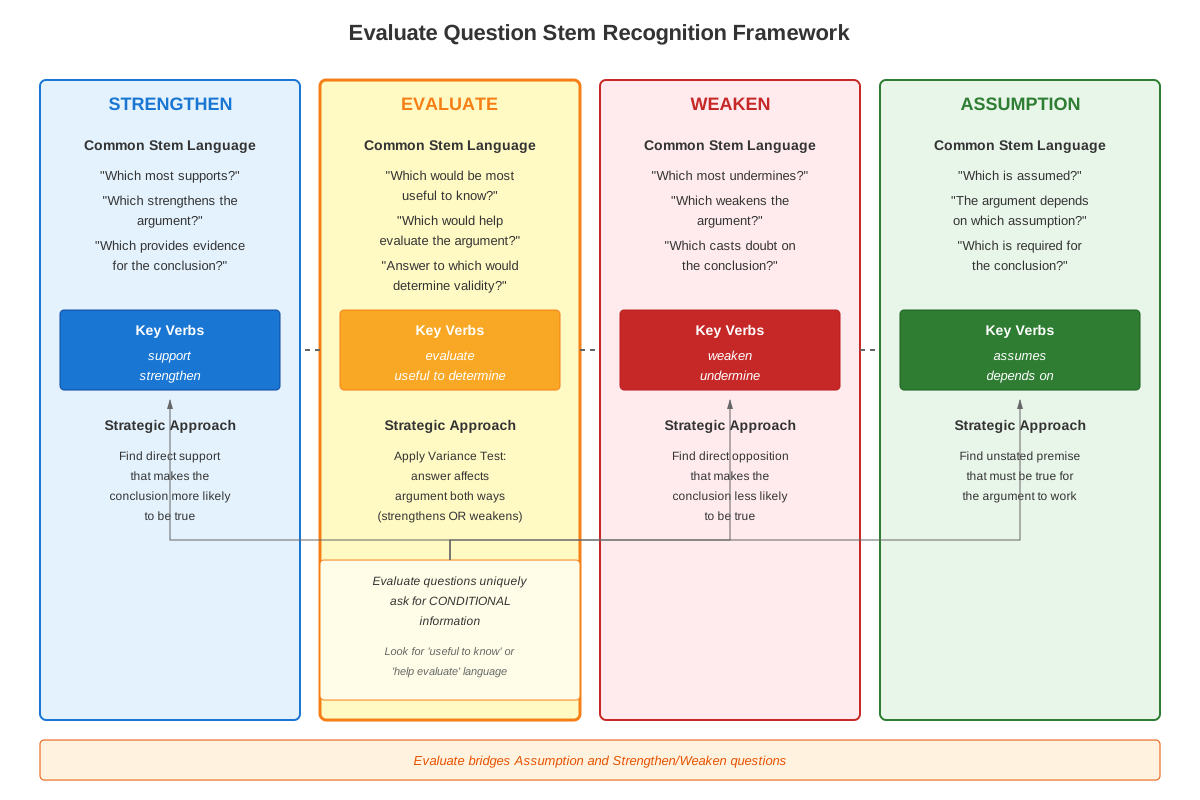
Within the broader framework of question stem recognition, Evaluate questions occupy a unique position. They bridge the gap between assumption questions (which ask what the argument takes for granted) and strengthen/weaken questions (which ask what information would support or undermine the argument). Recognizing Evaluate question stems quickly and accurately allows test-takers to adopt the appropriate strategic approach, saving valuable time and improving accuracy. The ability to distinguish these stems from similar-sounding questions is a hallmark of high-scoring test-takers.
Learning Objectives
- [ ] Identify how Evaluate question stems appears in LSAT questions
- [ ] Explain the reasoning pattern behind Evaluate question stems
- [ ] Apply Evaluate question stems to solve LSAT-style problems accurately
- [ ] Distinguish Evaluate question stems from strengthen, weaken, and assumption question stems
- [ ] Formulate the "Variance Test" to verify correct answers to Evaluate questions
- [ ] Recognize the common logical gaps that Evaluate questions target
Prerequisites
- Basic argument structure: Understanding premises, conclusions, and how they relate is fundamental to identifying what information would help evaluate an argument's validity.
- Assumption identification: Recognizing unstated premises helps identify the gaps that Evaluate questions typically target.
- Conditional reasoning fundamentals: Many Evaluate questions involve understanding how different conditions would affect an argument's strength.
- Question stem recognition basics: Familiarity with the general categories of Logical Reasoning questions provides context for where Evaluate questions fit within the broader taxonomy.
Why This Topic Matters
Evaluate questions test one of the most sophisticated analytical skills required for legal reasoning: the ability to identify what information is most relevant to assessing an argument's merit. In legal practice, attorneys must constantly evaluate which facts, if established, would most significantly impact their case. This mirrors the exact skill tested by Evaluate questions—determining what additional information would be most useful in judging whether reasoning is sound.
On the LSAT, Evaluate questions typically appear 2-4 times per test, representing approximately 4-8% of all Logical Reasoning questions. While this might seem modest, these questions are often among the most challenging, with lower average accuracy rates than many other question types. Students who master Evaluate questions gain a significant competitive advantage, as these questions frequently separate high scorers from average performers.
Evaluate questions commonly appear in arguments involving causal reasoning, analogies, statistical evidence, and proposals or recommendations. The LSAT frequently presents arguments that make implicit comparisons, assume certain conditions hold, or rely on unstated background information. Evaluate questions exploit these gaps by asking test-takers to identify what information would be most useful in determining whether these implicit elements are justified. Understanding this pattern allows strategic test-takers to anticipate the types of logical vulnerabilities that Evaluate questions will target.
Core Concepts
Defining Evaluate Questions
Evaluate question stems ask test-takers to identify information that would be most useful in assessing, judging, or evaluating an argument's reasoning or conclusion. These questions do not ask you to strengthen or weaken the argument directly; instead, they ask you to identify what you would need to know to make such a judgment. The correct answer to an Evaluate question is a piece of information that, depending on how it's answered, would either strengthen or weaken the argument significantly.
The key distinguishing feature of Evaluate questions is their conditional nature. They essentially ask: "What question, if answered, would most help us determine whether this argument is good or bad?" This requires understanding not just what the argument assumes, but what information would be most diagnostic in testing that assumption.
Common Evaluate Question Stem Formulations
Evaluate questions appear in several standard formulations, all of which share the core characteristic of asking what information would be useful for assessment:
- "Which of the following would it be most useful to know in evaluating the argument?"
- "The answer to which of the following questions would be most useful in evaluating the reasoning above?"
- "Which of the following would be most important to know in evaluating the hypothesis in the passage?"
- "In evaluating the argument, it would be most useful to determine which of the following?"
- "The answer to which of the following would most help in assessing the argument?"
Each formulation emphasizes the evaluative nature of the task—you're not being asked to fix the argument or attack it, but rather to identify what additional information would be most helpful in judging its merit.
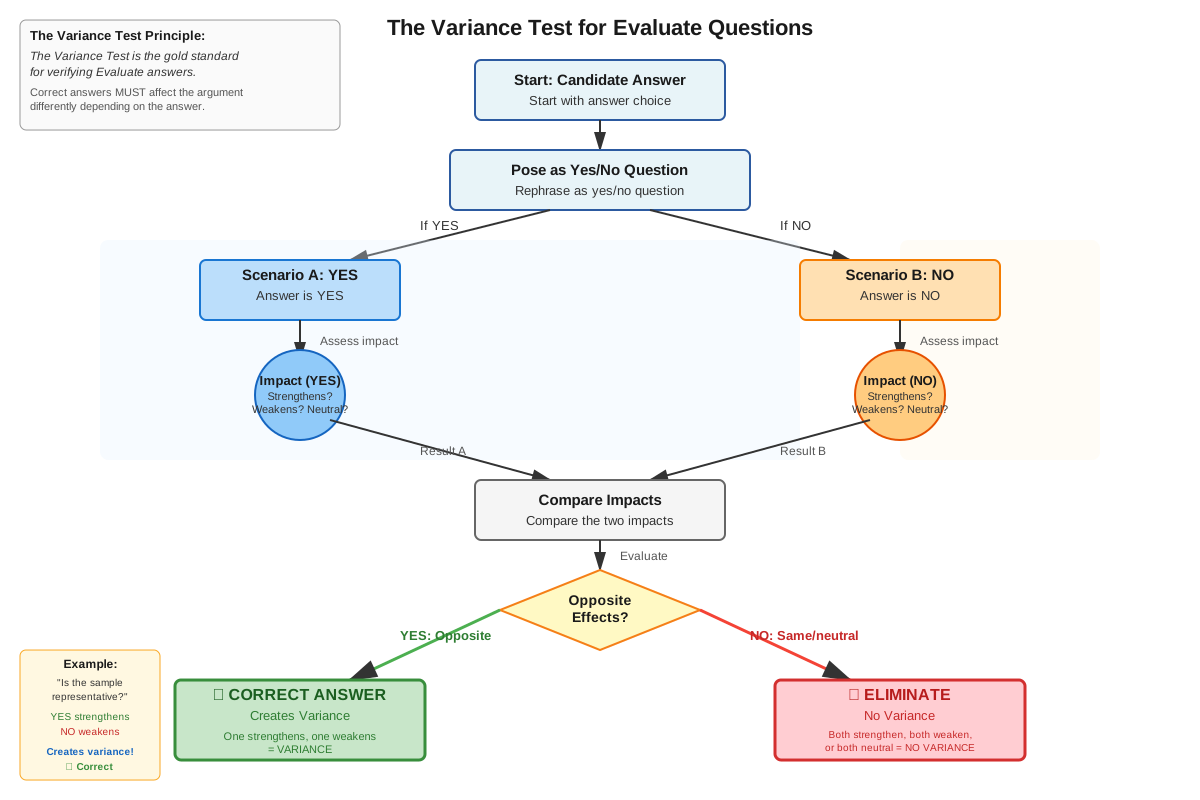
The Variance Test
The Variance Test is the most reliable method for verifying correct answers to Evaluate questions. This test involves examining each answer choice and asking: "If this were true, would it affect the argument? If this were false, would it affect the argument differently?" The correct answer will have significant variance—one answer to the question will strengthen the argument, while the opposite answer will weaken it (or vice versa).
For example, if an answer choice asks "Are the samples representative of the population?", you would test:
- If YES (samples are representative) → argument is strengthened
- If NO (samples are not representative) → argument is weakened
This significant variance indicates that knowing this information would indeed be useful in evaluating the argument. Incorrect answer choices typically fail the Variance Test because either (a) both answers to the question have the same effect on the argument, or (b) neither answer has any significant effect on the argument's validity.
Logical Gaps Targeted by Evaluate Questions
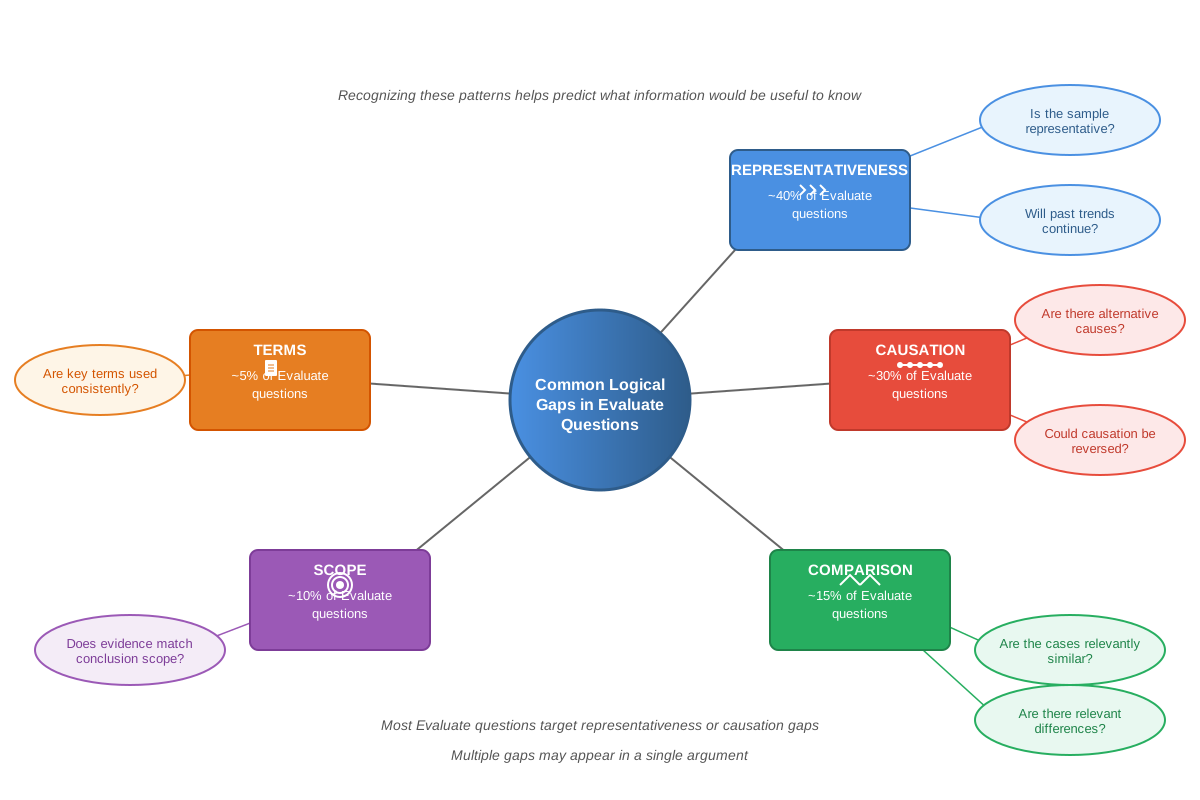
Evaluate questions systematically target specific types of logical gaps that appear frequently in LSAT arguments:
| Logical Gap Type | Description | Example Evaluate Question |
|---|---|---|
| Representativeness | Whether a sample accurately represents a larger group | "Are the surveyed individuals typical of the population?" |
| Causal Alternative | Whether other factors could explain an observed effect | "Are there other factors that could account for the observed change?" |
| Comparison Validity | Whether compared groups are sufficiently similar | "Are the two groups similar in relevant respects?" |
| Temporal Stability | Whether conditions remain constant over time | "Have relevant conditions changed between the two time periods?" |
| Scope Matching | Whether evidence matches the scope of the conclusion | "Does the evidence apply to all cases mentioned in the conclusion?" |
| Implementation Feasibility | Whether a proposal can actually be executed | "Are the resources necessary for implementation available?" |
Understanding these common gap types allows test-takers to anticipate what information would be most useful for evaluation even before examining the answer choices.
The Relationship Between Assumptions and Evaluate Questions
Every Evaluate question is intimately connected to the argument's assumptions. The information that would be most useful in evaluating an argument is typically information that would test whether the argument's key assumptions are justified. However, Evaluate questions differ from assumption questions in an important way: assumption questions ask what the argument takes for granted, while Evaluate questions ask what information would help determine whether what the argument takes for granted is actually true.
Consider this distinction:
- Assumption question: "What must be true for this argument to work?"
- Evaluate question: "What would we need to know to determine whether this argument works?"
The assumption is the gap itself; the Evaluate answer identifies what information would fill or test that gap.
Strategic Approach to Evaluate Questions
When approaching Evaluate questions, follow this systematic process:
- Identify the conclusion: Determine exactly what the argument is trying to establish
- Identify the premises: Note what evidence is provided
- Identify the gap: Determine what logical leap the argument makes from premises to conclusion
- Predict the answer: Formulate what information would test this gap
- Apply the Variance Test: For each answer choice, test whether different answers would have different effects on the argument
- Select the answer with maximum variance: Choose the option where knowing the answer would most significantly impact your assessment of the argument
This process ensures systematic analysis rather than relying on intuition, which can be misleading with Evaluate questions.
Concept Relationships
The concepts within Evaluate questions form an interconnected system. Question stem recognition serves as the foundation, enabling test-takers to identify when they're facing an Evaluate question rather than another question type. This recognition triggers the appropriate analytical approach. Once identified, understanding the Variance Test becomes the primary tool for answer selection, as it provides an objective method for determining which answer choice would be most useful for evaluation.
The logical gaps that Evaluate questions target connect directly to the argument's assumptions. Identifying these gaps requires understanding argument structure (premises and conclusions), which then allows prediction of what information would be most diagnostic. The strategic approach integrates all these elements into a systematic process that moves from argument analysis through gap identification to answer verification.
This topic connects to prerequisite knowledge in several ways: Assumption identification → enables recognition of logical gaps → which determines what information would be useful for evaluation. Conditional reasoning → helps understand how different answers to an Evaluate question would affect the argument differently → which is essential for applying the Variance Test. Argument structure → allows identification of the logical leap from premises to conclusion → which reveals what information would be most useful to know.
The relationship map flows as follows: Question Stem Recognition → Argument Analysis (conclusion, premises, gap) → Gap Classification (which type of logical gap) → Answer Prediction → Variance Test Application → Answer Selection.
High-Yield Facts
⭐ Evaluate questions ask what information would be most useful in assessing an argument, not what would strengthen or weaken it directly.
⭐ The Variance Test is the gold standard for verifying Evaluate answers: the correct answer will strengthen the argument if answered one way and weaken it if answered the opposite way.
⭐ Common Evaluate question stem language includes "most useful to know," "most important to determine," and "would most help in evaluating."
⭐ Evaluate questions typically target the argument's central assumption—the information that would test whether that assumption is justified is what you need to know.
⭐ The correct answer to an Evaluate question is usually phrased as a yes/no question or a statement about which you could determine truth or falsity.
- Evaluate questions appear 2-4 times per LSAT, making them a regular but not dominant question type.
- Incorrect answers to Evaluate questions often provide information that would only strengthen OR only weaken the argument, but not both depending on the answer.
- Many Evaluate questions involve causal reasoning, where the useful information would help determine whether alternative causes exist.
- Representativeness issues (whether a sample represents a population) are among the most common targets of Evaluate questions.
- Temporal stability (whether conditions have remained constant) frequently appears in Evaluate questions involving comparisons across time.
- Scope mismatches between evidence and conclusion often generate Evaluate questions asking whether the evidence applies to all cases in the conclusion.
- The correct answer to an Evaluate question must be directly relevant to the specific logical gap in the argument, not just generally relevant to the topic.
Quick check — test yourself on Evaluate question stems so far.
Try Flashcards →Common Misconceptions
Misconception: Evaluate questions are the same as assumption questions because both deal with gaps in reasoning.
Correction: While related, these question types are distinct. Assumption questions ask what must be true for the argument to work (identifying the gap itself), while Evaluate questions ask what information would help determine whether the argument works (identifying what would test the gap). The assumption is what the argument takes for granted; the Evaluate answer is what you'd need to know to determine if what's taken for granted is justified.
Misconception: The correct answer to an Evaluate question should strengthen the argument.
Correction: The correct answer should neither strengthen nor weaken the argument by itself—it should be information that COULD do either, depending on how the question is answered. If knowing something would only strengthen (or only weaken) the argument regardless of the specific answer, it's not testing the argument's validity, and therefore isn't the most useful information for evaluation.
Misconception: Any information related to the argument's topic is useful for evaluation.
Correction: Useful information must specifically address the logical gap between premises and conclusion. Information can be topically relevant but logically irrelevant. For example, in an argument about whether a new policy will reduce costs, knowing the policy's popularity might be topically related but wouldn't help evaluate whether it will actually reduce costs.
Misconception: Evaluate questions always ask for information about assumptions.
Correction: While Evaluate questions are connected to assumptions, they don't always explicitly ask about them. Instead, they ask what information would be most useful for assessment. This information tests assumptions but is framed as a question to be answered or a fact to be determined, not as an assumption to be identified.
Misconception: The Variance Test means the correct answer must make the argument valid if answered one way and invalid if answered the other way.
Correction: The Variance Test requires significant impact in opposite directions, but not necessarily from completely valid to completely invalid. The correct answer should substantially strengthen the argument if answered one way and substantially weaken it if answered the other way, but the argument might still have other flaws or strengths regardless of this information.
Worked Examples
Example 1: Causal Reasoning
Argument: "City officials report that after implementing a new traffic light timing system, traffic accidents at major intersections decreased by 15%. Therefore, the new timing system has made intersections safer."
Question Stem: "Which of the following would be most useful to know in evaluating the argument?"
Analysis:
- Conclusion: The new timing system has made intersections safer
- Premise: Accidents decreased by 15% after implementation
- Logical Gap: The argument assumes the timing system caused the decrease, but other factors could explain it (correlation vs. causation issue)
- Prediction: We need to know whether other factors changed that could account for the decrease
Answer Choices:
(A) Whether traffic accidents at intersections without the new system also decreased during the same period
(B) Whether the new timing system was more expensive than the old system
(C) Whether drivers approve of the new timing system
(D) Whether the city plans to implement the system at additional intersections
(E) Whether the decrease in accidents was statistically significant
Applying the Variance Test:
(A) If YES (accidents decreased elsewhere too) → suggests something other than the timing system caused the decrease → WEAKENS. If NO (accidents didn't decrease elsewhere) → suggests the timing system specifically caused the decrease → STRENGTHENS. Strong variance—this is likely correct.
(B) Whether YES or NO → doesn't affect whether the system made intersections safer, only whether it was cost-effective. No variance on the argument's conclusion.
(C) Whether YES or NO → driver approval doesn't determine actual safety impact. No variance.
(D) Whether YES or NO → future plans don't affect whether the system worked at current intersections. No variance.
(E) If YES (statistically significant) → strengthens confidence in the data. If NO (not significant) → weakens confidence in the data. This has some variance, but it addresses data reliability rather than the causal claim. (A) more directly addresses the logical gap.
Correct Answer: (A)
This example demonstrates how Evaluate questions target causal reasoning by asking for information that would help determine whether alternative explanations exist.
Example 2: Representativeness and Sampling
Argument: "A survey of 500 members of the National Physicians Association found that 78% support the proposed healthcare legislation. This demonstrates that the majority of doctors in the country support the legislation."
Question Stem: "The answer to which of the following questions would be most useful in evaluating the reasoning above?"
Analysis:
- Conclusion: The majority of doctors in the country support the legislation
- Premise: 78% of surveyed NPA members support it
- Logical Gap: The argument assumes NPA members are representative of all doctors in the country
- Prediction: We need to know whether the sample represents the broader population
Answer Choices:
(A) How many doctors in the country are members of the National Physicians Association?
(B) Whether the National Physicians Association members' views on healthcare legislation are representative of doctors generally?
(C) Whether the survey methodology was scientifically sound?
(D) What percentage of NPA members responded to the survey?
(E) Whether the proposed legislation has support from other healthcare professionals?
Applying the Variance Test:
(A) Whether many or few → knowing the size of NPA doesn't tell us if they're representative. A small group could be representative; a large group could be unrepresentative. Insufficient variance.
(B) If YES (NPA members are representative) → the conclusion is strongly supported → STRENGTHENS. If NO (NPA members are not representative) → the conclusion is not supported → WEAKENS. Strong variance—this directly tests the key assumption.
(C) If YES (sound methodology) → we can trust the 78% figure for NPA members, but this doesn't address whether NPA members represent all doctors. If NO (unsound methodology) → we can't trust the 78% figure. This has some variance but doesn't address the representativeness gap. (B) is more direct.
(D) Response rate affects reliability of the 78% figure but not whether NPA members represent all doctors. Addresses wrong gap.
(E) Whether YES or NO → support from other healthcare professionals doesn't tell us about doctors specifically. Off-topic.
Correct Answer: (B)
This example illustrates how Evaluate questions target representativeness issues in arguments that generalize from samples to populations.
Exam Strategy
When approaching Evaluate questions on the LSAT, time management and systematic analysis are crucial. Allocate approximately 1:20-1:30 per Evaluate question, as these questions require careful application of the Variance Test to multiple answer choices.
Trigger words and phrases that signal Evaluate questions include:
- "most useful to know"
- "most important to determine"
- "most helpful in evaluating"
- "most relevant to assessing"
- "answer to which of the following questions"
- "most useful to establish"
When you see these phrases, immediately shift to Evaluate question mode: your task is not to fix or attack the argument, but to identify what information would help you judge it.
Process of elimination strategy:
- Quickly eliminate answers that fail the Variance Test in obvious ways—those that would have the same effect on the argument regardless of how they're answered
- Eliminate answers that address tangential issues rather than the core logical gap
- Between remaining choices, select the one that most directly addresses the assumption connecting premises to conclusion
Exam Tip: If you're stuck between two answers, ask yourself: "Which answer choice, if I knew the answer to it, would more dramatically change my assessment of whether this argument is good or bad?" The answer with greater potential impact is usually correct.
Common traps to avoid:
- Choosing answers that would only strengthen OR only weaken, but not both
- Selecting information that's topically interesting but logically irrelevant
- Picking answers that address minor gaps rather than the central logical leap
- Confusing Evaluate questions with assumption questions and selecting the assumption itself rather than what would test it
Time-saving technique: After identifying the argument's conclusion and main premise, immediately articulate the gap in your mind as a question. For example, "Does the sample represent the population?" or "Could other factors explain this effect?" This prediction often matches the correct answer's structure, allowing faster elimination of incorrect choices.
Memory Techniques
EVALUATE Acronym for the systematic approach:
- Examine the conclusion
- Verify the premises
- Articulate the gap
- Look for what would test the gap
- Use the Variance Test
- Assess impact on argument
- Test opposite answers
- Eliminate non-varying choices
Variance Test Visualization: Picture a seesaw. The correct answer to an Evaluate question should tip the seesaw significantly in one direction if answered one way, and significantly in the opposite direction if answered the other way. Incorrect answers either don't move the seesaw at all, or only push it in one direction regardless of the answer.
Question Stem Recognition Mnemonic: "USEFUL questions EVALUATE" - When you see the word "useful" in a question stem, you're almost certainly dealing with an Evaluate question.
Gap Type Memory Device: "RC SITS" for common logical gaps:
- Representativeness
- Causal alternatives
- Scope matching
- Implementation feasibility
- Temporal stability
- Similarity of compared groups
Summary
Evaluate question stems represent a sophisticated LSAT Logical Reasoning question type that tests the ability to identify what information would be most useful in assessing an argument's validity. These questions require recognizing the logical gap between premises and conclusion, then determining what additional information would most effectively test whether that gap undermines the argument. The Variance Test—checking whether different answers to a question would have opposite effects on the argument—serves as the primary verification tool for correct answers. Evaluate questions typically target common logical vulnerabilities including representativeness of samples, existence of alternative causal explanations, validity of comparisons, temporal stability of conditions, and scope matching between evidence and conclusions. Success requires distinguishing these questions from related types (particularly assumption and strengthen/weaken questions), systematically analyzing argument structure, and applying the Variance Test rigorously to answer choices. Mastery of Evaluate questions significantly improves overall Logical Reasoning performance, as the analytical skills involved transfer broadly across question types.
Key Takeaways
- Evaluate questions ask what information would be most useful for assessing an argument, not what would strengthen or weaken it directly
- The Variance Test is essential: correct answers strengthen the argument if answered one way and weaken it if answered the opposite way
- Evaluate questions target the argument's central assumption by asking what information would test whether that assumption is justified
- Common trigger phrases include "most useful to know," "most important to determine," and "most helpful in evaluating"
- Systematic approach: identify conclusion → identify premises → identify gap → predict useful information → apply Variance Test → select answer with maximum variance
- Distinguish Evaluate questions from assumption questions: assumptions identify the gap itself; Evaluate answers identify what would test the gap
- Common logical gaps include representativeness, causal alternatives, comparison validity, temporal stability, and scope matching
Related Topics
Assumption Questions: Understanding how to identify what an argument takes for granted provides the foundation for determining what information would test those assumptions. Mastering Evaluate questions makes assumption questions easier, as you'll develop a keen eye for logical gaps.
Strengthen and Weaken Questions: These question types are closely related to Evaluate questions. The information that would be most useful for evaluation is often information that could strengthen or weaken the argument depending on how it's answered. Mastering Evaluate questions improves performance on strengthen/weaken questions by developing the ability to see how different information impacts arguments.
Causal Reasoning: Many Evaluate questions target causal arguments, asking for information that would help determine whether a causal relationship exists or whether alternative explanations are viable. Understanding causal reasoning patterns enhances Evaluate question performance.
Argument Structure and Diagramming: Advanced argument analysis techniques help identify the precise logical gaps that Evaluate questions target, enabling more accurate prediction of correct answers.
Practice CTA
Now that you've mastered the conceptual framework for Evaluate question stems, it's time to put your knowledge into practice. Attempt the practice questions to reinforce your understanding of question stem recognition, the Variance Test, and systematic argument analysis. Work through the flashcards to internalize the common logical gaps and trigger phrases that appear in Evaluate questions. Remember: recognizing these question stems quickly and applying the Variance Test systematically will give you a significant advantage on test day. Each practice question you complete strengthens your pattern recognition and builds the confidence needed for peak performance. You've built the foundation—now construct mastery through deliberate practice!
Sign up free to keep reading
Create a free AnvayaPrep account to finish this LSAT guide on Evaluate question stems — plus flashcards and practice questions.