Overview
Inference versus assumption stems represent two of the most fundamental question types in LSAT Logical Reasoning, yet they demand opposite analytical approaches. Understanding the distinction between these question types is critical because misidentifying the stem leads to applying the wrong strategy, wasting precious time, and selecting incorrect answers. Inference questions ask test-takers to identify what must be true based on the information provided in the stimulus, requiring strict logical deduction from explicit statements. Assumption questions, conversely, ask what must be true for the argument to work, requiring identification of unstated premises that bridge gaps in reasoning.
The ability to distinguish between these stems affects performance across approximately 40-50% of all Logical Reasoning questions on a typical LSAT. Inference questions (also called "Must Be True" questions) appear 4-6 times per Logical Reasoning section, while assumption questions (both Necessary and Sufficient) appear 6-8 times per section. Mastering question stem recognition for these types enables immediate activation of the correct mental framework, dramatically improving accuracy and speed.
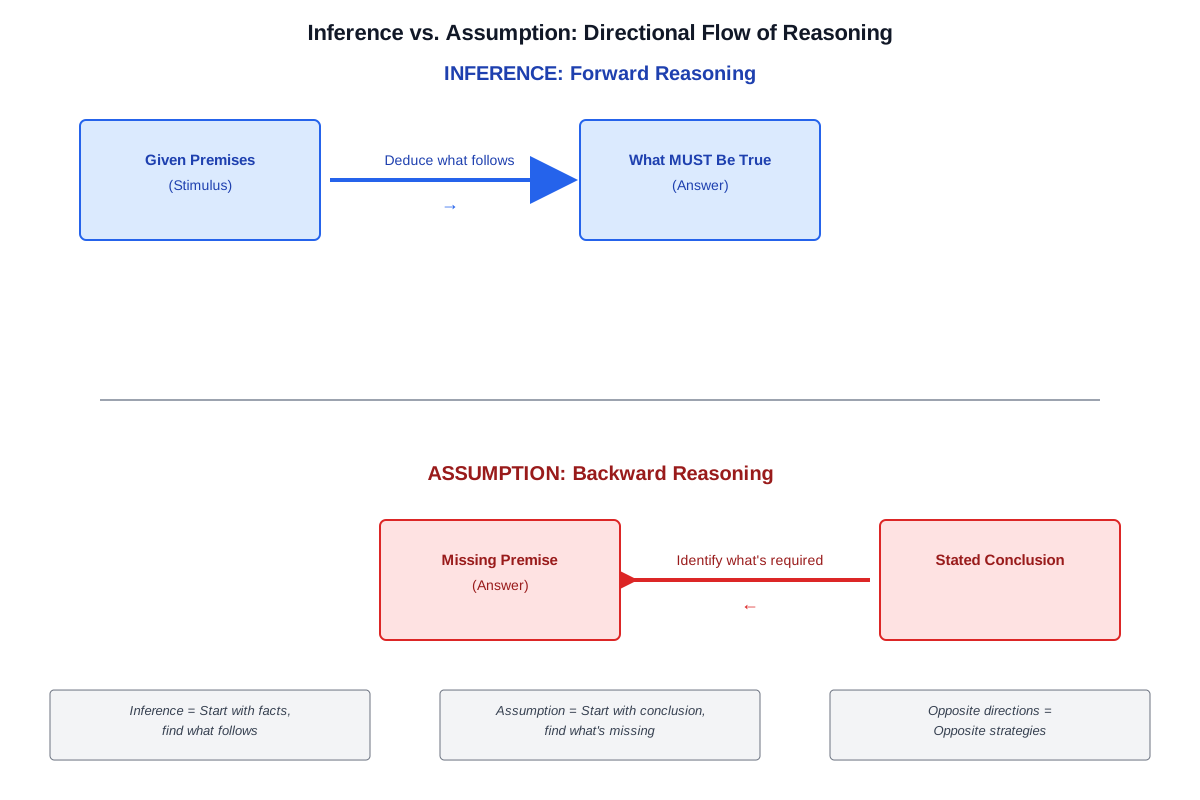
These question types sit at opposite ends of the logical reasoning spectrum. Inference questions work forward from premises to conclusions, asking what logically follows. Assumption questions work backward from conclusions to premises, asking what must be true for the reasoning to hold. Both require careful attention to logical structure, but inference questions reward conservative, text-bound thinking while assumption questions reward identification of logical gaps. This fundamental difference in directionality makes stem recognition the crucial first step in any Logical Reasoning question.
Learning Objectives
- [ ] Identify how inference versus assumption stems appears in LSAT questions
- [ ] Explain the reasoning pattern behind inference versus assumption stems
- [ ] Apply inference versus assumption stems to solve LSAT-style problems accurately
- [ ] Distinguish between inference and assumption question stems with 95%+ accuracy under timed conditions
- [ ] Recognize subtle variations in stem wording that signal inference versus assumption questions
- [ ] Predict the characteristics of correct answers based on stem type before reviewing answer choices
Prerequisites
- Basic argument structure: Understanding premises, conclusions, and how they connect is essential because both question types require identifying these components, though they use them differently
- Conditional logic fundamentals: Necessary and sufficient conditions appear frequently in both inference and assumption questions, particularly in recognizing what must be true versus what makes something true
- Logical validity versus soundness: Distinguishing between structurally valid reasoning and factually accurate claims helps separate what follows logically (inference) from what's required for validity (assumption)
- Reading comprehension skills: Accurate interpretation of stimulus content is foundational since inference questions require precise understanding of what's stated while assumption questions require recognizing what's unstated
Why This Topic Matters
The distinction between inference and assumption stems represents one of the highest-yield skills for LSAT success. These two question families account for nearly half of all Logical Reasoning points, making them statistically the most important question types to master. Students who confuse these stems typically score 5-8 points lower on Logical Reasoning sections than their potential, as they apply inference strategies to assumption questions (leading to overly conservative answers) or assumption strategies to inference questions (leading to answers that go beyond the text).
In real-world applications, the inference-assumption distinction mirrors critical thinking skills used in legal reasoning, scientific analysis, and policy evaluation. Lawyers must distinguish between what evidence proves (inference) versus what must be true for a legal theory to succeed (assumption). Scientists differentiate between what data shows (inference) versus what background conditions must hold for experimental conclusions to be valid (assumption).
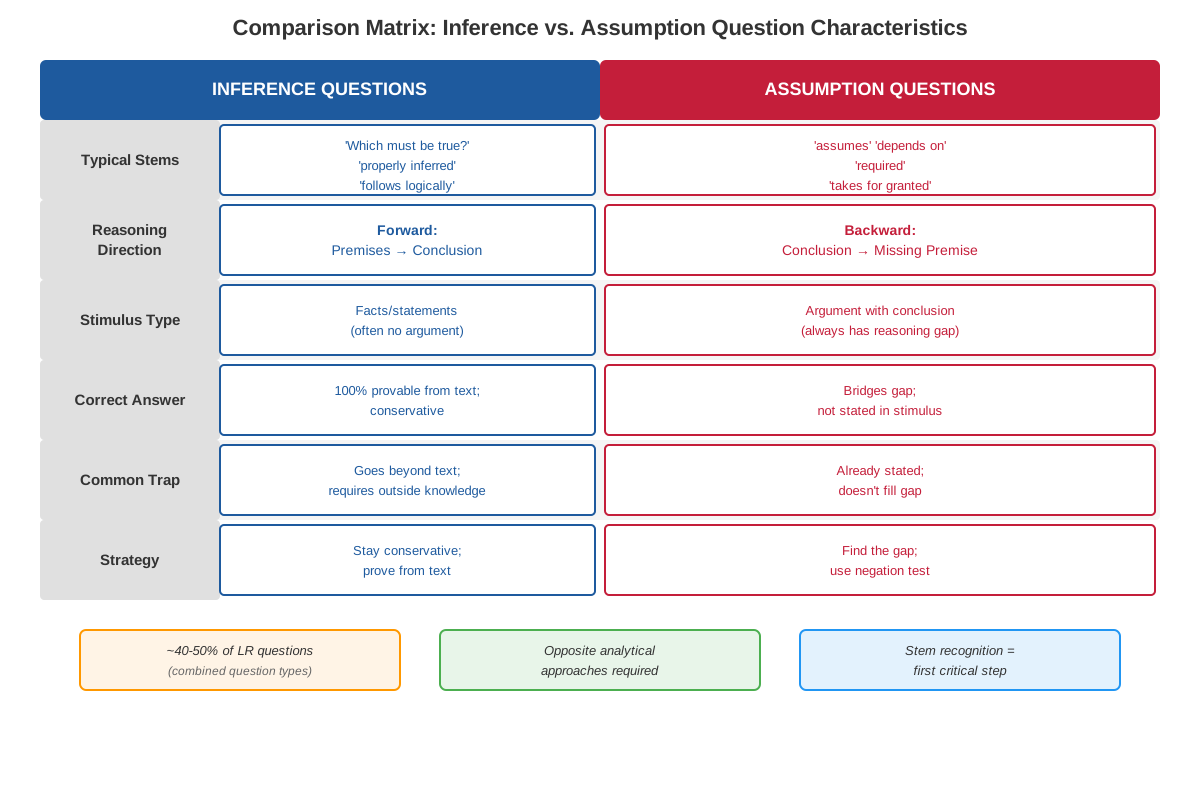
On the LSAT, inference questions typically appear as "Must Be True," "Most Supported," "Properly Inferred," or "Follows Logically" stems. Assumption questions appear as "Assumption," "Depends On," "Required," or "Presupposes" stems. Inference questions usually follow factual stimuli without explicit arguments, while assumption questions always follow stimuli containing arguments with identifiable conclusions. Recognizing these patterns within the first 5 seconds of reading a question stem can save 15-20 seconds per question by immediately activating the correct analytical approach.
Core Concepts
Inference Question Stems: Structure and Recognition
Inference questions ask test-takers to identify statements that must be true, are most supported by, or can be properly concluded from the stimulus. The key characteristic is that these questions work forward from the given information. The stimulus provides facts, statements, or observations, and the correct answer follows logically from those statements without requiring additional assumptions.
Common inference stem formulations include:
- "Which one of the following can be properly inferred from the passage?"
- "If the statements above are true, which one of the following must also be true?"
- "The statements above, if true, most strongly support which one of the following?"
- "Which one of the following follows logically from the statements above?"
- "The information above provides the most support for which one of the following?"
The critical recognition markers are phrases like "must be true," "can be inferred," "follows logically," "most supported," and "properly concluded." These phrases signal that the answer must be derivable from the stimulus through valid logical reasoning. The strength of the inference varies—"must be true" requires absolute logical necessity, while "most supported" allows for strong probabilistic support.
Assumption Question Stems: Structure and Recognition
Assumption questions ask test-takers to identify unstated premises that are necessary for an argument's conclusion to follow from its stated premises. These questions work backward from the conclusion, asking what must be true in the background for the reasoning to be valid. The stimulus always contains an argument with an identifiable conclusion and reasoning gap.
Common assumption stem formulations include:
- "Which one of the following is an assumption required by the argument?"
- "The argument depends on assuming which one of the following?"
- "The argument presupposes which one of the following?"
- "Which one of the following is an assumption on which the argument relies?"
- "The conclusion follows logically if which one of the following is assumed?"
Recognition markers include "assumption," "depends on," "requires," "presupposes," "relies on," and "takes for granted." These phrases signal that the correct answer fills a logical gap between premises and conclusion. The answer won't be stated in the stimulus but must be true for the argument to work.
The Directionality Principle
The fundamental difference between these question types lies in their logical directionality:
| Aspect | Inference Questions | Assumption Questions |
|---|---|---|
| Direction | Forward (premises → conclusion) | Backward (conclusion → required premise) |
| Stimulus Type | Facts, observations, statements | Argument with conclusion |
| Answer Relationship | Follows from stimulus | Required by stimulus |
| Logical Standard | Must be true given stimulus | Must be true for argument to work |
| Gap Analysis | Not required | Essential |
| Text Boundedness | Highly constrained to text | Identifies unstated elements |
Understanding this directionality prevents the most common error: treating inference questions like assumption questions by looking for gaps, or treating assumption questions like inference questions by selecting statements that merely follow from premises without addressing the conclusion.
Stimulus Characteristics
Inference question stimuli typically present:
- Collections of facts without explicit arguments
- Descriptive passages about situations, studies, or phenomena
- Multiple conditional statements that can be combined
- Statistical information or survey results
- Historical or scientific observations
These stimuli rarely contain conclusion indicators like "therefore," "thus," or "consequently" because they're not presenting arguments—they're presenting information from which inferences can be drawn.
Assumption question stimuli always present:
- Clear arguments with identifiable conclusions
- Reasoning that moves from evidence to claim
- Logical gaps between premises and conclusions
- Conclusion indicators ("therefore," "thus," "so," "consequently")
- Causal reasoning, predictions, or recommendations
The presence of an argument structure is the most reliable indicator that a question will be assumption-based rather than inference-based.
Answer Choice Characteristics
For inference questions, correct answers:
- Stay extremely close to the stimulus text
- Combine or rephrase information explicitly stated
- Use conservative language ("some," "may," "could")
- Avoid introducing new concepts not mentioned in stimulus
- Can be proven true using only stimulus information
Incorrect answers typically:
- Go beyond what the stimulus supports
- Introduce outside information
- Use extreme language not justified by stimulus
- Reverse or distort stimulus relationships
- Require additional assumptions
For assumption questions, correct answers:
- Fill specific gaps in the argument's reasoning
- Connect premise concepts to conclusion concepts
- Are necessary but not necessarily sufficient
- Pass the "negation test" (negating them destroys the argument)
- May introduce new concepts that bridge reasoning gaps
Incorrect answers typically:
- Strengthen the argument but aren't required
- Address irrelevant aspects of the argument
- Are too strong or go beyond what's necessary
- Fail the negation test
- Reverse the required logical relationship
The Negation Test for Assumptions
The negation test is the gold standard for verifying assumption answers. To apply it:
- Negate the answer choice (make it false)
- Re-evaluate the argument with the negated statement
- If the argument falls apart, the statement is a necessary assumption
- If the argument remains intact, the statement is not necessary
This test works only for assumption questions, never for inference questions. Attempting to apply it to inference questions is a clear sign of stem misidentification.
Concept Relationships
The relationship between inference and assumption questions forms a complementary pair in logical analysis. Both require understanding argument structure, but they examine it from opposite directions. Question stem recognition serves as the gateway skill that determines which analytical pathway to follow.
Inference questions → rely on → conditional logic and combination of statements → produce → conclusions that must be true. Assumption questions → rely on → gap identification → require → unstated premises → enable → valid conclusions. Both question types → depend on → accurate stimulus comprehension → but diverge in → analytical approach.
The connection to prerequisite knowledge flows as follows: Basic argument structure provides the foundation for identifying premises and conclusions. This enables recognition of whether a stimulus presents an argument (suggesting assumption questions) or mere facts (suggesting inference questions). Conditional logic skills apply to both types but serve different purposes—in inference questions, they help combine statements to reach conclusions; in assumption questions, they help identify necessary conditions for conclusions to hold.
Mastery of inference versus assumption stems enables progression to more complex question types. Strengthen/Weaken questions build on assumption identification skills, as they ask what would make assumptions more or less likely to be true. Parallel Reasoning questions require inference skills to determine what follows from different argument structures. Flaw questions combine both skills—identifying what an argument assumes and what can be inferred about why that's problematic.
High-Yield Facts
⭐ Inference questions work forward from premises; assumption questions work backward from conclusions
⭐ Inference stimuli typically lack explicit arguments; assumption stimuli always contain arguments with clear conclusions
⭐ Correct inference answers must be provable using only stimulus information; correct assumption answers fill gaps between premises and conclusions
⭐ The negation test works only for assumption questions—if negating an answer destroys the argument, it's a necessary assumption
⭐ Inference questions use stems with "must be true," "can be inferred," "follows logically," or "most supported"; assumption questions use "assumption," "depends on," "requires," or "presupposes"
- Inference questions appear 4-6 times per Logical Reasoning section; assumption questions appear 6-8 times per section
- Inference answers stay extremely close to stimulus text; assumption answers may introduce new bridging concepts
- "Most strongly supported" inference questions allow probabilistic reasoning; "must be true" questions require logical certainty
- Assumption questions always have identifiable conclusions; inference questions often do not
- Extreme language in answers is usually wrong for inference questions but may be correct for assumption questions if the argument requires it
- Combining conditional statements is a common inference question task
- Causal reasoning gaps are the most common type of assumption tested
- Inference questions can be based on scientific studies, surveys, historical facts, or hypothetical scenarios
- The correct assumption answer is necessary but not necessarily sufficient for the argument's validity
- Reading the question stem before the stimulus saves time by activating the correct analytical framework
Quick check — test yourself on Inference versus assumption stems so far.
Try Flashcards →Common Misconceptions
Misconception: Inference and assumption questions are essentially the same because both ask "what must be true."
Correction: While both involve logical necessity, they apply it differently. Inference questions ask what must be true given the stimulus (forward reasoning). Assumption questions ask what must be true for the argument to work (backward reasoning). The first derives conclusions from facts; the second identifies unstated premises required by arguments.
Misconception: Assumption answers must be explicitly connected to words in the stimulus.
Correction: Assumption answers often introduce new concepts that bridge gaps between premise concepts and conclusion concepts. If an argument concludes that "the policy will reduce crime" based on "the policy increases police presence," the assumption might introduce the concept of "deterrence" even though that word doesn't appear in the stimulus. The assumption connects police presence to crime reduction.
Misconception: The strongest, most supportive answer is always correct for inference questions.
Correction: The correct inference answer must be provable from the stimulus, not merely supported. An answer that seems strongly supported but requires even a small additional assumption is incorrect. "Must be true" means absolute logical necessity, not high probability. Conservative answers that stay close to the text are typically correct.
Misconception: If negating an answer weakens the argument, it's a necessary assumption.
Correction: The negation test requires that negating the answer destroys the argument, not merely weakens it. Many statements would weaken an argument if false, but only necessary assumptions make the argument completely fall apart when negated. The test requires total logical collapse, not partial damage.
Misconception: Inference questions never require combining information from multiple sentences.
Correction: Inference questions frequently require combining or synthesizing information from different parts of the stimulus. The key is that this combination must follow strict logical rules (especially with conditional statements) and not introduce outside assumptions. Combining "All A are B" with "All B are C" to infer "All A are C" is valid inference reasoning.
Misconception: Assumption questions ask what would strengthen the argument.
Correction: Assumption questions ask what is required for the argument to work, not what would make it stronger. Many statements would strengthen an argument without being necessary. The correct assumption is the minimum required for the conclusion to follow from the premises—it's what the argument already depends on, not additional support.
Worked Examples
Example 1: Inference Question
Stimulus: "A recent study found that 60% of adults who exercise regularly report sleeping better than they did before starting their exercise routine. However, the study also found that adults who exercise within three hours of bedtime report more difficulty falling asleep than those who exercise earlier in the day. All participants who reported sleeping better exercised at least four times per week."
Question Stem: "If the statements above are true, which one of the following must also be true?"
Analysis:
First, recognize this as an inference question through the stem phrase "must also be true." This signals forward reasoning from the given facts.
Second, identify the key facts:
- 60% of regular exercisers report better sleep
- Exercising within 3 hours of bedtime → difficulty falling asleep
- All who reported better sleep exercised ≥4 times/week
Third, look for what must be true by combining these facts:
The correct answer will likely combine information or draw a conservative conclusion. Let's evaluate potential answers:
(A) "Some adults who exercise at least four times per week exercise within three hours of bedtime."
This could be true but doesn't must be true. The stimulus doesn't tell us when the frequent exercisers work out.
(B) "At least some adults who exercise regularly and report sleeping better do not exercise within three hours of bedtime."
This must be true. We know 60% of regular exercisers report better sleep, and we know exercising within 3 hours of bedtime causes difficulty falling asleep (the opposite of better sleep). Therefore, at least some of the 60% who report better sleep must not be exercising within 3 hours of bedtime. This combines the facts validly.
(C) "Most adults who exercise regularly exercise at least four times per week."
This goes beyond the stimulus. We only know that all who reported better sleep exercised ≥4 times/week, not information about most regular exercisers generally.
Correct Answer: (B)
This demonstrates classic inference reasoning: combining explicitly stated facts to reach a conclusion that must be true without introducing assumptions.
Example 2: Assumption Question
Stimulus: "City Council Member: Our city should implement a congestion pricing system that charges drivers fees for entering the downtown area during peak hours. Studies from other cities show that congestion pricing reduces traffic by an average of 20%. Therefore, implementing this system will significantly improve air quality in our downtown area."
Question Stem: "The council member's argument depends on which one of the following assumptions?"
Analysis:
First, recognize this as an assumption question through "depends on...assumptions." This signals backward reasoning to find required premises.
Second, identify the argument structure:
- Premise: Congestion pricing reduces traffic by 20% (based on other cities)
- Conclusion: Implementing it will significantly improve air quality
- Gap: How does reduced traffic lead to improved air quality?
Third, identify the logical gap. The argument jumps from "reduced traffic" to "improved air quality." What must be true for this reasoning to work?
Let's evaluate potential answers:
(A) "The studies from other cities were conducted in cities similar to this city."
This would strengthen the argument but isn't strictly necessary. Even if the cities were different, the argument could still work if the traffic-to-air-quality connection holds.
(B) "Reduced traffic in the downtown area would lead to improved air quality."
This is necessary. Apply the negation test: If reduced traffic would NOT lead to improved air quality, the argument completely falls apart. The conclusion depends entirely on this connection between the premise (reduced traffic) and conclusion (improved air quality). This bridges the gap.
(C) "Air quality in the downtown area is currently poor."
This isn't necessary. The argument claims the system will "significantly improve" air quality, which could mean making good air quality even better. The current state doesn't need to be poor.
(D) "Congestion pricing is the most effective way to reduce traffic."
This isn't necessary. The argument only needs congestion pricing to reduce traffic enough to improve air quality, not to be the most effective method.
Correct Answer: (B)
Apply the negation test to confirm: "Reduced traffic in the downtown area would NOT lead to improved air quality." With this negation, the argument's reasoning collapses—there's no way to get from reduced traffic to improved air quality. This confirms (B) is a necessary assumption.
This demonstrates classic assumption reasoning: identifying the unstated premise that bridges the gap between stated premises and conclusion.
Exam Strategy
Stem Recognition Protocol
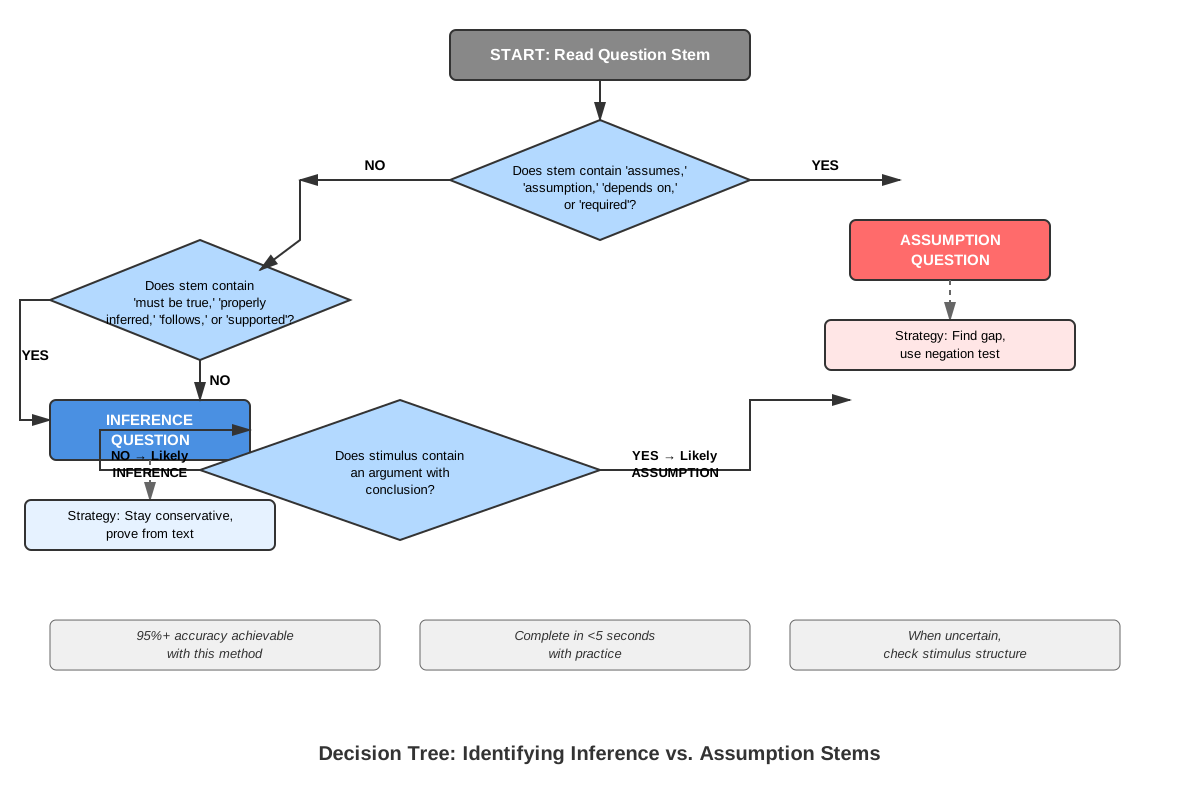
Read the question stem before reading the stimulus. This takes 3-5 seconds but saves 15-20 seconds by activating the correct analytical framework immediately. Look for these trigger phrases:
Inference triggers: "must be true," "can be inferred," "properly concluded," "follows logically," "most supported," "if true, then"
Assumption triggers: "assumption," "depends on," "requires," "presupposes," "relies on," "takes for granted"
If the stem contains inference triggers, prepare to:
- Read conservatively and literally
- Track facts that can be combined
- Avoid introducing outside information
- Look for answers that stay close to the text
If the stem contains assumption triggers, prepare to:
- Identify the conclusion immediately
- Map the reasoning gap
- Predict what bridges premises to conclusion
- Apply the negation test to contenders
Process of Elimination Strategies
For inference questions, eliminate answers that:
- Use extreme language not justified by stimulus ("all," "never," "only" unless the stimulus uses such language)
- Introduce concepts not mentioned in the stimulus
- Require additional assumptions beyond stimulus facts
- Reverse or distort relationships stated in stimulus
- Go beyond what can be proven from the text
For assumption questions, eliminate answers that:
- Merely strengthen without being necessary
- Pass the negation test (if negating them doesn't destroy the argument)
- Address elements irrelevant to the conclusion
- Are too extreme or go beyond what the argument requires
- Reverse the logical relationship needed
Time Allocation
Spend 10-15 seconds on stem recognition and stimulus analysis before looking at answers. This upfront investment prevents the costly error of applying the wrong strategy. For inference questions, spend more time carefully reading the stimulus since the answer must be derived from it. For assumption questions, spend more time identifying the conclusion and gap since the answer must address that specific gap.
If stuck between two answers on an inference question, choose the more conservative one that stays closer to the text. If stuck between two answers on an assumption question, apply the negation test to both—only one should destroy the argument.
Common Trap Patterns
Inference question traps:
- Answers that are probably true but not provably true
- Answers that reverse conditional logic (confusing sufficient and necessary conditions)
- Answers that seem strongly supported but require one small assumption
Assumption question traps:
- Answers that strengthen the argument but aren't required (sufficient but not necessary)
- Answers that address premises rather than the gap to the conclusion
- Answers that are too strong (the argument might need a weaker version)
Memory Techniques
The FIND Mnemonic for Inference Questions
Facts given → Infer forward → No new assumptions → Derivable conclusion
This reminds you that inference questions start with facts, reason forward, avoid assumptions, and reach derivable conclusions.
The GRAND Mnemonic for Assumption Questions
Gap identification → Required premise → Argument structure → Negation test → Destroy argument
This reminds you to find the gap, identify what's required, recognize the argument structure, apply the negation test, and confirm that negating the answer destroys the argument.
Visualization Strategy
Picture inference questions as a bridge you're walking across—you can only step on planks (facts) that are already there. You're moving forward from one side to the other using existing supports.
Picture assumption questions as a bridge with a missing plank—you need to identify which plank is missing to complete the path from premises to conclusion. You're looking backward from where you need to end up to see what's missing.
The Direction Reminder
Inference = IN (information goes IN to your analysis, you derive what comes out)
Assumption = ASK (you ASK what's missing, what must be true for this to work)
Summary
Distinguishing between inference and assumption stems is a foundational skill for LSAT Logical Reasoning success, affecting performance on nearly half of all questions. Inference questions ask what must be true or can be properly concluded from given information, requiring forward reasoning that stays strictly bound to the stimulus text. Assumption questions ask what unstated premises are necessary for an argument's conclusion to follow from its premises, requiring backward reasoning that identifies logical gaps. The key recognition markers are stem phrases: inference questions use "must be true," "can be inferred," or "follows logically," while assumption questions use "assumption," "depends on," or "requires." Inference stimuli typically present facts without explicit arguments, while assumption stimuli always contain arguments with identifiable conclusions. Correct inference answers combine or rephrase stimulus information conservatively; correct assumption answers fill reasoning gaps and pass the negation test. Mastering stem recognition enables immediate activation of the appropriate analytical framework, dramatically improving both accuracy and speed.
Key Takeaways
- Inference questions reason forward from facts to conclusions; assumption questions reason backward from conclusions to required premises
- Stem recognition is the critical first step—read the question stem before the stimulus to activate the correct analytical approach
- Inference answers must be provable from stimulus text alone; assumption answers identify unstated premises that bridge reasoning gaps
- The negation test is the gold standard for verifying assumptions—if negating an answer destroys the argument, it's necessary
- Inference stimuli present facts without arguments; assumption stimuli always contain arguments with clear conclusions
- Conservative, text-bound answers are typically correct for inference questions; gap-filling answers are correct for assumption questions
- These two question types account for 40-50% of Logical Reasoning points, making them the highest-yield skills to master
Related Topics
Strengthen and Weaken Questions: These build directly on assumption identification skills. Once you can identify what an argument assumes, strengthen questions ask what would make those assumptions more likely true, while weaken questions ask what would make them less likely true. Mastering assumptions is prerequisite to mastering strengthen/weaken questions.
Must Be False Questions: These are the logical inverse of inference questions. Instead of asking what must be true given the stimulus, they ask what cannot be true. The same forward-reasoning, text-bound approach applies, but you're looking for statements that contradict or are incompatible with the stimulus.
Sufficient Assumption Questions: These are a specialized variant of assumption questions that ask what, if assumed, would make the conclusion follow logically with certainty. They require identifying not just necessary assumptions but sufficient ones that guarantee the conclusion.
Parallel Reasoning Questions: These require strong inference skills to determine what follows from different argument structures. You must infer the logical pattern of the original argument and identify which answer choice follows the same pattern.
Practice CTA
Now that you understand the critical distinction between inference and assumption stems, it's time to cement this knowledge through practice. Attempt the practice questions associated with this topic, focusing on identifying stem type within the first 5 seconds and applying the appropriate analytical framework. Use the flashcards to drill recognition of common stem phrasings until identification becomes automatic. Remember: stem recognition is a skill that improves dramatically with deliberate practice. Each question you analyze strengthens your pattern recognition and builds the mental reflexes needed for test-day success. Your ability to distinguish these question types will directly translate to points on test day—make this distinction automatic, and you'll unlock significant score improvements across all Logical Reasoning sections.
Sign up free to keep reading
Create a free AnvayaPrep account to finish this LSAT guide on Inference versus assumption stems — plus flashcards and practice questions.