Overview
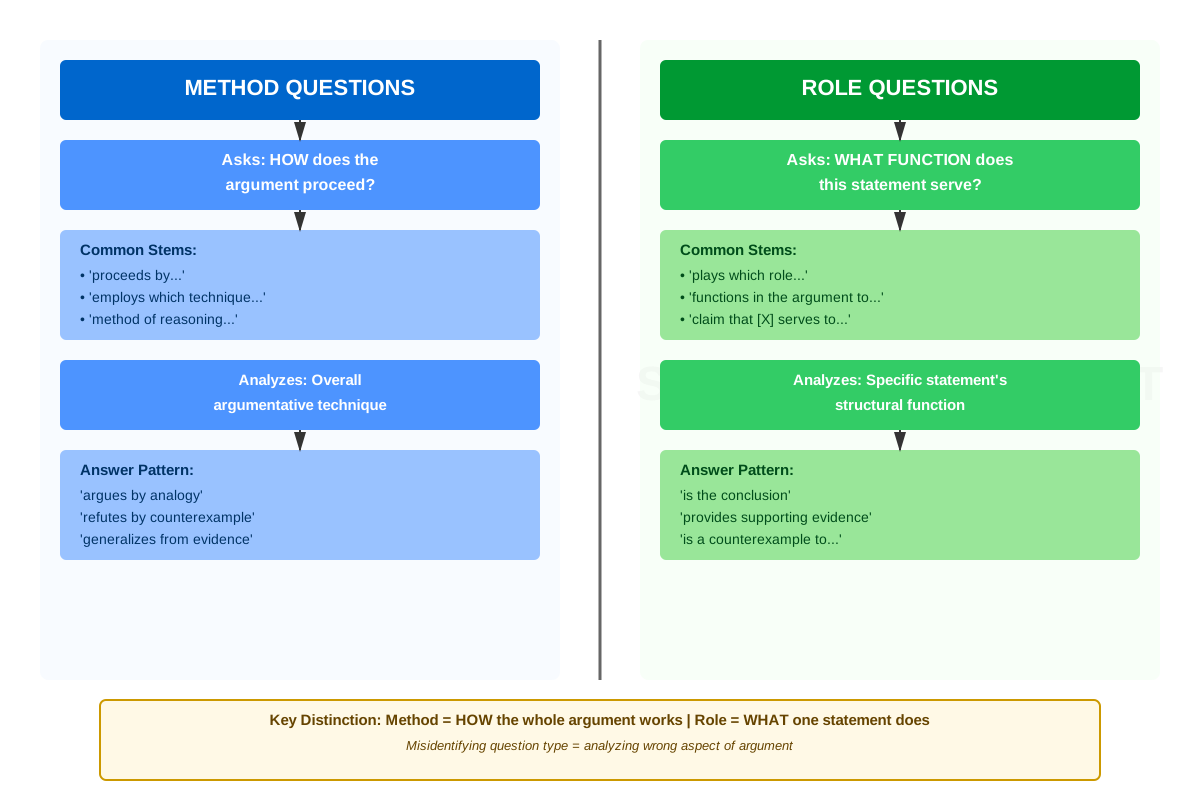
Method versus role stems represent a critical distinction in LSAT Logical Reasoning that many test-takers initially overlook, yet mastering this difference can significantly improve accuracy and speed on test day. Both question types ask about how an argument functions, but they target fundamentally different aspects of argumentative structure. Method questions ask how an argument proceeds—what argumentative technique or reasoning pattern the author employs. Role questions, by contrast, ask what function a specific statement plays within the larger argument—whether it serves as a premise, conclusion, counterexample, or another structural element.
Understanding this distinction is essential because misidentifying the question type leads to selecting answers that address the wrong aspect of the argument. A student who treats a role question as a method question might choose an answer describing the overall argumentative technique when the correct answer should identify what job a particular sentence performs. Conversely, treating a method question as a role question leads to focusing too narrowly on individual statements rather than the argument's overall logical structure. The LSAT deliberately includes both question types to test whether students can analyze arguments at multiple levels of abstraction.
This topic sits at the intersection of question stem recognition and argument analysis within Logical Reasoning. Mastering method versus role stems builds directly on foundational skills in identifying conclusions, premises, and argument structure, while also preparing students for more advanced tasks like parallel reasoning and argument evaluation. These question types appear regularly on every LSAT administration, making them high-yield material that rewards careful study and practice.
Learning Objectives
- [ ] Identify how Method versus role stems appears in LSAT questions
- [ ] Explain the reasoning pattern behind Method versus role stems
- [ ] Apply Method versus role stems to solve LSAT-style problems accurately
- [ ] Distinguish between method and role question stems with 95%+ accuracy under timed conditions
- [ ] Predict the correct answer type (abstract technique vs. structural function) before reading answer choices
- [ ] Recognize the 8-10 most common phrasings used for each question type on actual LSAT administrations
Prerequisites
- Argument structure identification: Recognizing conclusions, premises, and supporting evidence is essential because both method and role questions require understanding how arguments are constructed before analyzing them at a meta-level.
- Basic logical reasoning vocabulary: Familiarity with terms like "assumption," "counterexample," "analogy," and "generalization" enables students to understand both question stems and answer choices efficiently.
- Question stem recognition fundamentals: Understanding that different question types require different analytical approaches provides the framework for distinguishing method from role questions.
Why This Topic Matters
Method and role questions together constitute approximately 8-12% of all Logical Reasoning questions on a typical LSAT administration, appearing 3-5 times per test. This frequency makes them high-yield material—mastering these question types can directly improve scaled scores. More importantly, the analytical skills required for these questions strengthen performance across all Logical Reasoning question types, as they develop the ability to view arguments from multiple perspectives simultaneously.
In legal practice, attorneys constantly analyze both how arguments are constructed (method) and what function specific pieces of evidence serve (role). A prosecutor might employ an argument by analogy (method) while using a particular witness statement as a counterexample to the defense's theory (role). Law schools value students who can perform both types of analysis because legal reasoning requires understanding arguments at multiple levels of abstraction.
On the LSAT, method questions typically appear with longer, more complex arguments that employ sophisticated reasoning techniques like analogies, counterexamples, or reductio ad absurdum. Role questions often feature arguments with multiple premises or intermediate conclusions, where the structural function of individual statements might not be immediately obvious. Both question types reward careful, systematic analysis over quick intuitive judgments, making them excellent opportunities for prepared students to gain advantages over less-prepared competitors.
Core Concepts
Understanding Method Questions
Method questions ask students to describe the overall argumentative technique or reasoning pattern an author employs. These questions operate at a high level of abstraction, requiring students to step back from the specific content and identify the logical structure. The correct answer to a method question describes how the argument proceeds from premises to conclusion, not what the argument claims or whether it succeeds.
Common method question stems include:
- "The argument proceeds by..."
- "Which one of the following describes the technique of reasoning used above?"
- "The argument employs which one of the following methods?"
- "The reasoning above most closely conforms to which one of the following principles?"
Method questions test whether students can recognize abstract patterns like:
- Argument by analogy: Drawing a parallel between two situations to support a conclusion
- Reductio ad absurdum: Showing that an opponent's position leads to absurd consequences
- Generalization from examples: Moving from specific instances to a broader principle
- Elimination of alternatives: Ruling out competing explanations to support one conclusion
- Appeal to authority: Citing expert opinion as evidence
- Causal reasoning: Arguing that one phenomenon causes another
Understanding Role Questions
Role questions ask students to identify what function a specific statement plays within an argument's structure. These questions require precise identification of which sentence or claim the question references (often indicated by highlighting or line references), then determining whether that statement serves as the main conclusion, an intermediate conclusion, a premise, background information, a concession, a counterexample, or another structural element.
Common role question stems include:
- "The claim that [statement] plays which one of the following roles in the argument?"
- "The statement that [statement] figures in the argument in which one of the following ways?"
- "In the argument, the claim that [statement] is used to..."
- "Which one of the following most accurately describes the role played in the argument by the statement that [statement]?"
Role questions test whether students can identify:
- Main conclusion: The primary claim the argument aims to establish
- Intermediate conclusion: A claim that serves as both a conclusion (supported by some premises) and a premise (supporting the main conclusion)
- Premise: Evidence offered in direct support of a conclusion
- Background/context: Information that sets up the argument without directly supporting the conclusion
- Concession: A point granted to the opposing view
- Counterexample: A case that contradicts a general claim
- Illustration: An example that clarifies but doesn't prove a point
Key Distinctions Between Method and Role
| Aspect | Method Questions | Role Questions |
|---|---|---|
| Focus | Overall argumentative technique | Function of a specific statement |
| Abstraction level | High (pattern recognition) | Medium (structural analysis) |
| Scope | Entire argument | Single statement or claim |
| Answer format | Describes reasoning process | Identifies structural function |
| Typical length | Often longer, more complex arguments | Variable, but often multi-premise arguments |
| Key skill | Pattern recognition across content | Structural decomposition |
The Analytical Process for Method Questions
When approaching method questions, follow this systematic process:
- Read the argument carefully, identifying the conclusion and main premises
- Ignore specific content and focus on the logical structure—what type of reasoning connects premises to conclusion?
- Characterize the technique in your own words before reading answer choices
- Match your characterization to the answer choices, looking for abstract descriptions that fit the pattern
- Eliminate answers that describe content rather than method, or that describe methods not actually used
The Analytical Process for Role Questions
When approaching role questions, follow this systematic process:
- Locate the referenced statement precisely (it's often highlighted or quoted)
- Identify the main conclusion of the entire argument
- Determine the relationship between the referenced statement and the main conclusion
- Ask: Does this statement support the conclusion, IS the conclusion, provides context, or serves another function?
- Match your determination to answer choices that accurately describe structural relationships
Common Method Patterns on the LSAT
The LSAT recycles certain argumentative methods repeatedly. Recognizing these patterns accelerates analysis:
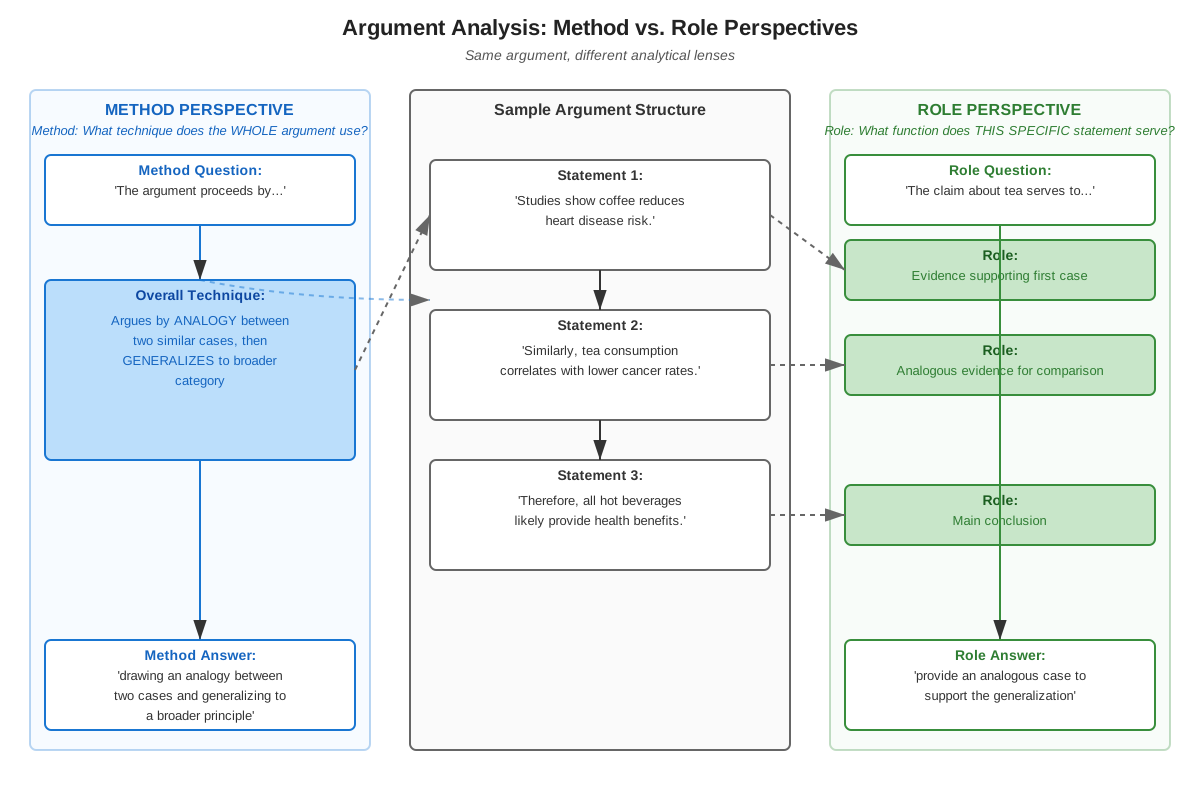
Argument by analogy: "Situation A has properties X, Y, Z. Situation B also has properties X, Y, Z. Therefore, what's true of A is likely true of B."
Counterexample: "Theory T claims all X are Y. But here's an X that isn't Y. Therefore, Theory T is false."
Elimination: "The outcome could result from causes A, B, or C. Evidence rules out A and B. Therefore, C must be the cause."
Generalization: "In observed cases 1, 2, and 3, pattern P held. Therefore, pattern P likely holds generally."
Reductio ad absurdum: "Assume position P is true. This leads to absurd consequence C. Therefore, position P must be false."
Common Role Functions on the LSAT
Similarly, certain structural roles appear frequently:
Intermediate conclusion: A claim supported by some premises that itself supports the main conclusion, creating a two-tier argument structure.
Concession: Acknowledging a point that might seem to weaken the argument, often followed by "but" or "however" before the main argument continues.
Principle: A general rule or standard that the argument applies to a specific case.
Illustration: An example that clarifies or makes vivid a point already established, rather than providing independent evidence.
Concept Relationships
Method and role questions both require strong argument structure analysis, but they apply this foundation differently. Argument structure identification → enables → both method and role analysis, but method questions require an additional step of abstraction (moving from specific content to general pattern), while role questions require precise structural mapping (determining exact relationships between statements).
Within this topic, understanding method questions helps with role questions because recognizing overall argumentative technique often clarifies what function individual statements must serve. For example, if you identify that an argument proceeds by analogy, you know certain statements must be describing the analogous situations, while others draw the parallel.
The distinction between method and role connects forward to parallel reasoning questions, which essentially ask students to identify arguments with the same method, and to argument evaluation questions, which require understanding both how arguments work (method) and what role evidence plays (role) to assess strength and weakness.
Quick check — test yourself on Method versus role stems so far.
Try Flashcards →High-Yield Facts
⭐ Method questions ask HOW an argument proceeds; role questions ask WHAT FUNCTION a specific statement serves
⭐ Method question stems typically include "proceeds by," "technique of reasoning," or "method"; role question stems include "plays which role," "figures in the argument," or "is used to"
⭐ Correct answers to method questions describe abstract patterns (analogy, elimination, generalization); correct answers to role questions describe structural functions (premise, conclusion, counterexample)
⭐ Method questions require analyzing the entire argument; role questions focus on one specific statement's relationship to the rest
⭐ The most common method patterns are: argument by analogy, elimination of alternatives, generalization from examples, and reductio ad absurdum
- Role questions often feature intermediate conclusions—claims that are both supported by evidence and support the main conclusion
- Method question wrong answers often describe the argument's content rather than its logical structure
- Role question wrong answers often correctly describe other statements in the argument, but not the one referenced
- Arguments using analogies typically have role questions about whether statements describe the first situation, second situation, or the parallel itself
- Concessions in arguments are frequently the subject of role questions, testing whether students recognize them as acknowledged opposing points rather than the author's own position
Common Misconceptions
Misconception: Method and role questions are essentially the same because both ask about argument structure.
Correction: While both involve structural analysis, method questions operate at a higher level of abstraction (overall technique) while role questions identify specific functional relationships. Confusing them leads to selecting answers at the wrong level of analysis.
Misconception: The correct answer to a method question should mention the argument's specific content or subject matter.
Correction: Method questions require abstract descriptions that could apply to arguments about completely different topics. If an answer choice mentions the specific subject matter (economics, biology, etc.), it's almost certainly wrong.
Misconception: In role questions, the referenced statement must be either a premise or the conclusion.
Correction: Statements can serve many functions beyond premise and conclusion, including intermediate conclusions, background information, concessions, illustrations, counterexamples, and objections. Many role questions specifically test these less obvious functions.
Misconception: If a statement provides information, it must be a premise.
Correction: Not all information in an argument serves as premises. Background context, illustrations, and concessions provide information without directly supporting the conclusion. The key question is whether the statement is offered as a reason to believe the conclusion.
Misconception: Method questions are always harder than role questions.
Correction: Difficulty varies by question. Some method questions involve straightforward patterns, while some role questions involve complex multi-tier arguments with subtle structural relationships. Both question types range from easy to difficult.
Misconception: You need to evaluate whether the argument is good or bad to answer method or role questions.
Correction: Both question types are purely descriptive—they ask what the argument does, not whether it does it well. Evaluating argument quality wastes time and can lead to wrong answers that describe what the argument should do rather than what it actually does.
Worked Examples
Example 1: Method Question
Argument: "Some people claim that automated customer service systems improve efficiency. However, a recent study of 500 companies found that those using automated systems had lower customer satisfaction ratings than those using human representatives. This suggests that automated systems actually harm overall business performance, since customer satisfaction directly impacts long-term profitability."
Question: The argument proceeds by
Analysis:
- Identify the conclusion: Automated systems harm overall business performance
- Identify the main evidence: Study showing lower satisfaction ratings for companies using automated systems
- Characterize the method: The argument presents a general claim (automated systems improve efficiency), offers evidence that contradicts it (study showing negative outcomes), and concludes that the general claim is false or misleading
- Abstract pattern: This is a counterexample or refutation by contrary evidence pattern
Correct answer type: "Citing evidence that contradicts a commonly held view to argue against that view" or "Presenting empirical data that undermines a general claim"
Wrong answer types to eliminate:
- Answers describing argument by analogy (no comparison between similar situations)
- Answers describing generalization (the argument uses existing data, doesn't generalize from examples)
- Answers mentioning specific content like "customer service" or "automation" (too specific, not abstract enough)
Example 2: Role Question
Argument: "The city council claims that the new parking regulations will reduce traffic congestion. However, traffic congestion is primarily caused by commuters entering the city during rush hour, not by people searching for parking. The new regulations only affect parking in commercial districts, which commuters generally avoid. Therefore, the regulations will not achieve their stated goal."
Question: The claim that traffic congestion is primarily caused by commuters entering the city during rush hour plays which role in the argument?
Analysis:
- Locate the referenced statement: "traffic congestion is primarily caused by commuters entering the city during rush hour, not by people searching for parking"
- Identify the main conclusion: The regulations will not achieve their stated goal
- Determine the relationship: This statement provides a reason to doubt the council's claim by identifying what actually causes congestion. It supports the conclusion by establishing that the regulations target the wrong cause
- Characterize the function: This is a premise that supports the main conclusion by providing factual information about causation
Correct answer: "A premise offered in support of the argument's main conclusion" or "A claim about causation used to undermine the city council's reasoning"
Wrong answers to eliminate:
- "The main conclusion" (No—the main conclusion is that regulations won't work)
- "A concession to the city council's position" (No—it contradicts the council's implicit assumption)
- "Background information" (No—it directly supports the conclusion, not just context)
- "An intermediate conclusion" (No—nothing in the argument supports this claim; it's presented as fact)
Exam Strategy
Immediate Identification Strategy
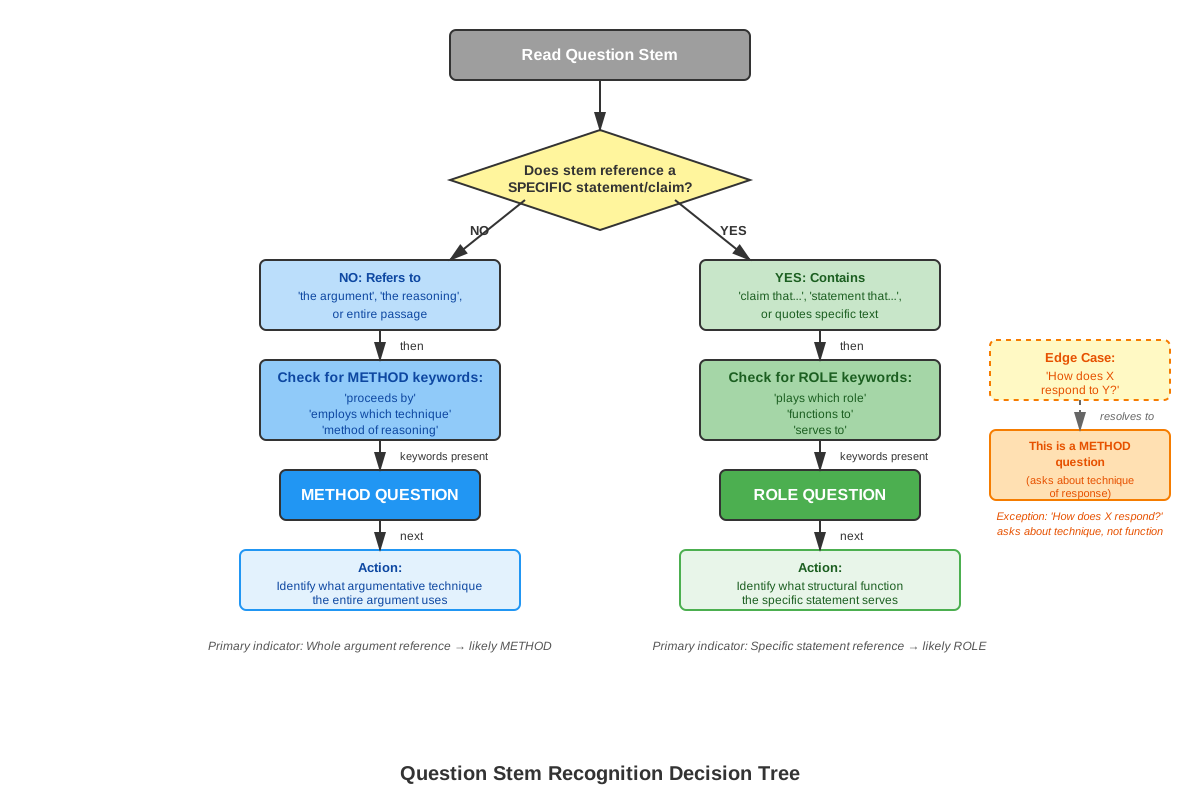
Develop the habit of categorizing the question type before analyzing the argument. Read the question stem first and ask: "Is this asking about the overall technique (method) or about what a specific statement does (role)?" This prevents the costly error of analyzing at the wrong level.
Method trigger phrases: "proceeds by," "technique," "method," "strategy," "does which of the following"
Role trigger phrases: "plays which role," "figures in the argument," "functions as," "serves to," "is used to," plus any question that quotes or highlights a specific statement
Pre-Phrasing Strategy
Before reading answer choices, articulate your answer in simple terms:
For method questions: "The argument [uses an analogy / eliminates alternatives / gives a counterexample / generalizes from cases]"
For role questions: "This statement [is the conclusion / supports the conclusion / is background / is a concession / is an example]"
This pre-phrasing prevents answer choices from confusing your analysis and makes wrong answers easier to eliminate.
Time Allocation
Method questions often take 15-30 seconds longer than average because they require abstracting from content to pattern. Don't rush this process—accuracy matters more than speed on these questions. Role questions can be answered more quickly once you've identified the main conclusion, typically in 60-75 seconds.
Process of Elimination Tips
For method questions, eliminate:
- Any answer mentioning specific content from the argument
- Any answer describing a technique not actually used (even if it would strengthen the argument)
- Any answer that evaluates the argument's quality rather than describing its structure
For role questions, eliminate:
- Any answer describing a different statement's function
- Any answer that describes what the statement should do rather than what it actually does
- Any answer using structural terms incorrectly (e.g., calling a premise a "conclusion")
Common Trap Patterns
The LSAT frequently includes wrong answers that:
- Describe the argument's content rather than its method (method questions)
- Correctly describe the function of a different statement (role questions)
- Use the right structural vocabulary but misapply it (both types)
- Describe what would strengthen the argument rather than what it actually does (both types)
Memory Techniques
METHOD Mnemonic
Method = Macro view (overall pattern)
Entire argument analyzed
Technique described abstractly
How does reasoning proceed?
Overall structure matters
Describe the pattern
ROLE Mnemonic
Relationship to conclusion
One specific statement
Locate the referenced claim
Examine its function
Visualization Strategy
For method questions, imagine zooming out from the argument until specific content blurs and only the logical structure remains visible—like seeing the skeleton of a building rather than its decorative details.
For role questions, imagine the argument as a machine where each statement is a part. The question asks: "What does this specific gear/lever/component do in making the machine work?"
The "Could This Apply to Any Topic?" Test
For method questions, ask whether your answer could describe an argument about a completely different subject. If not, you're thinking about content rather than method. The correct answer to a method question about an argument concerning parking regulations should be equally applicable to an argument about dietary recommendations if both use the same logical pattern.
Summary
Method versus role stems represent a crucial distinction in LSAT Logical Reasoning that tests whether students can analyze arguments at multiple levels of abstraction. Method questions ask students to identify the overall argumentative technique or reasoning pattern—how the argument proceeds from premises to conclusion using strategies like analogy, elimination, generalization, or counterexample. Role questions ask students to identify what structural function a specific statement serves within the argument—whether it acts as the main conclusion, a premise, an intermediate conclusion, background information, or another component. Success requires recognizing question type immediately through trigger phrases, analyzing at the appropriate level (macro for method, micro for role), and selecting answers that describe structure rather than content. These question types appear regularly on every LSAT, making them high-yield material that rewards systematic practice and careful attention to the distinction between overall technique and specific function.
Key Takeaways
- Method questions ask HOW an argument proceeds (overall technique); role questions ask WHAT FUNCTION a specific statement serves (structural position)
- Identify question type immediately by recognizing trigger phrases: "proceeds by" and "technique" signal method; "plays which role" and "figures in the argument" signal role
- Method answers must be abstract enough to apply to arguments about any topic; role answers must precisely describe one statement's relationship to the conclusion
- The five most common methods are: argument by analogy, elimination of alternatives, generalization from examples, counterexample/refutation, and reductio ad absurdum
- Pre-phrase your answer before reading choices to avoid confusion and speed up elimination
- Method questions require zooming out to see overall structure; role questions require zooming in on specific structural relationships
- Both question types are purely descriptive—they ask what the argument does, not whether it's effective
Related Topics
Parallel Reasoning Questions: These questions essentially ask students to identify another argument using the same method, making method question skills directly transferable and highly valuable for this challenging question type.
Argument Part Questions: A broader category that includes role questions but also asks about the function of reasoning techniques themselves, building on the analytical skills developed through method and role practice.
Argument Structure and Diagramming: Mastering method and role questions strengthens the ability to diagram complex arguments, identify intermediate conclusions, and map logical relationships—skills valuable across all Logical Reasoning question types.
Flaw Questions: Understanding how arguments proceed (method) and what function statements serve (role) provides essential foundation for identifying where arguments go wrong, as flaws often involve misapplying a method or misunderstanding a statement's role.
Practice CTA
Now that you understand the critical distinction between method and role stems, it's time to cement this knowledge through active practice. Attempt the practice questions designed for this topic, focusing on identifying question type before analyzing the argument. Use flashcards to drill recognition of common method patterns and role functions until identification becomes automatic. Remember: these question types appear on every LSAT, and mastering them provides a reliable source of points that can significantly impact your score. The analytical skills you're developing here will strengthen your performance across all Logical Reasoning questions, making this practice time an excellent investment in your overall LSAT success.
Sign up free to keep reading
Create a free AnvayaPrep account to finish this LSAT guide on Method versus role stems — plus flashcards and practice questions.