Overview
Parallel reasoning question stems represent one of the most distinctive and challenging question types on the LSAT Logical Reasoning section. These questions require test-takers to identify an argument structure that mirrors the logical pattern of a stimulus argument, regardless of the subject matter or content. Unlike other question types that focus on strengthening, weakening, or identifying flaws in arguments, parallel reasoning questions test the ability to abstract the underlying logical structure from specific content and match it to an analogous structure in the answer choices.
Mastering parallel reasoning questions is essential for LSAT success because they consistently appear on every administration of the exam, typically comprising 2-4 questions per test. These questions are particularly valuable for score improvement because they follow predictable patterns and can be approached systematically once the underlying methodology is understood. The ability to recognize and analyze argument structures—the core skill tested by parallel reasoning questions—also enhances performance across all logical reasoning question types, making this topic a high-yield investment of study time.
Within the broader framework of question stem recognition, parallel reasoning stems occupy a unique position. They signal that test-takers must shift from content-based analysis to structural analysis, focusing on the form of reasoning rather than the substance. This skill connects directly to formal logic, conditional reasoning, and argument structure analysis—all foundational elements of LSAT preparation. Understanding how to quickly identify parallel reasoning question stems allows for efficient time management and appropriate strategy deployment during the exam.
Learning Objectives
- [ ] Identify how parallel reasoning question stems appears in LSAT questions
- [ ] Explain the reasoning pattern behind parallel reasoning question stems
- [ ] Apply parallel reasoning question stems to solve LSAT-style problems accurately
- [ ] Distinguish between parallel reasoning and parallel flaw question stems
- [ ] Analyze argument structures by abstracting logical form from specific content
- [ ] Evaluate answer choices efficiently by eliminating structural mismatches
- [ ] Recognize common argument patterns that frequently appear in parallel reasoning questions
Prerequisites
- Basic argument structure: Understanding premises, conclusions, and how they connect is essential because parallel reasoning requires matching these structural elements across different arguments.
- Conditional logic fundamentals: Familiarity with if-then statements and their contrapositives helps identify matching logical relationships in parallel reasoning questions.
- Argument types and patterns: Knowledge of common reasoning patterns (causal, analogical, categorical) enables faster recognition of structural similarities.
- Question stem recognition basics: The ability to quickly categorize question types ensures appropriate strategy selection and efficient time management.
Why This Topic Matters
Parallel reasoning questions test a fundamental skill that extends beyond the LSAT: the ability to recognize patterns and structures independent of content. This cognitive skill is essential for legal reasoning, where attorneys must apply precedents (structurally similar cases) to new situations with different facts. Law school and legal practice constantly require identifying when two situations are analogous in their logical structure, making parallel reasoning questions highly predictive of law school success.
On the LSAT, parallel reasoning questions appear with remarkable consistency. Test-takers can expect to encounter 2-4 parallel reasoning questions per Logical Reasoning section, representing approximately 4-8% of all Logical Reasoning questions on any given exam. These questions typically appear in the medium-to-difficult range, with parallel flaw questions (a variant) often ranking among the most challenging questions on the test. The predictable appearance of these questions makes them high-yield for preparation: mastering the systematic approach to parallel reasoning can reliably secure 2-4 additional correct answers per test.
These questions most commonly appear in the Logical Reasoning sections (there are typically two per LSAT), though the structural reasoning skills they test also support success in Logic Games and Reading Comprehension. Parallel reasoning questions are particularly recognizable because their answer choices are substantially longer than those for other question types—each answer choice presents a complete argument that must be evaluated for structural similarity to the stimulus.
Core Concepts
Recognizing Parallel Reasoning Question Stems
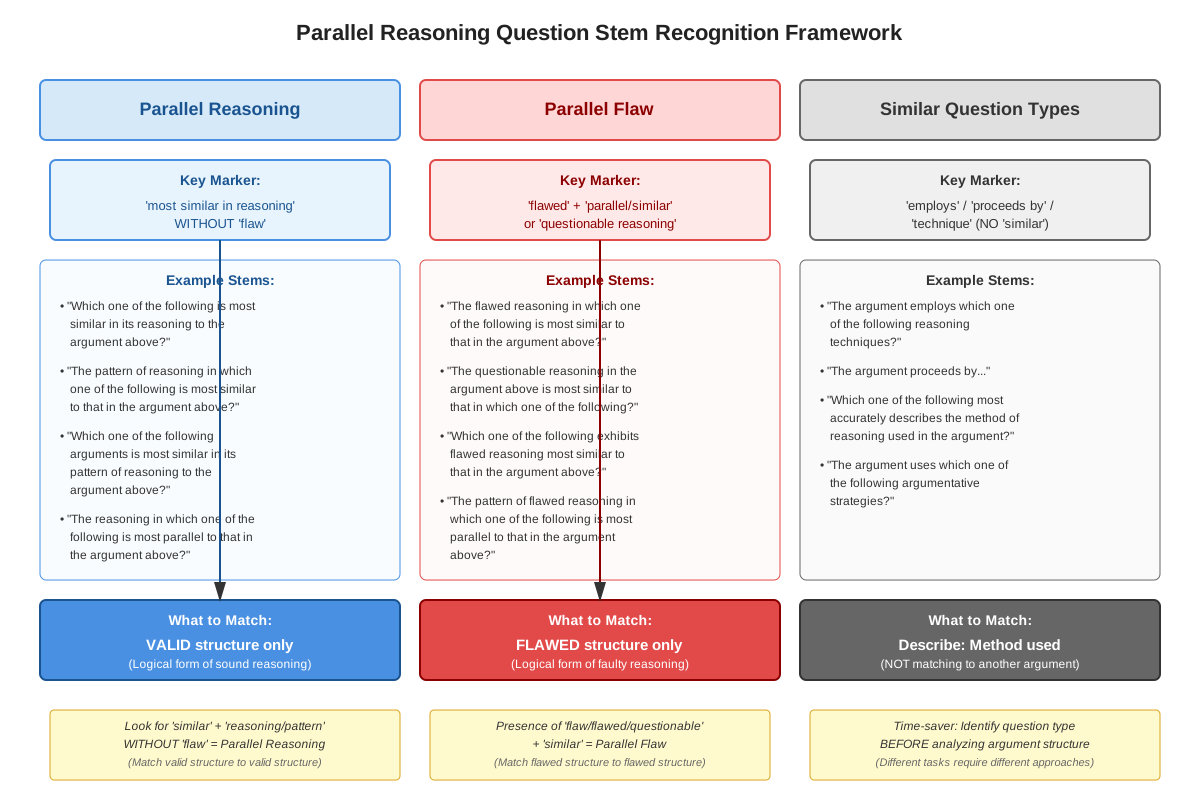
Parallel reasoning question stems are the specific phrasings that signal when a question requires matching argument structures. These stems are highly standardized and typically include language about similarity in reasoning or pattern of reasoning. The most common formulations include:
- "Which one of the following exhibits a pattern of reasoning most similar to that in the argument above?"
- "The reasoning in which one of the following is most similar to the reasoning in the argument above?"
- "Which one of the following arguments is most similar in its reasoning to the argument above?"
- "The pattern of reasoning in which one of the following arguments is most parallel to that in the argument above?"
The key identifying features of these stems are the words "similar," "parallel," "pattern," and "reasoning." When these elements appear together, test-takers should immediately recognize that content is irrelevant and structural matching is required.
Parallel Flaw Variant
A crucial distinction exists between standard parallel reasoning questions and parallel flaw questions. Parallel flaw stems include additional language indicating that the stimulus contains flawed reasoning:
- "Which one of the following exhibits flawed reasoning most similar to the flawed reasoning in the argument above?"
- "The flawed pattern of reasoning in which one of the following is most similar to that in the argument above?"
This variant requires matching both the structure AND the flaw type. The presence of "flaw" or "flawed" in the stem is the critical distinguishing feature.
Structural Elements to Match
When approaching parallel reasoning questions, test-takers must identify and match several structural components:
Logical form: The relationship between premises and conclusion (deductive vs. inductive, conditional vs. categorical, etc.)
Number of premises: Arguments with two premises must be matched with two-premise answer choices; three-premise arguments require three-premise matches.
Conclusion type: Definitive conclusions ("therefore X is true") differ structurally from qualified conclusions ("therefore X is probably true" or "therefore X might be true").
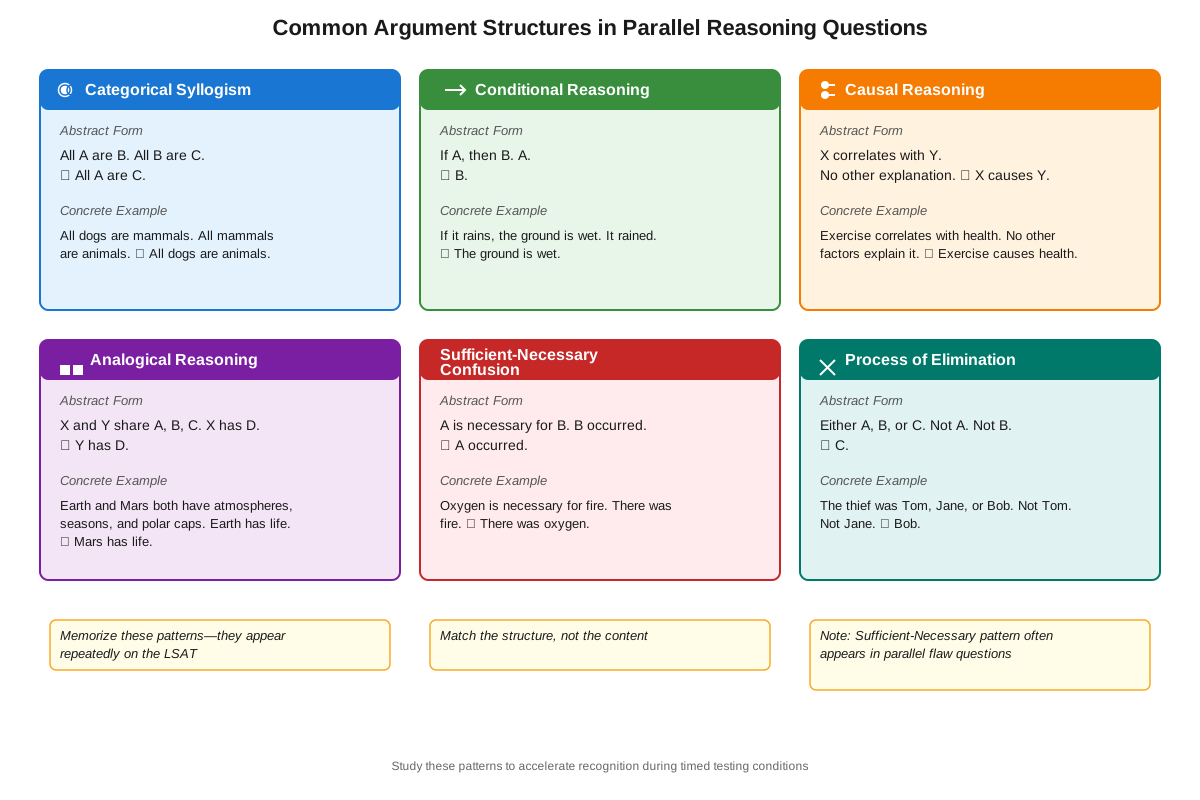
Reasoning pattern: Common patterns include:
- Categorical reasoning (All A are B; X is A; therefore X is B)
- Conditional reasoning (If A then B; A; therefore B)
- Analogical reasoning (X is like Y; Y has property Z; therefore X has property Z)
- Causal reasoning (A caused B in the past; A is present; therefore B will occur)
- Elimination reasoning (Either A or B; not A; therefore B)
Abstraction Process
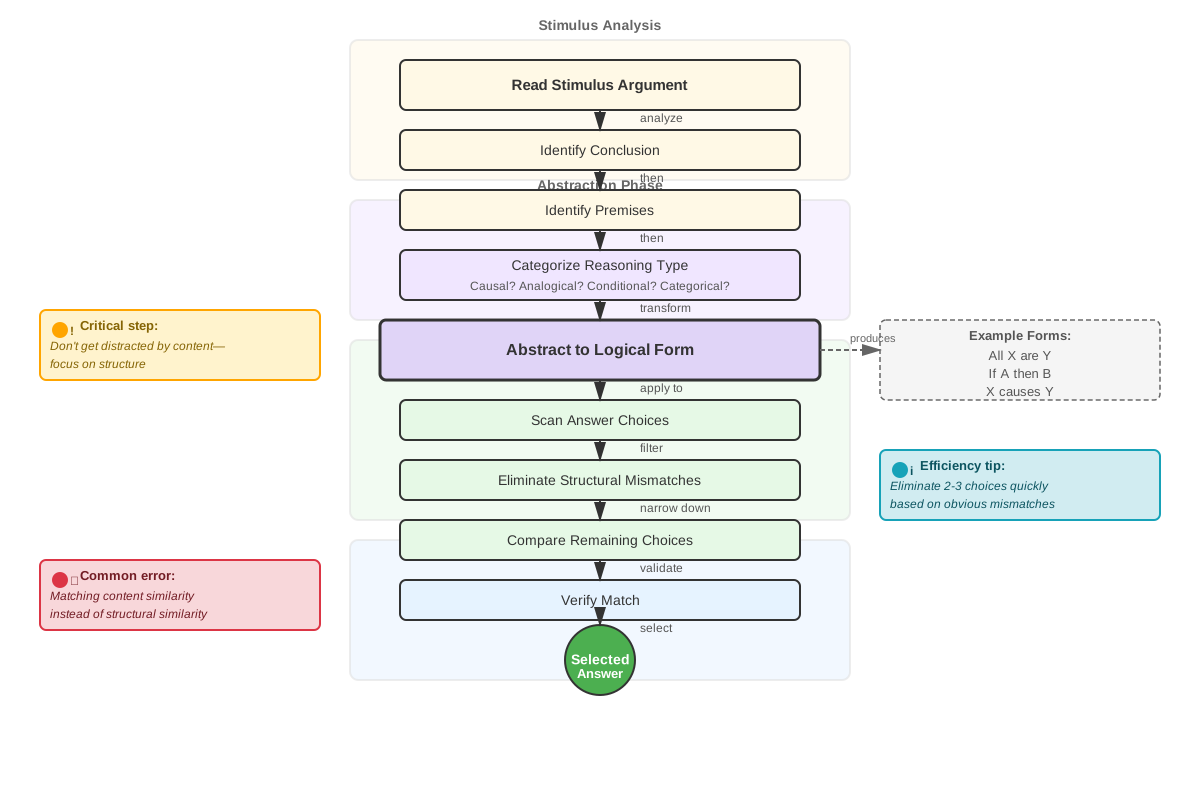
The core skill in parallel reasoning questions is abstraction—removing specific content to reveal underlying structure. Consider this example:
Concrete argument: "All dogs are mammals. Rover is a dog. Therefore, Rover is a mammal."
Abstract structure: "All X are Y. Z is X. Therefore, Z is Y."
This abstraction process allows comparison across completely different subject matters. An argument about plants, vehicles, or abstract concepts could share this identical structure.
Matching Strategy Table
| Element to Match | What to Look For | Example |
|---|---|---|
| Premise quantity | Count the number of supporting statements | 2 premises vs. 3 premises |
| Logical form | Deductive certainty vs. inductive probability | "Must be" vs. "likely is" |
| Conditional structure | If-then relationships and their direction | If A→B vs. If B→A |
| Quantifiers | Universal (all/none) vs. particular (some/most) | "All cats" vs. "Some cats" |
| Conclusion strength | Absolute vs. qualified claims | "Therefore X" vs. "Therefore probably X" |
| Reasoning type | Causal, analogical, categorical, etc. | Cause-effect vs. comparison |
Common Structural Patterns
Several argument structures appear repeatedly in LSAT parallel reasoning question stems:
- Universal-to-particular reasoning: All members of category X have property Y; this individual is in category X; therefore this individual has property Y.
- Conditional chain: If A then B; if B then C; A is true; therefore C is true.
- Disjunctive syllogism: Either A or B; not A; therefore B.
- Analogical structure: Situation X has characteristics 1, 2, and 3; Situation Y has characteristics 1 and 2; therefore Situation Y probably has characteristic 3.
- Causal prediction: Event A caused event B in the past; event A is occurring now; therefore event B will likely occur.
- Absence of evidence reasoning: No evidence exists for claim X; therefore claim X is probably false.
Concept Relationships
The concepts within parallel reasoning questions form a hierarchical relationship. Question stem recognition serves as the foundation—identifying the question type determines the entire approach. Once a parallel reasoning stem is recognized, the process flows to structural abstraction, where specific content is stripped away to reveal logical form. This abstraction enables element matching, where individual structural components (premises, conclusion type, logical form) are systematically compared between stimulus and answer choices.
Parallel reasoning connects to prerequisite topics in essential ways. Basic argument structure knowledge provides the vocabulary and framework for identifying premises and conclusions. Conditional logic skills enable recognition of if-then relationships and their proper matching. Argument pattern familiarity accelerates the abstraction process by allowing quick categorization of reasoning types.
The relationship map flows as follows:
Question Stem Recognition → Parallel Reasoning Identification → Structural Abstraction → Element Identification → Systematic Matching → Answer Selection
This process also connects forward to advanced topics. Mastery of parallel reasoning enhances argument evaluation skills by deepening understanding of how argument structure determines validity. It supports formal logic application by providing practice in symbolic representation of arguments. The structural analysis skills developed through parallel reasoning questions transfer directly to Reading Comprehension passage analysis and Logic Games rule application.
High-Yield Facts
⭐ Parallel reasoning question stems always include words like "similar," "parallel," or "pattern of reasoning"—these are the definitive identifiers that distinguish them from other question types.
⭐ Content is completely irrelevant in parallel reasoning questions—an argument about biology can be structurally identical to one about economics or art.
⭐ The number of premises in the stimulus must match the number of premises in the correct answer—this is one of the fastest elimination criteria.
⭐ Conclusion strength must match exactly—if the stimulus concludes "X must be true," the correct answer cannot conclude "X is probably true."
⭐ Parallel flaw questions require matching both structure AND flaw type—the correct answer must be flawed in the same way as the stimulus.
- Parallel reasoning questions typically have longer answer choices than other question types because each choice presents a complete argument.
- Universal quantifiers (all, none, every) must be matched with universal quantifiers, not particular quantifiers (some, most, many).
- Conditional reasoning direction matters—"If A then B" is structurally different from "If B then A."
- The correct answer will match the stimulus in logical form even if the subject matter is completely unrelated.
- Deductive arguments (where the conclusion follows necessarily from premises) must be matched with deductive arguments, not inductive ones.
- Analogical reasoning in the stimulus requires analogical reasoning in the correct answer.
- Causal claims in the stimulus must be matched with causal claims in the answer choices.
- The presence of intermediate conclusions in the stimulus requires intermediate conclusions in the correct answer.
- Negations and their placement matter—"All X are not Y" differs structurally from "Not all X are Y."
- Time allocation for parallel reasoning questions should be slightly higher than average due to longer answer choices requiring more reading.
Quick check — test yourself on Parallel reasoning question stems so far.
Try Flashcards →Common Misconceptions
Misconception: Parallel reasoning questions require finding answer choices with similar content or subject matter to the stimulus.
Correction: Content is completely irrelevant. An argument about animals can be structurally identical to one about technology. Only the logical form and structure matter, not the topics discussed.
Misconception: If an answer choice reaches the same conclusion as the stimulus, it must be the correct answer.
Correction: The conclusion's content is irrelevant; only its structural role and strength matter. An answer choice could have completely different content but the same structural relationship between premises and conclusion.
Misconception: Parallel reasoning and parallel flaw questions use the same approach.
Correction: While both require structural matching, parallel flaw questions add the requirement that the flaw type must also match. A valid argument cannot be the correct answer to a parallel flaw question, even if the structure matches.
Misconception: Longer answer choices are more likely to be correct because they provide more detail.
Correction: Length is not an indicator of correctness. The correct answer is determined solely by structural matching, regardless of how much detail or explanation is provided.
Misconception: If the stimulus uses conditional reasoning, any answer choice with conditional reasoning could be correct.
Correction: The specific structure of the conditional reasoning must match. "If A then B; A; therefore B" (affirming the antecedent) is structurally different from "If A then B; not B; therefore not A" (denying the consequent), even though both use conditional logic.
Misconception: Parallel reasoning questions are too time-consuming and should be skipped.
Correction: While these questions require careful analysis, they are highly systematic and predictable. With proper technique, they can be answered efficiently and represent reliable points that should not be abandoned.
Misconception: The correct answer must use the same number of words or sentences as the stimulus.
Correction: Surface-level features like word count or sentence structure are irrelevant. Only the logical structure—the relationship between premises and conclusion—must match.
Worked Examples
Example 1: Standard Parallel Reasoning
Stimulus: "All professional athletes train regularly. Maria trains regularly. Therefore, Maria is a professional athlete."
Question Stem: "Which one of the following exhibits a pattern of reasoning most similar to that in the argument above?"
Analysis Process:
Step 1: Identify the argument structure by abstracting from content.
- Premise 1: All X are Y
- Premise 2: Z is Y
- Conclusion: Z is X
Step 2: Recognize the logical form—this is a flawed categorical argument that affirms the consequent (just because all X are Y doesn't mean all Y are X).
Step 3: Note structural features to match:
- Two premises
- Universal quantifier in first premise ("all")
- Definitive conclusion ("therefore... is")
- Flawed reasoning (though this is standard parallel reasoning, not parallel flaw, so we match structure regardless of validity)
Step 4: Evaluate answer choices by checking each structural element.
Correct Answer: "All roses are flowers. This plant is a flower. Therefore, this plant is a rose."
Why it's correct: This matches perfectly:
- All X (roses) are Y (flowers)
- Z (this plant) is Y (flowers)
- Therefore Z (this plant) is X (a rose)
The structure is identical, including the same logical flaw. The content (plants vs. athletes) is completely different, but the form matches exactly.
Wrong Answer Example: "All professional athletes train regularly. John is a professional athlete. Therefore, John trains regularly."
Why it's wrong: This has the structure:
- All X are Y
- Z is X
- Therefore Z is Y
This is valid categorical reasoning (if all X are Y, and Z is X, then Z must be Y). The structure differs from the stimulus because the second premise identifies Z as a member of category X rather than category Y.
Example 2: Parallel Flaw with Conditional Reasoning
Stimulus: "If the company increases prices, then sales will decline. Sales have declined. Therefore, the company must have increased prices."
Question Stem: "The flawed reasoning in which one of the following is most similar to the flawed reasoning in the argument above?"
Analysis Process:
Step 1: Abstract the structure.
- Premise 1: If A then B
- Premise 2: B
- Conclusion: Therefore A
Step 2: Identify the flaw—this is affirming the consequent, a classic conditional reasoning error. Just because B occurred doesn't mean A caused it; other factors could cause B.
Step 3: Note that this is a parallel FLAW question, so the correct answer must contain the same structural flaw.
Step 4: Structural features to match:
- Conditional premise (if-then)
- Second premise affirms the consequent
- Conclusion incorrectly infers the antecedent
- Two premises, one conclusion
- Definitive conclusion ("must have")
Correct Answer: "If it rains, the ground will be wet. The ground is wet. Therefore, it must have rained."
Why it's correct: Perfect structural match including the flaw:
- If A (rains) then B (ground wet)
- B (ground is wet)
- Therefore A (it rained)
This commits the same logical error—the ground could be wet for other reasons (sprinklers, flooding, etc.), just as sales could decline for reasons other than price increases.
Wrong Answer Example: "If it rains, the ground will be wet. It did not rain. Therefore, the ground is not wet."
Why it's wrong: This has the structure:
- If A then B
- Not A
- Therefore not B
This is denying the antecedent (a different flaw), not affirming the consequent. While both are flawed conditional reasoning, the specific flaw type differs, making this structurally non-parallel.
Exam Strategy
Primary Strategy: Approach parallel reasoning questions systematically by abstracting structure first, then matching elements one by one.
Step-by-step approach:
- Identify the question type immediately by scanning for "similar," "parallel," or "pattern of reasoning" in the stem. Note whether "flaw" appears (parallel flaw vs. standard parallel reasoning).
- Abstract the stimulus structure before reading answer choices. Write down or mentally note:
- Number of premises
- Type of reasoning (conditional, categorical, analogical, causal)
- Quantifiers used (all, some, none, most)
- Conclusion strength (must, probably, might)
- Use rapid elimination on answer choices:
- First pass: Eliminate choices with wrong number of premises
- Second pass: Eliminate choices with wrong conclusion strength
- Third pass: Eliminate choices with wrong logical form
- Trigger words to watch for:
- Conditional indicators: "if," "only if," "unless," "whenever"
- Universal quantifiers: "all," "every," "none," "no"
- Particular quantifiers: "some," "most," "many," "few"
- Conclusion indicators: "therefore," "thus," "hence," "so"
- Strength modifiers: "must," "certainly," "probably," "might," "could"
- Time management: Allocate 90-120 seconds for parallel reasoning questions (slightly more than the 60-90 second average for other LR questions) due to longer answer choices. However, efficient elimination can reduce this time significantly.
- Process of elimination tips specific to parallel reasoning:
- Count premises first—this often eliminates 2-3 answer choices immediately
- Check conclusion strength second—eliminates another 1-2 choices typically
- Only then analyze the detailed logical structure of remaining choices
- If stuck between two choices, map out the structure of each explicitly using variables (X, Y, Z)
- Common trap patterns:
- Answer choices with similar content but different structure
- Choices that reverse the logical relationship (if A then B vs. if B then A)
- Choices with valid reasoning when the stimulus is flawed (in parallel flaw questions)
- Choices that match some but not all structural elements
Memory Techniques
MATCH acronym for systematic parallel reasoning analysis:
- Match the number of premises
- Abstract the logical form
- Test conclusion strength
- Check quantifiers and conditionals
- Hunt for structural differences
"Content is Costume" visualization: Imagine the argument structure as a skeleton and the specific content as clothing. Parallel reasoning requires matching skeletons, regardless of what costume they're wearing. A skeleton wearing a business suit and one wearing athletic gear are still the same skeleton if their bone structure matches.
Quantifier matching rhyme: "All with all, some with some, none with none—match them one by one."
Conditional direction reminder: "Arrow points the same way, or the structure goes astray." Visualize conditional statements as arrows (A→B) and ensure the arrow direction matches between stimulus and answer.
Premise counting finger technique: Physically count premises on your fingers while reading the stimulus, then eliminate any answer choice that doesn't match that finger count. This kinesthetic reinforcement prevents overlooking this crucial elimination criterion.
Summary
Parallel reasoning question stems represent a distinctive and high-yield question type on the LSAT Logical Reasoning section, requiring test-takers to match argument structures while ignoring content. These questions are identified by characteristic language including "similar," "parallel," and "pattern of reasoning," with the variant "parallel flaw" requiring matching both structure and flaw type. Success depends on the ability to abstract logical form from specific content, systematically matching structural elements including premise quantity, logical form, conclusion strength, quantifiers, and reasoning patterns. The most efficient approach involves rapid elimination based on easily identifiable mismatches (wrong number of premises, wrong conclusion strength) before detailed structural analysis of remaining choices. While these questions feature longer answer choices requiring slightly more time investment, they are highly systematic and predictable, making them reliable scoring opportunities for well-prepared test-takers. Mastery of parallel reasoning enhances overall logical reasoning skills by deepening understanding of argument structure and formal logic patterns.
Key Takeaways
- Parallel reasoning question stems always include identifying language like "similar," "parallel," or "pattern of reasoning"—recognize these immediately to deploy the correct strategy
- Content is completely irrelevant; only logical structure matters—arguments about entirely different subjects can be structurally identical
- Systematic elimination based on premise count and conclusion strength eliminates most wrong answers quickly and efficiently
- Parallel flaw questions require matching both the structure AND the specific type of flaw, not just the argument form
- Abstraction is the core skill—translate specific arguments into variables (X, Y, Z) to reveal underlying logical form
- These questions appear 2-4 times per test and are highly predictable, making them excellent targets for score improvement through focused practice
- Time investment in mastering parallel reasoning pays dividends across all Logical Reasoning question types by strengthening structural analysis skills
Related Topics
Formal Logic and Conditional Reasoning: Mastering parallel reasoning provides a foundation for advanced formal logic, where symbolic representation and structural analysis become even more explicit. Understanding how to match conditional structures in parallel reasoning questions directly supports success with complex conditional chains and formal logic games.
Argument Structure and Diagramming: The abstraction skills developed through parallel reasoning enhance the ability to diagram complex arguments, identify hidden assumptions, and recognize argument patterns across all Logical Reasoning question types.
Flaw Question Types: Parallel flaw questions bridge to standard flaw questions, where identifying reasoning errors is essential. Understanding common flaw patterns through parallel flaw practice strengthens the ability to spot these same flaws in other contexts.
Method of Reasoning Questions: These questions ask test-takers to describe how an argument proceeds, requiring similar structural analysis skills as parallel reasoning but focusing on description rather than matching.
Sufficient Assumption and Necessary Assumption Questions: The structural analysis skills from parallel reasoning transfer directly to assumption questions, where identifying gaps in argument structure is essential for finding correct answers.
Practice CTA
Now that you understand how to identify and approach parallel reasoning question stems, it's time to put these skills into practice. Work through the practice questions systematically, applying the MATCH acronym and elimination strategies outlined above. Focus on abstracting structure before evaluating answer choices, and time yourself to build efficiency. Remember that parallel reasoning questions are highly learnable—consistent practice with proper technique will transform these questions from challenging obstacles into reliable scoring opportunities. Each practice question you complete strengthens your pattern recognition and structural analysis skills, building the foundation for LSAT success. Begin your practice now, and watch your confidence and accuracy grow with each question you master.
Sign up free to keep reading
Create a free AnvayaPrep account to finish this LSAT guide on Parallel reasoning question stems — plus flashcards and practice questions.