Overview
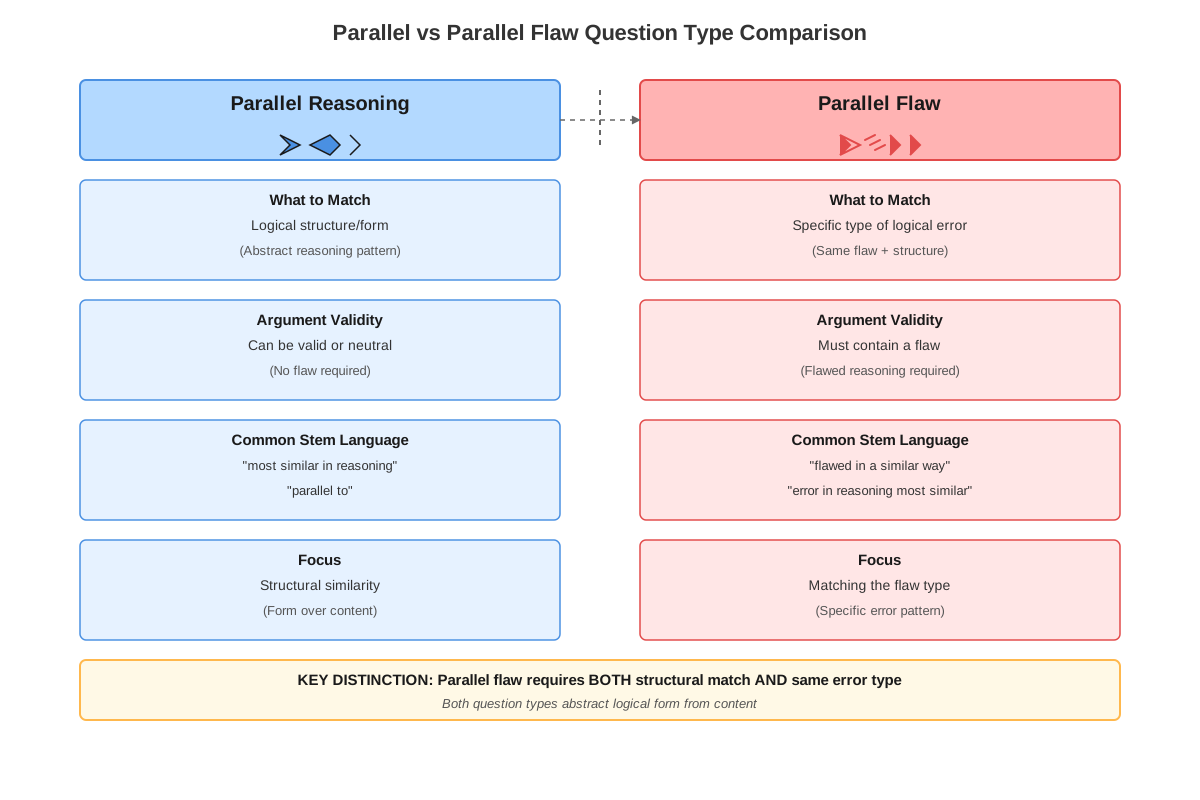
Parallel versus parallel flaw stems represent two distinct but closely related question types in LSAT logical reasoning sections. These questions test a student's ability to recognize and match the structure of arguments rather than their content. In parallel reasoning questions, test-takers must identify an answer choice that mirrors the logical structure of a valid or neutral argument presented in the stimulus. In parallel flaw questions, students must match the specific type of logical error or fallacy present in a flawed argument. The distinction between these two question types is critical: parallel questions focus on structural similarity regardless of validity, while parallel flaw questions specifically require matching the type of reasoning error.
Understanding the difference between these stem types is essential for LSAT success because misidentifying the question type leads to selecting answers that match the wrong criteria. A student who treats a parallel flaw question as a standard parallel question might select an answer with similar structure but without the same flaw, resulting in an incorrect response. These questions appear with significant frequency on every LSAT administration, typically comprising 3-5 questions per test across both logical reasoning sections. Mastering question stem recognition for these types directly impacts a student's ability to score in the upper percentiles.
Both question types connect to broader logical reasoning skills including argument structure analysis, formal logic, conditional reasoning, and flaw identification. They represent an advanced application of these foundational concepts, requiring students to abstract the logical form from specific content and then match that form to a new context. Success with parallel and parallel flaw questions demonstrates mastery of argument analysis at the structural level, which is precisely what law schools value and what the LSAT is designed to measure.
Learning Objectives
- [ ] Identify how parallel versus parallel flaw stems appears in LSAT questions
- [ ] Explain the reasoning pattern behind parallel versus parallel flaw stems
- [ ] Apply parallel versus parallel flaw stems to solve LSAT-style problems accurately
- [ ] Distinguish between parallel reasoning and parallel flaw question stems with 100% accuracy
- [ ] Analyze argument structures to extract their logical form independent of content
- [ ] Match flawed reasoning patterns across different subject matters and contexts
- [ ] Evaluate answer choices efficiently by eliminating structural mismatches early
Prerequisites
- Argument structure identification: Understanding premises, conclusions, and intermediate conclusions is necessary because parallel questions require matching these structural elements across different arguments.
- Common logical fallacies: Familiarity with fallacy types (ad hominem, circular reasoning, false dichotomy, etc.) is essential because parallel flaw questions specifically test the ability to recognize and match these errors.
- Conditional reasoning: Knowledge of sufficient and necessary conditions matters because many parallel questions involve matching conditional logic structures.
- Formal logic basics: Understanding logical operators (and, or, not, if-then) is required because these form the building blocks of argument structures being matched.
Why This Topic Matters
Parallel and parallel flaw questions test a fundamental legal reasoning skill: the ability to recognize when two situations are analogous in their logical structure. This mirrors the legal practice of applying precedent, where attorneys must determine whether the reasoning in one case applies to another based on structural similarity rather than superficial content. Law schools value this skill because it demonstrates abstract reasoning ability and the capacity to see beyond surface details to underlying patterns.
On the LSAT, parallel and parallel flaw questions typically appear 3-5 times per test, representing approximately 6-10% of all logical reasoning questions. These questions tend to be more time-consuming than average because they require analyzing not just the stimulus but also five complete arguments in the answer choices. However, they are also highly predictable once students master the recognition patterns. The LSAT consistently uses certain structural patterns and flaw types in these questions, making them high-yield targets for focused preparation.
These questions commonly appear in several formats: parallel reasoning questions may present valid deductive arguments, inductive generalizations, causal arguments, or analogical reasoning that students must match. Parallel flaw questions most frequently test circular reasoning, unwarranted assumptions, scope shifts, sampling errors, and conditional logic errors. The test writers deliberately use different subject matter in the stimulus versus answer choices to ensure students are matching structure rather than content, making these questions excellent measures of abstract reasoning ability.
Core Concepts
Understanding Parallel Reasoning Questions
Parallel reasoning questions ask test-takers to identify an answer choice that exhibits the same logical structure as the argument in the stimulus. The key word here is "structure"—the content, subject matter, and specific claims can be completely different, but the logical form must be identical. These questions typically use stems such as "Which one of the following is most similar in its reasoning to the argument above?" or "The pattern of reasoning in which one of the following is most similar to that in the argument above?"
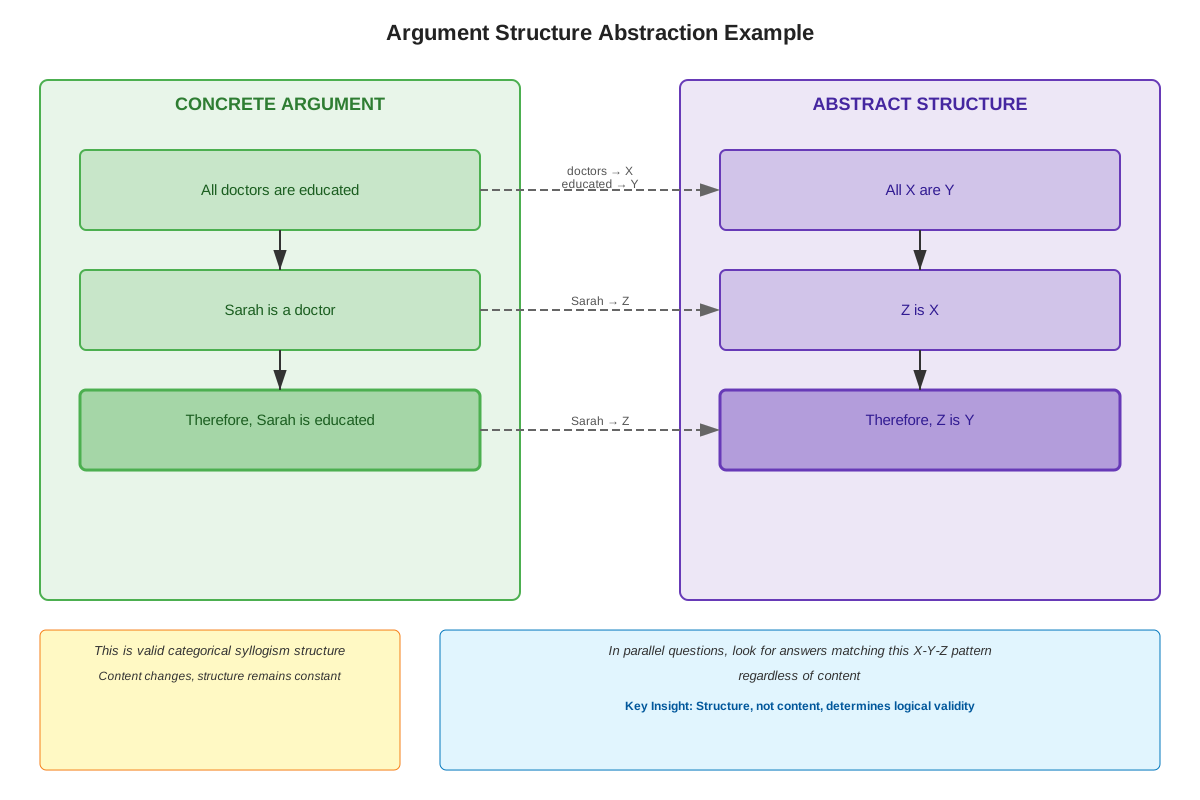
The critical skill is abstracting the logical form from the specific content. For example, if the stimulus argues "All A are B. All B are C. Therefore, all A are C," the correct answer must follow this same categorical syllogism structure, even if it discusses completely different subjects. The argument might be about dogs, breeds, and mammals in the stimulus, but the correct answer could be about vehicles, types, and machines—what matters is the identical logical progression.
Understanding Parallel Flaw Questions
Parallel flaw questions require students to match not just the structure but specifically the type of logical error present in the stimulus. These questions use stems like "Which one of the following exhibits a flawed pattern of reasoning most similar to that exhibited by the argument above?" or "The questionable reasoning in which one of the following is most similar to that in the argument above?" The word "flaw," "flawed," "questionable," or "vulnerable to criticism" signals this question type.
The distinction is crucial: in parallel flaw questions, students must identify what makes the reasoning faulty and then find an answer choice with the same type of flaw. If the stimulus commits a sampling error by generalizing from an unrepresentative sample, the correct answer must also commit a sampling error, not a different type of flaw like circular reasoning or a conditional logic error. Both the structure AND the specific type of error must match.
Key Structural Elements to Match
When analyzing parallel and parallel flaw questions, students must identify and match several structural elements:
- Number and type of premises: Does the argument have one premise or multiple? Are they categorical statements, conditional statements, or causal claims?
- Logical operators: What connecting words appear (all, some, none, if, then, unless, only if)?
- Conclusion type: Is it categorical, conditional, causal, or prescriptive?
- Logical progression: How do the premises connect to reach the conclusion?
- Scope and strength: Are claims universal or particular? Absolute or qualified?
For parallel flaw questions, add these elements:
- Type of flaw: What specific reasoning error occurs?
- Location of flaw: Does the error occur in moving from premises to conclusion, or within the premises themselves?
Common Argument Structures in Parallel Questions
| Structure Type | Form | Example |
|---|---|---|
| Categorical Syllogism | All A are B; All B are C; Therefore, all A are C | All lawyers are professionals; All professionals have degrees; Therefore, all lawyers have degrees |
| Conditional Chain | If A then B; If B then C; Therefore, if A then C | If it rains, the game is cancelled; If the game is cancelled, we get refunds; Therefore, if it rains, we get refunds |
| Disjunctive Syllogism | A or B; Not A; Therefore, B | The package arrived Monday or Tuesday; It didn't arrive Monday; Therefore, it arrived Tuesday |
| Analogical Reasoning | X has properties 1, 2, 3 and result R; Y has properties 1, 2, 3; Therefore, Y will have result R | This medication worked for patients with symptoms A, B, C; This patient has symptoms A, B, C; Therefore, this medication will work for this patient |
Common Flaws in Parallel Flaw Questions
Circular reasoning occurs when the conclusion merely restates a premise without providing independent support. The argument assumes what it's trying to prove. Example: "This policy is fair because it treats everyone equally, and treating everyone equally is what fairness means."
Unwarranted assumptions involve taking for granted something that requires proof. The argument jumps from premises to conclusion without establishing a necessary connection. Example: "Sales increased after we hired a new manager; therefore, the new manager caused the sales increase" (assumes no other factors could explain the increase).
Scope shifts occur when the conclusion discusses a different group, time period, or concept than the premises establish. Example: "Most doctors recommend this treatment for adults; therefore, it's the best treatment for children" (shifts from adults to children).
Conditional logic errors include affirming the consequent (If A then B; B; Therefore A) and denying the antecedent (If A then B; Not A; Therefore not B). Example: "If someone is a great chef, they can make excellent pasta; Maria makes excellent pasta; therefore, Maria is a great chef."
Sampling errors involve generalizing from an unrepresentative or insufficient sample. Example: "I surveyed my friends, and they all support this candidate; therefore, this candidate will win the election."
The Matching Process
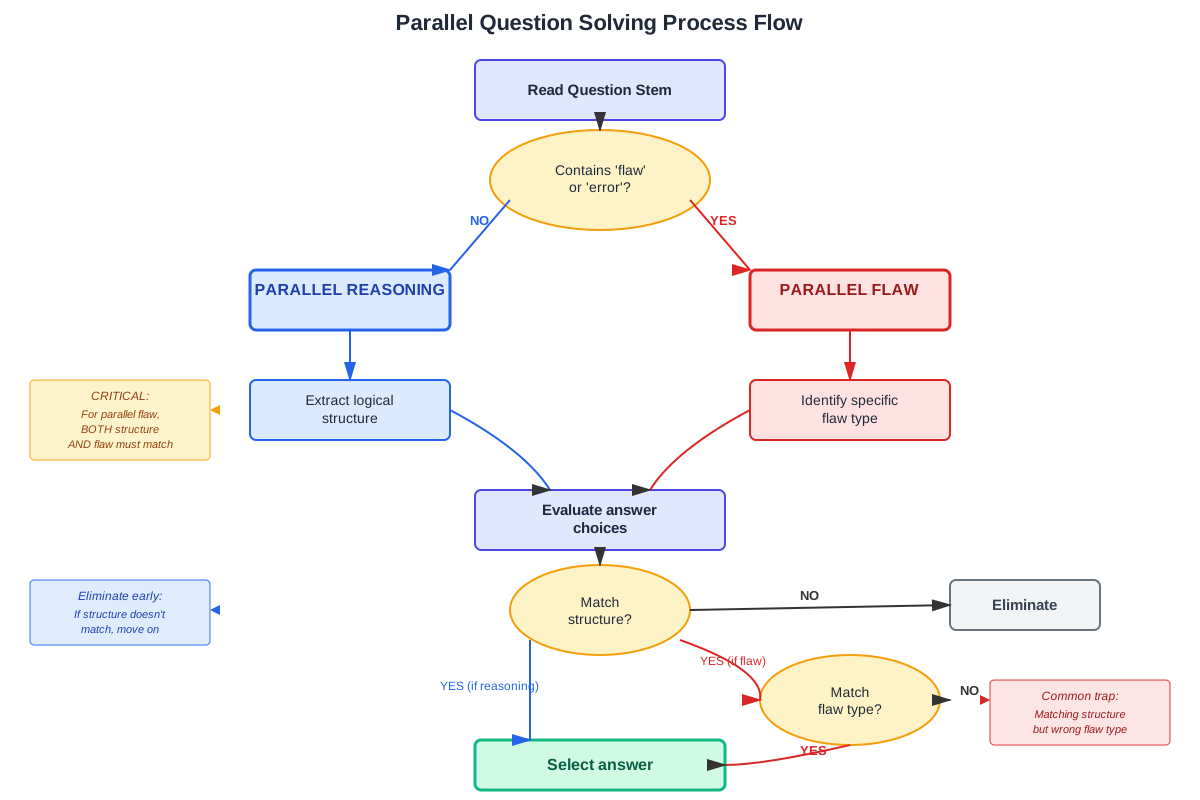
For both question types, follow this systematic approach:
- Identify the question type by carefully reading the stem for keywords indicating parallel versus parallel flaw
- Analyze the stimulus structure by mapping out premises, conclusion, and logical connections
- For parallel flaw questions, identify the specific flaw type before looking at answer choices
- Create a structural template that captures the logical form abstractly
- Eliminate answer choices that don't match the structure, working efficiently through obvious mismatches first
- Verify the remaining choice matches all structural elements (and the flaw type if applicable)
Concept Relationships
The distinction between parallel and parallel flaw stems builds directly on argument structure analysis, which is foundational to all logical reasoning questions. Students must first master identifying premises and conclusions before they can match argument structures across different contexts. This skill → enables → recognizing structural patterns → which enables → distinguishing valid from flawed reasoning → which enables → matching specific flaw types.
Parallel reasoning questions connect to formal logic and conditional reasoning because many parallel questions involve matching conditional chains, categorical syllogisms, or other formal structures. The ability to symbolize arguments abstractly (learned in formal logic) directly transfers to creating structural templates for parallel questions.
Parallel flaw questions integrate flaw identification skills with structural matching. Students must combine their knowledge of common fallacies (learned in flaw question practice) with their ability to abstract logical form (learned in parallel reasoning). This represents a higher-order synthesis: flaw identification + structural abstraction = parallel flaw mastery.
Both question types relate to assumption questions and strengthen/weaken questions because they all require understanding the gap between premises and conclusion. In parallel flaw questions, this gap often represents the flaw being matched. The relationship map: Argument structure → Premise-conclusion gaps → Assumptions → Flaws → Parallel flaws.
Question stem recognition skills learned here transfer to all logical reasoning question types. The ability to parse question stems carefully and identify exactly what the question asks prevents costly errors across the entire section. This metacognitive skill → improves → overall logical reasoning performance → which improves → total LSAT score.
High-Yield Facts
- ⭐ Parallel flaw questions require matching BOTH the structure AND the specific type of flaw; matching structure alone is insufficient
- ⭐ The word "flaw," "flawed," "questionable," or "vulnerable to criticism" in the question stem indicates a parallel flaw question, not a standard parallel question
- ⭐ Content and subject matter are deliberately different between stimulus and correct answer to test structural matching ability
- ⭐ Circular reasoning is the most commonly tested flaw type in parallel flaw questions on recent LSATs
- ⭐ Conditional logic errors (affirming the consequent, denying the antecedent) appear frequently in both parallel and parallel flaw questions
- The number of premises in the stimulus must match the number of premises in the correct answer choice
- Scope shifts between premises and conclusion are among the most common flaws tested in parallel flaw questions
- Parallel questions can involve valid reasoning, invalid reasoning, or neutral reasoning—what matters is structural similarity
- Answer choices in parallel questions often use extreme or absurd content to test whether students are matching structure versus content
- The logical operators (all, some, none, if, only if, unless) must match exactly between stimulus and correct answer
- Sampling errors in parallel flaw questions typically involve generalizing from unrepresentative or insufficient samples
- Analogical reasoning structures appear regularly in parallel questions, requiring matching of shared properties and inferred results
- Time management is critical: these questions take longer than average, so efficient elimination of structural mismatches is essential
- The conclusion type (categorical, conditional, causal, prescriptive) must match between stimulus and correct answer
Quick check — test yourself on Parallel versus parallel flaw stems so far.
Try Flashcards →Common Misconceptions
Misconception: Parallel questions require matching the content or subject matter of the argument. → Correction: Parallel questions require matching only the logical structure; content is deliberately varied to test abstraction ability. An argument about dogs can have the same structure as an argument about economics.
Misconception: In parallel flaw questions, any answer choice with a flaw is acceptable. → Correction: The specific TYPE of flaw must match. If the stimulus commits circular reasoning, the correct answer must also commit circular reasoning, not a different flaw like a sampling error or conditional logic mistake.
Misconception: Parallel reasoning questions always involve valid arguments. → Correction: Parallel reasoning questions can involve valid, invalid, or neutral reasoning patterns. The question asks for structural similarity regardless of validity. Only parallel FLAW questions specifically focus on flawed reasoning.
Misconception: If an answer choice has the same conclusion type as the stimulus, it's likely correct. → Correction: The entire logical structure must match, including the number and type of premises, the logical operators, and the progression from premises to conclusion. Matching only the conclusion is insufficient.
Misconception: Parallel flaw questions are just harder versions of parallel reasoning questions. → Correction: These are fundamentally different question types requiring different skills. Parallel flaw questions require first identifying what makes the reasoning faulty, then matching that specific error type—a two-step process distinct from pure structural matching.
Misconception: The correct answer in parallel questions will use similar vocabulary or terminology to the stimulus. → Correction: Test writers deliberately use different vocabulary and subject matter to ensure students match structure rather than surface features. Similar wording often appears in incorrect answer choices as a trap.
Misconception: Longer answer choices are more likely to match complex stimulus arguments. → Correction: Length is irrelevant to structural matching. A concise answer choice can perfectly match a longer stimulus if the logical form is identical. Longer choices may include irrelevant information that doesn't affect the core structure.
Worked Examples
Example 1: Parallel Reasoning Question
Stimulus: "Every member of the chess club is also a member of the debate team. Every member of the debate team has won at least one academic award. Therefore, every member of the chess club has won at least one academic award."
Question Stem: "Which one of the following arguments is most similar in its reasoning to the argument above?"
Analysis Process:
First, identify this as a parallel reasoning question (no mention of "flaw" or "questionable reasoning"). Next, extract the logical structure:
- Premise 1: All A are B (All chess club members are debate team members)
- Premise 2: All B are C (All debate team members are award winners)
- Conclusion: All A are C (All chess club members are award winners)
This is a valid categorical syllogism with universal quantifiers throughout. The structure chains two categorical statements to reach a conclusion about the relationship between the first and third categories.
Evaluating Answer Choices:
(A) "Some teachers are administrators. Some administrators have doctoral degrees. Therefore, some teachers have doctoral degrees."
Structure: Some A are B; Some B are C; Therefore, some A are C. This doesn't match—the stimulus uses "all" throughout, while this uses "some." The quantifiers don't match. Eliminate.
(B) "All electric vehicles are environmentally friendly. All environmentally friendly options are worth considering. Therefore, all electric vehicles are worth considering."
Structure: All A are B; All B are C; Therefore, all A are C. This matches perfectly! The quantifiers are identical, the number of premises matches, and the logical progression chains two universal categorical statements. Keep as strong contender.
(C) "If a restaurant is popular, it serves good food. This restaurant is popular. Therefore, this restaurant serves good food."
Structure: If A then B; A; Therefore B. This is a conditional argument (modus ponens), not a categorical syllogism. The logical form is completely different. Eliminate.
(D) "Most scientists support this theory. Most people who support this theory are well-informed. Therefore, most scientists are well-informed."
Structure: Most A are B; Most B are C; Therefore, most A are C. The quantifier "most" doesn't match "all," and this commits a quantifier shift fallacy that the stimulus doesn't commit. Eliminate.
(E) "All members of the committee are experienced. Therefore, the committee's decision will be sound."
This has only one premise leading to a conclusion, while the stimulus has two premises. The structure doesn't match. Eliminate.
Answer: (B) matches the structure perfectly with identical quantifiers, number of premises, and logical progression.
Example 2: Parallel Flaw Question
Stimulus: "The new traffic law must be effective at reducing accidents because the number of accidents has decreased since the law was implemented."
Question Stem: "The flawed reasoning in which one of the following is most similar to that in the argument above?"
Analysis Process:
First, identify this as a parallel flaw question (contains "flawed reasoning"). Next, identify the flaw type:
The argument commits a causal reasoning error by assuming that correlation implies causation. Just because accidents decreased after the law was implemented doesn't mean the law caused the decrease. Other factors could explain the reduction (better weather, fewer drivers, improved road conditions, etc.). The argument fails to rule out alternative explanations.
Structure with flaw:
- Premise: Event B occurred after Event A
- Conclusion: Event A caused Event B
- Flaw: Assumes temporal sequence implies causation without ruling out alternative causes
Evaluating Answer Choices:
(A) "The company's profits increased after hiring a new CEO. Therefore, the new CEO's strategies must be responsible for the increased profits."
Structure: Event B (profit increase) occurred after Event A (new CEO). Conclusion: A caused B. This commits the same causal reasoning error—assuming correlation implies causation without ruling out alternative explanations (market conditions, competitor failures, etc.). Strong match.
(B) "All successful businesses have strong leadership. This business has strong leadership. Therefore, this business will be successful."
This commits a conditional logic error (affirming the consequent), not a causal reasoning error. The flaw type doesn't match. Eliminate.
(C) "Most students who study regularly perform well on exams. Therefore, if you study regularly, you will definitely perform well on exams."
This commits an unwarranted certainty error (moving from "most" to "definitely"), not a causal reasoning error based on temporal sequence. Eliminate.
(D) "The survey shows that people prefer this product. Therefore, this product is objectively the best."
This commits an appeal to popularity fallacy, not a causal reasoning error. The flaw type doesn't match. Eliminate.
(E) "Every time I've worn my lucky shirt, my team has won. Therefore, wearing my lucky shirt causes my team to win."
This also involves post hoc reasoning (after this, therefore because of this), which is the same causal reasoning error as the stimulus. However, choice (A) matches more closely because it involves a single instance rather than repeated correlation. Both (A) and (E) are potential matches, but (A) better mirrors the single-instance structure of the stimulus.
Answer: (A) best matches both the structure and the specific flaw type—assuming causation from temporal correlation without ruling out alternatives.
Exam Strategy
When approaching parallel and parallel flaw questions, begin by investing 10-15 seconds in careful question stem analysis. The presence or absence of words like "flaw," "flawed," "questionable," or "vulnerable to criticism" completely changes what you're looking for. Misidentifying the question type wastes time and guarantees an incorrect answer.
For parallel reasoning questions, immediately abstract the logical structure before reading answer choices. Create a mental or written template using variables (A, B, C) or logical notation. Note the number of premises, the type of logical operators (all, some, if-then, unless), and the conclusion type. This template becomes your matching criterion.
For parallel flaw questions, add an extra step: identify and name the specific flaw type before evaluating answers. Ask yourself, "What makes this reasoning faulty?" Common flaw types include circular reasoning, unwarranted assumptions, scope shifts, conditional logic errors, sampling errors, and causal reasoning errors. Knowing the flaw type eliminates answer choices with different flaws immediately.
Exam Tip: Use aggressive elimination on parallel questions. These questions have five complete arguments to evaluate, making them time-intensive. Eliminate answer choices as soon as you spot a structural mismatch—don't waste time reading the entire choice once you've identified a disqualifying difference.
Watch for these trigger words and phrases in question stems:
- "Most similar in its reasoning" = parallel reasoning
- "Exhibits a flawed pattern of reasoning most similar" = parallel flaw
- "Pattern of reasoning... most similar" = parallel reasoning
- "Questionable reasoning... most similar" = parallel flaw
- "Vulnerable to criticism on similar grounds" = parallel flaw
Process-of-elimination strategy: Start by checking the number of premises—if an answer choice has a different number of premises than the stimulus, eliminate immediately. Next, check quantifiers and logical operators—"all" versus "some" or "if-then" versus categorical statements disqualify choices instantly. Then verify the conclusion type matches. Finally, for parallel flaw questions, confirm the flaw type matches.
Time allocation: Budget 90-120 seconds for parallel questions, slightly more than the 60-90 second average for other logical reasoning questions. These questions require analyzing multiple complete arguments, justifying the extra time. However, efficient elimination should keep you within this range. If you're spending more than two minutes, you're likely over-analyzing—make your best choice and move forward.
Memory Techniques
MATCH acronym for parallel reasoning questions:
- Map the structure first
- Abstract from content
- Template with variables
- Check quantifiers and operators
- Hunt for structural mismatches
FLAW-MATCH for parallel flaw questions:
- Find the flaw type first
- Label it specifically
- Analyze the structure
- Watch for different flaw types
- Match both structure AND flaw
- Avoid content similarity traps
- Test remaining choices carefully
- Confirm the flaw type matches
- Hunt for structural mismatches
Visualize parallel questions as architectural blueprints: The stimulus provides a blueprint (structure), and you must find which building (answer choice) was constructed from the same blueprint, even though the buildings use different materials (content). The blueprint (logical form) is what matters, not the materials (subject matter).
For parallel flaw questions, visualize broken machines: The stimulus shows a machine with a specific type of malfunction. You must find another machine with the same type of malfunction, not just any broken machine. A car with a flat tire doesn't match a car with a dead battery, even though both are broken.
Quantifier matching mnemonic: "ALL must match ALL, SOME must match SOME, NONE must match NONE"—quantifiers are non-negotiable in parallel questions.
Summary
Parallel versus parallel flaw stems represent two distinct question types that test structural reasoning ability at different levels. Parallel reasoning questions require matching the logical form of arguments regardless of content or validity, focusing purely on structural similarity. Parallel flaw questions add an additional requirement: matching not just the structure but the specific type of reasoning error present in the stimulus. The critical distinction lies in question stem recognition—the presence of words like "flaw," "flawed," or "questionable" signals that both structure and flaw type must match. Success requires abstracting logical form from specific content, creating structural templates, identifying flaw types accurately, and efficiently eliminating answer choices that don't match the required criteria. These questions appear 3-5 times per LSAT and are highly predictable once students master the recognition patterns and matching process. The key skills are careful question stem analysis, structural abstraction, flaw identification, and systematic elimination of mismatches.
Key Takeaways
- Parallel reasoning questions require matching logical structure only; parallel flaw questions require matching both structure AND the specific flaw type
- Question stem recognition is critical—words like "flaw," "flawed," or "questionable" indicate parallel flaw questions
- Abstract the logical structure using variables or templates before evaluating answer choices
- Content and subject matter are deliberately different between stimulus and correct answer to test structural matching
- For parallel flaw questions, identify and name the specific flaw type before reading answer choices
- Eliminate answer choices aggressively as soon as structural mismatches appear—don't waste time reading entire choices
- Common flaw types include circular reasoning, unwarranted assumptions, scope shifts, conditional logic errors, and causal reasoning errors
Related Topics
Formal Logic and Conditional Reasoning: Mastering parallel questions builds on formal logic skills and enables more sophisticated analysis of conditional chains, which appear frequently in both parallel and parallel flaw questions. Understanding sufficient and necessary conditions is essential for matching conditional structures.
Flaw Question Types: Parallel flaw questions integrate all flaw identification skills. Mastering individual flaw types (circular reasoning, sampling errors, etc.) directly improves parallel flaw performance and enables faster flaw recognition.
Argument Structure and Diagramming: The ability to diagram arguments and identify their component parts is foundational to parallel questions. Advanced diagramming techniques enable faster structural abstraction and more accurate matching.
Strengthen and Weaken Questions: Understanding premise-conclusion gaps in parallel flaw questions transfers to strengthen/weaken questions, where identifying what's missing from arguments is essential.
Practice CTA
Now that you understand the distinction between parallel and parallel flaw stems, it's time to apply these concepts to actual LSAT questions. Work through the practice questions systematically, focusing on question stem recognition first, then structural analysis, and finally efficient elimination. Use the flashcards to reinforce flaw type recognition and structural patterns. Remember: these questions are highly predictable once you master the patterns, making them excellent opportunities to gain points. Each practice question you complete strengthens your pattern recognition and builds the confidence needed for test day success. Start practicing now—your improved score awaits!
Sign up free to keep reading
Create a free AnvayaPrep account to finish this LSAT guide on Parallel versus parallel flaw stems — plus flashcards and practice questions.