Overview
Point at issue question stems represent a critical category within LSAT logical reasoning sections, appearing consistently across multiple test administrations. These questions present two speakers—typically labeled Speaker A and Speaker B, or given proper names—who express differing viewpoints on a particular subject. The test-taker's task is to identify the precise point of disagreement between the two speakers, requiring careful analysis of what each speaker explicitly commits to in their statements.
Understanding point at issue questions is essential for LSAT success because they test a fundamental skill in legal reasoning: the ability to identify the exact nature of a dispute. In legal practice, attorneys must frequently pinpoint the specific matter under contention between parties, distinguishing between areas of agreement and genuine disagreement. These questions typically appear 2-4 times per Logical Reasoning section, making them a high-yield topic that can significantly impact overall performance. Unlike assumption or strengthen/weaken questions, point at issue questions require students to engage with two distinct argumentative positions simultaneously, making question stem recognition particularly important for efficient test-taking.
The relationship between point at issue questions and other Logical Reasoning concepts is foundational. Mastering these questions develops skills in precise textual analysis, logical commitment identification, and argument structure recognition—all of which transfer directly to other question types. Point at issue questions serve as an excellent training ground for understanding what speakers do and do not claim, a skill that proves invaluable when analyzing single-speaker arguments in assumption, flaw, and inference questions.
Learning Objectives
- [ ] Identify how Point at issue question stems appears in LSAT questions
- [ ] Explain the reasoning pattern behind Point at issue question stems
- [ ] Apply Point at issue question stems to solve LSAT-style problems accurately
- [ ] Distinguish between genuine disagreements and mere differences in emphasis or scope
- [ ] Evaluate answer choices using the "commitment test" to verify both speakers take opposing positions
- [ ] Recognize common trap answers that only one speaker addresses or that both speakers would accept
Prerequisites
- Basic argument structure: Understanding premises and conclusions is necessary because point at issue questions require identifying what each speaker is actually claiming or supporting.
- Conditional reasoning fundamentals: Relevant because speakers often disagree about conditional relationships, and recognizing these structures helps identify precise points of contention.
- Distinction between explicit and implicit claims: Essential for determining what each speaker is genuinely committed to versus what might be inferred but not actually stated.
- Question stem identification skills: Important because recognizing point at issue stems quickly allows for proper strategic approach and prevents confusion with other two-speaker question types like principle or reasoning questions.
Why This Topic Matters
Point at issue questions assess a lawyer's core competency: identifying the exact nature of a legal dispute. In courtroom settings, attorneys must distinguish between matters both parties agree upon (stipulated facts) and the genuine points of contention that require judicial resolution. This skill prevents wasted time arguing points that aren't actually disputed and ensures focus remains on the material disagreement.
On the LSAT, point at issue questions appear with remarkable consistency. Test-takers can expect to encounter 2-4 such questions per Logical Reasoning section, translating to approximately 4-8 questions across an entire test administration. Given that each question carries equal weight, mastering this question type can contribute 3-6% to the overall Logical Reasoning score—a significant margin in a competitive testing environment where a few points can determine admission outcomes.
These questions commonly appear in several formats: dialogue between two named speakers, exchanges between researchers or experts in a field, debates about policy recommendations, or discussions about the interpretation of evidence or data. The LSAT frequently embeds these questions in contexts involving scientific research, business decisions, ethical dilemmas, or legal interpretations—all domains where precise identification of disagreement proves crucial. The test writers deliberately craft answer choices that include statements only one speaker addresses, statements both would accept, or statements that mischaracterize the nature of the disagreement, making strategic approach essential for consistent accuracy.
Core Concepts
Defining Point at Issue Questions
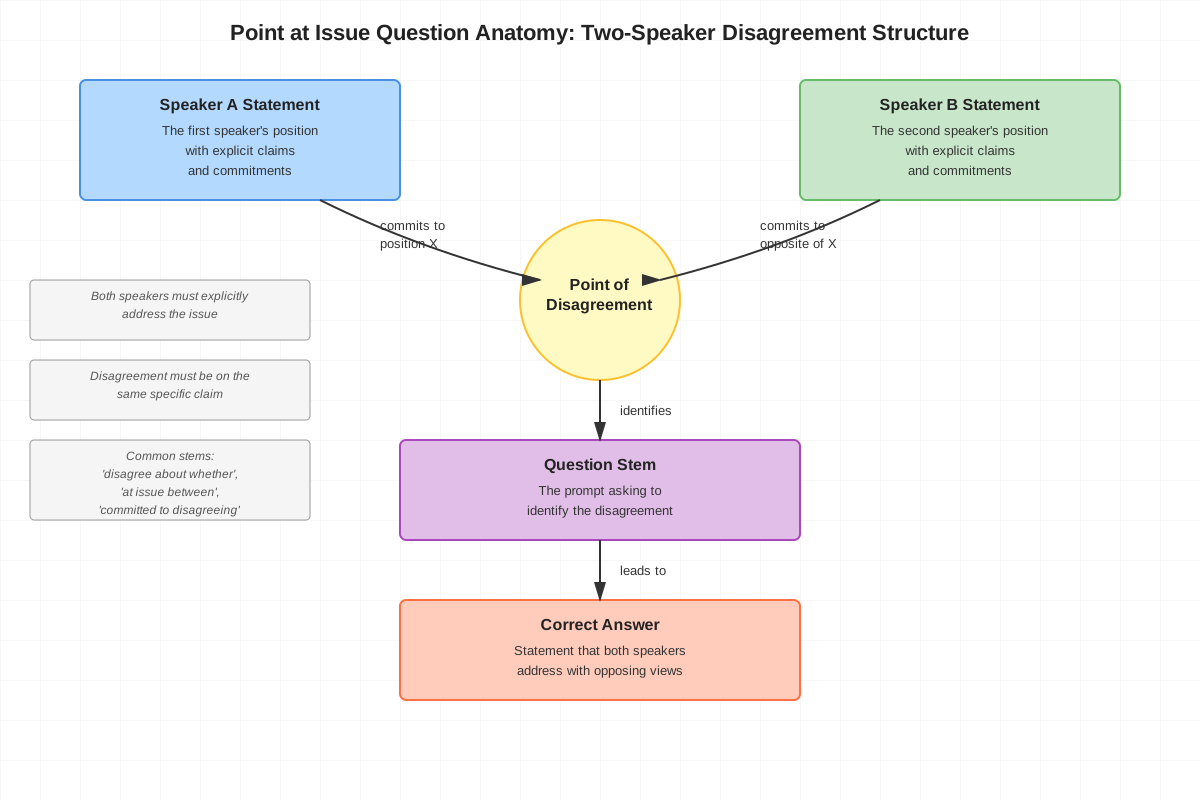
Point at issue question stems are prompts that ask test-takers to identify the specific proposition about which two speakers disagree. These stems typically follow a dialogue or exchange between two parties and request identification of the matter under dispute. The defining characteristic of these questions is that the correct answer must represent a statement where one speaker would respond affirmatively (or commit to its truth) while the other would respond negatively (or deny its truth).
The fundamental logical structure requires that both speakers take clear, opposing positions on the same proposition. This is not merely a difference in what topics they discuss or what aspects they emphasize—it is a genuine contradiction where their positions cannot both be true simultaneously. Understanding this binary opposition is crucial for eliminating trap answers and identifying correct responses.
Common Question Stem Formulations
LSAT point at issue question stems appear in several recognizable formats, and familiarity with these variations enables rapid question type identification:
- "The dialogue provides the most support for the claim that Maria and James disagree about whether..."
- "On the basis of their statements, Chen and Rodriguez are committed to disagreeing over..."
- "The statements above provide the most support for holding that the two speakers disagree about which one of the following?"
- "Which one of the following is the point at issue between the two speakers?"
- "The dialogue most strongly supports the claim that the two speakers disagree with each other about which one of the following?"
Each formulation shares the essential requirement: identifying a proposition where the speakers take opposing stances. The phrase "committed to disagreeing" is particularly important because it emphasizes that both speakers must have explicitly or implicitly taken positions on the matter—mere silence or failure to address a topic does not constitute disagreement.
The Commitment Test
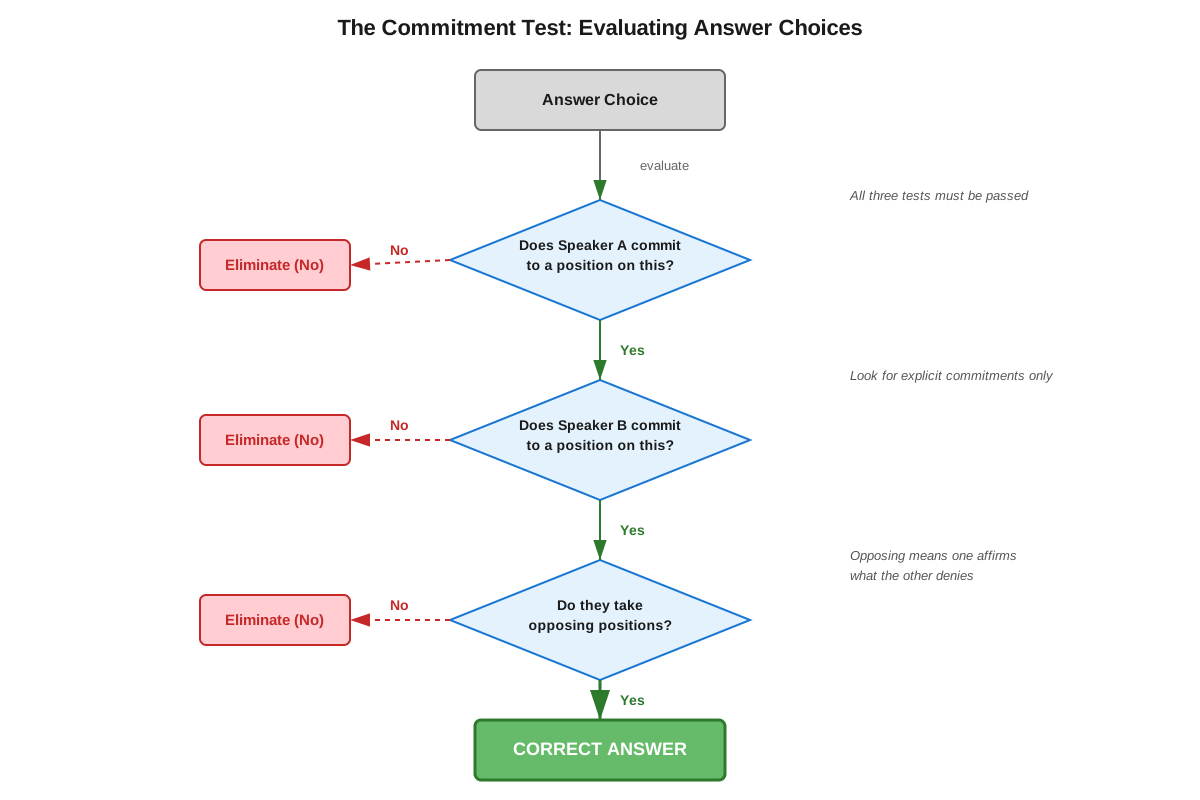
The most reliable method for evaluating answer choices in point at issue questions is the commitment test. This technique involves asking two questions for each answer choice:
- Would Speaker A agree or disagree with this statement (or is their position unclear)?
- Would Speaker B agree or disagree with this statement (or is their position unclear)?
For an answer choice to be correct, one speaker must clearly agree while the other clearly disagrees. If either speaker's position is unclear or unstated, the answer choice fails the test. If both speakers would agree or both would disagree, the answer choice also fails.
This systematic approach prevents the common error of selecting an answer simply because it relates to the topic under discussion. The commitment test forces verification that both speakers have actually taken opposing positions on the specific proposition presented.
Types of Disagreements
Point at issue questions can involve several categories of disagreement:
Factual disagreements: Speakers dispute what is actually true about the world. Example: One speaker claims a policy increased employment; the other claims it decreased employment.
Causal disagreements: Speakers dispute what causes what. Example: One speaker attributes a phenomenon to factor X; the other attributes it to factor Y.
Evaluative disagreements: Speakers dispute whether something is good, bad, justified, or problematic. Example: One speaker considers an action ethical; the other considers it unethical.
Interpretive disagreements: Speakers dispute what evidence means or how it should be understood. Example: One speaker interprets data as supporting a conclusion; the other interprets the same data as undermining it.
Predictive disagreements: Speakers dispute what will happen in the future. Example: One speaker predicts a policy will succeed; the other predicts it will fail.
Recognizing which type of disagreement is present helps narrow focus to the relevant aspects of each speaker's statement.
Scope and Precision in Disagreements
A critical aspect of point at issue questions involves scope—the breadth of the claim being made. Speakers might discuss related topics without actually disagreeing if their claims operate at different levels of generality or address different aspects of an issue.
For example, if Speaker A says "Some corporate mergers benefit consumers" and Speaker B says "Many corporate mergers harm competition," they are not necessarily disagreeing. Speaker A's claim about "some" mergers and Speaker B's claim about "many" mergers could both be true simultaneously. A genuine disagreement would require opposing positions on the same scope: whether a particular merger, or mergers generally, have a specific effect.
The LSAT frequently includes trap answers that present statements related to the discussion but operating at different scopes or addressing different aspects. Careful attention to quantifiers (all, some, most, many, few), qualifiers (usually, sometimes, always, never), and the specific subject matter is essential.
What Does Not Constitute Disagreement
Understanding what fails to qualify as a point at issue is equally important:
Different emphases: If one speaker focuses on economic factors and another on environmental factors, they may not disagree about anything—they simply emphasize different considerations.
Unstated positions: If Speaker A makes a claim but Speaker B never addresses that topic, there is no disagreement, only an absence of engagement.
Compatible claims: If both speakers' statements could be true simultaneously, even if they seem to pull in different directions, there is no logical disagreement.
Differences in reasoning: Speakers might reach the same conclusion through different reasoning paths. Unless they explicitly disagree about the validity of each other's reasoning, this represents agreement on the conclusion despite different justifications.
Concept Relationships
The concepts within point at issue questions form an interconnected system. Question stem recognition serves as the entry point, enabling test-takers to identify that they face a point at issue question and should activate the appropriate strategic approach. This recognition triggers application of the commitment test, which requires understanding the types of disagreements that can exist. Successfully applying the commitment test depends on careful attention to scope and precision, ensuring that both speakers are actually addressing the same proposition at the same level of generality.
Understanding what does not constitute disagreement functions as a negative filter, helping eliminate trap answers that might seem tempting but fail to represent genuine points of contention. This negative knowledge works in tandem with the positive identification of actual disagreements.
The relationship to prerequisite topics is direct: basic argument structure knowledge enables identification of what each speaker claims (their conclusions) and why (their premises). Conditional reasoning skills help recognize when speakers disagree about conditional relationships. The ability to distinguish explicit from implicit claims prevents over-inference—attributing positions to speakers that they haven't actually taken.
Point at issue questions also connect forward to other Logical Reasoning question types. The skill of identifying what a speaker is committed to transfers directly to assumption questions (what must the speaker believe?) and inference questions (what must be true given what the speaker said?). The precision required in point at issue questions—distinguishing between what is said and what is not said—proves invaluable across all Logical Reasoning question types.
Relationship Map:
Question Stem Recognition → Activates Commitment Test → Requires Understanding Types of Disagreement → Demands Attention to Scope and Precision → Filtered by Knowledge of Non-Disagreements → Produces Correct Answer Selection
High-Yield Facts
⭐ The correct answer to a point at issue question must be a statement where one speaker would clearly agree and the other would clearly disagree—if either speaker's position is unclear, the answer is wrong.
⭐ The commitment test is the most reliable method: ask whether each speaker would agree or disagree with each answer choice.
⭐ Point at issue questions typically appear 2-4 times per Logical Reasoning section, making them a high-frequency question type.
⭐ Trap answers often present statements that only one speaker addresses—if one speaker is silent on a topic, there is no disagreement.
⭐ Both speakers must take positions on the exact same proposition; related but distinct claims do not constitute disagreement.
- Common question stem language includes "disagree about whether," "committed to disagreeing over," and "point at issue between."
- Scope matters critically: disagreement about "some" instances versus "all" instances represents different propositions.
- Speakers can discuss the same topic without disagreeing if their claims are compatible or address different aspects.
- The correct answer often involves a claim that one speaker explicitly makes and the other explicitly denies or contradicts.
- Evaluative disagreements (whether something is good/bad, justified/unjustified) are common on the LSAT.
- Causal disagreements (what causes what) frequently appear in scientific or policy contexts.
- The LSAT rarely requires inference to determine disagreement—both positions are typically stated or clearly implied.
- Answer choices that both speakers would accept are common trap answers designed to catch test-takers who focus on topic rather than position.
- Time-efficient test-takers identify point at issue questions immediately and apply the commitment test systematically rather than relying on intuition.
Quick check — test yourself on Point at issue question stems so far.
Try Flashcards →Common Misconceptions
Misconception: If two speakers discuss the same topic, they must disagree about something.
Correction: Speakers can discuss the same topic while making compatible claims that don't contradict each other. Disagreement requires opposing positions on the same proposition, not merely discussion of related subjects.
Misconception: If one speaker makes a strong claim and another makes a weak claim on the same topic, they disagree.
Correction: Claims of different strengths can both be true. For example, "All X are Y" and "Some X are Y" don't contradict—the second is actually entailed by the first. Genuine disagreement requires incompatible positions.
Misconception: The correct answer will always use language that appears in both speakers' statements.
Correction: The correct answer often paraphrases or abstracts from the specific language used, capturing the logical content of the disagreement rather than repeating exact wording. Test-takers must focus on meaning, not mere word matching.
Misconception: If one speaker criticizes the other's reasoning, they necessarily disagree about the conclusion.
Correction: Speakers can agree on a conclusion while disagreeing about the reasoning that supports it. Unless the question specifically asks about disagreement regarding reasoning methodology, focus on substantive claims rather than argumentative structure.
Misconception: The longest or most complex answer choice is most likely correct because it captures nuance.
Correction: Correct answers are often straightforward statements that clearly capture the disagreement. Complexity can signal a trap answer that introduces distinctions neither speaker actually made. The commitment test works regardless of answer choice length.
Misconception: If an answer choice seems related to the main point of the dialogue, it's probably correct.
Correction: The main topic of discussion and the specific point of disagreement are not always the same. Speakers might agree on the main issue while disagreeing about a subsidiary point, or they might discuss a topic while actually disagreeing about something more fundamental.
Worked Examples
Example 1: Policy Disagreement
Dialogue:
Kenji: The city's new parking regulations will reduce traffic congestion downtown. By limiting street parking during peak hours, we'll discourage people from driving into the city center, leading them to use public transportation instead.
Alicia: The regulations won't reduce congestion. People who need to drive downtown will simply circle the blocks repeatedly looking for the limited parking spaces that remain, creating even more traffic than before.
Question: The dialogue provides the most support for the claim that Kenji and Alicia disagree about whether:
(A) the new parking regulations will reduce the number of available parking spaces downtown
(B) the new parking regulations will reduce traffic congestion downtown
(C) people should be encouraged to use public transportation
(D) most people who currently drive downtown could use public transportation instead
(E) the city should implement the new parking regulations
Solution:
Applying the commitment test to each answer choice:
(A) Would Kenji agree that regulations will reduce available spaces? His statement implies this ("limiting street parking"), so yes. Would Alicia agree? She refers to "limited parking spaces that remain," so yes. Both agree—this is not the disagreement. Eliminate.
(B) Would Kenji agree that regulations will reduce congestion? Yes, explicitly: "will reduce traffic congestion downtown." Would Alicia agree? No, explicitly: "won't reduce congestion." Clear disagreement with opposing positions. Strong candidate.
(C) Would Kenji agree people should be encouraged to use public transportation? His statement suggests this is desirable, so probably yes. Would Alicia agree or disagree? She never addresses whether encouraging public transportation use is good or bad—she only discusses whether the regulations will work. Her position is unclear. Eliminate.
(D) Would Kenji agree most people who drive downtown could use public transportation? He suggests people will be "led to use public transportation," implying it's possible, but he doesn't commit to "most" being able to. Would Alicia agree or disagree? She never addresses this. Both positions unclear. Eliminate.
(E) Would Kenji agree the city should implement the regulations? This seems implied by his positive assessment, but he doesn't explicitly state this normative claim. Would Alicia agree? She suggests they won't work, which might imply opposition, but she doesn't explicitly say they shouldn't be implemented. Both positions somewhat unclear, and this is more about policy recommendation than the factual disagreement they're actually having. Eliminate.
Correct Answer: (B)
This example demonstrates how the commitment test efficiently identifies the precise point of disagreement. Both speakers explicitly take opposing positions on whether the regulations will reduce congestion—Kenji says they will, Alicia says they won't. The other answer choices either represent points both speakers would accept (A) or matters one or both speakers don't clearly address (C, D, E).
Example 2: Interpretive Disagreement
Dialogue:
Dr. Martinez: The archaeological evidence from the site clearly indicates that the ancient settlement was abandoned gradually over several decades. We found tools and pottery from multiple time periods scattered throughout the ruins, suggesting people left in waves rather than all at once.
Dr. Okonkwo: I disagree with your interpretation. The presence of artifacts from different periods doesn't demonstrate gradual abandonment. Those items could have been left behind by people who returned to the site periodically after the settlement was abandoned, perhaps to salvage materials or conduct rituals.
Question: On the basis of their statements, Dr. Martinez and Dr. Okonkwo are committed to disagreeing over:
(A) whether the archaeological site contains tools and pottery from multiple time periods
(B) whether the ancient settlement was eventually abandoned
(C) whether the presence of artifacts from multiple time periods indicates gradual abandonment
(D) whether people ever returned to the site after it was initially abandoned
(E) whether archaeological evidence can reliably indicate how settlements were abandoned
Solution:
Applying the commitment test:
(A) Would Dr. Martinez agree the site contains artifacts from multiple periods? Yes, explicitly stated. Would Dr. Okonkwo agree? Yes—she doesn't dispute this fact, she disputes what it means. Both agree. Eliminate.
(B) Would Dr. Martinez agree the settlement was abandoned? Yes, she discusses "abandonment." Would Dr. Okonkwo agree? Yes, she refers to "after the settlement was abandoned." Both agree it was abandoned. Eliminate.
(C) Would Dr. Martinez agree that artifacts from multiple periods indicate gradual abandonment? Yes, this is her explicit interpretation: "suggesting people left in waves." Would Dr. Okonkwo agree? No, explicitly: "doesn't demonstrate gradual abandonment." Clear disagreement. Strong candidate.
(D) Would Dr. Martinez agree people returned after abandonment? She doesn't address this possibility. Would Dr. Okonkwo agree? She suggests this as a possibility ("could have been left behind by people who returned"), but doesn't commit to it actually happening—she's offering an alternative explanation. Dr. Martinez's position is unclear. Eliminate.
(E) Would Dr. Martinez agree archaeological evidence can reliably indicate how settlements were abandoned? She seems to think so in this case, but doesn't make a general claim about reliability. Would Dr. Okonkwo agree or disagree? She disputes this particular interpretation but doesn't make a general claim about whether archaeological evidence can ever be reliable for such determinations. Both positions unclear on this general principle. Eliminate.
Correct Answer: (C)
This example illustrates an interpretive disagreement—both speakers accept the same facts (artifacts from multiple periods exist) but disagree about what those facts indicate. The disagreement is specifically about whether the evidence supports the conclusion of gradual abandonment. Answer choice (A) is a classic trap: it presents a fact both speakers accept, confusing topic with disagreement. Answer choice (D) is tempting but fails because Dr. Martinez never addresses this possibility, so there's no disagreement—only Dr. Okonkwo's alternative hypothesis.
Exam Strategy
Immediate Recognition and Strategic Approach
When encountering a point at issue question, immediately recognize it through the characteristic stem language ("disagree about whether," "point at issue," "committed to disagreeing"). This recognition should trigger a specific strategic approach distinct from other question types. Unlike strengthen/weaken questions where you evaluate impact on an argument, or assumption questions where you identify gaps, point at issue questions require bilateral analysis—determining what both speakers commit to.
Pre-Answer Choice Strategy
Before examining answer choices, quickly identify:
- The main claim or position of Speaker A
- The main claim or position of Speaker B
- The general topic area where disagreement likely exists
This preliminary analysis provides a framework for efficient answer choice evaluation. However, avoid over-committing to a predicted answer—the LSAT often phrases the disagreement in unexpected ways.
Systematic Answer Choice Evaluation
Apply the commitment test to every answer choice, even if one seems obviously correct. The systematic approach prevents careless errors and often reveals that an initially attractive answer fails the test. For each choice:
- Ask: "Would Speaker A agree, disagree, or is their position unclear?"
- Ask: "Would Speaker B agree, disagree, or is their position unclear?"
- Eliminate unless one clearly agrees and one clearly disagrees
Trigger Words and Red Flags
Positive triggers (words that often appear in correct answers):
- "Whether" (introducing the proposition under dispute)
- Evaluative terms matching the dialogue's tone (should, justified, beneficial, problematic)
- Causal language when speakers dispute causation (causes, results in, leads to)
Red flag words (often appear in trap answers):
- Extreme quantifiers not used by either speaker (all, none, never, always) unless both speakers actually used such language
- Topics mentioned by only one speaker
- General principles when speakers discuss specific cases
- Specific cases when speakers discuss general principles
Time Management
Point at issue questions typically require 60-90 seconds for accurate completion. Spending more time usually indicates over-thinking rather than careful analysis. If the commitment test doesn't quickly reveal a clear answer, the most common error is misunderstanding what one speaker actually said—reread the dialogue focusing on precise claims rather than general impressions.
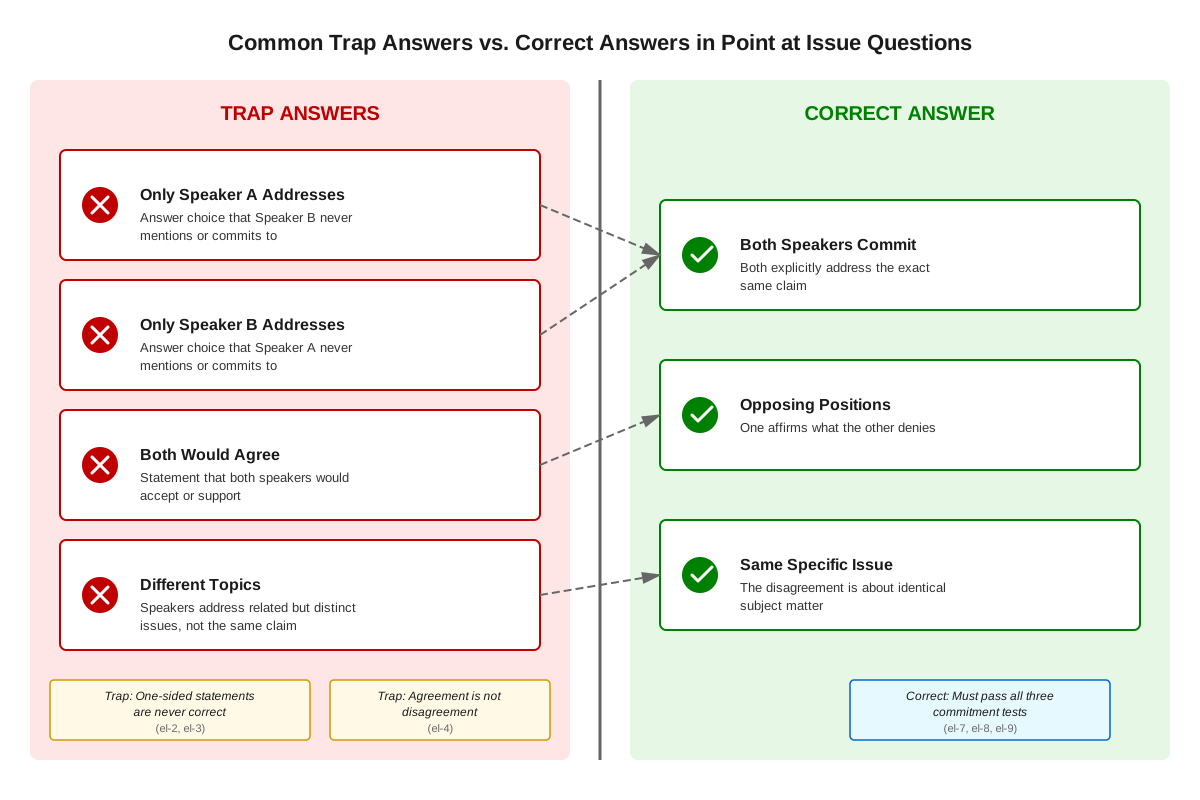
Common Trap Answer Patterns
The "Only One Speaker" trap: Answer presents something only one speaker discusses. If the other speaker is silent on the matter, there's no disagreement.
The "Both Agree" trap: Answer presents something both speakers would accept, often a background fact or shared premise.
The "Scope Shift" trap: Answer changes the scope from what speakers actually discussed (e.g., speakers discuss "some cases" but answer says "all cases").
The "Related But Distinct" trap: Answer addresses a topic related to the discussion but not the actual point of contention.
The "Reasoning vs. Conclusion" trap: Answer focuses on how speakers reason when they actually disagree about a substantive claim, or vice versa.
Memory Techniques
The "Two Thumbs" Mnemonic
Visualize giving two thumbs up or down for each answer choice—one thumb for each speaker. The correct answer is the only one where thumbs point opposite directions (one up, one down). If both thumbs point the same direction or either thumb is sideways (unclear position), eliminate the answer.
The SCOPE Acronym
Same proposition (both speakers must address the same claim)
Clear positions (both speakers must have clear, not ambiguous, stances)
Opposing views (one agrees, one disagrees—not both agreeing or both disagreeing)
Precise language (pay attention to quantifiers and qualifiers)
Explicit or clearly implied (don't over-infer what speakers might believe)
The "Courtroom Disagreement" Visualization
Imagine the two speakers as attorneys in court. The judge asks: "Do you both disagree about [answer choice]?" The correct answer is the only one where one attorney says "yes" and the other says "no" to the same question. If both say "yes," both say "no," or one says "I never addressed that," it's not the point at issue.
The Three-Column Method
When practicing, create three columns:
- Column 1: Answer choice
- Column 2: Speaker A's position (Agree/Disagree/Unclear)
- Column 3: Speaker B's position (Agree/Disagree/Unclear)
The correct answer is the only row showing "Agree/Disagree" or "Disagree/Agree" across columns 2 and 3.
Summary
Point at issue questions require test-takers to identify the precise proposition about which two speakers disagree, demanding careful analysis of what each speaker explicitly commits to in their statements. Success depends on recognizing characteristic question stems, applying the commitment test systematically to verify that one speaker agrees and the other disagrees with each answer choice, and avoiding common traps such as answers that only one speaker addresses or that both speakers would accept. These questions assess the fundamental legal skill of identifying the exact nature of a dispute, distinguishing genuine disagreement from mere differences in emphasis or compatible claims operating at different scopes. The commitment test—asking whether each speaker would agree or disagree with each answer choice—provides a reliable, systematic method for accurate answer selection. Understanding that disagreement requires opposing positions on the same proposition, not merely discussion of related topics, prevents the most common errors. With 2-4 questions per Logical Reasoning section, mastering point at issue questions significantly impacts overall LSAT performance and develops analytical precision valuable across all question types.
Key Takeaways
- Point at issue questions require identifying a proposition where one speaker clearly agrees and the other clearly disagrees—if either position is unclear, the answer is wrong
- The commitment test (asking whether each speaker would agree/disagree with each answer choice) is the most reliable method for systematic answer evaluation
- Common traps include answers that only one speaker addresses, that both speakers would accept, or that shift scope from what was actually discussed
- Disagreement requires opposing positions on the same proposition at the same level of generality—compatible claims or different emphases don't constitute disagreement
- These questions appear 2-4 times per Logical Reasoning section, making them high-yield for score improvement
- Recognition of characteristic stem language ("disagree about whether," "committed to disagreeing," "point at issue") enables immediate activation of appropriate strategy
- Precision in identifying what speakers actually claim versus what might be inferred prevents over-attribution of positions and improves accuracy across all Logical Reasoning question types
Related Topics
Principle Questions with Two Speakers: These questions present dialogues similar to point at issue questions but ask which principle one speaker uses that the other doesn't, or which principle resolves the disagreement. Mastering point at issue questions provides the foundation for identifying what each speaker believes, which is prerequisite to determining underlying principles.
Method of Reasoning Questions: Some method of reasoning questions involve two speakers, asking how one responds to the other. Understanding point at issue questions helps identify what the second speaker is actually responding to versus what they ignore or accept.
Parallel Reasoning with Dialogues: Occasionally, parallel reasoning questions involve matching the structure of a disagreement between two speakers. Point at issue skills help identify the logical structure of the original disagreement that must be matched.
Assumption Questions: The skill of determining what a speaker is committed to—central to point at issue questions—transfers directly to identifying what assumptions a single speaker must be making in standard assumption questions.
Inference Questions: Point at issue questions develop precision in determining what must be true based on what's stated, a skill directly applicable to inference questions where test-takers must identify what must be true given the stimulus.
Practice CTA
Now that you've mastered the core concepts, recognition patterns, and strategic approaches for point at issue questions, it's time to apply this knowledge to actual LSAT-style problems. The practice questions and flashcards have been specifically designed to reinforce the commitment test, help you recognize common trap answers, and build the speed and accuracy needed for test day success. Each practice question provides an opportunity to strengthen your ability to identify precise points of disagreement—a skill that will serve you not only on these specific question types but across the entire Logical Reasoning section. Approach the practice with confidence, apply the systematic methods you've learned, and watch your accuracy improve with each question you complete.
Sign up free to keep reading
Create a free AnvayaPrep account to finish this LSAT guide on Point at issue question stems — plus flashcards and practice questions.