Overview
Principle justify question stems represent one of the most strategically important question types in LSAT logical reasoning sections. These questions ask test-takers to identify a broad principle that, when applied to the specific argument presented in the stimulus, makes the argument's reasoning valid or strengthens its conclusion. Unlike standard assumption questions that seek necessary conditions, principle justify questions demand a sufficient condition—a rule or principle that, if true, would completely justify the logical leap from premises to conclusion.
Understanding LSAT principle justify question stems is essential because these questions appear with notable frequency on every LSAT administration, typically comprising 3-5 questions per test across both Logical Reasoning sections. Mastering this question type directly impacts overall LSAT performance, as these questions test the fundamental skill of recognizing logical gaps and identifying what would bridge them. The ability to work with principles—abstract rules that govern specific cases—is central to legal reasoning itself, making this question type particularly relevant to law school preparation.
Within the broader landscape of question stem recognition, principle justify questions occupy a unique position. They combine elements of sufficient assumption questions (providing what's needed to make an argument valid) with the abstraction required for principle questions (moving from specific cases to general rules). This hybrid nature means that mastering principle justify questions strengthens performance across multiple question types, including strengthen questions, assumption questions, and other principle-based questions. The skills developed here—identifying logical gaps, abstracting from specifics to generalities, and evaluating sufficiency—form the foundation of advanced logical reasoning competency.
Learning Objectives
- [ ] Identify how principle justify question stems appears in LSAT questions
- [ ] Explain the reasoning pattern behind principle justify question stems
- [ ] Apply principle justify question stems to solve LSAT-style problems accurately
- [ ] Distinguish principle justify questions from other principle question types and assumption questions
- [ ] Construct the logical structure of arguments to identify the specific gap that requires justification
- [ ] Evaluate answer choices for sufficiency versus necessity in justifying conclusions
- [ ] Recognize common wrong answer patterns in principle justify questions
Prerequisites
- Basic argument structure: Understanding premises, conclusions, and the relationship between them is essential because principle justify questions require identifying what's missing between given evidence and stated conclusions.
- Conditional reasoning fundamentals: Familiarity with sufficient and necessary conditions matters because principle justify questions seek sufficient conditions that validate arguments.
- Assumption question basics: Prior experience with assumption questions provides context because principle justify questions are essentially sufficient assumption questions presented at a higher level of abstraction.
- Principle question exposure: General understanding of how principles function in logical reasoning helps because these questions require moving between specific instances and general rules.
Why This Topic Matters
Principle justify questions test a lawyer's core competency: the ability to identify which legal rules or principles apply to specific factual situations to support particular conclusions. This mirrors the fundamental structure of legal argument, where attorneys must determine which statutes, precedents, or principles justify their positions in specific cases. The cognitive skill of bridging from concrete facts to abstract principles and back again represents essential legal thinking.
On the LSAT, principle justify questions appear with high frequency and strategic importance. Typically, test-takers encounter 3-5 of these questions per exam, distributed across both Logical Reasoning sections. These questions often appear in the medium-to-difficult range, with point values equal to any other question type. Because they test multiple skills simultaneously—argument analysis, gap identification, abstraction, and conditional reasoning—they serve as excellent discriminators between mid-range and high-scoring test-takers.
In exam passages, principle justify questions most commonly appear following arguments that contain clear logical gaps—situations where the author makes a recommendation, draws a conclusion about what should be done, or applies a specific rule to a particular case. The arguments often involve ethical reasoning, policy recommendations, or categorical judgments. Common contexts include business decisions, social policies, scientific methodology, and everyday reasoning scenarios. The test-makers deliberately construct these arguments to have obvious gaps that require principled justification, making pattern recognition a valuable skill.
Core Concepts
Defining Principle Justify Questions
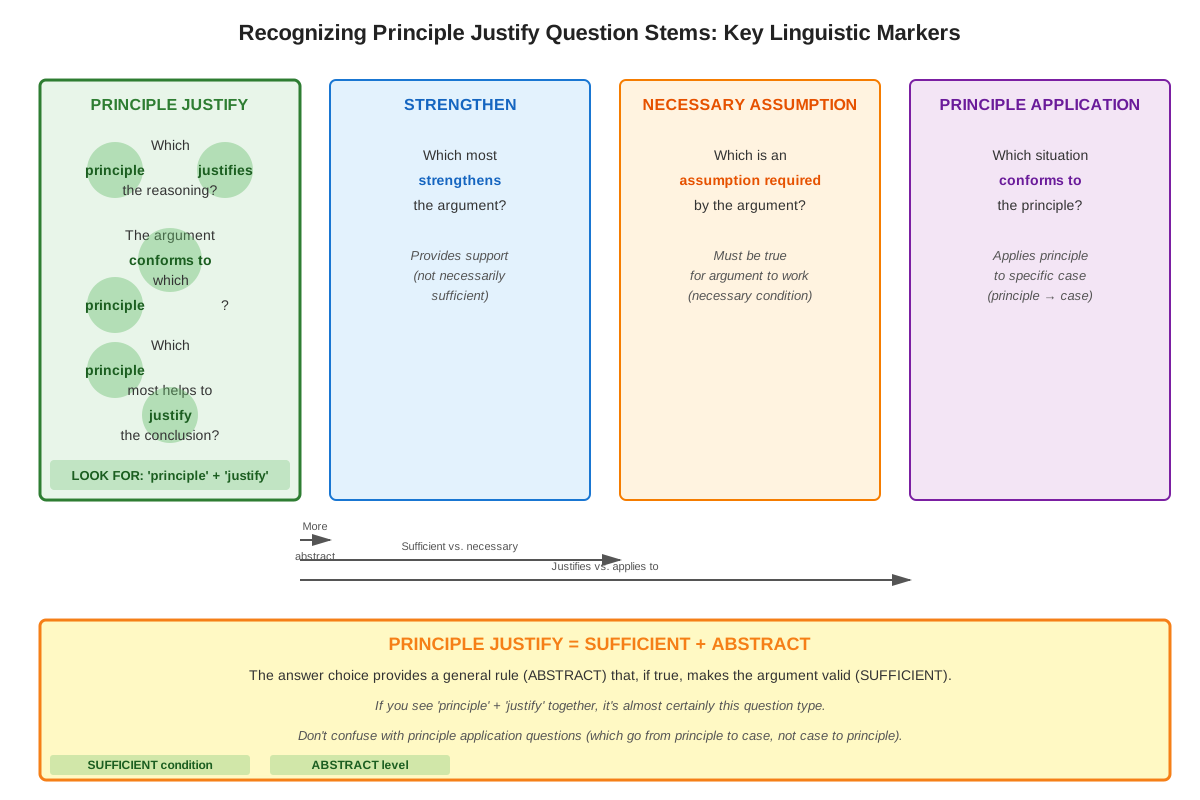
A principle justify question stem asks test-takers to identify a general rule or principle that, if assumed or accepted as true, would make the argument's reasoning logically valid or would provide complete support for its conclusion. The key distinguishing feature is the combination of two elements: (1) the answer must be a principle—a general, abstract rule applicable beyond the specific case—and (2) this principle must justify the argument by providing sufficient grounds for the conclusion.
Common phrasings of principle justify question stems include:
- "Which one of the following principles, if valid, most helps to justify the reasoning above?"
- "The reasoning above most closely conforms to which one of the following principles?"
- "Which one of the following principles, if established, would justify the conclusion?"
- "The argument's reasoning is most vulnerable to criticism unless which one of the following principles is assumed?"
The Logical Structure: Sufficiency vs. Necessity
Understanding the distinction between sufficient and necessary conditions is crucial for principle justify questions. These questions seek sufficient conditions—principles that, if true, would be enough to guarantee the conclusion follows from the premises. This differs from necessary assumption questions, which seek conditions that must be true for the argument to work.
| Feature | Principle Justify | Necessary Assumption |
|---|---|---|
| Logical role | Sufficient condition | Necessary condition |
| Strength | Often stronger than needed | Minimum required |
| Scope | Typically broad, general | Can be narrow, specific |
| Effect | Guarantees conclusion | Required for conclusion |
| Test method | Does this make it valid? | Negation test |
The principle in a correct answer provides a bridge that completely spans the logical gap. It doesn't merely help the argument or make it somewhat better—it makes the reasoning fully justified given the principle's truth.
Identifying the Logical Gap
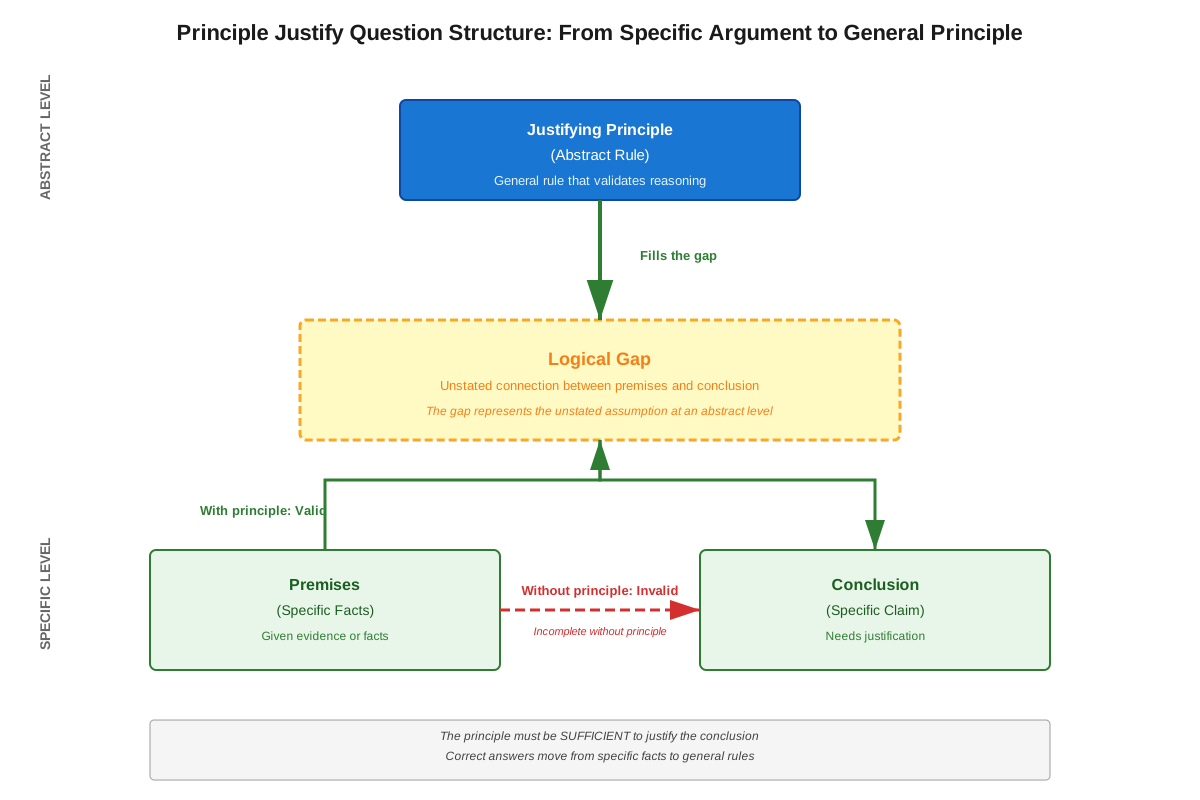
The critical first step in solving principle justify questions involves gap identification—determining what unstated connection the argument assumes between its premises and conclusion. This gap represents the space where the justifying principle must operate.
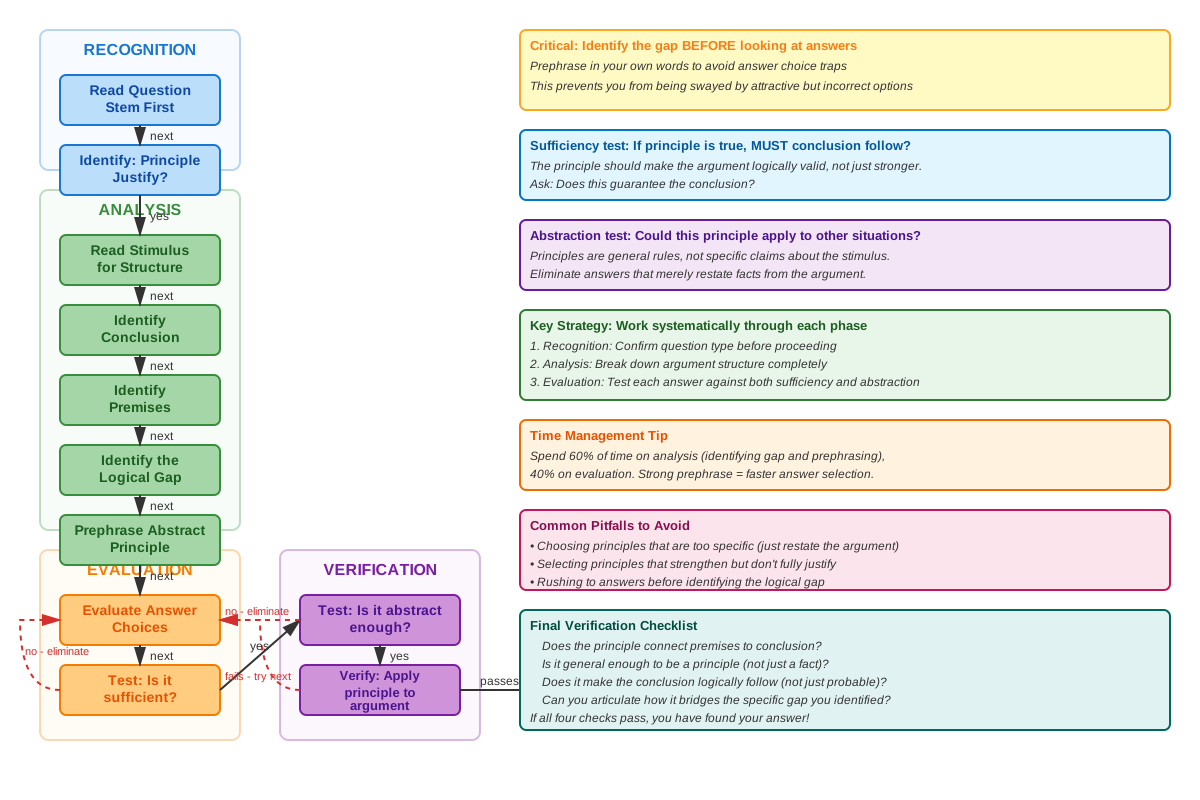
The process follows these steps:
- Isolate the conclusion: Identify exactly what the argument is trying to prove
- Catalog the premises: List what evidence or facts the argument provides
- Spot the leap: Determine what conceptual jump occurs between premises and conclusion
- Characterize the gap: Describe what type of connection is missing (causal, categorical, evaluative, etc.)
For example, if an argument concludes "The city should not build the stadium" based on premises about cost and alternative uses of funds, the gap involves the unstated principle about when financial considerations should determine municipal decisions.
Abstraction and Generalization
Principle justify questions require abstraction—the ability to move from specific details to general rules. The argument stimulus presents a specific case with particular details, but the correct answer must state a principle general enough to apply to multiple situations while specific enough to actually justify this particular argument.
The level of abstraction must be calibrated correctly:
- Too specific: An answer that merely restates the conclusion or applies only to the exact scenario fails to function as a principle
- Too general: An answer so broad it could justify almost any conclusion fails to specifically address the argument's gap
- Appropriately general: An answer that captures the essential logical structure while remaining applicable beyond this single case
Common Argument Patterns in Principle Justify Questions
Several recurring argument structures appear frequently in principle justify questions:
Prescriptive/Normative Arguments: The argument moves from descriptive facts to a prescriptive conclusion about what should be done. The gap involves the missing evaluative principle.
- Structure: "X has properties A and B. Therefore, we should do Y."
- Gap: What principle connects properties A and B to the recommendation Y?
Categorical Arguments: The argument places something in a category based on certain features. The gap involves the classification principle.
- Structure: "Z exhibits characteristics P and Q. Therefore, Z is a member of category C."
- Gap: What principle establishes that P and Q are sufficient for category membership?
Comparative Arguments: The argument draws a conclusion by comparing two situations. The gap involves the principle governing relevant similarities or differences.
- Structure: "Situation 1 has outcome O. Situation 2 resembles Situation 1 in respects R and S. Therefore, Situation 2 will have outcome O."
- Gap: What principle establishes that similarities R and S are the relevant factors?
Evaluating Answer Choices
When evaluating potential principles, apply these criteria:
Sufficiency Test: If this principle were true, would the conclusion necessarily follow from the premises? The correct answer must make the argument's reasoning completely valid, not merely stronger.
Relevance Test: Does this principle actually connect the specific premises to the specific conclusion? Wrong answers often state true or reasonable principles that don't address the particular gap in this argument.
Scope Test: Is the principle appropriately general (functioning as a true principle) while remaining specific enough to justify this argument? Wrong answers may be too narrow (not really principles) or too broad (not specifically helpful).
Direction Test: Does the principle run in the right logical direction? The principle must support moving from these premises to this conclusion, not the reverse.
Concept Relationships
The concepts within principle justify questions form an interconnected system. Question stem recognition enables identification of the task → gap identification reveals what needs justification → abstraction transforms the specific gap into general terms → sufficiency evaluation determines whether a principle completely bridges the gap → answer selection completes the process.
Principle justify questions connect to prerequisite topics through logical extension. Basic argument structure provides the foundation for identifying conclusions and premises, which principle justify questions build upon by requiring gap analysis. Conditional reasoning supplies the framework for understanding sufficiency, which principle justify questions apply to evaluating whether principles adequately justify conclusions. Assumption questions introduce the concept of unstated connections, which principle justify questions elaborate by requiring these connections to be expressed as general principles.
Within the broader LSAT ecosystem, principle justify questions relate closely to several question types:
- Sufficient Assumption questions: Principle justify questions are essentially sufficient assumption questions requiring abstract, general answers
- Strengthen questions: Both seek to support arguments, but principle justify questions must provide complete justification, not merely additional support
- Principle-Application questions: These reverse the direction, asking which specific case follows from a given principle
- Necessary Assumption questions: Both identify gaps, but necessary assumptions seek minimum requirements while principle justify questions seek sufficient conditions
Relationship map:
Argument Structure → Gap Identification → Abstraction to Principle Level → Sufficiency Evaluation → Answer Selection
High-Yield Facts
⭐ Principle justify questions seek sufficient conditions that make arguments valid, not merely necessary assumptions or strengthening factors.
⭐ The correct answer must be general enough to function as a principle applicable beyond the specific case while specific enough to actually justify the particular argument.
⭐ Common question stem phrasings include "principles, if valid, most helps to justify," "reasoning conforms to which principle," and "principle, if established, would justify."
⭐ The logical gap in the argument—the unstated connection between premises and conclusion—determines what the justifying principle must address.
⭐ Principle justify questions typically appear 3-5 times per LSAT, making them high-value targets for focused preparation.
- Wrong answers often state reasonable principles that don't address the specific gap in the argument presented.
- The correct principle must connect the specific premises given to the specific conclusion drawn, not to some other conclusion.
- Prescriptive arguments (concluding what "should" be done) frequently appear in principle justify questions and require evaluative principles.
- The principle must run in the correct logical direction: from the premises' subject matter to the conclusion's subject matter.
- Overly broad principles that could justify almost any conclusion are typically wrong answers.
- Overly narrow "principles" that merely restate the argument's conclusion fail to function as true principles.
- The sufficiency test—"If this principle is true, must the conclusion follow?"—is the definitive evaluation method.
- Principle justify questions reward pre-phrasing: predicting the gap's nature before reviewing answer choices.
Quick check — test yourself on Principle justify question stems so far.
Try Flashcards →Common Misconceptions
Misconception: Principle justify questions are the same as strengthen questions, just asking for a principle instead of a fact.
Correction: Principle justify questions require complete justification (sufficiency), making the argument's reasoning valid, while strengthen questions merely require additional support. A correct principle justify answer makes the conclusion follow necessarily from the premises; a strengthen answer only makes the conclusion more likely or better supported.
Misconception: The correct answer must use the same specific terms and examples as the argument stimulus.
Correction: The correct answer must be appropriately abstract and general, capturing the logical structure rather than repeating specific details. The principle should be applicable to multiple situations sharing the same logical form, not just the exact scenario described.
Misconception: Any true or reasonable principle that relates to the argument's topic is acceptable.
Correction: The principle must specifically bridge the gap between the given premises and the stated conclusion. Many wrong answers present plausible principles about the general topic that don't address the particular logical leap the argument makes.
Misconception: Longer, more complex answer choices are more likely to be correct because principles should be comprehensive.
Correction: Correct answers are often elegantly simple, stating just what's needed to justify the reasoning. Complexity and length don't correlate with correctness; precision and relevance do. Test-makers often use complexity to disguise irrelevant or insufficient principles.
Misconception: If a principle would help the argument somewhat, it's the correct answer.
Correction: The correct principle must completely justify the reasoning, not merely help it. Partial support or making the argument "better" isn't sufficient. The test is whether, given the principle, the conclusion must follow from the premises.
Misconception: Principle justify questions always involve ethical or moral principles.
Correction: While ethical reasoning appears frequently, principle justify questions can involve any type of general rule: causal principles, definitional principles, methodological principles, practical principles, or categorical principles. The content domain varies widely across questions.
Worked Examples
Example 1: Prescriptive Argument
Stimulus: "The city council should reject the proposed waterfront development. The development would generate significant tax revenue, but it would also restrict public access to the waterfront, which has been freely accessible for generations."
Question Stem: "Which one of the following principles, if valid, most helps to justify the reasoning above?"
Analysis:
Step 1 - Identify the conclusion: The city council should reject the proposed development.
Step 2 - Identify the premises:
- The development would generate significant tax revenue (positive factor)
- The development would restrict public access to the waterfront (negative factor)
- The waterfront has been freely accessible for generations (historical context)
Step 3 - Identify the gap: The argument acknowledges both a benefit (tax revenue) and a cost (restricted access) but concludes the development should be rejected. The gap involves what principle determines that preserving public access outweighs generating tax revenue. More specifically, the argument needs a principle establishing when maintaining traditional public access should take priority over financial benefits.
Step 4 - Pre-phrase the principle: Something like "Preserving long-standing public access to community resources should take priority over financial considerations" or "When a development would eliminate traditional public access, it should be rejected regardless of financial benefits."
Evaluating Answer Choices:
(A) "Public access to natural resources should never be restricted for private development."
- Analysis: Too extreme ("never") and doesn't account for the tax revenue consideration or the historical element. This might work but is stronger than necessary.
(B) "Development projects should be evaluated primarily on their potential to generate tax revenue."
- Analysis: This runs in the wrong direction—it would support approving the development, not rejecting it.
(C) "When a proposed development would eliminate long-standing public access to a community resource, the development should be rejected unless the financial benefits are essential to the community's welfare."
- Analysis: This is the correct answer. It establishes that long-standing public access (matching the "generations" premise) should be preserved unless financial benefits are essential (and the stimulus only says "significant," not "essential"). This principle makes the conclusion follow: since the benefits aren't characterized as essential, the development should be rejected.
(D) "City councils should consider both financial and non-financial factors when evaluating development proposals."
- Analysis: Too general and doesn't justify the specific conclusion. This principle would be consistent with either approving or rejecting the development.
(E) "Historical patterns of resource use should be maintained whenever possible."
- Analysis: This helps but doesn't address the weighing of public access against tax revenue, which is central to the argument's reasoning.
Correct Answer: (C)
Connection to Learning Objectives: This example demonstrates identifying principle justify question stems (the "if valid, most helps to justify" phrasing), explaining the reasoning pattern (prescriptive argument requiring evaluative principle about priority), and applying the approach to solve the problem accurately.
Example 2: Categorical Argument
Stimulus: "The new software program should be classified as a creative work rather than a functional tool. While the program does perform practical tasks, it does so through a highly innovative interface that represents a unique artistic vision, and the program's aesthetic qualities are as important to users as its functionality."
Question Stem: "The argument's conclusion is most strongly supported if which one of the following principles is assumed?"
Analysis:
Step 1 - Identify the conclusion: The software should be classified as a creative work rather than a functional tool.
Step 2 - Identify the premises:
- The program performs practical tasks (suggests functional tool)
- It uses a highly innovative interface (suggests creativity)
- The interface represents a unique artistic vision (suggests creative work)
- Aesthetic qualities are as important as functionality to users (suggests creative work)
Step 3 - Identify the gap: The argument must establish what criteria determine whether something is a "creative work" versus a "functional tool." The gap involves the principle for classification when something has both functional and aesthetic elements.
Step 4 - Pre-phrase the principle: Something like "When something has both functional and aesthetic elements, and the aesthetic elements are as important as the functional ones, it should be classified based on its creative aspects" or "Items that embody artistic vision should be classified as creative works even if they also serve practical purposes."
Evaluating Answer Choices:
(A) "Any product that performs practical tasks should be classified according to its primary function."
- Analysis: This would undermine the argument by suggesting functional classification, not support it.
(B) "When a product's aesthetic qualities are as significant to users as its practical functions, the product should be classified as a creative work."
- Analysis: This is the correct answer. It directly addresses the gap by establishing that equal importance of aesthetic and functional qualities warrants creative work classification. Given the premise that aesthetic qualities are as important as functionality, this principle makes the conclusion follow.
(C) "Software programs that feature innovative interfaces represent creative works."
- Analysis: This is close but doesn't address the weighing of aesthetic versus functional aspects, which is central to the argument's reasoning.
(D) "Products should be classified based on how their creators intended them to be used."
- Analysis: The argument doesn't discuss creator intent, so this principle doesn't connect to the given premises.
(E) "Creative works are distinguished by their ability to express unique artistic visions."
- Analysis: This defines creative works but doesn't establish when something with both functional and aesthetic elements should be classified as a creative work rather than a functional tool.
Correct Answer: (B)
Connection to Learning Objectives: This example illustrates recognizing principle justify questions (the "strongly supported if which principle is assumed" phrasing), understanding the categorical reasoning pattern requiring classification principles, and accurately applying the methodology to select the sufficient principle.
Exam Strategy
Initial Approach: When encountering a principle justify question, immediately recognize that the task requires finding a sufficient condition—a principle that makes the argument's reasoning completely valid. This recognition should trigger a specific analytical process distinct from other question types.
Trigger Words and Phrases: Watch for these question stem indicators:
- "principle, if valid, most helps to justify"
- "reasoning conforms to which principle"
- "principle, if established, would justify"
- "principle most strongly supports"
- "reasoning is most vulnerable to criticism unless which principle"
The presence of both "principle" and justification language ("justify," "supports," "conforms to") confirms the question type.
Systematic Process:
- Read the stimulus actively for structure (30-45 seconds): Identify the conclusion first, then catalog premises, consciously noting the gap between them.
- Characterize the gap before looking at answers (15-20 seconds): Mentally articulate what type of connection is missing. Pre-phrase the general form the principle must take.
- Evaluate answers using the sufficiency test (60-90 seconds): For each answer, ask "If this principle is true, must the conclusion follow from the premises?" Eliminate answers that fail this test.
- Verify the correct answer's scope (10-15 seconds): Confirm the answer is general enough to be a principle but specific enough to justify this particular argument.
Process of Elimination Tips:
- Eliminate wrong-direction principles: Answers that would support the opposite conclusion or that connect concepts in the reverse order
- Eliminate irrelevant principles: Answers about the general topic that don't address the specific logical gap
- Eliminate insufficient principles: Answers that would strengthen the argument but not make it fully valid
- Eliminate overly specific non-principles: Answers that merely restate the conclusion without providing a general rule
- Eliminate overly broad principles: Answers so general they could justify almost any conclusion about the topic
Time Allocation: Principle justify questions typically warrant 90-120 seconds. They require more analysis time than simple inference questions but shouldn't consume as much time as complex parallel reasoning questions. If stuck between two answers after two minutes, make an educated guess and move forward—these questions can become time traps.
Common Traps to Avoid:
- Selecting principles that are true or reasonable but don't bridge the specific gap
- Choosing necessary assumptions instead of sufficient principles
- Falling for principles that address part of the argument but miss the critical connection
- Being swayed by complex language that obscures an irrelevant or insufficient principle
Memory Techniques
GAPS Mnemonic for the solution process:
- Gap identification: Find what's missing between premises and conclusion
- Abstraction: Determine what general principle would bridge this gap
- Pre-phrase: Predict the principle before reviewing answers
- Sufficiency test: Verify the principle makes the conclusion follow necessarily
The Bridge Visualization: Picture the argument as two islands (premises and conclusion) separated by water (the logical gap). The correct principle is a bridge that completely spans the gap, allowing safe passage from premises to conclusion. Wrong answers are either bridges to different islands (irrelevant), bridges that don't reach all the way across (insufficient), or bridges too wide for the gap (overly broad).
Sufficiency vs. Necessity Reminder: "Sufficient = Satisfies completely" and "Necessary = Needed minimally." Principle justify questions want satisfaction, not just minimum requirements.
The Abstraction Ladder: Visualize a ladder with specific details at the bottom and overly broad generalities at the top. The correct principle sits in the middle rungs—general enough to apply beyond this case but specific enough to actually justify this reasoning.
PJ = SuP Acronym: Principle Justify questions require Sufficient Principles. This reminds you that these questions need more than mere support—they need sufficiency.
Summary
Principle justify question stems represent a high-value LSAT question type that combines gap identification, abstraction, and sufficiency evaluation. These questions ask test-takers to identify general principles that, if true, would make arguments' reasoning completely valid by bridging the logical gaps between premises and conclusions. Success requires recognizing the question type through characteristic stem language, systematically analyzing argument structure to identify the specific gap, abstracting from the particular case to determine what general principle would justify the reasoning, and evaluating answer choices for sufficiency rather than mere support. The correct answer must be appropriately general (functioning as a true principle applicable beyond the specific case) while remaining specific enough to actually justify the particular argument presented. Common wrong answers include principles that are irrelevant to the specific gap, insufficient to fully justify the conclusion, too narrow to function as principles, or too broad to specifically address the argument's reasoning. Mastering principle justify questions strengthens overall logical reasoning performance by developing essential skills in argument analysis, conditional reasoning, and the relationship between general rules and specific applications.
Key Takeaways
- Principle justify questions seek sufficient conditions—principles that make arguments completely valid, not merely stronger
- The correct answer must be a general principle (applicable beyond the specific case) that specifically bridges the gap in this particular argument
- Systematic gap identification before reviewing answer choices dramatically improves accuracy and efficiency
- The sufficiency test—"If this principle is true, must the conclusion follow?"—is the definitive evaluation criterion
- Common wrong answers include irrelevant principles, insufficient principles, overly narrow non-principles, and overly broad principles
- These questions appear 3-5 times per LSAT and test multiple skills simultaneously, making them high-value preparation targets
- Pre-phrasing the needed principle based on gap analysis prevents wrong answer traps and increases confidence
Related Topics
Sufficient Assumption Questions: These questions ask for what would make arguments valid but don't require answers to be stated as general principles. Mastering principle justify questions makes sufficient assumption questions easier because the core skill—identifying what would make reasoning valid—transfers directly.
Principle-Application Questions: These reverse the direction by providing a principle and asking which specific case it supports or which action it recommends. Understanding principle justify questions helps with application questions by clarifying how principles relate to specific instances.
Necessary Assumption Questions: While these seek minimum requirements rather than sufficient conditions, the gap identification skills developed for principle justify questions apply directly. Understanding the sufficiency/necessity distinction clarifies both question types.
Strengthen Questions: These require only additional support rather than complete justification. Mastering the higher standard of principle justify questions makes the lower standard of strengthen questions more manageable.
Parallel Reasoning Questions: These test the ability to recognize logical structure abstracted from content, a skill central to principle justify questions where abstraction from specific details to general principles is essential.
Practice CTA
Now that you understand principle justify question stems, it's time to apply this knowledge through deliberate practice. Work through the practice questions systematically, using the GAPS process for each one: identify the Gap, determine the needed Abstraction, Pre-phrase your answer, and apply the Sufficiency test. Review the flashcards to reinforce recognition of question stem variations and common wrong answer patterns. Remember that principle justify questions reward methodical analysis—invest the time to master the process, and your accuracy will increase significantly. These questions are highly learnable through focused practice, and each one you master brings you closer to your target LSAT score.
Sign up free to keep reading
Create a free AnvayaPrep account to finish this LSAT guide on Principle justify question stems — plus flashcards and practice questions.