Overview
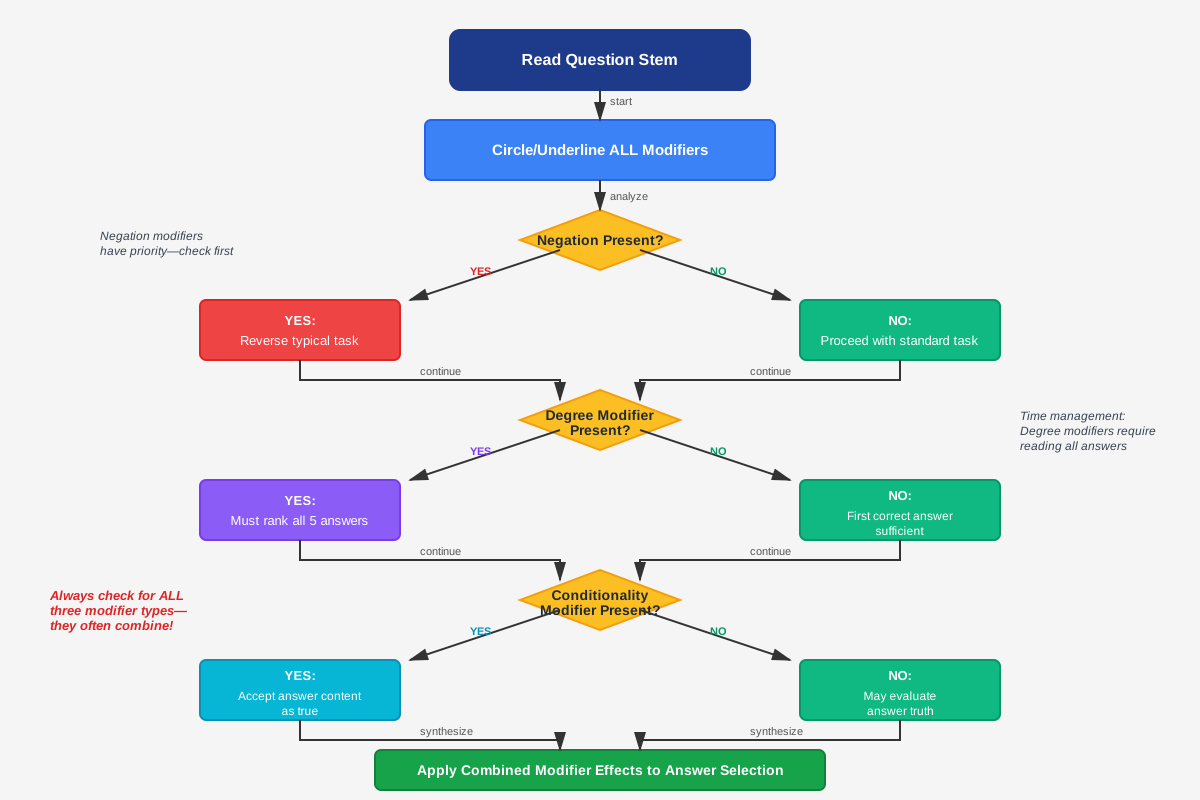
Question stem modifiers are critical linguistic elements that fundamentally alter the task required in LSAT logical reasoning questions. These modifiers—words or phrases that appear within the question stem itself—transform the nature of what test-takers must identify, evaluate, or accomplish. Understanding these modifiers is essential because they determine whether you're looking for a necessary assumption versus a sufficient assumption, a principle that justifies versus one that undermines, or whether you need the answer that most strengthens an argument versus the one that is most strongly supported by the stimulus.
The importance of recognizing and correctly interpreting question stem modifiers cannot be overstated. A single word like "EXCEPT," "if true," "most," or "primarily" can completely change the correct answer from choice (A) to choice (E). Students who master question stem recognition and specifically understand how modifiers function will avoid one of the most common pitfalls on the LSAT: answering the wrong question correctly. This means selecting an answer that would be perfect for a slightly different question type, but is incorrect for the actual question asked.
Within the broader landscape of Logical Reasoning, question stem modifiers serve as the bridge between understanding argument structure and selecting the correct answer. While recognizing basic question types (strengthen, weaken, assumption, inference, etc.) forms the foundation of LSAT preparation, modifiers add layers of complexity and precision that separate average scores from exceptional ones. These modifiers interact with your knowledge of formal logic, conditional reasoning, and argument analysis to create the full spectrum of question difficulty that appears on test day.
Learning Objectives
- [ ] Identify how Question stem modifiers appears in LSAT questions
- [ ] Explain the reasoning pattern behind Question stem modifiers
- [ ] Apply Question stem modifiers to solve LSAT-style problems accurately
- [ ] Distinguish between different categories of modifiers and their specific effects on question tasks
- [ ] Recognize modifier combinations and predict their cumulative impact on answer selection
- [ ] Develop systematic approaches to parsing complex question stems with multiple modifiers
- [ ] Evaluate answer choices through the lens of specific modifier requirements
Prerequisites
- Basic question type recognition: Understanding fundamental LSAT question categories (strengthen, weaken, assumption, inference, etc.) provides the foundation upon which modifiers build complexity.
- Argument structure analysis: The ability to identify conclusions, premises, and reasoning gaps is necessary because modifiers change how you interact with these structural elements.
- Conditional logic fundamentals: Many modifiers involve conditional relationships ("if true," "unless," "only if"), requiring comfort with basic conditional reasoning.
- Reading comprehension at LSAT level: Precise interpretation of nuanced language is essential since modifiers often involve subtle distinctions in meaning.
Why This Topic Matters
In real-world legal practice, attorneys must parse precise language in statutes, contracts, and judicial opinions where single words dramatically alter meaning and application. The LSAT's use of question stem modifiers mirrors this professional requirement, testing whether future law students can recognize how linguistic precision affects logical tasks. This skill translates directly to legal reading, writing, and argumentation.
On the LSAT itself, question stem modifiers appear in approximately 85-90% of all Logical Reasoning questions. While some questions have straightforward stems ("Which one of the following strengthens the argument?"), the majority include at least one modifier that adds complexity. Questions with modifiers like "EXCEPT," "if true," "most strongly," or "primarily relies on" appear across all question types and difficulty levels, making this topic universally relevant rather than confined to specific question categories.
Common manifestations include:
- Degree modifiers ("most," "best," "primarily") appearing in 40-50% of questions
- Conditional modifiers ("if true," "if assumed") in approximately 30-35% of questions
- Negation modifiers ("EXCEPT," "NOT," "fails to") in roughly 15-20% of questions
- Scope modifiers ("main," "overall," "primarily") in 20-25% of questions
- Combination modifiers where multiple types appear together in 25-30% of questions
Core Concepts
Categories of Question Stem Modifiers
LSAT question stem modifiers fall into several distinct functional categories, each serving a specific purpose in defining the task. Understanding these categories enables systematic analysis rather than case-by-case memorization.
Degree Modifiers specify the strength or extent of the relationship between the answer choice and the stimulus. These include:
- "most strongly" / "most seriously"
- "best" / "most accurately"
- "primarily" / "mainly"
- "most helps to" / "most contributes to"
These modifiers signal that multiple answer choices may have some merit, but only one optimally fulfills the requirement. The task becomes comparative rather than absolute—you're not looking for any answer that strengthens, but the one that strengthens most.
Conditional Modifiers establish hypothetical frameworks within which the answer must operate:
- "if true" / "if assumed"
- "if feasible" / "if acceptable"
- "assuming that"
The phrase "if true" is particularly significant because it instructs test-takers to accept the answer choice as factual regardless of real-world plausibility. This modifier appears most frequently in strengthen, weaken, and resolve/explain questions, reminding students not to reject answers based on outside knowledge or perceived implausibility.
Negation Modifiers reverse the standard task, requiring identification of the exception or opposite:
- "EXCEPT"
- "NOT"
- "LEAST"
- "fails to"
Questions with "EXCEPT" fundamentally transform the task. In a "weaken EXCEPT" question, four answers weaken the argument while the correct answer either strengthens it or has no effect. This requires tracking which answers do the opposite of what you'd normally seek.
Scope Modifiers define the breadth or focus of the required answer:
- "main" / "primary"
- "overall"
- "central"
- "specifically"
These modifiers distinguish between comprehensive and partial answers. An answer might address part of an argument, but if the modifier requires the "main" point or "overall" conclusion, partial answers are incorrect even if technically accurate.
How Modifiers Change Question Tasks
Consider the baseline question: "Which one of the following strengthens the argument?"
Adding modifiers transforms this:
- "Which one of the following, if true, most strongly strengthens the argument?" → Accept each answer as true, then compare their strengthening power
- "Each of the following strengthens the argument EXCEPT:" → Find four strengtheners and one non-strengthener
- "Which one of the following principles, if valid, most helps to justify the reasoning?" → Seek an abstract rule (principle) that, when accepted, provides the strongest justification
Each modifier adds a layer of specification:
| Modifier Type | Effect on Task | Example Impact |
|---|---|---|
| Degree | Requires comparison among viable options | Must rank answer choices by strength |
| Conditional | Establishes hypothetical acceptance | Cannot reject answers as "unrealistic" |
| Negation | Reverses the standard search pattern | Four answers do X; find the one that doesn't |
| Scope | Defines breadth of acceptable answer | Partial answers become incorrect |
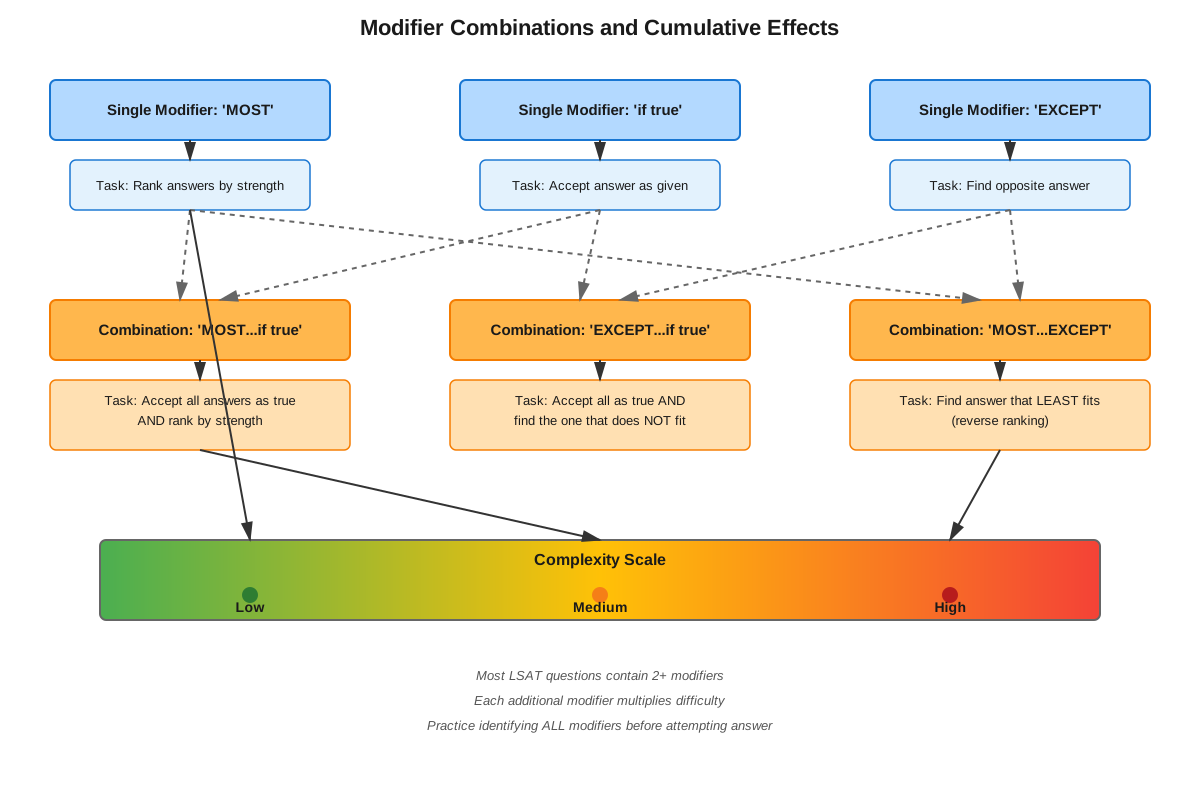
Modifier Combinations and Cumulative Effects
The most challenging LSAT questions often combine multiple modifier types. Consider: "Which one of the following, if assumed, would allow the conclusion to be properly drawn?"
This combines:
- Conditional modifier ("if assumed") → treat answer as given
- Degree modifier (implicit in "properly") → must be sufficient, not just helpful
- Task specification → this is a sufficient assumption question
The combination means you need an answer that, when added to the premises, guarantees the conclusion follows with logical necessity. A mere strengthener is insufficient; the modifier "properly drawn" requires complete logical sufficiency.
The "If True" Modifier: Special Considerations
The phrase "if true" deserves particular attention as it appears in roughly one-third of all Logical Reasoning questions. This modifier serves multiple functions:
- Suspends real-world skepticism: Students must evaluate the answer's logical impact, not its factual plausibility
- Levels the playing field: All five answer choices receive equal presumption of truth
- Focuses on logical relationships: The task becomes analyzing how the (assumed true) answer interacts with the argument
Common errors with "if true":
- Rejecting answers because they seem unlikely or implausible
- Bringing in outside knowledge to dispute answer choices
- Failing to fully accept the answer's truth when evaluating its impact
Negation Modifiers: The EXCEPT Question Pattern
Questions containing "EXCEPT," "LEAST," or "NOT" require a fundamentally different approach. The correct answer is the odd one out—the choice that doesn't do what the other four do.
Strategy for EXCEPT questions:
- Identify what the four wrong answers will do (e.g., in "weaken EXCEPT," four answers weaken)
- Mark each answer as it's evaluated (✓ for does the thing, ✗ for doesn't)
- The correct answer either does the opposite or has neutral effect
- Expect the correct answer to feel "wrong" since you're trained to find answers that perform the stated task
Degree Modifiers: Comparative Analysis
Words like "most," "best," and "primarily" transform questions from binary (correct/incorrect) to comparative (strongest among options). This requires:
- Relative evaluation: An answer might be good but not best
- Ranking methodology: Develop criteria for comparing answer strength
- Avoiding premature selection: Don't choose the first decent answer; evaluate all five
For "most strengthens" questions, compare answers by:
- Relevance to the argument's gap or assumption
- Degree of impact (eliminates vs. reduces a concern)
- Scope of application (addresses entire argument vs. one aspect)
Concept Relationships
Question stem modifiers exist within a hierarchical relationship structure. At the foundation lies basic question type recognition—understanding whether a question asks you to strengthen, weaken, identify an assumption, or draw an inference. Modifiers then refine and specify these basic tasks, adding layers of precision.
The relationship flows: Question Type → Modifier Application → Answer Selection Strategy
For example:
- Strengthen question (basic type) → "if true, most strongly strengthens" (modifiers applied) → comparative evaluation of strengthening power (strategy)
Modifiers also connect to formal logic and conditional reasoning. The "if true" modifier creates a conditional framework (IF answer choice is true, THEN what follows?). Negation modifiers like "EXCEPT" relate to logical negation and complement sets. Understanding these connections allows students to apply logical reasoning skills to modifier interpretation.
Within the topic itself, modifier categories interact:
- Degree modifiers + Conditional modifiers = "if true, most strongly" (very common combination)
- Negation modifiers + Degree modifiers = "LEAST supports" (double-check whether you're finding the weakest supporter or the one that doesn't support)
- Scope modifiers + Degree modifiers = "primarily relies on" (find the main reasoning pattern, not just any pattern present)
High-Yield Facts
⭐ The phrase "if true" appears in approximately 30-35% of all Logical Reasoning questions and instructs test-takers to accept answer choices as factual regardless of real-world plausibility.
⭐ "EXCEPT" questions reverse the task: four answers perform the stated action while the correct answer either does the opposite or has neutral effect.
⭐ Degree modifiers like "most" and "best" require comparative analysis among all five answer choices, not just identification of a sufficient answer.
⭐ The modifier "primarily" or "main" indicates that partial answers are incorrect even if technically accurate—the answer must address the central or most important element.
⭐ Combining "if assumed" with "properly drawn" signals a sufficient assumption question requiring an answer that guarantees the conclusion, not merely supports it.
- Conditional modifiers ("if true," "if assumed") appear most frequently in strengthen, weaken, and assumption questions.
- Negation modifiers require tracking four answers that do one thing and finding the fifth that doesn't.
- The absence of "if true" in an inference question means answers must be provable from the stimulus alone without additional assumptions.
- "Most strongly" questions often have 2-3 answers that have some merit, requiring careful comparison to identify the strongest.
- Scope modifiers distinguish between comprehensive answers (correct) and partial answers (incorrect) even when both are accurate.
- Multiple modifiers in a single question stem compound the complexity and require systematic parsing of each modifier's effect.
- The modifier "fails to" creates a negation task similar to "does NOT" or "EXCEPT."
Quick check — test yourself on Question stem modifiers so far.
Try Flashcards →Common Misconceptions
Misconception: "If true" means the answer choice is actually true or likely in the real world.
Correction: "If true" is a conditional instruction to accept the answer as factual for purposes of analysis, regardless of real-world plausibility. The modifier suspends skepticism and focuses evaluation on logical relationships.
Misconception: In "EXCEPT" questions, the correct answer must do the opposite of what the question asks.
Correction: The correct answer in "EXCEPT" questions either does the opposite OR has neutral effect. In "strengthen EXCEPT," the correct answer might weaken (opposite) or simply be irrelevant (neutral).
Misconception: "Most strongly" means finding any answer that strongly performs the task.
Correction: "Most strongly" requires comparative analysis. An answer that strongly strengthens an argument might still be incorrect if another answer strengthens it even more strongly.
Misconception: Degree modifiers like "primarily" and "mainly" are interchangeable with "partially" or "somewhat."
Correction: "Primarily" and "mainly" indicate the central, most important, or dominant element—not just any element that plays some role. These modifiers require identifying the most significant factor, not merely a contributing factor.
Misconception: Multiple modifiers in a question stem are redundant and don't change the task significantly.
Correction: Each modifier adds specific requirements. "Which one of the following, if true, most strongly supports" combines conditional acceptance (if true) with comparative analysis (most strongly), requiring both elements in your approach.
Misconception: The modifier "if assumed" is the same as "if true."
Correction: While both create conditional frameworks, "if assumed" typically appears in assumption questions and signals that the answer should function as an unstated premise, while "if true" appears across question types and simply instructs acceptance of the answer's factual content.
Worked Examples
Example 1: Degree Modifier Analysis
Question Stem: "Which one of the following, if true, most strongly supports the economist's argument?"
Stimulus: "The economist argues that raising the minimum wage will not increase unemployment because businesses will offset higher labor costs through improved efficiency rather than reducing staff."
Answer Choices:
(A) Studies show that some businesses improve efficiency when facing higher costs.
(B) In the last three minimum wage increases, unemployment remained stable.
(C) Businesses in high-wage countries consistently demonstrate greater efficiency than those in low-wage countries.
(D) Economic theory suggests multiple ways businesses can respond to increased costs.
(E) When minimum wage increased in Region X, 87% of surveyed businesses reported improving efficiency rather than cutting staff.
Analysis:
First, identify the modifiers:
- "if true" → accept each answer as factual
- "most strongly" → comparative analysis required
The argument's conclusion is that raising minimum wage won't increase unemployment. The reasoning is that businesses will improve efficiency instead of cutting staff.
Evaluating each answer:
(A) "Some businesses improve efficiency" - This supports the possibility but is weak ("some" is limited scope)
(B) "Unemployment remained stable" - This supports the conclusion directly but doesn't address the specific reasoning about efficiency
(C) "High-wage countries show greater efficiency" - This is correlational and doesn't directly address the causal mechanism in the argument
(D) "Multiple ways to respond" - This is too general and doesn't specifically support the efficiency-over-layoffs claim
(E) "87% improved efficiency rather than cutting staff" - This directly supports both the conclusion (unemployment won't increase) and the specific reasoning (businesses choose efficiency over layoffs), with strong quantitative evidence
Answer: (E)
The "most strongly" modifier requires comparing all options. While (B) supports the conclusion, (E) supports both the conclusion AND the specific reasoning mechanism, making it the strongest support. The "if true" modifier means we accept the 87% statistic without questioning its methodology.
Example 2: Negation Modifier (EXCEPT)
Question Stem: "Each of the following, if true, weakens the argument EXCEPT:"
Stimulus: "City Council Member: We should ban plastic bags because they harm marine life. Studies show plastic bags are found in the stomachs of sea turtles, and reducing plastic bag use will protect ocean ecosystems."
Answer Choices:
(A) Plastic bags account for less than 2% of plastic pollution affecting marine life.
(B) Sea turtles mistake many types of plastic for food, not just plastic bags.
(C) Banning plastic bags leads to increased use of paper bags, which require more energy to produce.
(D) Most plastic bags that reach the ocean come from countries without bag bans.
(E) Reusable bags carry bacteria that can cause food poisoning if not regularly cleaned.
Analysis:
The "EXCEPT" modifier means four answers will weaken the argument, and one will either strengthen it or be neutral.
Argument structure:
- Conclusion: Ban plastic bags
- Reasoning: They harm marine life (specifically sea turtles) → reducing use protects ecosystems
Evaluating each:
(A) Weakens - If plastic bags are only 2% of the problem, banning them won't significantly protect marine life
(B) Weakens - If sea turtles eat many types of plastic, banning just bags won't solve the problem
(C) Weakens - If the alternative (paper bags) has environmental costs, the net benefit is reduced
(D) Weakens - If most ocean plastic bags come from countries without bans, a local ban won't significantly help
(E) Neutral/Irrelevant - This addresses a different concern (food safety) unrelated to the argument about marine life protection
Answer: (E)
The "EXCEPT" modifier requires finding the answer that doesn't weaken. Answer (E) is irrelevant to the marine life argument—it raises a separate concern about reusable bags but doesn't address whether plastic bags harm marine life or whether banning them would help. Four answers weaken; (E) doesn't, making it correct.
Exam Strategy
Systematic Stem Analysis Protocol
Before reading answer choices, parse the question stem using this sequence:
- Identify the base question type (strengthen, weaken, assumption, inference, etc.)
- Circle or underline all modifiers in the stem
- Translate each modifier's requirement into a specific task
- Determine your evaluation approach based on modifier combination
Trigger Words and Phrases
High-priority modifiers to flag immediately:
- "EXCEPT," "LEAST," "NOT" → reverse your search pattern
- "if true," "if assumed," "if feasible" → accept answer as given
- "most," "best," "primarily," "mainly" → prepare for comparative analysis
- "properly drawn," "properly inferred" → requires logical sufficiency
- "main," "overall," "central" → partial answers are incorrect
Process of Elimination Strategies
For degree modifier questions ("most strongly"):
- Don't eliminate answers too quickly
- Use a ranking system (++, +, 0, -, --) to compare strength
- The correct answer must be noticeably stronger than the second-best option
For EXCEPT questions:
- Mark each answer as you evaluate it (✓ = does the thing, ✗ = doesn't)
- Expect four answers to cluster together in function
- The correct answer will feel "wrong" since it doesn't do what you're trained to find
For conditional modifier questions ("if true"):
- Actively suppress real-world skepticism
- Don't reject answers because they seem unlikely
- Focus purely on logical relationships between answer and stimulus
Time Allocation
- Simple stems (one or no modifiers): 5-10 seconds to parse
- Complex stems (multiple modifiers): 15-20 seconds to parse
- EXCEPT questions: Add 15-20 seconds to your typical time for that question type due to reverse logic
- Degree modifier questions: Add 10-15 seconds for comparative analysis of top contenders
Exam Tip: If you find yourself confused about what a question is asking, rewrite the stem in your own words, explicitly stating what the correct answer must do. For example, "Which one of the following, if true, most strongly supports" becomes "Find the answer that, when accepted as true, provides the strongest support."
Memory Techniques
The DICE Acronym for Modifier Categories
Degree (most, best, primarily)
Inversion (EXCEPT, NOT, LEAST)
Conditional (if true, if assumed)
Extent (main, overall, central)
Visualization for EXCEPT Questions
Picture a target with four arrows clustered together (the four wrong answers that all do the same thing) and one arrow far away (the correct answer that doesn't). This visual reminds you that the correct answer is the outlier.
The "IF-THEN" Conditional Framework
For any question with "if true" or "if assumed," mentally reframe as:
"IF [answer choice] is true, THEN does it [strengthen/weaken/justify/etc.] the argument?"
This conditional structure prevents premature rejection of seemingly implausible answers.
The Comparison Ladder for Degree Modifiers
Visualize a ladder where you place each answer choice on a rung based on its strength. The correct answer for "most strongly" questions sits on the highest rung. This prevents selecting the first decent answer you encounter.
The Scope Spectrum
For scope modifiers (main, primarily, overall), visualize a spectrum from "narrow/partial" to "broad/comprehensive." The correct answer must be on the comprehensive end, not merely somewhere on the spectrum.
Summary
Question stem modifiers are linguistic elements that specify, refine, and sometimes reverse the task required in LSAT Logical Reasoning questions. These modifiers fall into four main categories: degree modifiers (most, best, primarily), conditional modifiers (if true, if assumed), negation modifiers (EXCEPT, NOT, LEAST), and scope modifiers (main, overall, central). Each category serves a distinct function—degree modifiers require comparative analysis, conditional modifiers establish hypothetical frameworks, negation modifiers reverse the search pattern, and scope modifiers define answer breadth. Mastering these modifiers is essential because they appear in 85-90% of Logical Reasoning questions and determine whether an answer that would be correct for one question type is actually correct for the specific question asked. The most challenging questions combine multiple modifiers, requiring systematic parsing of each element's effect. Success requires recognizing each modifier type, understanding its specific impact on the task, and adjusting answer evaluation strategies accordingly. Students who master question stem modifiers avoid the critical error of answering the wrong question correctly and gain the precision necessary for top LSAT scores.
Key Takeaways
- Question stem modifiers appear in 85-90% of Logical Reasoning questions and fundamentally alter the task required, making their recognition essential for LSAT success.
- The four main modifier categories—degree, conditional, negation, and scope—each require distinct evaluation strategies and cannot be treated interchangeably.
- "If true" instructs test-takers to accept answer choices as factual regardless of real-world plausibility, focusing analysis on logical relationships rather than factual accuracy.
- EXCEPT questions reverse the standard task: four answers perform the stated action while the correct answer either does the opposite or remains neutral.
- Degree modifiers like "most" and "best" require comparative analysis among all five answer choices, not just identification of any sufficient answer.
- Multiple modifiers in a single question stem compound complexity and require systematic parsing of each modifier's specific effect before evaluating answers.
- Scope modifiers distinguish between comprehensive answers (correct) and partial answers (incorrect), even when both contain accurate information.
Related Topics
Conditional Reasoning and Formal Logic: Understanding how conditional statements work (if-then relationships, contrapositives, necessary vs. sufficient conditions) directly enhances interpretation of conditional modifiers like "if true" and "if assumed." Mastering question stem modifiers provides the foundation for applying conditional logic to answer evaluation.
Argument Structure and Component Identification: Recognizing premises, conclusions, and intermediate conclusions becomes more powerful when combined with modifier understanding. Scope modifiers like "main conclusion" require precise argument structure analysis.
Comparative Question Types: Questions requiring comparison (parallel reasoning, parallel flaw) build on the comparative analysis skills developed through degree modifiers. The ranking methodology used for "most strongly" questions transfers directly to these question types.
Sufficient vs. Necessary Assumptions: The distinction between these assumption types relates directly to degree and conditional modifiers. Understanding how "if assumed, properly drawn" signals sufficient assumptions while other phrasings indicate necessary assumptions deepens both topics.
Practice CTA
Now that you understand how question stem modifiers function and transform LSAT questions, it's time to apply this knowledge. Work through the practice questions associated with this topic, paying special attention to parsing each question stem before evaluating answer choices. Use the systematic approach outlined in the Exam Strategy section, and track which modifier types give you the most difficulty. Flashcards will help you internalize the specific effects of each modifier category, building the automatic recognition that saves time and prevents errors on test day. Remember: mastering modifiers is mastering precision, and precision is what separates good LSAT scores from great ones. You've built the foundation—now practice until modifier recognition becomes second nature.
Sign up free to keep reading
Create a free AnvayaPrep account to finish this LSAT guide on Question stem modifiers — plus flashcards and practice questions.