Overview
Strengthen versus justify stems represent one of the most critical distinctions students must master in LSAT logical reasoning. Both question types ask test-takers to support an argument, but they differ fundamentally in the degree of support required. Strengthen questions ask for answer choices that make the conclusion more likely to be true, adding some degree of support to the reasoning. Justify questions (also called "sufficient assumption" questions) demand answer choices that, when added to the premises, make the conclusion logically certain—creating an airtight, deductively valid argument.
Understanding this distinction is essential because misidentifying the question type leads to systematic errors in answer selection. Students who treat justify questions like strengthen questions often select answers that merely improve the argument rather than guaranteering its conclusion. Conversely, treating strengthen questions as justify questions causes students to eliminate correct answers that provide meaningful but incomplete support. The LSAT deliberately tests this distinction, making question stem recognition a foundational skill that determines success across multiple question types.
This topic sits at the intersection of several core logical reasoning competencies. It requires understanding argument structure (premises and conclusions), recognizing logical gaps, evaluating degrees of support, and distinguishing between inductive and deductive reasoning. Mastery of strengthen versus justify stems enables students to approach roughly 20-25% of all logical reasoning questions with precision and confidence, making it one of the highest-yield topics in LSAT preparation.
Learning Objectives
- [ ] Identify how strengthen versus justify stems appears in LSAT questions
- [ ] Explain the reasoning pattern behind strengthen versus justify stems
- [ ] Apply strengthen versus justify stems to solve LSAT-style problems accurately
- [ ] Distinguish between degrees of support required by different question stem formulations
- [ ] Recognize the logical gap in an argument and determine whether it needs to be partially or completely closed
- [ ] Evaluate answer choices using the appropriate standard (probabilistic improvement vs. logical sufficiency)
- [ ] Predict the type of support needed before reviewing answer choices
Prerequisites
- Basic argument structure: Understanding premises, conclusions, and how they relate is essential because both strengthen and justify questions require identifying what the argument claims and what evidence supports it
- Conditional reasoning fundamentals: Recognizing sufficient and necessary conditions helps students understand why justify questions create logical certainty
- Assumption identification: Recognizing unstated premises that arguments depend upon is crucial because both question types target these gaps
- Deductive versus inductive reasoning: Distinguishing between arguments that claim certainty versus probability helps students understand the different standards these question types employ
Why This Topic Matters
In legal reasoning and everyday argumentation, distinguishing between making a case stronger and proving it conclusively represents a fundamental analytical skill. Attorneys must know when they need merely to cast doubt on opposing arguments versus when they must establish facts beyond reasonable doubt. Policy analysts differentiate between evidence that supports a recommendation and evidence that necessitates a particular course of action. This cognitive distinction between degrees of support underlies critical thinking across professional contexts.
On the LSAT, strengthen and justify questions together constitute approximately 20-25% of all logical reasoning questions, appearing 8-12 times per test. Strengthen questions appear slightly more frequently (roughly 12-15% of LR questions), while justify questions appear in about 8-10% of questions. Both question types consistently appear in every LSAT administration, making them unavoidable and high-stakes. Furthermore, the skills developed through mastering this distinction transfer directly to other question types, including weaken questions, flaw questions, and assumption questions.
These question types typically appear in passages ranging from 2-5 sentences, presenting arguments with identifiable gaps between premises and conclusions. The LSAT tests this distinction by using specific language in question stems that signals the degree of support required. Students who master stem recognition can immediately calibrate their approach, saving valuable time and improving accuracy. Missing this distinction costs students points on questions they have the reasoning ability to answer correctly—making it a high-leverage area for score improvement.
Core Concepts
The Fundamental Distinction: Degree of Support
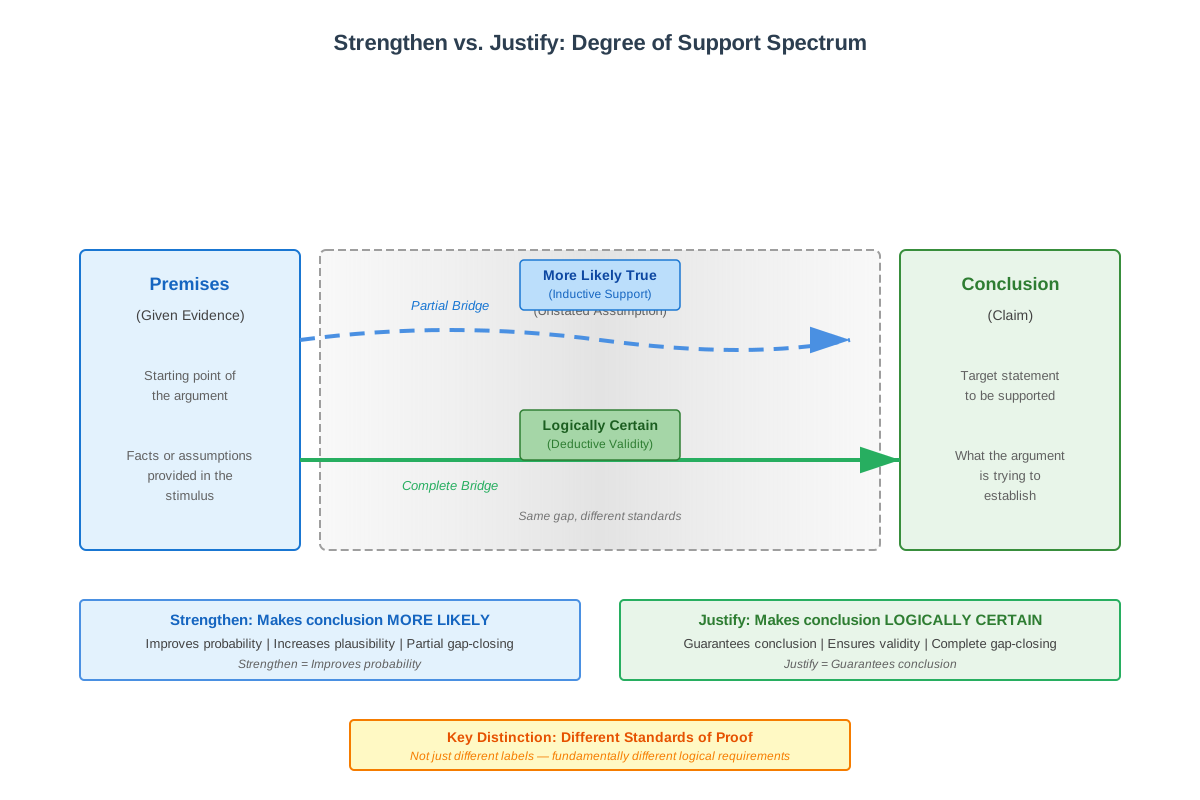
The core difference between strengthen and justify questions lies in the degree of support the correct answer must provide. Strengthen questions operate on a spectrum—the correct answer must make the conclusion more likely to be true than it was based on the premises alone, but it need not make the conclusion certain. The argument can still have weaknesses after the strengthening; it simply needs to be better than before. This reflects inductive reasoning, where evidence accumulates to make conclusions more probable.
Justify questions, by contrast, demand complete logical sufficiency. The correct answer, when combined with the stated premises, must guarantee the conclusion with logical certainty. If the premises and the correct answer are true, the conclusion must be true—no exceptions, no probability, no room for doubt. This reflects deductive reasoning, where conclusions follow necessarily from premises. The correct answer to a justify question functions as a sufficient assumption that bridges the logical gap completely.
Strengthen Question Stems
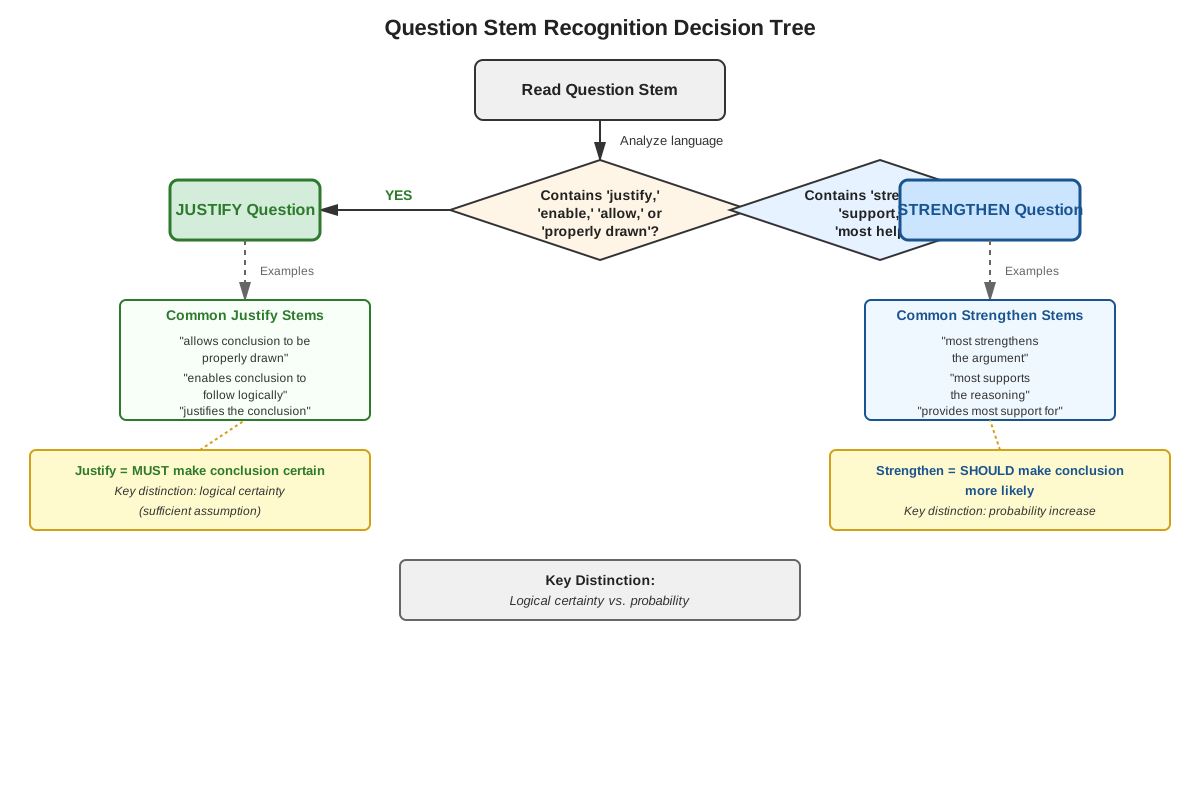
Strengthen question stems use language that indicates partial support or improvement. Common formulations include:
- "Which one of the following, if true, most strengthens the argument?"
- "Which one of the following, if true, provides the most support for the conclusion?"
- "Which one of the following, if true, most helps to justify the reasoning above?"
- "The argument would be most strengthened if which one of the following were true?"
The key indicators are words like "strengthens," "supports," "helps," and "most." These terms signal that the correct answer need only improve the argument's force, not render it bulletproof. The phrase "if true" appears in both strengthen and justify stems, so it does not distinguish between them. Students must focus on the action verb and the degree of support implied.
Justify Question Stems
Justify question stems use language indicating logical sufficiency or complete support. Common formulations include:
- "Which one of the following, if assumed, allows the conclusion to be properly drawn?"
- "The conclusion follows logically if which one of the following is assumed?"
- "Which one of the following principles, if valid, most helps to justify the reasoning?"
- "The conclusion above is properly drawn if which one of the following is assumed?"
Critical indicators include "allows the conclusion to be properly drawn," "follows logically," "properly drawn," and "if assumed." The word "assumed" frequently appears in justify stems because these questions ask for sufficient assumptions. The phrase "properly drawn" signals that the conclusion must follow with logical necessity, not merely probability.
The Logical Gap and How Each Question Type Addresses It
Every LSAT argument contains a logical gap—a space between what the premises establish and what the conclusion claims. This gap represents unstated assumptions the argument depends upon. The size and nature of this gap determine what type of support is needed.
For strengthen questions, the correct answer partially closes this gap. It might address one of several assumptions, provide evidence that makes a key premise more likely, or eliminate one potential objection to the reasoning. The gap remains, but it's smaller. Think of it as building a bridge that gets you closer to the other side but doesn't quite reach.
For justify questions, the correct answer completely closes the gap. It provides the exact missing link that, combined with the premises, makes the conclusion inescapable. This answer often takes the form of a conditional statement or principle that connects the premises directly to the conclusion. The bridge is complete, and you can walk across with certainty.
Comparison Table
| Feature | Strengthen Questions | Justify Questions |
|---|---|---|
| Degree of support | Partial, probabilistic | Complete, certain |
| Reasoning type | Inductive | Deductive |
| Effect on argument | Makes conclusion more likely | Makes conclusion logically necessary |
| Gap closure | Partially closes logical gap | Completely closes logical gap |
| Standard for correctness | Better than before | Logically sufficient |
| Common stem words | "strengthens," "supports," "helps" | "properly drawn," "follows logically," "if assumed" |
| Answer choice scope | Can be narrow or broad | Often broader, principle-like |
| Remaining vulnerabilities | Argument may still have weaknesses | Argument becomes airtight (given premises) |
The "Negation Test" Distinction
A useful diagnostic tool reveals the difference between these question types: the negation test works differently for each. For assumption questions (closely related to justify questions), negating the correct answer should destroy the argument. For justify questions, the correct answer itself (not its negation) should complete the argument. For strengthen questions, negating the correct answer should weaken the argument, but the original answer only needs to improve it—not make it perfect.
Recognizing Scope Differences
Justify question answers often have broader scope than strengthen question answers because they must cover all possible scenarios where the premises are true but the conclusion might be false. Strengthen answers can be more specific, addressing one particular way the argument could be improved. For example, if an argument concludes that "all employees will benefit from the new policy," a strengthen answer might show that "most employees surveyed expressed enthusiasm," while a justify answer would need something like "any policy that increases flexibility benefits all employees, and this policy increases flexibility."
Concept Relationships
The distinction between strengthen and justify stems builds directly on understanding argument structure—students must first identify premises and conclusions before determining what type of support is needed. This identification process connects to assumption recognition: the assumptions an argument makes determine the nature of the logical gap that strengthen or justify answers must address.
Argument Structure → Assumption Identification → Gap Recognition → Question Type Recognition → Answer Evaluation
Within this topic, understanding strengthen questions provides the foundation for understanding justify questions. Strengthen questions ask "what makes this better?" while justify questions ask "what makes this certain?" This relationship means students should master strengthen question recognition first, then learn to identify the heightened standard that justify questions demand.
The concepts also connect forward to other question types. Weaken questions are the inverse of strengthen questions—they make conclusions less likely rather than more likely. Flaw questions often identify the gap that strengthen or justify questions would address. Sufficient assumption questions are essentially identical to justify questions, just using different terminology. Necessary assumption questions ask what must be true for the argument to work, while justify questions ask what would be sufficient to make it work.
The relationship between these question types creates a conceptual network: Strengthen ↔ Weaken (opposites on the support spectrum) and Justify = Sufficient Assumption (same concept, different names), while Necessary Assumption ↔ Sufficient Assumption (different logical relationships to the conclusion).
High-Yield Facts
⭐ Strengthen questions require only that the answer make the conclusion MORE LIKELY, not certain
⭐ Justify questions require that the answer, combined with premises, make the conclusion LOGICALLY NECESSARY
⭐ The phrase "if assumed" strongly indicates a justify question, not a strengthen question
⭐ "Properly drawn" or "properly inferred" in a stem signals a justify question requiring complete logical support
⭐ Strengthen question answers can leave the argument with remaining vulnerabilities; justify answers cannot
- The word "most" in "most strengthens" indicates comparison among degrees of support, typical of strengthen questions
- Justify questions often have answer choices that are broader principles or conditional statements
- Both question types use "if true" in their stems, so this phrase does not distinguish between them
- Strengthen answers often provide additional evidence or examples; justify answers often provide logical rules or principles
- The correct answer to a justify question functions as a sufficient assumption—if it's true, the conclusion must follow
- Negating a strengthen answer should weaken the argument; the original answer need only improve it
- Justify questions may use language like "enables the conclusion to be properly drawn" or "allows the conclusion to follow logically"
- On the LSAT, strengthen questions appear slightly more frequently than justify questions (roughly 12-15% vs. 8-10% of LR questions)
Quick check — test yourself on Strengthen versus justify stems so far.
Try Flashcards →Common Misconceptions
Misconception: Any answer that helps an argument is correct for both strengthen and justify questions → Correction: Strengthen questions accept answers that merely improve the argument, while justify questions require answers that make the conclusion logically certain. An answer that strengthens might be insufficient for a justify question.
Misconception: The phrase "if true" indicates a strengthen question → Correction: Both strengthen and justify questions use "if true" in their stems. The distinguishing language is the action verb (strengthens vs. properly drawn) and the degree of support required.
Misconception: Justify questions ask for necessary assumptions → Correction: Justify questions ask for sufficient assumptions—conditions that, if met, guarantee the conclusion. Necessary assumptions are what must be true for the argument to work; sufficient assumptions are what would be enough to make it work.
Misconception: The correct answer to a strengthen question must address every weakness in the argument → Correction: Strengthen answers need only make the argument better in some way. The argument can still have other vulnerabilities; the answer just needs to provide some degree of additional support.
Misconception: Broader answer choices are always better for strengthen questions → Correction: While justify questions often require broader, principle-like answers, strengthen questions may have correct answers that are quite specific, addressing one particular aspect of the argument. Scope should match what's needed, not be maximized.
Misconception: If an answer makes the conclusion more likely, it's sufficient for a justify question → Correction: Justify questions require logical certainty, not increased probability. An answer that makes the conclusion "very likely" or "almost certain" is still incorrect if it doesn't guarantee the conclusion.
Misconception: Justify questions are just harder versions of strengthen questions → Correction: While justify questions may be more challenging, they're fundamentally different in kind, not just difficulty. They require deductive rather than inductive reasoning and demand a different evaluation standard.
Worked Examples
Example 1: Strengthen Question
Argument: "The city's new recycling program will reduce landfill waste. The program provides free recycling bins to all residents and includes weekly curbside pickup. Therefore, the amount of recyclable material sent to landfills will decrease significantly."
Question Stem: "Which one of the following, if true, most strengthens the argument?"
Answer Choices:
(A) Many residents have expressed interest in recycling
(B) Residents who receive free bins are significantly more likely to recycle than those who must purchase bins
(C) The city's landfills are nearly at capacity
(D) Recycling programs in other cities have had mixed results
(E) The city has hired additional workers to manage the program
Analysis:
First, identify the question type: "most strengthens" clearly indicates a strengthen question. We need an answer that makes the conclusion more likely, not necessarily certain.
Next, identify the logical gap: The argument assumes that providing bins and pickup will actually lead residents to recycle more. It jumps from "program provides resources" to "recycling will increase."
Evaluate each answer:
- (A) Interest is positive but doesn't guarantee behavior change—weak support
- (B) Directly addresses whether free bins lead to actual recycling behavior—strong support
- (C) Irrelevant to whether the program will work—no support
- (D) Mixed results elsewhere suggests uncertainty—no support or slight weakening
- (E) Management capacity doesn't address whether residents will use the program—minimal support
Correct Answer: (B)
This answer strengthens by providing evidence that the key mechanism (free bins) actually produces the desired behavior (more recycling). It doesn't guarantee success—perhaps these residents are different, or other factors matter—but it makes the conclusion more likely. This is sufficient for a strengthen question.
Example 2: Justify Question
Argument: "All the products manufactured by TechCorp are designed by engineers with at least ten years of experience. Therefore, all of TechCorp's products are reliable."
Question Stem: "The conclusion follows logically if which one of the following is assumed?"
Analysis:
First, identify the question type: "follows logically if...assumed" clearly indicates a justify question. We need an answer that, combined with the premise, makes the conclusion certain.
Next, identify the logical gap: The argument moves from "designed by experienced engineers" to "products are reliable." It assumes a connection between engineer experience and product reliability.
For a justify question, we need a principle or statement that bridges this gap completely. The answer must establish that experienced engineers → reliable products.
Potential Correct Answer: "Any product designed by an engineer with at least ten years of experience is reliable."
Why this works: This answer creates a conditional statement: If designed by engineer with 10+ years experience → reliable. The premise tells us all TechCorp products meet the sufficient condition (designed by engineers with 10+ years). Therefore, all must meet the necessary condition (reliable). The conclusion follows with logical certainty.
Why a strengthen answer wouldn't work: An answer like "Products designed by experienced engineers are usually reliable" would strengthen the argument but wouldn't justify it. "Usually" means "most of the time," which doesn't guarantee that all TechCorp products are reliable—some might be exceptions. This makes the conclusion more likely but not certain, failing the justify standard.
The key difference: Justify requires "all" or equivalent certainty; strengthen accepts "most" or "likely."
Exam Strategy
Immediate Recognition Protocol
When approaching any logical reasoning question, read the question stem first, before the argument. This allows immediate calibration of the evaluation standard. Look for these trigger words:
Strengthen indicators: strengthens, supports, helps justify, provides support for, most aids
Justify indicators: properly drawn, follows logically, if assumed, allows the conclusion, enables the conclusion
Exam Tip: If you see "properly drawn" or "properly inferred," you're dealing with a justify question requiring complete logical support. Adjust your evaluation standard immediately.
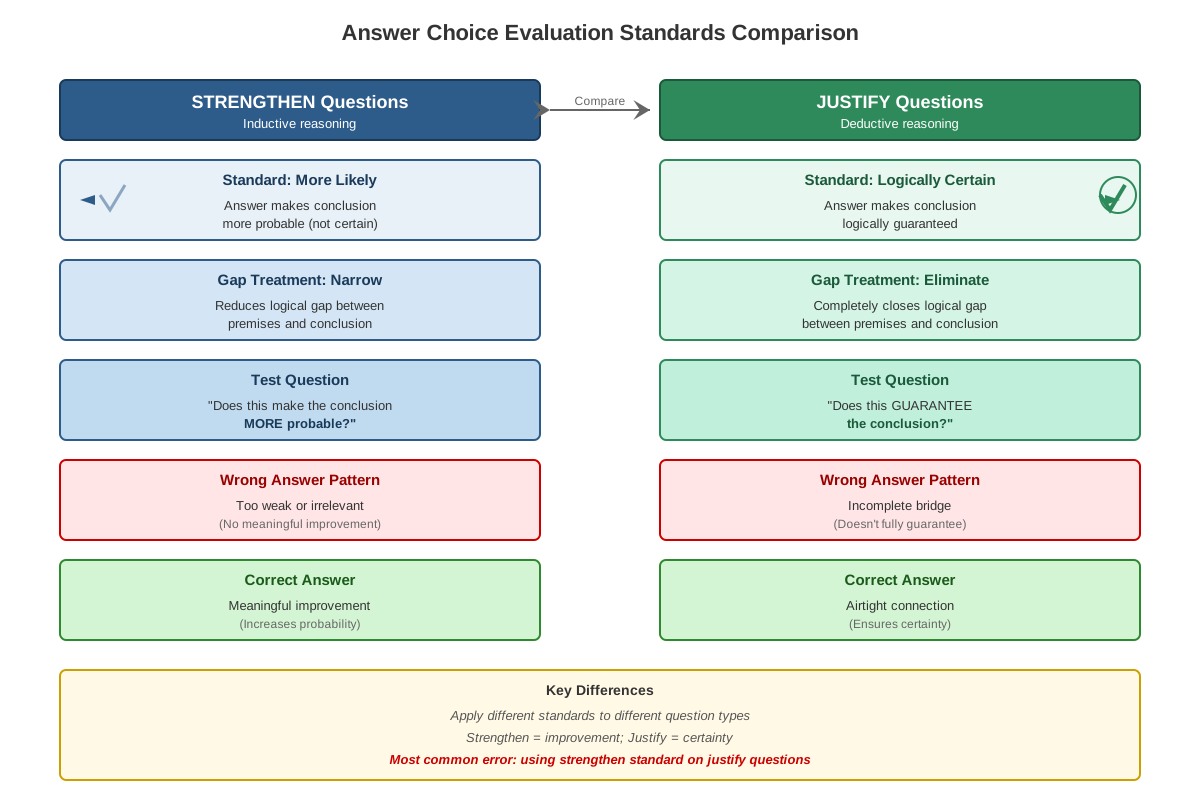
The Two-Standard Approach
For strengthen questions, ask: "Does this answer make the conclusion more likely than it was before?" The answer can be "yes" even if the argument still has weaknesses.
For justify questions, ask: "If I add this answer to the premises, must the conclusion be true?" The answer must be "yes, absolutely" with no exceptions.
Pre-Phrasing Strategy
Before looking at answer choices, identify the logical gap and predict what type of support would address it. For strengthen questions, think of several ways the argument could be improved. For justify questions, identify the exact logical link needed to make the conclusion certain.
This pre-phrasing prevents the LSAT from manipulating your thinking through attractive wrong answers. You'll recognize the right answer when you see it because it matches your prediction.
Process of Elimination Tactics
For strengthen questions, eliminate answers that:
- Are irrelevant to the conclusion
- Actually weaken the argument
- Merely restate premises without adding support
- Address issues outside the argument's scope
For justify questions, eliminate answers that:
- Make the conclusion more likely but not certain
- Are too narrow to cover all cases in the conclusion
- Introduce new terms not connecting premises to conclusion
- Would require additional assumptions to make the conclusion follow
Time Management
Strengthen questions typically require 1:00-1:20 to complete. Justify questions often take 1:20-1:40 because they require more careful evaluation of logical sufficiency. If you're spending more than 1:45 on either type, mark it and move on—you can return if time permits.
The "Extreme Answer" Consideration
For justify questions, don't automatically eliminate answers that seem too strong or absolute. Justify questions often require strong, categorical statements to create logical certainty. An answer with "all," "every," or "any" might be exactly what's needed. For strengthen questions, extreme answers are more suspicious because they often go beyond what's necessary for improvement.
Memory Techniques
The STRENGTH vs. PROOF Mnemonic
STRENGTH questions need:
- Some support
- Tilts probability
- Reduces doubt
- Enhances argument
- Not necessarily complete
- Gap partially closed
- Typically inductive
- Helps but doesn't guarantee
PROOF questions (Justify) need:
- Perfect logical connection
- Requires certainty
- Obligates conclusion
- Overall sufficiency
- Fully closes gap
The Bridge Visualization
Visualize the argument as two cliffs: premises on one side, conclusion on the other. The logical gap is the space between.
- Strengthen questions: Build a bridge that gets you closer to the other side—maybe 60%, 70%, 80% of the way across. You can see the other side more clearly, but you haven't quite reached it.
- Justify questions: Build a complete bridge that reaches all the way across. You can walk from premises to conclusion with absolute certainty.
The "Properly Drawn" = "Perfectly Drawn" Association
When you see "properly drawn" or "properly inferred," mentally substitute "perfectly drawn" or "certainly follows." This reminds you that the standard is logical perfection, not mere improvement.
The Assumption Type Acronym: SUN
- Sufficient assumptions = Justify questions (if this is true, conclusion must follow)
- Underlying assumptions = General assumption questions
- Necessary assumptions = Required for argument to work (different from sufficient)
Summary
Strengthen versus justify stems represent a critical distinction in LSAT logical reasoning that determines the evaluation standard for approximately 20-25% of all LR questions. Strengthen questions require answers that make conclusions more likely through inductive support, partially closing logical gaps while potentially leaving some vulnerabilities. Justify questions demand answers that make conclusions logically certain through deductive support, completely closing logical gaps by providing sufficient assumptions. Recognition depends on identifying key stem language: "strengthens," "supports," and "helps" indicate strengthen questions, while "properly drawn," "follows logically," and "if assumed" indicate justify questions. Mastery requires understanding that these question types differ in kind, not merely difficulty—they employ fundamentally different reasoning standards (probabilistic versus certain) and require different evaluation approaches. Students must calibrate their answer evaluation to match the question type, accepting partial support for strengthen questions while demanding complete logical sufficiency for justify questions.
Key Takeaways
- Strengthen questions need answers that make conclusions MORE LIKELY; justify questions need answers that make conclusions LOGICALLY CERTAIN
- Question stem language is the primary indicator: "strengthens/supports" versus "properly drawn/follows logically/if assumed"
- Both question types address logical gaps, but strengthen answers partially close gaps while justify answers completely close them
- The phrase "if true" appears in both types and does not distinguish between them
- Justify questions often require broader, principle-like answers that cover all cases; strengthen answers can be more specific
- Together, these question types constitute roughly 20-25% of LSAT logical reasoning questions
- Mastering this distinction prevents systematic errors in answer selection and improves performance across multiple question types
Related Topics
Weaken Questions: The inverse of strengthen questions, asking for answers that make conclusions less likely. Mastering strengthen questions provides the foundation for understanding weaken questions, as they use the same probabilistic reasoning but in the opposite direction.
Necessary Assumption Questions: Ask what must be true for an argument to work, complementing justify questions which ask what would be sufficient. Understanding the sufficient/necessary distinction deepens logical reasoning mastery.
Flaw Questions: Identify logical errors in arguments, often pointing to the same gaps that strengthen or justify questions would address. Recognizing flaws helps predict what type of support arguments need.
Sufficient Assumption Questions: Essentially identical to justify questions, using different terminology. Students who master justify stems can immediately transfer that knowledge to sufficient assumption questions.
Principle Questions: Often function as strengthen or justify questions but frame answers as general rules. Understanding strengthen versus justify helps determine whether a principle needs to make the conclusion certain or merely more likely.
Practice CTA
Now that you understand the critical distinction between strengthen and justify question stems, it's time to put this knowledge into practice. Attempt the practice questions designed for this topic, focusing on identifying question types before evaluating answer choices. Use the flashcards to reinforce recognition of key stem language and evaluation standards. Remember: mastering this distinction is one of the highest-yield investments you can make in your LSAT preparation, directly improving performance on roughly one-quarter of all logical reasoning questions. Each practice question you complete builds the pattern recognition and evaluation skills that will serve you throughout the exam. You have the conceptual foundation—now develop the execution through deliberate practice.
Sign up free to keep reading
Create a free AnvayaPrep account to finish this LSAT guide on Strengthen versus justify stems — plus flashcards and practice questions.