Overview
Breaking a link is one of the most powerful and frequently tested techniques in LSAT Logical Reasoning, particularly within strengthen and weaken questions. This concept involves identifying and disrupting the logical connection between an argument's premises and its conclusion. When test-takers master this skill, they gain the ability to recognize how arguments can be undermined by severing the assumed relationship between evidence and claim, or conversely, how arguments can be strengthened by reinforcing those connections.
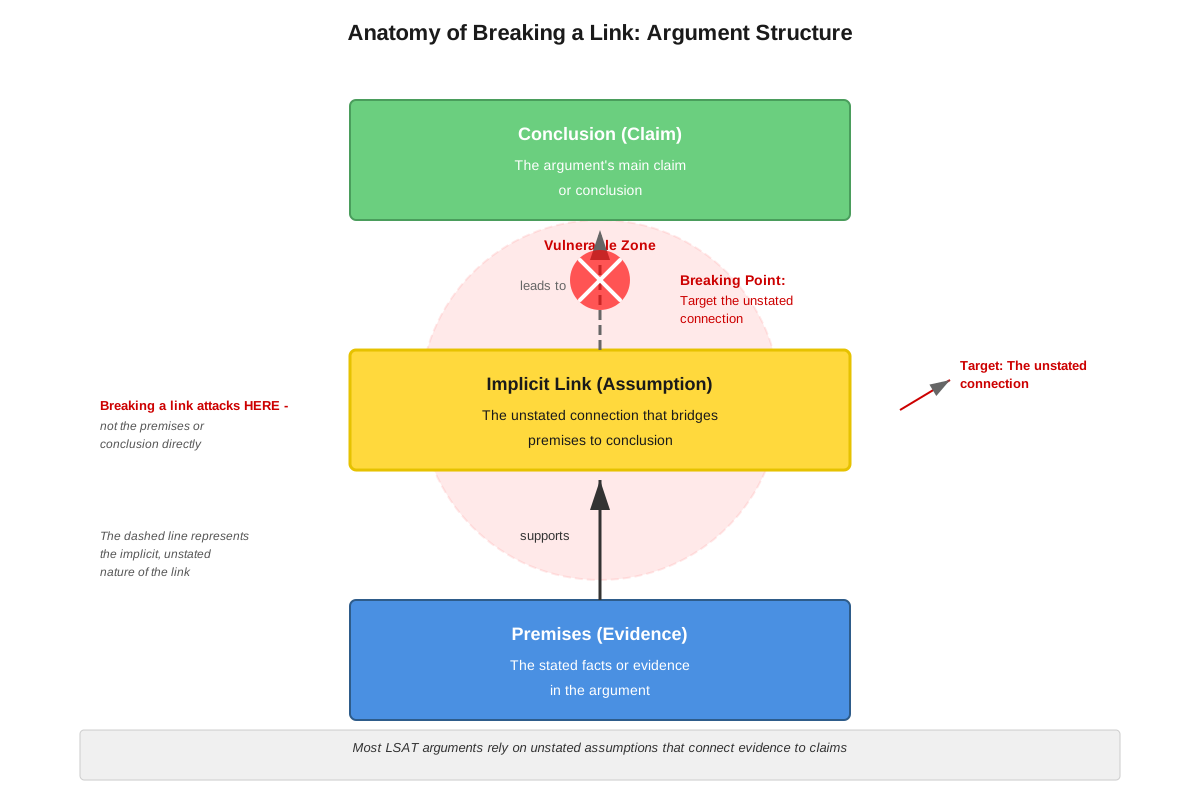
The LSAT tests breaking a link primarily through weaken questions, where the correct answer choice introduces information that disrupts the logical pathway from premises to conclusion. Rather than directly contradicting the conclusion or attacking the premises themselves, breaking a link exploits the gap between what is stated and what is assumed. This technique requires understanding that most LSAT arguments rely on unstated assumptions—implicit connections that the author takes for granted. By identifying these vulnerable connection points, test-takers can predict what information would damage the argument's logical structure.
Within the broader landscape of Logical Reasoning, breaking a link represents a sophisticated analytical skill that builds upon fundamental argument analysis. It connects directly to assumption identification, necessary and sufficient conditions, and causal reasoning patterns. Mastering this concept enables students to approach not only weaken questions but also strengthen questions (where the goal is to prevent a link from being broken), flaw questions (where broken links represent logical errors), and assumption questions (where the link itself must be identified). This topic typically appears in 3-5 questions per LSAT section, making it a high-yield area for score improvement.
Learning Objectives
- [ ] Identify how Breaking a link appears in LSAT questions
- [ ] Explain the reasoning pattern behind Breaking a link
- [ ] Apply Breaking a link to solve LSAT-style problems accurately
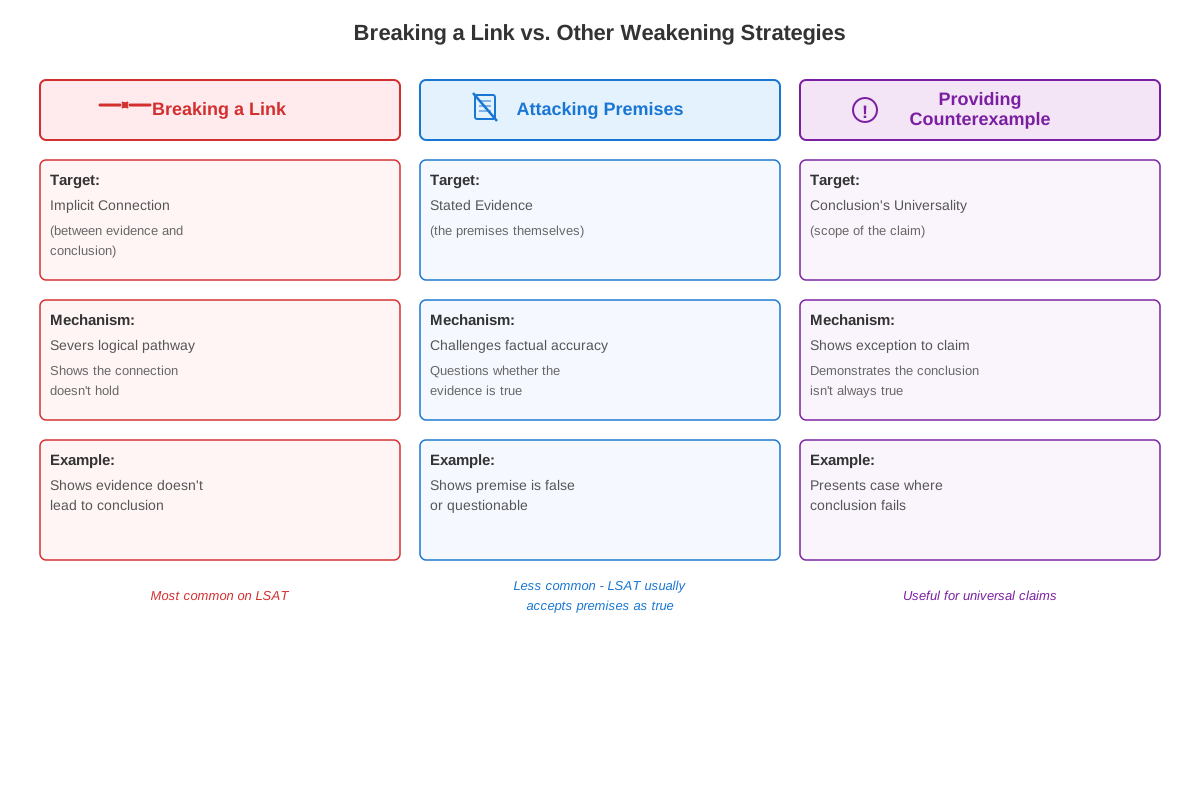
- [ ] Distinguish between breaking a link and other weakening strategies (attacking premises, providing counterexamples)
- [ ] Predict the most vulnerable links in an argument before reviewing answer choices
- [ ] Recognize when an answer choice strengthens an argument by preventing a link from being broken
Prerequisites
- Basic argument structure: Understanding premises, conclusions, and how to identify each component is essential because breaking a link requires recognizing what connects these elements
- Assumption identification: Recognizing unstated assumptions is fundamental since links are often implicit connections that arguments depend upon
- Causal reasoning patterns: Many arguments that are vulnerable to link-breaking involve causal claims, so understanding cause-and-effect relationships helps identify where links can be severed
- Strengthen and weaken question types: Familiarity with the basic mechanics of these question types provides the framework for understanding how breaking a link functions as a specific strategy
Why This Topic Matters
Breaking a link represents a critical thinking skill that extends far beyond standardized testing. In professional contexts—legal reasoning, business analysis, scientific evaluation, and policy assessment—the ability to identify weak connections between evidence and conclusions prevents flawed decision-making. Lawyers must recognize when opposing counsel's arguments contain vulnerable logical links; business analysts must identify when market data doesn't necessarily support strategic recommendations; researchers must evaluate whether experimental results truly support theoretical claims.
On the LSAT specifically, breaking a link appears in approximately 15-20% of all Logical Reasoning questions, making it one of the highest-yield concepts for score improvement. This technique most commonly appears in:
- Weaken questions (most frequent): "Which one of the following, if true, most seriously weakens the argument?"
- Strengthen questions (inverse application): "Which one of the following, if true, most strengthens the argument?" where correct answers prevent links from being broken
- Flaw questions: Where the argument's error involves an unjustified logical leap
- Necessary assumption questions: Where the link itself must be identified as an unstated requirement
The LSAT favors breaking a link in arguments involving causal claims, analogical reasoning, statistical evidence applied to specific cases, and predictions based on past patterns. Recognizing these argument types immediately signals the potential for link-breaking as a solution strategy.
Core Concepts
The Fundamental Mechanism of Breaking a Link
Breaking a link refers to the process of introducing information that disrupts the logical connection between an argument's evidence (premises) and its conclusion. Unlike attacking the truth of the premises themselves or directly contradicting the conclusion, this technique targets the inferential pathway—the reasoning process that supposedly leads from evidence to claim.
Every LSAT argument contains both explicit statements and implicit assumptions. The explicit statements are the premises and conclusion that appear in the text. The implicit assumptions are the unstated connections that must be true for the conclusion to follow logically from the premises. These implicit connections are the "links" in the logical chain. When an answer choice introduces information showing that the premises could be true while the conclusion remains false, it has successfully broken the link.
Consider this structure:
Premise: X is true
Implicit Link/Assumption: X being true means Y must be true
Conclusion: Therefore, Y is true
Breaking the link involves showing that X can be true without Y being true, thereby severing the connection the argument assumes exists.
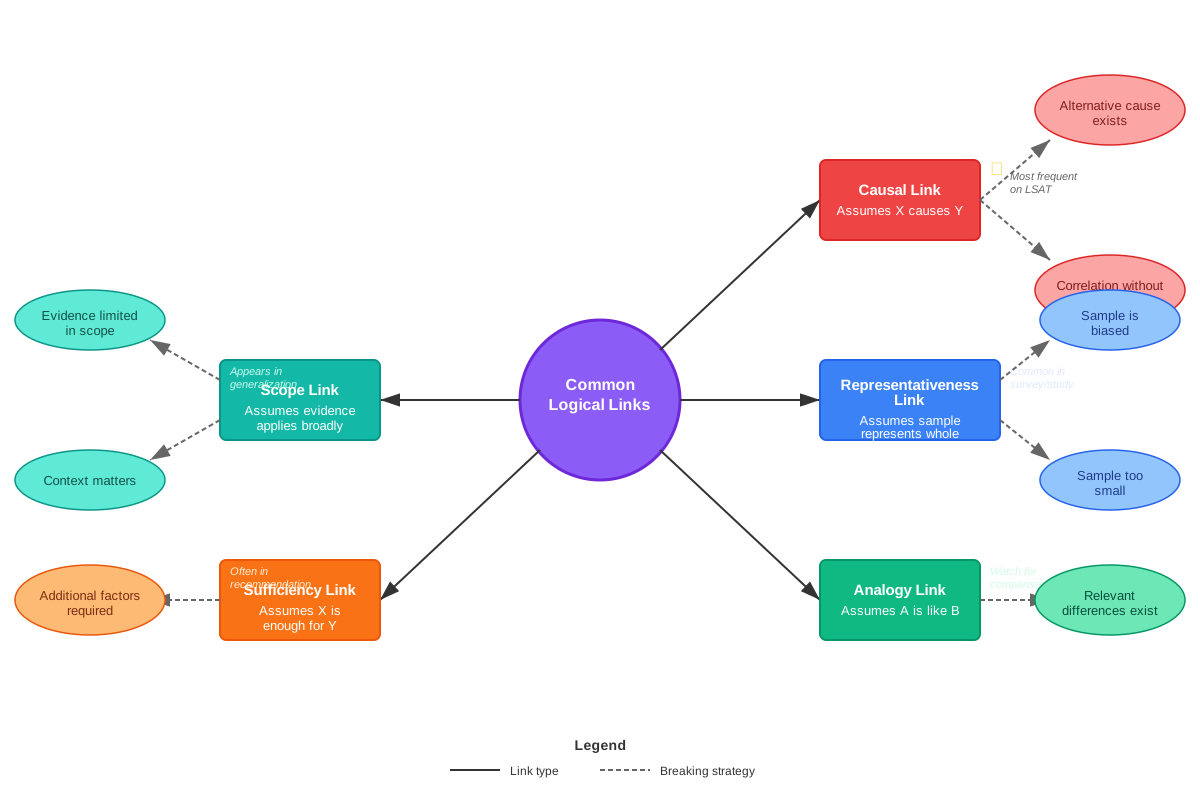
Types of Vulnerable Links
Different argument patterns create different types of vulnerable links that can be broken:
| Argument Pattern | Vulnerable Link | How to Break It |
|---|---|---|
| Causal reasoning | Assumes correlation indicates causation | Show alternative causes, reverse causation, or common cause |
| Analogical reasoning | Assumes two situations are relevantly similar | Identify relevant differences between compared situations |
| Statistical to specific | Assumes group data applies to individual case | Show the specific case differs from the statistical norm |
| Past to future prediction | Assumes past patterns will continue | Introduce changing conditions or relevant differences |
| Evidence to explanation | Assumes one explanation is correct | Provide alternative explanations for the same evidence |
The Three-Step Process for Identifying Breakable Links
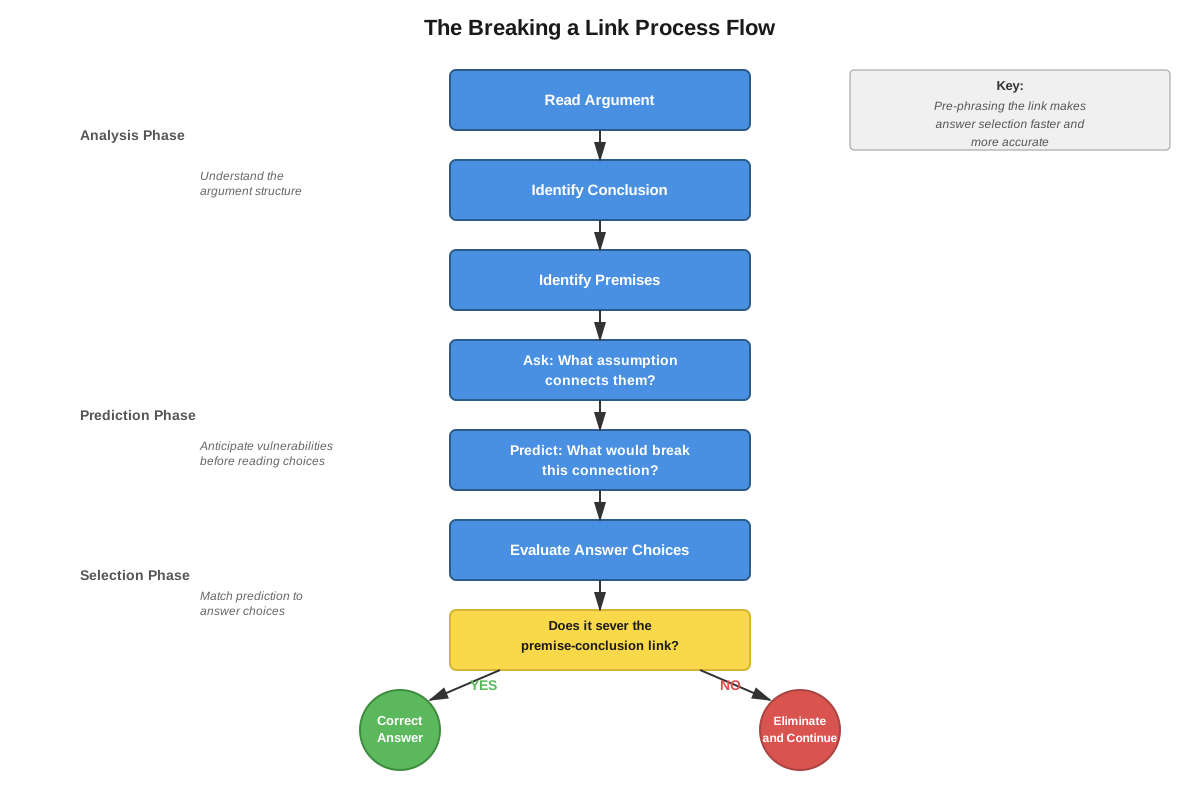
Step 1: Isolate the Conclusion
Identify exactly what the argument is trying to prove. The conclusion is the claim that depends on the logical link being intact.
Step 2: Identify the Evidence
Determine what premises the argument offers as support. These are the starting points of the logical chain.
Step 3: Find the Gap
Ask: "What must be true for this evidence to actually support this conclusion?" The answer reveals the implicit link. This gap represents the argument's vulnerability—the point where introducing contrary information would break the logical connection.
Breaking Links in Causal Arguments
Causal arguments are particularly vulnerable to link-breaking because they assume a specific relationship between events. When an argument claims "A caused B," it implicitly assumes:
- No alternative cause produced B
- A actually preceded B
- The correlation between A and B isn't coincidental
- No third factor C caused both A and B
Breaking the link in causal arguments typically involves introducing information that:
- Presents an alternative cause: Shows that something other than A could have produced B
- Reverses the causation: Demonstrates that B actually caused A, not vice versa
- Identifies a common cause: Reveals that C caused both A and B, making their correlation spurious
- Shows temporal problems: Indicates that the alleged cause didn't actually precede the effect
Breaking Links vs. Other Weakening Strategies
Understanding what breaking a link is NOT helps clarify the concept:
Breaking a link targets the connection between premises and conclusion. It accepts the premises as true but shows they don't lead to the conclusion.
Attacking premises challenges the truth or accuracy of the evidence itself. This is rarely the correct answer on the LSAT because questions typically ask you to assume the truth of the answer choices.
Providing counterexamples offers specific instances where the conclusion fails. While this can weaken an argument, it's distinct from breaking the logical link unless the counterexample specifically illustrates why the reasoning pattern fails.
Introducing irrelevant information brings up facts that don't affect the argument's logical structure. This is a common trap answer that students mistake for breaking a link.
Recognizing Link-Breaking in Answer Choices
Correct answer choices that break a link often contain specific linguistic markers:
- "However, most..." (introducing information that disrupts a generalization)
- "But the [evidence] could be explained by..." (offering alternative explanations)
- "Yet [relevant difference]..." (showing why an analogy fails)
- "The [group] studied differs from [group] in conclusion in that..." (breaking statistical-to-specific links)
These phrases signal that the answer choice is introducing information that severs the assumed connection between what the argument states and what it concludes.
Concept Relationships
Breaking a link serves as a central hub connecting multiple Logical Reasoning concepts. The relationship map flows as follows:
Argument Structure Analysis → enables → Assumption Identification → reveals → Vulnerable Links → which can be targeted by → Breaking a Link → which appears in → Weaken Questions (most common), Strengthen Questions (inverse), and Flaw Questions (identifying broken links)
The inverse relationship also holds: Strengthen Questions often require Preventing a Link from Being Broken by providing information that reinforces the connection between premises and conclusion.
Breaking a link connects to Causal Reasoning because causal arguments contain inherently vulnerable links between correlation and causation. It relates to Conditional Logic because breaking a link often involves showing that a sufficient condition doesn't actually guarantee a necessary condition as the argument assumes.
The concept also connects forward to Sufficient Assumption Questions, where the correct answer provides the missing link that would make the argument valid. Understanding what breaks a link helps identify what would complete it.
High-Yield Facts
⭐ Breaking a link targets the connection between premises and conclusion, not the truth of the premises themselves
⭐ The most common vulnerable links appear in causal arguments, analogies, and statistical-to-specific reasoning
⭐ Correct link-breaking answers introduce information that shows premises can be true while the conclusion remains false or unsupported
⭐ In strengthen questions, correct answers often prevent a link from being broken by ruling out alternative explanations or relevant differences
⭐ The gap between premises and conclusion—the implicit assumption—is where the link exists and where it can be broken
- Link-breaking appears in approximately 15-20% of all Logical Reasoning questions across weaken, strengthen, and flaw question types
- Alternative explanations are the most common way to break causal links on the LSAT
- Relevant differences between compared situations break analogical reasoning links
- Temporal sequence problems (showing the alleged cause came after the effect) definitively break causal links
- Statistical arguments are vulnerable when the specific case differs from the studied population in relevant ways
Quick check — test yourself on Breaking a link so far.
Try Flashcards →Common Misconceptions
Misconception: Breaking a link means proving the conclusion is false.
Correction: Breaking a link only requires showing that the premises don't adequately support the conclusion. The conclusion could still be true for other reasons; the link-breaking answer simply demonstrates that the given evidence doesn't establish it.
Misconception: Any information that makes the conclusion less likely breaks a link.
Correction: True link-breaking specifically targets the logical connection between stated premises and conclusion. Information that merely makes the conclusion less probable without addressing the reasoning pathway is not breaking the link—it's a different weakening strategy.
Misconception: Attacking the credibility or truth of a premise breaks the link.
Correction: Breaking a link accepts the premises as true but shows they don't lead to the conclusion. Attacking premises is a separate strategy that the LSAT rarely rewards because questions ask you to assume the truth of answer choices.
Misconception: Breaking a link requires introducing completely new information unrelated to the argument.
Correction: Effective link-breaking introduces information directly relevant to the reasoning gap between premises and conclusion. It must address the specific assumption the argument relies upon.
Misconception: In strengthen questions, the correct answer always provides additional supporting evidence.
Correction: Strengthen questions often reward answers that prevent a link from being broken—ruling out alternative explanations, confirming relevant similarities, or eliminating potential objections to the reasoning pathway. This is link-preservation rather than additional evidence.
Worked Examples
Example 1: Causal Reasoning Link
Argument:
"A recent study found that cities with higher rates of ice cream consumption also have higher rates of drowning deaths. Therefore, eating ice cream increases the risk of drowning."
Question: Which one of the following, if true, most seriously weakens the argument?
Analysis:
Step 1 - Identify the conclusion: Eating ice cream increases the risk of drowning.
Step 2 - Identify the premises: Cities with more ice cream consumption have more drowning deaths (a correlation).
Step 3 - Find the gap/link: The argument assumes that the correlation between ice cream consumption and drowning indicates that ice cream consumption CAUSES drowning. This is a classic causal reasoning link vulnerable to being broken.
Prediction: The correct answer will break this causal link by showing that the correlation doesn't indicate causation. The most effective ways would be: (1) identifying an alternative cause, (2) showing reverse causation, or (3) revealing a common cause.
Correct Answer: "Both ice cream consumption and swimming (which carries drowning risk) increase during hot weather."
Why this breaks the link: This answer identifies a common cause (hot weather) that produces both ice cream consumption and increased swimming/drowning risk. The correlation between ice cream and drowning is spurious—both are effects of a third factor. The premises (the correlation) can be completely true while the conclusion (causation) is false. The logical link is broken.
Connection to learning objectives: This example demonstrates how breaking a link appears in weaken questions (Objective 1), illustrates the reasoning pattern of introducing alternative explanations to sever causal connections (Objective 2), and shows the application process for solving these problems (Objective 3).
Example 2: Analogical Reasoning Link
Argument:
"The city of Riverside successfully reduced traffic congestion by implementing a congestion pricing system that charges drivers to enter the downtown area during peak hours. The city of Lakewood is experiencing similar traffic problems. Therefore, Lakewood should implement the same congestion pricing system to reduce its traffic congestion."
Question: Which one of the following, if true, most seriously weakens the argument?
Analysis:
Step 1 - Identify the conclusion: Lakewood should implement congestion pricing to reduce traffic congestion.
Step 2 - Identify the premises: Riverside successfully used congestion pricing; Lakewood has similar traffic problems.
Step 3 - Find the gap/link: The argument assumes that because congestion pricing worked in Riverside, it will work in Lakewood. This analogical reasoning link assumes the two cities are relevantly similar in all important respects. The vulnerability lies in potential relevant differences.
Prediction: The correct answer will identify a relevant difference between Riverside and Lakewood that would prevent the solution from transferring successfully.
Correct Answer: "Unlike Riverside, which has an extensive public transportation system, Lakewood has virtually no public transportation alternatives for commuters."
Why this breaks the link: This answer reveals a relevant difference that directly affects whether congestion pricing would work. Congestion pricing succeeds when people have alternatives to driving; without public transportation, Lakewood drivers have no way to avoid the charges, so the system wouldn't reduce congestion—it would just impose costs. The premises (Riverside's success and Lakewood's traffic problems) remain true, but the logical connection to the conclusion is severed because the situations aren't relevantly similar.
Connection to learning objectives: This example shows how breaking a link appears in analogical reasoning contexts (Objective 1), demonstrates the pattern of identifying relevant differences to break analogical links (Objective 2), and illustrates distinguishing this strategy from simply attacking premises—we're not saying Riverside didn't succeed; we're showing why that success doesn't transfer (Objective 4).
Exam Strategy
Approaching Link-Breaking Questions
When encountering a weaken or strengthen question, follow this systematic approach:
Before reading answer choices:
- Identify the conclusion with precision—underline or mentally note the exact claim
- Identify the premises—what evidence supports this conclusion?
- Articulate the gap—ask yourself: "What assumption connects this evidence to this conclusion?"
- Predict the vulnerability—what type of information would break (or strengthen) this connection?
This pre-phrasing strategy dramatically improves accuracy because you're actively hunting for the link before the answer choices attempt to distract you.
Trigger Words and Phrases
In question stems, watch for:
- "Weakens" / "undermines" / "calls into question" / "casts doubt on"
- "Strengthens" / "supports" / "provides evidence for"
- "Vulnerable to criticism" / "reasoning is flawed"
In arguments, identify vulnerability markers:
- "Therefore" / "thus" / "consequently" (signals conclusion—look for gap before it)
- "Because" / "since" / "given that" (signals premises—look for gap after it)
- "This shows that" / "this indicates" (signals inferential leap—prime link-breaking territory)
- Causal language: "causes" / "leads to" / "results in" / "produces"
- Comparative language: "similarly" / "likewise" / "just as"
In answer choices, recognize link-breaking language:
- "However" / "but" / "yet" (signals contrasting information)
- "Could be explained by" / "might be due to" (alternative explanations)
- "Differs from" / "unlike" (relevant differences)
- "Does not necessarily" / "not sufficient to" (challenges inferential connection)
Process of Elimination Tips
Eliminate answers that:
- Attack the truth of premises without addressing the reasoning (unless the question specifically asks about premise truth)
- Introduce completely irrelevant information that doesn't touch the premise-conclusion connection
- Strengthen when you need to weaken, or vice versa (surprisingly common error under time pressure)
- Address a different conclusion than the one actually stated in the argument
Favor answers that:
- Directly address the gap you identified in your pre-phrase
- Introduce alternative explanations for causal claims
- Identify relevant differences in analogical reasoning
- Show that a general principle doesn't apply to the specific case
- Prevent or create a logical leap between what's stated and what's concluded
Time Allocation
For link-breaking questions:
- 15-20 seconds: Read and analyze the argument, identify the link
- 10-15 seconds: Pre-phrase what would break/strengthen the link
- 30-40 seconds: Evaluate answer choices with your pre-phrase in mind
- Total: 55-75 seconds per question
If you find yourself spending more than 90 seconds, you likely haven't clearly identified the link. Circle the question, make your best guess, and return if time permits. The ability to quickly spot the vulnerable link improves dramatically with practice.
Exam Tip: The LSAT often places the most tempting wrong answer immediately before or after the correct answer. If you've identified what seems like a perfect link-breaking answer, still read the remaining choices—but trust your analysis if nothing better appears.
Memory Techniques
The BREAK Acronym
For identifying vulnerable links in arguments:
- Between premises and conclusion (where the link exists)
- Reasoning gap (what assumption connects them?)
- Examine the argument type (causal, analogical, statistical?)
- Alternatives (what other explanations or differences exist?)
- Kill the connection (how would you sever this link?)
The "Bridge Visualization"
Visualize the argument as a bridge:
- Left bank = Premises (solid ground you're starting from)
- Bridge = The logical link (the connection you're examining)
- Right bank = Conclusion (where the argument wants to take you)
Breaking a link means showing the bridge is unstable or incomplete. You're not destroying the banks (premises/conclusion); you're showing the bridge doesn't actually connect them reliably.
The Three C's of Causal Link-Breaking
When facing causal arguments, remember the three ways to break the causal link:
- Common cause (third factor causes both)
- Confounding alternative (different cause produces the effect)
- Causation reversed (effect actually causes alleged cause)
The "Same or Different" Test for Analogies
For analogical reasoning, ask: "Same or Different in relevant ways?"
- If Same in all relevant respects → analogy holds → strengthens
- If Different in relevant respects → analogy fails → weakens (link broken)
Summary
Breaking a link is a sophisticated analytical technique that targets the logical connection between an argument's premises and its conclusion. Rather than attacking the truth of evidence or directly contradicting claims, this approach identifies and exploits the gap between what an argument states and what it assumes. The LSAT tests this concept extensively through weaken questions (where breaking the link is the goal), strengthen questions (where preventing the link from being broken is the objective), and flaw questions (where the broken link represents the logical error). Mastery requires three core skills: identifying the implicit assumption that connects premises to conclusion, recognizing argument patterns that create vulnerable links (especially causal reasoning, analogical reasoning, and statistical-to-specific applications), and predicting what information would sever or reinforce these connections before evaluating answer choices. The most effective link-breaking strategies introduce alternative explanations for causal claims, identify relevant differences in analogical reasoning, and show that general principles don't apply to specific cases. Success on these high-frequency questions depends on systematic analysis—isolating the conclusion, identifying supporting evidence, articulating the gap, and pre-phrasing the vulnerability—rather than passively reading answer choices and hoping to recognize the correct response.
Key Takeaways
- Breaking a link targets the logical connection between premises and conclusion, not the truth of the premises themselves or the conclusion
- The implicit assumption—the unstated connection the argument relies upon—is where the link exists and where it can be broken
- Causal arguments are highly vulnerable to link-breaking through alternative explanations, common causes, or reversed causation
- Analogical reasoning links break when relevant differences between compared situations are identified
- In strengthen questions, correct answers often prevent links from being broken rather than providing additional supporting evidence
- Pre-phrasing the vulnerable link before reading answer choices dramatically improves accuracy and speed
- Link-breaking appears in 15-20% of Logical Reasoning questions, making it one of the highest-yield concepts for score improvement
Related Topics
Necessary vs. Sufficient Assumptions: Understanding the distinction between assumptions required for an argument to work (necessary) and assumptions that would guarantee the conclusion (sufficient) deepens link-breaking skills. Necessary assumptions are often the links themselves—breaking them destroys the argument.
Causal Reasoning Patterns: Advanced study of causation, including Mill's Methods, correlation vs. causation fallacies, and temporal sequence requirements, provides additional tools for identifying and breaking causal links.
Conditional Logic and Formal Logic: Many arguments contain conditional relationships (if-then structures) where the link involves assuming a sufficient condition or necessary condition. Breaking these links requires understanding when conditional relationships don't hold.
Flaw Question Types: Many flaws involve broken or unjustified links. Mastering link-breaking enables recognition of common logical errors like hasty generalizations, false analogies, and post hoc reasoning.
Parallel Reasoning Questions: These questions require identifying arguments with the same logical structure, including the same types of links between premises and conclusions. Understanding links helps match argument patterns.
Practice CTA
Now that you've mastered the concept of breaking a link, it's time to cement your understanding through active practice. The difference between passively understanding this concept and being able to execute it under timed conditions comes from repeated application. Attempt the practice questions associated with this topic, focusing on identifying the vulnerable link before evaluating answer choices. Create flashcards for the different argument types and their characteristic vulnerabilities. Most importantly, review every practice question—whether you answered correctly or incorrectly—to articulate exactly where the link existed and how the correct answer broke it. This deliberate practice transforms conceptual knowledge into the automatic pattern recognition that produces top LSAT scores. You've built the foundation; now construct the skill through application.
Sign up free to keep reading
Create a free AnvayaPrep account to finish this LSAT guide on Breaking a link — plus flashcards and practice questions.