Overview
Irrelevant answer choices represent one of the most pervasive and challenging obstacles students face when tackling strengthen and weaken questions in LSAT Logical Reasoning. These answer choices are deliberately crafted to appear connected to the argument at first glance, yet they fail to impact the logical relationship between the premises and conclusion. Mastering the identification and elimination of irrelevant answer choices is not merely a helpful skill—it is essential for achieving a competitive LSAT score, as these distractors appear in virtually every Logical Reasoning section and consume valuable time when students cannot quickly recognize their irrelevance.
The LSAT test makers design irrelevant answer choices with sophisticated precision. They exploit common cognitive biases, including the tendency to select answers that use familiar terminology from the stimulus, address tangentially related issues, or sound authoritative despite lacking logical force. Understanding why an answer choice is irrelevant requires more than surface-level reading; it demands a precise analysis of the argument's logical structure, identification of the specific gap or assumption being tested, and rigorous evaluation of whether each answer choice actually addresses that gap. Students who cannot efficiently eliminate irrelevant options often find themselves choosing between multiple seemingly plausible answers, leading to decreased accuracy and increased time pressure.
Within the broader landscape of LSAT Logical Reasoning, the ability to identify irrelevant answer choices connects directly to fundamental skills in argument analysis, scope recognition, and conditional reasoning. This topic serves as a bridge between understanding what makes arguments strong or weak in theory and applying that understanding under timed conditions. The patterns of irrelevance that appear in strengthen and weaken questions also manifest across other question types, including necessary assumption, sufficient assumption, and flaw questions, making this a high-transfer skill that improves performance across the entire Logical Reasoning section.
Learning Objectives
- [ ] Identify how irrelevant answer choices appear in LSAT questions
- [ ] Explain the reasoning pattern behind irrelevant answer choices
- [ ] Apply irrelevant answer choices recognition to solve LSAT-style problems accurately
- [ ] Distinguish between answer choices that are irrelevant versus those that are relevant but incorrect
- [ ] Analyze the specific mechanisms test makers use to create plausible-sounding but irrelevant distractors
- [ ] Develop a systematic process for evaluating answer choice relevance before assessing strength or weakness
- [ ] Recognize the relationship between argument scope and answer choice relevance
Prerequisites
- Basic argument structure identification: Understanding premises, conclusions, and the logical relationship between them is essential because relevance can only be assessed relative to a specific argument structure.
- Distinction between strengthen and weaken questions: Recognizing what the question task requires is necessary because an answer choice's relevance depends on whether it needs to support or undermine the conclusion.
- Concept of logical gaps and assumptions: Identifying unstated assumptions helps determine which answer choices address the argument's vulnerability points versus those that discuss unrelated matters.
- Scope analysis skills: Understanding the boundaries of what an argument claims is fundamental to recognizing when answer choices introduce out-of-scope information.
Why This Topic Matters
In real-world contexts, the ability to distinguish relevant from irrelevant information is crucial for legal reasoning, policy analysis, scientific evaluation, and any field requiring critical thinking. Lawyers must identify which evidence strengthens or weakens a case while filtering out prejudicial but logically irrelevant information. This skill translates directly to law school success, where students must parse complex arguments and focus on legally relevant factors while disregarding tangential considerations.
On the LSAT specifically, irrelevant answer choices appear with remarkable frequency. Research on LSAT question construction indicates that approximately 60-80% of wrong answer choices in strengthen and weaken questions are irrelevant rather than relevant-but-opposite (strengthening when you need to weaken, or vice versa). This means that in a typical five-answer-choice question, three to four options will be irrelevant distractors. Students who cannot efficiently eliminate these options face significantly reduced odds of selecting the correct answer and waste precious seconds deliberating between choices that never had logical force.
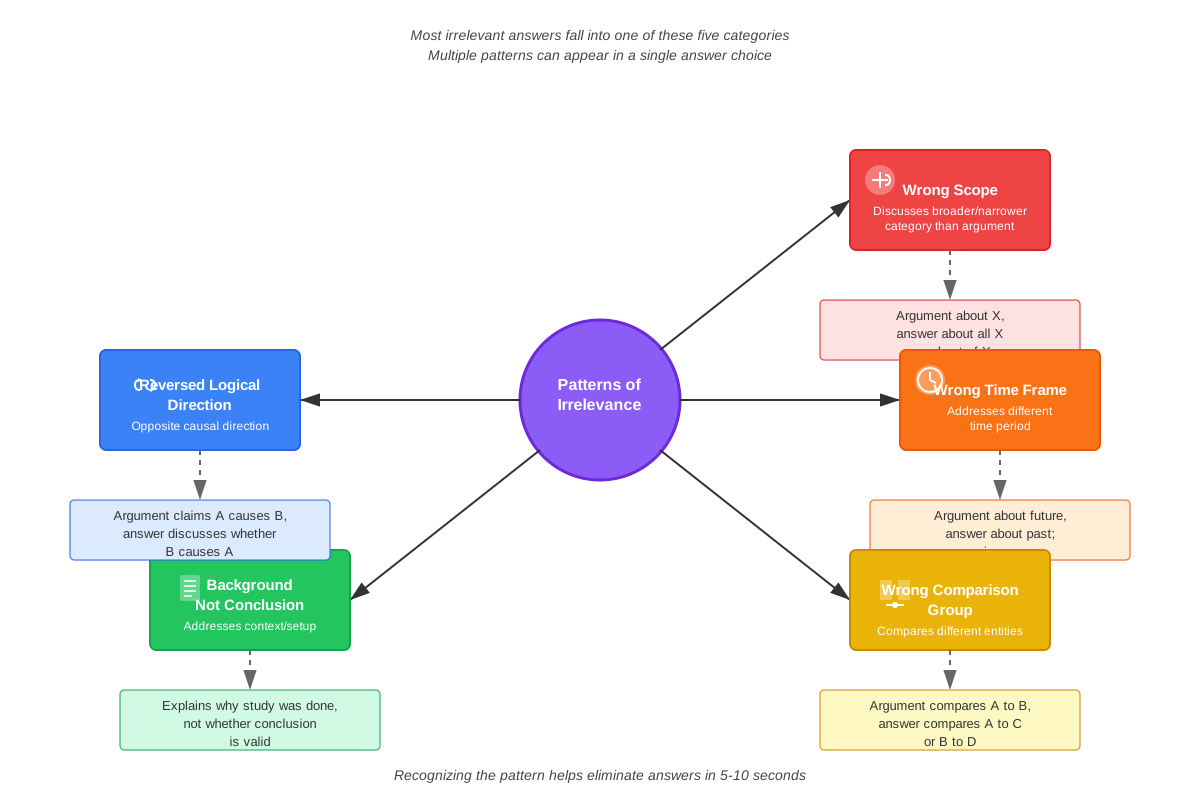
Strengthen and weaken questions themselves constitute approximately 20-25% of all Logical Reasoning questions on any given LSAT, making them one of the most common question types. Within these questions, irrelevant answer choices typically manifest in several predictable patterns: they may address a different conclusion than the one stated, discuss factors that don't impact the logical connection between premises and conclusion, introduce information about irrelevant comparison groups, or provide background context that doesn't affect the argument's validity. Recognizing these patterns allows students to eliminate wrong answers quickly and confidently, improving both accuracy and timing.
Core Concepts
Defining Irrelevance in Logical Reasoning
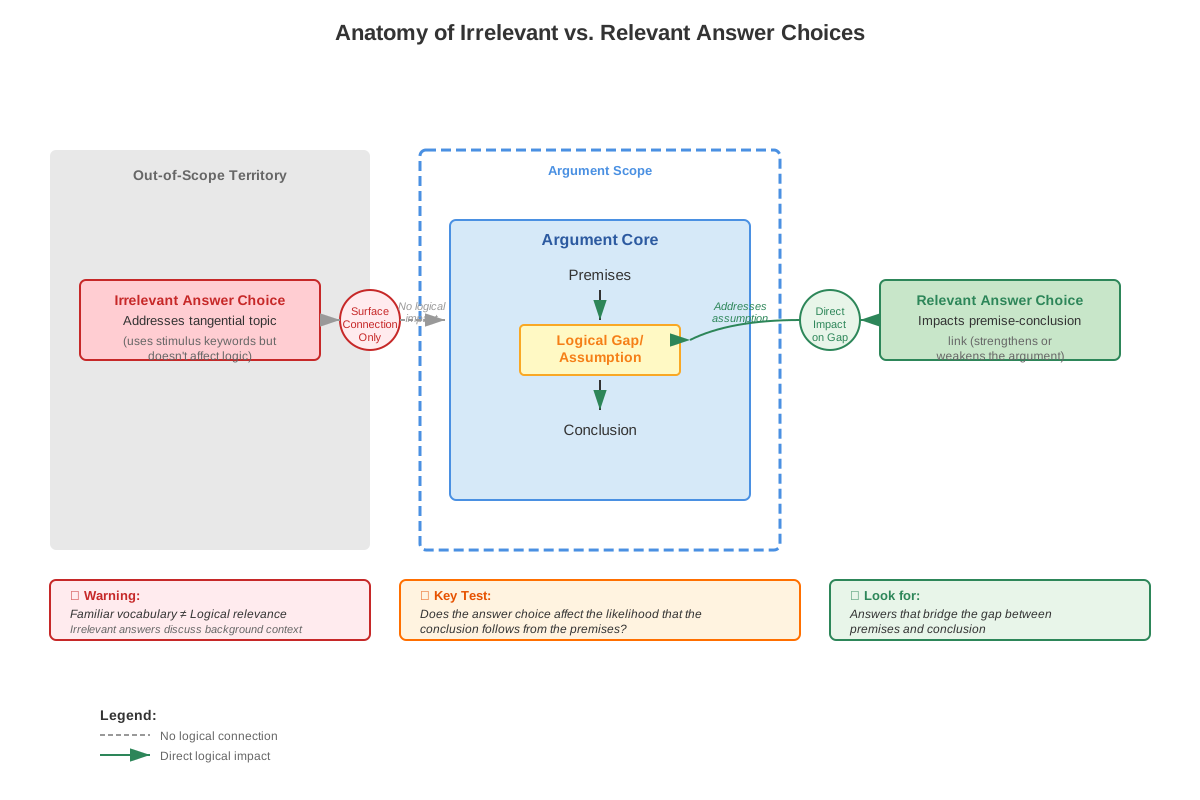
An answer choice is irrelevant when it fails to impact the logical relationship between an argument's premises and its conclusion. Relevance is not determined by whether information is interesting, related to the topic, or mentioned in the stimulus—it is determined solely by whether the information affects the strength of the reasoning. An irrelevant answer choice might discuss the same subject matter as the argument but address a different aspect that doesn't bear on the conclusion's validity.
Consider this distinction: if an argument concludes that "Policy X will reduce traffic congestion," a relevant answer choice must address whether Policy X will actually achieve this specific outcome. An answer choice stating "Policy X will be expensive to implement" is irrelevant to the conclusion about traffic reduction, even though it discusses Policy X. The cost doesn't impact whether the policy will reduce congestion—it addresses a different evaluative criterion entirely.
The Scope Principle
The scope principle is fundamental to identifying irrelevant answer choices. Every argument makes claims within certain boundaries—specific time periods, particular populations, defined contexts, or limited causal relationships. Answer choices that venture outside these boundaries are irrelevant regardless of their truth value.
| Argument Scope Element | Relevant Answer Choice | Irrelevant Answer Choice |
|---|---|---|
| Conclusion about Company A | Discusses Company A's characteristics | Discusses Company B's characteristics |
| Conclusion about future outcomes | Provides evidence about future conditions | Provides evidence only about past conditions |
| Conclusion about causal relationship | Addresses whether cause produces effect | Addresses correlation without causation |
| Conclusion about specific population | Provides data about that population | Provides data about different population |
Common Irrelevance Patterns
Pattern 1: Wrong Conclusion Addressed
Many irrelevant answer choices address a conclusion different from the one actually stated in the argument. If the argument concludes "the new policy will be effective," an answer choice discussing whether the policy will be popular is irrelevant. Effectiveness and popularity are distinct concepts, and evidence about one doesn't necessarily impact the other.
Pattern 2: Premise Restatement or Support
Some irrelevant answer choices simply restate information already provided in the premises or offer additional support for a premise rather than the conclusion. Since strengthen and weaken questions ask about the conclusion's support, information that only confirms what's already accepted as true in the premises is irrelevant. The argument structure already grants the premises as given facts.
Pattern 3: Tangential Information
These answer choices discuss factors that are topically related but logically disconnected from the argument's reasoning. For example, if an argument claims "increased exercise improves cardiovascular health," an answer choice about "exercise improving mental health" is tangential—it discusses exercise and health but doesn't address the specific cardiovascular claim.
Pattern 4: Irrelevant Comparisons
Arguments often make claims about a specific entity, policy, or phenomenon. Answer choices that introduce comparisons to other entities are irrelevant unless the argument's reasoning depends on such comparisons. If an argument concludes "Restaurant A serves high-quality food," information about Restaurant B's quality is irrelevant unless the argument explicitly relies on comparative reasoning.
Pattern 5: Mechanism Without Impact
Some answer choices explain how or why something occurs without affecting whether it occurs or what its consequences are. If an argument concludes that "X causes Y," an answer choice explaining the biochemical mechanism by which X causes Y is irrelevant—it doesn't strengthen or weaken the causal claim itself.
The Relevance Test Framework
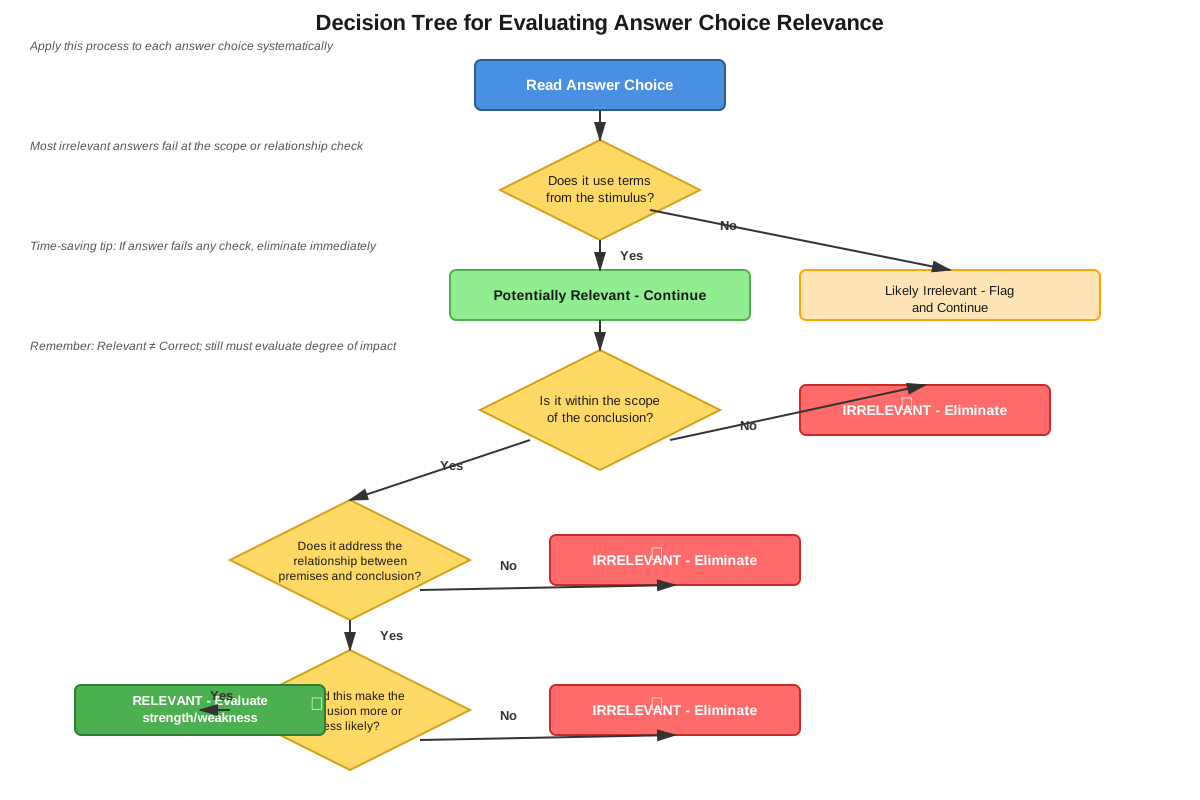
To systematically evaluate whether an answer choice is relevant, apply this three-step framework:
- Identify the precise conclusion: What specific claim is the argument making? Note exact scope, qualifiers, and the relationship being asserted.
- Identify the logical gap: What assumption or unstated connection does the argument rely upon? What could make this reasoning stronger or weaker?
- Apply the "So What?" test: After reading the answer choice, ask "So what? How does this impact whether the conclusion follows from the premises?" If no clear connection emerges, the answer choice is likely irrelevant.
Distinguishing Irrelevant from Relevant-but-Wrong
A critical distinction exists between answer choices that are irrelevant and those that are relevant but incorrect. A relevant-but-wrong answer choice addresses the correct logical gap but moves in the wrong direction (strengthens when you need to weaken) or doesn't move far enough to be the best answer. An irrelevant answer choice doesn't address the logical gap at all.
For example, if asked to weaken an argument that "increasing teacher salaries will improve student performance," consider these answer choices:
- Irrelevant: "Teacher salaries have remained stagnant for a decade" (doesn't address whether increases would improve performance)
- Relevant-but-wrong: "Higher teacher salaries attract more qualified candidates" (relevant to the reasoning but strengthens rather than weakens)
- Correct: "Studies show no correlation between teacher salary increases and student performance improvements" (relevant and weakens)
Context Versus Causation
Many irrelevant answer choices provide contextual background information without establishing causal or logical connections. Context explains circumstances surrounding a situation, while causation or logical connection explains why a conclusion follows from premises. LSAT irrelevant answer choices frequently exploit this distinction by offering interesting context that doesn't affect the argument's validity.
If an argument concludes "the company's new marketing strategy will increase sales," an answer choice stating "the company has been in business for 30 years" provides context but doesn't address whether the new strategy will work. The company's age doesn't impact the causal claim about the marketing strategy's effectiveness.
Concept Relationships
The ability to identify irrelevant answer choices builds directly upon argument structure analysis. Students must first accurately identify the conclusion and premises before they can determine what information would be relevant to that specific argument. This foundational skill → enables → scope recognition, which → enables → relevance evaluation.
Scope recognition connects intimately with irrelevant answer choice identification because scope violations are the most common form of irrelevance. When students understand an argument's precise boundaries, they can immediately flag answer choices that venture outside those boundaries. This skill also connects to assumption identification—understanding what an argument assumes → reveals → what information would be relevant to strengthening or weakening it.
The relationship between strengthen and weaken questions and irrelevant answer choices is bidirectional. Understanding what makes information relevant to strengthening or weakening → improves → the ability to eliminate irrelevant options. Conversely, efficiently eliminating irrelevant answer choices → increases → accuracy on strengthen and weaken questions by narrowing the field to genuinely competitive options.
This topic also relates to conditional reasoning because many irrelevant answer choices discuss sufficient or necessary conditions that don't apply to the argument's logical structure. Understanding when conditional relationships are relevant versus when they're tangential requires integrating both skill sets.
High-Yield Facts
⭐ Approximately 60-80% of wrong answer choices in strengthen and weaken questions are irrelevant rather than relevant-but-opposite.
⭐ An answer choice can be factually true and topically related yet still be completely irrelevant to the argument's logical structure.
⭐ Irrelevant answer choices often use terminology from the stimulus to create a false appearance of relevance.
⭐ The most common form of irrelevance is scope violation—addressing a different population, time period, or aspect than the conclusion specifies.
⭐ Information that only supports or restates premises is irrelevant because strengthen and weaken questions target the conclusion.
- Answer choices that explain mechanisms or processes are typically irrelevant unless the argument's reasoning depends on how something occurs.
- Comparative information is irrelevant unless the argument explicitly relies on comparative reasoning.
- Background context that doesn't establish causal or logical connections is irrelevant regardless of how interesting or informative it may be.
- An answer choice addressing a different conclusion than the one stated is always irrelevant, even if it addresses a related or implied conclusion.
- Irrelevant answer choices can be eliminated before determining whether remaining choices strengthen or weaken, improving efficiency.
- The "So What?" test—asking how information impacts the conclusion—is the most reliable method for identifying irrelevance.
Quick check — test yourself on Irrelevant answer choices so far.
Try Flashcards →Common Misconceptions
Misconception: If an answer choice discusses the same topic as the argument, it must be relevant.
Correction: Topical similarity does not guarantee logical relevance. An answer choice must address the specific logical relationship between the argument's premises and conclusion. Many irrelevant answer choices deliberately use similar terminology while discussing logically disconnected aspects of the topic.
Misconception: True statements are more likely to be correct answers, so factually accurate answer choices are probably relevant.
Correction: The truth value of an answer choice is independent of its relevance. The LSAT tests logical reasoning, not factual knowledge. An answer choice can be completely true yet entirely irrelevant to the argument's reasoning structure.
Misconception: Longer, more detailed answer choices are more likely to be relevant because they provide more information.
Correction: Length and detail do not indicate relevance. Test makers often create lengthy irrelevant answer choices packed with tangential information to consume time and appear substantive. Conversely, correct answers are frequently concise and direct.
Misconception: If an answer choice addresses something mentioned in the premises, it must be relevant.
Correction: Premises are accepted as given in LSAT arguments. Information that merely supports or elaborates on premises is irrelevant because strengthen and weaken questions ask about the conclusion's support. Relevant answer choices must impact the connection between premises and conclusion.
Misconception: Eliminating irrelevant answer choices takes too much time; it's faster to evaluate all choices equally.
Correction: Efficiently identifying and eliminating irrelevant answer choices actually saves time by reducing the number of options requiring careful evaluation. Students who cannot quickly spot irrelevance often waste time deliberating between multiple wrong answers.
Misconception: If an answer choice weakens the argument when you need to strengthen it (or vice versa), it's irrelevant.
Correction: This describes a relevant-but-wrong answer choice, not an irrelevant one. Such answer choices are relevant because they address the correct logical gap—they simply move in the wrong direction. Truly irrelevant answer choices don't address the logical gap at all.
Worked Examples
Example 1: Identifying Scope Violations
Stimulus:
"City officials claim that installing speed cameras at major intersections will reduce traffic accidents. They point to the fact that speeding is a contributing factor in 40% of accidents at these intersections. Therefore, by reducing speeding through camera enforcement, the city will decrease the overall accident rate."
Question: Which of the following, if true, most weakens the argument?
Answer Choices:
(A) Speed cameras have been shown to reduce average vehicle speeds by 15% at monitored intersections.
(B) Many drivers are unaware that speed cameras have been installed at major intersections.
(C) The majority of accidents at major intersections are caused by factors other than speeding, such as failure to yield and distracted driving.
(D) Speed cameras generate significant revenue for cities through traffic fines.
(E) Residential neighborhoods have higher accident rates than major intersections.
Analysis:
First, identify the conclusion: "By reducing speeding through camera enforcement, the city will decrease the overall accident rate."
The argument assumes that reducing speeding (which contributes to 40% of accidents) will reduce the overall accident rate.
Evaluating each choice:
(A) Irrelevant: This actually strengthens the argument by confirming that cameras reduce speeds. We need to weaken, but more importantly, this is relevant because it addresses whether the proposed mechanism (cameras reducing speed) works.
(B) Relevant but insufficient: This is relevant because driver awareness could affect whether cameras reduce speeding, but it doesn't strongly weaken the argument because even unaware drivers might slow down after receiving tickets.
(C) CORRECT - Relevant and weakens: This directly addresses the logical gap. Even if cameras reduce speeding (the 40% factor), the majority of accidents stem from other causes that cameras won't address. This weakens the conclusion that overall accident rates will decrease.
(D) Irrelevant: Revenue generation doesn't impact whether cameras will reduce accidents. This is a classic tangential information trap—it discusses cameras but addresses a completely different evaluative criterion (financial impact rather than safety impact).
(E) Irrelevant: This is a scope violation. The argument concerns major intersections specifically. Information about residential neighborhoods is outside the scope and doesn't affect whether cameras at major intersections will reduce accidents there.
Key Lesson: Choices (D) and (E) demonstrate the two most common irrelevance patterns: tangential information and scope violations. Both discuss topics related to the stimulus but fail to address the specific logical relationship between premises and conclusion.
Example 2: Distinguishing Context from Causation
Stimulus:
"The Brookfield Symphony Orchestra has experienced declining ticket sales over the past five years. The orchestra's director attributes this decline to increased competition from streaming music services, which allow people to enjoy classical music at home. The director concludes that to reverse the decline, the orchestra must enhance the in-person concert experience by adding visual elements like projected images and lighting effects."
Question: Which of the following, if true, most strengthens the director's conclusion?
Answer Choices:
(A) Streaming music services have grown substantially in popularity over the past five years.
(B) Other orchestras that have added visual elements to concerts have seen increased ticket sales.
(C) The Brookfield Symphony Orchestra has maintained consistent programming quality throughout the five-year period.
(D) Classical music streaming represents a small percentage of overall streaming music consumption.
(E) Concert tickets for the Brookfield Symphony Orchestra cost less than subscriptions to major streaming services.
Analysis:
The conclusion is: "To reverse the decline, the orchestra must enhance the in-person concert experience by adding visual elements."
The argument assumes that visual enhancements will make in-person concerts more appealing relative to streaming, thereby increasing ticket sales.
Evaluating each choice:
(A) Irrelevant - Context without causation: This provides background context confirming that streaming has grown, but it doesn't address whether visual enhancements will solve the problem. The argument already accepts that streaming is a factor; the question is whether the proposed solution will work.
(B) CORRECT - Relevant and strengthens: This directly supports the assumption that visual enhancements will increase ticket sales by providing evidence that this strategy has worked for comparable organizations.
(C) Irrelevant - Premise support: This supports the premise that competition (not quality decline) explains the sales drop, but it doesn't address whether visual enhancements will reverse the trend. It confirms what the argument already assumes rather than strengthening the conclusion.
(D) Irrelevant - Scope violation: This discusses overall streaming consumption patterns, but the argument concerns classical music listeners specifically. The proportion of classical music in total streaming doesn't affect whether visual enhancements will attract classical music audiences to live concerts.
(E) Irrelevant - Wrong comparison: This compares ticket prices to streaming costs, but the argument isn't about price competition—it's about experiential competition. The director's solution involves enhancing the experience, not adjusting prices, so price comparisons are irrelevant to whether visual enhancements will work.
Key Lesson: Choice (A) demonstrates how contextual information can seem relevant because it confirms something mentioned in the stimulus, yet it fails to address the specific conclusion about the proposed solution. Choice (C) shows how premise support is irrelevant to strengthen/weaken questions.
Exam Strategy
Pre-Answer Choice Strategy
Before evaluating answer choices, invest 15-20 seconds in precise argument analysis:
- Identify and paraphrase the conclusion in your own words, noting exact scope
- Identify the logical gap or assumption the argument relies upon
- Predict what would be relevant: What type of information would strengthen or weaken this specific reasoning?
This upfront investment pays dividends by creating a relevance filter that allows rapid elimination of irrelevant options.
Trigger Words for Irrelevance
Watch for these warning signs that often indicate irrelevant answer choices:
- Comparative language when the argument doesn't rely on comparisons: "more than," "less than," "compared to"
- Different time frames than the conclusion specifies: "historically," "in the past," "traditionally" when the conclusion is about the future
- Different populations or entities than those in the conclusion
- Mechanism or process language when the argument is about outcomes: "the way in which," "the process by which," "the mechanism"
- Alternative issues or criteria: "also," "additionally," "furthermore" introducing new evaluative standards
The Elimination Sequence
Use this systematic approach:
- First pass - Eliminate obvious scope violations (10-15 seconds): Quickly scan for answer choices discussing different populations, time periods, or topics than the conclusion specifies.
- Second pass - Apply the "So What?" test (15-20 seconds): For remaining choices, explicitly ask how each impacts the conclusion. If no clear connection emerges within 3-4 seconds, eliminate it as likely irrelevant.
- Third pass - Evaluate remaining relevant choices (20-30 seconds): Among choices that survive relevance screening, determine which most strongly strengthens or weakens the argument.
Time Allocation
- Argument analysis: 15-20 seconds
- Eliminating irrelevant choices: 20-30 seconds
- Evaluating relevant choices: 20-30 seconds
- Total target time: 60-80 seconds per question
Students who cannot efficiently identify irrelevant answer choices often spend 90-120 seconds per question, creating time pressure that cascades through the section.
Exam Tip: If you find yourself deliberating between two answer choices for more than 20 seconds, one is likely irrelevant. Return to the conclusion and ask which choice actually addresses the specific claim being made.
Common Trap Patterns
The Familiar Term Trap: Test makers deliberately use terminology from the stimulus in irrelevant answer choices. Don't be seduced by familiar words—focus on logical relationships.
The Interesting Fact Trap: Irrelevant answer choices often present compelling or surprising information that's interesting but logically disconnected. Resist the temptation to select answers because they're informative or thought-provoking.
The Premise Echo Trap: Answer choices that restate or support premises feel relevant because they align with the argument, but they're irrelevant to strengthen/weaken questions that target the conclusion.
Memory Techniques
The SCOPE Acronym
Use SCOPE to remember the five most common irrelevance patterns:
- Subject mismatch (wrong entity, population, or topic)
- Context without causation (background that doesn't affect reasoning)
- Outcome confusion (addresses different result than conclusion specifies)
- Premise support (confirms what's already given rather than addressing conclusion)
- Extraneous comparisons (introduces irrelevant comparative information)
The Relevance Visualization
Visualize the argument as a bridge connecting premises (one side) to conclusion (other side). Relevant answer choices affect the bridge's strength—they either reinforce it or weaken it. Irrelevant answer choices are like boats floating under the bridge or birds flying over it—they're in the vicinity but don't touch the bridge structure at all.
The "So What?" Mantra
Train yourself to automatically ask "So what?" after reading each answer choice. Make this an auditory habit—literally hear the question in your mind. If you can't immediately articulate how the information impacts the conclusion, it's likely irrelevant.
The Three-Second Rule
If you cannot identify a clear connection between an answer choice and the conclusion within three seconds of applying the "So What?" test, eliminate it as likely irrelevant and move on. Trust your initial assessment—if relevance isn't obvious, it probably isn't there.
Summary
Irrelevant answer choices represent the most common wrong answer type in LSAT strengthen and weaken questions, accounting for 60-80% of incorrect options. These choices are deliberately designed to appear connected to the argument through shared terminology, topical similarity, or interesting information, yet they fail to impact the logical relationship between premises and conclusion. Mastering irrelevance identification requires understanding that relevance is determined solely by whether information affects the specific conclusion's validity, not by topical connection or factual accuracy. The most common irrelevance patterns include scope violations (addressing different populations, time periods, or aspects), tangential information (topically related but logically disconnected), premise support (confirming what's already given), and context without causation (background that doesn't affect reasoning). Efficient elimination of irrelevant answer choices through systematic application of the "So What?" test and scope analysis dramatically improves both accuracy and timing on strengthen and weaken questions while building transferable skills applicable across all Logical Reasoning question types.
Key Takeaways
- Irrelevant answer choices constitute 60-80% of wrong answers in strengthen and weaken questions, making their identification the highest-yield elimination skill
- Relevance is determined by whether information impacts the conclusion's validity, not by topical similarity, factual truth, or use of familiar terminology
- The most common irrelevance pattern is scope violation—answer choices addressing different populations, time periods, or aspects than the conclusion specifies
- Apply the "So What?" test systematically: if you cannot articulate within three seconds how an answer choice affects the conclusion, eliminate it as likely irrelevant
- Information that only supports or restates premises is irrelevant because strengthen and weaken questions target the conclusion, not the premises
- Distinguish between irrelevant answer choices (don't address the logical gap) and relevant-but-wrong choices (address the gap but move in the wrong direction)
- Invest 15-20 seconds in precise argument analysis before evaluating answer choices to create an effective relevance filter
Related Topics
Necessary Assumption Questions: Understanding irrelevant answer choices in strengthen/weaken questions directly transfers to identifying irrelevant assumptions. The same scope principles and relevance tests apply, as necessary assumptions must address the specific gap between premises and conclusion.
Sufficient Assumption Questions: These questions require identifying information that guarantees the conclusion follows. Irrelevant answer choices in sufficient assumption questions often address tangential issues or wrong conclusions, making irrelevance identification skills essential.
Flaw Questions: Many incorrect answer choices in flaw questions describe irrelevant reasoning errors—flaws the argument doesn't actually commit. The ability to match answer choices to the specific argument structure developed through irrelevance training applies directly.
Parallel Reasoning Questions: Identifying structural parallels requires filtering out irrelevant content differences. Students skilled at recognizing irrelevance can focus on logical structure rather than being distracted by different subject matter.
Method of Reasoning Questions: These questions ask how arguments proceed. Irrelevant answer choices often describe reasoning methods the argument doesn't employ, requiring the same scope-matching skills developed through irrelevance training.
Practice CTA
Now that you understand how to identify and eliminate irrelevant answer choices, it's time to apply these skills under test-like conditions. Complete the practice questions for this topic, focusing on systematically applying the "So What?" test and identifying scope violations before evaluating whether remaining choices strengthen or weaken arguments. Use the flashcards to reinforce the five common irrelevance patterns (SCOPE) and practice distinguishing irrelevant choices from relevant-but-wrong options. Remember: every irrelevant answer choice you eliminate quickly increases your odds of selecting the correct answer and frees up time for more challenging questions. Mastery of this skill is one of the highest-yield investments you can make in your LSAT preparation—commit to it now, and watch your Logical Reasoning scores improve.
Sign up free to keep reading
Create a free AnvayaPrep account to finish this LSAT guide on Irrelevant answer choices — plus flashcards and practice questions.