Overview
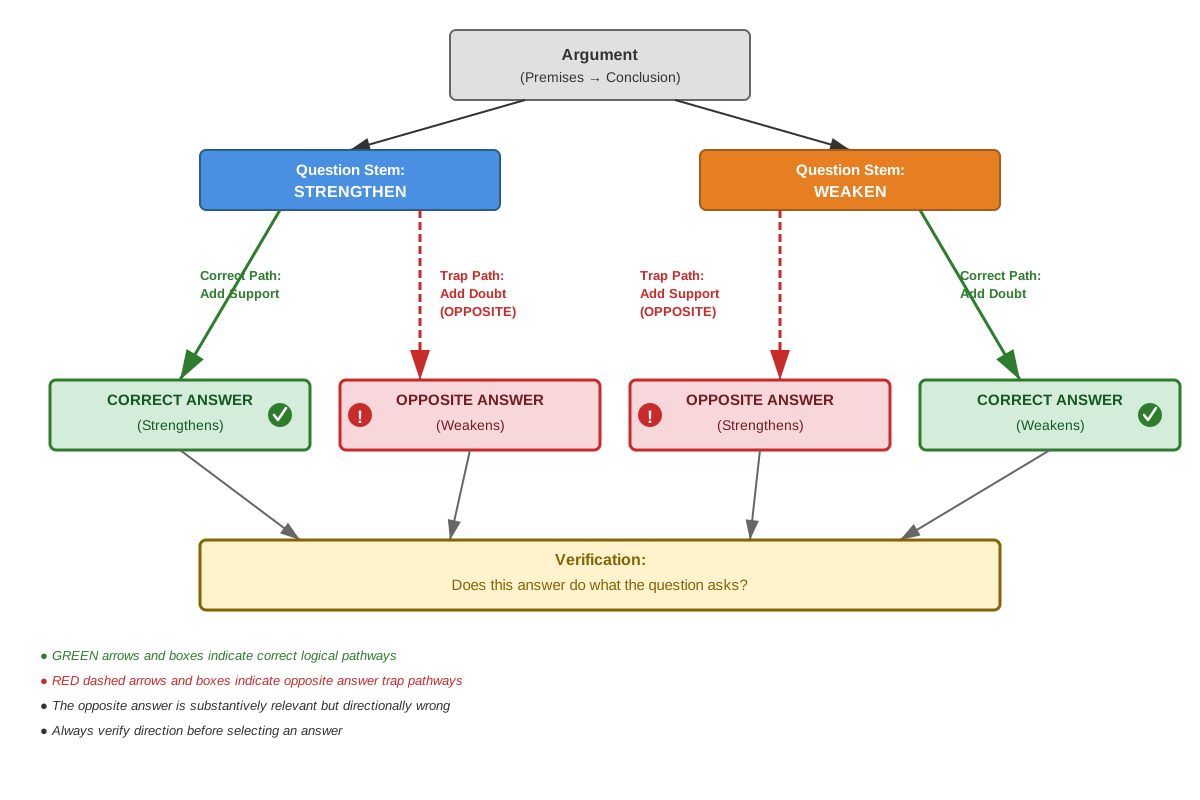
Opposite answer choices represent one of the most insidious traps on the LSAT Logical Reasoning section, particularly within strengthen and weaken questions. These deceptive answer options do precisely the reverse of what the question stem requests: when asked to strengthen an argument, an opposite answer choice will weaken it; when asked to weaken an argument, an opposite answer choice will strengthen it. The LSAT test makers deliberately craft these answers to exploit students who misread the question stem, work too quickly under time pressure, or lose track of their task while analyzing complex arguments.
Understanding and identifying LSAT opposite answer choices is crucial because these wrong answers appear with remarkable frequency—often in 60-80% of strengthen and weaken questions. They serve as the primary distractor for test-takers who correctly understand the argument's logical structure but momentarily forget whether they're supposed to support or undermine it. The sophistication of opposite answers lies in their substantive engagement with the argument: they're not obviously irrelevant or out of scope, but rather directly address the argument's reasoning in the wrong direction. This makes them particularly attractive to students who recognize that an answer choice is "doing something important" to the argument but fail to verify that it's doing the right thing.
The concept of opposite answer choices connects fundamentally to the broader architecture of LSAT Logical Reasoning. Mastering this topic requires solid understanding of argument structure (premises, conclusions, and assumptions), the distinction between strengthening and weakening moves, and the discipline to maintain task awareness throughout each question. This skill also transfers to other question types where directional confusion can occur, such as Must Be True versus Cannot Be True questions, making it a cornerstone competency for achieving elite LSAT scores.
Learning Objectives
- [ ] Identify how Opposite answer choices appears in LSAT questions
- [ ] Explain the reasoning pattern behind Opposite answer choices
- [ ] Apply Opposite answer choices to solve LSAT-style problems accurately
- [ ] Distinguish opposite answer choices from other wrong answer types (irrelevant, out-of-scope, etc.)
- [ ] Develop systematic verification habits to avoid selecting opposite answers under time pressure
- [ ] Recognize the psychological triggers that make opposite answers particularly attractive
Prerequisites
- Argument structure identification: Understanding premises, conclusions, and assumptions is essential because opposite answers work by affecting these components in the wrong direction
- Strengthen and weaken question fundamentals: Students must know what it means to strengthen or weaken an argument before they can recognize when an answer does the opposite
- Assumption recognition: Many opposite answers exploit the gap between premises and conclusion, making assumption identification critical
- Question stem classification: The ability to quickly and accurately identify what a question is asking prevents the directional confusion that leads to selecting opposite answers
Why This Topic Matters
In real-world contexts, the ability to distinguish between evidence that supports versus undermines a position is fundamental to critical thinking, legal reasoning, scientific inquiry, and policy analysis. Lawyers must recognize when new evidence strengthens or weakens their case; researchers must evaluate whether experimental results support or contradict their hypotheses. The LSAT tests this directional reasoning because it's central to the analytical skills required for law school success.
On the LSAT itself, opposite answer choices appear with exceptional frequency. Research on released LSAT questions indicates that approximately 65-75% of strengthen and weaken questions include at least one opposite answer choice among the five options. In many questions, the opposite answer is deliberately positioned as the second-most attractive option, serving as the primary trap for students who have narrowed their choices correctly but make a final directional error. Some test administrations feature strengthen/weaken questions in 25-30% of the Logical Reasoning section, meaning that opposite answer recognition directly impacts performance on 6-8 questions per test—a difference of several percentile points in final scores.
Common manifestations include: strengthen questions where one answer choice introduces a significant weakness to the argument's reasoning; weaken questions where one answer provides strong support for the conclusion; and questions where the opposite answer is substantively correct and relevant but directionally wrong. The LSAT also employs subtle variations, such as answers that strengthen one part of an argument while weakening the overall conclusion, requiring careful analysis of what specifically the question asks students to affect.
Core Concepts
Definition and Mechanism of Opposite Answer Choices
An opposite answer choice is a wrong answer option that performs the inverse function of what the question stem requests. In strengthen questions, opposite answers weaken the argument; in weaken questions, opposite answers strengthen it. The mechanism behind these answers exploits a fundamental aspect of test-taking psychology: once students invest cognitive effort in understanding an argument's structure and identifying its vulnerabilities or potential support points, they may select an answer that correctly engages with those elements while forgetting to verify the directional requirement.
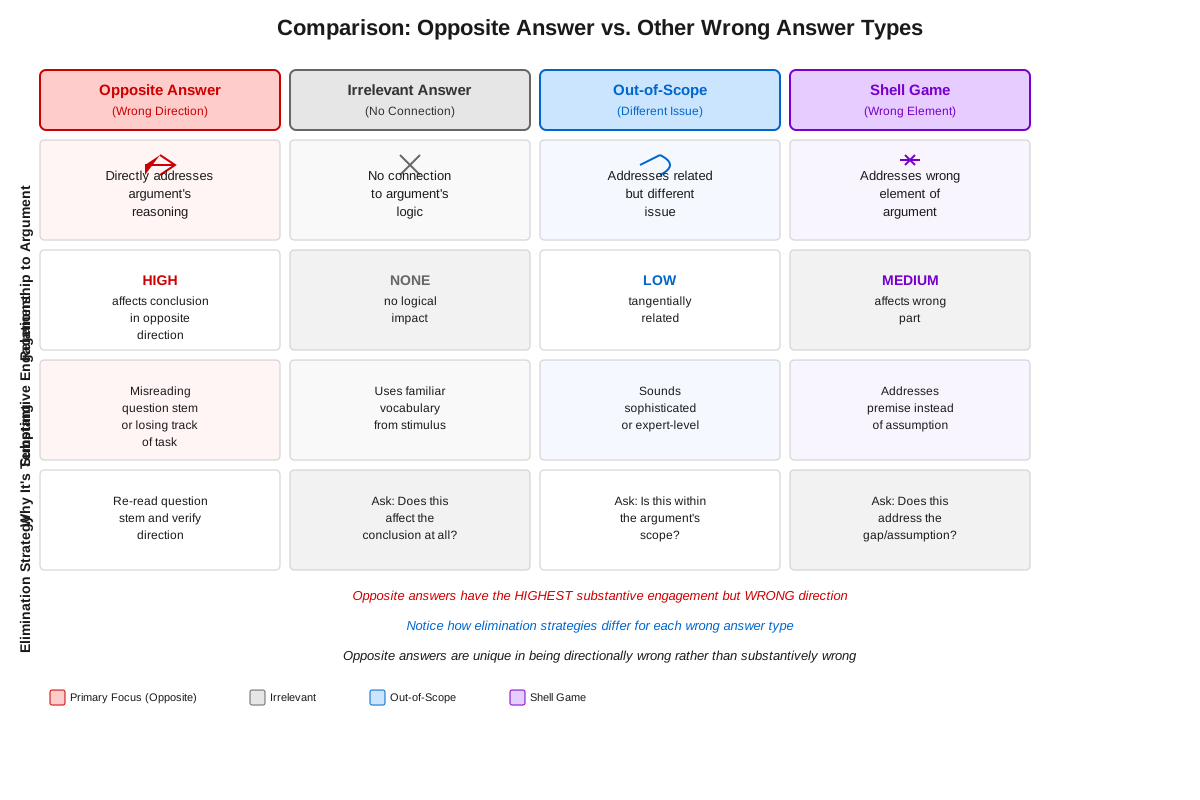
The power of opposite answers lies in their substantive correctness in all respects except direction. Unlike irrelevant answers that discuss unrelated topics or out-of-scope answers that go beyond the argument's domain, opposite answers demonstrate sophisticated understanding of the argument's logical structure. They identify the right assumption, address the right gap, and engage with the right concepts—they simply push in the wrong direction.
The Psychology of Opposite Answer Attraction
Several psychological factors make opposite answers particularly seductive. First, confirmation bias leads students who have identified an argument's weakness to feel satisfied when they see an answer addressing that weakness, without verifying whether it's being addressed in the requested direction. Second, task fatigue under timed conditions causes students to lose track of whether they're strengthening or weakening, especially when questions alternate between these types. Third, the illusion of relevance makes opposite answers feel correct because they're highly relevant to the argument—they're just relevant in the wrong way.
The LSAT exploits these vulnerabilities by placing opposite answers in strategic positions, often as choice (D) or (E) where students arrive after eliminating obviously wrong answers. The test also uses language that sounds supportive or critical without students carefully analyzing the logical effect. For example, an answer might say "many experts disagree with the conclusion," which sounds weakening but might actually strengthen the argument if the conclusion is that expert opinion is divided.
Structural Patterns in Opposite Answers
Opposite answers follow predictable structural patterns that skilled test-takers can learn to recognize:
- Assumption-filling opposites: In strengthen questions, these answers introduce information that breaks the connection between premises and conclusion rather than supporting it
- Alternative explanation opposites: In weaken questions, these answers eliminate alternative explanations rather than introducing them
- Statistical opposites: These provide data that moves in the opposite direction from what would help or hurt the argument
- Scope-matching opposites: These perfectly match the argument's scope and terminology while having the wrong logical effect
Comparison Table: Opposite vs. Other Wrong Answer Types
| Feature | Opposite Answer | Irrelevant Answer | Out-of-Scope Answer | Correct Answer |
|---|---|---|---|---|
| Relevance to argument | Highly relevant | Not relevant | Somewhat relevant | Highly relevant |
| Addresses core reasoning | Yes | No | Partially | Yes |
| Logical effect | Wrong direction | No effect | Unclear/no effect | Right direction |
| Attractiveness | Very high | Low | Medium | Highest |
| Requires to eliminate | Directional check | Relevance check | Scope check | Comparative analysis |
The Verification Process
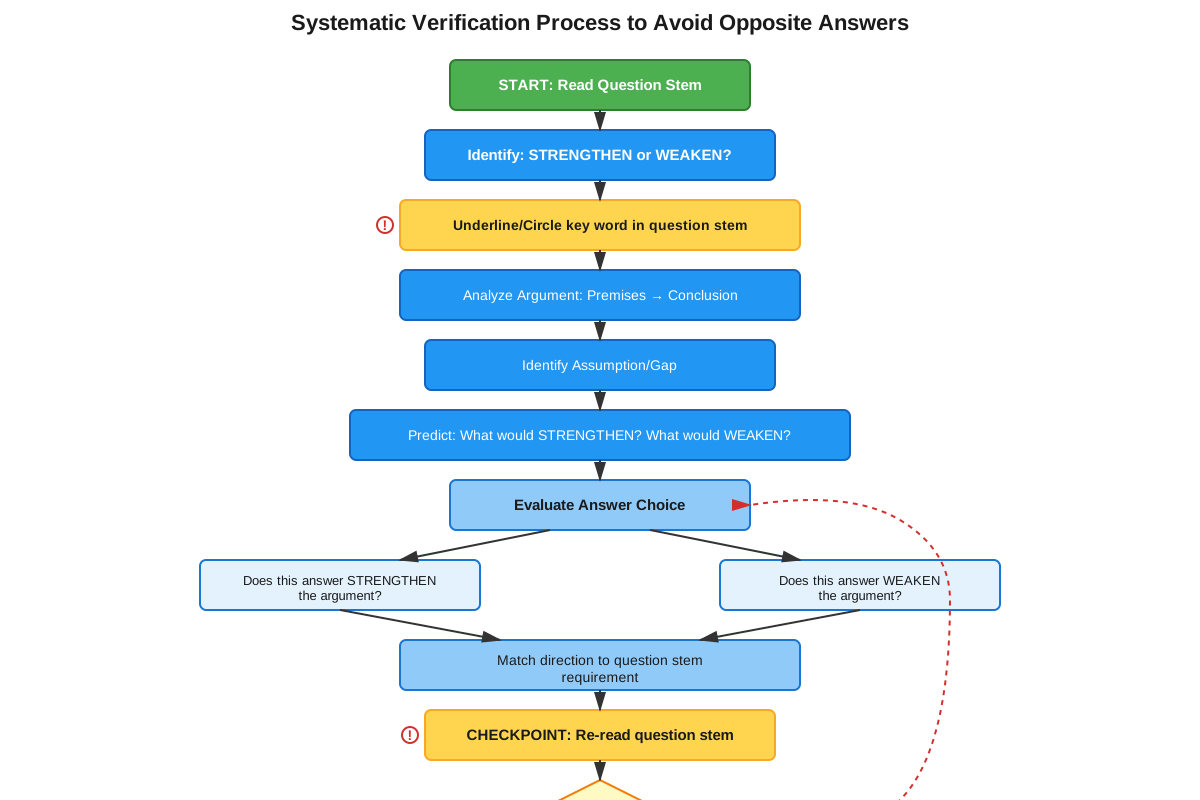
To avoid selecting opposite answers, students must implement a systematic verification process:
- Read and annotate the question stem: Physically mark whether the task is to strengthen or weaken
- Predict the direction: Before reading answers, determine what kind of information would strengthen or weaken
- Evaluate each answer's logical effect: For each option, explicitly state whether it strengthens, weakens, or has no effect
- Match effect to task: Verify that the answer's effect aligns with the question's request
- Double-check before selecting: Before marking the final answer, reread the question stem to confirm directional alignment
Language Patterns and Trigger Words
Opposite answers often use language that creates a false sense of alignment with the task. In strengthen questions, opposite answers might use words like "however," "but," "challenges," or "contradicts"—language that signals opposition to the conclusion. In weaken questions, opposite answers might use "supports," "confirms," "consistent with," or "validates"—language suggesting agreement. Skilled test-takers learn to ignore these surface-level linguistic cues and focus instead on the logical relationship between the answer and the argument.
Concept Relationships
The concept of opposite answer choices sits at the intersection of multiple Logical Reasoning skills. It directly builds upon argument structure analysis because identifying an opposite answer requires understanding what would strengthen or weaken the specific connection between premises and conclusion. Without clear recognition of where an argument's vulnerability lies, students cannot determine whether an answer choice is helping or hurting that vulnerability.
Opposite answers connect intimately to assumption identification. Many opposite answers work by either filling an assumption gap (when they should be widening it) or widening a gap (when they should be filling it). For example, if an argument assumes that correlation implies causation, a strengthen question's opposite answer might introduce information suggesting the correlation is coincidental, while the correct answer would support the causal interpretation.
The relationship flows as follows: Argument Structure Analysis → Assumption Identification → Prediction of Strengthen/Weaken Direction → Recognition of Opposite Answers → Systematic Verification. Each step depends on the previous one, and weakness at any stage increases vulnerability to opposite answer traps.
Opposite answers also relate to question stem classification skills. Students who misclassify a question stem (reading "strengthen" as "weaken" or vice versa) will systematically select opposite answers. This makes careful, active reading of question stems a prerequisite skill. Additionally, the concept connects to time management strategies: students working too quickly are more likely to lose track of directional requirements, while those who work too slowly may experience cognitive fatigue that impairs verification.
High-Yield Facts
⭐ Approximately 65-75% of strengthen and weaken questions include at least one opposite answer choice among the five options
⭐ Opposite answers are substantively relevant and engage with the argument's core reasoning—they simply work in the wrong direction
⭐ The most common position for opposite answers is as the second-most attractive option, serving as the primary trap after obviously wrong answers are eliminated
⭐ Opposite answers often use language that sounds aligned with the task (e.g., "challenges" in strengthen questions) to create false confidence
⭐ The key to avoiding opposite answers is systematic verification: always reread the question stem before making a final selection
- Opposite answers exploit confirmation bias by satisfying the feeling that you've found something important about the argument
- In strengthen questions, opposite answers typically introduce alternative explanations, contradictory evidence, or information that breaks the premise-conclusion link
- In weaken questions, opposite answers typically eliminate alternative explanations, provide confirming evidence, or fill assumption gaps
- Students who work too quickly or too slowly are both more vulnerable to opposite answer traps for different reasons
- Opposite answers are more common in medium and difficult questions than in easy questions, where wrong answers tend to be more obviously irrelevant
Quick check — test yourself on Opposite answer choices so far.
Try Flashcards →Common Misconceptions
Misconception: If an answer choice is highly relevant to the argument and addresses its core reasoning, it must be correct → Correction: Opposite answers are specifically designed to be highly relevant while working in the wrong direction. Relevance is necessary but not sufficient for correctness; directional alignment with the question stem is equally essential.
Misconception: The language in an answer choice (words like "supports" or "undermines") reliably indicates its logical effect → Correction: The LSAT deliberately uses misleading language in opposite answers. An answer might say it "supports" something while actually weakening the overall argument, or describe something that "challenges" a premise while ultimately strengthening the conclusion. Always analyze the logical relationship independent of surface language.
Misconception: Once you've identified what the argument assumes or where it's vulnerable, you can quickly select the answer that addresses that point → Correction: This is precisely how opposite answers trap students. Both the correct answer and the opposite answer will address the same assumption or vulnerability—they just push in different directions. After identifying the relevant issue, you must carefully determine which direction each answer pushes.
Misconception: Opposite answers only appear in strengthen and weaken questions → Correction: While most common in strengthen/weaken questions, opposite answer patterns also appear in Must Be True vs. Cannot Be True questions, Principle questions (support vs. violate), and other question types where directional confusion is possible.
Misconception: If you understand the argument well, you won't fall for opposite answers → Correction: Opposite answers exploit task confusion, not comprehension failure. Students with excellent argument analysis skills are still vulnerable when working under time pressure, experiencing fatigue, or momentarily losing track of the question's specific request. Systematic verification habits are necessary regardless of skill level.
Worked Examples
Example 1: Strengthen Question with Opposite Answer
Argument: "City officials claim that the new traffic cameras have improved safety at intersections. Since the cameras were installed six months ago, the number of accidents at camera-equipped intersections has decreased by 30%."
Question Stem: Which of the following, if true, most strengthens the city officials' claim?
Answer Choices:
(A) Traffic volume at camera-equipped intersections has decreased by 35% over the same period
(B) Accidents at intersections without cameras have remained constant
(C) The cameras have generated significant revenue from traffic fines
(D) Similar camera programs in other cities have produced mixed results
(E) Driver awareness campaigns were launched simultaneously with camera installation
Analysis:
First, identify the argument structure:
- Premise: Accidents decreased 30% at camera-equipped intersections after installation
- Conclusion: The cameras improved safety
- Assumption: The cameras (not some other factor) caused the decrease
We need to strengthen this causal claim. The correct answer should make it more likely that cameras caused the decrease.
Choice (A) - This is the opposite answer. If traffic volume decreased by 35% (even more than accidents decreased), this suggests accidents didn't decrease as much as they should have given the reduced traffic. This actually weakens the argument by suggesting the cameras might not be effective. Many students select this because it's highly relevant to the statistics, but it works in the wrong direction.
Choice (B) - This strengthens the argument. If accidents stayed constant at non-camera intersections while decreasing at camera intersections, this supports the claim that cameras (specifically) caused the improvement. This is the correct answer.
Choice (C) - Irrelevant. Revenue doesn't address whether cameras improved safety.
Choice (D) - Weakens slightly by suggesting uncertainty, but not as directly relevant as (A).
Choice (E) - Weakens by introducing an alternative explanation (awareness campaigns might have caused the decrease).
Key Lesson: Choice (A) is a classic opposite answer—it's statistically relevant and addresses the causal reasoning, but it weakens rather than strengthens. Students who identify that traffic volume is relevant but forget to check the direction will select this trap.
Example 2: Weaken Question with Opposite Answer
Argument: "The Riverside Museum's new interactive exhibits have been highly successful. Visitor surveys show that 85% of visitors rate the interactive exhibits as 'excellent' or 'very good,' compared to only 60% for traditional exhibits."
Question Stem: Which of the following, if true, most seriously weakens the argument?
Answer Choices:
(A) Visitors who choose to complete surveys are more likely to have strong opinions about exhibits
(B) The interactive exhibits cost three times more to maintain than traditional exhibits
(C) Visitors spend an average of 45 minutes at interactive exhibits versus 20 minutes at traditional exhibits
(D) Only visitors who experienced the interactive exhibits were asked to complete surveys
(E) Other museums have reported similar satisfaction ratings for their interactive exhibits
Analysis:
Argument structure:
- Premise: 85% rate interactive exhibits highly vs. 60% for traditional exhibits
- Conclusion: Interactive exhibits have been highly successful
- Assumption: The survey accurately represents visitor preferences and the comparison is valid
We need to weaken this argument—find information that undermines the conclusion.
Choice (A) - Weakens slightly by suggesting survey bias, but doesn't directly address the comparison.
Choice (B) - Irrelevant to whether exhibits are successful with visitors (addresses cost, not success).
Choice (C) - This is the opposite answer. Spending more time at interactive exhibits actually strengthens the claim that they're successful—it's additional evidence of visitor engagement. Students select this because it's relevant to measuring success, but it works in the wrong direction.
Choice (D) - This weakens the argument significantly. If only people who experienced interactive exhibits took surveys, the comparison is invalid—we're comparing ratings from people who saw interactive exhibits to ratings from a potentially different group. This is the correct answer.
Choice (E) - Irrelevant or slightly strengthening (confirms the pattern is real).
Key Lesson: Choice (C) is an opposite answer that strengthens when we need to weaken. It provides additional evidence of success (time spent), making the conclusion more credible. Students who recognize that "time spent" is a relevant metric for success but forget they're supposed to weaken the argument will fall for this trap.
Exam Strategy
Pre-Question Preparation
Before reading any answer choices, invest 5-10 seconds in clear task identification. Physically mark the question stem with "STR" or "WEAK" in your test booklet. This small action creates a physical reminder that persists throughout your analysis of answer choices. Consider using different symbols or marks for different question types to create visual distinctiveness.
Trigger Words to Watch For
In question stems, watch for these exact phrasings:
- "Most strengthens" / "Most supports" / "Most justifies" → You need strengthening
- "Most weakens" / "Most undermines" / "Most calls into question" / "Most seriously damages" → You need weakening
- "If true, which of the following" → The answer choices are assumed true; you're evaluating their effect
In answer choices, be suspicious of:
- Language that sounds opposite to the task (e.g., "contradicts" in strengthen questions)
- Statistical information that's relevant but requires careful directional analysis
- Information about alternative explanations (these strengthen when eliminated, weaken when introduced)
Process of Elimination Strategy
Use a two-pass system:
- First pass: Eliminate obviously irrelevant answers and those that have no logical effect
- Second pass: For remaining answers, explicitly state the direction of effect ("this strengthens because..." or "this weakens because...")
When down to two answers, one of which is often the opposite answer:
- Reread the question stem
- For each remaining answer, complete this sentence: "This answer makes the conclusion [more/less] likely because..."
- Verify that your selected answer's direction matches the question's request
Time Allocation
Spend approximately:
- 30-40 seconds reading and analyzing the argument
- 10 seconds clearly identifying the task and predicting what you need
- 60-70 seconds evaluating answer choices
- 10-15 seconds verifying your selection matches the question stem
The verification step is crucial and should never be skipped, even under time pressure. The 10-15 seconds spent verifying prevents the 2-minute penalty of missing a question you had the skills to answer correctly.
When You're Unsure
If you're torn between two answers and suspect one might be an opposite answer:
- Cover the question stem and determine each answer's effect independently
- Uncover the question stem and match effects to the task
- If both answers seem to have strong effects, one is almost certainly the opposite answer
- The answer that feels "too perfect" or "too obvious" in addressing the argument's weakness might be the opposite answer if you're in a strengthen question (or vice versa)
Memory Techniques
The STOP Acronym
Before selecting any answer in strengthen/weaken questions, use STOP:
- Stem: Reread the question stem
- Task: Confirm whether you're strengthening or weakening
- Opposite: Ask "Could this be an opposite answer?"
- Proceed: Select only after verification
Visualization Strategy
Imagine the argument as a bridge between premises (one side) and conclusion (other side). Strengthening answers add support beams under the bridge. Weakening answers remove support or add weight that stresses the bridge. An opposite answer is a support beam when you need to add weight, or added weight when you need support. Visualize what you're supposed to do before evaluating whether an answer does it.
The Direction Check Habit
Develop a physical habit of pointing or nodding when you verify direction. After reading an answer choice, physically point up (for strengthen) or down (for weaken) based on its effect, then verify this matches what the question asks. The physical movement engages motor memory and reduces purely cognitive errors.
The "Opposite Day" Technique
When practicing, occasionally do "opposite day" where you deliberately select the opposite answer for several questions, then review why each was wrong. This trains your brain to recognize the pattern of opposite answers and makes them more obvious during actual testing.
Summary
Opposite answer choices represent one of the most sophisticated and frequently deployed traps in LSAT Logical Reasoning, appearing in approximately 65-75% of strengthen and weaken questions. These wrong answers are deliberately designed to be substantively relevant, engaging directly with the argument's core reasoning and assumptions while working in precisely the wrong direction. Unlike irrelevant or out-of-scope answers that can be eliminated quickly, opposite answers require careful directional verification because they correctly identify what matters in the argument but incorrectly affect it. The key to avoiding these traps lies not in better argument analysis—students who fall for opposite answers typically understand the argument well—but in systematic task verification habits. Successful test-takers implement a consistent process: clearly marking the question stem's request, predicting the needed direction before reading answers, explicitly stating each answer's logical effect, and always verifying directional alignment before making a final selection. Under time pressure and cognitive fatigue, these verification habits become essential safeguards against the psychological vulnerabilities that opposite answers exploit, including confirmation bias, task confusion, and the illusion that relevance equals correctness.
Key Takeaways
- Opposite answer choices do the reverse of what the question requests: they weaken when you need to strengthen and strengthen when you need to weaken
- These answers appear in 65-75% of strengthen/weaken questions and serve as the primary trap for students who understand the argument but lose track of the task
- Opposite answers are highly relevant and substantively engage with the argument's reasoning—relevance alone does not indicate correctness
- The critical defense against opposite answers is systematic verification: always reread the question stem before making your final selection
- Surface-level language in answer choices (words like "supports" or "undermines") can be misleading; focus on the logical relationship between the answer and the conclusion
- Implement the STOP protocol (Stem, Task, Opposite, Proceed) before selecting any answer in strengthen/weaken questions
- Opposite answers exploit psychological vulnerabilities including confirmation bias, task fatigue, and the satisfaction of finding something relevant to the argument
Related Topics
Assumption Questions: Understanding assumptions is crucial for recognizing opposite answers because many opposite answers work by filling assumption gaps when they should widen them (or vice versa). Mastering opposite answer recognition in strengthen/weaken questions builds the directional reasoning skills needed for assumption questions.
Necessary vs. Sufficient Assumptions: This distinction helps clarify why some answers that seem to support an argument actually don't strengthen it enough, or why answers that seem problematic don't actually weaken it—skills that complement opposite answer recognition.
Causal Reasoning: Many opposite answers in strengthen/weaken questions involve causal relationships, either supporting alternative causal explanations when they should eliminate them, or vice versa. Mastering causal reasoning patterns makes opposite answers more transparent.
Flaw Questions: Understanding common logical flaws helps predict what would strengthen or weaken an argument, making it easier to verify whether an answer is working in the correct direction.
Parallel Reasoning: The skill of tracking logical structure and direction developed through opposite answer mastery transfers directly to parallel reasoning questions, where directional consistency is essential.
Practice CTA
Now that you understand the mechanics and psychology of opposite answer choices, it's time to put this knowledge into practice. The difference between understanding this concept intellectually and mastering it operationally comes through deliberate practice with immediate feedback. As you work through practice questions, focus not just on getting the right answer, but on explicitly identifying which wrong answers are opposite answers and why they're attractive. This metacognitive awareness—understanding not just what's right but why wrong answers tempt you—is what separates good LSAT performance from great performance. Challenge yourself to catch every opposite answer before it catches you, and watch your accuracy on strengthen and weaken questions climb steadily upward.
Sign up free to keep reading
Create a free AnvayaPrep account to finish this LSAT guide on Opposite answer choices — plus flashcards and practice questions.