Overview
Prephrasing strengthen answers is one of the most powerful and efficient techniques for mastering Logical Reasoning questions on the LSAT. This strategic approach involves predicting what type of information would strengthen an argument before looking at the answer choices. By engaging actively with the stimulus and formulating expectations about what would make the argument more convincing, test-takers can dramatically improve both their accuracy and speed on strengthen and weaken questions.
The technique of LSAT prephrasing strengthen answers transforms students from passive readers into active critical thinkers. Rather than evaluating five answer choices blindly, students who prephrase effectively can often identify the correct answer immediately or eliminate wrong answers with confidence. This skill is particularly valuable because strengthen questions appear frequently on every LSAT administration, typically accounting for 10-15% of all Logical Reasoning questions. Mastering prephrasing creates a systematic approach that reduces cognitive load during the high-pressure testing environment.
Within the broader landscape of Logical Reasoning, prephrasing strengthen answers builds directly on fundamental skills like identifying conclusions, recognizing assumptions, and understanding argument structure. It represents an intermediate-to-advanced application of these foundational concepts, requiring students to not only analyze what an argument says but also anticipate what additional information would make it more persuasive. This topic connects intimately with assumption identification, causal reasoning, and evidence evaluation—all critical components of LSAT success.
Learning Objectives
- [ ] Identify how prephrasing strengthen answers appears in LSAT questions
- [ ] Explain the reasoning pattern behind prephrasing strengthen answers
- [ ] Apply prephrasing strengthen answers to solve LSAT-style problems accurately
- [ ] Formulate specific, testable predictions about strengthen answer content before reviewing answer choices
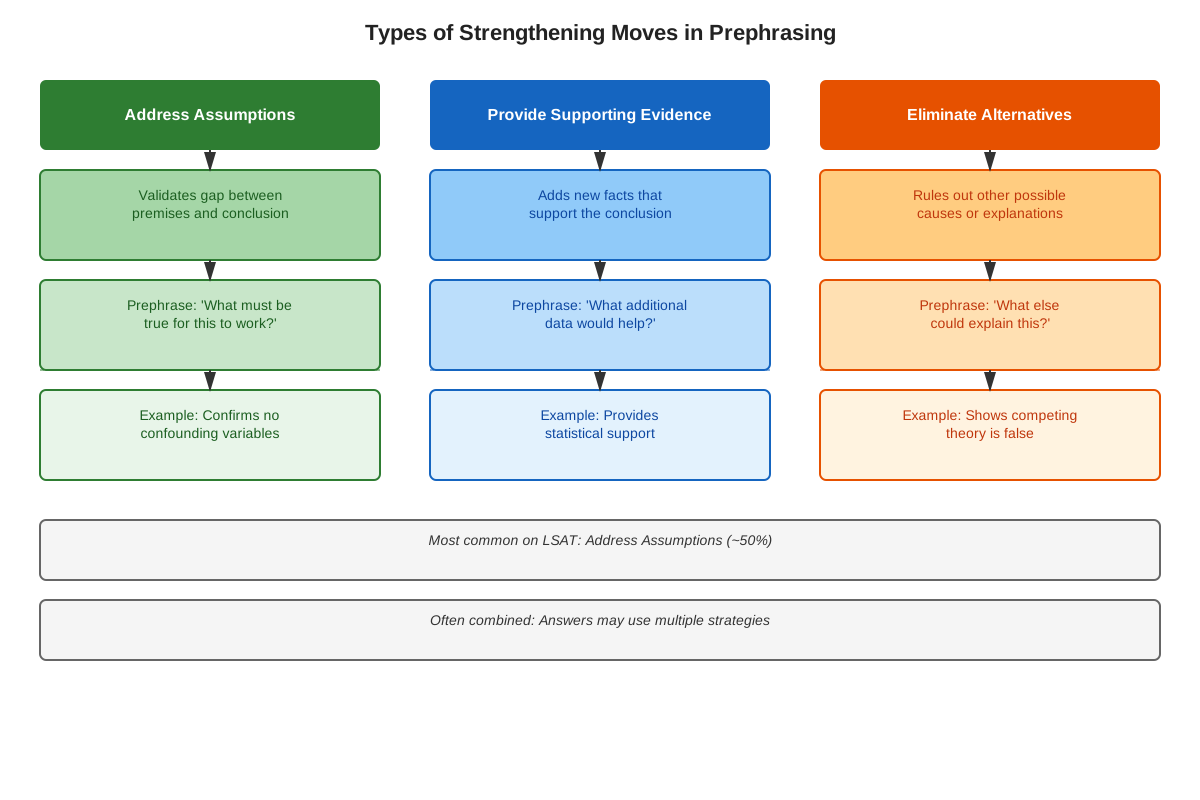
- [ ] Distinguish between different types of strengthening moves (addressing assumptions, providing supporting evidence, eliminating alternative explanations)
- [ ] Evaluate the quality and specificity of prephrase predictions to improve answer selection efficiency
Prerequisites
- Argument structure identification: Understanding premises, conclusions, and how they connect is essential because prephrasing requires recognizing what the argument claims and what evidence supports it.
- Assumption recognition: Identifying gaps between premises and conclusions enables effective prephrasing, as strengthen answers often validate these unstated assumptions.
- Basic strengthen question mechanics: Familiarity with what it means to strengthen an argument provides the foundation for predicting how strengthening will occur.
- Causal reasoning patterns: Many strengthen questions involve causal arguments, so recognizing cause-and-effect claims helps predict what evidence would support them.
- Conditional logic fundamentals: Some strengthen questions involve conditional relationships, requiring understanding of sufficient and necessary conditions.
Why This Topic Matters
Prephrasing strengthen answers represents a critical skill that separates high-scoring LSAT test-takers from average performers. In real-world contexts, this skill translates directly to legal reasoning, where attorneys must anticipate what evidence would support their arguments and what information would undermine opposing positions. The ability to think several steps ahead and predict what would make an argument more convincing is fundamental to legal advocacy, case preparation, and judicial reasoning.
On the LSAT specifically, strengthen questions appear with remarkable consistency. Each Logical Reasoning section typically contains 3-5 strengthen questions, meaning students will encounter 6-10 such questions per test administration. These questions carry the same weight as any other Logical Reasoning question, making them high-value targets for score improvement. The question stems vary but commonly include phrases like "Which one of the following, if true, most strengthens the argument?" or "Which one of the following, if true, provides the most support for the conclusion?"
Prephrasing appears in strengthen questions through several common patterns. Arguments with causal claims often require evidence ruling out alternative causes or demonstrating the proposed cause actually produces the effect. Arguments relying on analogies need evidence showing the compared situations are truly similar. Arguments based on statistical evidence benefit from information confirming the sample is representative or the correlation is meaningful. Arguments making predictions require evidence that past patterns will continue or that relevant conditions remain stable. By recognizing these patterns, students can prephrase with precision and confidence.
Core Concepts
The Prephrasing Process
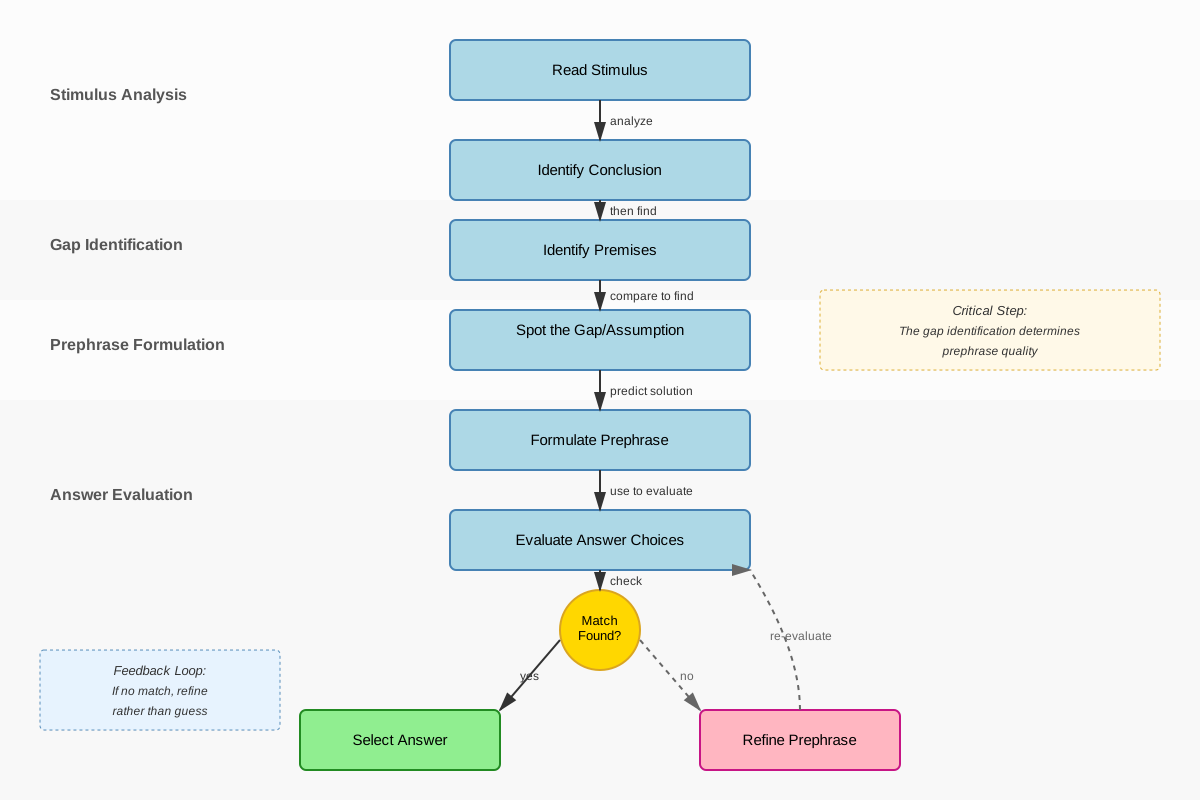
Prephrasing strengthen answers involves a systematic four-step process that transforms how students approach these questions. First, identify the argument's conclusion—the main claim the author wants you to accept. Second, identify the premises—the evidence offered in support of that conclusion. Third, identify the gap or assumption—the unstated connection between premises and conclusion that the argument takes for granted. Fourth, predict what information would close that gap or validate that assumption.
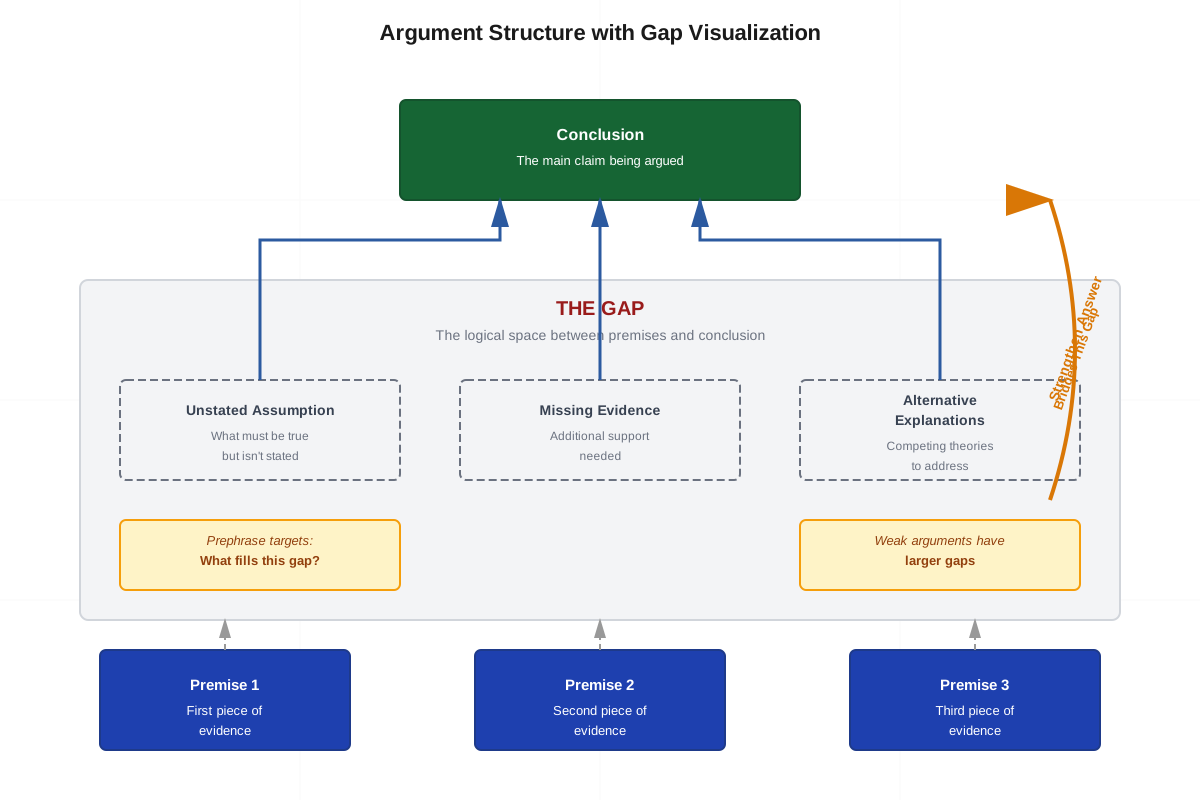
This process works because strengthen questions fundamentally test whether students can recognize what's missing from an argument. Every LSAT argument contains logical gaps—if arguments were airtight, there would be nothing to strengthen. The correct answer provides information that makes the conclusion more likely to be true given the premises. By identifying the gap before looking at answer choices, students create a mental target that helps them recognize the correct answer immediately.
Types of Strengthening Moves
Understanding the different ways arguments can be strengthened enables more precise prephrasing. The most common strengthening moves include:
| Strengthening Type | What It Does | Example Context |
|---|---|---|
| Assumption validation | Confirms an unstated assumption is true | "The plan assumes X" → answer confirms X is true |
| Alternative explanation elimination | Rules out competing explanations for observed phenomena | Causal argument → answer shows other causes weren't responsible |
| Representative sample confirmation | Establishes that a sample accurately reflects the population | Statistical argument → answer shows sample wasn't biased |
| Mechanism demonstration | Shows how a proposed cause produces its effect | Causal claim → answer explains the causal pathway |
| Precedent establishment | Provides evidence that similar situations produced similar results | Predictive argument → answer shows pattern held in past |
| Necessary condition confirmation | Verifies that required conditions are met | Conditional argument → answer confirms necessary conditions exist |
Identifying Argument Vulnerabilities
Effective prephrasing requires recognizing where arguments are vulnerable. Causal arguments are vulnerable to alternative explanations, reverse causation, and correlation-without-causation problems. When an argument claims "X causes Y," prephrase by thinking: "What would rule out other causes? What would show X actually produces Y rather than just correlating with it?"
Analogical arguments are vulnerable to relevant differences between the compared situations. When an argument claims "Situation A worked this way, so Situation B will too," prephrase by thinking: "What would show A and B are truly similar in relevant respects?"
Statistical arguments are vulnerable to sampling bias, unrepresentative data, and confounding variables. When an argument draws conclusions from data, prephrase by thinking: "What would show this sample accurately represents the population? What would rule out alternative interpretations of the data?"
Predictive arguments are vulnerable to changed circumstances and broken patterns. When an argument claims something will happen in the future based on past patterns, prephrase by thinking: "What would show the pattern will continue? What would confirm relevant conditions remain stable?"
Specificity in Prephrasing
The quality of a prephrase matters as much as having one. Specific prephrases identify particular information that would strengthen the argument. For example, if an argument claims "Reducing speed limits will reduce accidents," a specific prephrase might be: "Evidence that lower speeds actually cause fewer accidents, not just correlate with them" or "Data showing that when other cities reduced speed limits, accidents decreased."
General prephrases identify the type of information needed without specifying details. Using the same example, a general prephrase might be: "Something showing the causal relationship is real." While less precise, general prephrases still provide valuable direction.
Both types of prephrases improve performance, but specific prephrases enable faster answer selection. Students should aim for specificity but recognize that even general prephrases provide significant advantages over approaching answer choices without any prediction.
The Gap-Filling Principle
The gap-filling principle states that strengthen answers work by providing information that bridges the logical space between premises and conclusion. Every argument makes logical leaps—moving from what's stated to what's concluded requires assumptions. The correct strengthen answer typically validates one of these assumptions or provides evidence that makes the leap more justified.
Consider this argument structure: "All observed X have property Y. Therefore, the next X we encounter will have property Y." The gap involves assuming that future instances will resemble past instances and that our observations were representative. A strengthen answer might confirm our sample was comprehensive or provide theoretical reasons why X must have property Y.
Common Argument Patterns and Their Prephrases
Certain argument patterns appear repeatedly on the LSAT, each with predictable prephrasing opportunities:
- Causal claims from correlation: When an argument observes that X and Y occur together and concludes X causes Y, prephrase: "Evidence ruling out reverse causation, evidence eliminating alternative causes, or evidence showing the mechanism by which X produces Y."
- Plans and proposals: When an argument proposes a plan to achieve a goal, prephrase: "Evidence that the plan will actually produce the intended effect, evidence that necessary conditions for success are present, or evidence that potential obstacles won't prevent success."
- Explanatory arguments: When an argument offers an explanation for a phenomenon, prephrase: "Evidence making this explanation more likely than alternatives, evidence that the explanation accounts for all relevant facts, or evidence that the explanation's predictions have been confirmed."
- Comparative arguments: When an argument compares two things and draws conclusions, prephrase: "Evidence that the comparison is valid, evidence that relevant similarities exist, or evidence that relevant differences don't undermine the comparison."
Concept Relationships
The concepts within prephrasing strengthen answers form an interconnected system. The prephrasing process serves as the foundation, providing the systematic approach that enables all other concepts. This process directly depends on identifying argument vulnerabilities, which in turn requires understanding types of strengthening moves. The gap-filling principle explains why prephrasing works at a theoretical level, while specificity in prephrasing addresses the practical quality of predictions. Common argument patterns represent the application of all these concepts to recurring LSAT scenarios.
These concepts connect to prerequisite knowledge in essential ways. Argument structure identification enables the first two steps of the prephrasing process (identifying conclusion and premises). Assumption recognition directly feeds into identifying gaps and vulnerabilities. Basic strengthen question mechanics provides the conceptual framework that prephrasing optimizes. Causal reasoning patterns inform how to prephrase for causal arguments specifically.
The relationship map flows as follows: Argument Structure → Assumption Identification → Gap Recognition → Vulnerability Analysis → Prephrase Formulation → Answer Evaluation. Each step builds on the previous one, creating a systematic approach that transforms strengthen questions from challenging puzzles into manageable, predictable tasks.
High-Yield Facts
⭐ Strengthen questions typically account for 10-15% of all Logical Reasoning questions, making them one of the most common question types.
⭐ The correct strengthen answer almost always addresses the argument's central assumption or most significant logical gap.
⭐ Prephrasing before looking at answer choices can reduce time spent per question by 20-30% while improving accuracy.
⭐ Causal arguments are the most common argument type in strengthen questions, appearing in approximately 40% of such questions.
⭐ The correct strengthen answer doesn't need to prove the conclusion—it only needs to make the conclusion more likely to be true.
- Strengthen answers often work by eliminating alternative explanations rather than providing direct supporting evidence.
- Arguments about plans and proposals are strengthened by evidence that necessary conditions are met or that obstacles won't prevent success.
- Statistical arguments are strengthened by evidence that samples are representative or that confounding variables don't explain the results.
- Analogical arguments are strengthened by evidence of relevant similarities or evidence that apparent differences don't matter.
- Wrong answers on strengthen questions often address irrelevant issues, strengthen premises rather than the conclusion, or actually weaken the argument.
- The most effective prephrases identify what assumption the argument makes and predict information that would validate that assumption.
- Strengthen questions never require outside knowledge—all necessary information appears in the stimulus and correct answer.
Quick check — test yourself on Prephrasing strengthen answers so far.
Try Flashcards →Common Misconceptions
Misconception: Prephrasing means predicting the exact wording of the correct answer. → Correction: Prephrasing involves predicting the type or category of information that would strengthen the argument, not the specific language. The correct answer may express the strengthening information in unexpected ways while still matching your prephrase conceptually.
Misconception: If none of the answer choices match your prephrase, you must have prephrased incorrectly. → Correction: Arguments can be strengthened in multiple ways. If your prephrase doesn't appear, evaluate answer choices based on whether they address assumptions or gaps in the argument. Your prephrase may have identified one strengthening approach while the correct answer uses another valid approach.
Misconception: Strengthen answers must provide conclusive proof that the conclusion is true. → Correction: Strengthen answers only need to make the conclusion more likely or more reasonable—they don't need to prove it definitively. Even modest support that addresses a key assumption counts as strengthening.
Misconception: You should prephrase for every strengthen question regardless of difficulty or time pressure. → Correction: While prephrasing is valuable, it should be flexible. For straightforward arguments with obvious gaps, a quick prephrase is efficient. For complex arguments, spending time on detailed prephrasing pays off. For arguments where the gap isn't immediately clear, it may be more efficient to evaluate answer choices while keeping the conclusion and premises in mind.
Misconception: The correct strengthen answer will always address the biggest or most obvious gap in the argument. → Correction: While correct answers often address major gaps, they sometimes address smaller but still significant assumptions. The correct answer is the one that provides the most strengthening among the available options, even if it doesn't address what seems like the most important issue.
Misconception: Prephrasing is only useful for strengthen questions, not for other Logical Reasoning question types. → Correction: Prephrasing is valuable for many question types including weaken, assumption, flaw, and evaluate questions. The skill of predicting what information matters to an argument transfers across question types.
Worked Examples
Example 1: Causal Argument
Stimulus: "City officials noticed that after installing brighter streetlights in the downtown area, reported crime decreased by 15%. They concluded that the brighter lighting caused the reduction in crime."
Question: Which one of the following, if true, most strengthens the city officials' conclusion?
Step 1 - Identify the conclusion: The brighter lighting caused the reduction in crime.
Step 2 - Identify the premises: After installing brighter streetlights, reported crime decreased by 15%.
Step 3 - Identify the gap/assumption: The argument assumes the lighting caused the decrease rather than some other factor. It assumes correlation indicates causation. It also assumes "reported crime" accurately reflects actual crime.
Step 4 - Prephrase: "Something that rules out alternative explanations for the crime decrease. Maybe evidence that other factors (police presence, economic conditions, weather patterns) didn't change during this period. Or evidence that areas without the new lighting didn't see crime decreases. Or evidence that the lighting specifically deters crime through a known mechanism."
Evaluating answer choices with the prephrase:
- (A) "Crime rates in neighboring cities remained constant during the same period." → This is good! It suggests the decrease wasn't due to regional trends affecting all areas. This matches our prephrase about ruling out alternative explanations.
- (B) "The downtown area has historically had higher crime rates than other parts of the city." → This doesn't strengthen. It's about past comparisons, not about what caused the recent decrease.
- (C) "Brighter lighting makes it easier for security cameras to capture clear images." → This provides a mechanism but doesn't rule out alternatives or confirm the lighting was responsible.
- (D) "Residents reported feeling safer after the new lights were installed." → Feeling safer doesn't mean crime actually decreased due to the lighting.
- (E) "The city increased police patrols in the downtown area at the same time the lights were installed." → This actually introduces an alternative explanation, weakening rather than strengthening.
Answer: (A) - This matches our prephrase by eliminating the alternative explanation that regional crime trends caused the decrease.
Example 2: Plan/Proposal Argument
Stimulus: "The university plans to reduce student parking fees by 50% to encourage more students to drive to campus. University administrators believe this will reduce the overcrowding problem in campus dormitories, as more students will choose to live off-campus and commute."
Question: Which one of the following, if true, most strengthens the administrators' reasoning?
Step 1 - Identify the conclusion: Reducing parking fees will reduce dormitory overcrowding.
Step 2 - Identify the premises: Lower parking fees will encourage more students to drive to campus. (Implicit: Students who drive are more likely to live off-campus.)
Step 3 - Identify the gap/assumption: The argument assumes that (1) parking fees are a significant factor in students' decisions about where to live, (2) students who currently live on campus would move off-campus if parking were cheaper, (3) the parking fee reduction will actually lead to more driving, and (4) there's sufficient off-campus housing available.
Step 4 - Prephrase: "Something showing that parking costs actually influence housing decisions. Maybe evidence that students currently live on campus specifically because commuting is too expensive. Or evidence that when parking became cheaper elsewhere, students moved off-campus. Or survey data showing students would move off-campus if parking were more affordable."
Evaluating answer choices with the prephrase:
- (A) "Many students who currently live on campus cited high commuting costs as their primary reason for not living off-campus." → Excellent! This directly validates the assumption that parking costs influence housing decisions and that reducing these costs would change behavior. This matches our prephrase perfectly.
- (B) "Off-campus housing near the university is generally less expensive than dormitory housing." → This doesn't strengthen the specific plan. Students already know this, yet they still live on campus, suggesting other factors matter more.
- (C) "The university has been experiencing dormitory overcrowding for the past three years." → This confirms there's a problem but doesn't strengthen the claim that this solution will work.
- (D) "Students who live off-campus report higher satisfaction with their living arrangements." → This doesn't address whether cheaper parking would cause students to move off-campus.
- (E) "The university has ample parking space available for additional vehicles." → This addresses a potential obstacle but doesn't strengthen the core claim that cheaper parking will reduce dormitory overcrowding.
Answer: (A) - This validates the key assumption that parking costs actually drive housing decisions, making it much more likely the plan will achieve its goal.
Exam Strategy
When approaching strengthen questions on the LSAT, implement this systematic process:
Trigger word recognition: Immediately identify strengthen questions by watching for stems containing "strengthen," "support," "justify," "most helps to establish," or "provides the most reason to believe." These phrases signal that you need to find information making the conclusion more likely.
Active reading approach: Read the stimulus with prephrasing in mind. As you read, actively think: "What is this argument assuming? Where are the logical gaps? What would make this more convincing?" This active engagement primes your mind for effective prephrasing.
Time allocation: Spend 15-20 seconds on prephrasing for strengthen questions. This upfront investment typically saves 20-30 seconds during answer evaluation and dramatically improves accuracy. For particularly complex arguments, spending up to 30 seconds on careful prephrasing is justified.
Answer choice evaluation order: After prephrasing, scan answer choices looking for your predicted strengthener. If you find a clear match, select it confidently. If no answer matches your prephrase, evaluate each choice by asking: "Does this address an assumption or gap in the argument? Does this make the conclusion more likely?"
Process of elimination tips specific to strengthen questions:
- Eliminate answers that address irrelevant issues not connected to the conclusion
- Eliminate answers that strengthen premises rather than the inference from premises to conclusion
- Eliminate answers that actually weaken the argument (these appear as trap answers)
- Eliminate answers that are consistent with the argument but don't make the conclusion more likely
- Be cautious of answers that seem relevant but address minor rather than central assumptions
Flexibility principle: If prephrasing doesn't immediately reveal the answer, don't force it. Shift to evaluating answer choices while keeping the argument's structure and gaps in mind. The goal is efficiency, not rigid adherence to a process.
Exam Tip: The correct strengthen answer often feels "too obvious" or "too simple." Don't overthink. If an answer directly addresses the argument's central assumption, it's likely correct even if it seems straightforward.
Memory Techniques
GAPS Acronym for Prephrasing Process:
- Get the conclusion (identify what the argument claims)
- Analyze the premises (understand what evidence is offered)
- Pinpoint the assumption (find the logical gap)
- Strengthen by prediction (prephrase what would close the gap)
RACE Mnemonic for Common Strengthening Moves:
- Rule out alternatives (eliminate competing explanations)
- Assumption validation (confirm what the argument takes for granted)
- Confirm conditions (verify necessary conditions are met)
- Establish mechanism (show how cause produces effect)
Visualization Strategy: Picture the argument as a bridge with the premises on one side and the conclusion on the other. The gap is the missing section of bridge. Your prephrase identifies what material would fill that gap. The correct answer provides that material.
The "What's Missing?" Question: Train yourself to automatically ask "What's missing from this argument?" after reading the stimulus. This simple question triggers the gap-identification process essential for effective prephrasing.
Pattern Recognition Flashcards: Create mental flashcards linking argument patterns to prephrasing strategies. For example: "Causal claim from correlation → Prephrase: rule out alternative causes." Repeated exposure to these patterns builds automatic recognition.
Summary
Prephrasing strengthen answers represents a systematic approach to one of the LSAT's most common question types. By predicting what information would strengthen an argument before evaluating answer choices, test-takers dramatically improve both speed and accuracy. The process involves four key steps: identifying the conclusion, analyzing the premises, pinpointing assumptions or gaps, and predicting what information would address those gaps. Effective prephrasing requires understanding different types of strengthening moves—including assumption validation, alternative explanation elimination, and condition confirmation—and recognizing common argument patterns like causal claims, plans, and analogies. The quality of prephrasing matters: specific predictions enable faster answer selection, though even general predictions provide significant advantages. Strengthen answers work by filling logical gaps between premises and conclusions, making conclusions more likely without necessarily proving them definitively. Mastering this technique requires practice recognizing argument vulnerabilities and flexibility in applying the prephrasing process based on argument complexity and time constraints.
Key Takeaways
- Prephrasing strengthen answers involves predicting what information would support an argument before reviewing answer choices, dramatically improving efficiency and accuracy
- The four-step prephrasing process—identify conclusion, analyze premises, pinpoint gaps, predict strengtheners—provides a systematic approach to these questions
- Strengthen answers typically work by validating assumptions, ruling out alternative explanations, or confirming necessary conditions
- Causal arguments, the most common type in strengthen questions, are strengthened by evidence eliminating alternative causes or demonstrating causal mechanisms
- Effective prephrasing focuses on identifying what the argument assumes or what gaps exist between premises and conclusion
- The correct strengthen answer makes the conclusion more likely but doesn't need to prove it conclusively
- Flexibility is essential—if your prephrase doesn't appear in the answer choices, evaluate options based on whether they address argument assumptions or gaps
Related Topics
Assumption Questions: Mastering prephrasing for strengthen questions directly enables success with assumption questions, as both require identifying what arguments take for granted. Assumption questions ask you to identify necessary assumptions, while strengthen questions ask you to validate those assumptions.
Weaken Questions: The mirror image of strengthen questions, weaken questions benefit from similar prephrasing techniques. Understanding how to strengthen arguments clarifies how to weaken them—by attacking assumptions, introducing alternative explanations, or showing necessary conditions aren't met.
Evaluate Questions: These questions ask what information would be most useful in assessing an argument's strength. Prephrasing skills transfer directly, as you must identify what gaps or assumptions matter most to the argument's validity.
Sufficient Assumption Questions: These advanced questions require identifying assumptions that, if true, would make arguments logically valid. The prephrasing skills developed for strengthen questions provide the foundation for this more demanding task.
Flaw Questions: Recognizing argument vulnerabilities—a key component of prephrasing—directly supports identifying logical flaws. Understanding what would strengthen an argument clarifies what weaknesses it currently contains.
Practice CTA
Now that you understand the systematic approach to prephrasing strengthen answers, it's time to put these concepts into practice. The techniques you've learned—identifying gaps, predicting strengtheners, and efficiently evaluating answer choices—become automatic only through repeated application. Challenge yourself with the practice questions and flashcards designed specifically for this topic. Pay attention to how prephrasing changes your approach and improves your confidence. Each practice question is an opportunity to refine your technique and build the pattern recognition that separates high scorers from average performers. Your investment in mastering prephrasing will pay dividends across multiple question types and significantly boost your Logical Reasoning score. Start practicing now—your LSAT success depends on transforming these concepts from knowledge into instinctive skill.
Sign up free to keep reading
Create a free AnvayaPrep account to finish this LSAT guide on Prephrasing strengthen answers — plus flashcards and practice questions.