Overview
Scope in weaken questions represents one of the most critical analytical skills tested in LSAT Logical Reasoning sections. Understanding scope—the precise boundaries and limitations of an argument—is essential for identifying answer choices that genuinely weaken an argument versus those that merely introduce irrelevant information. Many test-takers struggle with weaken questions not because they fail to understand the argument's conclusion, but because they select answer choices that fall outside the argument's scope, addressing tangential issues rather than the core reasoning structure.
The LSAT consistently tests whether students can distinguish between answer choices that directly challenge an argument's logical foundation and those that discuss related but ultimately irrelevant matters. LSAT scope in weaken questions requires recognizing the specific terms, timeframes, populations, and conditions that define an argument's boundaries. An answer choice might present factually accurate information that seems intuitively related to the topic, yet fails to weaken the argument because it addresses a different scope—perhaps discussing a different population, time period, or set of circumstances than those specified in the stimulus.
Mastering scope in strengthen and weaken questions connects directly to fundamental skills in argument analysis, including identifying conclusions, recognizing assumptions, and understanding conditional reasoning. This topic serves as a bridge between basic argument comprehension and advanced critical reasoning, requiring students to maintain laser-like precision about what an argument actually claims versus what it might seem to imply. Success with scope issues dramatically improves performance across all Logical Reasoning question types, as scope awareness prevents the most common trap answers that the LSAT employs.
Learning Objectives
- [ ] Identify how scope in weaken questions appears in LSAT questions
- [ ] Explain the reasoning pattern behind scope in weaken questions
- [ ] Apply scope in weaken questions to solve LSAT-style problems accurately
- [ ] Distinguish between in-scope and out-of-scope answer choices within 15 seconds
- [ ] Recognize the five most common scope shifts that appear in wrong answer choices
- [ ] Predict the scope boundaries of an argument before reviewing answer choices
- [ ] Evaluate whether new information falls within an argument's established parameters
Prerequisites
- Basic argument structure identification: Understanding premises, conclusions, and evidence is necessary because scope analysis requires knowing exactly what claim needs to be weakened
- Conditional reasoning fundamentals: Recognizing sufficient and necessary conditions helps identify when answer choices shift from the argument's specific conditions to different scenarios
- Assumption identification: Recognizing unstated assumptions is relevant because many scope-based weaken questions target the gap between stated premises and conclusions
- Reading comprehension at LSAT level: The ability to parse complex sentences accurately ensures correct identification of scope limitations embedded in argument language
Why This Topic Matters
Scope errors represent the single most common reason test-takers select incorrect answers on weaken questions. The LSAT deliberately constructs wrong answer choices that sound relevant and introduce information that seems to challenge the argument, but these choices address issues outside the argument's defined boundaries. Mastering scope analysis transforms performance on weaken questions from guesswork into systematic evaluation.
On the LSAT, weaken questions appear approximately 5-8 times per Logical Reasoning section, making them one of the highest-frequency question types. Among these questions, scope-based wrong answers appear in roughly 70-80% of weaken question answer choices. The test makers consistently exploit scope confusion because it reveals whether students truly understand argument structure or merely respond to superficial topic similarity.
This topic appears in several distinct patterns on the exam. Arguments might specify a particular population (e.g., "adults over 65"), and wrong answers will discuss a different population (e.g., "children"). Arguments might establish a specific causal relationship under certain conditions, and wrong answers will address that relationship under different conditions. Arguments might make claims about correlation, and wrong answers will discuss causation. Arguments might focus on a specific time period, geographic location, or set of circumstances, and wrong answers will shift one or more of these parameters. Recognizing these scope shifts immediately eliminates wrong answers and dramatically improves accuracy and speed.
Core Concepts
Defining Scope in Arguments
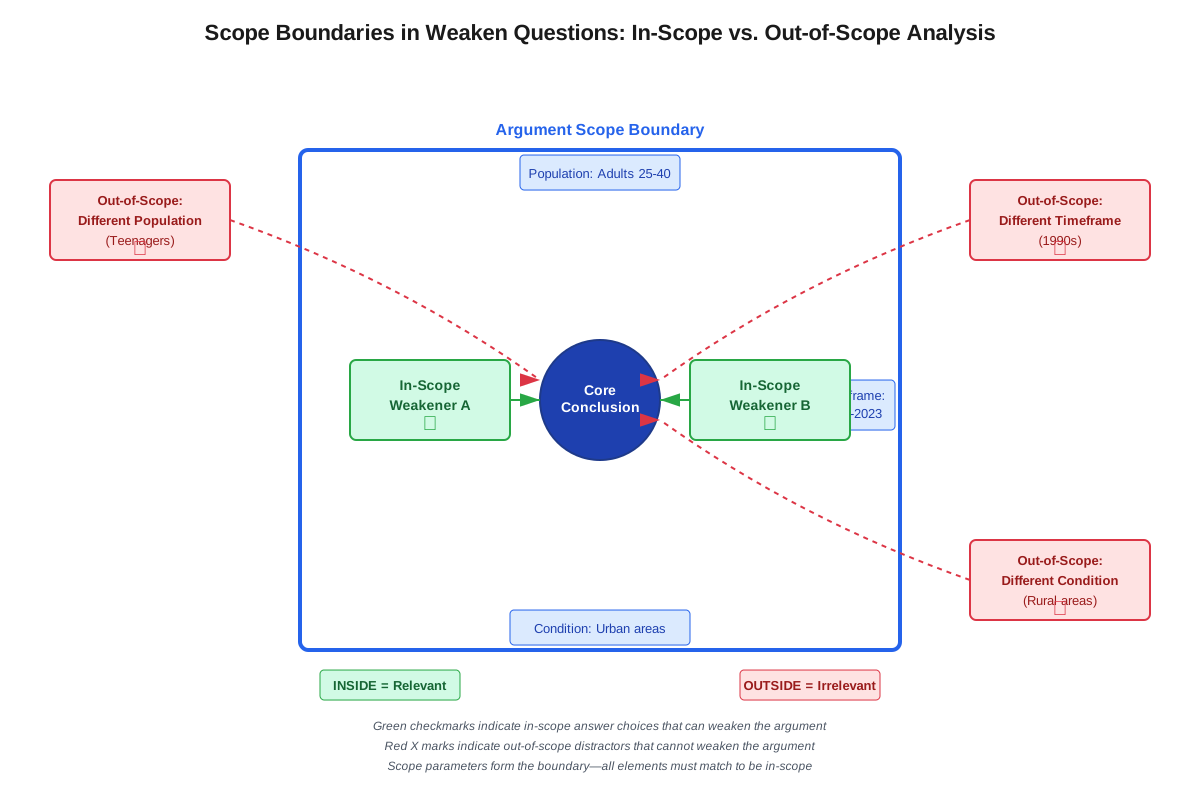
Scope refers to the precise boundaries of an argument—the specific subjects, conditions, timeframes, populations, and circumstances to which the argument's reasoning applies. Every LSAT argument establishes its scope through the language used in its premises and conclusion. When an argument states "Most companies in the technology sector have increased remote work options," the scope is limited to technology sector companies, not all companies, not all organizations, and not companies in other sectors.
Understanding scope requires attention to three key elements:
- Subject scope: What specific entities, groups, or phenomena does the argument discuss?
- Temporal scope: What time period or timeframe does the argument address?
- Conditional scope: Under what specific conditions or circumstances does the argument's reasoning apply?
Scope Violations in Weaken Questions
A scope violation occurs when an answer choice introduces information that falls outside the argument's established boundaries. These violations represent the most common wrong answer type in weaken questions because they exploit the natural human tendency to think associatively rather than analytically. When test-takers encounter information related to the general topic, they often fail to notice that the specific parameters have shifted.
Consider this example: An argument concludes that "increasing police patrols in downtown areas reduces property crime." The scope is specifically downtown areas and property crime. An answer choice stating "Violent crime rates have not decreased despite increased police presence in residential neighborhoods" commits a scope violation on multiple dimensions—it shifts from property crime to violent crime and from downtown areas to residential neighborhoods. Despite seeming relevant to policing and crime, this answer choice cannot weaken the original argument because it addresses entirely different parameters.
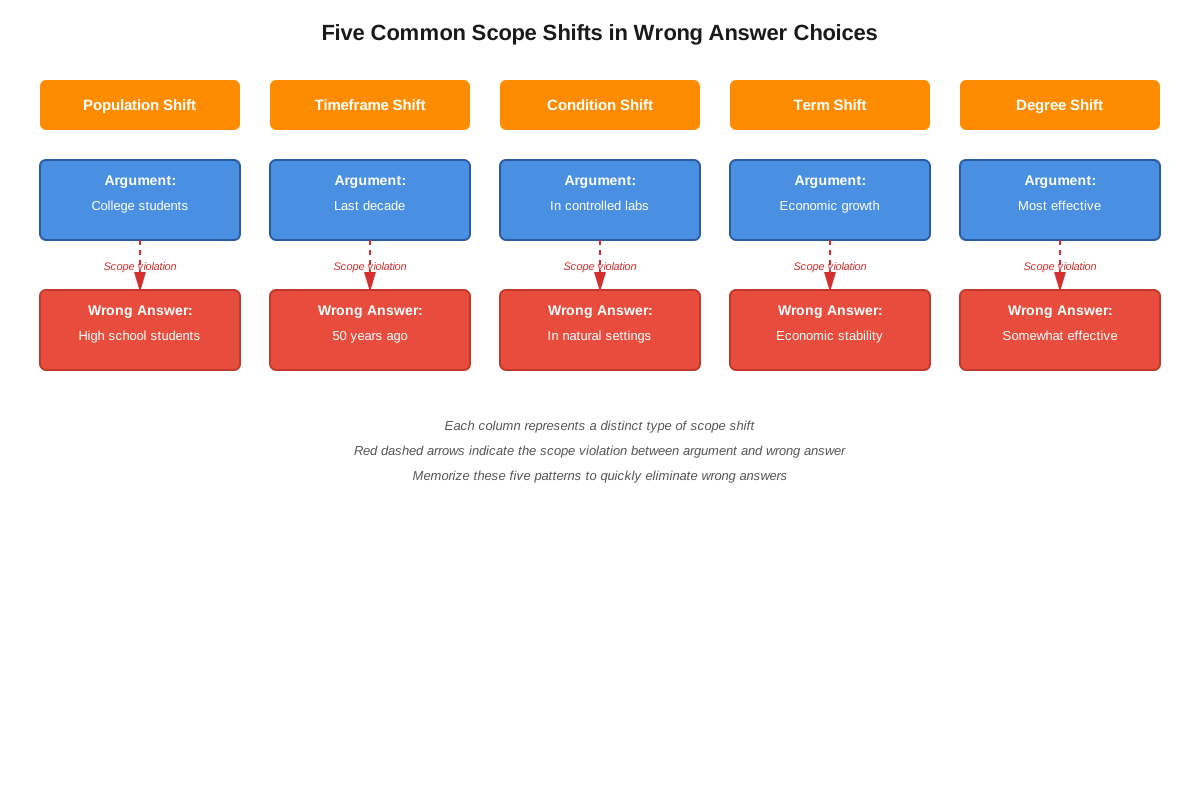
Types of Scope Shifts
The LSAT employs several recurring scope shift patterns:
| Scope Shift Type | Original Argument Scope | Wrong Answer Scope | Why It Fails |
|---|---|---|---|
| Population Shift | Professional athletes | Amateur athletes | Different group with potentially different characteristics |
| Temporal Shift | Current practices | Historical practices | Different time period may have different conditions |
| Geographic Shift | Urban environments | Rural environments | Different locations may have different relevant factors |
| Degree Shift | Complete elimination | Partial reduction | Different magnitude of effect |
| Category Shift | Economic benefits | Environmental benefits | Different type of outcome |
| Conditional Shift | Under specific conditions | Under different conditions | Different circumstances may produce different results |
Recognizing Scope Markers
Arguments signal their scope through specific linguistic markers. Recognizing these markers allows test-takers to establish scope boundaries before evaluating answer choices:
- Quantifiers: "most," "some," "all," "many," "few" establish how broadly claims apply
- Qualifiers: "typically," "usually," "often," "rarely" indicate frequency limitations
- Specific terms: Precise nouns and adjectives that narrow the subject matter
- Temporal indicators: "currently," "in recent years," "historically," "in the future"
- Conditional language: "when," "if," "under circumstances where," "provided that"
The Scope-Assumption Connection
Many weaken questions that test scope awareness simultaneously test assumption identification. Arguments often make assumptions about scope—assuming that what's true in one context applies to another, or that a relationship holds across different populations or conditions. An effective weakener might introduce information showing that the argument's scope is more limited than the conclusion suggests, or that factors differ across the scope boundaries the argument assumes are irrelevant.
For example, an argument might present evidence about medication effectiveness in clinical trials and conclude the medication will be effective for general patients. The scope assumption is that clinical trial populations adequately represent general patient populations. A weakener might reveal that clinical trials excluded patients with common comorbidities, showing the scope of the evidence is narrower than the scope of the conclusion.
Maintaining Scope While Weakening
A correct weaken answer must accomplish two things simultaneously: (1) remain within the argument's scope, and (2) genuinely challenge the reasoning. This dual requirement means that correct answers often feel more subtle or limited than wrong answers. Wrong answers frequently feel more dramatic or sweeping because they bring in new information from outside the scope, which naturally seems more impactful. Correct answers work within constraints, making them sometimes feel less obviously relevant to test-takers who haven't mastered scope analysis.
The most effective weaken answers typically introduce information that directly contradicts a premise, reveals a flawed assumption, provides an alternative explanation, or demonstrates that the stated relationship doesn't hold—all while respecting every scope boundary the argument established.
Concept Relationships
The concepts within scope analysis form an interconnected system. Scope definition serves as the foundation, requiring careful reading of the argument to establish boundaries. This leads directly to scope marker recognition, where specific language signals the precise parameters. Understanding scope markers enables scope violation identification, the ability to spot when answer choices shift parameters. This identification skill connects to scope shift categorization, recognizing the specific type of shift occurring (population, temporal, conditional, etc.).
These analytical skills connect to prerequisite knowledge of argument structure because scope boundaries typically appear in both premises and conclusions, and the relationship between premise scope and conclusion scope often reveals assumptions. The connection to conditional reasoning appears when arguments establish relationships that hold under specific conditions, requiring test-takers to recognize when answer choices shift those conditions.
The relationship map flows as follows:
Careful Argument Reading → Scope Boundary Identification → Scope Marker Recognition → Pre-phrase Scope Parameters → Answer Choice Evaluation → Scope Violation Detection → Correct Answer Selection
This process also connects forward to more advanced topics like sufficient assumption questions (which often require matching scope between premises and conclusions) and parallel reasoning questions (which require matching scope structure across arguments).
High-Yield Facts
⭐ Scope violations represent 70-80% of wrong answers in LSAT weaken questions
⭐ An answer choice can be factually true and logically sound yet still be wrong if it falls outside the argument's scope
⭐ The most common scope shifts involve population changes, temporal changes, and conditional changes
⭐ Correct weaken answers must address the same subject, timeframe, and conditions as the original argument
⭐ Arguments that use specific, narrow terms in premises but broader terms in conclusions often contain scope-based assumptions
- Scope boundaries are established by the most restrictive terms in the argument, not the most general
- When an argument shifts scope between premises and conclusion, that shift itself represents an assumption that can be attacked
- Answer choices that introduce new comparison groups typically commit scope violations
- Quantifier shifts (from "some" to "all" or vice versa) represent scope changes that often appear in wrong answers
- Geographic and demographic specificity in arguments must be matched by answer choices
- Temporal scope includes not just explicit time references but also verb tenses that indicate timeframes
- The phrase "other things being equal" or similar language establishes conditional scope that must be maintained
Quick check — test yourself on Scope in weaken questions so far.
Try Flashcards →Common Misconceptions
Misconception: If an answer choice discusses the same general topic as the argument, it's within scope. → Correction: Scope requires matching specific parameters, not just general subject matter. An argument about technology company hiring practices and an answer about technology company stock prices share a topic but have different scopes.
Misconception: More dramatic or surprising information makes for a better weakener. → Correction: The strength of a weakener depends on its logical relationship to the argument's reasoning, not its dramatic impact. A subtle fact that directly contradicts a key premise within scope is stronger than dramatic information outside scope.
Misconception: If an answer choice weakens a related argument, it weakens the given argument. → Correction: Each argument establishes its own scope boundaries. An answer choice must weaken the specific argument presented, not a similar or related argument.
Misconception: Scope only matters for the conclusion, not the premises. → Correction: Scope boundaries appear throughout arguments. Premises establish evidentiary scope, and the relationship between premise scope and conclusion scope often reveals assumptions that can be attacked.
Misconception: When an argument doesn't explicitly state limitations, there are no scope boundaries. → Correction: All arguments have scope boundaries established by the specific language used. Even without explicit limiting phrases, the particular terms, subjects, and conditions mentioned define the scope.
Misconception: Answer choices that expand the scope of an argument weaken it by showing the conclusion is too narrow. → Correction: Expanding scope doesn't weaken an argument; it simply discusses something different. An argument claiming "X is true for Group A" isn't weakened by information about Group B.
Misconception: Temporal scope only matters when arguments explicitly mention dates or time periods. → Correction: Verb tenses, words like "current" or "recent," and context all establish temporal scope even without explicit dates. An argument using present tense establishes current timeframe scope.
Worked Examples
Example 1: Population Scope Shift
Argument: "A recent study found that among professional musicians who practice at least four hours daily, 85% report high job satisfaction. Therefore, increasing practice time leads to greater job satisfaction for musicians."
Question: Which of the following, if true, most weakens the argument?
Answer Choices:
(A) Many amateur musicians who practice fewer than two hours daily report high job satisfaction.
(B) Professional musicians who practice four hours daily earn significantly more than those who practice less.
(C) Among professional musicians who practice at least four hours daily, those who chose their specialization freely are more likely to report high job satisfaction than those who did not.
(D) Some professional musicians who practice more than six hours daily report lower job satisfaction than those who practice four hours daily.
(E) Amateur musicians generally have different motivations for practicing than professional musicians.
Analysis:
First, identify the scope: The argument is about professional musicians who practice at least four hours daily and their job satisfaction. The conclusion claims a causal relationship between practice time and satisfaction.
Now evaluate each answer:
(A) Scope violation: This discusses amateur musicians with fewer than two hours of practice. The argument establishes scope as professional musicians with at least four hours, so information about a different population with different practice levels falls outside scope. Even though it discusses musicians and satisfaction, the parameters have shifted.
(B) Potentially relevant but doesn't weaken: This stays within scope (professional musicians, four hours practice) but introduces earnings information. This doesn't weaken the causal claim; if anything, it might suggest an alternative explanation, but it doesn't directly challenge the practice-satisfaction relationship.
(C) CORRECT: This stays perfectly within scope—professional musicians practicing at least four hours daily. It weakens the argument by suggesting that the correlation between practice time and satisfaction might be explained by a confounding variable (freedom of choice in specialization) rather than practice time causing satisfaction. This provides an alternative explanation while maintaining all scope parameters.
(D) Scope extension without weakening the core claim: This discusses professional musicians but shifts to "more than six hours," which is beyond the scope of "at least four hours." The argument doesn't claim that more practice always leads to more satisfaction, only that the four-hour level correlates with high satisfaction.
(E) Scope violation: This compares amateur and professional musicians, but the argument only makes claims about professional musicians. Information about differences between groups doesn't weaken claims about one specific group.
Key Lesson: Answer choice (C) demonstrates how correct weakeners stay within scope while introducing information that challenges the reasoning. Answer choices (A) and (E) show common population scope violations, while (D) shows how extending beyond the stated parameters creates a scope violation.
Example 2: Conditional and Temporal Scope
Argument: "City officials claim that the new traffic camera system has improved safety. Since the cameras were installed six months ago at ten major intersections, accidents at those intersections have decreased by 30%. Therefore, the traffic camera system is effective at reducing accidents."
Question: Which of the following, if true, most seriously weakens the argument?
Answer Choices:
(A) Traffic cameras installed in a neighboring city five years ago showed no long-term reduction in accidents.
(B) During the same six-month period, accidents decreased by 35% at major intersections throughout the city that did not have cameras installed.
(C) The traffic cameras have generated significant revenue from traffic violations.
(D) Some drivers report that they are more cautious at intersections where they know cameras are present.
(E) Traffic cameras are expensive to maintain and require regular technical updates.
Analysis:
Scope identification: The argument concerns specific intersections (the ten with cameras), a specific timeframe (six months since installation), and a specific outcome (accident reduction). The conclusion claims the camera system caused the reduction.
Evaluate each answer:
(A) Temporal and geographic scope violation: This discusses a different city (geographic shift) and a different timeframe (five years ago versus current six months). The argument makes claims about the current system in this city, so information about different circumstances doesn't weaken it.
(B) CORRECT: This maintains perfect scope—same city, same timeframe, same outcome measure (accidents at major intersections). It devastatingly weakens the causal claim by showing that intersections without cameras experienced even greater accident reduction, suggesting the cameras didn't cause the improvement. Some other factor affecting the entire city likely explains the reduction.
(C) Irrelevant scope shift: This shifts from safety/accident reduction to revenue generation. The argument's scope is accident reduction effectiveness, not financial considerations.
(D) Supports rather than weakens: This stays within scope and actually supports the causal mechanism by explaining how cameras might reduce accidents. It doesn't weaken the argument.
(E) Scope shift to cost considerations: Like (C), this shifts from effectiveness at reducing accidents to financial/maintenance issues, which falls outside the argument's scope.
Key Lesson: Answer choice (B) illustrates how maintaining temporal and geographic scope while introducing comparison data can effectively weaken causal claims. The wrong answers show various scope violations: temporal/geographic (A), outcome measure shifts (C, E), and information that supports rather than weakens (D).
Exam Strategy
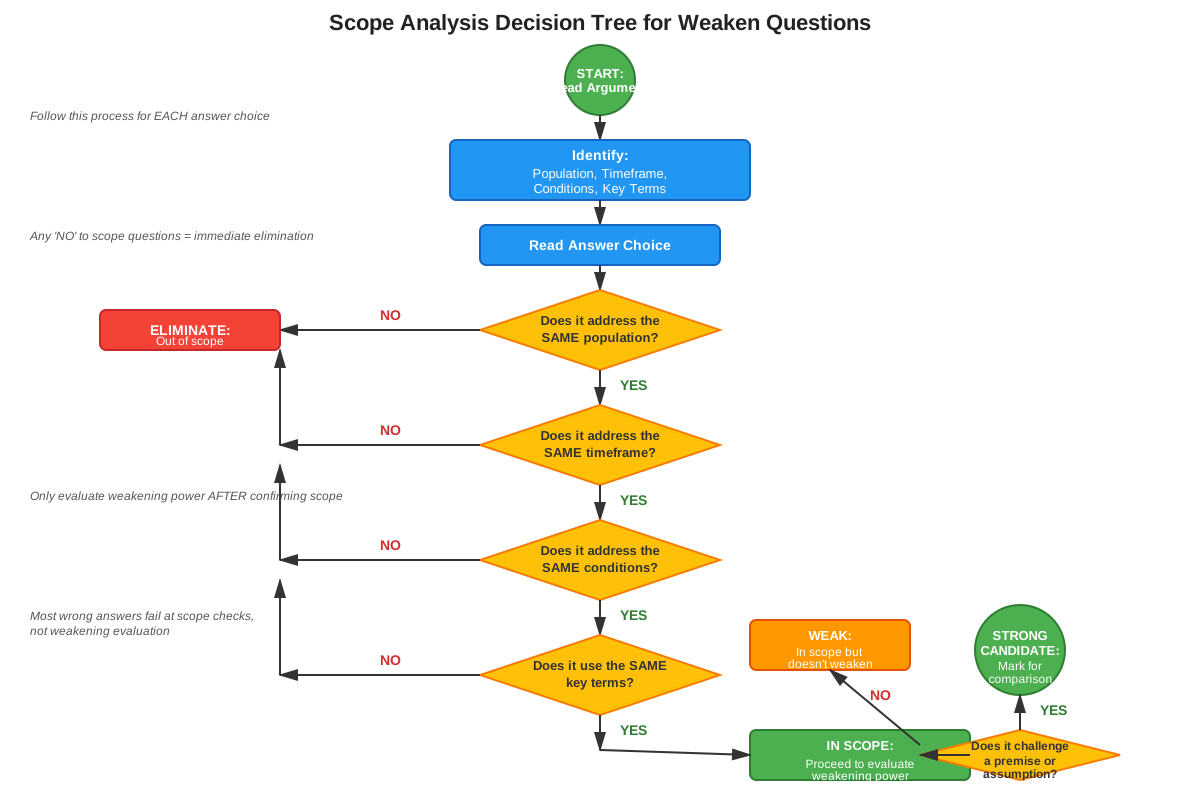
When approaching weaken questions with scope considerations, follow this systematic process:
Step 1: Read the argument and identify scope markers (30 seconds)
- Circle or mentally note specific terms, quantifiers, temporal indicators, and conditional language
- Ask: "What exactly is this argument about? What are the boundaries?"
Step 2: Articulate scope parameters before reading answers (15 seconds)
- Mentally state: "This argument is specifically about [subject] in [context] during [timeframe] under [conditions]"
- This pre-phrasing prevents answer choices from shifting your understanding
Step 3: Evaluate each answer choice for scope compliance first (10 seconds per choice)
- Before considering whether an answer weakens, ask: "Does this discuss the same subject, timeframe, and conditions?"
- Eliminate scope violations immediately
Step 4: Among scope-compliant answers, identify the strongest weakener (15 seconds)
- Only after confirming scope compliance, evaluate logical impact
Exam Tip: If you find yourself attracted to an answer choice because it seems dramatic or introduces surprising information, pause and verify scope. The LSAT exploits the psychological appeal of dramatic information that falls outside scope.
Trigger words indicating scope boundaries:
- "Specifically," "particularly," "only," "exclusively" → narrow scope markers
- "In this case," "under these conditions," "when" → conditional scope markers
- "Recent," "current," "historically," "in the past" → temporal scope markers
- "Most," "some," "all," "many" → quantifier scope markers
Process-of-elimination strategy:
- First pass: Eliminate obvious scope violations (typically 2-3 answers)
- Second pass: Among remaining answers, eliminate those that strengthen or are irrelevant
- Final evaluation: Choose the answer that weakens while maintaining scope
Time allocation: Spend more time on scope identification upfront (45 seconds) to save time eliminating wrong answers (30 seconds total). This front-loaded approach prevents the time-consuming mistake of seriously considering scope-violating answers.
Memory Techniques
SCOPE Acronym for Boundary Checking:
- Subject: What specific entity or group?
- Conditions: Under what circumstances?
- Outcome: What specific result or effect?
- Population: Which people or things exactly?
- Era: What timeframe?
The "Same Game" Visualization: Picture the argument as occurring in a specific room with specific people at a specific time. A correct weaken answer must enter that same room—same people, same time, same circumstances. Wrong answers try to enter different rooms (different people, times, or circumstances) even if the rooms are in the same building (same general topic).
The Spotlight Metaphor: Imagine the argument's scope as a spotlight illuminating a specific area on a stage. Correct answers must stay within that lit area. Wrong answers step outside the spotlight into darkness, even if they're still on the same stage (same general topic area).
Quantifier Hierarchy Memory Aid:
- ALL > MOST > MANY > SOME > FEW
- Moving down this hierarchy narrows scope; moving up broadens it
- Scope violations often involve moving up or down this hierarchy
The Three T's of Scope: Topic (general subject), Terms (specific language), Timeframe (when). All three must match for an answer to be in scope.
Summary
Scope in weaken questions represents a critical analytical skill that separates high-scoring test-takers from those who struggle with Logical Reasoning. Understanding scope means recognizing the precise boundaries of an argument—the specific subjects, populations, timeframes, conditions, and circumstances to which the reasoning applies. The LSAT consistently exploits scope confusion by creating wrong answer choices that discuss related topics but shift one or more scope parameters, making them irrelevant to the actual argument despite superficial topical similarity. Mastering scope analysis requires careful attention to scope markers in the argument (quantifiers, qualifiers, specific terms, temporal indicators, and conditional language), systematic evaluation of whether answer choices maintain all scope parameters, and the discipline to eliminate dramatic-sounding information that falls outside the argument's boundaries. The most effective approach involves identifying scope boundaries before reading answer choices, eliminating scope violations first, and only then evaluating the logical impact of scope-compliant answers. This skill connects fundamentally to argument structure analysis, assumption identification, and conditional reasoning, while serving as a foundation for advanced question types throughout Logical Reasoning.
Key Takeaways
- Scope violations represent the most common wrong answer type in weaken questions, appearing in 70-80% of incorrect choices
- Maintaining scope requires matching all parameters: subject, population, timeframe, conditions, and outcome measures
- Dramatic or surprising information outside scope is weaker than subtle information within scope that directly challenges the reasoning
- Identify scope boundaries before reading answer choices to prevent answer choices from shifting your understanding of the argument
- The SCOPE acronym (Subject, Conditions, Outcome, Population, Era) provides a systematic framework for boundary checking
- Scope shifts most commonly involve population changes, temporal changes, and conditional changes
- Every argument establishes scope through specific language—even arguments without explicit limiting phrases have boundaries defined by the terms used
Related Topics
Strengthen Questions with Scope Considerations: While this guide focuses on weaken questions, scope analysis applies equally to strengthen questions, where correct answers must remain within scope while supporting the reasoning. Mastering scope in weaken questions directly transfers to strengthen question performance.
Necessary Assumption Questions: These questions often test whether students recognize scope gaps between premises and conclusions. Understanding scope boundaries helps identify when conclusions make claims beyond the scope of the evidence provided.
Sufficient Assumption Questions: These require matching scope between premises and conclusions, often by adding information that bridges scope gaps. Scope mastery in weaken questions provides the foundation for recognizing these gaps.
Flaw Questions: Many logical flaws involve scope issues—arguments that generalize beyond their evidence, shift terms between premises and conclusions, or make claims about one group based on evidence about another. Scope awareness developed through weaken questions enhances flaw identification.
Parallel Reasoning Questions: These require matching argument structure, including scope structure. Understanding how scope operates in weaken questions helps recognize when parallel arguments maintain or violate scope boundaries.
Practice CTA
Now that you understand scope in weaken questions, it's time to apply these concepts to actual LSAT-style problems. The practice questions and flashcards will help you internalize scope boundary identification, recognize common scope violations, and develop the systematic approach that leads to consistent accuracy. Remember: scope mastery transforms weaken questions from challenging puzzles into systematic exercises. Each practice question you complete strengthens your ability to spot scope violations instantly, giving you both accuracy and speed advantages on test day. Approach the practice materials with the same careful attention to scope markers and boundaries that this guide has emphasized—your investment in deliberate practice will pay dividends across all Logical Reasoning question types.
Sign up free to keep reading
Create a free AnvayaPrep account to finish this LSAT guide on Scope in weaken questions — plus flashcards and practice questions.