Overview
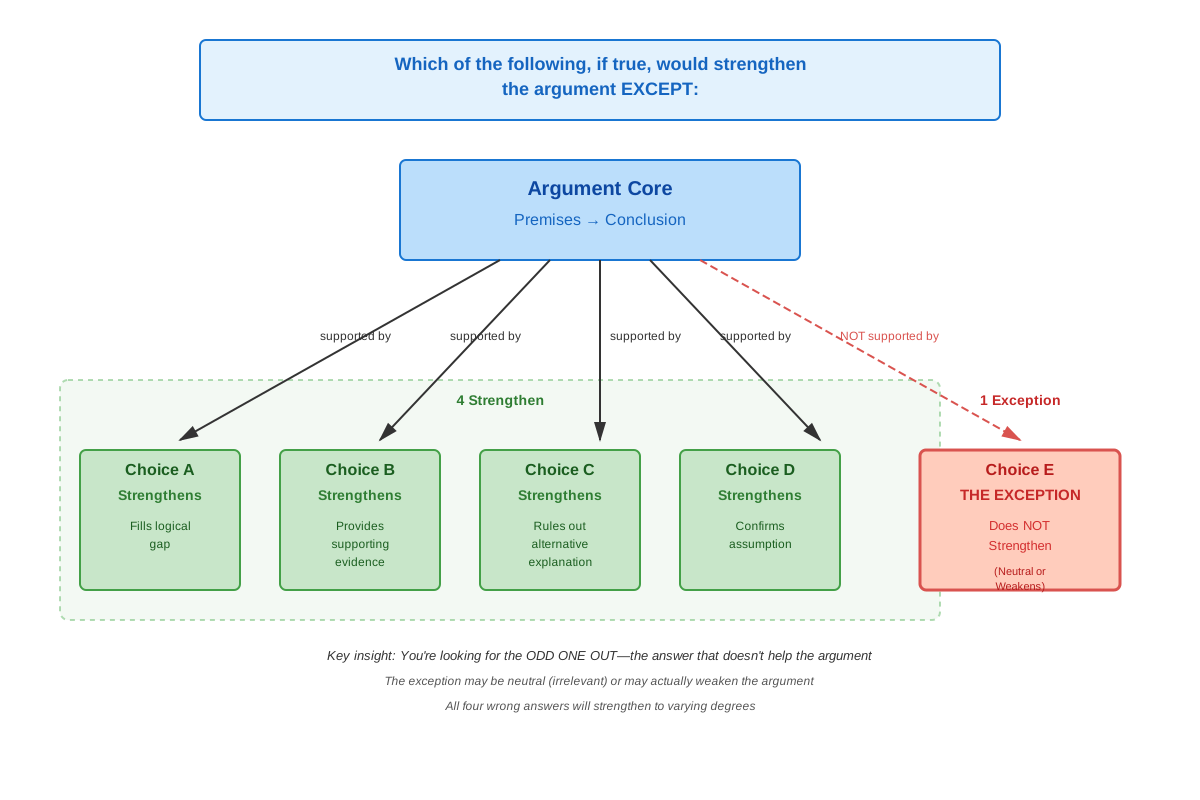
Strengthen except questions represent a unique and challenging question type within the LSAT's Logical Reasoning section. Unlike standard strengthen questions that ask test-takers to identify which answer choice most supports an argument, strengthen except questions flip the script by asking which answer choice does NOT strengthen the argument—or may even weaken it or have no effect. This question type tests not only a student's ability to recognize supporting evidence but also their capacity to distinguish between different types of logical relationships under time pressure.
These questions are essential for LSAT success because they require a sophisticated understanding of argument structure and the various ways evidence can relate to a conclusion. Students must evaluate five answer choices, typically finding four that strengthen the argument in different ways, while identifying the one outlier that fails to provide support. This demands careful analysis and the ability to avoid common traps, such as confusing neutral statements with strengthening ones or mistaking weak support for no support at all.
Within the broader landscape of strengthen and weaken questions, strengthen except questions occupy a critical position. They build upon foundational skills in argument analysis, assumption identification, and evidence evaluation while adding an additional layer of complexity through their inverted structure. Mastering this question type enhances overall performance on Logical Reasoning by sharpening the ability to recognize subtle distinctions between answer choices—a skill that transfers to virtually every other question type on the exam.
Learning Objectives
- [ ] Identify how Strengthen except questions appears in LSAT questions
- [ ] Explain the reasoning pattern behind Strengthen except questions
- [ ] Apply Strengthen except questions to solve LSAT-style problems accurately
- [ ] Distinguish between answer choices that strengthen an argument and those that are neutral or weakening
- [ ] Recognize common trap answers in strengthen except questions
- [ ] Evaluate the degree of support provided by different types of evidence
- [ ] Efficiently process all five answer choices to identify the exception
Prerequisites
- Basic argument structure: Understanding premises, conclusions, and assumptions is fundamental because strengthen except questions require identifying which answer choice fails to support the connection between premises and conclusion.
- Standard strengthen questions: Familiarity with how evidence can support an argument provides the foundation for recognizing when evidence does NOT provide support.
- Logical reasoning fundamentals: Knowledge of valid and invalid reasoning patterns enables quick evaluation of whether an answer choice adds logical force to an argument.
- Assumption identification: Recognizing unstated assumptions helps determine which answer choices fill logical gaps (strengthening) versus which do not.
Why This Topic Matters
Strengthen except questions appear regularly on the LSAT, typically comprising 2-4 questions per exam across both Logical Reasoning sections. While less common than standard strengthen or weaken questions, they are considered medium-to-high difficulty and often separate high scorers from average performers. Test-makers favor these questions because they efficiently assess multiple skills simultaneously: argument comprehension, evidence evaluation, and careful attention to question stems.
In real-world applications, the skills developed through strengthen except questions translate directly to critical thinking in legal practice. Attorneys must constantly evaluate which pieces of evidence support their case and which are irrelevant or potentially harmful. During discovery, trial preparation, and oral arguments, the ability to quickly categorize information as helpful, neutral, or damaging is invaluable. Law students who excel at strengthen except questions often find these same analytical skills essential for case briefing, legal writing, and classroom discussions.
On the LSAT, these questions commonly appear with question stems such as "Each of the following, if true, strengthens the argument EXCEPT," "All of the following provide support for the conclusion EXCEPT," or "Each of the following, if true, provides a reason to believe the conclusion EXCEPT." The capitalized "EXCEPT" serves as a critical signal that students must adjust their approach from the standard strengthen question strategy.
Core Concepts
Understanding the Question Structure
Strengthen except questions follow a distinctive format that requires careful attention to the question stem. The stem explicitly states that four answer choices will strengthen the argument while one will not. This "one of these things is not like the others" structure means students must evaluate each answer choice individually and compare their effects on the argument. The correct answer—the exception—may weaken the argument, have no effect on it, or provide such minimal support that it's functionally neutral.
The key distinction lies in understanding what "strengthen" means in this context. An answer choice strengthens an argument when it makes the conclusion more likely to be true given the premises. This can occur through multiple mechanisms: providing additional supporting evidence, ruling out alternative explanations, confirming necessary assumptions, or demonstrating that conditions favorable to the conclusion exist.
The Four Types of Exception Answers
When identifying the exception in strengthen except questions, the correct answer typically falls into one of four categories:
- Weakening answer: This choice actually undermines the argument by suggesting the conclusion is less likely to be true. This is the most straightforward type of exception.
- Neutral answer: This choice provides information that is factually true but logically irrelevant to the argument's conclusion. It neither strengthens nor weakens.
- Irrelevant scope answer: This choice discusses a related topic but falls outside the specific scope of the argument, making it unable to provide meaningful support.
- Minimal support answer: This choice provides such weak or tangential support that it effectively fails to strengthen the argument in any meaningful way.
Evaluating Answer Choices Systematically
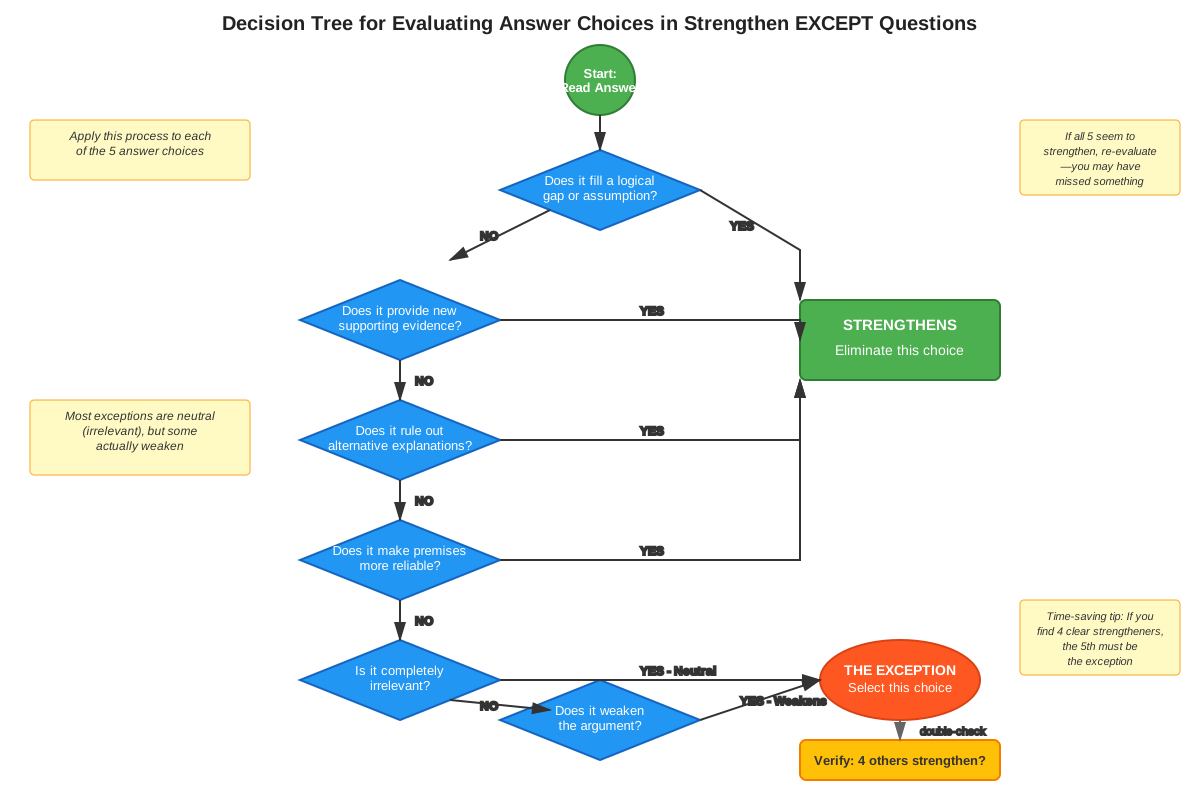
The most effective approach to strengthen except questions involves a systematic evaluation process. First, identify the argument's conclusion and premises clearly. Second, recognize any gaps or assumptions in the reasoning. Third, evaluate each answer choice by asking: "If this were true, would it make the conclusion more likely?" Fourth, mark each choice as either "strengthens" or "exception candidate." Finally, verify that the chosen exception truly fails to strengthen while the other four choices do provide support.
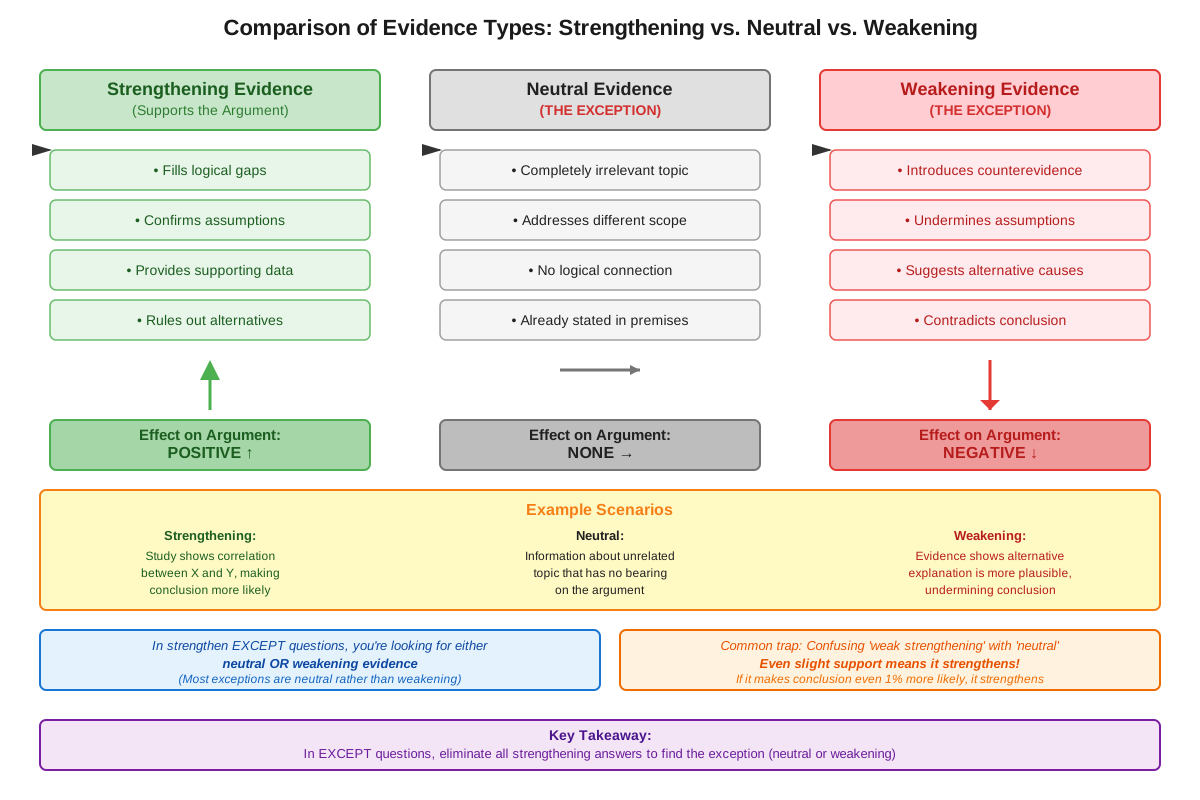
| Answer Choice Type | Effect on Argument | How to Identify |
|---|---|---|
| Strengthens (wrong answer) | Makes conclusion more likely | Fills logical gaps, adds supporting evidence, confirms assumptions |
| Weakens (correct exception) | Makes conclusion less likely | Contradicts premises, suggests alternative explanations, undermines assumptions |
| Neutral (correct exception) | No effect on likelihood | Discusses unrelated information, provides irrelevant facts |
| Out of scope (correct exception) | Cannot affect argument | Addresses different subject matter or time frame |
Common Strengthening Mechanisms
Understanding how answer choices typically strengthen arguments helps identify when one fails to do so. The most common strengthening mechanisms include:
- Assumption confirmation: The answer choice explicitly states an assumption the argument depends upon
- Alternative explanation elimination: The answer choice rules out competing explanations for the evidence presented
- Causal link support: The answer choice provides evidence that a causal relationship exists when the argument assumes one
- Representativeness confirmation: The answer choice shows that a sample or example is representative of a larger group
- Feasibility demonstration: The answer choice shows that a proposed plan or action is practical and achievable
The Role of Conditional Logic
Many strengthen except questions involve conditional reasoning, where the argument contains "if-then" relationships. In these cases, answer choices that strengthen typically either confirm the sufficient condition has occurred, deny the necessary condition has failed, or establish that the conditional relationship itself is valid. The exception answer might reverse the conditional, confuse necessary and sufficient conditions, or introduce irrelevant conditional statements.
Degree of Support Matters
A subtle but important concept in strengthen except questions is that the four strengthening answers need not provide equal support. One answer might dramatically strengthen the argument while another provides only modest support—both are still "wrong" answers because they do strengthen. The exception is the only choice that crosses the threshold into providing no meaningful support (or actively weakening). Students must avoid the trap of selecting an answer that provides weak support, thinking it's the exception when it actually does strengthen the argument to some degree.
Concept Relationships
The concepts within strengthen except questions form an interconnected web of logical relationships. Understanding the question structure → enables systematic evaluation of answer choices → which requires knowledge of strengthening mechanisms → which depends on recognizing argument assumptions → which connects back to basic argument structure.
Strengthen except questions build directly upon standard strengthen questions, inverting the task while requiring the same foundational skills. They also relate closely to weaken questions, as the exception answer may actually weaken the argument. The ability to distinguish between strengthening, neutral, and weakening effects connects to assumption questions, as assumptions represent gaps that strengthening evidence fills.
Within the broader unit of strengthen and weaken questions, these except questions represent an advanced application that tests mastery of the entire category. They require not just identifying one correct relationship between evidence and conclusion, but evaluating five different relationships simultaneously. This skill transfers to parallel reasoning questions, where multiple logical structures must be compared, and to method of reasoning questions, where the function of evidence must be precisely characterized.
High-Yield Facts
- ⭐ Strengthen except questions ask for the ONE answer choice that does NOT strengthen the argument; four choices will strengthen, one will not
- ⭐ The correct answer (the exception) may weaken the argument, be neutral/irrelevant, or provide such minimal support it's effectively useless
- ⭐ The question stem will always contain the word "EXCEPT" in capital letters as a critical signal to adjust strategy
- ⭐ All four incorrect answers must strengthen the argument to some degree, but they need not provide equal amounts of support
- ⭐ The most common trap is selecting an answer that provides weak support, mistaking it for no support
- Strengthen except questions typically appear 2-4 times per LSAT exam across both Logical Reasoning sections
- The exception answer is often neutral rather than weakening, making it harder to identify than in standard strengthen questions
- Evaluating each answer choice with "If this were true, would the conclusion be more likely?" is the most reliable approach
- Answer choices that discuss irrelevant scope or time frames are frequently the correct exception
- Strengthening mechanisms include confirming assumptions, eliminating alternatives, supporting causal links, and demonstrating feasibility
- The argument's conclusion must be clearly identified before evaluating answer choices, as support is always relative to the conclusion
- Conditional logic often appears in strengthen except questions, requiring careful attention to necessary and sufficient conditions
- Time management is critical: spending too long searching for perfect strengthening can waste valuable seconds
- The exception answer will never strengthen the argument even slightly—if it provides any support, it's not the correct answer
- Process of elimination works well: mark each strengthening answer and the remaining choice is the exception
Quick check — test yourself on Strengthen except questions so far.
Try Flashcards →Common Misconceptions
Misconception: The exception answer must weaken the argument. → Correction: While the exception may weaken the argument, it can also be completely neutral or irrelevant. Many correct exceptions simply provide information that has no bearing on the conclusion's likelihood.
Misconception: All four strengthening answers must provide strong, obvious support. → Correction: The four strengthening answers can vary significantly in the degree of support they provide. One might dramatically strengthen while another provides only modest support—both are still incorrect answers because they do strengthen to some degree.
Misconception: If an answer choice is factually true, it must strengthen the argument. → Correction: Truth and relevance are separate issues. An answer choice can be completely true but logically irrelevant to the argument's conclusion, making it unable to provide support.
Misconception: The exception answer will be obviously different from the other four choices. → Correction: Test-makers deliberately craft answer choices to appear similar in structure and content. The distinction between strengthening and not strengthening can be subtle, requiring careful analysis rather than pattern recognition.
Misconception: Strengthen except questions are just strengthen questions in reverse. → Correction: While related, strengthen except questions require a different cognitive approach. Instead of finding the best support, students must evaluate all five choices and identify the single outlier, which demands more comprehensive analysis and comparison.
Misconception: The correct answer will always be in a specific position (like choice E). → Correction: The LSAT randomizes correct answer positions. While some students perceive patterns, statistical analysis shows no positional bias for exception answers.
Misconception: If an answer choice introduces new information, it cannot strengthen the argument. → Correction: Strengthening answers frequently introduce new information—that's often how they provide support. The question is whether the new information makes the conclusion more likely, not whether it was mentioned in the stimulus.
Worked Examples
Example 1: Environmental Policy Argument
Stimulus: A city council member argues that the city should ban single-use plastic bags because such bans have reduced plastic waste in other cities. The council member notes that plastic bags contribute significantly to landfill volume and that residents have expressed concern about environmental issues.
Question Stem: Each of the following, if true, strengthens the council member's argument EXCEPT:
Answer Choices:
(A) Reusable bags are readily available and affordable for all city residents.
(B) The city's landfill is approaching capacity and will require expensive expansion within five years.
(C) Surveys show that 78% of city residents support environmental protection measures.
(D) Cities with plastic bag bans have seen a 60% reduction in plastic waste within two years of implementation.
(E) Plastic bags are manufactured using petroleum-based materials.
Analysis:
First, identify the conclusion: The city should ban single-use plastic bags. The premises are: (1) such bans have reduced plastic waste elsewhere, (2) plastic bags contribute to landfill volume, and (3) residents care about environmental issues.
Now evaluate each choice:
(A) Strengthens: If reusable bags are accessible and affordable, this removes a potential objection to the ban (that residents couldn't comply) and makes the policy more feasible. This supports implementing the ban.
(B) Strengthens: This adds urgency to the argument by showing that reducing landfill volume (which the ban would accomplish) is particularly important now. This makes the conclusion more compelling.
(C) Neutral/Exception: While this tells us residents support environmental protection generally, it doesn't specifically connect to plastic bag bans. Residents might support environmental measures but oppose this particular ban, or they might prioritize other environmental issues. This provides no meaningful support for the specific conclusion about banning plastic bags.
(D) Strengthens: This provides concrete evidence that plastic bag bans actually work as intended, directly supporting the premise that such bans reduce plastic waste and making the conclusion more justified.
(E) Strengthens: This adds an additional environmental concern (petroleum use) beyond the landfill issue already mentioned, providing another reason to support the ban.
Correct Answer: (C) is the exception because it discusses general environmental attitudes without connecting them specifically to plastic bag bans.
Example 2: Business Strategy Argument
Stimulus: A retail company's CEO argues that opening stores in rural areas will increase overall profitability. The CEO points out that the company currently has no presence in rural markets and that rural populations have been growing over the past decade. Additionally, the company's market research shows that rural consumers have fewer shopping options than urban consumers.
Question Stem: All of the following provide support for the CEO's conclusion EXCEPT:
Answer Choices:
(A) Rural consumers have demonstrated brand loyalty to the first major retailer that enters their market.
(B) The company's products are designed to appeal to demographic groups well-represented in rural areas.
(C) Transportation costs for supplying rural stores would be offset by lower real estate and labor costs in rural locations.
(D) Urban markets where the company currently operates are becoming increasingly saturated with competitors.
(E) Rural areas have experienced population growth primarily among retirees with fixed incomes.
Analysis:
The conclusion is: Opening stores in rural areas will increase overall profitability. The premises are: (1) no current rural presence, (2) rural populations growing, and (3) rural consumers have fewer options.
Evaluate each choice:
(A) Strengthens: If rural consumers are loyal to first entrants, and the company would be entering an underserved market, this suggests they could capture significant market share, supporting increased profitability.
(B) Strengthens: If the company's products match rural demographics, this increases the likelihood that rural stores would attract customers and generate sales, supporting the profitability conclusion.
(C) Strengthens: This directly addresses a potential concern about rural expansion (high costs) by showing that cost disadvantages would be balanced by savings, making profitability more likely.
(D) Strengthens: This provides an additional reason to expand into rural areas—urban markets are becoming less profitable due to competition, making rural expansion relatively more attractive.
(E) Weakens/Exception: This actually undermines the argument. If rural population growth is primarily among retirees with fixed incomes, these consumers may have limited purchasing power, making them less profitable customers. This suggests rural expansion might not increase profitability as predicted.
Correct Answer: (E) is the exception because it weakens rather than strengthens the argument by suggesting the growing rural population may not represent profitable customers.
Exam Strategy
When approaching lsat strengthen except questions, begin by reading the question stem carefully before reading the stimulus. Seeing "EXCEPT" immediately signals that the task is inverted—find the one that doesn't strengthen rather than the one that does. This mental preparation prevents the common error of selecting the first strengthening answer encountered.
Exam Tip: Circle or underline "EXCEPT" in the question stem to maintain awareness throughout answer choice evaluation. This physical action reinforces the inverted task.
After reading the stimulus, identify the conclusion explicitly. Write a brief note or mentally articulate: "The conclusion is X." This anchor point is essential because strengthening is always relative to the conclusion. Then identify the main premises and any obvious gaps or assumptions in the reasoning.
As you evaluate answer choices, use a marking system. Place a small "S" next to choices that strengthen and leave blank or mark with "?" any that might be the exception. This visual tracking prevents confusion when comparing multiple choices. If time permits, briefly note how each strengthening answer provides support—this helps verify that it truly strengthens rather than just appearing relevant.
Trigger words and phrases to watch for in strengthen except questions include:
- "EXCEPT" (always capitalized)
- "All of the following...EXCEPT"
- "Each of the following...EXCEPT"
- "provides support," "strengthens," "provides a reason to believe"
Process of elimination strategy: Since four answers must strengthen, finding even three clear strengtheners means the correct answer is one of the remaining two. This can save time by allowing you to focus comparison on just two choices rather than re-evaluating all five.
Time allocation: Spend approximately 1:15-1:30 on strengthen except questions, slightly more than standard strengthen questions due to the need to evaluate all five choices rather than stopping at the first correct answer. If you're uncertain between two choices, select the one that seems more neutral or irrelevant rather than the one that provides weak support—weak support still counts as strengthening.
Common trap avoidance: Be especially wary of answer choices that seem relevant to the topic but don't actually connect to the conclusion. Test-makers often include answers that discuss related issues without providing logical support for the specific conclusion stated.
Memory Techniques
SWEEP - A mnemonic for evaluating strengthen except questions:
- Stem signals exception (check for EXCEPT)
- What's the conclusion? (identify before evaluating choices)
- Evaluate each choice individually
- Eliminate strengtheners systematically
- Pick the outlier (neutral, weakening, or irrelevant)
The Four Ns - Remember the four types of exception answers:
- Neutral (no effect)
- Negative (weakens)
- Narrow scope (irrelevant)
- Negligible support (too weak to count)
Visualization strategy: Picture the argument as a bridge with gaps. Strengthening answers are planks that fill gaps or support the structure. The exception answer is either a plank that doesn't fit any gap (neutral), a plank for a different bridge (irrelevant), or something that damages the bridge (weakening). This mental image helps distinguish between relevant support and the exception.
The "More Likely" Test: For each answer choice, ask "Does this make the conclusion MORE LIKELY?" If yes, it strengthens (wrong answer). If no or unclear, it's the exception candidate. This simple verbal test provides a consistent evaluation framework.
Summary
Strengthen except questions represent a sophisticated LSAT question type that tests the ability to evaluate multiple logical relationships simultaneously. These questions require identifying the one answer choice among five that fails to strengthen an argument, while the other four provide varying degrees of support. The exception answer may weaken the argument, remain neutral, fall outside the argument's scope, or provide such minimal support that it's functionally useless. Success requires careful attention to the question stem's "EXCEPT" signal, clear identification of the argument's conclusion, systematic evaluation of each answer choice, and the ability to distinguish between strengthening, neutral, and weakening effects. The most common trap is selecting an answer that provides weak support, mistaking it for no support. By understanding strengthening mechanisms, recognizing common exception types, and applying systematic evaluation strategies, students can master this challenging question type and improve overall Logical Reasoning performance.
Key Takeaways
- Strengthen except questions ask for the ONE answer choice that does NOT strengthen; four will strengthen, one will not
- The exception may weaken, be neutral/irrelevant, fall outside scope, or provide negligible support—it need not actively undermine the argument
- Always identify the conclusion before evaluating answer choices, as strengthening is relative to what the argument is trying to prove
- Use systematic evaluation: mark each strengthener and identify the outlier through comparison
- The most common error is selecting weak support instead of no support—any degree of strengthening makes an answer incorrect
- Process of elimination is highly effective: finding three clear strengtheners narrows the correct answer to two remaining choices
- Watch for answer choices that seem topically related but don't logically connect to the specific conclusion stated
Related Topics
Standard Strengthen Questions: Mastering strengthen except questions builds upon and reinforces skills in standard strengthen questions, where the task is to identify the single best strengthening answer. Understanding both question types together provides comprehensive knowledge of how evidence supports conclusions.
Weaken Questions and Weaken Except Questions: These mirror strengthen questions but focus on undermining arguments. The logical skills developed through strengthen except questions transfer directly to evaluating weakening relationships.
Necessary Assumption Questions: These questions identify gaps in arguments that must be filled for the reasoning to work. Strengthen except questions often test whether answer choices fill these gaps, making assumption identification a closely related skill.
Sufficient Assumption Questions: Understanding what would guarantee a conclusion helps recognize strong versus weak support, a distinction critical for strengthen except questions.
Parallel Reasoning Questions: The ability to evaluate multiple logical structures simultaneously, developed through strengthen except questions, applies directly to parallel reasoning questions where argument structures must be compared.
Practice CTA
Now that you've mastered the core concepts behind strengthen except questions, it's time to put your knowledge into practice. Work through the practice questions carefully, applying the systematic evaluation strategies and memory techniques covered in this guide. Pay special attention to identifying the conclusion before evaluating answer choices, and remember to mark strengtheners as you go. Each practice question you complete strengthens your ability to recognize patterns and avoid common traps. The flashcards will help reinforce key concepts and ensure you can quickly recall strengthening mechanisms under time pressure. Consistent practice with these materials will transform strengthen except questions from a challenging obstacle into a reliable opportunity to demonstrate your logical reasoning mastery. You've got this!
Sign up free to keep reading
Create a free AnvayaPrep account to finish this LSAT guide on Strengthen except questions — plus flashcards and practice questions.