Overview
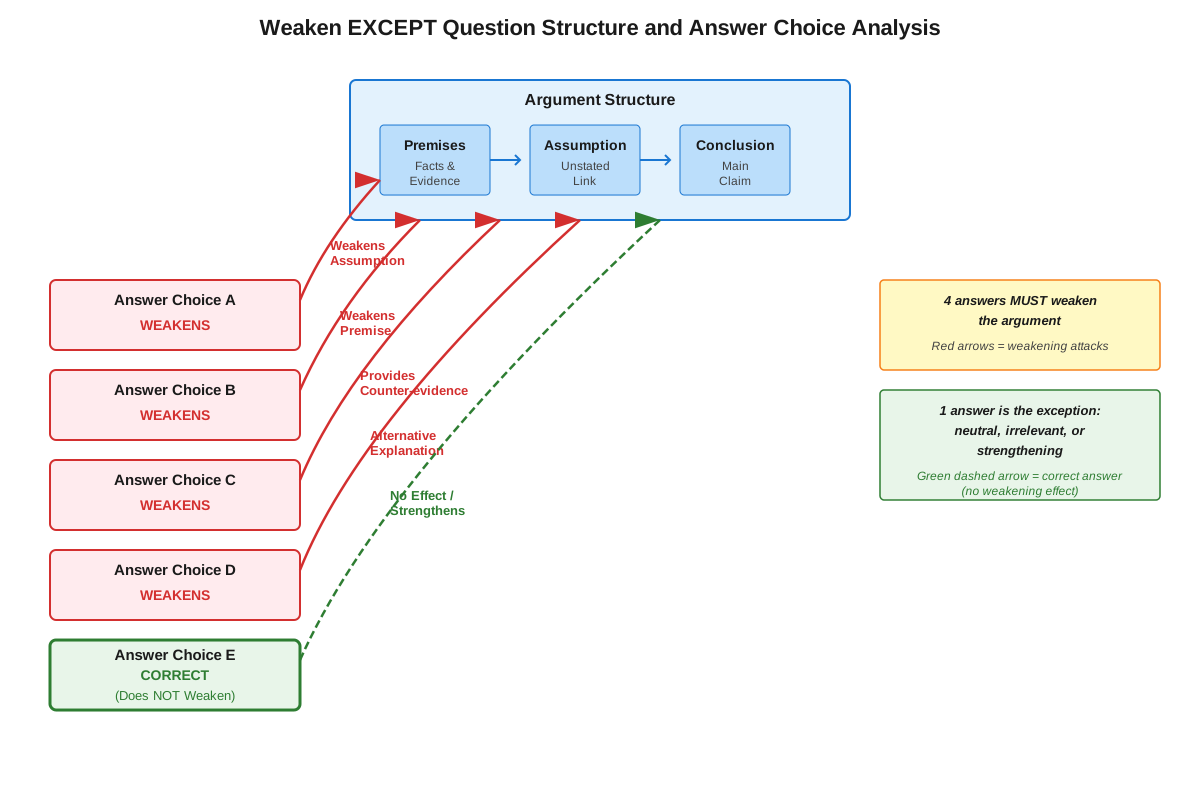
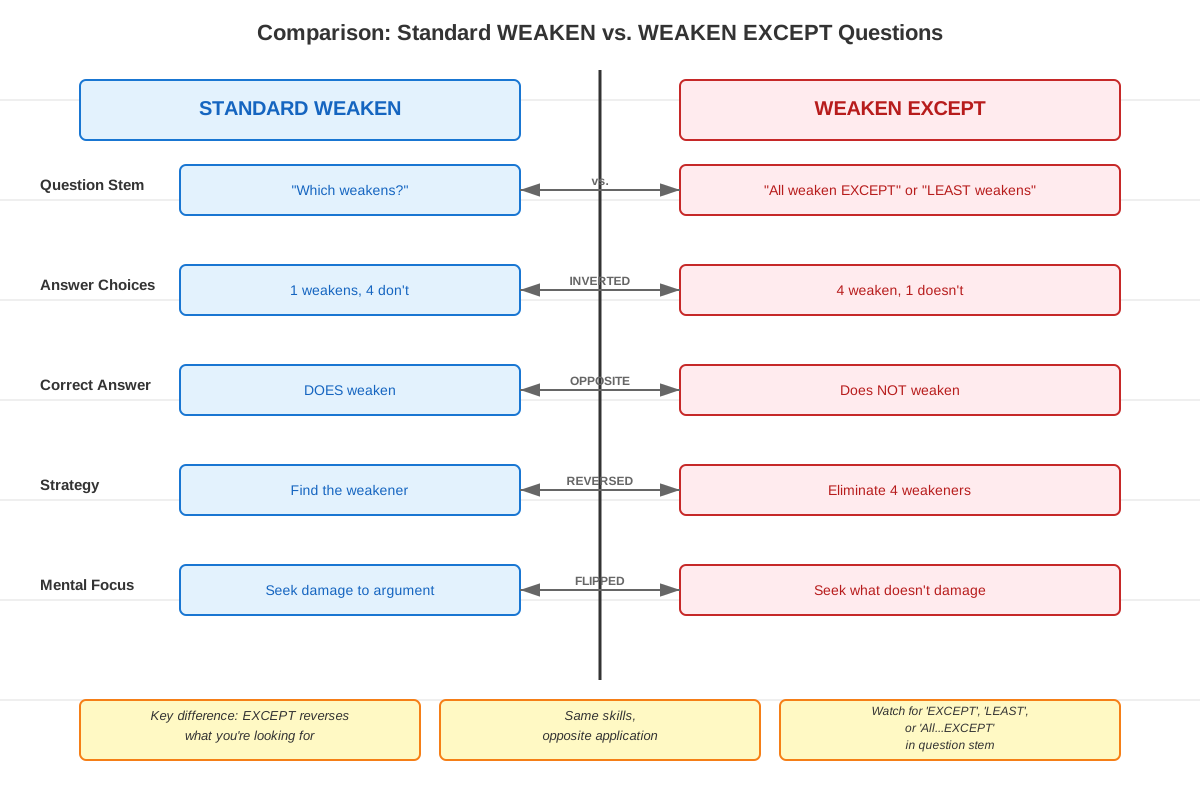
Weaken except questions represent a sophisticated variation of standard weakening questions on the LSAT's Logical Reasoning section. While traditional weaken questions ask test-takers to identify an answer choice that undermines an argument, weaken except questions flip this task: they require identifying the one answer choice that does NOT weaken the argument. This means four answer choices will damage the argument's reasoning, while the correct answer will either strengthen it, be irrelevant to it, or have no effect whatsoever. This question type tests not only the ability to recognize logical vulnerabilities but also demands careful attention to question stems and the mental flexibility to reverse typical analytical patterns.
Understanding lsat weaken except questions is essential because they appear regularly on the exam and frequently trip up even well-prepared students. The cognitive demand is higher than standard weaken questions because test-takers must evaluate five answer choices through a reversed lens, maintaining focus while identifying four weakeners before selecting the exception. This question type integrates seamlessly with the broader category of strengthen and weaken questions, requiring mastery of argument structure, assumption identification, and causal reasoning patterns that appear throughout the Logical Reasoning section.
The strategic importance of mastering weaken except questions extends beyond scoring points on this specific question type. These questions reinforce fundamental skills in argument analysis, strengthen understanding of logical relationships, and build the mental agility needed for other complex question types. Students who excel at weaken except questions typically demonstrate strong overall performance in Logical Reasoning because they've developed the ability to see arguments from multiple angles simultaneously—a skill that translates directly to success across the entire LSAT.
Learning Objectives
- [ ] Identify how Weaken except questions appears in LSAT questions
- [ ] Explain the reasoning pattern behind Weaken except questions
- [ ] Apply Weaken except questions to solve LSAT-style problems accurately
- [ ] Distinguish between answer choices that weaken an argument and those that are neutral or strengthening
- [ ] Recognize common trap patterns specific to weaken except questions
- [ ] Execute a systematic elimination strategy that minimizes errors under time pressure
Prerequisites
- Standard Weaken Questions: Understanding how to identify and apply information that undermines an argument's conclusion is foundational, as weaken except questions require recognizing four such instances.
- Argument Structure Analysis: The ability to identify premises, conclusions, and assumptions is essential because evaluating whether something weakens an argument depends on understanding what the argument claims and how it supports that claim.
- Strengthen Questions: Familiarity with strengthening arguments helps identify the correct answer when it happens to strengthen rather than simply being neutral.
- Assumption Identification: Recognizing unstated assumptions allows test-takers to spot vulnerabilities that answer choices might exploit to weaken the argument.
Why This Topic Matters
Weaken except questions appear with notable frequency on the LSAT, typically comprising 2-4 questions per exam across both Logical Reasoning sections. While this may seem modest, their strategic importance exceeds their numerical representation. These questions often appear in the medium-to-difficult range of question difficulty, meaning they serve as differentiators between good and excellent scores. Students aiming for scores above 165 must handle these questions efficiently and accurately.
In real-world applications, the analytical skills developed through weaken except questions mirror the critical thinking required in legal practice. Attorneys must constantly evaluate multiple arguments, identify which challenges genuinely threaten their case versus which are irrelevant or even supportive, and maintain clarity when analyzing complex information from multiple angles simultaneously. This question type trains precisely these cognitive abilities.
On the LSAT, weaken except questions typically appear with distinctive question stems such as "Each of the following weakens the argument EXCEPT," "All of the following cast doubt on the conclusion EXCEPT," or "Each of the following, if true, undermines the claim EXCEPT." The arguments themselves span all common LSAT topics: causal reasoning, statistical arguments, analogies, plans and proposals, and explanatory hypotheses. Recognizing the question type immediately allows for proper strategic approach, preventing the costly error of selecting a strong weakener (which would be correct on a standard weaken question but incorrect here).
Core Concepts
Understanding the Question Type Structure
Weaken except questions fundamentally reverse the standard weakening task. In a typical weaken question, test-takers search for the single answer choice that damages the argument while eliminating four that don't. In weaken except questions, this ratio inverts: four answer choices will weaken the argument, and the correct answer will be the exception—the one that doesn't weaken it. This exception can take three forms: it might strengthen the argument, it might be completely irrelevant to the argument, or it might have no discernible effect on the argument's logical force.
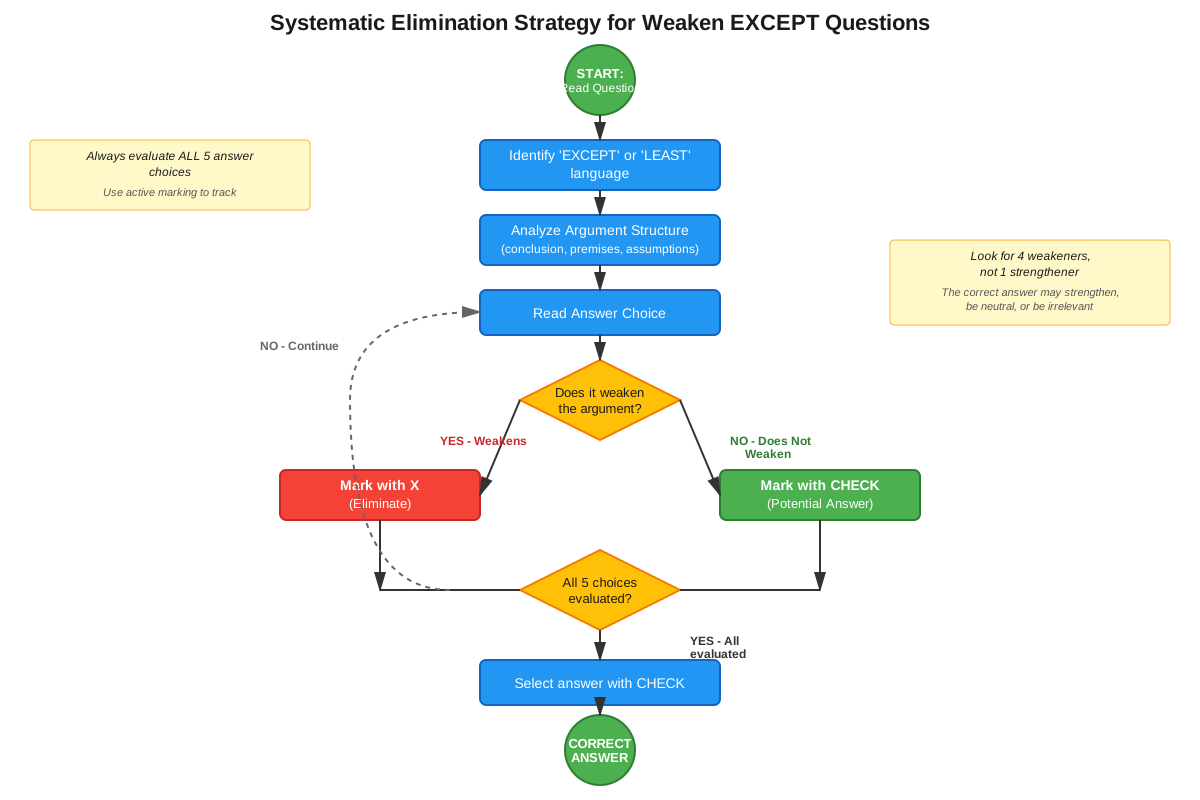
The cognitive challenge lies in maintaining reversed focus throughout the evaluation process. Test-takers must actively look for weakeners while remembering they're eliminating them, not selecting them. This requires explicit mental tagging: "This weakens—eliminate. This weakens—eliminate. This is neutral—this might be correct." The question type demands sustained attention and systematic processing to avoid the natural tendency to select a strong weakener.
The Three Types of Correct Answers
Understanding what makes an answer choice "not weaken" the argument is crucial for efficient elimination:
| Answer Type | Characteristics | Example Context |
|---|---|---|
| Strengthener | Provides support for the conclusion or fills a gap in reasoning | If the argument claims a policy will succeed, the correct answer might provide evidence of similar successful policies |
| Irrelevant | Addresses a topic outside the argument's scope | If the argument concerns economic effects, the correct answer might discuss unrelated social factors |
| Neutral/No Effect | Relates to the topic but doesn't impact the logical connection | If the argument makes a causal claim, the correct answer might provide information that neither supports nor undermines that specific causal relationship |
Most commonly, the correct answer is either irrelevant or neutral. Strengthening answers appear less frequently but are often easier to identify when they do appear because they stand out starkly against four weakeners.
Systematic Elimination Strategy
The most reliable approach to weaken except questions involves a methodical four-step process:
- Identify the conclusion and reasoning structure: Before examining answer choices, articulate the argument's conclusion and understand how the premises support it. Identify any assumptions or logical gaps.
- Predict potential weakeners: Consider what types of information would undermine the argument. Would alternative explanations weaken it? Would evidence that a key assumption is false weaken it? Would data showing the opposite correlation weaken it?
- Evaluate each answer choice: For each option, explicitly ask: "Does this weaken the argument?" If yes, eliminate it. If no, mark it as a potential correct answer.
- Verify the exception: Once four weakeners are identified, confirm that the remaining answer choice genuinely doesn't weaken the argument. Check whether it might strengthen, be irrelevant, or have no effect.
This systematic approach prevents the common error of selecting the first weakener encountered (which would be correct on a standard weaken question but wrong here).
Common Argument Vulnerabilities in Weaken Except Questions
The arguments in weaken except questions typically contain standard LSAT logical vulnerabilities. Understanding these patterns helps predict what the four wrong answers (the weakeners) will target:
Causal reasoning flaws: Arguments claiming X causes Y are vulnerable to alternative causes, reversed causation, or evidence that the correlation doesn't hold. Four answer choices might present these challenges, while the correct answer might address an unrelated factor.
Statistical and sampling issues: Arguments based on surveys or studies can be weakened by information about sample bias, sample size, or unrepresentative data. The correct answer might provide information that doesn't affect the statistical validity.
Comparison and analogy weaknesses: Arguments drawing parallels between situations can be undermined by relevant differences. The correct answer might note an irrelevant difference or a relevant similarity.
Plan and proposal assumptions: Arguments advocating for a course of action assume it's feasible, will achieve its goal, and won't have offsetting negative consequences. The correct answer might address a factor that doesn't impact these assumptions.
The Role of Scope in Weaken Except Questions
Scope plays a critical role in identifying the correct answer. Many correct answers in weaken except questions are irrelevant because they fall outside the argument's scope. The argument might discuss economic factors, while the correct answer discusses environmental factors. The argument might concern short-term effects, while the correct answer addresses long-term considerations that don't impact the specific claim being made.
However, test-takers must be careful: not everything that seems tangentially related is actually out of scope. The LSAT frequently tests whether students can recognize when apparently distant information actually does impact an argument's logic. The key is asking whether the information, if true, would give reason to doubt the conclusion or the reasoning leading to it.
Concept Relationships
The concepts within weaken except questions form an interconnected analytical framework. Understanding the question type structure enables proper application of the systematic elimination strategy, which in turn requires knowledge of common argument vulnerabilities to predict what the four weakeners will target. The three types of correct answers framework helps categorize the remaining option once four weakeners are eliminated, while scope analysis often provides the quickest path to identifying irrelevant answer choices.
These concepts connect directly to prerequisite knowledge: standard weaken questions provide the foundation for recognizing what damages an argument, while strengthen questions help identify when the exception actually supports the conclusion. Argument structure analysis underlies all evaluation, as determining whether something weakens an argument requires understanding what the argument claims and how it reasons to that claim.
The relationship map flows as follows: Question Type Recognition → Argument Analysis → Prediction of Vulnerabilities → Systematic Evaluation of Choices → Identification of Exception → Verification. Each step depends on the previous one, and weakness at any stage compromises accuracy.
High-Yield Facts
- ⭐ Weaken except questions require identifying the ONE answer choice that does NOT weaken the argument; four choices will weaken it
- ⭐ The correct answer can strengthen the argument, be irrelevant to it, or have no effect on it—all three types appear on the LSAT
- ⭐ Common question stems include "Each of the following weakens EXCEPT," "All of the following cast doubt EXCEPT," and similar phrasings with "EXCEPT" or "LEAST"
- ⭐ The most frequent correct answers are either irrelevant to the argument's scope or neutral with no impact on the reasoning
- ⭐ Systematic elimination is more reliable than trying to identify the correct answer directly; mark each weakener as it's found
- The cognitive trap is selecting a strong weakener because that's the correct approach for standard weaken questions
- Arguments in weaken except questions contain the same vulnerabilities as standard weaken questions: causal assumptions, sampling issues, comparison flaws, and plan feasibility
- Time management requires spending slightly more time on weaken except questions than standard weaken questions due to evaluating five choices in reverse
- Answer choices that strengthen the argument are often easier to spot because they contrast sharply with four weakeners
- Scope violations are a common feature of correct answers; information outside the argument's domain cannot weaken it
- Reading the question stem carefully is critical—missing "EXCEPT" leads to selecting the exact opposite of the correct answer
- Pre-phrasing potential weakeners before reading answer choices improves efficiency in identifying the four wrong answers
Quick check — test yourself on Weaken except questions so far.
Try Flashcards →Common Misconceptions
Misconception: The correct answer must strengthen the argument. → Correction: While strengthening answers can be correct, most correct answers are either irrelevant or neutral. Strengtheners appear less frequently than the other two types, so don't eliminate an answer just because it doesn't strengthen.
Misconception: If an answer choice relates to the topic, it must affect the argument. → Correction: Topical relevance doesn't guarantee logical relevance. An answer can discuss the same subject matter while addressing a different aspect that doesn't impact the specific reasoning or conclusion in the argument.
Misconception: Weaken except questions are just harder versions of weaken questions. → Correction: They're not harder; they're different. The difficulty lies in the reversed task and maintaining focus, not in more complex reasoning. With proper strategy, they're equally manageable.
Misconception: The correct answer will be obviously different from the other four. → Correction: The LSAT designs these questions so all five answers appear plausible. The correct answer often seems related to the argument, requiring careful analysis to determine it doesn't actually weaken the reasoning.
Misconception: You should identify the correct answer first, then verify the others weaken. → Correction: The more reliable strategy is identifying four weakeners through systematic elimination, then verifying the remaining choice doesn't weaken. This prevents confirmation bias.
Misconception: Spending equal time on each answer choice is most efficient. → Correction: Once you've confidently identified four weakeners, you can select the remaining answer without extensive analysis of it, saving time. The verification step should be quick.
Worked Examples
Example 1: Causal Reasoning Argument
Argument: "City officials claim that the new traffic cameras installed at major intersections have reduced accidents by 30%. They point to accident statistics from the six months after installation compared to the six months before installation. Therefore, the traffic cameras are an effective safety measure that should be expanded to more intersections."
Question: Each of the following, if true, weakens the argument EXCEPT:
(A) The six months before camera installation had unusually high accident rates due to road construction that has since been completed.
(B) Most of the reduction in accidents occurred at intersections where cameras were installed but not yet activated or publicized.
(C) The city implemented a major public awareness campaign about intersection safety during the same period the cameras were installed.
(D) Traffic cameras at similar intersections in neighboring cities have been associated with increased rear-end collisions.
(E) The traffic cameras were installed at intersections that already had lower-than-average accident rates compared to other major intersections.
Analysis:
First, identify the conclusion: Traffic cameras are effective and should be expanded. The reasoning: Accident rates dropped 30% after installation.
The argument assumes the cameras caused the reduction and that no other factors explain it. It also assumes the comparison period is representative.
Evaluating each choice:
(A) WEAKENS: If the "before" period was unusually dangerous due to construction, the reduction might reflect normal conditions returning, not camera effectiveness. The comparison is flawed. Eliminate.
(B) WEAKENS: If accidents dropped even where cameras weren't active, the cameras themselves didn't cause the reduction—perhaps awareness of their presence did, or another factor entirely. This undermines the causal claim. Eliminate.
(C) WEAKENS: This provides an alternative explanation for the accident reduction—the public awareness campaign rather than the cameras. This is a classic alternative cause weakener. Eliminate.
(D) WEAKENS: Evidence from similar situations showing negative effects casts doubt on whether these cameras are truly effective safety measures. This weakens the conclusion that they're effective. Eliminate.
(E) Does NOT weaken: This tells us about the baseline accident rates at these intersections, but it doesn't undermine the claim that cameras reduced accidents there. Whether intersections started with high or low rates doesn't affect whether a 30% reduction occurred or whether cameras caused it. This is the correct answer.
Correct Answer: (E)
Example 2: Plan and Proposal Argument
Argument: "The university should require all students to complete an internship before graduation. Studies show that students who complete internships have higher employment rates within six months of graduation than those who don't. Therefore, making internships mandatory would improve employment outcomes for all students."
Question: All of the following cast doubt on the argument's conclusion EXCEPT:
(A) Students who seek out internships may be more motivated and career-focused than those who don't, which could explain their higher employment rates.
(B) The university lacks sufficient staff to coordinate internship placements for all students, potentially resulting in low-quality internship experiences.
(C) Many academic programs already strongly encourage internships, and most students in those programs complete them voluntarily.
(D) Mandatory internships might displace advanced coursework that some employers value more highly than internship experience.
(E) Some industries prefer to hire recent graduates without prior internship experience so they can train them in company-specific methods.
Analysis:
Conclusion: Mandatory internships would improve employment outcomes for all students. Evidence: Students with internships have higher employment rates.
The argument assumes correlation implies causation and that making internships mandatory would produce the same benefits as voluntary internships.
Evaluating each choice:
(A) WEAKENS: This is a classic self-selection problem. If more motivated students choose internships, their higher employment rates might stem from motivation, not internships. Making internships mandatory wouldn't transfer that motivation to all students. Eliminate.
(B) WEAKENS: This suggests the plan might not be feasible or might produce poor-quality internships that don't help employment. This undermines whether the plan would achieve its goal. Eliminate.
(C) Does NOT weaken: This tells us about current practices but doesn't undermine the claim that mandatory internships would improve outcomes. If anything, it suggests internships are already valued, which is consistent with the argument. This doesn't cast doubt on the conclusion.
(D) WEAKENS: This presents a potential negative consequence—students might lose valuable coursework, potentially hurting rather than helping employment outcomes. This undermines the conclusion. Eliminate.
(E) WEAKENS: If some industries prefer candidates without internships, mandatory internships might actually harm employment prospects for students targeting those industries. This casts doubt on the claim that it would improve outcomes for "all students." Eliminate.
Correct Answer: (C)
Exam Strategy
When approaching weaken except questions on the LSAT, begin by reading the question stem carefully and noting the "EXCEPT" or "LEAST" qualifier. Consider circling or underlining this word to maintain awareness throughout the problem. This simple step prevents the costly error of selecting a strong weakener.
Next, analyze the argument before reading answer choices. Identify the conclusion explicitly, understand the reasoning structure, and note any assumptions or logical gaps. Spend 15-20 seconds on this analysis—it's time well invested because it enables efficient evaluation of answer choices.
As you evaluate each answer choice, use a clear marking system. Many successful test-takers mark weakeners with an "X" or cross them out, while marking potential correct answers with a check or circle. This physical notation reinforces the reversed task and prevents confusion.
Exam Tip: If you find yourself drawn to an answer that strongly weakens the argument, pause and reread the question stem. Your instinct may be correct for a standard weaken question but wrong for a weaken except question.
Watch for trigger phrases in question stems: "Each of the following weakens EXCEPT," "All of the following cast doubt EXCEPT," "Each of the following undermines EXCEPT," and variations using "LEAST" instead of "EXCEPT" (e.g., "Which of the following LEAST weakens"). All indicate the same reversed task.
For time management, allocate approximately 1:30-1:45 for weaken except questions, slightly more than the 1:20-1:30 typical for standard questions. The additional time accounts for evaluating five choices with reversed logic. However, once you've identified four clear weakeners, select the remaining answer without excessive deliberation.
Process of elimination is particularly powerful for this question type. Don't try to identify the correct answer directly; instead, systematically eliminate the four weakeners. This approach is more reliable because recognizing what weakens an argument is typically easier than determining whether something is truly neutral or irrelevant.
If you're stuck between two answer choices, both of which seem like they might not weaken the argument, compare them directly. Ask: "If this information were true, would it give me any reason to doubt the conclusion?" Even slight doubt means it weakens and should be eliminated.
Memory Techniques
Use the acronym "FOUR-W-ONE-N" to remember the structure: FOUR answers WEAKEN, ONE is NEUTRAL (or strengthens/is irrelevant).
Visualize weaken except questions as a "reverse target" where you're eliminating the arrows that hit the bullseye (the weakeners) and selecting the one arrow that misses (the exception).
Create a mental checklist using "SCAN":
- Stem: Check for "EXCEPT" or "LEAST"
- Conclusion: Identify what's being argued
- Assumptions: Note logical gaps
- Neutralize: Eliminate four weakeners, select the neutral/strengthening/irrelevant option
For remembering the three types of correct answers, use "SIN":
- Strengthens the argument
- Irrelevant to the argument
- Neutral (no effect on the argument)
Remember the phrase: "Four attack, one holds back" to maintain focus on the reversed task throughout the question.
Summary
Weaken except questions represent a critical LSAT question type that tests argument analysis through a reversed lens. Unlike standard weaken questions where test-takers select the one answer that damages an argument, weaken except questions require identifying the single answer choice that does NOT weaken it—meaning four choices will undermine the argument while the correct answer either strengthens it, is irrelevant to it, or has no effect on its logical force. Success requires careful attention to question stems containing "EXCEPT" or "LEAST," systematic elimination of the four weakeners, and understanding that correct answers most commonly fall outside the argument's scope or provide neutral information. The strategic approach involves analyzing the argument's structure and assumptions before evaluating answer choices, explicitly marking each weakener during elimination, and verifying that the remaining choice genuinely doesn't damage the reasoning. Mastering this question type builds essential skills in maintaining analytical focus under reversed conditions, recognizing logical vulnerabilities from multiple angles, and distinguishing between information that impacts an argument versus information that merely relates to its topic—capabilities that enhance performance across all Logical Reasoning questions.
Key Takeaways
- Weaken except questions require selecting the ONE answer that does NOT weaken the argument; four answers will weaken it
- The correct answer typically either strengthens the argument, is irrelevant to it, or has no effect on the reasoning
- Always read question stems carefully and note "EXCEPT" or "LEAST" to avoid selecting the opposite of the correct answer
- Use systematic elimination: identify and mark four weakeners, then select the remaining choice
- Scope analysis is crucial—information outside the argument's domain cannot weaken it, making out-of-scope answers frequently correct
- Allocate slightly more time (1:30-1:45) than for standard weaken questions due to the reversed evaluation process
- The arguments contain standard LSAT vulnerabilities (causal assumptions, sampling issues, comparison flaws), which the four wrong answers will exploit
Related Topics
Standard Weaken Questions: Mastering weaken except questions reinforces skills for standard weaken questions by requiring recognition of four weakeners per question, providing intensive practice in identifying logical vulnerabilities.
Strengthen Questions: Understanding what strengthens arguments helps identify correct answers in weaken except questions when the exception actually supports the conclusion rather than being neutral or irrelevant.
Necessary Assumption Questions: These questions test similar skills in identifying logical gaps and unstated premises that weaken except questions exploit through their wrong answer choices.
Parallel Reasoning Questions: Like weaken except questions, these require maintaining complex analytical frameworks while evaluating multiple answer choices, building the same cognitive flexibility.
Sufficient Assumption Questions: Understanding what would guarantee a conclusion helps recognize when information in weaken except questions falls short of impacting the argument.
Practice CTA
Now that you understand the structure, strategy, and common patterns in weaken except questions, it's time to apply this knowledge. Work through the practice questions systematically, using the elimination strategy outlined above. Mark each weakener as you identify it, and verify that your selected answer genuinely doesn't weaken the argument. Review the flashcards to reinforce the key concepts, trigger phrases, and the three types of correct answers. Remember: these questions reward careful, methodical analysis more than speed. With focused practice, you'll develop the mental flexibility to handle these reversed questions as confidently as standard weaken questions, turning a potential weakness into a consistent source of points on test day.
Sign up free to keep reading
Create a free AnvayaPrep account to finish this LSAT guide on Weaken except questions — plus flashcards and practice questions.