Overview
Strengthening statistical arguments is a critical skill tested extensively in the LSAT's Logical Reasoning section, appearing in approximately 15-20% of all strengthen questions. These questions require test-takers to identify which answer choice most effectively bolsters a conclusion drawn from statistical data, survey results, or numerical evidence. Unlike pure logical arguments that rely on formal reasoning structures, statistical arguments introduce probabilistic reasoning, sampling concerns, and data interpretation challenges that demand a unique analytical approach.
The LSAT frequently presents arguments that move from statistical evidence (such as "70% of surveyed doctors recommend...") to broader conclusions about populations, causation, or policy recommendations. To strengthen such arguments, students must recognize the inherent vulnerabilities in statistical reasoning: sampling bias, confounding variables, representativeness issues, and the distinction between correlation and causation. Mastering this topic requires understanding both what makes statistical arguments weak and what types of evidence can shore up these weaknesses.
Within the broader landscape of strengthen and weaken questions, statistical arguments represent a specialized subset that combines elements of formal logic with quantitative reasoning. This topic connects directly to causal reasoning, survey methodology, and argument structure analysis—all fundamental components of LSAT success. Students who excel at strengthening statistical arguments demonstrate sophisticated critical thinking skills that extend beyond pattern recognition to genuine analytical reasoning about data quality, inference validity, and evidentiary support.
Learning Objectives
- [ ] Identify how strengthening statistical arguments appears in LSAT questions
- [ ] Explain the reasoning pattern behind strengthening statistical arguments
- [ ] Apply strengthening statistical arguments to solve LSAT-style problems accurately
- [ ] Distinguish between different types of statistical vulnerabilities (sampling, representativeness, causation)
- [ ] Evaluate answer choices based on their impact on statistical inference validity
- [ ] Recognize common wrong answer patterns in statistical strengthening questions
- [ ] Construct mental frameworks for assessing data quality and generalizability
Prerequisites
- Basic argument structure identification: Understanding premises, conclusions, and assumptions is essential because statistical arguments follow the same fundamental structure, with data serving as premises supporting broader claims.
- Distinction between correlation and causation: Statistical arguments frequently confuse these concepts, and strengthening them often requires addressing this gap.
- Understanding of strengthen question types: Familiarity with how strengthen questions function generally provides the foundation for the specialized statistical variant.
- Sampling and survey concepts: Basic awareness that samples should represent populations helps identify what makes statistical evidence strong or weak.
Why This Topic Matters
Statistical reasoning pervades modern decision-making in medicine, public policy, business, and law. Legal professionals regularly encounter expert testimony based on statistical studies, epidemiological data in tort cases, and survey evidence in trademark disputes. The ability to evaluate statistical arguments critically is not merely an academic exercise but a practical skill that lawyers use daily when assessing evidence quality, cross-examining expert witnesses, and constructing persuasive arguments based on data.
On the LSAT, lsat strengthening statistical arguments questions appear with remarkable frequency. Approximately 3-5 questions per test involve statistical reasoning, and strengthen questions constitute roughly 25% of all Logical Reasoning questions. This means students can expect to encounter 1-2 statistical strengthening questions on every LSAT administration. These questions typically appear in the medium-to-difficult range, making them high-value targets for score improvement.
Common manifestations include arguments based on survey results ("A poll of 500 residents found that..."), comparative statistics ("City A has twice the crime rate of City B, therefore..."), medical studies ("Patients taking Drug X showed a 30% improvement..."), and demographic data ("Among college graduates, 60% report..."). The LSAT tests whether students can identify what additional information would make these statistical inferences more reliable, valid, or generalizable.
Core Concepts
Understanding Statistical Arguments
A statistical argument uses numerical data, percentages, survey results, or quantitative comparisons as evidence to support a conclusion. Unlike purely logical arguments, statistical arguments involve probabilistic reasoning and inductive inference—moving from observed data about a sample to claims about a broader population or causal relationships. The fundamental structure typically follows this pattern: "In a study/survey/sample, X% showed characteristic Y, therefore [conclusion about population/causation/policy]."
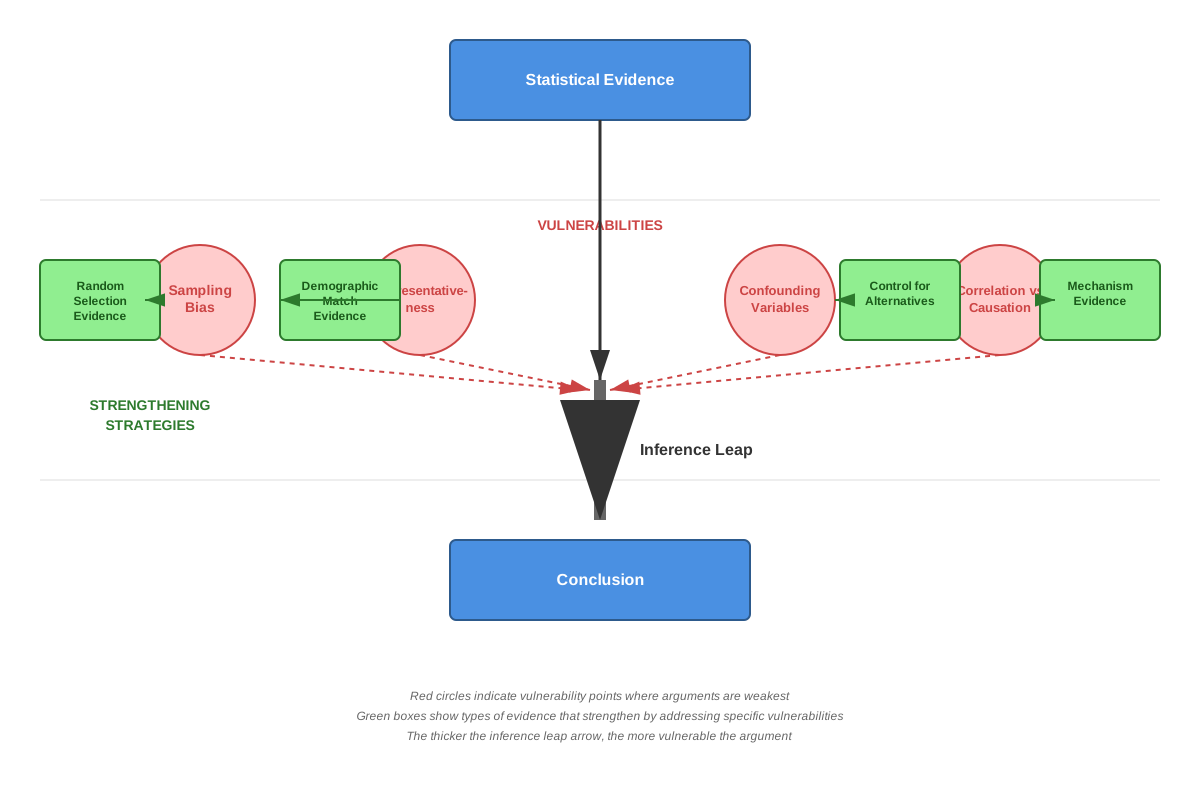
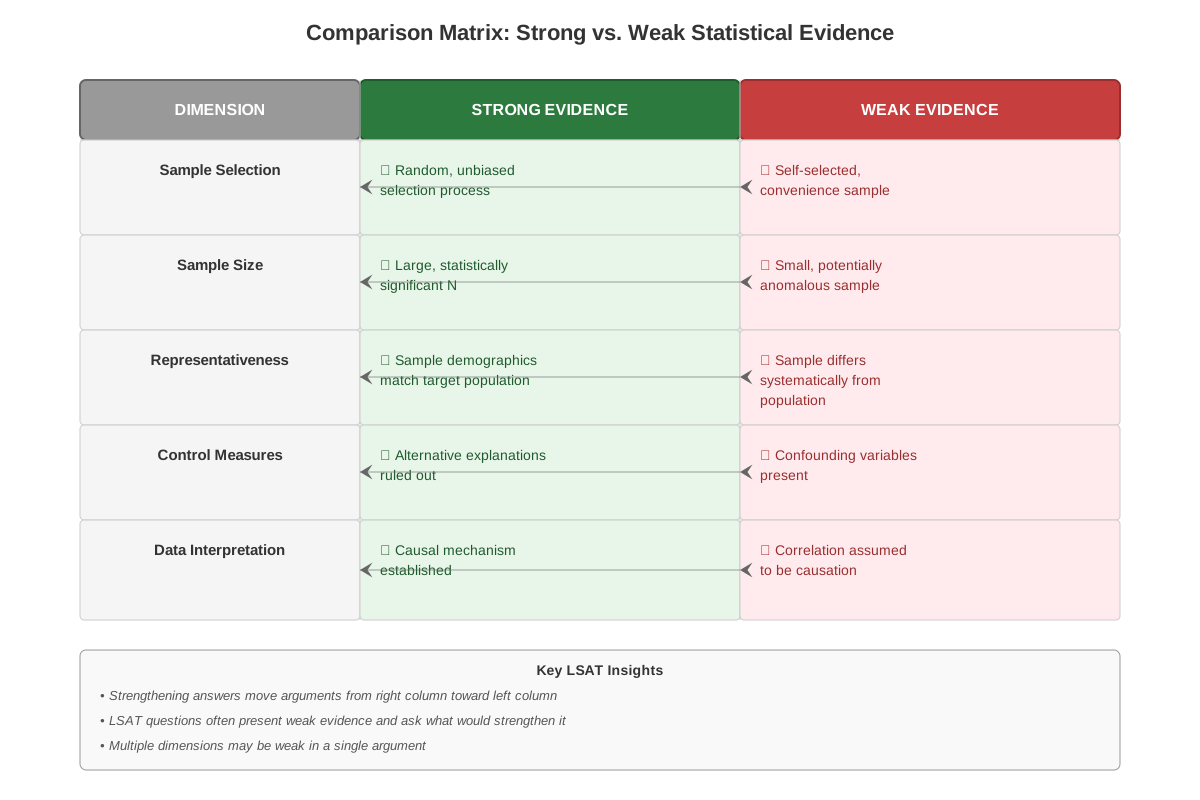
The strength of statistical arguments depends on several factors: sample size, sampling methodology, representativeness, control for confounding variables, and the appropriateness of the inference drawn. When the LSAT asks students to strengthen such arguments, it tests whether they can identify which piece of additional information addresses the argument's most significant vulnerability.
Types of Statistical Vulnerabilities
Statistical arguments exhibit predictable weaknesses that strengthening answer choices must address:
| Vulnerability Type | Description | Strengthening Approach |
|---|---|---|
| Sampling Bias | The sample doesn't represent the target population | Show the sample was randomly selected or representative |
| Small Sample Size | Insufficient data for reliable conclusions | Provide evidence of adequate sample size or replication |
| Confounding Variables | Alternative explanations for observed correlations | Demonstrate controls for other factors |
| Temporal Issues | Data from one time period applied to another | Show consistency across time periods |
| Measurement Problems | Unreliable or invalid data collection methods | Confirm accurate measurement techniques |
| Generalization Errors | Applying findings beyond appropriate scope | Establish similarity between sample and target population |
The Representativeness Principle
One of the most frequently tested concepts in strengthening statistical arguments is representativeness—whether the sample accurately reflects the population about which conclusions are drawn. An argument claiming "A survey of 1,000 smartphone users found that 80% prefer Brand X, so Brand X is the most popular smartphone" is vulnerable if those 1,000 users were all surveyed at a Brand X store. A strengthening answer might establish that the survey participants were randomly selected from all smartphone users nationwide.
The LSAT often presents arguments where the sample differs systematically from the target population in age, geography, socioeconomic status, or other relevant characteristics. Strengthening such arguments requires evidence that either (1) the sample is actually representative, or (2) the differences between sample and population don't affect the characteristic being measured.
Causation vs. Correlation
Statistical arguments frequently commit the classic error of inferring causation from correlation. An argument might note that "Cities with more police officers have higher crime rates, therefore hiring more police causes crime to increase." This confuses correlation with causation—perhaps high-crime cities respond by hiring more officers, or a third factor (like population size) explains both variables.
To strengthen a causal claim based on statistical correlation, answer choices typically must:
- Rule out reverse causation (Y causing X instead of X causing Y)
- Eliminate confounding variables (Z causing both X and Y)
- Establish temporal precedence (X occurred before Y)
- Demonstrate a plausible mechanism (how X could cause Y)
Control Groups and Comparison Standards
Many statistical arguments compare two groups or time periods: "After implementing Policy X, crime decreased by 20%." Such arguments are vulnerable because the decrease might have occurred anyway due to broader trends. A strengthening answer might establish that similar cities without Policy X saw no decrease, or that crime was stable before Policy X's implementation.
The presence or absence of appropriate control groups dramatically affects statistical argument strength. When the LSAT presents comparative statistics, students should immediately ask: "Compared to what?" and "What if the same change occurred in the comparison group?"
Survey Methodology Issues
Arguments based on surveys face unique vulnerabilities: response rates, question wording, self-selection bias, and social desirability bias. An argument concluding that "Most employees are satisfied with working conditions" based on a voluntary survey is weak if only satisfied employees chose to respond. Strengthening such arguments requires evidence about response rates, random sampling, or verification that non-respondents don't differ systematically from respondents.
Statistical Significance vs. Practical Significance
The LSAT occasionally tests whether students recognize that statistically significant findings (unlikely to occur by chance) may lack practical importance. An argument claiming "Drug X is superior to Drug Y because it reduces symptoms by an average of 0.5%" might be statistically significant with a large enough sample but practically meaningless. Strengthening such arguments might involve showing that the effect size is clinically meaningful or that small differences compound over time.
Concept Relationships
The concepts within statistical strengthening form an interconnected web. Sampling bias and representativeness are closely related—bias occurs when samples aren't representative. Both connect to generalization errors, which happen when conclusions extend beyond what the sample can support. Causation vs. correlation issues often involve confounding variables, which are alternative explanations that must be ruled out. Control groups serve as the primary method for addressing both confounding variables and temporal issues.
The relationship map flows as follows:
Statistical Argument → Identify Conclusion Type (descriptive/causal/predictive) → Assess Primary Vulnerability → Match Strengthening Evidence to Vulnerability
This topic builds directly on prerequisite knowledge of basic argument structure (identifying conclusions and premises) and strengthen questions generally (understanding what "strengthen" means). It extends into related topics like causal reasoning, necessary and sufficient conditions, and formal logic by adding the dimension of probabilistic inference and data quality assessment.
Mastering statistical strengthening enables progression to more complex topics like resolving paradoxes (which often involve statistical anomalies), evaluating arguments (assessing what information would help judge argument strength), and parallel reasoning (recognizing similar statistical structures across different contexts).
High-Yield Facts
⭐ Statistical arguments are strengthened by evidence that the sample is representative of the target population.
⭐ Correlation does not imply causation; strengthening causal claims requires ruling out confounding variables and reverse causation.
⭐ Random sampling is the gold standard for representativeness and addresses most sampling bias concerns.
⭐ Control groups or comparison standards strengthen arguments by showing that observed effects don't occur in their absence.
⭐ Temporal consistency (showing patterns hold across different time periods) strengthens arguments that generalize from one time to another.
- Large sample sizes strengthen statistical arguments by reducing the likelihood that results occurred by chance.
- Evidence that measurement methods were accurate and reliable strengthens arguments dependent on data quality.
- Showing that non-respondents in surveys don't differ from respondents strengthens survey-based arguments.
- Replication of findings in different contexts or by different researchers strengthens statistical conclusions.
- Evidence eliminating alternative explanations strengthens arguments by making the proposed explanation more likely.
- Demonstrating a plausible mechanism connecting cause and effect strengthens causal statistical arguments.
- Showing that the relationship between variables persists when controlling for other factors strengthens causal claims.
Quick check — test yourself on Strengthening statistical arguments so far.
Try Flashcards →Common Misconceptions
Misconception: Any additional statistical data strengthens a statistical argument. → Correction: Only data that addresses the argument's specific vulnerability strengthens it. Irrelevant statistics, even if impressive-sounding, don't strengthen the reasoning. If an argument's weakness is sampling bias, information about sample size doesn't help.
Misconception: Strengthening a statistical argument requires proving the conclusion is definitely true. → Correction: Strengthen questions ask which answer makes the conclusion more likely or better supported, not certain. Even strong statistical arguments remain probabilistic, not absolute.
Misconception: Larger sample sizes always strengthen statistical arguments. → Correction: Sample size only matters if the sample is representative. A biased sample of 10,000 is weaker than a representative sample of 500. Size without representativeness doesn't strengthen arguments about populations.
Misconception: If a study shows correlation, establishing that the correlation is strong strengthens a causal conclusion. → Correction: The strength of correlation doesn't address whether the relationship is causal. Even perfect correlation doesn't imply causation if confounding variables or reverse causation haven't been ruled out.
Misconception: Statistical arguments are strengthened by showing the data is recent. → Correction: Recency only strengthens arguments if temporal change is relevant to the conclusion. If an argument claims a timeless relationship (like "tall people have longer arms"), data age doesn't matter.
Misconception: Expert opinion about statistical data strengthens the underlying statistical argument. → Correction: Expert interpretation doesn't address vulnerabilities in the data itself. If the sample is biased, expert endorsement doesn't fix the bias. Strengthen questions focus on evidence quality, not authority.
Worked Examples
Example 1: Survey Representativeness
Argument: "A survey of 1,000 adults found that 75% support increased funding for public transportation. Therefore, the majority of the population supports this policy."
Question: Which of the following, if true, most strengthens the argument?
Answer Choices:
(A) The survey was conducted by a reputable polling organization.
(B) The 1,000 adults surveyed were randomly selected from voter registration lists across the entire state.
(C) Other surveys on different topics have shown similar response rates.
(D) Public transportation funding has increased in recent years.
(E) The survey question was clearly worded and easy to understand.
Analysis:
The argument moves from survey results (75% of 1,000 adults) to a conclusion about "the majority of the population." The primary vulnerability is representativeness—do these 1,000 adults accurately represent the broader population?
- (A) addresses credibility but not whether the sample represents the population. A reputable organization could still use a biased sample.
- (B) CORRECT directly addresses representativeness by establishing random selection from a comprehensive list covering the entire state. This makes it much more likely the sample reflects the population.
- (C) is irrelevant—response rates on other topics don't affect whether this sample is representative.
- (D) discusses actual policy, not whether the survey accurately measures public opinion.
- (E) addresses measurement quality but not sampling—even perfectly worded questions don't help if the sample is biased.
Connection to Learning Objectives: This example demonstrates how to identify the statistical vulnerability (representativeness), evaluate which answer choice addresses that specific weakness, and eliminate answers that address different concerns or are simply irrelevant.
Example 2: Causal Claims from Correlation
Argument: "A study found that employees who work from home three or more days per week report 40% higher job satisfaction than those who work in the office full-time. Therefore, allowing employees to work from home more frequently will increase their job satisfaction."
Question: Which of the following, if true, most strengthens the argument?
Answer Choices:
(A) The study included employees from various industries and company sizes.
(B) Employees with higher job satisfaction are not more likely to request work-from-home arrangements than dissatisfied employees.
(C) Job satisfaction has been linked to increased productivity in numerous studies.
(D) The difference in job satisfaction between the two groups was statistically significant.
(E) Employees who work from home report fewer interruptions during work hours.
Analysis:
This argument infers causation (working from home causes higher satisfaction) from correlation (work-from-home employees have higher satisfaction). The key vulnerability is reverse causation—perhaps already-satisfied employees seek out work-from-home arrangements, rather than working from home causing satisfaction.
- (A) strengthens generalizability but doesn't address the causation issue.
- (B) CORRECT rules out reverse causation by showing that satisfaction level doesn't predict who works from home. This makes it more likely that working from home causes satisfaction rather than vice versa.
- (C) is irrelevant—the link between satisfaction and productivity doesn't address whether working from home causes satisfaction.
- (D) addresses statistical significance but not causation. Even highly significant correlations don't imply causation.
- (E) provides a potential mechanism but doesn't rule out reverse causation or confounding variables.
Connection to Learning Objectives: This example illustrates the critical distinction between correlation and causation, demonstrates how to identify reverse causation as a vulnerability, and shows how to recognize answer choices that address causal inference problems.
Exam Strategy
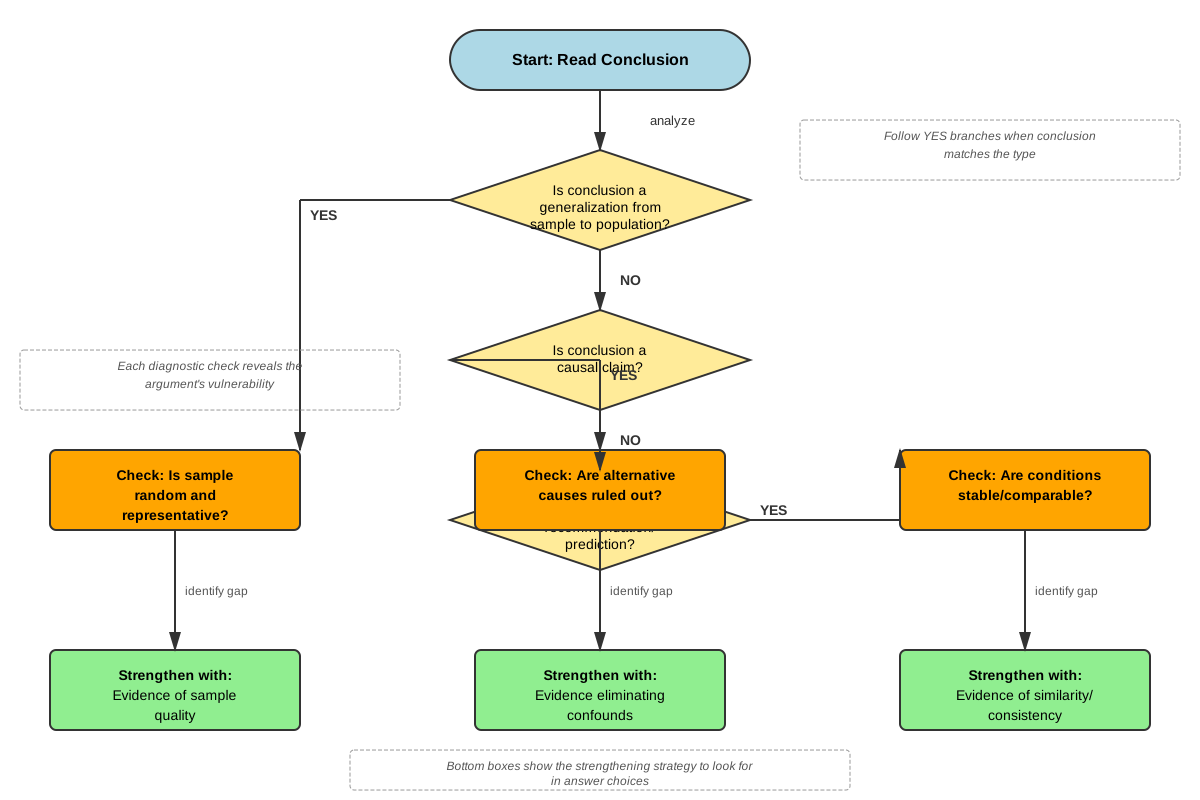
When approaching strengthen and weaken questions involving statistical arguments on the LSAT, follow this systematic process:
Step 1: Identify the Statistical Evidence and Conclusion
Locate the numerical data, survey results, or comparative statistics (the premises) and determine what conclusion the argument draws from this evidence. Ask: "What claim is being made based on the data?"
Step 2: Classify the Argument Type
Determine whether the argument makes a descriptive claim (about a population), a causal claim (X causes Y), or a predictive claim (what will happen). This classification reveals likely vulnerabilities.
Step 3: Spot the Primary Vulnerability
Ask these diagnostic questions:
- Is the sample representative of the target population?
- Does the argument confuse correlation with causation?
- Are there potential confounding variables?
- Is there an appropriate comparison/control group?
- Could the results be due to chance or measurement error?
Step 4: Predict the Strengthening Answer
Before looking at choices, mentally formulate what would strengthen the argument: "This argument would be stronger if we knew that [the sample was random/confounding variables were controlled/the effect persists over time]."
Step 5: Eliminate Wrong Answer Patterns
Trigger words to watch for: "representative sample," "randomly selected," "controlled for," "compared to," "ruled out," "consistent across," "independent of"
Common wrong answer patterns in statistical strengthening questions:
- Irrelevant statistics: Additional data that doesn't address the argument's vulnerability
- Premise boosters: Information that makes a premise more credible without addressing the inference gap
- Opposite effect: Answers that actually weaken rather than strengthen (easy to select under time pressure)
- Scope mismatches: Information about a different population, time period, or variable than the argument concerns
Time Allocation: Spend 1:15-1:30 on statistical strengthening questions. They require careful analysis but follow predictable patterns. Don't rush the vulnerability identification step—15-20 seconds here saves time by making answer choice evaluation faster.
Memory Techniques
SCRAM Mnemonic for statistical argument vulnerabilities:
- Sampling bias
- Confounding variables
- Representativeness issues
- Alternative explanations
- Measurement problems
The "Compared to What?" Mantra: Whenever you see comparative statistics, immediately ask "Compared to what?" This triggers analysis of whether appropriate control groups or baselines exist.
Causation Checklist Visualization: Picture a three-legged stool labeled "Causal Claim." The three legs are:
- Rule out reverse causation
- Eliminate confounding variables
- Establish temporal precedence
A causal argument is only as strong as its weakest leg. Strengthening answers add support to wobbly legs.
The Representative Sample Test: Visualize the target population as a jar of mixed jellybeans. Ask: "Does my sample look like a random handful from the jar, or did I pick only red ones from the top?" This mental image helps identify sampling bias.
Summary
Strengthening statistical arguments on the LSAT requires recognizing that statistical evidence introduces unique vulnerabilities beyond those in purely logical arguments. The core skill involves identifying whether an argument's weakness lies in sampling methodology, representativeness, causal inference, confounding variables, or generalization scope, then selecting the answer choice that specifically addresses that vulnerability. Statistical arguments move from observed data about samples to conclusions about populations or causal relationships, and this inferential leap creates predictable weak points. Successful test-takers systematically diagnose the argument type (descriptive, causal, or predictive), spot the primary vulnerability using frameworks like SCRAM, and eliminate wrong answers that provide irrelevant data or address different concerns. The distinction between correlation and causation remains paramount—many statistical strengthening questions test whether students recognize that ruling out confounding variables and reverse causation is essential for supporting causal claims. Mastery requires understanding both what makes statistical evidence weak and what types of additional information genuinely strengthen statistical inferences.
Key Takeaways
- Statistical arguments are strengthened by addressing their specific vulnerabilities: sampling bias, representativeness, confounding variables, or causal inference problems
- Random sampling and representative samples are the gold standard for strengthening arguments that generalize from samples to populations
- Causal claims require ruling out reverse causation and confounding variables, not merely establishing correlation strength
- Control groups and appropriate comparison standards strengthen arguments by showing effects don't occur in their absence
- Wrong answers often provide irrelevant statistics or address different vulnerabilities than the argument's primary weakness
- The systematic approach—identify evidence/conclusion, classify argument type, spot vulnerability, predict strengthener—improves both accuracy and speed
- Approximately 3-5 questions per LSAT involve statistical reasoning, making this a high-value topic for score improvement
Related Topics
Weakening Statistical Arguments: The mirror image of this topic, focusing on identifying information that undermines statistical inferences. Mastering strengthening provides the foundation for recognizing what weakens these arguments.
Causal Reasoning: Statistical arguments frequently make causal claims, and deeper study of causal reasoning patterns (sufficient conditions, necessary conditions, causal chains) enhances statistical argument analysis.
Survey and Study Design: More advanced understanding of research methodology, including concepts like double-blind studies, placebo effects, and statistical significance, builds on the foundational concepts covered here.
Flaw Questions with Statistical Arguments: Identifying flaws in statistical reasoning requires recognizing the same vulnerabilities covered in strengthening questions but from a critical rather than supportive perspective.
Necessary Assumption Questions: Statistical arguments rest on assumptions about representativeness, causation, and data quality. Identifying these assumptions deepens understanding of what strengthens such arguments.
Practice CTA
Now that you've mastered the core concepts of strengthening statistical arguments, it's time to cement your understanding through active practice. Attempt the practice questions designed specifically for this topic, paying special attention to identifying argument vulnerabilities before looking at answer choices. Use the flashcards to reinforce high-yield facts and common wrong answer patterns. Remember: statistical strengthening questions are highly predictable once you recognize the patterns. Each practice question you complete builds the pattern recognition that translates directly to points on test day. Your investment in mastering this high-frequency topic will pay dividends across multiple questions on every LSAT section.
Sign up free to keep reading
Create a free AnvayaPrep account to finish this LSAT guide on Strengthening statistical arguments — plus flashcards and practice questions.