Overview
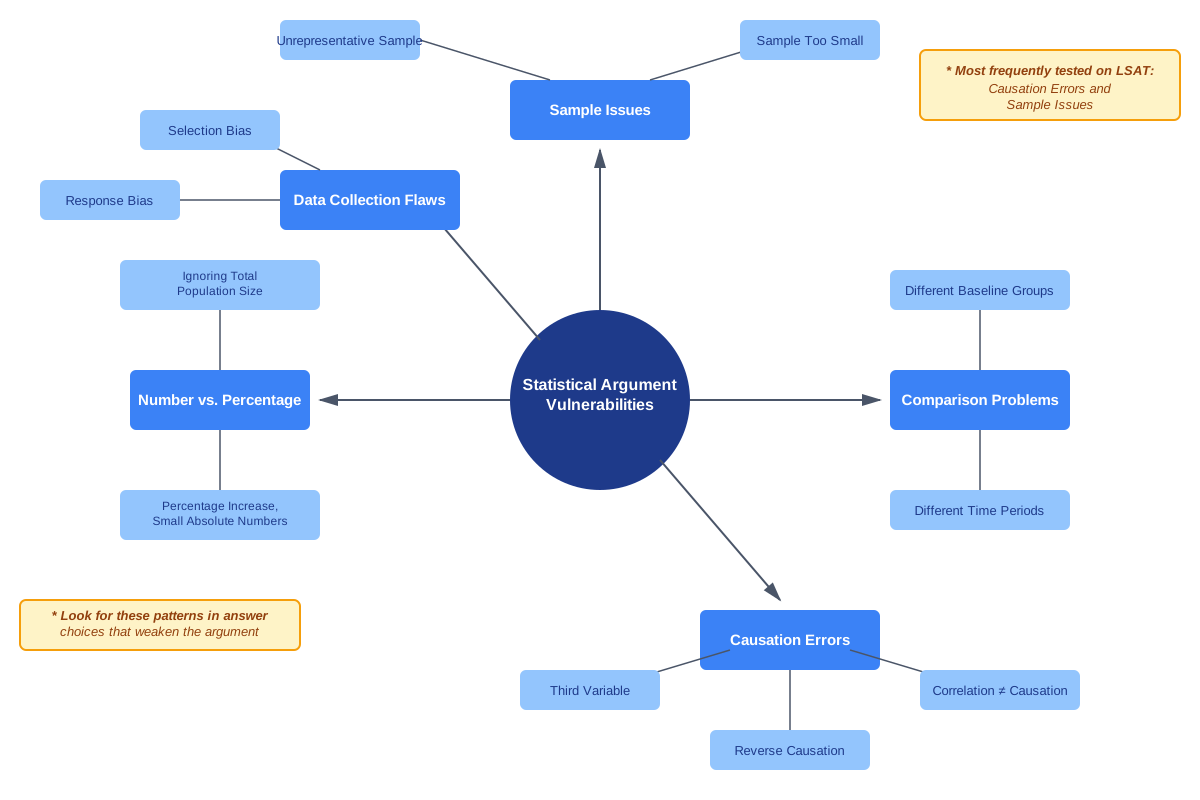
Weakening statistical arguments represents one of the most frequently tested question types in LSAT Logical Reasoning sections. These questions challenge test-takers to identify flaws in arguments that rely on numerical data, percentages, surveys, studies, or statistical correlations. The LSAT tests the ability to recognize when statistical evidence has been misapplied, misinterpreted, or when crucial information has been omitted that would undermine the argument's conclusion.
Statistical arguments appear deceptively strong because they invoke the authority of numbers and research. However, the LSAT consistently demonstrates that statistics can be misleading when sample sizes are inadequate, comparison groups are inappropriate, or when correlation is confused with causation. Mastering the skill of weakening these arguments requires understanding both the logical structure of statistical reasoning and the specific vulnerabilities that make such arguments susceptible to attack. This topic bridges fundamental logical reasoning skills with specialized knowledge about how data can be properly or improperly used to support conclusions.
Within the broader category of strengthen and weaken questions, statistical arguments represent a specialized subset that demands particular attention. While general weakening strategies focus on attacking assumptions and providing counterevidence, weakening statistical arguments requires familiarity with specific patterns: questioning representativeness of samples, identifying confounding variables, exposing selection bias, and recognizing when absolute numbers matter more than percentages (or vice versa). These skills not only prove essential for LSAT success but also develop critical thinking abilities applicable to evaluating research claims, policy arguments, and data-driven reasoning in professional contexts.
Learning Objectives
- [ ] Identify how Weakening statistical arguments appears in LSAT questions
- [ ] Explain the reasoning pattern behind Weakening statistical arguments
- [ ] Apply Weakening statistical arguments to solve LSAT-style problems accurately
- [ ] Distinguish between correlation and causation in statistical arguments
- [ ] Recognize common statistical fallacies including sampling bias, unrepresentative samples, and inappropriate comparison groups
- [ ] Evaluate whether statistical evidence adequately supports the conclusion drawn from it
- [ ] Generate multiple potential weakeners for a given statistical argument
Prerequisites
- Basic argument structure: Understanding premises, conclusions, and assumptions is essential because statistical arguments follow the same fundamental logical structure, with statistics serving as premises.
- General weakening strategies: Familiarity with how to attack assumptions and provide counterevidence provides the foundation upon which statistical weakening techniques build.
- Conditional reasoning: Many statistical arguments involve conditional claims (if-then relationships) that must be properly analyzed.
- Causation concepts: Basic understanding of cause-and-effect relationships helps identify when statistical correlations are improperly treated as causal connections.
Why This Topic Matters
Statistical arguments pervade modern discourse, from medical research and public policy debates to marketing claims and legal arguments. The ability to critically evaluate statistical evidence represents a fundamental skill for legal professionals, who must assess expert testimony, interpret studies presented as evidence, and construct or deconstruct data-driven arguments. Law school curricula and legal practice both demand sophisticated statistical literacy, making this LSAT topic directly relevant to future legal work.
On the LSAT itself, questions involving statistical reasoning appear with remarkable frequency. Approximately 15-20% of Logical Reasoning questions involve some form of statistical argument, whether in weakening, strengthening, flaw, or assumption questions. These questions consistently appear across both Logical Reasoning sections in every administered test. The LSAT favors statistical arguments because they efficiently test multiple reasoning skills simultaneously: the ability to identify unstated assumptions, recognize logical gaps, and apply abstract principles to concrete situations.
Statistical arguments typically appear in several common formats on the LSAT: survey results used to draw conclusions about populations, studies comparing two groups to establish causation, percentage changes presented as evidence of trends, and correlations cited to support policy recommendations. The test-makers particularly favor scenarios where the statistical evidence seems compelling at first glance but contains subtle flaws that become apparent only upon careful analysis. Questions may present medical studies with unrepresentative samples, economic data that confuses absolute and relative changes, or polling results that suffer from selection bias.
Core Concepts
Understanding Statistical Arguments
A statistical argument uses numerical data, research findings, percentages, rates, or other quantitative information as evidence to support a conclusion. These arguments derive their persuasive force from the apparent objectivity and precision of numbers. On the LSAT, statistical arguments typically follow this structure: a study, survey, or data set is presented as a premise, and a conclusion is drawn about causation, trends, policy effectiveness, or population characteristics.
The key vulnerability in statistical arguments lies in the gap between the statistical evidence presented and the conclusion drawn from it. This gap creates space for weakening answer choices that expose how the statistics fail to adequately support the conclusion. Effective weakening requires identifying what additional information would make the statistical evidence less supportive of the conclusion.
Sample Representativeness
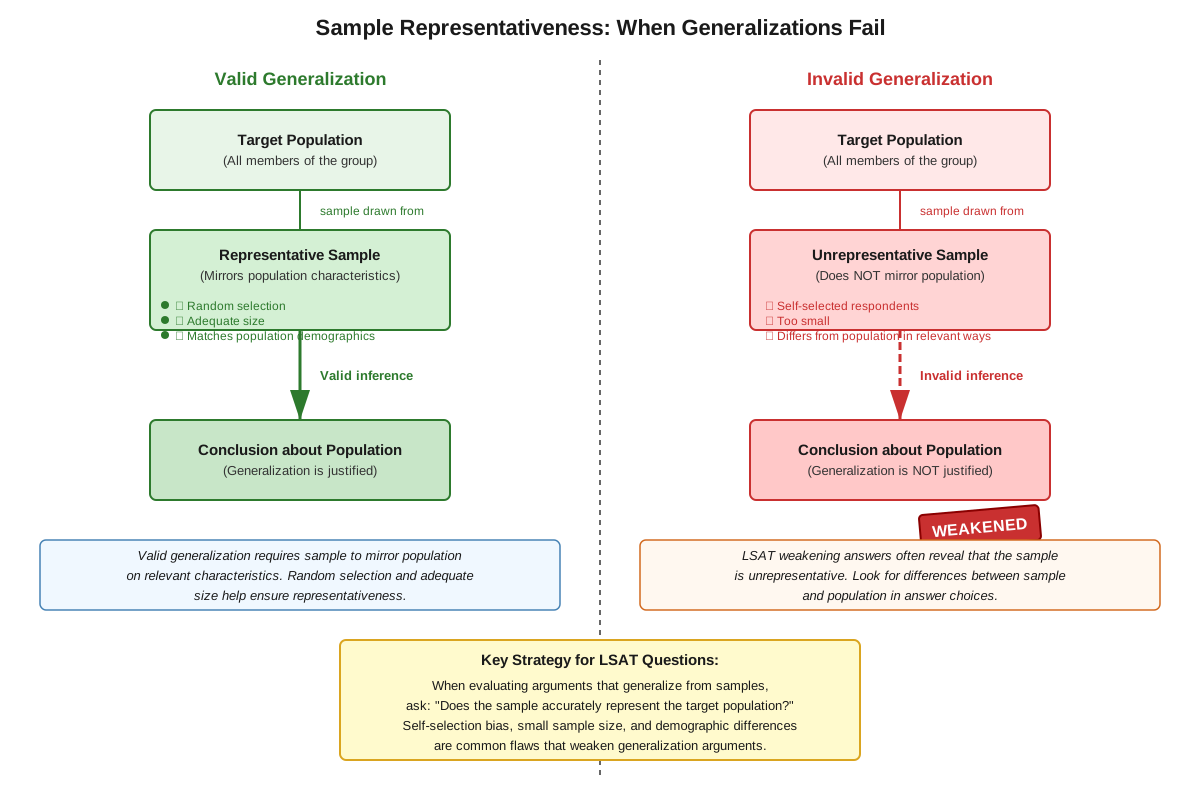
One of the most powerful ways to weaken a statistical argument involves questioning whether the sample accurately represents the population about which conclusions are drawn. A sample is the subset of individuals or cases actually studied, while the population is the larger group about which the argument makes claims.
Sample bias occurs when the sample systematically differs from the population in ways relevant to the conclusion. For example, if an argument concludes that "most residents support the new policy" based on a survey of people who attended a town hall meeting, the sample (meeting attendees) likely differs from the population (all residents) because attendees may be more politically engaged or have stronger opinions.
Common forms of sample bias include:
- Self-selection bias: When participants choose whether to be included (surveys with voluntary response)
- Convenience sampling: When researchers study only easily accessible subjects
- Survival bias: When only successful cases remain visible for study
- Response bias: When certain groups are more or less likely to respond to surveys
Absolute vs. Relative Numbers
The LSAT frequently tests the distinction between absolute numbers (raw counts) and relative numbers (percentages, rates, proportions). Arguments often present one type while the conclusion actually requires the other type for proper support.
| Type | Example | When It Matters |
|---|---|---|
| Absolute | "500 more accidents occurred" | When total impact or magnitude is relevant |
| Relative | "Accident rate increased 20%" | When comparing groups of different sizes |
| Both needed | "20% increase from 100 to 120" | When both proportion and scale matter |
A classic weakening strategy involves showing that an impressive-sounding percentage change corresponds to a trivial absolute change, or that a small percentage change represents a massive absolute impact. For instance, "Company profits increased 200%" sounds impressive but means little if profits went from $1 to $3, while "profits increased 2%" might represent millions of dollars for a large corporation.
Correlation vs. Causation
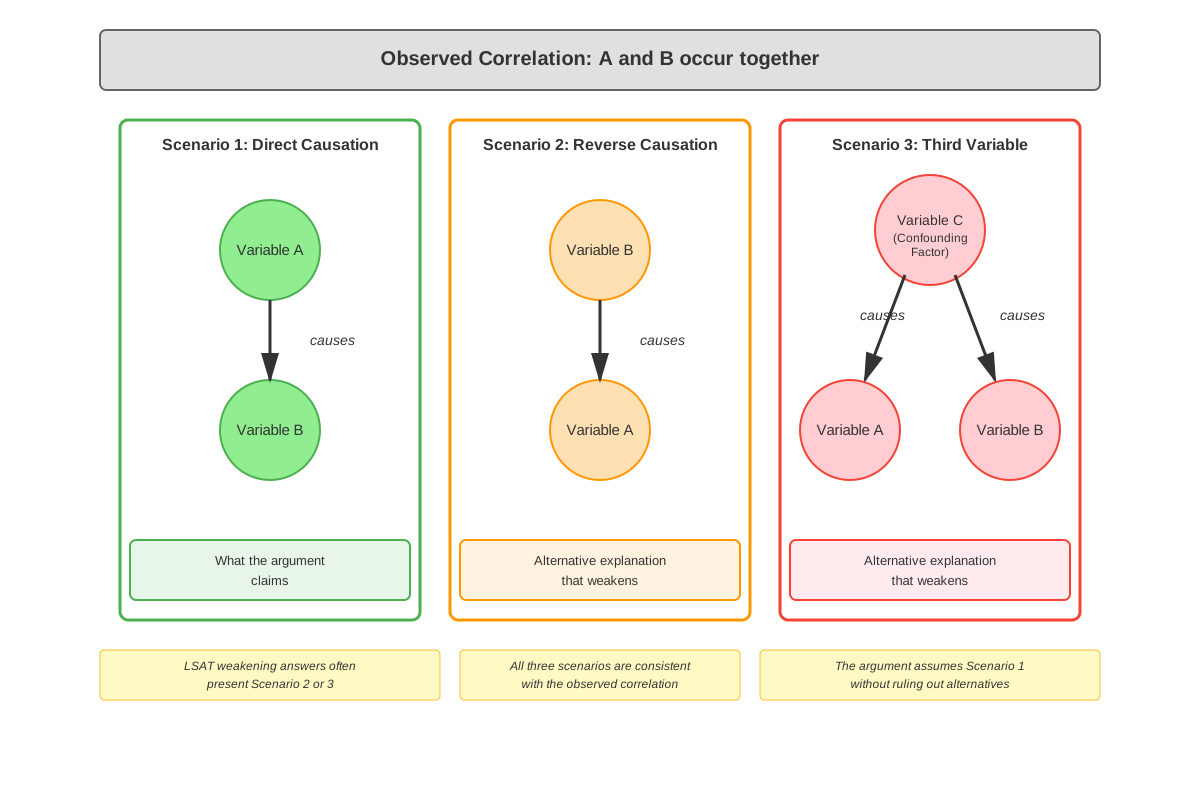
Perhaps the most frequently tested statistical fallacy involves confusing correlation (two things occurring together) with causation (one thing causing another). When an argument presents evidence that X and Y are correlated and concludes that X causes Y, multiple weakening strategies become available:
- Reverse causation: Y might actually cause X rather than X causing Y
- Common cause: A third factor Z might cause both X and Y
- Coincidence: The correlation might be spurious or accidental
- Confounding variables: Other factors might explain the relationship
For example, if an argument notes that ice cream sales and drowning deaths are correlated and concludes that ice cream consumption causes drowning, a weakener might point out that warm weather causes both increased ice cream sales and more swimming (common cause).
Comparison Group Problems
Statistical arguments often compare two groups to establish that a difference in outcomes results from a difference in treatment or characteristics. Weakening such arguments involves showing that the groups differ in other relevant ways beyond the factor being studied.
Confounding variables are factors other than the one being studied that differ between groups and could explain the observed outcome. If a study concludes that Drug A is more effective than Drug B because patients taking Drug A recovered faster, a weakener might reveal that Drug A patients were younger, had milder cases, or received better overall care.
The control group in a study should be identical to the experimental group except for the variable being tested. When groups differ in multiple ways, it becomes impossible to determine which difference caused the outcome difference.
Temporal Issues
Statistical arguments can be weakened by showing that the time period studied was atypical or that temporal relationships don't support the causal claim. Key temporal weakening strategies include:
- Baseline problems: The starting point for comparison may be unusual (measuring crime reduction from an abnormally high year)
- Trend reversal: The pattern observed might reverse over longer time periods
- Timing mismatch: The alleged cause occurred after the effect, or too long before to be plausibly connected
- Seasonal variation: The data might reflect seasonal patterns rather than genuine trends
Rate vs. Number Confusion
Arguments frequently shift between discussing rates (per capita, per unit, percentages) and absolute numbers in ways that obscure the truth. A city might have an increasing crime rate (crimes per 1,000 residents) while total crimes decrease, if population is declining faster than crime. Conversely, a decreasing rate might accompany increasing absolute numbers if population grows rapidly.
Missing Information
Many statistical arguments can be weakened by identifying crucial missing information that would affect the conclusion's validity. Common categories of missing information include:
- Response rates: What percentage of surveyed individuals actually responded?
- Sample size: How many subjects were studied? (Small samples are less reliable)
- Margin of error: How precise are the measurements?
- Comparison baseline: What is the normal rate or expected value?
- Alternative explanations: What other factors might explain the results?
Concept Relationships
The concepts within weakening statistical arguments form an interconnected web of reasoning patterns. Sample representativeness serves as the foundation, as nearly all statistical arguments rely on generalizing from a sample to a population. When samples are unrepresentative, all subsequent reasoning becomes suspect, connecting this concept to every other weakening strategy.
The correlation vs. causation distinction operates at a higher level of analysis, applying after sample quality has been established. Once we accept that a correlation exists in the data, we must still question whether that correlation supports a causal conclusion. This connects directly to comparison group problems and confounding variables, as these represent specific mechanisms by which correlations can exist without causation.
Absolute vs. relative numbers and rate vs. number confusion represent parallel concepts, both involving the distinction between different ways of expressing quantities. These concepts often work together: an argument might use a percentage (relative) to obscure a small absolute change, while simultaneously confusing a rate with a total number.
Temporal issues cut across all other concepts, as time-related problems can affect sample representativeness (studying an atypical time period), causation claims (timing mismatches), and numerical comparisons (baseline problems).
The relationship map flows as follows:
Statistical Argument Presented → Evaluate Sample Quality → Assess Whether Statistics Support Conclusion → Identify Type of Statistical Flaw (Sample/Causation/Numerical/Temporal) → Select Answer That Exploits That Flaw
This topic connects to prerequisite knowledge of general weakening strategies by applying those strategies specifically to statistical contexts. It also relates to assumption questions (identifying what statistical arguments assume) and flaw questions (describing the error in statistical reasoning).
Quick check — test yourself on Weakening statistical arguments so far.
Try Flashcards →High-Yield Facts
⭐ Sample representativeness is the most frequently tested vulnerability in statistical arguments - if the sample differs systematically from the population, conclusions about the population are undermined.
⭐ Correlation does not establish causation - three alternative explanations always exist: reverse causation, common cause, or coincidence.
⭐ Percentage changes can be misleading without knowing absolute numbers - a 200% increase from 1 to 3 is less significant than a 10% increase from 1,000 to 1,100.
⭐ Self-selected samples are inherently biased - people who choose to participate in surveys differ from those who don't, making voluntary response surveys unrepresentative.
⭐ Comparison groups must be identical except for the variable being studied - any other difference between groups represents a potential confounding variable.
- Small sample sizes produce unreliable results that don't generalize well to larger populations.
- Response rates matter - a survey with a 5% response rate tells us more about the 5% who responded than about the entire population.
- Temporal baselines affect conclusions - measuring change from an abnormally high or low starting point distorts the apparent trend.
- Rates and absolute numbers can move in opposite directions when population size changes.
- The absence of a control group makes it impossible to determine whether an observed outcome resulted from the treatment or would have occurred anyway.
- Confounding variables provide alternative explanations for observed correlations, weakening causal claims.
- Survival bias occurs when only successful cases remain visible, creating a misleading picture of typical outcomes.
Common Misconceptions
Misconception: Any statistical evidence automatically makes an argument strong because numbers are objective.
Correction: Statistics can be misleading, misapplied, or based on flawed methodology. The quality of statistical evidence depends entirely on how the data was collected, analyzed, and interpreted.
Misconception: If a sample is large, it must be representative of the population.
Correction: Sample size and representativeness are independent qualities. A massive sample can still be biased if it systematically excludes certain population segments or includes only self-selected participants. A survey of 10,000 volunteers tells us about volunteers, not about the general population.
Misconception: Correlation between X and Y means X causes Y or Y causes X.
Correction: Correlation is consistent with causation but doesn't establish it. A third factor might cause both X and Y, or the correlation might be coincidental. Additional evidence beyond mere correlation is needed to establish causation.
Misconception: To weaken a statistical argument, you must prove the statistics are false or fabricated.
Correction: Weakening doesn't require proving the statistics wrong. Instead, effective weakeners show that even if the statistics are accurate, they don't adequately support the conclusion because of sampling issues, confounding variables, or other logical gaps.
Misconception: If an answer choice provides an alternative explanation for the data, it automatically weakens the argument.
Correction: An alternative explanation weakens the argument only if it's relevant to the specific conclusion being drawn. The alternative explanation must actually compete with the argument's explanation, not merely describe a different phenomenon.
Misconception: Percentages and rates mean the same thing and can be used interchangeably.
Correction: While related, percentages express proportions while rates express quantities per unit (per capita, per year, etc.). Arguments can equivocate between these concepts, and absolute numbers differ from both percentages and rates.
Worked Examples
Example 1: Survey Representativeness
Argument: "A recent survey found that 75% of respondents support building a new sports stadium downtown. This demonstrates that the majority of city residents favor the stadium project, and the city council should approve it."
Question: Which of the following, if true, most weakens the argument?
Analysis Process:
- Identify the conclusion: The city council should approve the stadium because most city residents favor it.
- Identify the statistical evidence: A survey showing 75% support.
- Identify the logical gap: The argument assumes the survey respondents represent all city residents. This is a sample representativeness issue.
- Consider weakening strategies:
- Question who was surveyed
- Question how they were selected
- Question whether respondents differ from non-respondents
- Evaluate answer choices (hypothetical):
- (A) "The survey was conducted at sporting events in the city" - CORRECT WEAKENER. This reveals severe sample bias. People attending sporting events are far more likely to support a sports stadium than the general population. The sample systematically differs from the population in a way directly relevant to the conclusion.
- (B) "The stadium will cost $50 million to build" - This doesn't weaken the argument about public support; it's irrelevant to whether the survey accurately measures resident opinion.
- (C) "Other cities have successfully built downtown stadiums" - This strengthens rather than weakens the argument.
- (D) "The survey included 1,000 respondents" - Sample size alone doesn't address representativeness. A large biased sample is still biased.
Key Takeaway: This example demonstrates how identifying the sample composition can devastate a statistical argument. The 75% figure might be accurate for people at sporting events, but tells us nothing about the general population.
Example 2: Correlation and Causation
Argument: "Over the past five years, as the number of organic food stores in the city has increased from 5 to 25, the city's average life expectancy has increased by 2 years. Therefore, the availability of organic food has caused residents to live longer, and the city should provide tax incentives to encourage more organic food stores."
Question: Which of the following, if true, most seriously weakens the argument?
Analysis Process:
- Identify the conclusion: Organic food availability caused increased life expectancy, so the city should incentivize more organic stores.
- Identify the statistical evidence: Correlation between increasing organic stores (5 to 25) and increasing life expectancy (2 years) over five years.
- Identify the logical gap: The argument treats correlation as causation. Multiple alternative explanations could account for both trends.
- Consider weakening strategies:
- Common cause (third factor causes both)
- Reverse causation (unlikely here)
- Coincidence
- Confounding variables
- Evaluate answer choices (hypothetical):
- (A) "During the same five-year period, the city opened three new hospitals and expanded its emergency medical services" - CORRECT WEAKENER. This provides an alternative explanation for increased life expectancy. Better medical care is a more plausible cause of longer life than organic food availability, and this represents a confounding variable that changed during the same time period.
- (B) "Organic food stores also sell vitamins and supplements" - This doesn't weaken the causal claim; if anything, it might strengthen it by suggesting additional health benefits.
- (C) "The number of organic food stores has continued to increase in the current year" - This is irrelevant to whether the correlation indicates causation.
- (D) "Some residents prefer conventional food to organic food" - This doesn't address whether organic food availability caused the life expectancy increase.
Key Takeaway: This example illustrates how providing an alternative explanation for a correlation weakens causal claims. The argument's evidence (correlation) remains true, but the conclusion (causation) is undermined by showing another factor could explain the observed pattern.
Exam Strategy
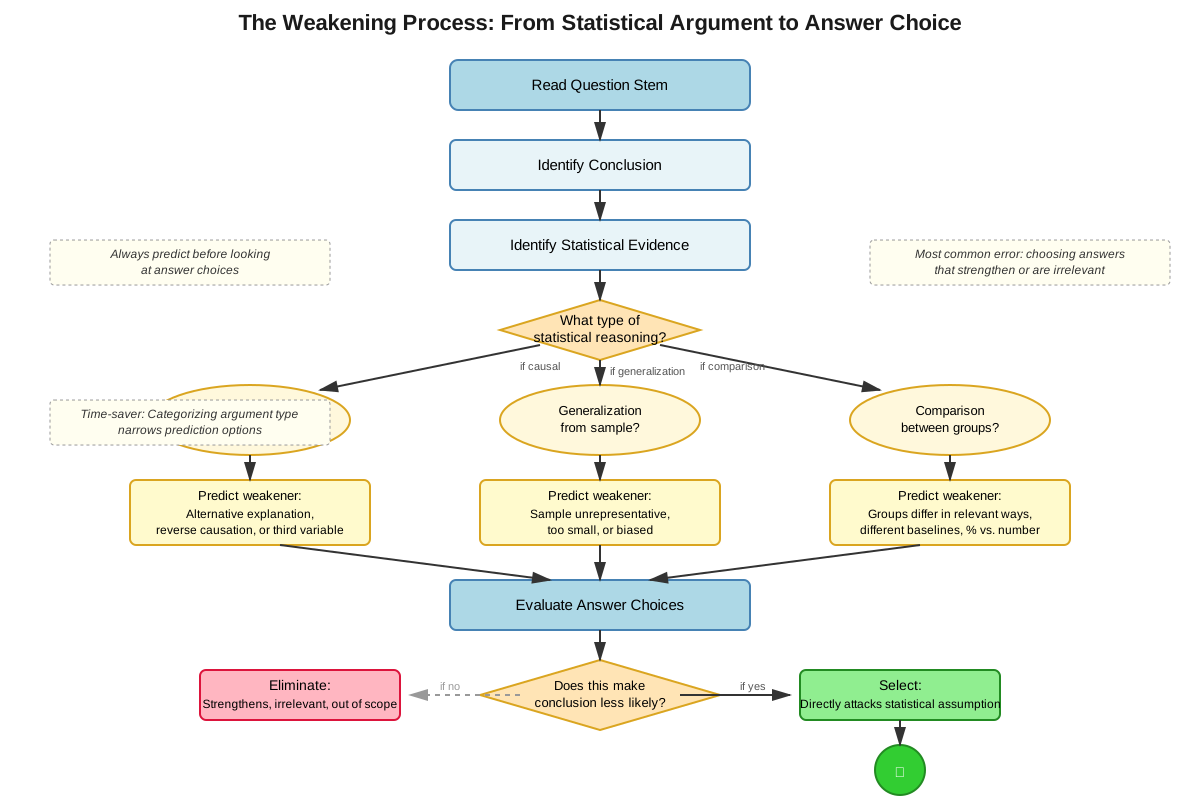
When approaching LSAT weakening statistical arguments questions, follow this systematic process:
Step 1: Identify that the argument is statistical (trigger words: "survey," "study," "research shows," "statistics indicate," "percentage," "rate," "correlation," "data reveals")
Step 2: Locate the statistical evidence and the conclusion separately. Ask: "What do the numbers actually show?" versus "What does the argument claim the numbers prove?"
Step 3: Identify the type of statistical argument:
- Sample-to-population generalization
- Causal claim based on correlation
- Comparison between groups
- Trend or change over time
Step 4: Anticipate vulnerabilities before reading answer choices:
- If sample-based: Is the sample representative?
- If causal: Could correlation exist without causation?
- If comparative: Are the groups truly comparable?
- If temporal: Is the time period typical?
Step 5: Eliminate answer choices systematically:
- Eliminate strengtheners (opposite effect)
- Eliminate irrelevant information
- Eliminate answers that don't address the statistical gap
- Select the answer that most directly exploits the argument's statistical vulnerability
Exam Tip: The correct weakener often introduces new information that reveals a flaw in how the statistics were gathered or interpreted, rather than disputing the numbers themselves.
Time allocation: Spend 1:15-1:30 on these questions. The argument analysis requires careful attention to what the statistics actually show versus what the conclusion claims, but answer choice evaluation should be relatively quick once you've identified the statistical flaw.
Trigger phrases for specific weakening strategies:
- "The survey respondents were selected from..." → Sample bias
- "During the same period..." → Confounding variable
- "The percentage increased from X to Y..." → Check if absolute numbers matter
- "Studies show that X is correlated with Y..." → Causation assumption
Process of elimination tips:
- Answers that accept the argument's causal interpretation usually don't weaken
- Answers about sample size alone rarely weaken (unless the sample is absurdly small)
- The correct answer often reveals information about methodology, sample selection, or alternative explanations
- Beware of answers that seem relevant but don't actually address the logical gap between evidence and conclusion
Memory Techniques
SCANT - Remember the five major categories of statistical weakeners:
- Sample representativeness
- Correlation vs. causation
- Absolute vs. relative numbers
- Number vs. rate confusion
- Temporal issues
"Correlation is NOT Causation" - Memorize the three alternatives:
- Reverse causation (Y causes X, not X causes Y)
- Common cause (Z causes both X and Y)
- Coincidence (spurious correlation)
The Sample Quality Checklist - Visualize checking these boxes:
- ☐ Who was included in the sample?
- ☐ Who was excluded from the sample?
- ☐ How were participants selected?
- ☐ Did participants self-select?
- ☐ What was the response rate?
"Percent of What?" - When you see percentages, always ask:
- Percent of what total?
- What are the absolute numbers?
- Are we comparing percentages of different-sized groups?
The Confounding Variable Test - Ask: "What else changed?" Visualize a timeline with multiple factors changing simultaneously, not just the one the argument focuses on.
Summary
Weakening statistical arguments on the LSAT requires recognizing that numerical evidence, while appearing objective, can be misleading when improperly collected, analyzed, or interpreted. The most powerful weakening strategies target sample representativeness (showing the sample doesn't reflect the population), causation assumptions (providing alternative explanations for correlations), and numerical confusion (revealing that percentages obscure absolute numbers or that rates differ from totals). Success on these questions demands identifying the specific type of statistical reasoning employed, anticipating the logical gap between evidence and conclusion, and selecting answer choices that exploit that gap by revealing methodological flaws, confounding variables, or missing information. The key insight is that weakening doesn't require proving statistics false; rather, it requires showing that even accurate statistics don't adequately support the conclusion drawn from them due to sampling bias, causal fallacies, inappropriate comparisons, or temporal issues.
Key Takeaways
- Sample representativeness is the most frequently exploited vulnerability - if the sample systematically differs from the population, conclusions about the population fail
- Correlation never establishes causation without additional evidence ruling out reverse causation, common causes, and coincidence
- Percentages and rates can be misleading without absolute numbers for context, and vice versa
- Comparison groups must be identical except for the variable being studied, or confounding variables provide alternative explanations
- Self-selected samples are inherently biased and don't represent populations
- Weakening statistical arguments requires showing the gap between what the statistics actually demonstrate and what the conclusion claims they prove
- The correct weakener typically reveals information about methodology, sample selection, or alternative explanations rather than disputing the numbers themselves
Related Topics
Strengthening Statistical Arguments: The mirror image of this topic, involving answer choices that make statistical evidence more supportive of conclusions by addressing sample quality, ruling out alternative explanations, or providing missing information. Mastering weakening strategies naturally prepares students for strengthening questions.
Flaw Questions with Statistical Reasoning: These questions ask test-takers to describe the error in statistical arguments rather than weaken them. The same conceptual understanding applies, but the task shifts from selecting evidence to articulating the logical flaw.
Assumption Questions in Statistical Contexts: Statistical arguments rest on assumptions about sample representativeness, causal mechanisms, and numerical relationships. Identifying these assumptions requires the same analytical skills as weakening the arguments.
Necessary vs. Sufficient Assumptions: Understanding the difference between what an argument must assume (necessary) and what would guarantee its conclusion (sufficient) becomes particularly important in statistical contexts where multiple assumptions operate simultaneously.
Causal Reasoning: A broader topic that encompasses statistical causation but extends to non-statistical causal arguments, providing deeper understanding of how causes and effects relate logically.
Practice CTA
Now that you've mastered the core concepts of weakening statistical arguments, it's time to apply this knowledge to actual LSAT-style questions. The practice questions and flashcards will reinforce your ability to quickly identify statistical vulnerabilities, anticipate weakening strategies, and select correct answers under timed conditions. Remember: understanding the concepts is only the first step—achieving mastery requires repeated application to diverse question types. Each practice question you complete strengthens your pattern recognition and builds the automaticity needed for test day success. Approach the practice materials strategically, reviewing not just why correct answers work but also why wrong answers fail. Your investment in deliberate practice now will translate directly into points on test day.
Sign up free to keep reading
Create a free AnvayaPrep account to finish this LSAT guide on Weakening statistical arguments — plus flashcards and practice questions.