Overview
Supporting a link is a critical concept within LSAT Logical Reasoning that appears frequently in strengthen and weaken questions. This concept focuses on identifying and reinforcing the connection between an argument's evidence and its conclusion. When an LSAT question asks you to strengthen an argument by supporting a link, you're being tested on your ability to recognize gaps in reasoning and select answer choices that bridge those gaps by making the logical connection more secure.
Understanding how to support a link is essential because many LSAT arguments contain implicit assumptions—unstated connections between premises and conclusions. The test makers deliberately construct arguments with logical gaps, then ask you to identify which answer choice best fills that gap or makes the reasoning more sound. This skill is fundamental not only for strengthen questions but also for understanding argument structure across all Logical Reasoning question types. Mastering this concept will improve your performance on approximately 15-20% of all Logical Reasoning questions.
Within the broader context of LSAT supporting a link questions, this topic connects directly to assumption questions, necessary assumption questions, and sufficient assumption questions. All these question types require you to understand the relationship between premises and conclusions. However, strengthen questions specifically ask you to make an existing argument better rather than identify what must be true for the argument to work. This distinction is crucial for exam success and represents a more nuanced application of your analytical reasoning skills.
Learning Objectives
- [ ] Identify how Supporting a link appears in LSAT questions
- [ ] Explain the reasoning pattern behind Supporting a link
- [ ] Apply Supporting a link to solve LSAT-style problems accurately
- [ ] Distinguish between answer choices that support a link versus those that provide general support
- [ ] Recognize common argument structures where link-supporting is the primary strengthening strategy
- [ ] Evaluate the relative strength of different link-supporting answer choices
- [ ] Predict the type of link support needed before reviewing answer choices
Prerequisites
- Basic argument structure: Understanding premises, conclusions, and how they relate is essential because supporting a link requires identifying the gap between evidence and claim
- Conditional reasoning fundamentals: Recognizing if-then relationships helps identify logical connections that need strengthening
- Assumption identification: The ability to spot unstated assumptions is crucial since supporting a link often means making implicit assumptions more explicit
- Causal reasoning basics: Many link-supporting questions involve causal arguments where the connection between cause and effect needs reinforcement
Why This Topic Matters
Supporting a link questions represent one of the most sophisticated reasoning skills tested on the LSAT. In real-world contexts, this skill translates directly to legal practice, where attorneys must construct persuasive arguments by connecting evidence to legal conclusions. Judges and juries need to see clear logical pathways from facts to verdicts, and lawyers who can identify and strengthen these connections are more effective advocates. This same skill applies to policy analysis, business strategy, and any field requiring rigorous analytical thinking.
On the LSAT, strengthen questions appear in approximately 8-12 questions per test across both Logical Reasoning sections. Of these strengthen questions, roughly 60-70% specifically test your ability to support a link rather than provide general support or eliminate alternative explanations. This makes lsat supporting a link one of the highest-yield concepts for score improvement. Questions testing this concept typically appear at medium to high difficulty levels, making them crucial for students aiming for scores above 160.
These questions commonly appear with specific language patterns: "Which one of the following, if true, most strengthens the argument?" or "Which one of the following, if true, provides the most support for the conclusion?" The arguments themselves often involve causal claims, analogical reasoning, statistical generalizations, or predictions about future outcomes. Recognizing these patterns allows you to anticipate what type of link needs support before examining the answer choices.
Core Concepts
Understanding the Link in Arguments
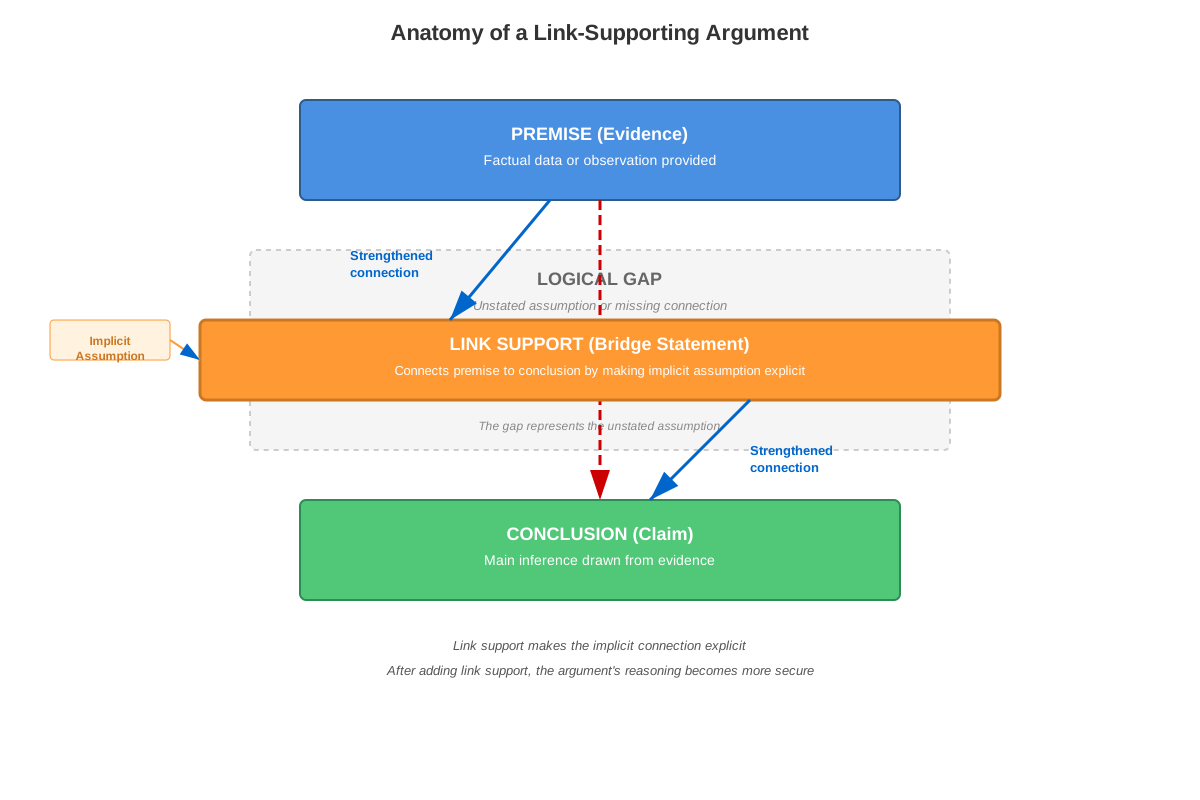
The link in an argument refers to the logical connection between the evidence (premises) and the conclusion. Every argument makes an inferential leap—the conclusion goes beyond what the premises explicitly state. This gap represents the link that may need support. In a strong argument, this link is secure and obvious; in weaker arguments (which the LSAT typically presents), the link contains assumptions that could be questioned.
Consider this basic structure:
- Premise: Company X's sales increased after hiring a new marketing director
- Conclusion: The new marketing director caused the sales increase
The link here is the causal connection between the hiring and the sales increase. The argument assumes no other factors caused the increase, that the timing wasn't coincidental, and that the marketing director actually implemented changes. Supporting a link means providing information that makes this causal connection more plausible.
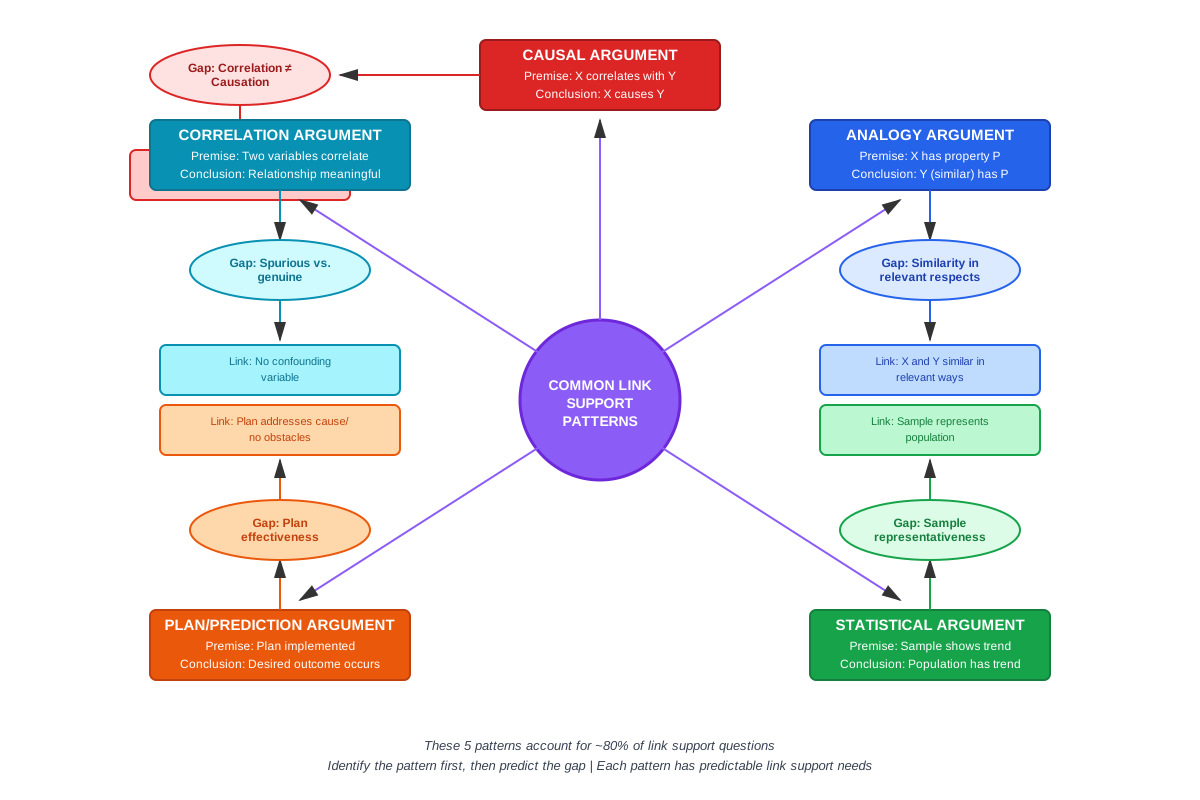
Types of Links That Need Support
Different argument structures create different types of links that may require strengthening:
Causal Links: These arguments claim one thing causes another. Supporting the link means ruling out alternative causes, establishing temporal sequence, or showing a mechanism connecting cause and effect.
Analogical Links: These arguments claim two situations are similar enough that what's true of one is true of the other. Supporting the link means highlighting relevant similarities or showing the comparison is appropriate.
Statistical/Sampling Links: These arguments generalize from a sample to a population. Supporting the link means showing the sample is representative or that sampling methodology was sound.
Predictive Links: These arguments claim past patterns will continue or that current conditions will lead to specific outcomes. Supporting the link means showing stability of conditions or reliability of the pattern.
The Mechanism of Link Support
When an answer choice supports a link, it performs one of several specific functions:
- Eliminates a potential disconnect: Shows that a factor that could break the connection between premise and conclusion doesn't apply
- Establishes relevance: Demonstrates that the evidence actually relates to the conclusion in the way the argument assumes
- Confirms an assumption: Makes explicit an unstated assumption that the argument depends upon
- Provides a connecting principle: Offers a general rule that bridges the gap between specific evidence and conclusion
The most effective link-supporting answer choices directly address the specific gap in the argument rather than providing tangential support or general background information.
Distinguishing Link Support from Other Strengthening Methods
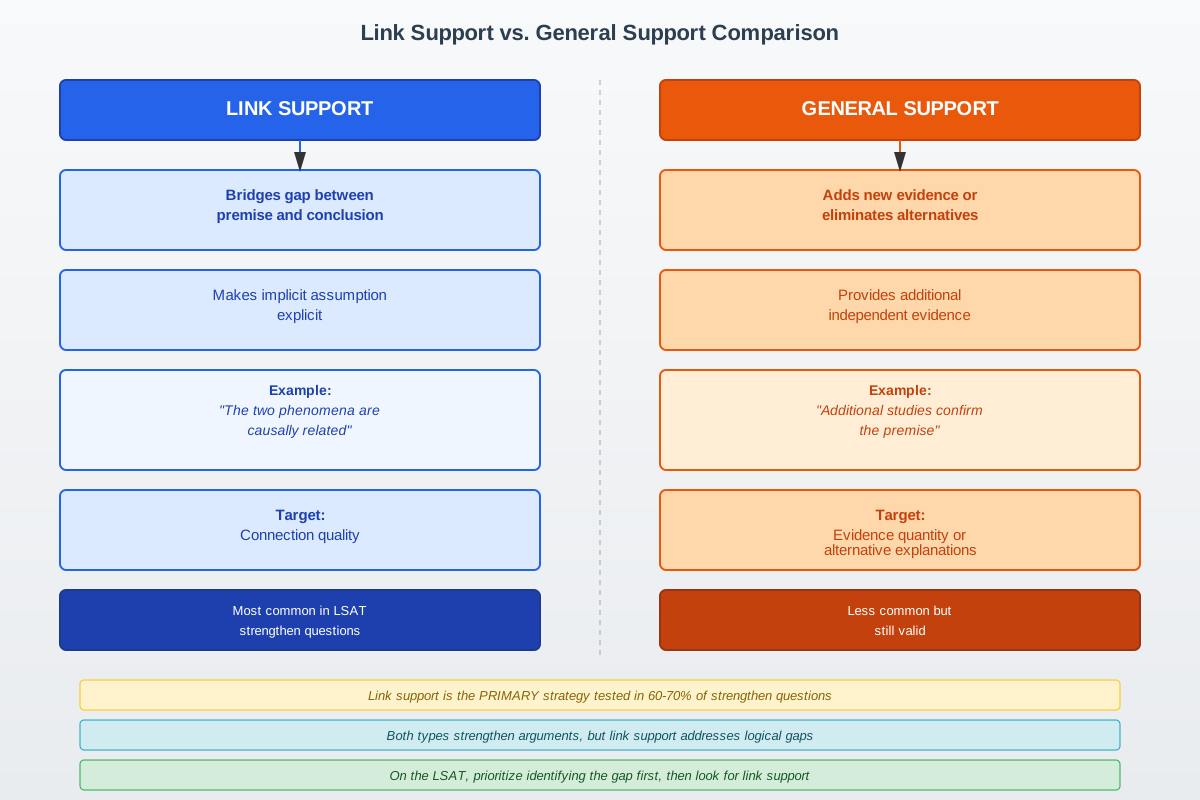
Not all strengthen answer choices work by supporting a link. Understanding the distinction is crucial:
| Strengthening Method | How It Works | Example |
|---|---|---|
| Supporting a Link | Bridges the gap between premise and conclusion | Shows that the sample used in a study is representative of the population |
| Eliminating Alternative Explanations | Rules out competing causes or interpretations | Shows that no other factor could have caused the observed effect |
| Providing Additional Evidence | Adds new premises that independently support the conclusion | Offers a second study with similar results |
| Establishing Credibility | Shows the source of information is reliable | Indicates the researcher is an expert in the field |
Supporting a link is the most common and often most powerful strengthening method because it addresses the argument's internal logic rather than adding external support.
Identifying What Link Needs Support
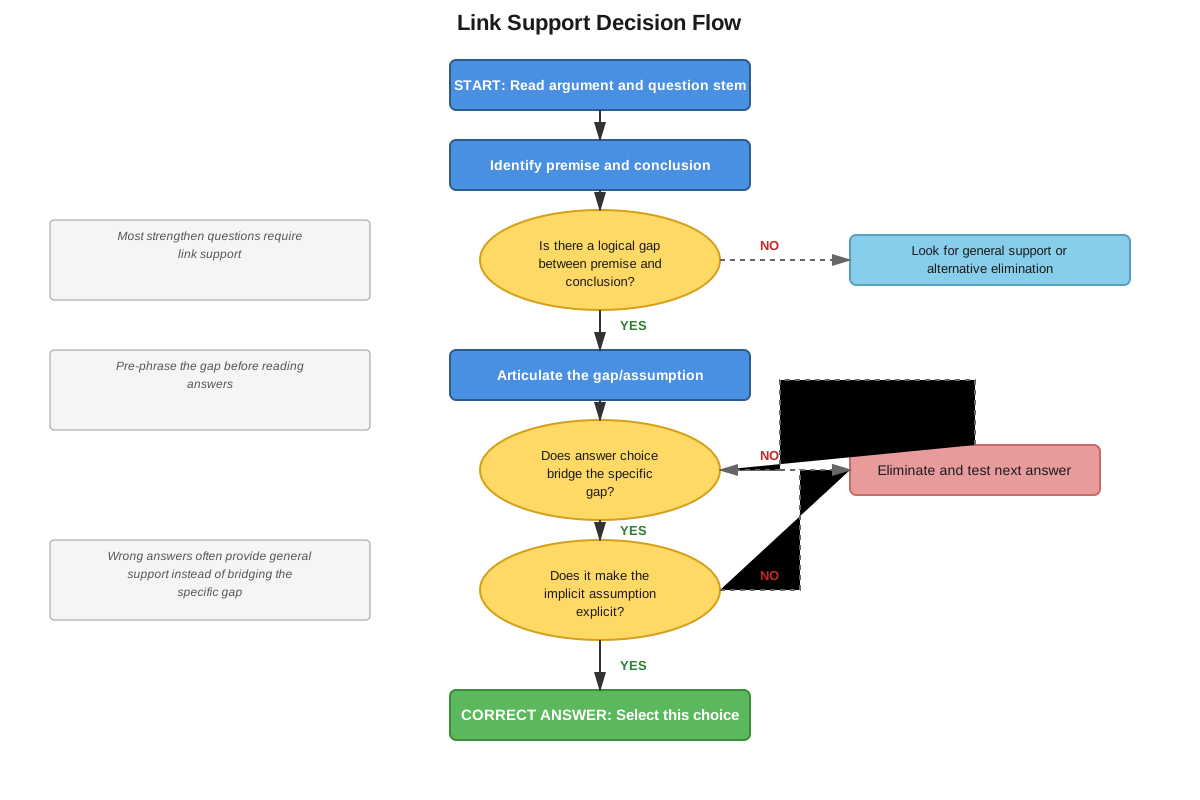
Before examining answer choices, skilled test-takers identify the specific link that needs strengthening. This process involves:
- Isolate the conclusion: Identify exactly what the argument is trying to prove
- Identify the evidence: Determine what facts or premises are offered
- Spot the gap: Ask "What assumption connects this evidence to this conclusion?"
- Predict the support: Anticipate what information would make that connection stronger
For example, if an argument concludes that a new teaching method is effective because students who used it scored higher on tests, the link that needs support is the connection between using the method and the test scores. You should predict that the correct answer will show the method actually caused the improvement (perhaps by ruling out that these students were already higher-performing, or by showing they received no other special instruction).
Common Argument Patterns Requiring Link Support
Certain argument structures appear repeatedly on the LSAT and consistently require link support:
Plan/Proposal Arguments: These argue that a proposed action will achieve a desired outcome. The link needing support is between the action and the predicted result. Support often comes from showing the plan addresses the actual cause of the problem or that similar plans have succeeded.
Explanation Arguments: These offer an explanation for an observed phenomenon. The link needing support is between the proposed explanation and the phenomenon. Support often comes from showing the explanation is consistent with other known facts or that alternative explanations don't fit.
Recommendation Arguments: These recommend a course of action based on certain goals or values. The link needing support is between the action and the achievement of those goals. Support often comes from showing the action is feasible or that it won't have counterproductive effects.
Concept Relationships
The concept of supporting a link sits at the intersection of several fundamental logical reasoning skills. Understanding argument structure is the foundation—you cannot support a link without first identifying what the premises and conclusion are. This leads directly to assumption identification, since the link that needs support is typically an unstated assumption in the argument.
Supporting a link connects closely to necessary assumption questions because both question types require you to identify what the argument depends upon. However, while necessary assumption questions ask for what must be true, strengthen questions ask for what would make the argument better, allowing for a broader range of correct answers.
The relationship flows as follows:
Argument Structure Analysis → Gap/Assumption Identification → Link Recognition → Prediction of Support Needed → Answer Choice Evaluation
This concept also relates to weaken questions through inverse logic. If you understand what would support a link, you can identify what would break that link. Many students find that mastering strengthen questions simultaneously improves their performance on weaken questions.
Additionally, supporting a link connects to sufficient assumption questions, where the correct answer completely closes the logical gap. In strengthen questions, the correct answer makes the link stronger but doesn't necessarily make the argument perfect—it's a matter of degree rather than sufficiency.
High-Yield Facts
⭐ Supporting a link means strengthening the connection between an argument's premises and its conclusion, not just adding any information that makes the conclusion more likely
⭐ The correct answer in link-supporting questions directly addresses the specific gap between evidence and conclusion rather than providing tangential support
⭐ Approximately 60-70% of strengthen questions on the LSAT specifically test link-supporting rather than other strengthening methods
⭐ Causal arguments are the most common argument type requiring link support, typically needing answer choices that rule out alternative causes or establish causal mechanisms
⭐ Before examining answer choices, identify the specific assumption connecting the premise to the conclusion—this is the link that needs support
- Link-supporting answer choices often work by making implicit assumptions explicit or by showing that potential objections don't apply
- Arguments involving analogies, comparisons, or generalizations almost always require link support rather than additional evidence
- The strength of link support is determined by how directly it addresses the specific gap in reasoning, not by how much additional information it provides
- Wrong answer choices in link-supporting questions often strengthen the premises rather than the connection between premises and conclusion
- Temporal sequence, representativeness, and relevance are the three most common types of links that need support on the LSAT
Quick check — test yourself on Supporting a link so far.
Try Flashcards →Common Misconceptions
Misconception: Any answer choice that makes the conclusion more likely is supporting the link → Correction: Supporting a link specifically means strengthening the connection between the given premises and the conclusion. An answer that provides entirely new evidence for the conclusion isn't supporting the link—it's providing additional independent support. The correct answer must address the relationship between what's already stated and what's concluded.
Misconception: The correct answer must prove the conclusion is true → Correction: Strengthen questions ask you to make the argument better, not perfect. The correct answer should make the conclusion more likely given the premises, but it doesn't need to establish certainty. Even after the strengthening, the argument may still have weaknesses.
Misconception: Supporting a link is the same as identifying a necessary assumption → Correction: While related, these are distinct tasks. A necessary assumption is something that must be true for the argument to work at all. Supporting a link means providing information that makes the connection stronger, which may go beyond what's strictly necessary. A link-supporting answer choice might provide more support than minimally required.
Misconception: Longer or more detailed answer choices provide better link support → Correction: The strength of link support depends on relevance to the specific gap in reasoning, not on the amount of information provided. A concise answer choice that directly addresses the key assumption is stronger than a lengthy answer that provides tangential information.
Misconception: If an answer choice is true and relevant to the topic, it strengthens the argument → Correction: An answer choice can be true and topically relevant without strengthening the specific link between premises and conclusion. For example, in an argument about whether a new drug is effective, learning that the drug is inexpensive might be true and relevant to healthcare policy, but it doesn't support the link between clinical trial results and the conclusion about effectiveness.
Worked Examples
Example 1: Causal Argument
Argument: "City traffic congestion decreased by 15% after the city implemented a new traffic light timing system. Therefore, the new timing system reduced traffic congestion."
Question: Which of the following, if true, most strengthens the argument?
Analysis Process:
- Identify the conclusion: The new timing system reduced traffic congestion
- Identify the premise: Congestion decreased after the system was implemented
- Identify the gap/link: The argument assumes the timing system caused the decrease, but correlation doesn't prove causation. Other factors might have caused the decrease, or it might be coincidental.
- Predict what would support the link: Information showing no other factors caused the decrease, or that the timing system was the only relevant change
Answer Choices:
- (A) The city's population remained stable during the period
- (B) No other significant changes to traffic management occurred during this period
- (C) Other cities have also experienced reduced congestion
- (D) The timing system was expensive to implement
- (E) Traffic congestion had been increasing for five years before the new system
Evaluation:
- (A) helps somewhat by ruling out population decrease as an alternative cause, but doesn't fully support the link
- (B) directly supports the causal link by eliminating alternative explanations—this is the correct answer
- (C) provides general support but doesn't address whether the timing system caused this city's decrease
- (D) is irrelevant to whether the system caused the decrease
- (E) provides context but doesn't strengthen the causal connection
Why (B) is correct: It directly addresses the gap in the argument by ruling out alternative causes, making it more likely that the timing system specifically caused the decrease. This is classic link support for a causal argument.
Example 2: Analogical Argument
Argument: "The new smartphone app was successful in helping users in Japan reduce their energy consumption. Therefore, the app will likely help users in Canada reduce their energy consumption as well."
Question: Which of the following, if true, most strengthens the argument?
Analysis Process:
- Identify the conclusion: The app will help Canadian users reduce energy consumption
- Identify the premise: The app helped Japanese users reduce energy consumption
- Identify the gap/link: The argument assumes Japan and Canada are similar enough that success in one predicts success in the other. The link depends on relevant similarities.
- Predict what would support the link: Information showing that relevant factors (energy use patterns, technology adoption, climate, etc.) are similar between the two countries
Answer Choices:
- (A) Canadian users are generally enthusiastic about new technology
- (B) Energy consumption patterns and household energy use are similar in Japan and Canada
- (C) The app is available in both Japanese and English
- (D) Energy costs are high in both countries
- (E) The app's developers are planning a marketing campaign in Canada
Evaluation:
- (A) might suggest adoption but doesn't support the link between Japanese success and predicted Canadian success
- (B) directly supports the analogical link by showing relevant similarity—this is the correct answer
- (C) addresses a practical concern but doesn't strengthen the reasoning that success in one country predicts success in another
- (D) provides some support but doesn't directly address whether the situations are analogous in ways relevant to the app's effectiveness
- (E) is about implementation, not about whether the analogy is sound
Why (B) is correct: Analogical arguments depend on relevant similarities between the compared situations. By showing that energy consumption patterns—the most relevant factor for an energy-reduction app—are similar, this answer directly supports the link between Japanese success and predicted Canadian success.
Exam Strategy
When approaching strengthen and weaken questions that test supporting a link, follow this systematic process:
Step 1: Read the question stem first to confirm you're looking for an answer that strengthens (not weakens) the argument. Note whether it asks for "most strengthens" (comparative) or "strengthens" (any degree of support).
Step 2: Identify the conclusion precisely. Underline or mentally note the exact claim being made. Don't confuse intermediate conclusions with the main conclusion.
Step 3: Identify the premises. What evidence is offered? What facts are presented as support?
Step 4: Articulate the gap. Ask yourself: "What assumption connects this evidence to this conclusion?" or "Why might someone doubt that this evidence proves this conclusion?" The answer to these questions reveals the link that needs support.
Step 5: Predict before looking at choices. Spend 5-10 seconds thinking about what information would make the connection stronger. You don't need to predict the exact wording, but having a general sense of what's needed dramatically improves accuracy.
Exam Tip: The most common trigger phrases for link-supporting questions are "most strengthens the argument," "provides the most support for the conclusion," and "most justifies the conclusion." These phrases indicate you should focus on the connection between premises and conclusion.
Step 6: Evaluate each answer choice by asking: "Does this address the specific gap I identified?" Eliminate choices that:
- Strengthen the premises rather than the link
- Provide tangential information
- Address a different gap than the one in the argument
- Actually weaken the argument (common trap)
Step 7: Compare remaining choices. If multiple answers seem to strengthen the argument, ask which one more directly addresses the specific assumption or gap. The correct answer will have a tighter logical connection to the argument's reasoning.
Time allocation: Spend approximately 1:15-1:30 on these questions. The upfront investment in identifying the gap (Steps 2-5) should take 30-40 seconds but will save time in evaluating answer choices and dramatically improve accuracy.
Watch for these trigger words in answer choices:
- "Only," "solely," "exclusively" (often indicate the answer rules out alternatives)
- "Representative," "typical," "similar" (often support statistical or analogical links)
- "Actually," "in fact," "indeed" (often confirm assumptions)
- "No other," "no additional" (often eliminate alternative explanations)
Memory Techniques
The BRIDGE Acronym for identifying what link needs support:
- Between: Focus on the connection between premises and conclusion
- Relevance: Ask if the evidence is actually relevant to the conclusion
- Implicit: Identify implicit assumptions
- Disconnect: Look for potential disconnects or gaps
- Gap: Articulate the specific gap in reasoning
- Expect: Predict what would close that gap
The Three C's of causal link support (the most common type):
- Correlation confirmed: The relationship exists
- Causation mechanism: How does A lead to B?
- Competing causes eliminated: Nothing else caused the effect
Visualization Strategy: Picture the argument as a bridge. The premises are one side, the conclusion is the other side, and the link is the bridge connecting them. If the bridge has a gap or weak spot, that's where support is needed. The correct answer provides materials to strengthen that specific weak point, not to build an entirely new bridge or to reinforce the solid parts.
The "So What?" Test: After reading the premises, ask "So what?" or "Why does that prove the conclusion?" Your answer reveals the link. For example: "Sales increased after hiring a new director." So what? "So the director caused the increase." That's your link—the causal connection that needs support.
Summary
Supporting a link is a fundamental skill for LSAT Logical Reasoning that requires identifying and strengthening the connection between an argument's premises and its conclusion. Unlike other strengthening methods that add new evidence or eliminate alternatives, supporting a link specifically addresses the logical gap or assumption that allows the conclusion to follow from the evidence. This concept appears in 60-70% of strengthen questions, making it one of the highest-yield topics for score improvement. Success requires a systematic approach: identify the conclusion, recognize the premises, articulate the specific gap in reasoning, predict what would close that gap, and select the answer choice that most directly addresses that connection. The most common argument types requiring link support involve causal claims, analogies, statistical generalizations, and predictions, each requiring specific types of support to strengthen the inferential leap from evidence to conclusion.
Key Takeaways
- Supporting a link means strengthening the specific connection between given premises and the conclusion, not just making the conclusion more believable in general
- Always identify the gap or assumption in the argument before examining answer choices—this gap represents the link that needs support
- Causal arguments are the most frequent type requiring link support, typically needing answer choices that rule out alternative causes or establish causal mechanisms
- The correct answer directly addresses the specific reasoning gap rather than providing tangential information or strengthening the premises themselves
- Distinguish link support from other strengthening methods: link support bridges the gap between existing evidence and conclusion, while other methods add new evidence or eliminate alternatives
- Predict the type of support needed before reviewing answer choices to improve accuracy and speed
- Link-supporting questions appear in approximately 8-12 questions per LSAT, representing one of the most testable concepts in Logical Reasoning
Related Topics
Necessary Assumption Questions: These questions ask you to identify what must be true for an argument to work, which is closely related to identifying the link that needs support. Mastering link support provides the foundation for recognizing necessary assumptions.
Sufficient Assumption Questions: While link support makes an argument stronger, sufficient assumptions make arguments logically complete. Understanding the difference between strengthening and proving helps distinguish these question types.
Weaken Questions: These are the inverse of strengthen questions. Once you understand what supports a link, you can identify what would break that link, making weaken questions more approachable.
Flaw Questions: Many flawed arguments contain weak or unsupported links. Recognizing what link needs support helps you identify and articulate logical flaws.
Causal Reasoning: Since many link-supporting questions involve causal arguments, deepening your understanding of causal logic will enhance your ability to identify what support is needed.
Practice CTA
Now that you understand the concept of supporting a link, it's time to apply this knowledge to actual LSAT questions. The practice questions and flashcards have been specifically designed to reinforce the skills covered in this guide. Focus on identifying the gap in reasoning before looking at answer choices—this single habit will dramatically improve your accuracy. Remember, mastering this concept will help you with 8-12 questions on test day, potentially adding several points to your score. Approach each practice question systematically, and review both correct and incorrect answers to understand why certain choices support the link while others don't. You've built the foundation; now strengthen it through deliberate practice!
Sign up free to keep reading
Create a free AnvayaPrep account to finish this LSAT guide on Supporting a link — plus flashcards and practice questions.