Overview
Supporting measurement is a critical reasoning pattern that appears frequently in LSAT Logical Reasoning sections, particularly within strengthen and weaken questions. This pattern involves arguments that rely on measurements, statistics, surveys, or quantitative data to support a conclusion. Understanding how to evaluate these measurement-based arguments is essential because the LSAT regularly tests whether students can identify what additional information would strengthen or weaken conclusions drawn from numerical evidence.
The core challenge with supporting measurement questions lies in recognizing that raw numbers or percentages alone rarely tell the complete story. An argument might cite that "70% of respondents prefer Product A," but without knowing the sample size, selection method, or comparison baseline, this measurement provides limited support for broader conclusions. LSAT supporting measurement questions test the ability to identify what contextual information, comparative data, or methodological details would make measurement-based evidence more or less convincing.
This topic connects directly to broader Logical Reasoning skills including assumption identification, causal reasoning, and argument evaluation. Mastering supporting measurement patterns enables students to quickly recognize when an argument's numerical foundation is solid versus when it rests on incomplete or misleading data. This skill proves particularly valuable because measurement-based arguments appear across multiple question types, including strengthen, weaken, assumption, and flaw questions, making it one of the highest-yield patterns to master for LSAT success.
Learning Objectives
- [ ] Identify how Supporting measurement appears in LSAT questions
- [ ] Explain the reasoning pattern behind Supporting measurement
- [ ] Apply Supporting measurement to solve LSAT-style problems accurately
- [ ] Distinguish between absolute numbers and relative percentages in argument evaluation
- [ ] Recognize common measurement flaws including inadequate sample sizes and unrepresentative samples
- [ ] Evaluate whether comparison groups are appropriate for the conclusion being drawn
- [ ] Determine what baseline or contextual information is necessary to properly interpret measurements
Prerequisites
- Basic argument structure: Understanding premises, conclusions, and how evidence supports claims is essential because supporting measurement questions require identifying what additional evidence would strengthen the logical connection between measurement data and conclusions.
- Strengthen and weaken question fundamentals: Familiarity with how answer choices can make arguments more or less convincing provides the foundation for evaluating which measurements or contextual information would impact argument strength.
- Percentage versus absolute number concepts: Basic mathematical literacy regarding how percentages relate to total populations enables recognition of when arguments confuse relative proportions with absolute quantities.
- Survey and study methodology basics: General awareness that how data is collected affects its reliability helps identify when measurement methods themselves strengthen or weaken conclusions.
Why This Topic Matters
Supporting measurement questions represent approximately 15-20% of all Logical Reasoning questions on the LSAT, making this one of the most frequently tested patterns. These questions appear not only in explicitly labeled strengthen/weaken formats but also in assumption questions (where the assumption provides missing measurement context), flaw questions (where the flaw involves misusing measurements), and evaluation questions (where determining what information matters requires understanding measurement gaps).
In real-world applications, the ability to critically evaluate measurement-based claims is fundamental to legal reasoning. Attorneys must assess statistical evidence in discrimination cases, evaluate survey data in trademark disputes, analyze accident statistics in liability cases, and scrutinize expert testimony involving measurements and quantitative analysis. The LSAT tests this skill because it directly predicts success in legal practice where numerical evidence frequently appears.
Common manifestations in LSAT passages include arguments about business performance based on sales figures, public health conclusions drawn from disease rates, policy recommendations supported by survey results, and causal claims backed by correlation statistics. The test writers deliberately construct these arguments with measurement gaps—missing comparison groups, unclear denominators, ambiguous time frames, or unrepresentative samples—then ask students to identify what information would strengthen or weaken the reasoning.
Core Concepts
The Supporting Measurement Pattern
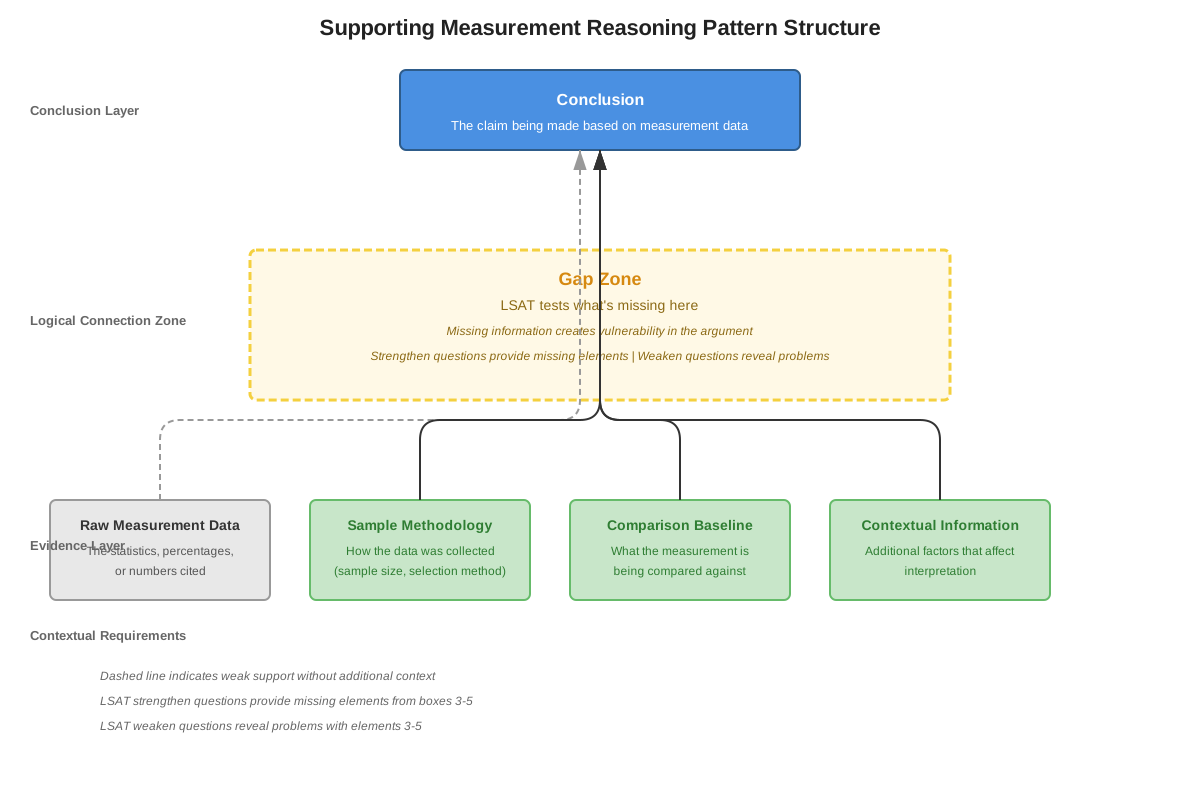
The supporting measurement pattern occurs when an argument uses quantitative data—numbers, percentages, rates, averages, or statistical findings—as evidence for a conclusion. The logical structure typically follows this form: "Measurement X shows Y, therefore conclusion Z follows." The vulnerability in these arguments lies in the gap between what the measurement actually demonstrates and what the conclusion claims it demonstrates.
LSAT questions exploit this gap by testing whether students recognize what additional measurement information is necessary to bridge the logical distance between data and conclusion. For example, knowing that "sales increased by 20%" only supports a conclusion about business success if we also know relevant context: increased compared to what baseline, over what time period, in comparison to competitors, and whether profit margins also increased.
Absolute Numbers Versus Relative Percentages
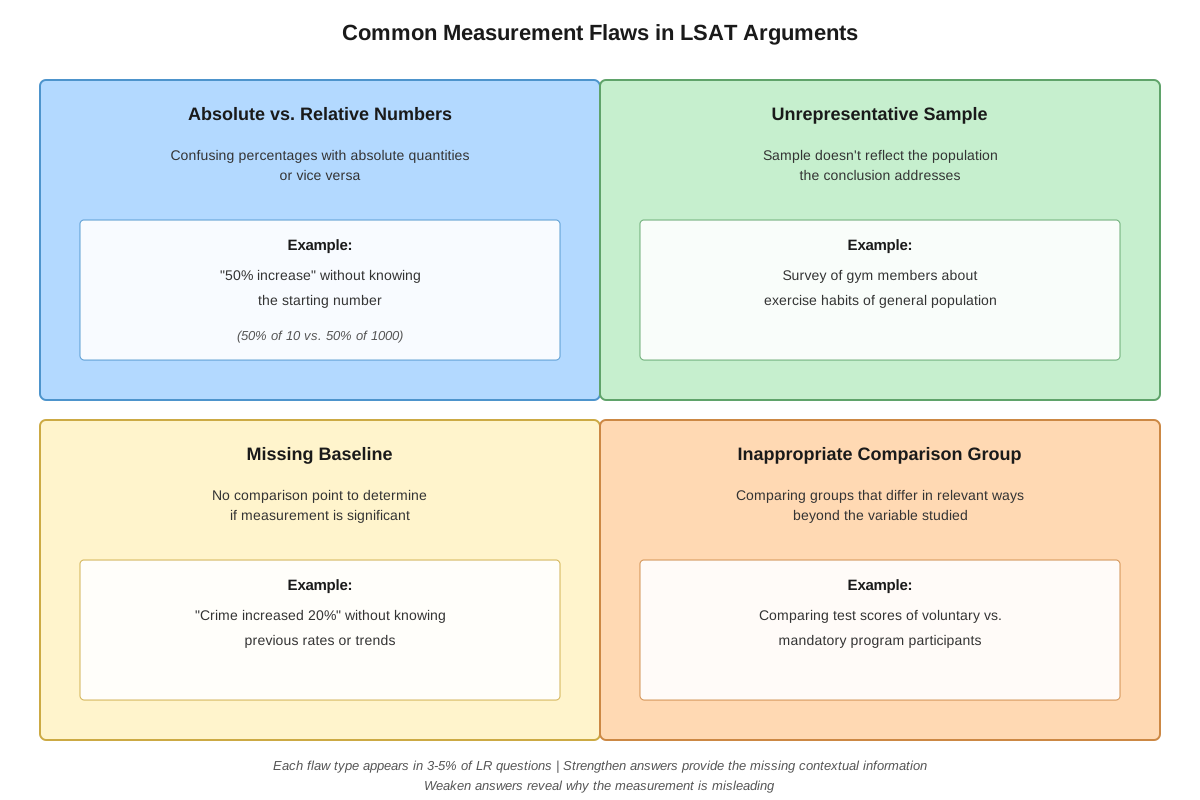
A fundamental distinction in measurement-based reasoning involves understanding when absolute numbers matter versus when percentages or rates are more relevant. An argument claiming "City A has more crime than City B because City A reported 5,000 crimes while City B reported 3,000 crimes" commits a measurement error if City A has triple the population of City B. The absolute numbers are higher, but the crime rate (crimes per capita) might actually be lower.
Conversely, some arguments inappropriately focus on percentages when absolute numbers matter more. If an argument states "Treatment X has a 50% higher success rate than Treatment Y," this percentage increase might represent a change from 2% to 3% success—a statistically significant percentage increase but a minimal absolute improvement. LSAT questions frequently test whether students recognize which measurement type (absolute or relative) is appropriate for evaluating the specific conclusion being drawn.
Sample Representativeness and Size
Many supporting measurement arguments rely on surveys, studies, or samples to draw conclusions about larger populations. The strength of these arguments depends critically on whether the sample accurately represents the target population and whether the sample size is adequate for the conclusion's scope.
A survey of 100 college students cannot reliably support conclusions about "most Americans" because college students are not representative of the general population in age, education level, or socioeconomic status. Similarly, even a representative sample of only 20 people provides insufficient data to support confident generalizations about millions. LSAT questions test whether students recognize when information about sample composition or size would strengthen or weaken measurement-based arguments.
Comparison Groups and Baselines
Measurements gain meaning through comparison. A statement that "60% of patients improved with Treatment X" provides limited support for the treatment's effectiveness without knowing what percentage would have improved without treatment, with a placebo, or with alternative treatments. The comparison group or baseline provides the context necessary to interpret whether a measurement represents a significant finding.
LSAT arguments frequently present measurements without appropriate comparisons, then test whether students recognize that information about comparison groups would strengthen the argument. For instance, learning that "only 30% of patients improve without treatment" would strengthen the claim that Treatment X (with 60% improvement) is effective, while learning that "70% improve with standard treatment" would weaken it.
Time Frame and Trend Direction
The temporal context of measurements significantly affects their evidential value. An argument stating "unemployment decreased this month" might support a conclusion about economic improvement, but this support weakens if unemployment had been increasing for the previous twelve months and this month's decrease is minimal. Information about whether a measurement represents a temporary fluctuation or a sustained trend directly impacts argument strength.
Additionally, the specific time period during which measurements were taken can affect representativeness. Sales figures from December might not represent typical monthly performance for retail businesses. LSAT questions test whether students recognize when information about time frames, seasonal variations, or trend directions would affect measurement-based conclusions.
Measurement Methodology and Reliability
How measurements are obtained affects their reliability and relevance. Survey questions can be biased or ambiguous, measurement instruments can be imprecise, and data collection methods can systematically exclude certain groups. An argument relying on a survey where respondents self-select (like an online poll) is weaker than one using random sampling because self-selection creates unrepresentative samples.
The LSAT tests whether students recognize that information about measurement methodology—how data was collected, what specific questions were asked, who was included or excluded, and what measurement standards were used—can strengthen or weaken arguments. For example, learning that a customer satisfaction survey was conducted by an independent third party strengthens its credibility compared to a survey conducted by the company itself.
Confounding Variables and Alternative Explanations
Even when measurements accurately show a correlation or change, the conclusion that one factor caused another requires ruling out alternative explanations. If a city implements a new policing strategy and crime decreases, the measurement shows correlation, but the conclusion that the strategy caused the decrease is weakened if other factors changed simultaneously (economic improvement, demographic shifts, weather patterns affecting crime rates).
Supporting measurement questions often test whether students recognize that information ruling out confounding variables would strengthen causal conclusions, while information revealing additional factors would weaken them. The key is identifying what measurements or contextual information would help distinguish between the proposed explanation and alternative explanations for the observed data.
Concept Relationships
The supporting measurement pattern connects directly to several fundamental logical reasoning concepts. At its foundation, it relies on argument structure analysis—identifying premises (the measurements) and conclusions (what the measurements supposedly demonstrate). The gap between measurement and conclusion creates the space where assumptions reside: unstated beliefs about what makes the measurement relevant and sufficient.
The relationship flows as follows: Measurement data → requires contextual information → to support conclusions. This contextual information might include comparison baselines (what to measure against), sample representativeness (whether the measured group reflects the target population), absolute versus relative numbers (which measurement type matters), and confounding variables (what else might explain the measurements).
Supporting measurement connects to causal reasoning because many measurement-based arguments claim that one measured factor causes another. It connects to survey and study reasoning because measurements often derive from these sources. It relates to necessary versus sufficient conditions because measurements might be necessary evidence for a conclusion without being sufficient on their own.
Within strengthen and weaken questions specifically, supporting measurement represents one category of reasoning vulnerability. Other categories include alternative explanations, implementation problems, and scope mismatches. However, supporting measurement is distinctive because it focuses specifically on the adequacy and interpretation of quantitative evidence rather than logical structure alone.
High-Yield Facts
⭐ Percentages without denominators are incomplete: Knowing "X increased by 50%" is meaningless without knowing 50% of what baseline amount.
⭐ Sample size and representativeness are distinct issues: A large unrepresentative sample is no better than a small unrepresentative sample for drawing general conclusions.
⭐ Correlation measurements do not establish causation: Even perfect correlation requires additional evidence to support causal claims.
⭐ Comparison groups are essential for interpreting measurements: A measurement's significance depends on what it's compared against.
⭐ Absolute numbers and percentages can point in opposite directions: One can increase while the other decreases depending on the denominator.
- Time frames affect whether measurements represent trends or anomalies: Single data points are weaker evidence than sustained patterns.
- Self-selected samples are systematically unrepresentative: People who choose to respond differ from those who don't.
- Measurement methodology affects reliability: How data is collected matters as much as what the data shows.
- Average measurements can mask important distribution patterns: Mean values don't reveal whether results cluster or vary widely.
- Measurements of different populations aren't directly comparable without adjustment: Raw numbers must account for population size, demographics, or other relevant differences.
Quick check — test yourself on Supporting measurement so far.
Try Flashcards →Common Misconceptions
Misconception: If a measurement shows an increase or improvement, it automatically strengthens any conclusion about positive performance.
Correction: The measurement only strengthens conclusions if it's compared to an appropriate baseline. An increase might still represent below-average performance, or the increase might be smaller than competitors' increases.
Misconception: A large sample size automatically makes survey results reliable and representative.
Correction: Sample size and representativeness are independent qualities. A survey of 10,000 people who all come from the same demographic group is less representative than a properly randomized survey of 500 people from diverse backgrounds.
Misconception: When an argument cites a percentage, the absolute numbers don't matter for evaluating the conclusion.
Correction: Whether absolute numbers or percentages are more relevant depends on the specific conclusion. For resource allocation decisions, absolute numbers often matter more; for comparing rates across different-sized populations, percentages are more appropriate.
Misconception: If measurements show correlation between two factors, information about causation is irrelevant to strengthen/weaken questions.
Correction: Many measurement-based arguments implicitly or explicitly claim causal relationships. Information that rules out alternative explanations strengthens causal claims, while information revealing confounding variables weakens them.
Misconception: Measurement-based arguments are either completely strong or completely weak based on a single factor.
Correction: Multiple factors affect measurement argument strength. An argument might have a representative sample but an inadequate comparison group, or vice versa. Strengthen/weaken questions often test one specific dimension of measurement adequacy.
Misconception: If a measurement comes from an official or scientific source, its methodology doesn't need evaluation.
Correction: The source's authority doesn't eliminate the need to consider whether the measurement methodology is appropriate for the conclusion. Even legitimate studies can have limitations that affect how broadly their findings apply.
Worked Examples
Example 1: Sales Performance Argument
Argument: "Acme Corporation's new marketing strategy has been highly successful. In the first quarter after implementing the strategy, Acme's sales increased by 15% compared to the previous quarter."
Question: Which of the following, if true, would most strengthen the argument?
Answer Choices:
(A) Acme's competitors experienced sales decreases during the same quarter.
(B) Acme's marketing budget increased by 20% when implementing the new strategy.
(C) The previous quarter had unusually low sales due to supply chain disruptions.
(D) Acme's profit margins remained constant during both quarters.
(E) Customer satisfaction surveys showed improved brand perception.
Analysis:
The argument uses a measurement (15% sales increase) to support a conclusion about the marketing strategy's success. The logical gap involves whether this measurement actually demonstrates the strategy's effectiveness or whether alternative explanations exist.
Step 1: Identify what would make the measurement more convincing evidence for the conclusion. We need information that either provides appropriate comparison context or rules out alternative explanations.
Step 2: Evaluate each choice:
(A) STRENGTHENS SIGNIFICANTLY - If competitors' sales decreased while Acme's increased, this suggests Acme's performance wasn't due to general market conditions but rather to something specific to Acme (likely the new strategy). This provides crucial comparison context.
(B) Weakens slightly - If the budget increased substantially, the sales increase might be due to spending more rather than the strategy being effective per dollar spent.
(C) WEAKENS - If the previous quarter was abnormally low, the 15% increase might just represent a return to normal levels rather than genuine improvement from the strategy.
(D) Neutral to slight strengthen - Constant profit margins mean the sales increase translated to proportional profit increase, but this doesn't address whether the strategy caused the sales increase.
(E) Slight strengthen - Improved perception supports that the marketing strategy had some effect, but doesn't directly address whether it caused the sales increase or whether the increase is significant.
Answer: (A) provides the strongest support by offering comparison context that rules out the alternative explanation that general market conditions caused the sales increase.
Connection to Learning Objectives: This example demonstrates how supporting measurement questions require identifying what comparison information (here, competitor performance) would make measurement-based evidence more convincing.
Example 2: Public Health Policy Argument
Argument: "The city's new anti-smoking campaign has been ineffective. A survey conducted six months after the campaign launch found that 32% of city residents smoke, which is the same percentage as before the campaign began."
Question: Which of the following, if true, would most weaken the argument?
Answer Choices:
(A) The survey was conducted by an independent research firm with no connection to the city government.
(B) Neighboring cities without anti-smoking campaigns saw smoking rates increase from 30% to 35% during the same period.
(C) The city's anti-smoking campaign cost significantly less than similar campaigns in other cities.
(D) The survey included both adults and teenagers, while the previous survey included only adults.
(E) Public awareness of the health risks of smoking increased during the six-month period.
Analysis:
The argument concludes the campaign was ineffective based on unchanged smoking rates (32% before and after). The measurement pattern involves comparing two percentages to evaluate program effectiveness.
Step 1: Identify what would weaken the conclusion that the campaign was ineffective. We need information suggesting the unchanged rate actually represents success or that the measurement comparison is flawed.
Step 2: Evaluate each choice:
(A) Neutral - Survey independence affects reliability but doesn't change the interpretation of unchanged rates.
(B) WEAKENS SIGNIFICANTLY - If smoking rates increased in comparable cities without campaigns, maintaining the same rate represents relative success. The campaign might have prevented an increase that would otherwise have occurred. This provides crucial baseline comparison.
(C) Neutral - Cost efficiency is irrelevant to whether the campaign achieved its goal of reducing smoking.
(D) WEAKENS - If the survey methodologies differed, the percentages aren't directly comparable. Including teenagers (who typically have different smoking rates) means the 32% figures might represent different underlying realities.
(E) Slight strengthen - If awareness increased independently, the campaign might be even less responsible for any effects, though this doesn't directly address the unchanged rate.
Answer: (B) most weakens the argument by providing comparison context showing that maintaining the same rate actually represents success relative to the trend in similar populations.
Connection to Learning Objectives: This example illustrates how comparison baselines (what happened in similar situations without the intervention) are essential for interpreting whether a measurement represents success or failure.
Exam Strategy
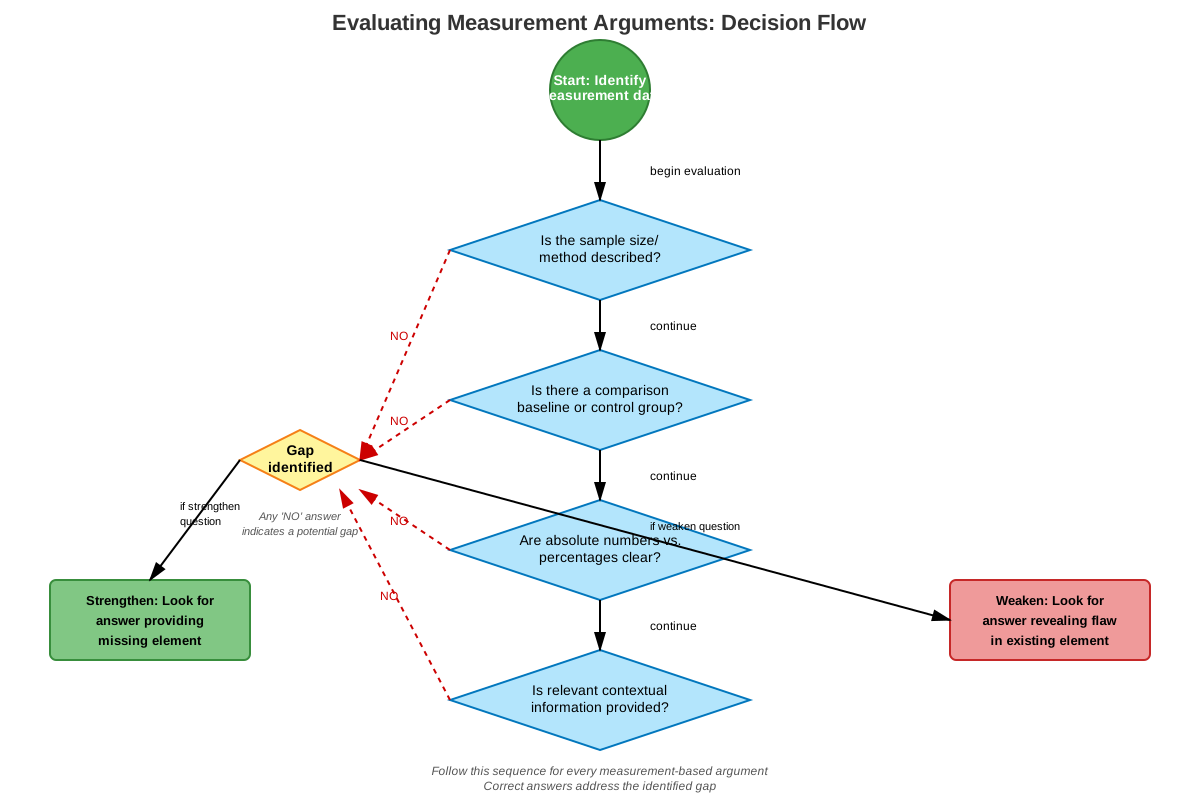
When approaching LSAT questions involving supporting measurement, follow this systematic process:
Step 1: Identify the measurement being used as evidence. Look for numbers, percentages, rates, survey results, or statistical claims. Note exactly what is being measured and what conclusion the measurement supposedly supports.
Step 2: Spot the measurement gap. Ask yourself: What contextual information is missing? Common gaps include:
- No comparison group or baseline
- Unclear whether numbers are absolute or relative
- Unknown sample size or representativeness
- Missing time frame or trend information
- Unclear measurement methodology
Step 3: Predict what information would fill the gap. Before looking at answer choices, anticipate what would make the measurement more or less convincing. For strengthen questions, think: "What comparison or context would make this measurement better evidence?" For weaken questions: "What would reveal this measurement is misleading or insufficient?"
Exam Tip: Trigger phrases that signal supporting measurement questions include "survey shows," "statistics indicate," "percentage of," "rate of," "increased by," "compared to," and "measurement reveals."
Step 4: Eliminate answers that don't address the measurement gap. Many wrong answers discuss tangentially related issues without actually affecting whether the measurement supports the conclusion. Stay focused on what would make the specific measurement more or less convincing evidence.
Step 5: Choose the answer that most directly addresses the measurement's evidential value. The correct answer typically provides comparison context, reveals methodology problems, clarifies absolute versus relative numbers, or addresses sample representativeness.
Time allocation: Spend 15-20 seconds identifying the measurement and its gap, then 30-40 seconds evaluating answer choices. Don't get distracted by answers that seem relevant to the topic but don't actually affect the measurement's strength.
Process of elimination tip: Wrong answers in supporting measurement questions often commit these errors:
- Addressing a different aspect of the argument than the measurement
- Providing information that's interesting but doesn't affect the measurement's evidential value
- Confusing causation with correlation without addressing the measurement itself
- Introducing new issues rather than clarifying the existing measurement
Memory Techniques
SCRAM - Remember the five key factors that affect measurement strength:
- Sample (size and representativeness)
- Comparison (baseline or control group)
- Relative vs. absolute (which measurement type matters)
- Alternative explanations (confounding variables)
- Methodology (how data was collected)
The "Compared to What?" Question - Whenever you see a measurement in an argument, immediately ask "Compared to what?" This mental habit helps identify missing comparison context, the most common measurement gap on the LSAT.
Percentage-Number Flip - Visualize a seesaw with percentages on one side and absolute numbers on the other. When the denominator changes, they can move in opposite directions. This image helps remember that percentages and absolute numbers can tell different stories.
Sample Size Isn't Sample Quality - Picture a huge bucket of red marbles (unrepresentative sample) versus a small handful of mixed colors (representative sample). Size doesn't equal quality for sampling purposes.
Trend vs. Blip - Imagine a graph with one data point versus a graph showing multiple points forming a pattern. Single measurements are "blips" that might not represent trends; multiple measurements over time show patterns.
Summary
Supporting measurement represents a critical LSAT Logical Reasoning pattern where arguments use quantitative data—numbers, percentages, rates, or statistics—as evidence for conclusions. The key vulnerability in these arguments lies in the gap between what measurements actually demonstrate and what conclusions claim they demonstrate. Success on these questions requires recognizing what contextual information is necessary to properly interpret measurements: comparison baselines, sample representativeness, absolute versus relative numbers, time frames, and methodology details. The LSAT tests whether students can identify what additional measurement information would strengthen or weaken arguments by making the quantitative evidence more or less convincing. Mastering this pattern involves systematically asking what comparison context is missing, whether the measurement type matches the conclusion, and what alternative explanations the measurement fails to rule out. This skill appears across multiple question types and represents approximately 15-20% of Logical Reasoning questions, making it one of the highest-yield patterns for LSAT preparation.
Key Takeaways
- Supporting measurement questions test whether students recognize what contextual information makes quantitative evidence convincing or unconvincing for specific conclusions
- Comparison baselines are essential—measurements gain meaning only in relation to appropriate comparison groups, previous time periods, or alternative conditions
- Distinguish between absolute numbers and relative percentages; which matters depends on the specific conclusion being evaluated
- Sample representativeness and sample size are independent qualities; both matter for generalizing from measurements to broader populations
- Measurement methodology affects reliability; how data was collected is as important as what the data shows
- Single measurements are weaker evidence than trends; time frame and pattern information strengthen measurement-based arguments
- The SCRAM framework (Sample, Comparison, Relative vs. absolute, Alternative explanations, Methodology) provides a systematic approach to evaluating measurement arguments
Related Topics
Causal Reasoning: Supporting measurement connects directly to causal arguments because many measurement-based claims assert that one measured factor causes another. Mastering measurement evaluation provides the foundation for assessing whether correlations support causal conclusions.
Survey and Study Reasoning: Many measurements derive from surveys or studies, making methodology evaluation essential. Understanding supporting measurement enables deeper analysis of how research design affects argument strength.
Necessary and Sufficient Assumptions: The gap between measurements and conclusions often involves unstated assumptions about what makes the measurement relevant. Identifying these assumptions requires recognizing what measurement context is missing.
Scope and Degree Issues: Measurement arguments frequently involve scope problems—generalizing from limited samples to broad populations or from small changes to significant conclusions. Supporting measurement skills transfer directly to scope analysis.
Flaw Questions: Many flawed arguments misuse measurements by ignoring comparison groups, confusing correlation with causation, or generalizing inappropriately. Recognizing measurement patterns helps identify these flaws quickly.
Practice CTA
Now that you understand the supporting measurement pattern, it's time to apply these concepts to actual LSAT questions. The practice questions and flashcards will help solidify your ability to quickly identify measurement gaps and predict what information would strengthen or weaken arguments. Focus especially on questions where you must distinguish between absolute and relative numbers or identify missing comparison groups—these represent the highest-yield applications of supporting measurement concepts. Remember, mastering this pattern will improve your performance not just on strengthen/weaken questions but across multiple Logical Reasoning question types. Each practice question you complete builds the pattern recognition that leads to faster, more accurate performance on test day.
Sign up free to keep reading
Create a free AnvayaPrep account to finish this LSAT guide on Supporting measurement — plus flashcards and practice questions.