Overview
Timing in strengthen questions represents a critical analytical skill within LSAT Logical Reasoning that tests whether students can identify how temporal relationships affect the validity of arguments. This concept appears when an argument's conclusion depends on events occurring in a specific sequence, or when the strength of causal reasoning hinges on whether one event preceded, coincided with, or followed another. Understanding timing issues is essential because many LSAT arguments contain implicit assumptions about when things happened, and the correct answer to a strengthen question often provides information that confirms the appropriate temporal relationship.
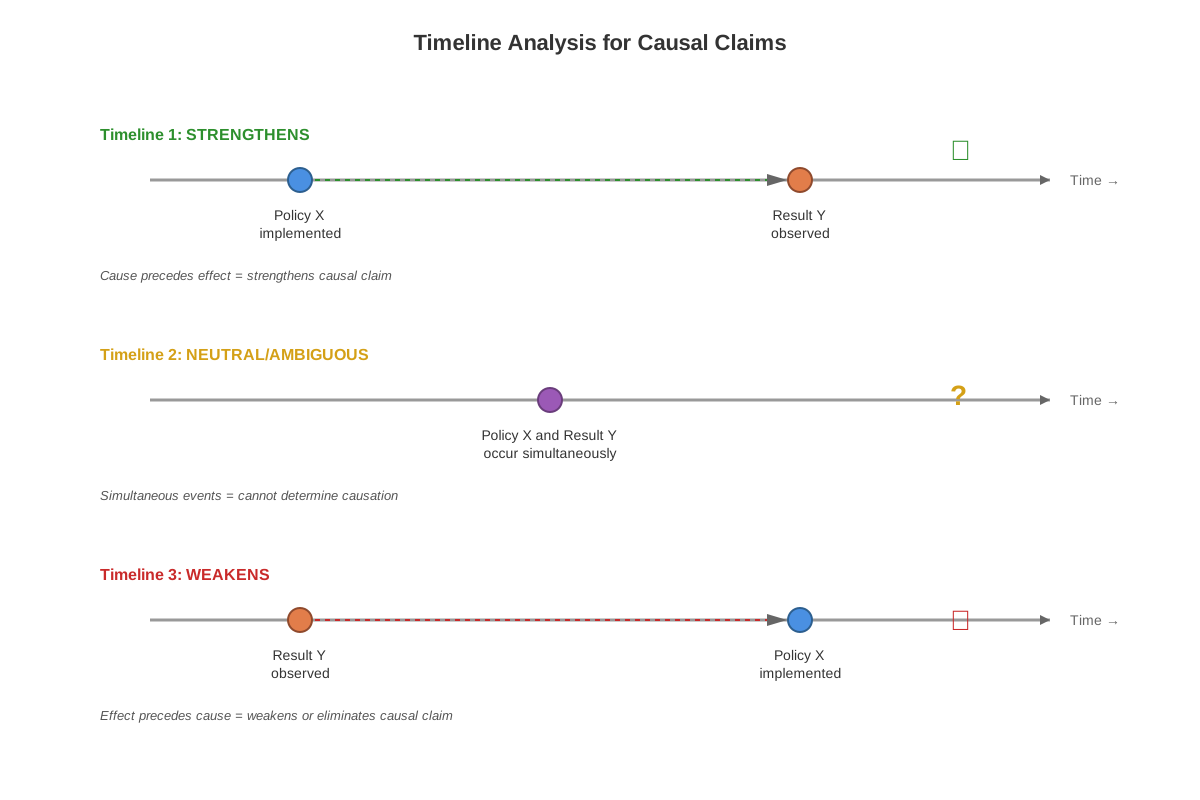
The LSAT frequently tests timing concepts because they reveal sophisticated reasoning abilities. An argument might claim that Policy X caused Result Y, but this causal claim is only valid if Policy X was implemented before Result Y occurred. Similarly, an argument might assume that a correlation observed at one point in time reflects a stable pattern rather than a temporary anomaly. Students who master timing in strengthen questions gain the ability to spot these temporal vulnerabilities and recognize which answer choices provide the chronological information needed to make arguments more convincing.
Within the broader landscape of strengthen and weaken questions, timing issues represent one of several common reasoning patterns, alongside causation, sampling, analogy, and alternative explanations. Timing often intersects with causal reasoning—since causes must precede effects—but also appears independently when arguments make claims about trends, comparisons across time periods, or the sequence of events. Mastering this topic strengthens overall performance on approximately 15-20% of Logical Reasoning questions and builds analytical skills that transfer to Reading Comprehension passages involving historical sequences or policy implementation timelines.
Learning Objectives
- [ ] Identify how timing in strengthen questions appears in LSAT questions
- [ ] Explain the reasoning pattern behind timing in strengthen questions
- [ ] Apply timing in strengthen questions to solve LSAT-style problems accurately
- [ ] Distinguish between timing issues and other common strengthen question patterns (causation, sampling, alternative explanations)
- [ ] Recognize implicit temporal assumptions within argument structures
- [ ] Evaluate answer choices that provide temporal information to determine which most effectively strengthens the argument
- [ ] Predict the type of timing information needed to strengthen an argument before reviewing answer choices
Prerequisites
- Basic argument structure identification: Understanding premises, conclusions, and assumptions is essential because timing issues typically involve unstated assumptions about when events occurred relative to each other.
- Causal reasoning fundamentals: Many timing questions involve causal claims, and recognizing that causes must precede effects provides the foundation for identifying temporal vulnerabilities.
- Strengthen question mechanics: Students must understand that strengthen questions ask which answer choice makes the conclusion more likely to be true, not necessarily proven true.
- Conditional reasoning basics: Some timing arguments involve conditional relationships where the temporal sequence affects whether sufficient or necessary conditions have been met.
Why This Topic Matters
Timing issues appear in approximately 3-5 questions per LSAT exam, making them a high-yield topic that can significantly impact scores. These questions appear across both Logical Reasoning sections and occasionally influence Reading Comprehension questions involving historical arguments or policy analysis. The ability to identify timing vulnerabilities separates high-scoring students from average performers because these issues often involve subtle, implicit assumptions that less-prepared students overlook.
In real-world applications, temporal reasoning is fundamental to legal analysis. Attorneys must establish timelines to prove causation in tort cases, demonstrate that contracts were breached before damages occurred, or show that evidence was obtained before or after a warrant was issued. Judges evaluate whether precedents apply based on when they were established relative to the case at hand. The LSAT tests timing reasoning because it reflects essential skills for legal practice.
Common manifestations of timing in LSAT questions include:
- Arguments claiming one event caused another without establishing temporal sequence
- Comparisons between time periods that assume conditions remained constant
- Predictions based on past trends that may not continue
- Claims about effectiveness of interventions without confirming implementation preceded results
- Arguments assuming current conditions reflect historical patterns
Core Concepts
The Fundamental Timing Principle
The core principle underlying timing in strengthen questions is that temporal relationships often determine whether an argument's reasoning is valid. When an argument makes a claim involving causation, correlation, trends, or comparisons across time, the conclusion's strength depends on specific chronological facts. A strengthen answer choice provides temporal information that confirms the argument's implicit assumptions about when events occurred.
Consider this basic structure: "After the city installed speed cameras, traffic accidents decreased by 30%. Therefore, the speed cameras reduced accidents." This argument assumes the cameras were installed before the accident reduction occurred. An answer choice stating "The accident reduction began in the month following camera installation" would strengthen the argument by confirming the appropriate temporal sequence.
Types of Temporal Vulnerabilities
Causal Sequence Vulnerabilities represent the most common timing issue. Arguments claiming X caused Y must establish that X preceded Y. Without temporal information, the argument remains vulnerable to the possibility that Y occurred first, or that both occurred simultaneously due to a common cause. Strengthen answers provide evidence that the alleged cause preceded the alleged effect.
Temporal Stability Assumptions appear when arguments assume conditions, patterns, or relationships observed at one time continue to hold at another time. An argument might cite data from five years ago to support a conclusion about current conditions, implicitly assuming nothing has changed. Strengthen answers confirm that relevant conditions remained constant across the time period in question.
Trend Projection Vulnerabilities occur when arguments extrapolate from past patterns to predict future outcomes. These arguments assume that factors driving historical trends will continue operating in the future. Strengthen answers provide evidence that conditions supporting past trends remain in effect or will persist going forward.
Comparison Timing Issues arise when arguments compare two groups, locations, or time periods without ensuring the comparison is temporally valid. An argument might compare crime rates in two cities without confirming the data comes from the same time period, or compare a company's current performance to its past performance without accounting for changed circumstances.
Identifying Timing Vulnerabilities
To identify timing vulnerabilities, students should ask three diagnostic questions:
- Does the argument make a causal claim? If yes, has the temporal sequence (cause before effect) been established?
- Does the argument rely on data or conditions from a different time period? If yes, has the argument established that relevant conditions remained constant?
- Does the argument predict future outcomes based on past patterns? If yes, has the argument established that trend-driving factors will continue?
The Temporal Assumption Gap
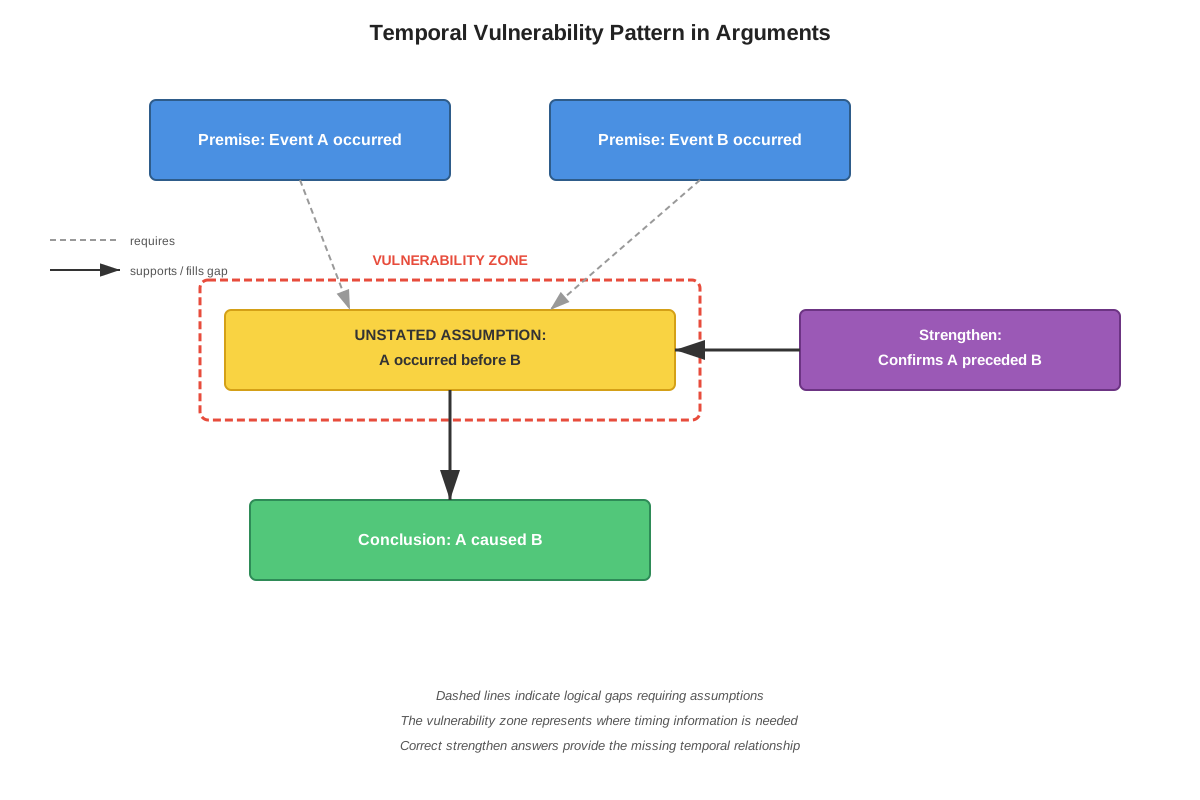
Every timing-vulnerable argument contains a temporal assumption gap—an unstated premise about chronological relationships that must be true for the conclusion to follow from the premises. Identifying this gap is crucial for predicting correct strengthen answers. The gap typically takes one of these forms:
| Gap Type | Assumption Structure | Example |
|---|---|---|
| Sequence Gap | Event A occurred before Event B | The policy was implemented before results appeared |
| Continuity Gap | Conditions at Time 1 persist at Time 2 | Factors present in 2020 remain present in 2024 |
| Stability Gap | Pattern observed historically will continue | Past growth trends will persist into the future |
| Simultaneity Gap | Events occurred during the same period | Data being compared comes from the same timeframe |
Strengthen Mechanisms for Timing Issues
Answer choices strengthen timing-vulnerable arguments through several mechanisms:
Direct Temporal Confirmation provides explicit information about when events occurred, confirming the assumed sequence. Example: "The new training program was implemented in January, and productivity increases began in February."
Continuity Evidence establishes that relevant conditions remained constant across the time period in question. Example: "The company's workforce size and composition remained stable throughout the period studied."
Trend Persistence Evidence shows that factors driving past patterns continue to operate. Example: "The demographic shifts that increased demand over the past decade are projected to continue."
Temporal Scope Clarification narrows the timeframe to eliminate alternative temporal explanations. Example: "The improvement occurred specifically during the three months following the intervention, not before."
Concept Relationships
Timing in strengthen questions connects intimately with causal reasoning because establishing causation requires demonstrating temporal precedence—causes must occur before effects. When students encounter a causal claim in a strengthen question, they should immediately consider whether timing information would strengthen the argument by confirming the proper sequence.
The relationship flows as follows: Causal Claim → Requires Temporal Sequence → Creates Timing Vulnerability → Strengthen Answer Provides Temporal Confirmation
Timing issues also intersect with alternative explanation patterns. When an argument claims X caused Y, alternative explanations often involve different temporal sequences (Y actually preceded X, or Z caused both X and Y simultaneously). Strengthen answers that provide timing information simultaneously support the causal claim and eliminate temporal alternatives.
Additionally, timing connects to sampling and generalization issues. Arguments that generalize from past data to current or future situations make temporal assumptions about stability and continuity. These connections mean that strong LSAT students often consider multiple reasoning patterns simultaneously, recognizing that a single argument might have both timing and sampling vulnerabilities.
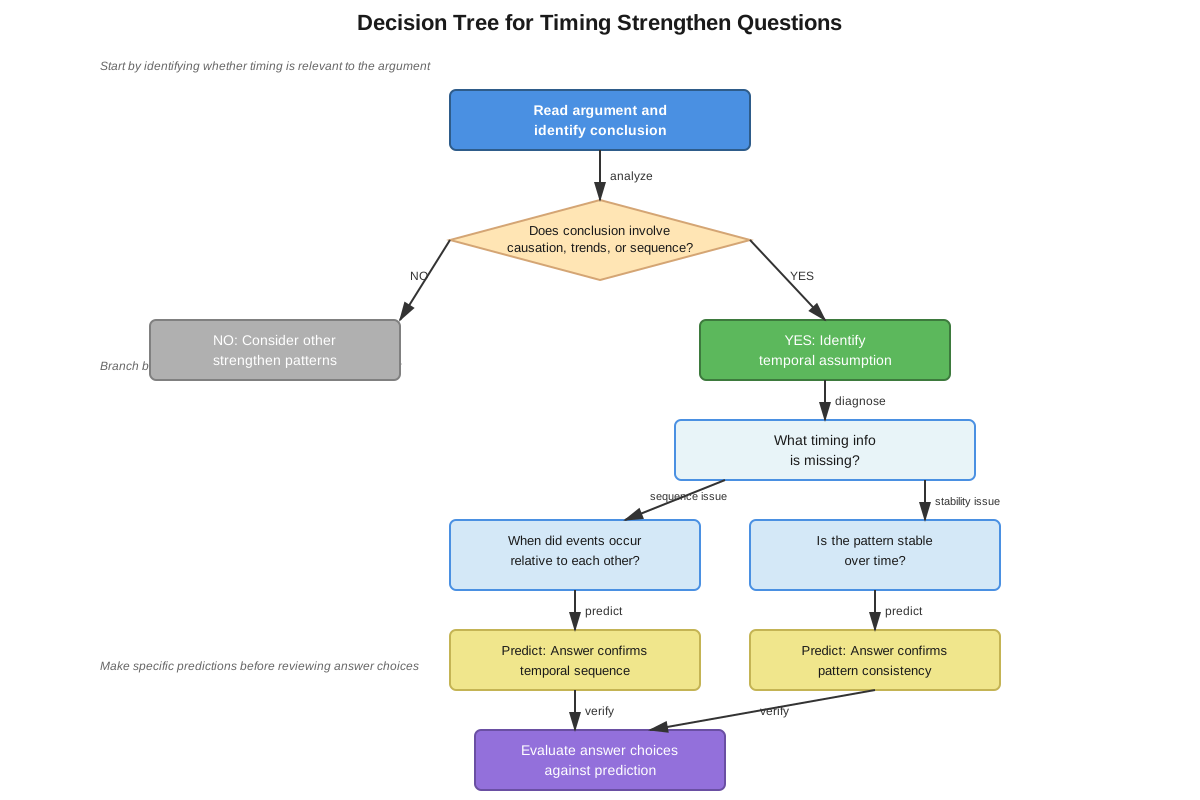
The progression of mastery follows this path: Recognize Causal Claims → Identify Temporal Assumptions → Predict Timing Information Needed → Evaluate Answer Choices → Select Strongest Temporal Confirmation
High-Yield Facts
⭐ Causal arguments require temporal precedence: Any argument claiming X caused Y is strengthened by evidence that X occurred before Y, and weakened by evidence of reverse or simultaneous timing.
⭐ Timing vulnerabilities are often implicit: Arguments rarely explicitly state "we don't know when this happened"—students must recognize unstated temporal assumptions.
⭐ Correlation does not establish temporal sequence: When an argument cites correlation as evidence for causation, timing information is almost always relevant to strengthen or weaken the claim.
⭐ Past data requires continuity assumptions: Arguments using historical data to support current conclusions assume relevant conditions remained stable—strengthen answers confirm this stability.
⭐ Trend projections assume persistence: Arguments predicting future outcomes from past trends assume trend-driving factors will continue—strengthen answers provide evidence of persistence.
- Answer choices providing specific dates, timeframes, or sequences directly address timing vulnerabilities more effectively than vague temporal references.
- "Before/after" language in answer choices signals potential timing-based strengthen or weaken effects.
- Arguments comparing different time periods are strengthened by evidence that measurement methods and relevant conditions remained constant.
- Timing strengthen answers often eliminate alternative temporal explanations simultaneously with confirming the argument's assumed sequence.
- The phrase "during the same period" or "throughout the timeframe" in answer choices often signals continuity evidence that strengthens temporal assumptions.
Quick check — test yourself on Timing in strengthen questions so far.
Try Flashcards →Common Misconceptions
Misconception: If an argument mentions that two events both occurred, the temporal sequence has been established. → Correction: Merely stating that two events occurred does not establish which came first. Arguments are strengthened by explicit information about temporal sequence, not just the occurrence of events.
Misconception: Timing issues only matter in arguments making explicit causal claims. → Correction: Timing vulnerabilities appear in many argument types, including comparisons across time periods, trend projections, and claims about effectiveness or correlation. Any argument involving events at different times potentially has timing vulnerabilities.
Misconception: An answer choice that provides any temporal information will strengthen a timing-vulnerable argument. → Correction: The temporal information must specifically address the argument's temporal assumption gap. Irrelevant timing information (about events not central to the argument) does not strengthen the conclusion.
Misconception: If the argument states "after X, Y occurred," the temporal sequence is definitively established. → Correction: "After" can be ambiguous—it might mean "immediately following" or simply "at some later point." Strengthen answers often provide more specific temporal information that confirms the relevant causal or correlational relationship.
Misconception: Timing strengthen questions are really just causation questions in disguise. → Correction: While timing and causation frequently overlap, timing issues appear independently in arguments about trends, comparisons, and temporal stability. Not all timing questions involve causal claims, and not all causal questions have timing vulnerabilities.
Misconception: The correct answer to a timing strengthen question must prove the conclusion is true. → Correction: Strengthen questions ask which answer makes the conclusion more likely to be true, not certain. Timing information that confirms temporal assumptions strengthens the argument even if other vulnerabilities remain.
Worked Examples
Example 1: Causal Sequence Timing
Argument: "City Hospital implemented a new patient safety protocol in 2023. Hospital infection rates decreased by 25% in 2023. Therefore, the new protocol reduced infection rates."
Question: Which of the following, if true, most strengthens the argument?
Analysis: This argument makes a causal claim—the protocol caused the infection rate decrease. The temporal vulnerability is that we don't know whether the protocol was implemented before the decrease occurred, or whether the decrease might have begun before implementation. The argument assumes the protocol preceded the decrease.
Predicted Answer: We need information confirming that the protocol was implemented before the infection rate decrease began, or that the decrease occurred specifically after implementation.
Answer Choices:
(A) Other hospitals that did not implement the protocol saw no decrease in infection rates.
(B) The infection rate decrease began in the month following protocol implementation.
(C) The protocol was developed by leading experts in hospital safety.
(D) Hospital staff received extensive training on the new protocol.
(E) The hospital had been seeking ways to reduce infection rates for several years.
Solution: Choice (B) most strengthens the argument by providing temporal information that confirms the protocol preceded the infection rate decrease. This timing confirmation supports the causal claim. Choice (A) provides comparison evidence (a different strengthen mechanism), but doesn't address the temporal sequence issue. Choices (C), (D), and (E) are irrelevant to whether the protocol actually caused the decrease. Answer: (B)
Connection to Learning Objectives: This example demonstrates how to identify timing vulnerabilities in causal arguments (Objective 2), recognize the implicit temporal assumption (Objective 5), and apply timing reasoning to select the correct strengthen answer (Objective 3).
Example 2: Temporal Stability Assumption
Argument: "A study conducted in 2015 found that employees who worked remotely were 15% more productive than office-based employees. Our company should therefore implement a remote work policy to increase productivity."
Question: Which of the following, if true, most strengthens the argument?
Analysis: This argument uses past data (from 2015) to support a current recommendation. The temporal vulnerability is that conditions affecting remote work productivity might have changed between 2015 and now. The argument implicitly assumes that factors making remote work productive in 2015 remain operative today.
Predicted Answer: We need information confirming that relevant conditions remained stable between 2015 and the present, or that factors affecting remote work productivity haven't changed.
Answer Choices:
(A) The 2015 study examined workers in the same industry as our company.
(B) Technology and communication tools available for remote work have remained essentially unchanged since 2015.
(C) Remote work has become increasingly popular since 2015.
(D) The 2015 study was conducted by reputable researchers.
(E) Some employees prefer remote work while others prefer office work.
Solution: Choice (B) most strengthens the argument by confirming temporal stability—the tools and conditions affecting remote work productivity haven't changed since the study was conducted. This addresses the temporal assumption gap. Choice (A) addresses sampling/analogy issues but not timing. Choice (C) is irrelevant to whether the productivity relationship holds. Choices (D) and (E) don't address whether 2015 findings apply today. Answer: (B)
Connection to Learning Objectives: This example illustrates how timing issues appear beyond simple causal claims (Objective 1), demonstrates the reasoning pattern of temporal stability assumptions (Objective 2), and shows how to distinguish timing issues from other strengthen patterns (Objective 4).
Exam Strategy
When approaching strengthen questions on the LSAT, implement this systematic process for identifying and addressing timing issues:
Step 1: Identify the Conclusion Type
Immediately classify whether the conclusion involves causation, prediction, comparison, or correlation. These conclusion types frequently involve timing vulnerabilities.
Step 2: Spot Temporal Trigger Language
Watch for words and phrases that signal potential timing issues:
- "After," "following," "subsequently," "then"
- "Previously," "historically," "in the past"
- "Will," "going forward," "in the future"
- References to specific years, dates, or time periods
- "Caused," "resulted in," "led to," "produced"
Step 3: Ask the Diagnostic Questions
Before reviewing answer choices, ask: (1) Has temporal sequence been established for any causal claims? (2) Does the argument rely on data from a different time period? (3) Does the argument project trends without confirming persistence?
Step 4: Predict the Temporal Gap
Articulate the specific temporal assumption: "This argument assumes [event X] occurred before [event Y]" or "This argument assumes conditions in [past time] remain true in [present/future time]."
Step 5: Evaluate Answer Choices for Temporal Information
Prioritize answer choices that provide specific temporal information addressing your predicted gap. Be wary of choices that provide irrelevant timing information about events not central to the argument.
Exam Tip: If you identify a timing vulnerability but don't see an answer choice directly addressing it, the question might be testing a different reasoning pattern. Don't force a timing interpretation if the answer choices point elsewhere.
Time Allocation Advice: Spend 15-20 seconds identifying the argument's temporal assumptions before reviewing answer choices. This upfront investment prevents wasting time on attractive wrong answers that address different vulnerabilities. Timing strengthen questions typically require 60-75 seconds total—slightly less than questions involving complex conditional logic.
Process of Elimination Tips:
- Eliminate answer choices that provide temporal information about irrelevant events
- Eliminate choices that confirm timing for premises rather than assumptions
- Eliminate choices that provide vague temporal references ("at some point," "eventually") when specific timing would strengthen more effectively
- Keep choices that provide "before/after" information relevant to causal claims
- Keep choices that confirm stability or continuity across relevant time periods
Memory Techniques
CAST Mnemonic for identifying timing vulnerabilities:
- Causation claims need sequence confirmation
- Assumptions about stability across time periods
- Sequence of events must be established
- Trends require persistence evidence
Visualization Strategy: When reading an argument with potential timing issues, create a mental timeline with events placed in sequence. If you cannot confidently place events in order based on the argument's explicit information, you've identified a timing vulnerability.
The "Before/After" Test: For any causal claim, mentally insert the phrase "and we know [cause] occurred before [effect]" after the conclusion. If this addition would strengthen the argument, timing is likely the key issue.
Temporal Stability Acronym - PAST:
- Past data used for present conclusions
- Assumes conditions remained constant
- Strengthened by continuity evidence
- Temporal gaps need bridging
The Timeline Technique: Draw a simple arrow timeline for complex arguments:
Event A → Event B → Event C → Conclusion
  ?         ?         ?
Question marks indicate where temporal relationships are assumed but not established. The correct strengthen answer typically provides information that removes one or more question marks.
Summary
Timing in strengthen questions tests the ability to identify and address temporal vulnerabilities in LSAT arguments. These vulnerabilities arise when arguments make causal claims without establishing temporal sequence, use past data without confirming continuity, project trends without evidence of persistence, or compare time periods without ensuring valid temporal relationships. The core skill involves recognizing implicit temporal assumptions—the unstated premises about when events occurred relative to each other that must be true for the conclusion to follow from the premises. Strengthen answers provide temporal information that confirms these assumptions, most commonly through direct sequence confirmation, continuity evidence, or trend persistence data. Mastering this topic requires systematic analysis: identifying conclusion types prone to timing issues, spotting temporal trigger language, diagnosing specific temporal assumption gaps, and evaluating answer choices for relevant temporal information. Success depends on distinguishing timing issues from other reasoning patterns while recognizing that timing often intersects with causation, alternative explanations, and sampling issues. Students who master timing in strengthen questions gain a significant advantage on 15-20% of Logical Reasoning questions and develop analytical skills essential for legal reasoning.
Key Takeaways
- Timing vulnerabilities appear whenever arguments involve causation, trends, predictions, or comparisons across time periods—these argument types require temporal assumptions that strengthen answers can confirm.
- Causal claims require temporal precedence—arguments claiming X caused Y are strengthened by evidence that X occurred before Y and weakened by evidence of reverse or simultaneous timing.
- Past data requires continuity assumptions—arguments using historical information to support current conclusions assume relevant conditions remained stable and are strengthened by evidence confirming this stability.
- Identify temporal assumption gaps before reviewing answer choices—articulating the specific unstated temporal premise enables efficient answer choice evaluation and prevents distraction by irrelevant options.
- Timing issues often intersect with other reasoning patterns—particularly causation and alternative explanations, requiring integrated analysis of multiple vulnerabilities.
- Specific temporal information strengthens more effectively than vague references—answer choices providing precise sequences, dates, or timeframes address timing vulnerabilities more directly than general temporal statements.
- Not all temporal information strengthens the argument—the timing information must specifically address the argument's temporal assumption gap to strengthen the conclusion.
Related Topics
Causation in Strengthen and Weaken Questions: Since establishing causation requires demonstrating temporal precedence, mastering timing issues provides essential foundation for analyzing causal reasoning patterns, including alternative causes, correlation versus causation, and necessary versus sufficient conditions for causal relationships.
Sampling and Generalization: Arguments that generalize from samples to populations often involve temporal dimensions—whether past samples represent current populations, or whether samples from one time period predict future patterns. Timing analysis enhances sampling evaluation skills.
Comparison and Analogy Questions: Many comparison arguments involve temporal elements—comparing past to present, or assuming conditions in one time period match another. Understanding timing strengthens the ability to evaluate whether comparisons are valid.
Necessary Assumptions: Timing assumptions represent a specific category of necessary assumptions. Mastering timing in strengthen questions builds skills for identifying necessary assumptions more broadly, including recognizing implicit premises that arguments require.
Practice CTA
Now that you understand how timing functions in strengthen questions, you're ready to apply these concepts to practice problems. The ability to spot temporal vulnerabilities and predict timing-based strengthen answers develops through repeated application. Challenge yourself with the practice questions and flashcards designed for this topic—each problem you work through strengthens your pattern recognition and builds the analytical reflexes needed for test-day success. Remember that timing issues appear in approximately one out of every six Logical Reasoning questions, making this a high-yield investment of your study time. Your systematic approach to identifying temporal assumption gaps will translate directly into points on test day. Begin practicing now to cement these concepts and build confidence in your timing analysis skills.
Sign up free to keep reading
Create a free AnvayaPrep account to finish this LSAT guide on Timing in strengthen questions — plus flashcards and practice questions.