Overview
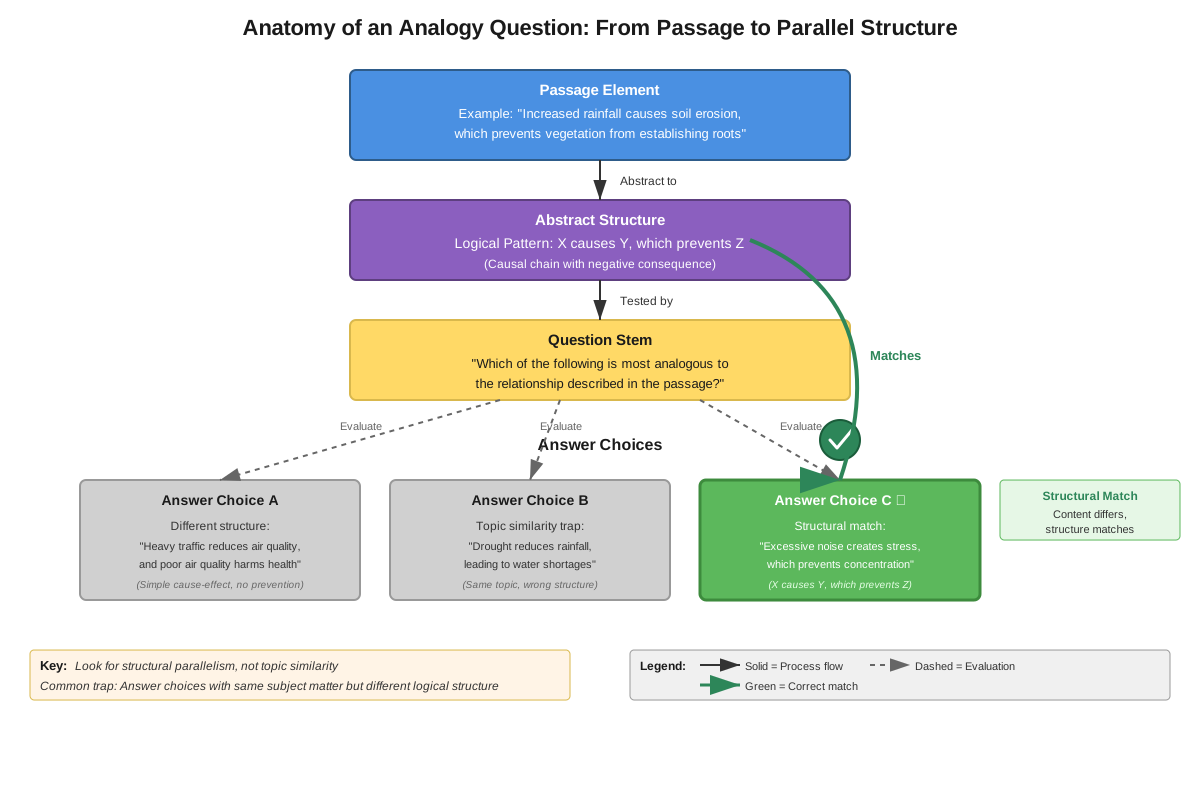
Analogy questions represent a sophisticated question type within LSAT reading comprehension that tests a student's ability to recognize and apply structural reasoning patterns across different contexts. These questions ask test-takers to identify scenarios, situations, or relationships that parallel the reasoning, structure, or relationship presented in the passage. Rather than simply testing comprehension of what the passage says, analogy questions assess whether students understand how the passage's ideas work—the underlying logical architecture that could apply to entirely different subject matter.
On the LSAT, analogy questions typically appear as one of several reading comprehension question types that evaluate higher-order thinking skills. They require students to abstract the essential features of an argument, relationship, or situation from the passage and recognize those same features in a new context. This cognitive skill is fundamental to legal reasoning, where attorneys must constantly identify precedents, distinguish cases, and apply established principles to novel situations. The ability to see structural similarities across different domains is precisely what makes analogy questions both challenging and highly relevant to legal practice.
Understanding analogy questions is essential because they test the deepest level of passage comprehension—the ability to extract transferable patterns rather than merely recall specific details. These questions connect to broader reading comprehension skills including main point identification, argument structure analysis, and author's purpose recognition. Mastering lsat analogy questions strengthens overall analytical reading abilities and prepares students for the type of abstract reasoning that pervades both the LSAT and legal education itself.
Learning Objectives
- [ ] Identify how Analogy questions appears in LSAT questions
- [ ] Explain the reasoning pattern behind Analogy questions
- [ ] Apply Analogy questions to solve LSAT-style problems accurately
- [ ] Distinguish between superficial similarity and structural parallelism in answer choices
- [ ] Analyze passage elements to extract the essential features needed for valid analogies
- [ ] Evaluate answer choices by systematically comparing structural elements to the passage
- [ ] Recognize common distractor patterns specific to analogy questions
Prerequisites
- Basic passage comprehension skills: Understanding main ideas, supporting details, and passage structure is necessary before attempting to abstract structural patterns for analogies.
- Argument structure recognition: Identifying premises, conclusions, and logical relationships within passages provides the foundation for recognizing parallel structures.
- Familiarity with LSAT question stems: Knowing how different question types are phrased helps students quickly identify analogy questions and activate appropriate strategies.
- Abstract reasoning ability: The capacity to separate form from content—recognizing that different subjects can share identical logical structures—is fundamental to analogy work.
Why This Topic Matters
Analogy questions matter profoundly for both LSAT success and legal practice. In law, precedent-based reasoning requires attorneys to identify when past cases structurally resemble current situations, even when the surface details differ dramatically. A contract dispute involving software licensing might follow the same legal principles as a 19th-century case about horse trading if the underlying relationship structure is identical. Analogy questions train precisely this skill—seeing through surface differences to recognize deep structural similarities.
On the LSAT, analogy questions typically appear 1-2 times per reading comprehension section, though their frequency can vary. They are considered medium-to-high difficulty questions because they require multiple cognitive steps: comprehending the passage, abstracting its essential structure, and comparing that structure against multiple answer choices. According to LSAT performance data, analogy questions have lower average accuracy rates than detail-oriented questions, making them high-value targets for score improvement.
These questions commonly appear in passages discussing relationships between concepts, processes, methodologies, or theoretical frameworks. For example, a passage might describe how one scientific theory challenged an established paradigm, and an analogy question would ask which scenario most closely parallels this relationship. They also frequently appear with passages presenting arguments, where students must identify situations with parallel reasoning structures. Understanding how to approach these questions systematically can significantly improve reading comprehension section performance.
Core Concepts
Understanding Analogy Question Structure
Analogy questions on the LSAT ask test-takers to identify situations, relationships, or scenarios that structurally parallel something described in the passage. The question stem typically includes phrases like "most analogous to," "most similar to," "most closely parallels," or "most resembles." These questions differ fundamentally from application questions (which ask how passage principles apply to new situations) because analogy questions seek structural similarity rather than direct application of stated principles.
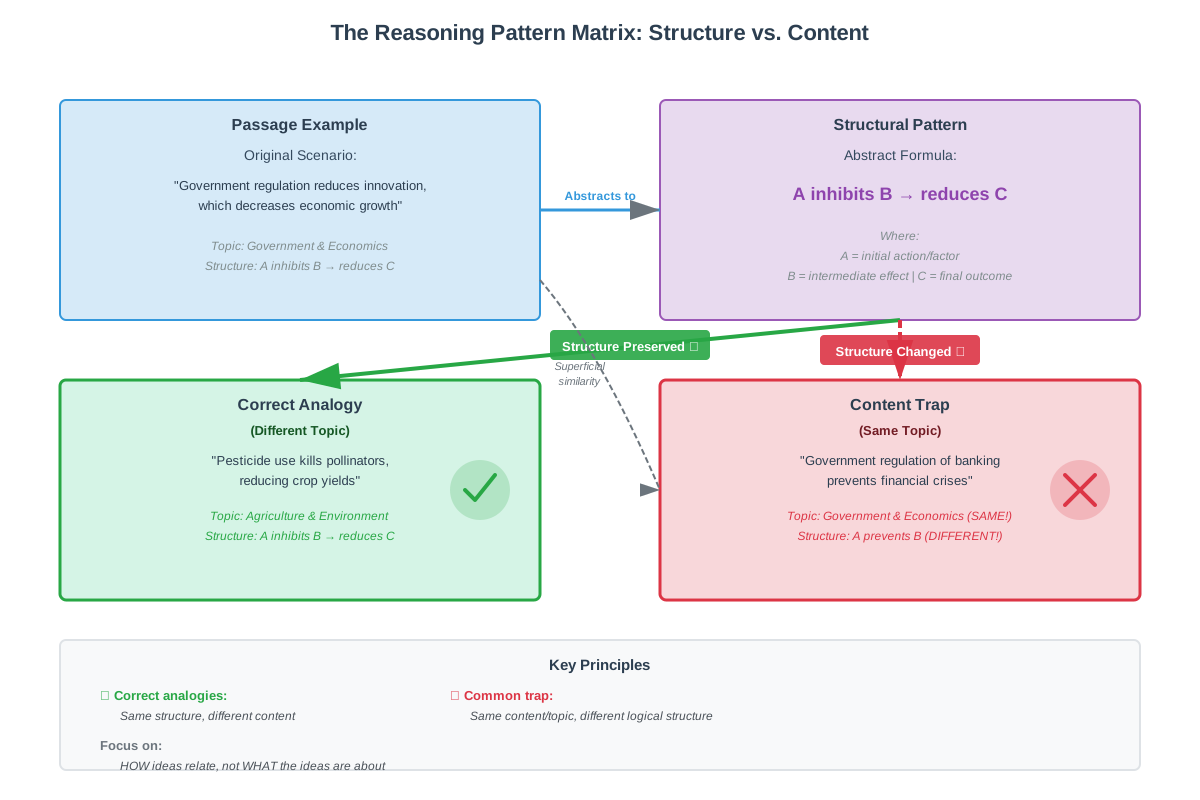
The key to these questions lies in understanding that analogies operate at the level of form rather than content. Two situations can be perfectly analogous despite having completely different subject matter. For instance, a passage discussing how impressionist painters challenged academic art conventions could be analogous to a scenario about jazz musicians challenging classical music traditions—not because art and music are similar, but because the relationship structure (innovative movement challenging established tradition) is identical.
Identifying Essential Features
To answer analogy questions correctly, students must extract the essential features of the passage element being analogized. Essential features are the structural, relational, or logical components that define the situation, stripped of specific content details. This process involves three steps:
- Identify the scope: Determine exactly what part of the passage the question asks about (a relationship, an argument, a process, a situation)
- Abstract the structure: Remove content-specific details and identify the underlying pattern or relationship
- List key components: Note the elements that must be present in any valid analogy
For example, if a passage describes how Theory A replaced Theory B because Theory A explained anomalies that Theory B couldn't address, the essential features include: (1) two competing theories, (2) one theory's inadequacy regarding specific phenomena, (3) a replacement theory that addresses those inadequacies, and (4) the replacement of the old theory by the new one.
Structural vs. Superficial Similarity
A critical distinction in analogy questions separates structural similarity from superficial similarity. Superficial similarity involves shared content, subject matter, or surface-level details. Structural similarity involves shared logical relationships, patterns, or organizational principles. The LSAT consistently uses superficial similarity as a trap in incorrect answer choices.
| Structural Similarity | Superficial Similarity |
|---|---|
| Same logical relationship | Same subject matter |
| Parallel reasoning pattern | Similar vocabulary |
| Identical role structure | Related content domain |
| Matching process steps | Comparable details |
| Equivalent functional relationships | Thematic connections |
Consider a passage about how antibiotics revolutionized medicine by eliminating previously fatal bacterial infections. A structurally similar scenario might involve how refrigeration revolutionized food preservation by preventing spoilage—completely different subject matter but identical structure (technology → solves previously unsolvable problem → transforms field). A superficially similar but structurally different scenario might involve a new antibiotic that treats resistant bacteria—same subject matter but different structure (improvement within established paradigm rather than revolutionary transformation).
Common Analogy Patterns
LSAT passages present several recurring patterns that frequently appear in analogy questions:
Challenge-Response Pattern: An established view faces criticism or challenge, leading to modification or replacement. The analogy must include: (1) an established position, (2) a challenge or criticism, (3) a response or change.
Methodological Parallel: A passage describes how someone approaches a problem or conducts research. The analogy must match: (1) the type of problem, (2) the approach characteristics, (3) the reasoning behind the approach.
Relationship Structure: The passage presents a relationship between entities (causal, hierarchical, oppositional, complementary). The analogy must preserve: (1) the number of entities, (2) the type of relationship, (3) the directionality or dynamics.
Process or Development: The passage traces how something evolves or unfolds over time. The analogy must match: (1) the stages or phases, (2) the driving forces, (3) the outcome or direction.
Evaluating Answer Choices Systematically
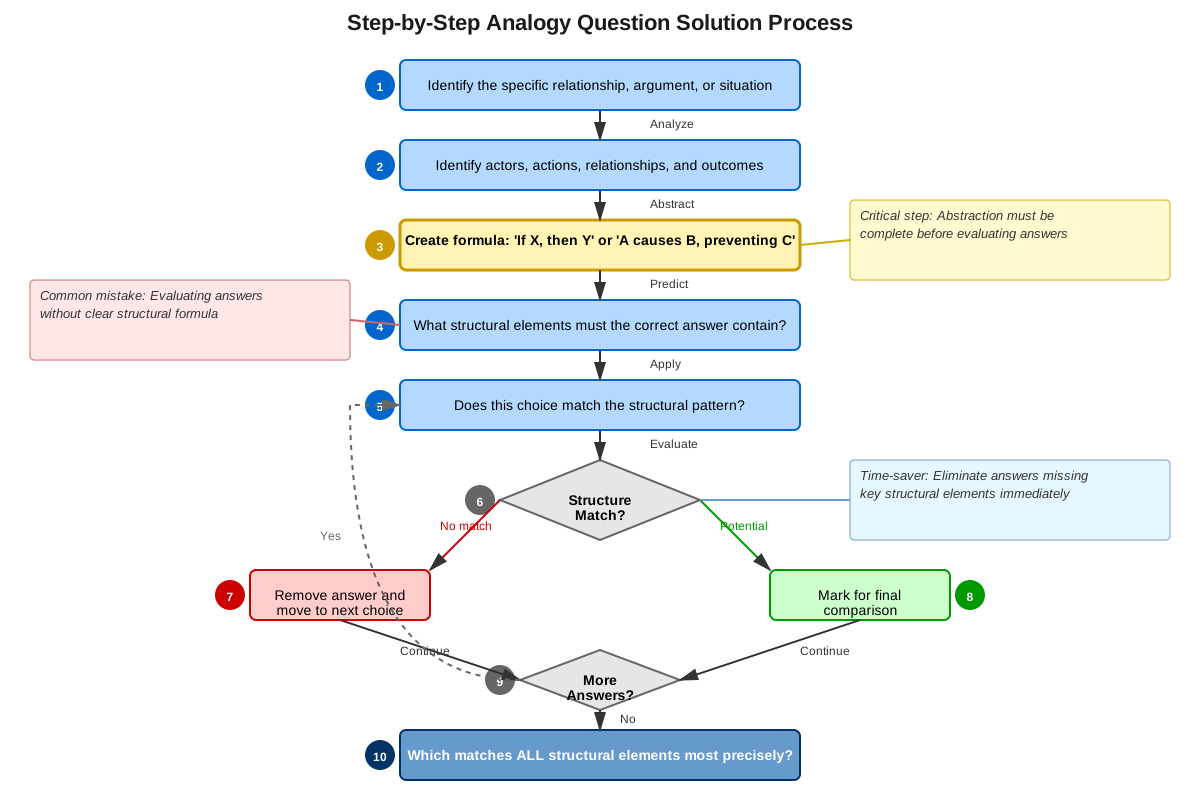
Effective analogy question solving requires systematic comparison of each answer choice against the essential features identified from the passage. This process involves:
- Create a checklist: List the 3-5 essential features that must be present
- Evaluate each choice: Check whether each answer choice contains all essential features
- Eliminate mismatches: Remove choices missing any essential feature
- Compare remaining choices: If multiple choices seem viable, identify which most completely matches all features
This systematic approach prevents the common error of selecting an answer that matches some but not all essential features, or that adds extraneous elements not present in the original structure.
Concept Relationships
The concepts within analogy questions form an interconnected system. Identifying essential features serves as the foundation—without accurately abstracting the passage's structure, students cannot evaluate answer choices effectively. This identification process directly enables the distinction between structural and superficial similarity, which in turn allows students to avoid trap answers that share subject matter but lack parallel structure.
Common analogy patterns represent recurring applications of these principles—recognizing these patterns accelerates the essential feature identification process. When students recognize a challenge-response pattern, for instance, they immediately know to look for an established position, a challenge, and a response in answer choices.
The relationship to prerequisite topics is equally important. Argument structure recognition provides the analytical tools needed to break down passage elements into components that can be abstracted. Basic passage comprehension ensures students understand what they're abstracting before attempting to find parallels. These skills flow together: Comprehension → Structure Recognition → Feature Abstraction → Pattern Matching → Answer Selection.
Analogy questions also connect forward to other advanced reading comprehension skills. The ability to abstract structure strengthens performance on application questions, strengthening/weakening questions, and inference questions—all of which require seeing beyond surface content to underlying logical relationships.
High-Yield Facts
⭐ Analogy questions test structural similarity, not content similarity—the correct answer may involve completely different subject matter from the passage.
⭐ Essential features must be abstracted from specific content—remove all content-specific details to identify the underlying pattern or relationship structure.
⭐ Every essential feature must be present in the correct answer—if an answer choice lacks even one key structural element, it cannot be correct.
⭐ Superficial similarity is the most common trap—wrong answers frequently share subject matter with the passage but lack structural parallelism.
⭐ The correct answer matches the passage's logical structure exactly—not approximately, not mostly, but precisely in all essential features.
- Analogy question stems typically include phrases like "most analogous to," "most closely parallels," or "most similar to."
- The number of elements in a relationship matters—if the passage describes a three-way relationship, the analogy must also involve three elements.
- Directionality is crucial—if A causes B in the passage, the analogy must preserve this causal direction, not reverse it.
- Temporal sequence must be preserved—if the passage describes events in a specific order, the analogy must maintain that sequence.
- The role each element plays must match—if X challenges Y in the passage, the analogous scenario must have one element challenging another, not supporting or complementing it.
- Degree and intensity matter less than structure—a "revolutionary" change in the passage could parallel a "significant" change in the answer if the structural relationship is identical.
- Multiple valid analogies could theoretically exist, but only one answer choice will match all essential features precisely.
Quick check — test yourself on Analogy questions so far.
Try Flashcards →Common Misconceptions
Misconception: Analogy questions ask which answer choice is most related to the passage topic.
Correction: Analogy questions ask which scenario most closely parallels the passage's structure, not its topic. The correct answer might involve a completely unrelated subject matter as long as the structural relationship is identical.
Misconception: If an answer choice shares vocabulary or concepts with the passage, it's likely correct.
Correction: Shared vocabulary often indicates a superficial similarity trap. The LSAT deliberately includes wrong answers that use similar terms but lack structural parallelism. Focus on relationship structure, not word overlap.
Misconception: An answer choice that matches most essential features is good enough.
Correction: The correct answer must match all essential features. An answer that captures 80% of the structure is still wrong. Partial matches are designed distractors.
Misconception: Analogy questions are asking for the "best" answer among imperfect options.
Correction: While LSAT questions do ask for the "best" answer, in analogy questions, the correct answer will be a complete structural match, not merely the least-bad option. If no answer seems to match perfectly, re-examine your understanding of the passage's essential features.
Misconception: The correct answer should feel intuitively similar to the passage.
Correction: Intuitive similarity often reflects superficial rather than structural similarity. The correct answer might initially seem unrelated because it involves different content. Trust systematic structural analysis over intuitive "feel."
Misconception: Complex passages require complex analogies.
Correction: The complexity of the passage content doesn't determine the complexity of the analogous structure. A sophisticated philosophical passage might have a simple two-element relationship structure, while a straightforward scientific passage might involve a complex multi-stage process.
Worked Examples
Example 1: Challenge-Response Pattern
Passage Summary: A passage describes how 19th-century geologists initially believed Earth's features formed gradually over millions of years (uniformitarianism). However, evidence of sudden catastrophic events (like meteor impacts) challenged this view. Modern geology now accepts that both gradual processes and catastrophic events shaped Earth's features, representing a synthesis of both perspectives.
Question: Which of the following is most analogous to the development in geological theory described in the passage?
Answer Choices:
(A) Astronomers once believed the universe was static, but evidence of cosmic expansion led them to abandon this view entirely in favor of Big Bang theory.
(B) Economists initially emphasized either free markets or government intervention, but contemporary economics recognizes that both mechanisms play important roles in different contexts.
(C) Biologists studying evolution focus on both genetic mutations and environmental pressures as contributing factors.
(D) Physicists developed quantum mechanics to explain phenomena that classical physics could not adequately address.
(E) Chemists discovered new elements that filled gaps in the periodic table, confirming predictions made by earlier theories.
Solution Process:
Step 1: Identify essential features from the passage
- Initial dominant theory (uniformitarianism)
- Challenging evidence or alternative view (catastrophism)
- Synthesis that incorporates both perspectives rather than complete replacement
- The synthesis represents a more complete understanding
Step 2: Evaluate each answer choice
(A) Eliminate: This describes complete replacement of one theory by another, not synthesis. The old view was "abandoned entirely."
(B) Strong candidate: Initial either-or perspectives (free markets vs. government intervention), followed by recognition that both play roles—this is a synthesis incorporating both perspectives.
(C) Eliminate: This describes two factors that work together but doesn't show an initial conflict or challenge followed by synthesis. No indication of competing theories.
(D) Eliminate: This describes one theory addressing inadequacies of another—replacement, not synthesis of both theories.
(E) Eliminate: This describes confirmation and extension of existing theory, not a challenge followed by synthesis.
Correct Answer: (B)
This answer matches all essential features: two initially competing perspectives, recognition that both have validity, and synthesis that incorporates both rather than choosing one over the other. The content (economics vs. geology) is completely different, but the structural pattern is identical.
Example 2: Methodological Parallel
Passage Summary: A passage discusses how anthropologist Margaret Mead studied Samoan culture by immersing herself in the community, learning the language, and observing daily life from within rather than as an outside observer. This participant-observation method allowed her to understand cultural practices from the natives' perspective rather than imposing external interpretations.
Question: The approach described in the passage is most similar to which of the following?
Answer Choices:
(A) A historian analyzing ancient texts using modern linguistic theory to decode their meaning
(B) A psychologist conducting controlled laboratory experiments to test hypotheses about human behavior
(C) A journalist living in a neighborhood for months to understand residents' experiences before writing about urban poverty
(D) A sociologist distributing surveys to gather statistical data about community attitudes
(E) A literary critic comparing multiple authors' works to identify common themes
Solution Process:
Step 1: Identify essential features
- Researcher enters the environment being studied
- Extended immersion rather than brief observation
- Inside perspective rather than external analysis
- Understanding emerges from participants' viewpoint
- Avoids imposing external frameworks
Step 2: Evaluate each answer choice
(A) Eliminate: Uses external framework (modern linguistic theory) to interpret—opposite of avoiding external imposition.
(B) Eliminate: Controlled laboratory setting removes subjects from natural environment—opposite of immersion in natural context.
(C) Strong candidate: Journalist enters environment (neighborhood), extended immersion (months), seeks inside perspective (residents' experiences), understands from within before interpreting.
(D) Eliminate: Surveys maintain researcher distance—no immersion or inside perspective.
(E) Eliminate: Analyzing texts from outside—no immersion in the environment being studied.
Correct Answer: (C)
This answer perfectly parallels the methodological structure: entering the environment, extended immersion, seeking insider perspective, and understanding before interpretation. The content differs (journalism vs. anthropology, urban poverty vs. Samoan culture), but the methodological structure is identical.
Exam Strategy
When approaching analogy questions on the LSAT, implement this systematic process:
Step 1: Identify the Question Type
Watch for trigger phrases: "most analogous to," "most similar to," "most closely parallels," "most resembles," "situation most like." These phrases signal that structural parallelism, not content similarity, is being tested.
Step 2: Locate and Understand the Reference
Determine exactly what the question asks you to analogize. Is it a relationship between concepts? An argument structure? A process? A situation? A development over time? Reread that specific portion of the passage carefully.
Step 3: Abstract the Essential Features
Create a mental or physical checklist of 3-5 essential structural features. Strip away all content-specific details. Ask: "What is the form of this relationship/argument/process?" Use generic placeholders: "Theory A challenges Theory B" rather than "Impressionism challenges Academic Art."
Step 4: Predict Before Reading Choices
Before looking at answer choices, articulate what a correct answer must include. This prediction prevents you from being swayed by attractive but incorrect options.
Step 5: Eliminate Systematically
Go through each answer choice with your checklist. Eliminate any choice missing even one essential feature. Be ruthless—partial matches are wrong answers.
Step 6: Beware of Content Traps
Actively distrust answer choices that share subject matter, vocabulary, or thematic elements with the passage. These are often deliberate traps. The correct answer might seem initially unrelated.
Exam Tip: If you're torn between two answers, both probably have superficial appeal. Return to the passage, re-abstract the essential features more carefully, and check which answer matches all features precisely.
Time Management: Analogy questions typically require 60-90 seconds. Don't rush the abstraction phase—15-20 seconds spent clearly identifying essential features saves time by enabling rapid, confident elimination. If you're spending more than 90 seconds, you may be over-thinking or haven't clearly identified the essential features.
Process of Elimination Specific Tips:
- Eliminate answers with wrong number of elements (if passage has three-way relationship, answer must too)
- Eliminate answers with reversed directionality (if A causes B, answer can't have B causing A)
- Eliminate answers with different relationship types (if passage shows opposition, answer can't show cooperation)
- Eliminate answers that add elements not present in the original structure
Memory Techniques
MAPS Mnemonic for evaluating answer choices:
- Match all essential features (not just some)
- Avoid superficial similarity traps
- Preserve structure, not content
- Systematic elimination using checklist
The "Skeleton" Visualization: Imagine the passage element as a skeleton—the bones represent structure, the flesh represents content. Strip away all the flesh (specific details, subject matter) to see only the bones (relationships, roles, sequence). The correct answer has an identical skeleton, even if covered with completely different flesh.
STRIP Acronym for abstracting essential features:
- Structure: What is the relationship pattern?
- Temporal: What is the sequence or timing?
- Roles: What role does each element play?
- Interaction: How do elements relate to each other?
- Purpose: What is the function or outcome?
The "Different Movie, Same Plot" Analogy: Think of the passage and correct answer as different movies with identical plot structures. Star Wars and The Lion King have completely different settings, characters, and details, but share the same hero's journey structure. This mental model reinforces that content differences don't matter if structure matches.
Summary
Analogy questions on the LSAT test the ability to recognize structural parallelism across different contexts—a fundamental skill for legal reasoning. These questions require students to abstract essential features from passage elements by stripping away content-specific details to reveal underlying patterns, relationships, or logical structures. The key challenge lies in distinguishing structural similarity (matching logical relationships and patterns) from superficial similarity (shared subject matter or vocabulary), as the LSAT consistently uses superficial similarity as a trap in incorrect answer choices. Success requires systematic analysis: identifying exactly what element needs to be analogized, extracting 3-5 essential structural features, and evaluating each answer choice against all features. The correct answer must match every essential feature precisely, even if it involves completely different subject matter. Common patterns include challenge-response structures, methodological parallels, relationship structures, and developmental processes. By focusing on form rather than content and applying systematic evaluation rather than intuitive similarity, students can consistently identify correct answers and avoid the traps that make these medium-difficulty questions challenging for many test-takers.
Key Takeaways
- Analogy questions test structural similarity, not content similarity—correct answers often involve completely different subject matter from the passage
- Essential features must be abstracted by removing all content-specific details to reveal underlying patterns and relationships
- Every essential feature must be present in the correct answer; partial matches are incorrect
- Superficial similarity (shared vocabulary, subject matter, or themes) is the most common trap in wrong answers
- Systematic evaluation using a checklist of essential features is more reliable than intuitive similarity judgments
- Common patterns include challenge-response, methodological parallels, relationship structures, and developmental processes
- The correct answer matches the passage's structure exactly in all essential features—number of elements, roles, directionality, and sequence
Related Topics
Application Questions: While analogy questions ask for structural parallels, application questions ask how passage principles apply to new situations. Mastering analogy questions strengthens application question skills by developing the ability to see how abstract principles operate across contexts.
Argument Structure Questions: Understanding how arguments are constructed—premises, conclusions, reasoning patterns—provides the foundation for recognizing when different arguments share identical structures, a key skill for analogy questions.
Inference Questions: Both inference and analogy questions require reading beyond surface content to understand deeper logical relationships. The structural analysis skills developed for analogies enhance inference question performance.
Comparative Reading: Some LSAT sections include paired passages where recognizing structural similarities and differences between passages is crucial. Analogy question skills directly transfer to comparative reading analysis.
Parallel Reasoning in Logical Reasoning: The Logical Reasoning section includes parallel reasoning questions that are essentially analogy questions applied to arguments. Mastering reading comprehension analogy questions provides excellent preparation for these related question types.
Practice CTA
Now that you understand the principles behind analogy questions, it's time to apply these concepts to actual LSAT-style problems. The practice questions and flashcards will reinforce your ability to abstract essential features, distinguish structural from superficial similarity, and systematically evaluate answer choices. Remember: analogy questions reward systematic analysis over intuitive judgment. Each practice question you work through strengthens your pattern recognition and builds the confidence needed to tackle these questions efficiently on test day. Your ability to see through surface differences to recognize deep structural similarities is a skill that improves dramatically with deliberate practice—so dive into those practice materials and watch your accuracy soar!
Sign up free to keep reading
Create a free AnvayaPrep account to finish this LSAT guide on Analogy questions — plus flashcards and practice questions.