Overview
Weaken answer traps represent one of the most challenging aspects of LSAT Logical Reasoning questions, particularly within strengthen and weaken questions. These traps are deliberately crafted incorrect answer choices that appear compelling at first glance but fail to actually weaken the argument when subjected to careful analysis. Understanding these traps is not merely about avoiding wrong answers—it requires developing a sophisticated understanding of what truly constitutes a weakening statement versus what only appears to do so. The LSAT test makers invest considerable effort in creating answer choices that exploit common reasoning errors, cognitive biases, and superficial reading habits that students bring to the exam.
The ability to identify and avoid LSAT weaken answer traps is essential because these questions constitute approximately 25% of all Logical Reasoning questions on any given LSAT administration. Missing even a few of these questions due to trap answers can significantly impact overall scores, particularly for students aiming for scores above the 160 threshold. These traps are designed to be attractive under time pressure, making them especially dangerous in the actual testing environment where students must balance speed with accuracy.
Within the broader context of Logical Reasoning, weaken answer traps connect directly to fundamental skills in argument analysis, assumption identification, and causal reasoning. Mastering this topic requires synthesizing knowledge about argument structure, logical relationships, and the specific ways that evidence can undermine a conclusion. Students who excel at avoiding these traps demonstrate not only technical knowledge but also the disciplined thinking and careful reading that characterizes top LSAT performers across all question types.
Learning Objectives
- [ ] Identify how weaken answer traps appear in LSAT questions
- [ ] Explain the reasoning pattern behind weaken answer traps
- [ ] Apply weaken answer traps to solve LSAT-style problems accurately
- [ ] Distinguish between answers that genuinely weaken an argument and those that merely seem relevant
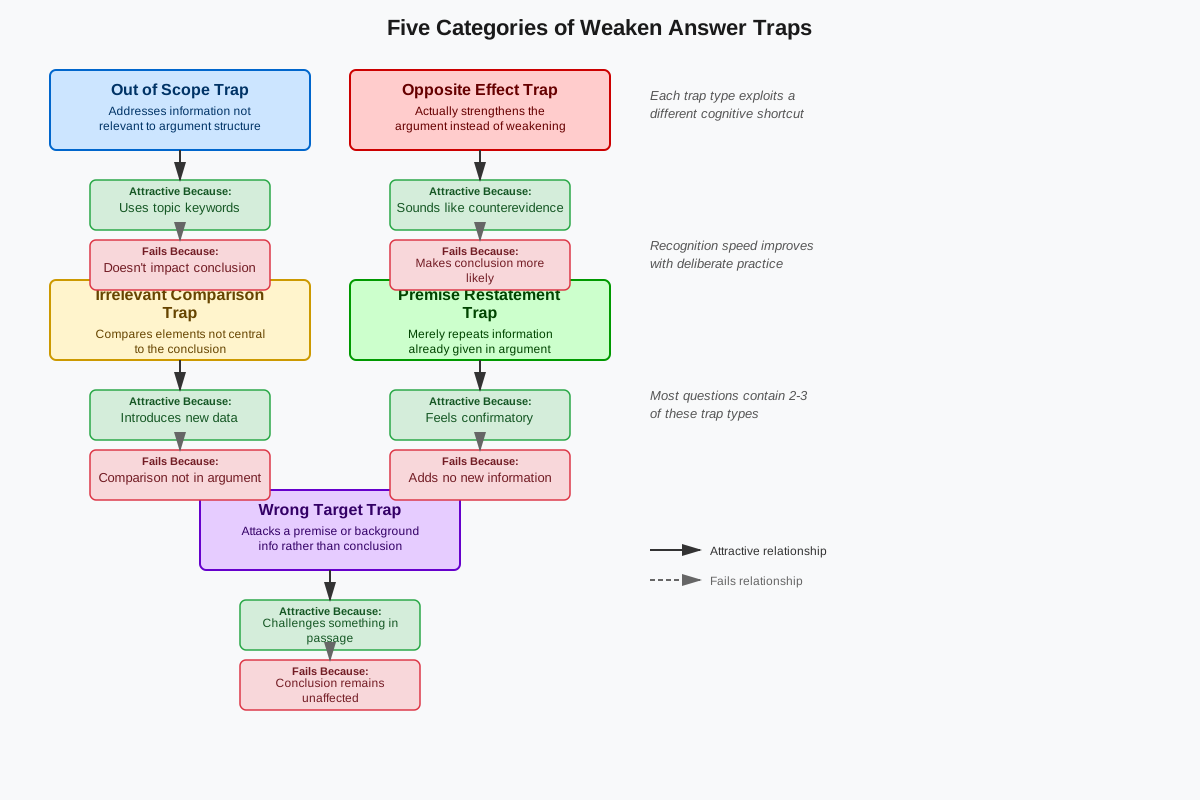
- [ ] Recognize the five most common categories of weaken answer traps
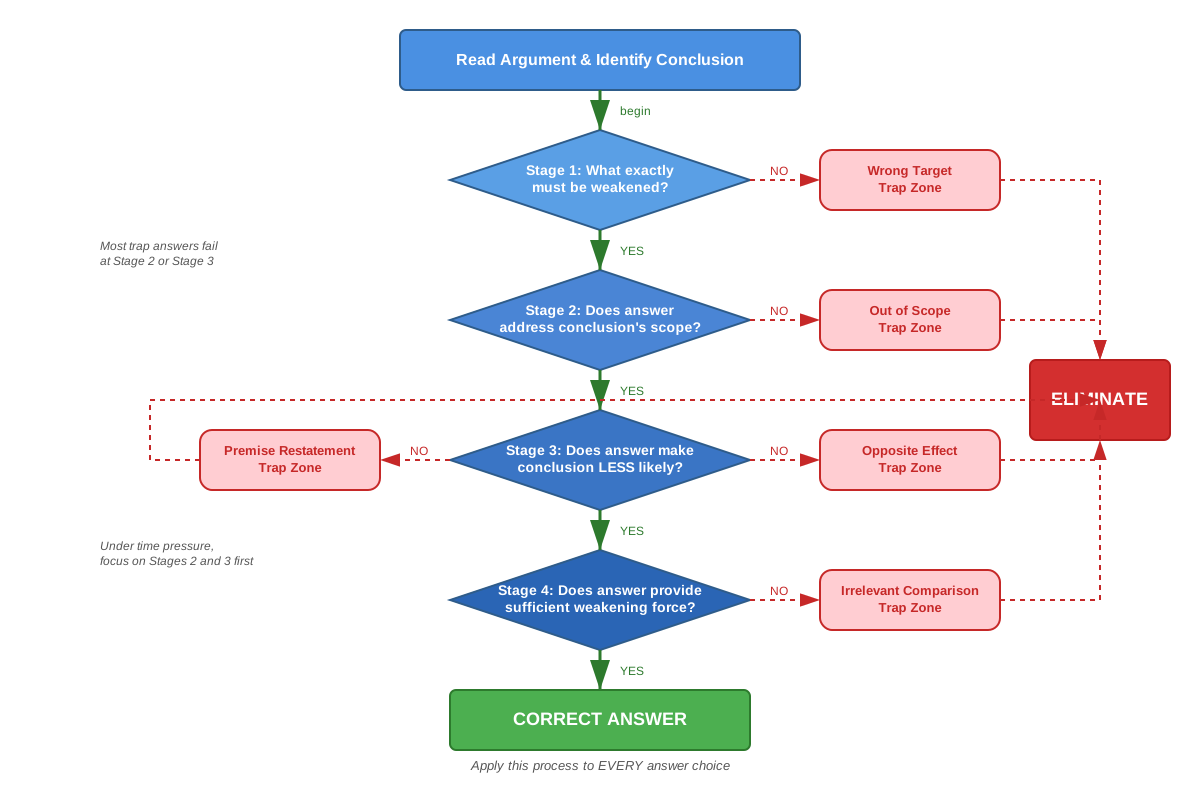
- [ ] Develop a systematic process for eliminating trap answers under timed conditions
- [ ] Predict which types of traps are most likely to appear based on argument structure
Prerequisites
- Argument structure identification: Understanding premises, conclusions, and assumptions is essential because weaken answer traps often exploit confusion about which component of the argument is being targeted
- Basic logical relationships: Familiarity with necessary and sufficient conditions helps distinguish between answers that actually impact the argument versus those that address tangential issues
- Causal reasoning fundamentals: Many weaken questions involve causal arguments, and traps frequently involve alternative causes or correlation-causation confusion
- Standard weaken question mechanics: Students must understand what it means to weaken an argument before they can identify answers that fail to do so
Why This Topic Matters
In real-world contexts, the ability to identify flawed counterarguments is crucial for legal reasoning, policy analysis, and critical evaluation of claims. Attorneys must distinguish between objections that genuinely undermine their opponent's case and those that merely sound persuasive. This skill translates directly to evaluating evidence, constructing rebuttals, and identifying weaknesses in reasoning across professional contexts.
On the LSAT specifically, weaken questions appear with remarkable consistency—typically 6-8 questions per Logical Reasoning section, meaning 12-16 questions across both sections. This represents roughly 15% of the entire exam score. More importantly, lsat weaken answer traps are deliberately placed in these questions to separate high scorers from mid-range performers. Research on LSAT performance indicates that students who master trap avoidance in weaken questions see score improvements of 3-5 points on average.
These traps appear in several predictable patterns within exam passages. The most common scenario involves arguments with causal claims, where trap answers introduce alternative explanations that don't actually weaken the specific causal relationship claimed. Another frequent pattern occurs in arguments about representative samples or generalizations, where traps provide information about different populations or time periods that seem relevant but don't impact the argument's logic. Finally, prediction-based arguments often feature traps that address past data rather than the future-oriented conclusion, or that strengthen rather than weaken the argument despite appearing critical.
Core Concepts
The Nature of Weakening
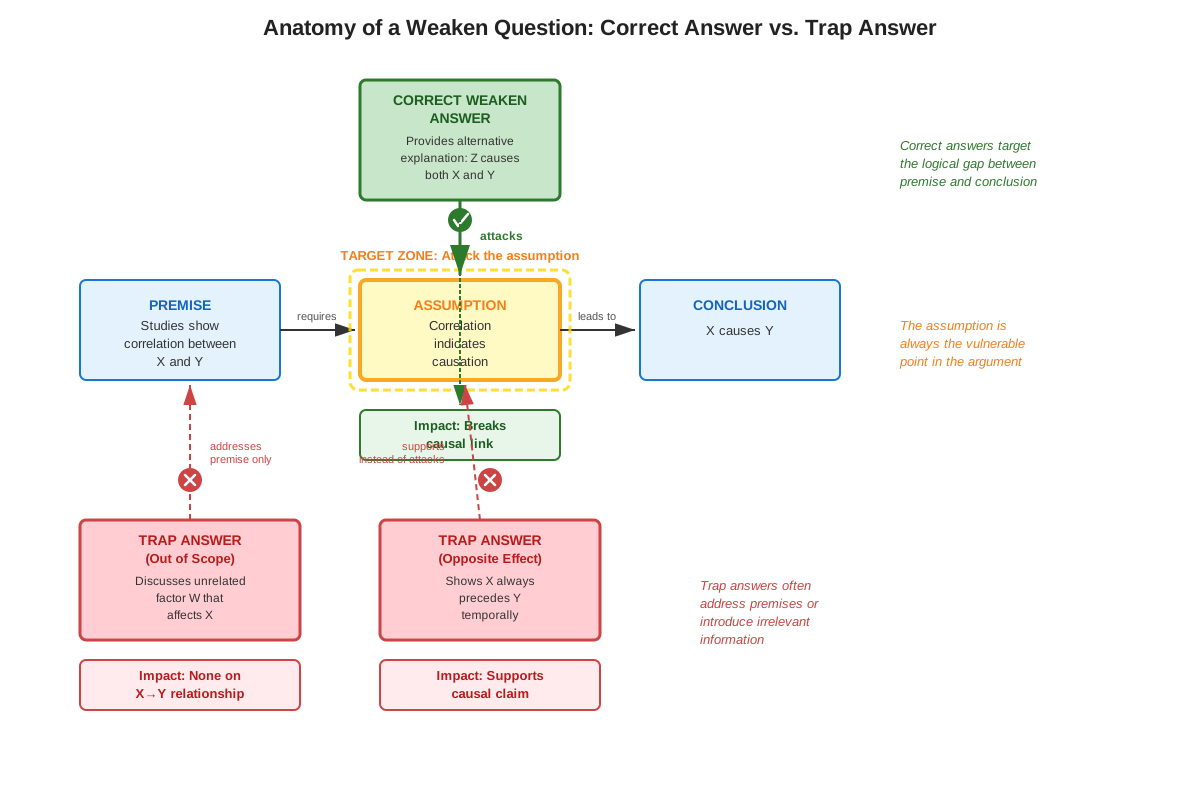
To understand weaken answer traps, students must first have a precise understanding of what it means to weaken an argument. A correct weakening answer makes the conclusion less likely to be true given the premises, or it undermines the connection between the premises and conclusion. This can occur by attacking an assumption, providing counterevidence, suggesting alternative explanations, or demonstrating that the evidence doesn't support the conclusion as strongly as claimed.
Critically, weakening does not require proving the conclusion false or making it impossible. Even a slight reduction in the argument's logical force constitutes weakening. This nuance is important because many trap answers fail by setting an unrealistically high bar—they don't completely destroy the argument, so test-takers incorrectly eliminate them, falling for traps that seem more dramatic but don't actually weaken the logic.
The Five Major Categories of Weaken Answer Traps
1. The Irrelevant Distinction Trap
This trap introduces information that seems related to the argument but actually addresses a different issue, population, time period, or scenario than what the argument discusses. The answer choice might use similar terminology or concepts from the stimulus, creating an illusion of relevance.
Example pattern: If an argument claims "Policy X will reduce crime in urban areas," a trap might state "Policy X was ineffective in rural areas." This seems relevant because it discusses Policy X and crime, but it doesn't weaken the claim about urban areas specifically.
2. The Strengthener in Disguise Trap
Perhaps the most insidious trap, this answer choice actually supports the argument while using language that sounds critical or negative. Test-takers who focus on tone rather than logical impact often select these answers.
Example pattern: For an argument concluding "The new medication is safe," a trap might state "Only 2% of patients experienced side effects." The word "only" and mention of "side effects" sounds negative, but this information actually strengthens the safety claim.
3. The Premise Booster Trap
This trap restates or supports one of the argument's premises rather than attacking the connection between premises and conclusion. Since premises are assumed to be true in LSAT arguments, providing additional support for them doesn't weaken the argument's logic.
Example pattern: If an argument states "Sales increased 20% after the advertising campaign, so the campaign was effective," a trap might say "Sales data was accurately measured." This supports a premise but doesn't weaken the causal conclusion.
4. The Wrong Conclusion Trap
This answer choice would weaken a different conclusion than the one actually stated in the argument. Test-takers who misidentify the conclusion or who assume a related claim is being made fall for this trap.
Example pattern: If an argument concludes "The company should expand to Asia," a trap might provide evidence that "Expansion to Europe would be unprofitable." This addresses a different conclusion entirely.
5. The Scope Shift Trap
This trap addresses a broader or narrower scope than the argument's actual claim. It might weaken a general principle when the argument makes a specific claim, or vice versa.
Example pattern: For an argument claiming "This particular school's test scores will improve with the new curriculum," a trap might state "Nationwide, the curriculum has shown mixed results." The scope shift from one school to nationwide makes this irrelevant.
Recognizing Trap Patterns Through Argument Structure
The type of trap most likely to appear correlates strongly with the argument's structure. Causal arguments (X causes Y) most frequently feature alternative cause traps and correlation-without-causation traps. Sampling arguments (generalizing from a sample to a population) typically include traps about different populations or samples. Prediction arguments (X will happen in the future) often feature traps about past data that don't impact future predictions. Comparison arguments (X is better than Y) frequently include traps that address only one element being compared.
Understanding this correlation allows strategic prediction. When approaching a weaken question, identifying the argument type immediately suggests which traps to watch for, enabling faster and more accurate elimination.
The Mechanism of Trap Effectiveness
Weaken answer traps succeed by exploiting predictable cognitive patterns. Confirmation bias makes test-takers gravitate toward answers that align with their intuitive sense that something is wrong with the argument, even if the answer doesn't logically weaken it. Superficial similarity causes answers using terminology from the stimulus to seem more relevant than they are. Time pressure forces quick decisions based on initial impressions rather than careful logical analysis. Emotional language in answer choices triggers responses based on tone rather than content.
The LSAT deliberately constructs these traps to punish fast, intuitive thinking while rewarding slow, analytical reasoning. This design reflects the exam's purpose: identifying candidates who can think carefully under pressure, a crucial skill for legal practice.
Concept Relationships
The concepts within weaken answer traps form an interconnected system. Understanding what genuinely weakens an argument serves as the foundation, from which recognition of the five trap categories emerges. Each trap category represents a specific way that an answer can fail to weaken: by being irrelevant (Irrelevant Distinction, Scope Shift), by actually helping the argument (Strengthener in Disguise, Premise Booster), or by attacking the wrong target (Wrong Conclusion).
These trap categories connect to prerequisite knowledge in specific ways: Irrelevant Distinction and Scope Shift traps require strong argument structure skills to identify what the argument actually claims. Strengthener in Disguise traps demand understanding of both weakening and strengthening mechanisms. Premise Booster traps necessitate distinguishing premises from conclusions and understanding that premises are assumed true. Wrong Conclusion traps require precise conclusion identification skills.
The relationship map flows as follows:
Argument Structure Analysis → Conclusion Identification → Understanding Weakening Mechanism → Recognizing What Doesn't Weaken → Identifying Specific Trap Categories → Systematic Trap Elimination → Accurate Answer Selection
This topic also connects forward to advanced Logical Reasoning skills. Mastering weaken answer traps improves performance on strengthen questions (by understanding the inverse relationship), assumption questions (by recognizing what must be true for an argument to work), and flaw questions (by identifying reasoning errors). The analytical discipline required for trap avoidance transfers to all question types requiring careful logical analysis.
High-Yield Facts
⭐ Approximately 15% of all LSAT questions are weaken questions, making trap avoidance crucial for score optimization
⭐ The most common trap in weaken questions is the Strengthener in Disguise, appearing in roughly 30% of weaken questions
⭐ Answers that address a different time period, population, or scenario than the argument discusses are almost always traps
⭐ If an answer choice makes you think "but that doesn't completely destroy the argument," it might still be correct—weakening doesn't require total refutation
⭐ Causal arguments attract alternative cause traps more than any other trap type
- Trap answers often use extreme language ("always," "never," "all") that makes them seem strong but actually makes them easier to dismiss as irrelevant
- The correct answer in weaken questions is frequently less dramatic or exciting than trap answers
- Answers that support or restate premises never weaken arguments, since premises are assumed true
- Scope shift traps often use words like "generally," "usually," "nationwide," or "historically" when the argument makes a specific claim
- Wrong conclusion traps frequently address subsidiary points or background information rather than the main conclusion
Quick check — test yourself on Weaken answer traps so far.
Try Flashcards →Common Misconceptions
Misconception: A weakening answer must prove the conclusion false or make it impossible.
Correction: Weakening only requires making the conclusion less likely or undermining the logical connection between premises and conclusion. Even slight doubt introduced into the reasoning constitutes weakening.
Misconception: If an answer uses terminology from the stimulus, it must be relevant to the argument.
Correction: Superficial similarity in language is a primary mechanism of trap effectiveness. Answers can use the same terms while addressing completely different issues, populations, or time periods.
Misconception: Answers that sound negative or critical must weaken the argument.
Correction: Tone and content are distinct. Strengthener in Disguise traps deliberately use negative-sounding language while actually supporting the argument's logic.
Misconception: The correct answer will be the one that seems most related to the argument's topic.
Correction: Topical relevance differs from logical relevance. An answer can discuss the same general subject while failing to impact the specific logical relationship between premises and conclusion.
Misconception: If an answer doesn't address the conclusion directly, it can't weaken the argument.
Correction: Answers can weaken by attacking assumptions, undermining premises' relevance, or providing alternative explanations, even without mentioning the conclusion explicitly.
Misconception: Extreme or dramatic answers are more likely to be correct because they weaken more strongly.
Correction: The LSAT typically makes correct answers moderate and precise, while traps often use extreme language that makes them easier to dismiss as irrelevant or out of scope.
Misconception: All information that seems to contradict something in the argument weakens it.
Correction: Contradicting a premise doesn't weaken the argument because premises are assumed true. Only information that undermines the logical connection or attacks assumptions weakens effectively.
Worked Examples
Example 1: Causal Argument with Alternative Cause Trap
Stimulus: "City officials note that traffic accidents decreased by 15% in the year following installation of new traffic cameras at major intersections. They conclude that the traffic cameras caused the reduction in accidents."
Question: Which of the following, if true, most weakens the officials' conclusion?
Answer Choices:
(A) The traffic cameras were expensive to install and maintain.
(B) A new public transportation system opened during the same year, reducing the number of cars on the road by 20%.
(C) Some drivers complained about the traffic cameras being an invasion of privacy.
(D) Traffic cameras in other cities have also been associated with accident reductions.
(E) The traffic cameras successfully recorded numerous traffic violations.
Analysis:
First, identify the argument structure: This is a causal argument claiming that traffic cameras (cause) led to reduced accidents (effect). The assumption is that no other factor explains the reduction.
Now examine each answer:
(A) Expense trap (Irrelevant Distinction): The cost of the cameras doesn't affect whether they caused the accident reduction. This addresses a different issue—financial considerations—rather than the causal relationship. TRAP.
(B) Alternative cause: This provides a different explanation for the accident reduction—fewer cars on the road due to new public transportation. If 20% fewer cars were driving, this could fully or partially explain the 15% accident reduction without the cameras playing any causal role. This directly weakens the causal claim. STRONG CANDIDATE.
(C) Privacy concerns (Irrelevant Distinction): Driver complaints about privacy don't affect whether the cameras reduced accidents. This addresses a different issue entirely. TRAP.
(D) Strengthener in Disguise: This actually supports the argument by showing that the camera-accident correlation appears in other cities too, making the causal relationship more plausible rather than less. Despite seeming like neutral information, it strengthens. TRAP.
(E) Premise Booster: This supports the premise that the cameras were functioning (recording violations) but doesn't address whether they caused accident reduction. Supporting a premise doesn't weaken the argument. TRAP.
Correct Answer: (B)
This example demonstrates how causal arguments attract alternative cause answers (the correct choice) while featuring multiple trap types: irrelevant distinctions (A, C), a strengthener in disguise (D), and a premise booster (E).
Example 2: Prediction Argument with Scope Shift Trap
Stimulus: "A political analyst predicts that the incumbent mayor will win re-election next month. The analyst notes that the mayor's approval rating currently stands at 58%, and in this city, no incumbent with an approval rating above 55% has ever lost a re-election bid."
Question: Which of the following, if true, most seriously weakens the analyst's prediction?
Answer Choices:
(A) The mayor's approval rating was 65% six months ago.
(B) The challenger has significantly more campaign funding than the incumbent mayor.
(C) In other cities, incumbents with approval ratings above 55% have sometimes lost re-elections.
(D) The mayor's approval rating has historically fluctuated by as much as 10 percentage points in the final month before elections.
(E) Most voters in the city are satisfied with the mayor's performance on economic issues.
Analysis:
Identify the argument structure: This is a prediction argument based on historical patterns. The conclusion is future-oriented (will win next month), supported by current data (58% approval) and historical precedent (no one above 55% has lost).
Examine each answer:
(A) Past data (Irrelevant Distinction): What the approval rating was six months ago doesn't affect the prediction based on current ratings and historical patterns. This addresses the past when the argument is about the future. TRAP.
(B) Campaign funding: While this might seem relevant, the argument's logic is based specifically on approval ratings and historical patterns, not on campaign funding. This introduces a new factor but doesn't undermine the specific reasoning about approval ratings. WEAK TRAP (tempting but doesn't address the argument's actual logic).
(C) Scope Shift Trap: This addresses "other cities" when the argument specifically discusses patterns "in this city." The historical precedent is city-specific, so data from other cities doesn't weaken it. TRAP.
(D) Rating volatility: This directly undermines the prediction by showing that the current 58% rating might drop below 55% before the election (in one month). If ratings can fluctuate by 10 points in a month, the current rating doesn't reliably predict the election-day rating. This attacks the assumption that current approval will hold. STRONG CANDIDATE.
(E) Strengthener in Disguise: Voter satisfaction with the mayor's performance supports the prediction of re-election rather than weakening it. The word "satisfied" might seem neutral, but this information makes the prediction more likely. TRAP.
Correct Answer: (D)
This example shows how prediction arguments attract scope shift traps (C), past-data irrelevance traps (A), and strengtheners in disguise (E). The correct answer undermines the temporal assumption connecting current data to future outcomes.
Exam Strategy
When approaching weaken questions on the LSAT, implement a systematic process that minimizes trap vulnerability:
Step 1: Identify the conclusion precisely (15-20 seconds). Underline or mentally note the exact claim being made. Many traps succeed because test-takers attack the wrong conclusion.
Step 2: Identify the argument type (5-10 seconds). Is this causal, predictive, sampling-based, or comparative? This predicts likely trap types.
Step 3: Identify the key assumption (10-15 seconds). What must be true for the premises to support the conclusion? The correct answer often attacks this assumption.
Step 4: Pre-phrase an ideal answer (5-10 seconds). Before reading choices, think "What would weaken this?" This creates a mental filter against traps.
Step 5: Eliminate using trap awareness (30-40 seconds). Actively ask of each answer: "Does this address a different scope/population/time? Does this actually strengthen? Does this just support a premise?"
Exam Tip: If you find yourself attracted to an answer because it "sounds bad" or uses negative language, pause and verify that it actually weakens the logic rather than just the tone.
Trigger words to watch for in trap answers:
- Scope shifters: "generally," "usually," "in other contexts," "historically," "nationwide"
- Strengthener signals: "only," "merely," "just," "as many as" (when followed by a small number)
- Irrelevance signals: "expensive," "difficult," "unpopular" (when these don't affect the logical relationship)
Process-of-elimination specific tips:
- Eliminate any answer addressing a different population, time period, or scenario than the argument discusses (unless the argument explicitly generalizes)
- Eliminate any answer that makes you think "this supports a premise"
- Eliminate any answer that would strengthen a related but different conclusion
- Between two remaining answers, choose the one that more directly addresses the assumption or logical gap
Time allocation: Spend 45-60 seconds on the stimulus and question, then 30-45 seconds on answer choices. If you're spending more than 90 seconds total, you're likely overthinking—trust your systematic process and move on.
Memory Techniques
SIREN Acronym for Trap Types:
- Strengthener in disguise
- Irrelevant distinction
- Repeats/supports premises
- Erroneous conclusion targeted
- Narrow/broad scope shift
Visualization Strategy: Picture the argument as a bridge connecting premises (one side) to conclusion (other side). The correct weakening answer either removes a support beam (attacks assumption), adds weight to the conclusion side (counterevidence), or shows the bridge doesn't reach where claimed (scope problem). Trap answers either strengthen the bridge, discuss a different bridge, or add decorations that don't affect structural integrity.
The "Different D's" Mnemonic for Irrelevance:
- Different Demographic
- Different Date/time period
- Different Domain/context
- Different Degree (scope)
The Tone-Logic Split Reminder: "TONE ≠ LOGIC" - Write this on your scratch paper. Negative tone doesn't mean logical weakening; positive tone doesn't mean logical strengthening.
Summary
Weaken answer traps represent sophisticated incorrect answer choices designed to exploit common reasoning errors and time pressure on the LSAT. These traps fall into five major categories: Irrelevant Distinction (addressing different scope, population, or time), Strengthener in Disguise (actually supporting the argument despite negative tone), Premise Booster (supporting premises rather than attacking the logical connection), Wrong Conclusion (weakening a different claim than what's actually concluded), and Scope Shift (addressing broader or narrower claims than the argument makes). Success in avoiding these traps requires precise conclusion identification, understanding of what genuinely constitutes weakening, recognition of argument types and their associated trap patterns, and systematic elimination processes that prioritize logical relevance over superficial similarity. The correct weakening answer makes the conclusion less likely given the premises or undermines the connection between them, but it need not prove the conclusion false. Mastering trap avoidance is essential for LSAT success, as weaken questions constitute approximately 15% of the exam and trap answers are deliberately designed to separate high scorers from mid-range performers.
Key Takeaways
- Weaken answer traps appear in approximately 15% of all LSAT questions and are designed to exploit intuitive but incorrect reasoning patterns
- The five major trap categories (Irrelevant Distinction, Strengthener in Disguise, Premise Booster, Wrong Conclusion, Scope Shift) account for nearly all incorrect answers in weaken questions
- Correct weakening answers need only make the conclusion less likely—they don't need to prove it false or completely destroy the argument
- Superficial similarity in language and negative tone are primary mechanisms that make traps attractive but don't indicate logical relevance
- Systematic processes (precise conclusion identification, argument type recognition, assumption identification, pre-phrasing, and trap-aware elimination) dramatically improve accuracy
- Causal arguments most frequently feature alternative cause traps, while prediction arguments attract scope shift and temporal irrelevance traps
- The correct answer typically addresses the argument's core assumption or logical gap rather than peripheral details or premises
Related Topics
Strengthen Questions: The inverse of weaken questions, where understanding trap patterns helps identify answers that genuinely support arguments versus those that merely seem positive. Mastering weaken traps provides direct insight into strengthen trap patterns.
Assumption Questions: These require identifying what must be true for an argument to work. The assumptions identified in these questions are precisely what correct weakening answers attack, making the skills highly transferable.
Flaw Questions: These ask students to identify reasoning errors in arguments. Many weaken answer traps exploit the same logical gaps that flaw questions test, so understanding both question types reinforces the same analytical skills.
Parallel Reasoning Questions: Advanced questions requiring recognition of argument structure. The argument-type identification skills developed for predicting weaken traps transfer directly to parallel reasoning success.
Practice CTA
Now that you understand the sophisticated patterns behind weaken answer traps, it's time to put this knowledge into practice. Attempt the practice questions associated with this topic, focusing on actively identifying trap types before eliminating them. Use the flashcards to reinforce recognition of the five major trap categories and their characteristic features. Remember: every trap you learn to avoid is a point you've added to your LSAT score. The difference between a good score and a great score often comes down to trap avoidance in high-frequency question types like weaken questions. You now have the analytical framework that top scorers use—apply it consistently, and watch your accuracy improve.
Sign up free to keep reading
Create a free AnvayaPrep account to finish this LSAT guide on Weaken answer traps — plus flashcards and practice questions.