Overview
Weakening analogies is a critical reasoning pattern tested extensively on the LSAT's Logical Reasoning section. An analogy argument draws a comparison between two situations, objects, or cases, concluding that because they share certain characteristics, they likely share another characteristic as well. When the LSAT asks you to weaken an analogy, you must identify an answer choice that undermines the strength of this comparison by highlighting relevant differences between the two things being compared.
This topic sits at the intersection of argument structure analysis and critical thinking skills that define success on strengthen and weaken questions. Approximately 15-20% of Logical Reasoning questions involve strengthening or weakening arguments, and analogical reasoning appears frequently within this category. Mastering LSAT weakening analogies requires understanding not just what makes analogies strong or weak, but also developing the ability to quickly identify the core comparison in an argument and spot which differences matter most.
The skill of evaluating analogies extends beyond isolated weaken questions. It connects to assumption questions (where you identify what must be true for the analogy to hold), flaw questions (where analogies often contain reasoning errors), and parallel reasoning questions (which test your ability to match argument structures). Understanding how to weaken analogies therefore strengthens your overall logical reasoning toolkit and improves performance across multiple question types.
Learning Objectives
- [ ] Identify how weakening analogies appears in LSAT questions
- [ ] Explain the reasoning pattern behind weakening analogies
- [ ] Apply weakening analogies to solve LSAT-style problems accurately
- [ ] Distinguish between relevant and irrelevant differences when evaluating analogies
- [ ] Recognize the structural components of analogical arguments (source analog, target analog, shared features, inferred feature)
- [ ] Predict effective weakeners before reviewing answer choices
- [ ] Evaluate the degree to which different answer choices weaken an analogical argument
Prerequisites
- Basic argument structure: Understanding premises, conclusions, and how evidence supports claims is essential because weakening questions require identifying what the argument asserts before determining how to undermine it.
- Conditional reasoning fundamentals: Many analogies involve implicit conditional relationships, and recognizing these patterns helps identify which differences actually matter.
- Assumption identification: Weakening an analogy often means attacking an unstated assumption that the compared situations are relevantly similar.
- Strengthen and weaken question basics: Familiarity with the general approach to these question types provides the foundation for the specialized skill of weakening analogies.
Why This Topic Matters
Analogical reasoning pervades legal thinking, making it a natural focus for the LSAT. Lawyers regularly argue that a current case should be decided like a previous case because of their similarities, or that two cases differ in legally significant ways. The ability to identify relevant differences between compared situations is fundamental to legal analysis, which explains why the LSAT tests this skill extensively.
On the exam, weakening analogies appears in approximately 3-5 questions per test, distributed across both Logical Reasoning sections. These questions typically present arguments that compare business practices, scientific studies, historical situations, policy proposals, or everyday scenarios. The question stems usually include phrases like "Which one of the following, if true, most weakens the argument?" or "Which one of the following, if true, most calls into question the reasoning above?"
The practical importance extends beyond test day. Critical evaluation of analogies is essential in academic writing, professional decision-making, and everyday reasoning. When someone argues "This policy worked in Country A, so it will work in Country B," the ability to identify relevant differences between the countries determines whether you accept or reject the argument. This cognitive skill helps avoid false equivalencies and strengthens analytical thinking across domains.
Core Concepts
The Structure of Analogical Arguments
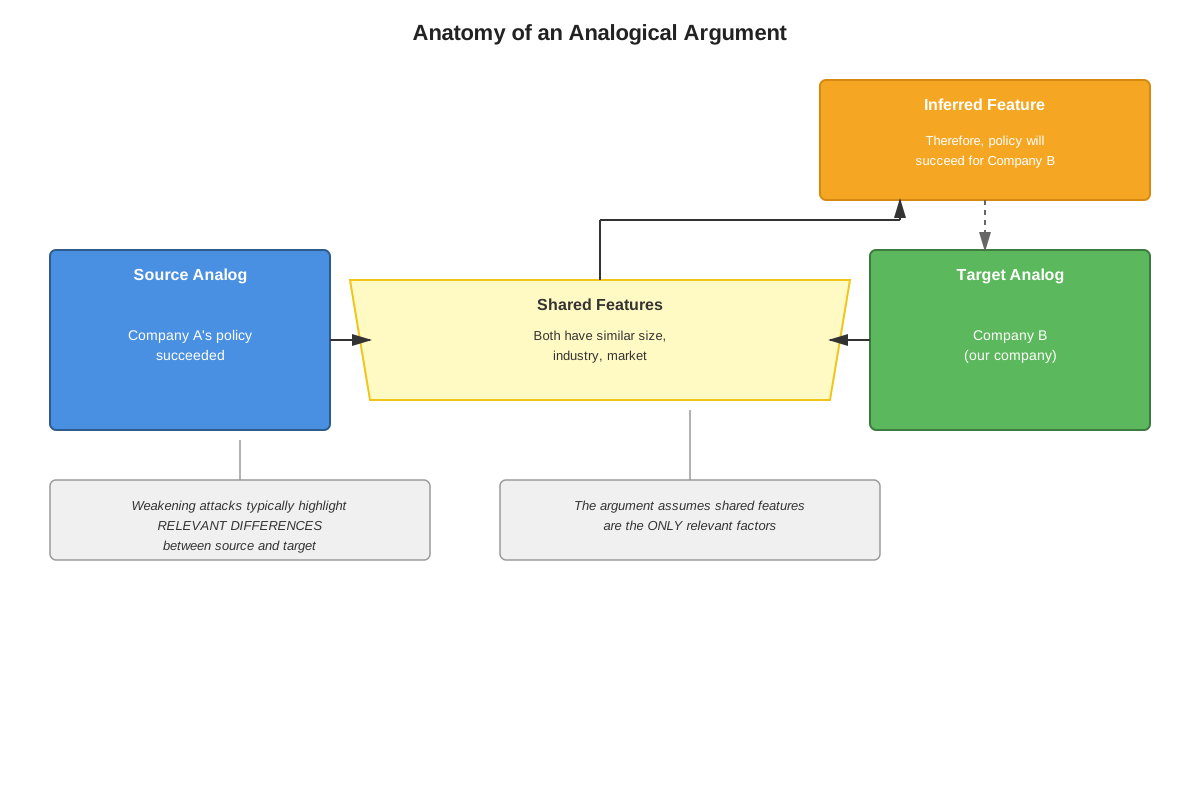
An analogical argument follows a predictable pattern that you must recognize instantly on test day. The argument presents a source analog (the comparison case) and a target analog (the case being argued about), identifies shared features between them, and concludes that they likely share an additional inferred feature.
For example: "Company X implemented flexible work schedules and saw productivity increase by 20%. Company Y is similar to Company X in size, industry, and workforce demographics. Therefore, Company Y should also implement flexible work schedules to increase productivity."
Here, Company X is the source analog, Company Y is the target analog, the shared features are size, industry, and workforce demographics, and the inferred feature is that flexible schedules will increase productivity at Company Y.
The Logic Behind Weakening Analogies
The strength of an analogical argument depends entirely on the relevance and sufficiency of the similarities between the compared cases. An analogy is strong when the shared features are the ones that actually matter for the conclusion, and when there are no significant relevant differences that would prevent the inferred feature from transferring.
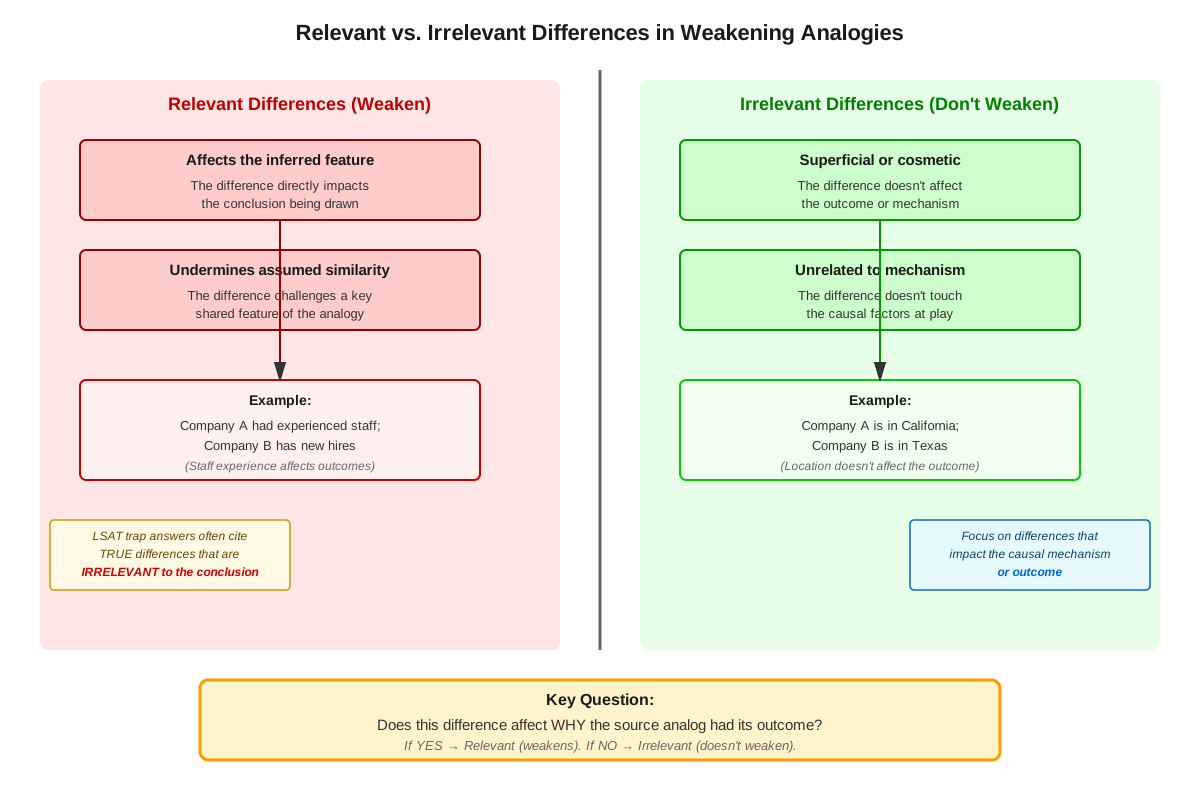
To weaken an analogy, you must introduce information that suggests the comparison is flawed. This typically means identifying a relevant difference—a way in which the source and target analogs differ that would affect whether the inferred feature applies to the target. Not all differences matter; only those that bear on the specific conclusion being drawn.
Consider the Company X and Company Y example. If you learned that Company X's workforce was primarily office-based while Company Y's workforce was primarily manufacturing-based, this would be a relevant difference. The nature of the work affects whether flexible scheduling would impact productivity similarly. However, if you learned that Company X was founded in 1995 while Company Y was founded in 2005, this would likely be an irrelevant difference—founding dates don't obviously affect how flexible scheduling impacts productivity.
Types of Relevant Differences
Understanding the categories of differences that can weaken analogies helps you predict correct answers:
| Type of Difference | Description | Example |
|---|---|---|
| Contextual | Different circumstances or environments | One study conducted in summer, another in winter |
| Causal mechanism | Different underlying processes at work | One treatment works through immune response, another through direct cell destruction |
| Scale or magnitude | Significant size or degree differences | Small pilot program vs. nationwide implementation |
| Temporal | Different time periods with changed conditions | Historical precedent from different economic era |
| Population characteristics | Different relevant features of affected groups | Different age ranges, health statuses, or skill levels |
| Implementation details | Different methods of execution | Different dosages, frequencies, or procedures |
The Relevance Principle
The most important concept in weakening analogies is relevance. A difference between two compared situations only weakens the analogy if it plausibly affects the conclusion. The LSAT frequently includes wrong answers that identify real differences between the compared cases but differences that don't matter for the specific inference being drawn.
To apply the relevance principle:
- Identify the conclusion precisely: What specific feature is being inferred?
- Ask "So what?": Would this difference affect whether the inferred feature transfers?
- Consider the causal chain: Does this difference interrupt the mechanism by which the source analog produced its result?
Degree of Weakening
Not all weakeners are equally strong. The LSAT often asks for the answer that "most weakens" or "most calls into question" the argument, requiring you to compare the relative strength of different weakeners. A stronger weakener:
- Identifies a difference more directly relevant to the conclusion
- Suggests a more significant impact on the outcome
- Undermines a more central assumption of the analogy
- Provides more definitive evidence of dissimilarity
For instance, showing that two medical treatments work through entirely different biological mechanisms is a stronger weakener than showing they're administered at different times of day (unless timing is specifically relevant to the conclusion).
Common Analogy Structures on the LSAT
The LSAT presents analogies in several recurring formats:
Precedent-based: "Policy A worked in Situation 1, so it will work in Situation 2"
Study-based: "Study X found Result Y, so Study Z will likely find similar results"
Historical: "Event A occurred under Conditions 1, so Event B will occur under Conditions 2"
Comparative: "Entity A has Feature X because of Characteristic Y, so Entity B has Feature X because it shares Characteristic Y"
Recognizing these patterns helps you quickly identify the source analog, target analog, and the features being compared.
Concept Relationships
The concepts within weakening analogies form an interconnected system. The structure of analogical arguments provides the foundation—you must identify this structure before you can weaken it. This structure recognition leads directly to applying the relevance principle, which determines which differences actually matter. The relevance principle connects to understanding types of relevant differences, which provides categories for predicting and evaluating answer choices. All of these concepts feed into assessing the degree of weakening, which determines which answer choice is correct when multiple options weaken the argument to different extents.
This topic builds directly on assumption identification from prerequisite knowledge. Every analogy contains the implicit assumption that the compared cases are similar in all relevant respects. Weakening the analogy means showing this assumption is false. The connection to strengthen and weaken questions generally is that analogies represent one specific argument type that appears in these questions, alongside causal arguments, statistical arguments, and others.
Weakening analogies also connects forward to flaw questions, where "weak analogy" or "false analogy" is a common flaw type. The same analytical skills apply: identifying the comparison and recognizing why it's problematic. Additionally, parallel reasoning questions require matching argument structures, and analogical arguments are one structure type you'll need to recognize and match.
Relationship map: Argument structure recognition → Identify source/target analogs and shared/inferred features → Apply relevance principle → Categorize potential differences → Evaluate degree of weakening → Select strongest weakener
High-Yield Facts
⭐ An analogy is weakened by showing a relevant difference between the compared cases, not just any difference
⭐ The relevance of a difference depends entirely on the specific conclusion being drawn
⭐ Stronger weakeners identify differences that more directly affect the mechanism producing the outcome
⭐ Wrong answers often present irrelevant differences that don't impact the conclusion
⭐ The structure of analogical arguments includes: source analog, target analog, shared features, and inferred feature
- Analogies assume that similarities in some respects indicate similarity in the inferred respect
- Contextual differences (environment, circumstances, conditions) frequently weaken analogies on the LSAT
- Temporal differences matter only when conditions have changed between time periods
- Scale differences (pilot vs. full implementation) often provide strong weakeners
- Population characteristic differences weaken analogies when those characteristics affect the outcome
- Implementation detail differences weaken analogies when the details affect the mechanism
- Multiple small differences can collectively weaken an analogy even if no single difference is decisive
- The LSAT rarely requires specialized knowledge to identify relevant differences—logical reasoning suffices
- Strengthening an analogy means showing additional relevant similarities or eliminating potential differences
- Analogies in legal reasoning often compare precedent cases, making this skill directly relevant to law school
Quick check — test yourself on Weakening analogies so far.
Try Flashcards →Common Misconceptions
Misconception: Any difference between the compared cases weakens the analogy → Correction: Only relevant differences weaken analogies. The LSAT frequently includes wrong answers that identify true but irrelevant differences. You must always ask whether the difference would affect the specific conclusion being drawn.
Misconception: The longest or most detailed answer choice is usually correct → Correction: Correct weakeners are often concise and direct. The LSAT includes verbose wrong answers that discuss irrelevant details at length. Focus on relevance, not length.
Misconception: Weakening an analogy means proving the conclusion false → Correction: Weakening means reducing the strength of support the premises provide for the conclusion. The conclusion might still be true; you're just showing the analogy doesn't prove it well.
Misconception: You need to find a difference in the shared features explicitly mentioned in the argument → Correction: Effective weakeners often identify differences in features not mentioned in the original argument but relevant to the conclusion. The argument's failure to consider these features is precisely what makes it weak.
Misconception: Similarities between the compared cases strengthen the argument, so they can't be part of a weakener → Correction: Sometimes an answer choice acknowledges similarities while introducing a crucial difference. The presence of some similarities doesn't prevent an answer from being a weakener if it identifies a relevant difference.
Misconception: Historical or temporal differences are always relevant → Correction: Time differences only matter when conditions have changed in ways that affect the conclusion. If nothing relevant has changed, the time difference doesn't weaken the analogy.
Misconception: Statistical or numerical differences automatically weaken analogies → Correction: Numbers matter only when the magnitude affects the outcome. A 10% size difference might be irrelevant while a 1000% size difference might be crucial—it depends on the specific context and conclusion.
Worked Examples
Example 1: Business Policy Analogy
Argument: "TechCorp implemented a four-day workweek and reported a 15% increase in employee satisfaction and no decrease in productivity. DataSystems is a technology company of similar size to TechCorp, operating in the same geographic region. Therefore, DataSystems should implement a four-day workweek to achieve similar benefits."
Question: Which of the following, if true, most weakens the argument?
Answer Choices:
(A) TechCorp's employees are primarily software developers who work independently, while DataSystems' employees primarily work in customer service roles requiring continuous coverage.
(B) TechCorp was founded five years before DataSystems.
(C) DataSystems has a slightly larger office space than TechCorp.
(D) Some employees at TechCorp initially opposed the four-day workweek.
(E) Both companies offer similar salary ranges and benefits packages.
Analysis:
First, identify the argument structure:
- Source analog: TechCorp
- Target analog: DataSystems
- Shared features: Technology company, similar size, same geographic region
- Inferred feature: Four-day workweek will increase satisfaction without decreasing productivity
Next, identify the conclusion: DataSystems will achieve similar benefits from a four-day workweek.
Now evaluate each answer:
(A) This identifies a relevant difference in work structure. Software developers working independently can more easily adjust to a four-day schedule because their work doesn't require continuous presence. Customer service roles requiring continuous coverage would need additional staffing or schedule coordination, potentially preventing the same benefits. This directly affects whether the inferred feature (increased satisfaction, maintained productivity) would transfer. Strong weakener.
(B) Founding dates are irrelevant unless they correlate with some relevant difference in operations or culture. The argument gives no reason to think founding dates affect how a four-day workweek would perform. Irrelevant difference.
(C) Office space size doesn't obviously affect whether a four-day workweek would succeed. This is a real difference but not a relevant one. Irrelevant difference.
(D) Initial opposition that was presumably overcome doesn't weaken the argument. If anything, it suggests the policy can succeed despite initial resistance. Doesn't weaken; might slightly strengthen.
(E) This shows an additional similarity, which would strengthen rather than weaken the analogy. Strengthener, not weakener.
Correct Answer: (A)
Connection to Learning Objectives: This example demonstrates identifying how weakening analogies appears in LSAT questions (business policy comparison), explaining the reasoning pattern (relevant difference in work structure affects outcome), and applying the concept to solve the problem accurately (eliminating irrelevant differences and selecting the answer that undermines the key assumption).
Example 2: Scientific Study Analogy
Argument: "A study of 500 adults in Norway found that daily consumption of omega-3 supplements reduced the incidence of heart disease by 30% over a five-year period. A similar study should be conducted in Japan, as it would likely yield comparable results given that both countries have high life expectancies and advanced healthcare systems."
Question: Which of the following, if true, most seriously weakens the argument's prediction about the Japanese study?
Answer Choices:
(A) The Norwegian study participants had low baseline omega-3 levels due to limited fish consumption, while the average Japanese diet already includes high levels of omega-3 from regular fish consumption.
(B) Japan has a slightly higher life expectancy than Norway.
(C) The Norwegian study was funded by a pharmaceutical company.
(D) Healthcare costs are structured differently in Japan than in Norway.
(E) Some participants in the Norwegian study reported minor side effects from the supplements.
Analysis:
Argument structure:
- Source analog: Norwegian study
- Target analog: Proposed Japanese study
- Shared features: High life expectancy, advanced healthcare systems
- Inferred feature: Similar 30% reduction in heart disease
The conclusion predicts the Japanese study will yield comparable results.
Evaluate each answer:
(A) This identifies a crucial difference in baseline conditions. If Norwegian participants had low omega-3 levels and benefited from supplementation, but Japanese participants already have high omega-3 levels from dietary fish, the supplements might provide little additional benefit. This directly affects the mechanism by which the intervention works—you can't benefit from supplementation if you're not deficient. Very strong weakener.
(B) This shows an additional similarity or even suggests Japan might have better health outcomes, which wouldn't weaken the prediction. Strengthener or neutral.
(C) Funding source might raise questions about bias in the original study, but the question asks what weakens the prediction about the Japanese study specifically. Even if the Norwegian results were biased, that doesn't tell us whether a Japanese study would yield different results. Doesn't address the comparison.
(D) Healthcare cost structures don't obviously affect whether omega-3 supplements reduce heart disease. This is a real difference but not relevant to the biological mechanism being studied. Irrelevant difference.
(E) Side effects in the Norwegian study don't predict whether the Japanese study would find similar efficacy. This might affect whether the intervention is advisable, but not whether it would work. Doesn't weaken the prediction.
Correct Answer: (A)
Connection to Learning Objectives: This example shows how to distinguish between relevant and irrelevant differences (baseline omega-3 levels vs. healthcare structures), recognize structural components (identifying the mechanism by which the intervention works), and evaluate degree of weakening (answer A undermines the core assumption more directly than other options).
Exam Strategy
Approaching Weakening Analogy Questions
When you encounter a weakening question involving an analogy, follow this systematic approach:
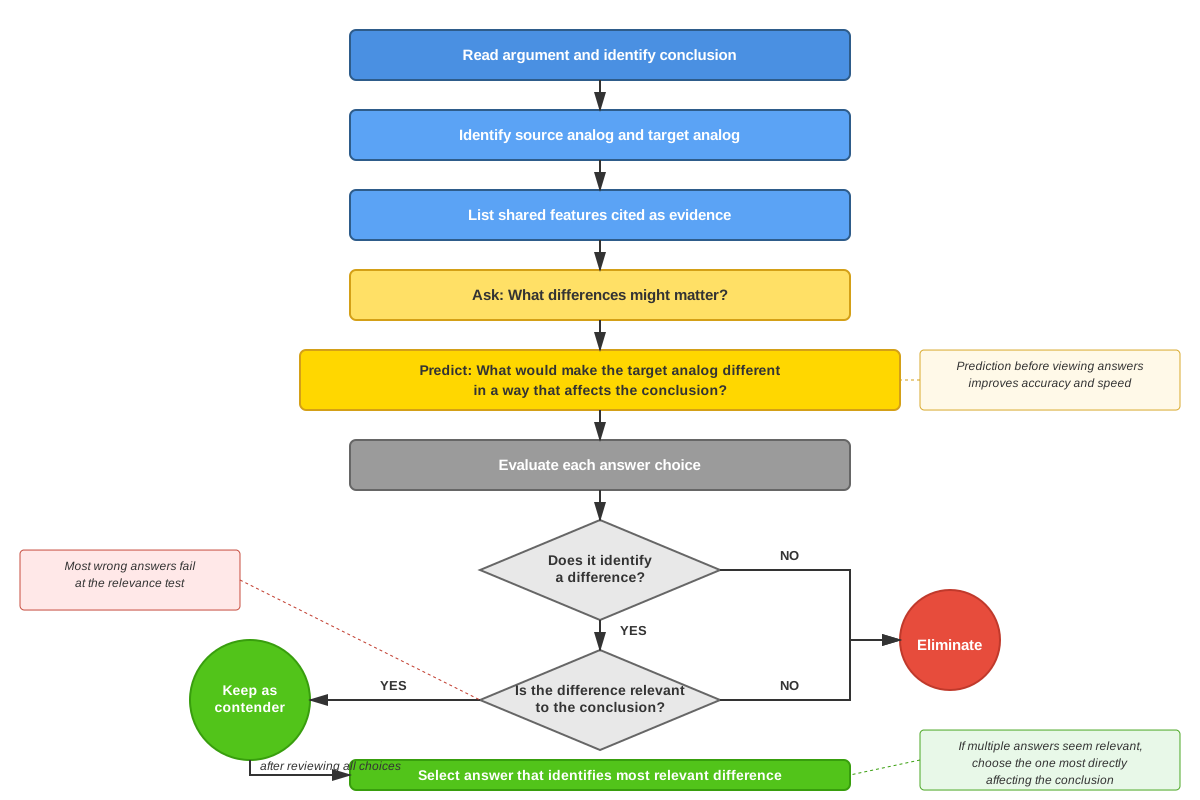
- Read the argument carefully and identify the comparison: Note what two things are being compared and what conclusion is drawn from the comparison.
- Map the analogy structure: Mentally label the source analog, target analog, shared features, and inferred feature. This takes 5-10 seconds but dramatically improves accuracy.
- Identify the conclusion precisely: Know exactly what claim you're trying to weaken. Vague understanding leads to selecting irrelevant weakeners.
- Predict before reading answers: Ask yourself, "What kind of difference would matter here?" Generate one or two potential weakeners. This prevents you from being seduced by attractive wrong answers.
- Apply the relevance test to each answer: For each choice, ask "Would this difference affect whether the conclusion follows?" Eliminate answers that fail this test.
- Compare remaining answers: If multiple answers seem to weaken the argument, determine which identifies a more direct or significant difference.
Trigger Words and Phrases
Watch for these indicators that an argument involves an analogy:
- "Similarly," "likewise," "in the same way"
- "Just as... so too..."
- "Analogous to," "comparable to," "parallel to"
- "Like [Case A], [Case B]..."
- References to precedent, previous studies, or historical examples
- "Should also," "would also," "will likely also"
Question stems for weakening analogies typically include:
- "Which one of the following, if true, most weakens..."
- "Which one of the following, if true, most calls into question..."
- "Which one of the following, if true, casts the most doubt on..."
- "Which one of the following, if true, most undermines..."
Process of Elimination Tips
Eliminate answers that:
- Identify irrelevant differences (apply the "So what?" test)
- Strengthen the analogy by showing additional similarities
- Are neutral or don't affect the argument either way
- Address a different conclusion than the one actually drawn
- Require multiple additional assumptions to connect to the conclusion
Be suspicious of answers that:
- Seem impressive but don't directly relate to the specific conclusion
- Use technical language to obscure irrelevance
- Identify differences in features not mentioned in the argument unless those features clearly matter
Favor answers that:
- Identify differences in causal mechanisms or processes
- Show the compared cases differ in ways that affect the outcome
- Undermine assumptions about relevant similarity
- Are directly connected to the conclusion without requiring additional inferences
Time Allocation
Weakening analogy questions typically require 1:15 to 1:30 to complete accurately. Allocate:
- 20-30 seconds: Read and map the argument structure
- 10-15 seconds: Predict potential weakeners
- 30-45 seconds: Evaluate answer choices
- 10-15 seconds: Confirm your selection
If you're stuck between two answers, invest an extra 15-20 seconds comparing them directly rather than moving on and guessing. These questions reward careful analysis.
Memory Techniques
The STAR Method for Weakening Analogies
Source and Target: Identify what's being compared
Assumption: The cases are relevantly similar
Relevant difference: Find what matters for the conclusion
This acronym helps you remember the systematic approach: identify the comparison, recognize the assumption, find the relevant difference.
The "So What?" Visualization
When evaluating whether a difference matters, visualize yourself in a debate. Your opponent presents the analogy. You say, "But these cases differ in [X way]." Your opponent responds, "So what? How does that affect my conclusion?" If you can't answer convincingly, the difference isn't relevant. This mental dialogue helps filter irrelevant differences.
The Mechanism Check
Remember: "Different paths, different destinations." If the compared cases achieve their results through different mechanisms or processes, the analogy is weak. Visualize the causal chain in each case—if the chains differ at crucial points, you've found a relevant difference.
The Three R's of Relevance
Related to the conclusion?
Reasonable connection?
Real impact on outcome?
All three must be "yes" for a difference to effectively weaken an analogy.
Summary
Weakening analogies is a high-yield LSAT skill that requires understanding how analogical arguments work and what makes them vulnerable to criticism. An analogy draws a comparison between a source analog and target analog, identifies shared features, and infers that an additional feature will also be shared. To weaken such an argument, you must identify a relevant difference—one that actually affects whether the inferred feature would transfer from the source to the target. The key principle is relevance: not all differences matter, only those that bear on the specific conclusion being drawn. The LSAT tests this skill by presenting arguments that compare business practices, scientific studies, policies, or situations, then asking you to identify which answer choice most weakens the comparison. Success requires systematically mapping the analogy structure, precisely identifying the conclusion, predicting potential weakeners, and applying the relevance test to eliminate wrong answers that identify irrelevant differences. This skill connects to broader logical reasoning abilities including assumption identification, argument structure analysis, and critical evaluation of evidence.
Key Takeaways
- Weakening an analogy means identifying a relevant difference between the compared cases that affects the conclusion
- Relevance is determined by whether the difference impacts the specific feature being inferred, not just whether it's a real difference
- Map the analogy structure (source, target, shared features, inferred feature) before evaluating answer choices
- The LSAT frequently includes wrong answers that identify true but irrelevant differences—always apply the "So what?" test
- Stronger weakeners identify differences in mechanisms, processes, or conditions that directly affect outcomes
- Predict potential weakeners before reading answer choices to avoid being misled by attractive wrong answers
- Analogies assume relevant similarity; weakeners show this assumption is false
Related Topics
Strengthening Analogies: The mirror image of this topic, where you identify additional relevant similarities or eliminate potential differences. Mastering weakening analogies makes strengthening them intuitive, as you'll understand what makes analogies strong or weak.
Flaw Questions - Weak Analogy: Many flaw questions identify "reasoning by analogy" or "false comparison" as the error in reasoning. The analytical skills developed here transfer directly to recognizing and articulating why an analogy is flawed.
Assumption Questions with Analogies: Analogies contain implicit assumptions about relevant similarity. Assumption questions may ask you to identify what must be true for the analogy to work, requiring the same understanding of what makes comparisons valid.
Parallel Reasoning: These questions require matching argument structures, and analogical arguments are one common structure type. Understanding analogy structure helps you recognize and match these patterns.
Causal Reasoning: Many analogies involve causal claims ("X caused Y in Case 1, so X will cause Y in Case 2"). Understanding how to weaken causal analogies requires integrating knowledge of both causal reasoning and analogical reasoning.
Practice CTA
Now that you understand the principles behind weakening analogies, it's time to apply these concepts to actual LSAT questions. The practice questions and flashcards will reinforce your ability to quickly identify analogy structures, distinguish relevant from irrelevant differences, and select the strongest weakeners under timed conditions. Each practice question you complete strengthens your pattern recognition and builds the confidence you need to excel on test day. Remember: weakening analogies is a learnable skill that improves dramatically with deliberate practice. Start practicing now to transform this knowledge into automatic, accurate performance.
Sign up free to keep reading
Create a free AnvayaPrep account to finish this LSAT guide on Weakening analogies — plus flashcards and practice questions.