Overview
Strengthening analogies is a critical reasoning pattern tested extensively on the LSAT's Logical Reasoning section. This question type asks test-takers to identify which answer choice most effectively supports an argument that relies on an analogy between two situations, cases, or phenomena. An analogy-based argument claims that because two things are similar in certain respects, they will likely be similar in another respect. To strengthen such an argument, one must demonstrate that the similarities between the compared items are relevant and significant, while any differences are minimal or irrelevant to the conclusion being drawn.
Understanding how to strengthen analogical reasoning is essential for LSAT success because these questions appear regularly throughout the exam and test fundamental critical thinking skills that law schools value. The ability to evaluate analogies is central to legal reasoning itself, as attorneys and judges frequently argue by precedent—claiming that a current case should be decided similarly to a past case because of relevant similarities. Mastering this topic requires recognizing the structure of analogical arguments, identifying what makes analogies strong or weak, and quickly evaluating which additional information would make the comparison more compelling.
Within the broader landscape of Logical Reasoning, strengthening analogies sits at the intersection of argument structure analysis and evidence evaluation. This topic connects directly to strengthen and weaken questions, which together constitute approximately 20-25% of all Logical Reasoning questions on the LSAT. While strengthen questions can involve various argument types (causal, statistical, conditional), those involving analogies require a specific analytical approach focused on similarity and difference. Understanding this reasoning pattern also builds foundational skills for parallel reasoning questions and helps develop the comparative thinking essential for Reading Comprehension passages that present contrasting viewpoints.
Learning Objectives
- [ ] Identify how strengthening analogies appears in LSAT questions
- [ ] Explain the reasoning pattern behind strengthening analogies
- [ ] Apply strengthening analogies to solve LSAT-style problems accurately
- [ ] Distinguish between relevant and irrelevant similarities when evaluating analogies
- [ ] Recognize common wrong answer patterns in strengthening analogy questions
- [ ] Construct a systematic approach for analyzing the strength of analogical arguments
- [ ] Evaluate multiple answer choices efficiently by focusing on the comparison's key elements
Prerequisites
- Basic argument structure: Understanding premises, conclusions, and how evidence supports claims is essential because analogical arguments follow this fundamental structure with comparison as the primary reasoning mechanism.
- Strengthen question fundamentals: Familiarity with what it means to strengthen an argument (making the conclusion more likely to be true given the premises) provides the foundation for the specific task of strengthening analogies.
- Logical reasoning question types: Recognizing different question stems and their requirements allows quick identification of when an analogy-strengthening approach is needed.
- Comparative reasoning: Basic ability to identify similarities and differences between two entities or situations enables the analysis required for evaluating analogies.
Why This Topic Matters
Strengthening analogies represents one of the most practical applications of logical reasoning tested on the LSAT. In legal practice, attorneys constantly argue by analogy, citing precedent cases and claiming that similar facts should yield similar legal outcomes. Judges evaluate these analogies by determining whether the similarities are legally relevant and whether differences are significant enough to distinguish the cases. This same analytical skill—assessing whether two situations are sufficiently similar to warrant similar treatment or conclusions—applies across countless professional and personal contexts, from policy-making to ethical reasoning to business strategy.
On the LSAT itself, strengthening analogy questions appear with notable frequency. Approximately 3-5 questions per test involve analogical reasoning in some form, with 1-2 questions explicitly asking test-takers to strengthen an argument based on an analogy. These questions appear in both Logical Reasoning sections and occasionally influence how arguments are structured in Reading Comprehension passages. The question stems typically include phrases like "Which one of the following, if true, most strengthens the argument?" or "Which one of the following, if true, most supports the analogy?" when applied to passages containing explicit comparisons.
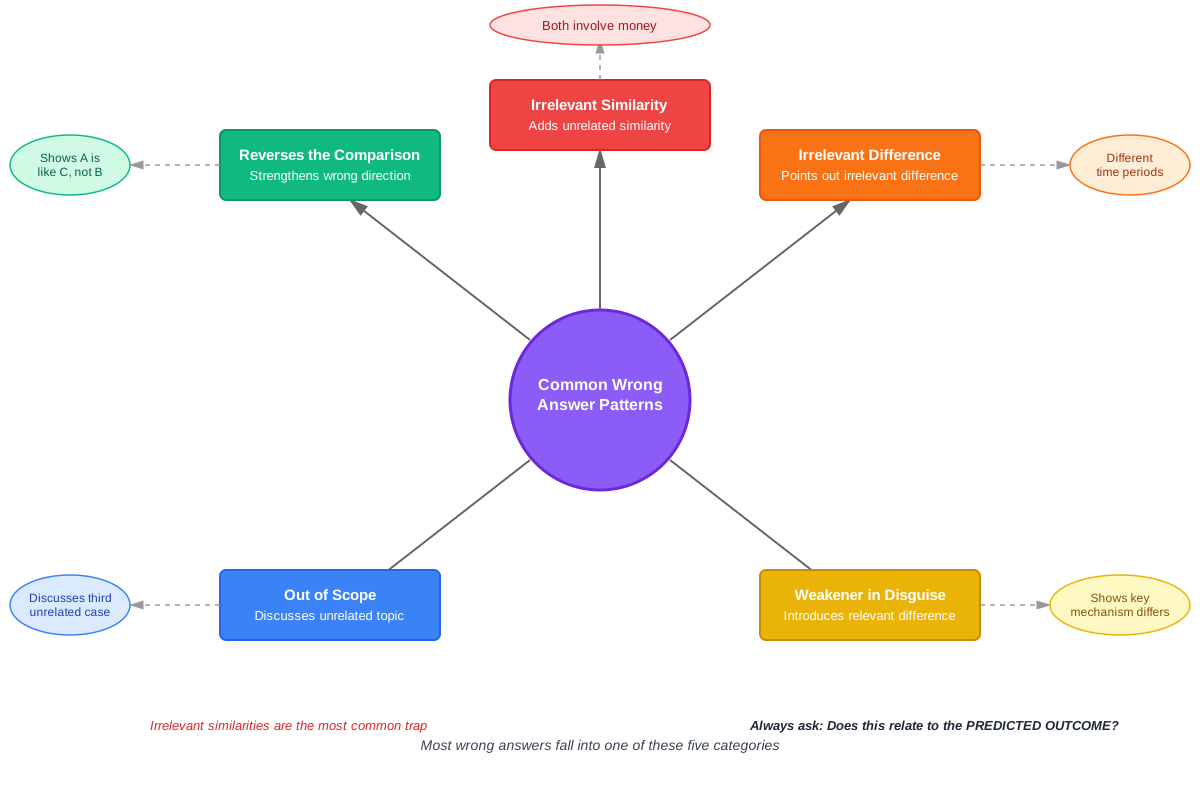
Common manifestations include arguments comparing business strategies across different companies, scientific experiments in different contexts, policy implementations in different jurisdictions, or historical situations to contemporary ones. The LSAT frequently tests whether students can identify that showing additional relevant similarities strengthens an analogy, while showing that apparent differences are actually irrelevant also strengthens the comparison. Test-makers design wrong answers that introduce irrelevant similarities, highlight differences that don't matter to the conclusion, or address aspects of only one situation without making a comparison.
Core Concepts
The Structure of Analogical Arguments
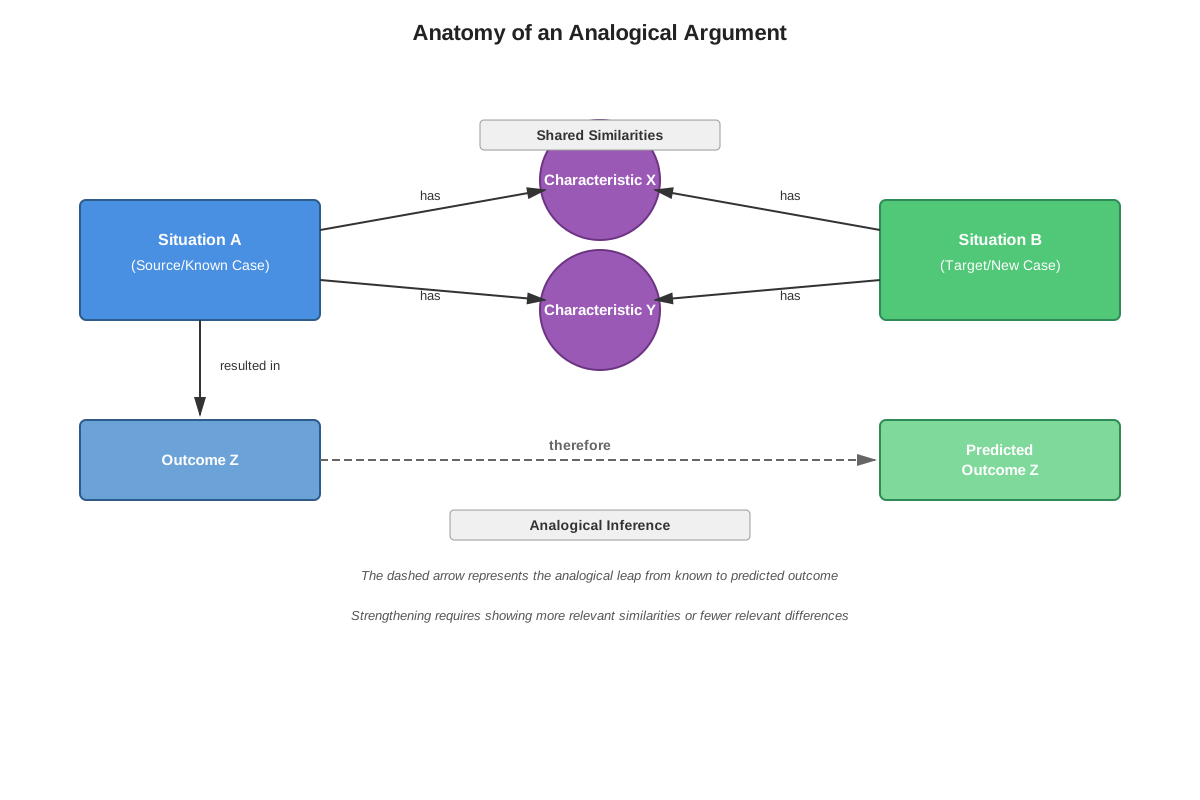
An analogical argument follows a specific logical pattern: it identifies similarities between two cases (Case A and Case B), notes that Case A has a particular characteristic or outcome, and concludes that Case B will likely have that same characteristic or outcome. The argument's strength depends entirely on whether the similarities cited are relevant to the conclusion and whether any differences between the cases undermine the comparison.
The basic structure can be mapped as follows:
- Premise 1: Case A and Case B share characteristics X, Y, and Z
- Premise 2: Case A has outcome or characteristic Q
- Conclusion: Therefore, Case B will likely have outcome or characteristic Q
For example: "City A implemented a bike-sharing program and saw reduced traffic congestion. City B has similar population density, public transit infrastructure, and cycling culture to City A. Therefore, City B should implement a bike-sharing program to reduce its traffic congestion." The argument assumes that the cited similarities (population density, transit infrastructure, cycling culture) are relevant to whether a bike-sharing program will reduce congestion.
What Strengthens an Analogy
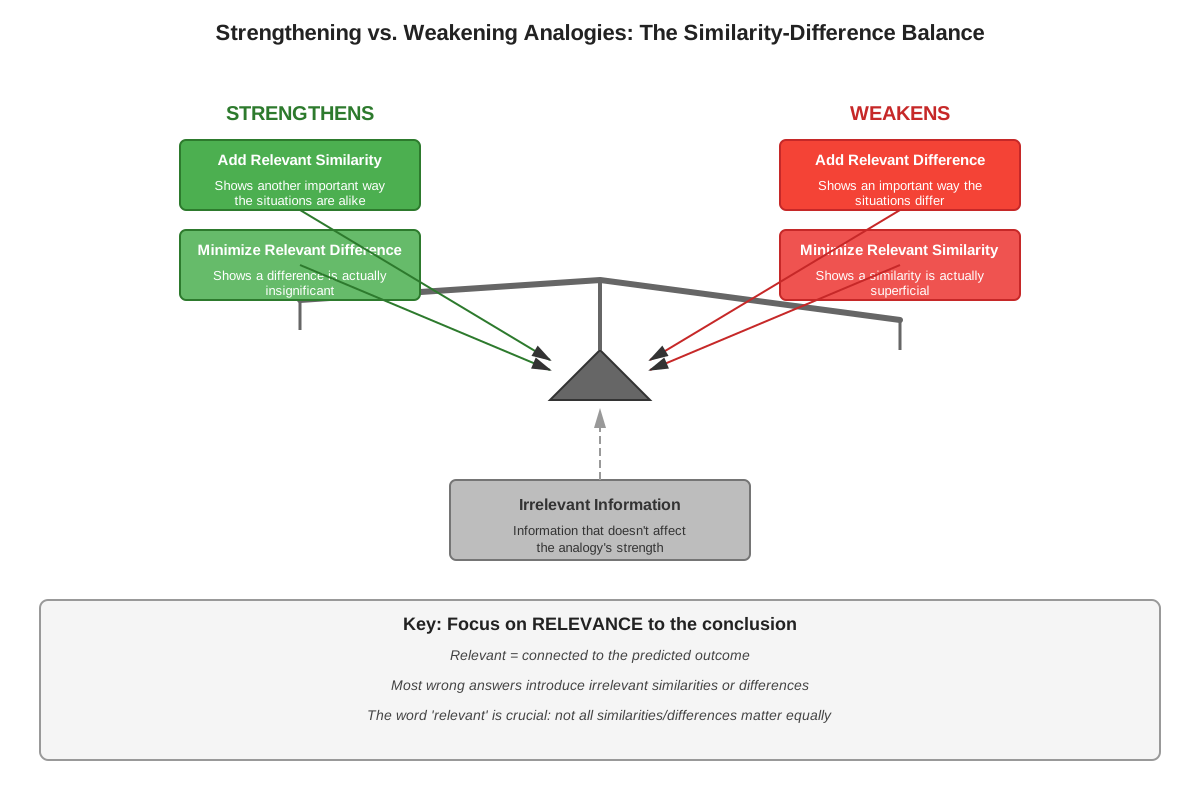
Strengthening analogies involves providing additional information that makes the comparison more compelling and the conclusion more likely to follow from the premises. There are three primary ways to strengthen an analogical argument:
1. Identifying Additional Relevant Similarities: The most direct way to strengthen an analogy is to show that the two cases share another characteristic that is relevant to the conclusion. If the argument compares two cities' bike-sharing programs, showing that both cities also have similar weather patterns (relevant because weather affects cycling) strengthens the analogy. The key word is "relevant"—the similarity must plausibly relate to the outcome being predicted.
2. Showing That Apparent Differences Are Irrelevant: Sometimes an analogy can be strengthened by demonstrating that a potential difference between the cases doesn't actually matter to the conclusion. If someone objects that City B has different architectural styles than City A, showing that architectural style doesn't affect bike-sharing success would strengthen the original analogy by eliminating a potential weakness.
3. Demonstrating That the Cited Similarities Are Causally Connected to the Outcome: Strengthening the link between the shared characteristics and the predicted outcome makes the analogy more powerful. If evidence shows that population density specifically causes bike-sharing programs to succeed (rather than just correlating with success), this strengthens any analogy based on similar population densities.
The Role of Relevance in Analogical Reasoning
Relevance is the critical concept that determines whether a similarity or difference matters to an analogical argument. Not all similarities strengthen an analogy, and not all differences weaken it. The test is whether the similarity or difference plausibly affects the likelihood of the conclusion being true.
Consider this comparison: "Medical School A has a high bar passage rate for its graduates. Medical School B has similar admission standards, faculty credentials, and curriculum to Medical School A. Therefore, Medical School B's graduates will likely have a high bar passage rate." This argument contains a fatal flaw—medical school graduates don't take the bar exam; law school graduates do. The similarities cited might be relevant to medical outcomes but are irrelevant to bar passage rates.
On the LSAT, wrong answers frequently exploit this concept by offering similarities that sound impressive but don't actually relate to the conclusion. Test-takers must constantly ask: "Does this similarity make it more likely that the conclusion will hold true?"
Distinguishing Strengthening from Weakening
Understanding what strengthens an analogy requires clarity about what would weaken it. An analogy is weakened by:
- Identifying relevant differences between the cases
- Showing that cited similarities are actually irrelevant to the conclusion
- Demonstrating that the outcome in Case A resulted from factors not present in Case B
The relationship between strengthening and weakening is inverse but not perfectly symmetrical. While showing a relevant difference weakens an analogy, showing the absence of that difference doesn't always strengthen it significantly—it merely removes a potential weakness. The strongest strengtheners actively add new relevant similarities rather than just defending against potential objections.
Common Patterns in LSAT Analogy Questions
LSAT strengthening analogies questions follow recognizable patterns that test-takers can learn to identify quickly:
| Pattern Type | Description | Example Context |
|---|---|---|
| Policy Implementation | Comparing how a policy worked in one jurisdiction to predict its effects in another | City, state, or national programs |
| Scientific Experiments | Comparing experimental results across different studies or contexts | Medical research, behavioral studies |
| Business Strategies | Comparing company decisions and their outcomes | Marketing campaigns, management approaches |
| Historical Precedent | Using past events to predict or explain current situations | Political movements, economic trends |
| Causal Mechanisms | Comparing situations where similar causes produced similar effects | Natural phenomena, social dynamics |
Each pattern requires the same analytical approach: identify what's being compared, determine what similarities are cited, understand what conclusion is drawn, and evaluate what additional information would make the comparison more compelling.
Concept Relationships
The concepts within strengthening analogies form an interconnected logical framework. At the foundation lies analogical argument structure, which provides the template for all such reasoning. This structure necessarily invokes the concept of relevance, which serves as the filter determining whether any given similarity or difference matters. Relevance, in turn, connects directly to causal reasoning—understanding whether shared characteristics actually influence outcomes makes it possible to evaluate which similarities are relevant.
The relationship can be mapped as: Analogical Argument Structure → requires assessment of → Relevance of Similarities/Differences → which depends on understanding → Causal or Correlational Relationships → which determines → Strength of the Analogy.
This topic connects to prerequisite knowledge of basic argument structure by applying those principles to a specific reasoning pattern. While all arguments have premises and conclusions, analogical arguments specifically use comparison as their primary inferential mechanism. The connection to general strengthen questions is that strengthening analogies represents a specialized application of the broader skill of identifying what makes conclusions more likely to be true.
Looking forward, mastering strengthening analogies builds skills essential for parallel reasoning questions, which require identifying structurally similar arguments, and flaw questions, which often involve recognizing when analogies fail due to relevant differences or irrelevant similarities. The comparative thinking developed here also enhances performance on Reading Comprehension questions that ask about the relationship between different viewpoints or the application of principles across contexts.
High-Yield Facts
⭐ Strengthening an analogy requires identifying additional relevant similarities between the compared cases, not just any similarities.
⭐ The most common correct answers show that the two cases share another characteristic that plausibly affects the predicted outcome.
⭐ Showing that an apparent difference is actually irrelevant to the conclusion strengthens an analogy by eliminating a potential weakness.
⭐ Not all similarities strengthen an analogy—only those relevant to the specific conclusion being drawn.
⭐ The strength of an analogy depends on both the number and the relevance of similarities, with relevance being more important than quantity.
- Wrong answers often cite similarities that are true but irrelevant to the conclusion being supported.
- Demonstrating that the cited similarities are causally connected to the outcome strengthens the analogy more than merely showing correlation.
- Analogical arguments are never deductively valid—they only make conclusions more or less probable.
- The absence of a relevant difference is less powerful than the presence of an additional relevant similarity.
- LSAT analogy questions frequently involve policy, business, or scientific contexts where outcomes depend on multiple factors.
- Strengthening an analogy does not require proving the conclusion true, only making it more likely given the premises.
- The best strengtheners address the specific mechanism or factor that would make the outcome in Case B similar to Case A.
- Temporal or geographical proximity between cases is rarely relevant unless the argument specifically depends on those factors.
Quick check — test yourself on Strengthening analogies so far.
Try Flashcards →Common Misconceptions
Misconception: Any similarity between two cases strengthens an analogy between them.
Correction: Only relevant similarities—those that plausibly affect the conclusion being drawn—strengthen an analogy. Two cities might both have rivers running through them, but this similarity is irrelevant to whether a tax policy that worked in one city will work in the other.
Misconception: Strengthening an analogy means proving the conclusion is definitely true.
Correction: Strengthening makes the conclusion more likely or more probable, but analogical arguments remain inductive reasoning that never guarantees their conclusions. The goal is to increase confidence in the conclusion, not to establish certainty.
Misconception: The more similarities cited, the stronger the analogy, regardless of what those similarities are.
Correction: Quality matters more than quantity. One highly relevant similarity (both cities have identical tax bases) strengthens an analogy about tax policy more than five irrelevant similarities (both have baseball teams, similar climates, same founding dates, etc.).
Misconception: Showing that two cases are different in some way always weakens an analogy between them.
Correction: Only relevant differences weaken analogies. If two medical treatments are being compared, the fact that they were developed in different decades is likely irrelevant to their effectiveness. Irrelevant differences don't affect the argument's strength.
Misconception: The correct answer will always introduce a new similarity not mentioned in the original argument.
Correction: While this is common, correct answers can also work by showing that a potential difference is irrelevant, by strengthening the causal connection between cited similarities and the outcome, or by eliminating alternative explanations for the outcome in Case A.
Misconception: If Case A and Case B are similar in most respects, the analogy is automatically strong.
Correction: The analogy's strength depends on whether they're similar in the respects that matter to the conclusion. Two restaurants might be similar in location, décor, and price range, but if one succeeds because of a celebrity chef and the other lacks this feature, the analogy predicting similar success is weak despite numerous other similarities.
Worked Examples
Example 1: Business Strategy Analogy
Argument: "Company X increased its market share by 15% after implementing a four-day workweek for its employees. Company Y operates in the same industry, has a similar employee demographic, and faces comparable competitive pressures. Therefore, Company Y should implement a four-day workweek to increase its market share."
Question: Which of the following, if true, most strengthens the argument?
Answer Choices:
(A) Company X and Company Y both have headquarters in urban areas.
(B) The increased market share at Company X resulted primarily from improved employee productivity and morale, which are strongly linked to work schedule flexibility.
(C) Company Y has been considering various strategies to increase its market share.
(D) Several other companies in different industries have also implemented four-day workweeks.
(E) Company X's CEO has publicly advocated for work-life balance initiatives.
Analysis:
First, identify the analogical structure:
- Case A (Company X): Four-day workweek → 15% market share increase
- Cited similarities: Same industry, similar employee demographic, comparable competitive pressures
- Conclusion: Case B (Company Y) should expect similar results from a four-day workweek
To strengthen this analogy, we need information that makes it more likely that Company Y will experience the same outcome as Company X. The key question is: what additional relevant similarity or causal connection would make this comparison more compelling?
(A) Both having headquarters in urban areas is a similarity, but is it relevant to whether a four-day workweek will increase market share? This seems unlikely to affect the causal mechanism. Eliminate.
(B) This answer does two powerful things: it identifies the causal mechanism (improved productivity and morale) and links it to work schedule flexibility. This strengthens the analogy because it shows that the four-day workweek wasn't just correlated with increased market share—it caused it through a specific mechanism. Moreover, since Company Y has similar employee demographics, this mechanism should work similarly there. Strong candidate.
(C) That Company Y is considering various strategies tells us nothing about whether the four-day workweek specifically will work. This doesn't add any relevant similarity or strengthen the comparison. Eliminate.
(D) Other companies in different industries implementing four-day workweeks doesn't strengthen the specific comparison between Company X and Company Y. The argument already established they're in the same industry, which is more relevant than what happens in different industries. Eliminate.
(E) The CEO's advocacy tells us about Company X's leadership values but doesn't strengthen the prediction about Company Y's outcomes. This is background information about Case A only, not a comparison. Eliminate.
Correct Answer: (B)
This example demonstrates the learning objective of applying strengthening analogies to solve problems accurately. The correct answer strengthens by clarifying the causal mechanism and showing it's relevant to both companies.
Example 2: Policy Implementation Analogy
Argument: "When Country A implemented mandatory financial literacy courses in high schools, consumer debt levels among young adults decreased by 20% over five years. Country B has similar economic conditions and educational infrastructure to Country A. Therefore, Country B should implement mandatory financial literacy courses to reduce consumer debt among its young adults."
Question: Which of the following, if true, most strengthens the argument?
Answer Choices:
(A) Country A and Country B have similar rates of college enrollment among high school graduates.
(B) In Country A, the decrease in consumer debt was observed specifically among individuals who completed the financial literacy courses, while debt levels remained stable among those who graduated before the requirement was implemented.
(C) Country B's government has expressed interest in educational reforms.
(D) Financial literacy courses in Country A covered topics including budgeting, credit management, and investment basics.
(E) Country A and Country B both have similar average household incomes.
Analysis:
The analogical structure:
- Case A (Country A): Mandatory financial literacy courses → 20% decrease in young adult consumer debt
- Cited similarities: Similar economic conditions, similar educational infrastructure
- Conclusion: Case B (Country B) will achieve similar debt reduction
The argument assumes the financial literacy courses caused the debt reduction. What would strengthen this comparison?
(A) Similar college enrollment rates might be somewhat relevant to educational outcomes generally, but the argument is specifically about high school financial literacy courses and their effect on debt. This similarity doesn't directly connect to the causal mechanism. Weak.
(B) This is powerful evidence that the financial literacy courses specifically caused the debt reduction in Country A, rather than the reduction being due to other factors during that five-year period. By showing that only those who took the courses experienced reduced debt, this eliminates alternative explanations and strengthens the causal link. If the courses caused the effect in Country A, and Country B is similar, the analogy becomes much stronger. Strong candidate.
(C) The government's interest in reform doesn't strengthen the prediction about outcomes. This addresses willingness to implement but not likely effectiveness. Eliminate.
(D) Knowing what topics were covered in Country A's courses is descriptive information about Case A but doesn't strengthen the comparison to Country B unless we know Country B would cover the same topics. This doesn't add a relevant similarity. Eliminate.
(E) Similar average household incomes is a relevant similarity for economic conditions, which the argument already stated were similar. This is somewhat redundant and doesn't add much new strength to the analogy. Weak.
Correct Answer: (B)
This example illustrates how strengthening an analogy often involves confirming the causal relationship in Case A, which then makes the prediction about Case B more reliable. The correct answer eliminates alternative explanations for the outcome in Country A, thereby strengthening the inference that the same intervention will produce similar results in Country B.
Exam Strategy
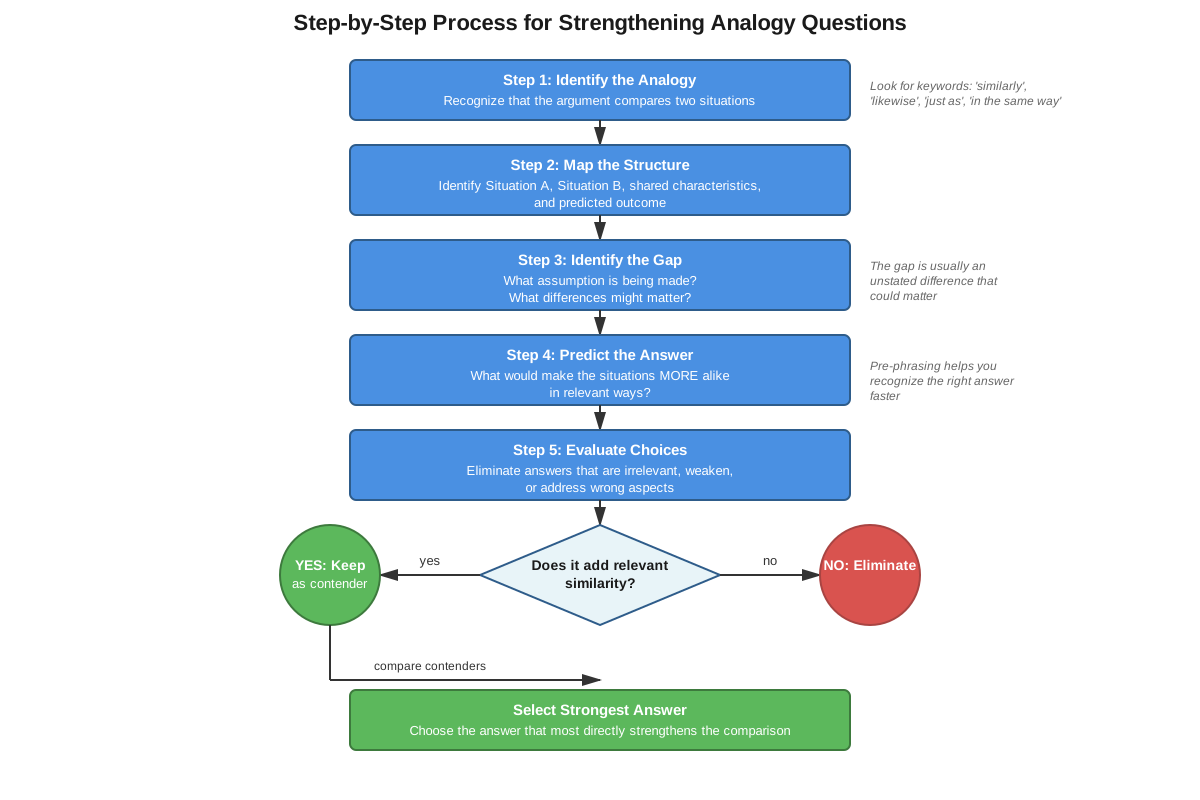
When approaching strengthen and weaken questions involving analogies on the LSAT, employ this systematic process:
Step 1: Identify the Analogy Structure (10-15 seconds)
Quickly map out what's being compared to what, what similarities are cited, and what conclusion is drawn. Look for comparison language like "similarly," "likewise," "just as," or explicit statements that two cases share characteristics.
Step 2: Determine What's Relevant (5-10 seconds)
Ask yourself: "What factors would actually affect whether the conclusion holds true?" This helps you predict what kind of information would strengthen the analogy before looking at answer choices.
Step 3: Evaluate Each Answer Choice (30-40 seconds total)
For each option, ask three questions:
- Does this provide a relevant similarity or show a difference is irrelevant?
- Does this connect to the specific outcome being predicted?
- Does this address both cases or only one?
Trigger Words and Phrases to Watch For:
In question stems:
- "Most strengthens the analogy"
- "Most supports the comparison"
- "Most justifies the reasoning by analogy"
- "Provides the most support for applying the principle"
In arguments:
- "Similarly," "likewise," "in the same way"
- "Just as... so too..."
- "Comparable," "analogous," "parallel"
- References to precedent or past cases
Process of Elimination Tips:
Eliminate answers that:
- Introduce similarities that are clearly irrelevant to the conclusion (different but unrelated characteristics)
- Address only one case without making a comparison
- Weaken rather than strengthen (show relevant differences)
- Are too vague to establish a clear connection to the outcome
- Confuse correlation with causation without strengthening the causal link
Time Allocation:
Spend approximately 1:20-1:30 on strengthening analogy questions. They require careful analysis but shouldn't consume excessive time. If you're stuck between two answers, choose the one that more directly addresses the causal mechanism or adds a similarity most relevant to the specific conclusion.
Exam Tip: The correct answer will almost always make you think, "Yes, that makes the comparison more convincing because it shows they're similar in a way that matters to this specific outcome." If you're thinking, "That's true, but so what?"—it's probably not the right answer.
Memory Techniques
R-A-S-P Mnemonic for Evaluating Analogies:
- Relevance: Is the similarity relevant to the conclusion?
- Additional: Does it add a new similarity not already mentioned?
- Specific: Does it specifically address the outcome being predicted?
- Plausible: Is there a plausible connection between the similarity and the conclusion?
The "Bridge" Visualization:
Picture an analogy as a bridge connecting two islands (Case A and Case B). Each relevant similarity is a support beam. Strengthening the analogy means either adding more support beams (new relevant similarities) or reinforcing existing beams (showing cited similarities are causally connected to the outcome). Irrelevant similarities are decorative flags—they might make the bridge look more similar to other bridges, but they don't make it stronger.
The "Recipe" Analogy:
Think of analogical arguments like claiming two recipes will produce similar results. Strengthening the analogy is like showing the recipes share another key ingredient (relevant similarity) or that the shared ingredients are the ones that actually determine the dish's flavor (causal connection). Showing they both use the same brand of measuring cups (irrelevant similarity) doesn't strengthen the prediction that they'll taste similar.
S-T-R-O-N-G Acronym for Correct Answers:
- Similarity that's new
- Tied to the outcome
- Relevant to both cases
- Obviously connected
- Not just descriptive
- Genuinely strengthening
Summary
Strengthening analogies on the LSAT requires understanding that analogical arguments claim two cases will have similar outcomes because they share relevant characteristics. The strength of such arguments depends entirely on whether the cited similarities actually relate to the predicted outcome and whether any differences are significant enough to undermine the comparison. To strengthen an analogy, test-takers must identify answer choices that add relevant similarities, show that apparent differences don't matter, or demonstrate that the cited similarities are causally connected to the outcome. The key analytical skill is distinguishing relevant from irrelevant information—not all similarities strengthen an analogy, only those that plausibly affect the conclusion. Success on these questions requires systematic analysis: identify what's being compared, determine what factors would actually influence the outcome, and evaluate whether each answer choice makes the comparison more compelling in a way that matters to the specific conclusion being drawn.
Key Takeaways
- Strengthening analogies means making the comparison between two cases more compelling by showing they're similar in ways that matter to the conclusion
- Relevance is everything—only similarities that plausibly affect the predicted outcome strengthen an analogy
- The most common correct answers identify additional relevant similarities or demonstrate that cited similarities are causally connected to the outcome
- Not all similarities are created equal; one highly relevant similarity strengthens more than multiple irrelevant ones
- Showing that an apparent difference is irrelevant can strengthen an analogy by eliminating a potential weakness
- Wrong answers often introduce true but irrelevant similarities or address only one case without making a comparison
- Systematic analysis (identify structure → determine relevance → evaluate choices) leads to consistent accuracy on these questions
Related Topics
Weakening Analogies: The inverse skill of identifying what undermines analogical arguments by showing relevant differences or irrelevant similarities. Mastering strengthening analogies provides the foundation for quickly recognizing what weakens them.
Parallel Reasoning Questions: These require identifying arguments with similar logical structures, building on the comparative analysis skills developed through analogy questions.
Necessary Assumption Questions: Often involve analogies where the assumption is that the cases are similar in relevant respects, connecting assumption identification to analogy evaluation.
Causal Reasoning: Understanding cause-and-effect relationships is essential for evaluating whether similarities between cases are relevant to predicted outcomes, making this a natural progression from analogy work.
Flaw Questions Involving False Analogies: Recognizing when analogies fail due to relevant differences or irrelevant similarities represents an advanced application of the principles learned here.
Practice CTA
Now that you've mastered the conceptual framework for strengthening analogies, it's time to apply these skills to actual LSAT questions. Work through the practice questions systematically, using the R-A-S-P framework to evaluate each answer choice. Pay special attention to why wrong answers fail—understanding common traps will sharpen your ability to identify correct answers quickly. The flashcards will help reinforce the key distinctions between relevant and irrelevant similarities. Remember: every practice question is an opportunity to refine your analytical process and build the confidence you need for test day. You've got this!
Sign up free to keep reading
Create a free AnvayaPrep account to finish this LSAT guide on Strengthening analogies — plus flashcards and practice questions.