Overview
Weakening causal arguments represents one of the most frequently tested skills in LSAT Logical Reasoning sections. Causal reasoning pervades everyday thinking and legal analysis, making it a prime target for test makers who want to assess critical thinking abilities. When an LSAT question asks you to weaken an argument that establishes a cause-and-effect relationship, you must identify vulnerabilities in the logical connection between the alleged cause and its purported effect.
The LSAT tests your ability to recognize that correlation does not necessarily imply causation, and that even when causation exists, alternative explanations may be equally or more plausible. LSAT weakening causal arguments questions require you to understand the structure of causal claims and the specific ways these claims can be undermined. These questions typically present an argument concluding that X causes Y, then ask you to select the answer choice that most weakens this causal claim. Success requires recognizing the standard vulnerabilities in causal reasoning: reverse causation, common cause scenarios, coincidence, and alternative explanations.
Within the broader category of strengthen and weaken questions, causal arguments occupy a special position because they follow predictable patterns. Unlike other argument types that may require highly specific domain knowledge, causal arguments can be systematically analyzed using a consistent framework. Mastering this topic provides a foundation for understanding how evidence relates to conclusions throughout Logical Reasoning, and the skills developed here transfer directly to Reading Comprehension passages that present causal theories and to Analytical Reasoning scenarios involving conditional relationships.
Learning Objectives
- [ ] Identify how Weakening causal arguments appears in LSAT questions
- [ ] Explain the reasoning pattern behind Weakening causal arguments
- [ ] Apply Weakening causal arguments to solve LSAT-style problems accurately
- [ ] Distinguish between different types of causal weakeners (reverse causation, common cause, coincidence, alternative cause)
- [ ] Recognize the structural indicators of causal claims in argument stems
- [ ] Evaluate answer choices systematically to identify the most effective weakener
- [ ] Predict common weakening strategies before reviewing answer choices
Prerequisites
- Basic argument structure: Understanding premises, conclusions, and how evidence supports claims is essential because causal arguments are a specific type of argument structure
- Correlation vs. causation distinction: Recognizing that two events occurring together does not prove one causes the other provides the foundation for identifying causal reasoning flaws
- Conditional reasoning fundamentals: Understanding if-then relationships helps distinguish between necessary/sufficient conditions and causal relationships
- Question stem identification: Knowing how to recognize weaken questions ensures proper approach and answer choice evaluation
Why This Topic Matters
Causal reasoning appears in virtually every domain of human inquiry—from medical research determining whether a drug causes side effects, to legal cases establishing whether negligence caused harm, to policy debates about whether regulations cause economic effects. The ability to critically evaluate causal claims is fundamental to legal practice, where attorneys must challenge opposing theories of causation and establish their own causal narratives. This makes causal reasoning a high-priority testing area for law school admissions.
On the LSAT, weakening causal arguments appears in approximately 15-20% of all Logical Reasoning questions, making it one of the most frequently tested specific argument types. These questions appear in both Logical Reasoning sections, meaning students typically encounter 6-8 causal weakening questions per test. The questions range from straightforward identification of alternative causes to complex scenarios requiring recognition of reverse causation or common cause relationships.
Causal arguments appear in LSAT questions through several common formats: scientific studies claiming one variable causes another, historical analyses attributing effects to specific causes, business scenarios linking policies to outcomes, and social science arguments connecting behaviors to consequences. The test makers favor scenarios where the causal connection seems initially plausible but contains exploitable logical gaps. Questions may present survey data, observational studies, expert opinions, or anecdotal evidence as the basis for causal claims, then ask you to identify information that would undermine the causal inference.
Core Concepts
The Structure of Causal Arguments
A causal argument asserts that one phenomenon (the cause) brings about or produces another phenomenon (the effect). The basic structure follows this pattern: "X causes Y" or "X is responsible for Y" or "Y occurs because of X." On the LSAT, causal arguments rarely state the relationship this explicitly. Instead, they use causal language markers such as "leads to," "results in," "produces," "brings about," "is responsible for," "explains why," "accounts for," or "is the reason for."
The critical feature distinguishing causal arguments from mere correlational observations is the claim of a productive or generative relationship. The argument asserts not just that X and Y occur together, but that X actively produces Y through some mechanism. This distinction matters because the strategies for weakening causal arguments specifically target this claimed productive relationship.
The Four Primary Weakening Strategies
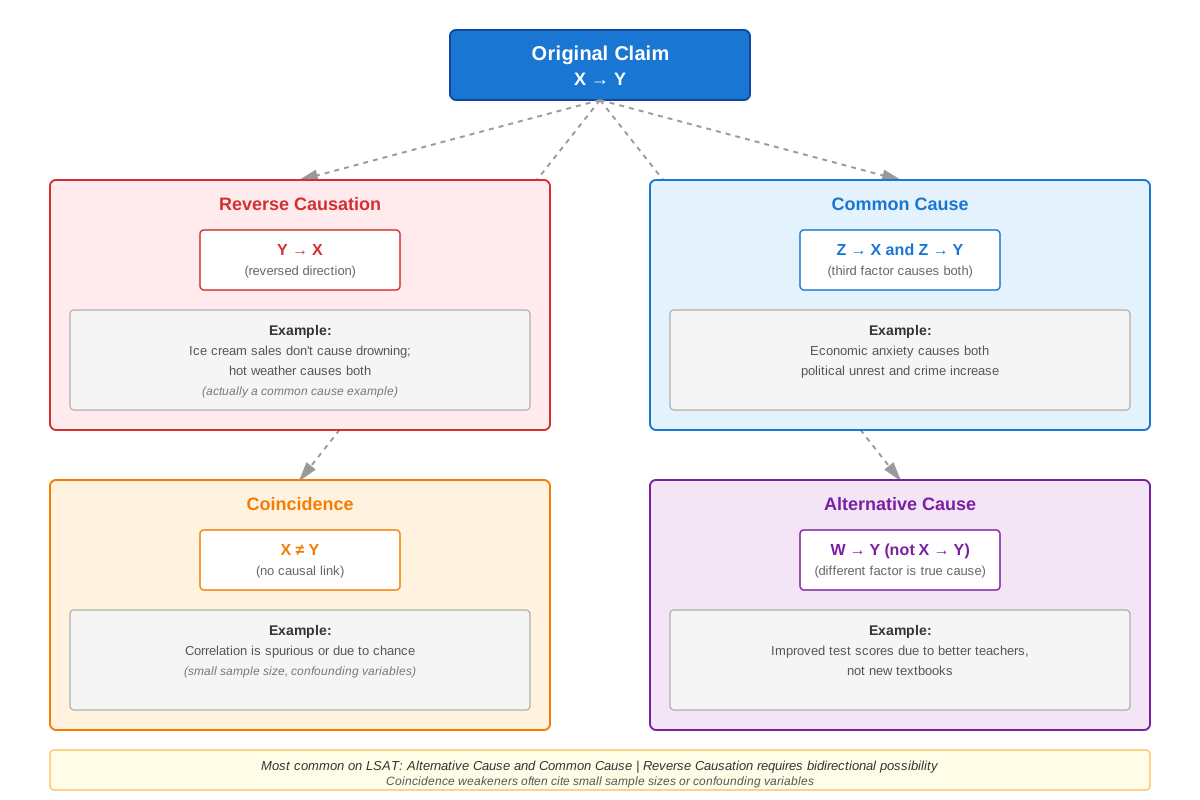
When approaching lsat weakening causal arguments, four main strategies consistently appear:
| Weakening Strategy | Description | Example Pattern |
|---|---|---|
| Alternative Cause | Suggests a different factor actually causes the effect | "Actually, Z causes Y, not X" |
| Reverse Causation | Proposes the effect actually causes the supposed cause | "Y causes X, not the other way around" |
| Common Cause | Identifies a third factor causing both the alleged cause and effect | "W causes both X and Y" |
| Coincidence/Correlation Without Causation | Shows the relationship is merely coincidental or correlational | "X and Y occur together by chance" |
Alternative cause weakeners introduce a different explanation for the observed effect. If an argument claims that increased advertising (X) caused increased sales (Y), an alternative cause weakener might suggest that a competitor went out of business during the same period, making this the true cause of increased sales. This strategy is the most common on the LSAT because it directly challenges the causal claim while accepting that the effect occurred.
Reverse causation weakeners flip the causal arrow, suggesting that what the argument identifies as the effect actually causes what the argument identifies as the cause. If an argument claims that job satisfaction causes high productivity, a reverse causation weakener would suggest that high productivity leads to job satisfaction (perhaps because productive workers receive more recognition). This strategy is particularly effective when both variables are present and the temporal sequence is ambiguous.
Common cause weakeners introduce a third factor that causes both the alleged cause and the alleged effect, explaining their correlation without accepting the proposed causal relationship. If an argument claims that coffee consumption causes heart disease, a common cause weakener might suggest that stress causes both increased coffee consumption and heart disease. This strategy explains the observed correlation while denying the direct causal link.
Coincidence weakeners suggest that the correlation between the alleged cause and effect is merely accidental or due to chance rather than any causal mechanism. These weakeners are less common on the LSAT because they typically require additional evidence (such as statistical analysis) to be compelling.
Identifying Causal Arguments in Question Stems
Before you can weaken a causal argument, you must recognize that the argument makes a causal claim. LSAT arguments signal causal reasoning through specific linguistic markers:
- Explicit causal verbs: causes, produces, brings about, generates, creates, leads to, results in, gives rise to
- Explanatory language: explains, accounts for, is responsible for, is the reason for, is due to
- Consequential phrasing: consequently, as a result, therefore (when connecting cause to effect)
- Conditional causal claims: "If X, then Y will result" (combining conditional and causal reasoning)
The conclusion of a causal argument typically appears in one of these forms, though the causal claim may also appear in a premise that the question asks you to weaken. Recognizing these markers allows you to immediately activate your causal reasoning framework and anticipate the types of weakeners that will appear in the answer choices.
The Temporal Sequence Requirement
A fundamental principle of causation is that causes must precede their effects in time. This temporal sequence requirement creates a specific vulnerability in causal arguments: if evidence shows that the alleged effect occurred before the alleged cause, the causal claim is definitively refuted. While this represents the strongest possible weakener, it appears relatively rarely on the LSAT because it completely destroys rather than merely weakens the argument.
More commonly, LSAT questions exploit ambiguity about temporal sequence. When an argument observes that X and Y occur together and concludes that X causes Y, a weakener might reveal that the temporal relationship is unclear or that Y actually preceded X. This ambiguity opens the door for reverse causation weakeners.
Correlation as Evidence for Causation
Most LSAT causal arguments begin with correlational evidence—observations that two phenomena occur together—then leap to a causal conclusion. The argument structure typically follows this pattern:
- Premise: X and Y are correlated (when X is present, Y is present; when X is absent, Y is absent)
- Conclusion: Therefore, X causes Y
This inferential leap from correlation to causation creates the logical gap that weakening answer choices exploit. Strong causal arguments provide additional evidence beyond mere correlation: they establish temporal sequence, rule out alternative explanations, identify a plausible mechanism, or demonstrate that manipulating the cause changes the effect. Weak causal arguments rely solely on correlation, making them highly vulnerable to the weakening strategies described above.
Mechanism and Plausibility
Some causal arguments strengthen their claims by proposing a mechanism—an explanation of how the cause produces the effect. For example, an argument might claim that "Exercise reduces stress by triggering endorphin release." The proposed mechanism (endorphin release) makes the causal claim more plausible. Weakeners can target either the causal claim itself or the proposed mechanism. An answer choice might suggest that exercise reduces stress through an entirely different mechanism, or that the proposed mechanism doesn't actually produce the claimed effect.
Concept Relationships
The concepts within weakening causal arguments form a hierarchical structure. At the foundation lies the ability to identify causal arguments through their linguistic markers and structural features. This identification skill enables the application of the four primary weakening strategies (alternative cause, reverse causation, common cause, and coincidence). Each strategy exploits a different vulnerability in the logical leap from correlation to causation.
The temporal sequence requirement connects to reverse causation weakeners—if causes must precede effects, then showing the effect preceded the cause reverses the causal arrow. Similarly, understanding that correlation does not imply causation (a prerequisite concept) directly enables recognition of common cause scenarios, where correlation exists but the proposed causal relationship does not.
These causal reasoning concepts connect to broader Logical Reasoning skills. The ability to identify alternative explanations (alternative cause weakeners) applies equally to non-causal arguments where you must weaken a conclusion by providing different reasons for the evidence. The skill of recognizing unstated assumptions helps identify the gap between correlational evidence and causal conclusions. Understanding conditional reasoning helps distinguish between "if X then Y" (conditional) and "X causes Y" (causal), preventing confusion between these related but distinct logical structures.
The relationship map flows as follows: Correlation observation → Causal inference → Logical gap → Weakening strategies (Alternative cause / Reverse causation / Common cause / Coincidence) → Answer choice evaluation → Correct response selection
High-Yield Facts
- ⭐ Causal arguments conclude that one phenomenon produces or brings about another, not merely that they occur together
- ⭐ Alternative cause weakeners introduce a different explanation for the observed effect while accepting that the effect occurred
- ⭐ Reverse causation weakeners flip the causal arrow, suggesting the alleged effect actually causes the alleged cause
- ⭐ Common cause weakeners introduce a third factor that causes both the alleged cause and the alleged effect
- ⭐ Temporal sequence is essential to causation—causes must precede their effects in time
- Causal language markers include "causes," "leads to," "results in," "produces," "brings about," "is responsible for," and "explains"
- Correlation between two variables does not establish that one causes the other
- The strongest causal arguments provide evidence beyond mere correlation, such as temporal sequence, mechanism, or experimental manipulation
- Coincidence weakeners suggest the observed correlation is accidental rather than causal
- Weakening a causal argument does not require proving the causal claim is false—only making it less likely to be true
- Multiple weakeners can apply to the same argument, but LSAT questions ask for the answer that weakens most or best
- Causal arguments can be weakened by showing the cause occurs without the effect or the effect occurs without the cause
- Proposed mechanisms can be targeted separately from the causal claim itself
- Confounding variables (factors that correlate with both cause and effect) create opportunities for common cause weakeners
Quick check — test yourself on Weakening causal arguments so far.
Try Flashcards →Common Misconceptions
Misconception: Any answer choice that provides an alternative explanation automatically weakens the argument most effectively.
Correction: Alternative explanations only weaken causal arguments if they provide a plausible alternative cause for the observed effect. Alternative explanations for unrelated aspects of the scenario do not weaken the causal claim. The alternative must directly compete with the proposed cause as an explanation for the specific effect in question.
Misconception: Reverse causation and common cause are the same thing because both involve different causal relationships than the one proposed.
Correction: Reverse causation maintains a direct causal link between the two variables but flips the direction (Y causes X instead of X causes Y). Common cause introduces a third variable (W) that causes both X and Y, denying any direct causal relationship between them. These are structurally distinct weakening strategies.
Misconception: Weakening a causal argument requires proving the causal claim is definitely false.
Correction: Weakening only requires making the conclusion less likely to be true or reducing confidence in the causal claim. Providing reasonable doubt about the causal relationship suffices; definitive refutation is not necessary and rarely appears on the LSAT.
Misconception: If two things are correlated, there must be some causal relationship between them, even if the proposed direction is wrong.
Correction: Correlation can exist without any causal relationship. Two variables may correlate due to coincidence, due to both being caused by a third factor (common cause), or due to both being effects of a complex system without directly causing each other. Correlation alone provides weak evidence for causation.
Misconception: Temporal sequence alone establishes causation—if X precedes Y, then X causes Y.
Correction: While causes must precede effects, precedence alone does not establish causation. Many events precede other events without causing them. Temporal sequence is necessary but not sufficient for causation. The rooster's crow precedes the sunrise, but does not cause it.
Misconception: Weakening answer choices must directly contradict information in the stimulus.
Correction: Effective weakeners typically introduce new information that undermines the logical connection between premises and conclusion. They rarely contradict stated facts; instead, they provide additional context, alternative explanations, or overlooked factors that reduce the argument's persuasive force.
Worked Examples
Example 1: Alternative Cause Weakener
Stimulus: "A recent study found that employees who work from home are 30% more productive than those who work in the office. This increased productivity is clearly caused by the elimination of commute-related stress, which allows remote workers to begin their workday more refreshed and focused."
Question: Which of the following, if true, most weakens the argument?
Analysis:
The argument structure identifies a correlation (remote work and increased productivity) and proposes a specific causal explanation (elimination of commute stress causes the productivity increase). The conclusion makes a causal claim: commute elimination → reduced stress → increased productivity.
To weaken this, we should look for:
- An alternative cause for the increased productivity
- Evidence that commute stress doesn't affect productivity
- Evidence that the proposed mechanism doesn't work as claimed
Strong Weakener: "The study compared employees who volunteered for remote work with those who preferred office work, and employees who volunteer for remote work tend to be more self-motivated and disciplined regardless of work location."
Why this works: This answer provides an alternative cause (self-motivation and discipline) for the observed effect (increased productivity). It suggests that the productivity difference existed before the work location change and is due to pre-existing personality traits rather than commute elimination. This directly competes with the argument's causal explanation while accepting the observed correlation.
Connection to learning objectives: This example demonstrates how to identify the causal claim (objective 1), recognize the reasoning pattern of inferring causation from correlation (objective 2), and apply the alternative cause weakening strategy (objective 3).
Example 2: Reverse Causation Weakener
Stimulus: "Data from the past decade shows that cities with higher rates of bicycle infrastructure development have experienced greater increases in cycling rates. Urban planners conclude that building bike lanes causes more people to choose cycling as their primary mode of transportation."
Question: Which of the following, if true, most seriously weakens the urban planners' conclusion?
Analysis:
The argument observes a correlation (bike infrastructure development and increased cycling rates) and concludes that infrastructure causes increased cycling. The causal claim is: bike lane construction → increased cycling rates.
The argument assumes the temporal and causal sequence flows from infrastructure to behavior. A reverse causation weakener would suggest that increased cycling interest leads to infrastructure development, not the other way around.
Strong Weakener: "Cities typically decide to invest in bicycle infrastructure only after surveys show that a significant portion of their population has expressed strong interest in cycling and has begun cycling despite inadequate infrastructure."
Why this works: This answer reverses the causal arrow. It suggests that increased cycling interest and behavior (Y) actually causes infrastructure development (X), rather than infrastructure (X) causing increased cycling (Y). The correlation remains, but the causal direction is flipped. Cities respond to existing demand rather than creating demand through infrastructure.
Alternative analysis: We might also consider a common cause weakener: "Cities that develop bicycle infrastructure and experience increased cycling rates are typically cities with growing environmental consciousness, which independently motivates both government infrastructure investment and individual transportation choices." This introduces environmental consciousness as a third factor causing both variables, but the reverse causation weakener more directly challenges the specific causal claim.
Connection to learning objectives: This example shows how to identify causal reasoning patterns (objective 2), distinguish between different weakening strategies (objective 4), and evaluate which weakener most effectively targets the specific causal claim (objective 6).
Exam Strategy
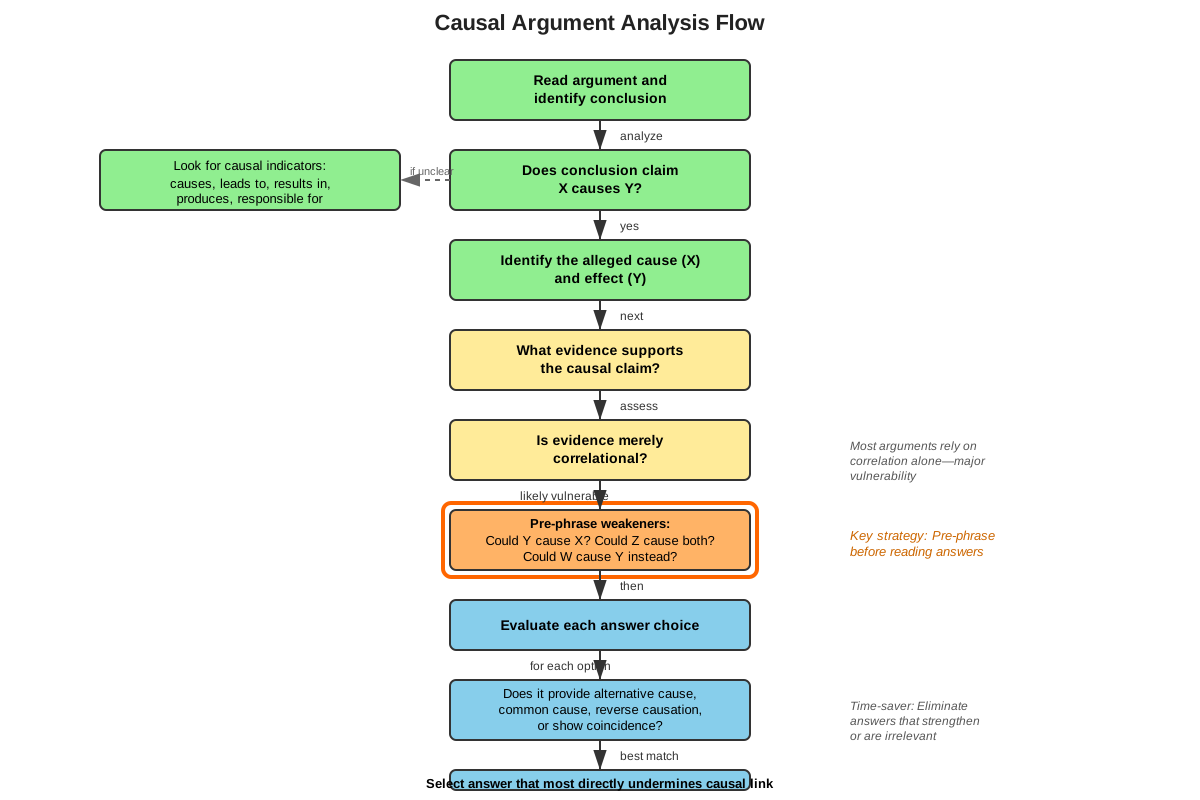
When approaching LSAT weakening causal arguments questions, follow this systematic process:
Step 1: Identify the causal claim (15-20 seconds)
Read the stimulus carefully and locate the conclusion. Look for causal language markers: "causes," "leads to," "results in," "is responsible for," "explains," "produces." Identify what the argument claims is the cause and what it claims is the effect. Write a simple notation: "X → Y" to represent the causal claim.
Step 2: Identify the evidence (10 seconds)
Determine what evidence the argument provides for the causal claim. Most commonly, this will be correlational evidence (X and Y occur together) or temporal evidence (X precedes Y). Recognize that the logical gap lies in the leap from this evidence to the causal conclusion.
Step 3: Predict weakening strategies (15-20 seconds)
Before looking at answer choices, mentally generate the four main weakening approaches:
- Alternative cause: "What else could cause Y?"
- Reverse causation: "Could Y cause X instead?"
- Common cause: "What third factor might cause both X and Y?"
- Mechanism challenge: "Does the proposed explanation actually work?"
Exam Tip: Spending 20 seconds predicting weakeners before reading answer choices dramatically improves accuracy and speed. You'll recognize correct answers immediately rather than being seduced by attractive wrong answers.
Step 4: Evaluate answer choices systematically (45-60 seconds)
For each answer choice, ask:
- Does this introduce new information relevant to the causal claim?
- Does this make the causal conclusion less likely to be true?
- Does this provide an alternative explanation for the observed effect?
- Does this challenge the logical connection between cause and effect?
Trigger words to watch for in answer choices:
- "Actually" (often signals alternative cause or reverse causation)
- "Instead" (suggests alternative explanation)
- "Also" or "Additionally" (may introduce common cause)
- "Before" or "Prior to" (may establish temporal sequence problems)
- "Regardless of" (may show effect occurs without the cause)
Process of elimination tips:
- Eliminate answer choices that strengthen rather than weaken (common trap)
- Eliminate answer choices that are irrelevant to the causal claim (may be relevant to other aspects of the stimulus but don't affect the cause-effect relationship)
- Eliminate answer choices that weaken a different claim than the one identified in Step 1
- Eliminate answer choices that merely restate information from the stimulus without adding new information
- Between two seemingly good weakeners, choose the one that more directly challenges the specific causal mechanism or provides a more complete alternative explanation
Time allocation:
Allocate approximately 90 seconds total for causal weakening questions: 45 seconds for reading and analysis (Steps 1-3), 45 seconds for answer choice evaluation (Step 4). These questions reward careful initial analysis, so don't rush the stimulus reading. However, if you've correctly identified the causal claim and predicted weakeners, answer choice evaluation should proceed quickly.
Common trap answers:
- Strengtheners disguised as weakeners (read carefully to determine whether new information supports or undermines the causal claim)
- Irrelevant information that seems related to the topic but doesn't affect the causal relationship
- Weakeners that target a premise rather than the conclusion
- Answer choices that weaken a different causal claim than the one in the conclusion
- Answer choices that show the cause or effect is less common than thought (this may be interesting but doesn't weaken the causal relationship when it does occur)
Memory Techniques
RACE mnemonic for the four primary weakening strategies:
- Reverse causation (flip the arrow)
- Alternative cause (different explanation)
- Common cause (third factor causes both)
- Eliminate the connection (coincidence/correlation only)
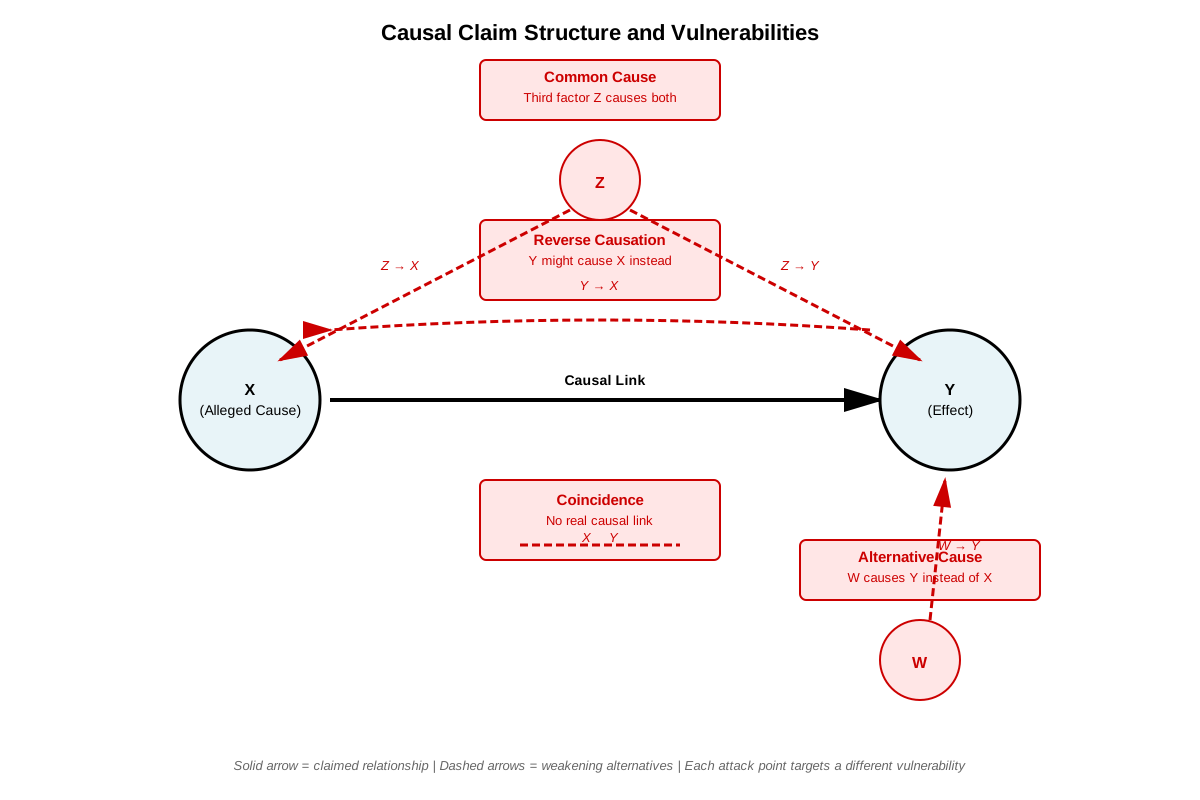
Visualization strategy: Picture a causal argument as an arrow pointing from cause to effect (X → Y). Visualize each weakening strategy:
- Alternative cause: Draw a second arrow from a different source (Z → Y)
- Reverse causation: Flip the arrow (Y → X)
- Common cause: Draw a third factor above with arrows pointing down to both (W → X and W → Y)
- Coincidence: Draw X and Y side by side with no arrow, just a question mark between them
Causal language marker acronym - PRELEP:
- Produces
- Results in
- Explains
- Leads to
- Effects (brings about)
- Prompts
When you see these words, immediately activate your causal reasoning framework.
The "Third Factor" reminder: When you see a correlation, always ask "What third factor might explain both?" This automatically generates common cause weakeners and prevents premature acceptance of causal claims.
Summary
Weakening causal arguments requires understanding that LSAT arguments frequently leap from correlational evidence to causal conclusions, creating logical gaps that answer choices exploit. The four primary weakening strategies—alternative cause, reverse causation, common cause, and coincidence—each target different vulnerabilities in causal reasoning. Alternative cause weakeners provide different explanations for the observed effect; reverse causation weakeners flip the causal arrow; common cause weakeners introduce third factors that cause both variables; and coincidence weakeners suggest the correlation is accidental. Success on these questions depends on quickly identifying causal claims through language markers, recognizing the evidence-to-conclusion gap, predicting likely weakening strategies before reviewing answer choices, and systematically evaluating options to find the one that most effectively undermines the causal relationship. These questions appear frequently on the LSAT (15-20% of Logical Reasoning questions), making mastery essential for achieving a competitive score. The skills developed through practicing causal argument analysis transfer broadly to legal reasoning and critical thinking.
Key Takeaways
- Causal arguments claim one phenomenon produces another, not merely that they correlate; identify these claims through markers like "causes," "leads to," "results in," and "is responsible for"
- The four primary weakening strategies are alternative cause, reverse causation, common cause, and coincidence—memorize these and predict which might appear before reading answer choices
- Alternative cause weakeners (most common) provide different explanations for the observed effect while accepting the effect occurred
- Reverse causation weakeners flip the causal arrow, suggesting the alleged effect actually causes the alleged cause
- Common cause weakeners introduce third factors that cause both the alleged cause and effect, explaining correlation without accepting direct causation
- Correlation does not imply causation—most LSAT causal arguments rely on correlational evidence and make an inferential leap to causal conclusions
- Weakening requires only making the conclusion less likely, not proving it false; reasonable doubt suffices
Related Topics
Strengthening causal arguments: After mastering weakening strategies, study how to strengthen causal claims by providing additional evidence for the causal relationship, ruling out alternative explanations, establishing temporal sequence, or demonstrating mechanism. Strengthening is the mirror image of weakening—understanding one deepens mastery of the other.
Necessary and sufficient assumptions in causal arguments: Causal arguments rest on assumptions that can be tested through Necessary Assumption and Sufficient Assumption questions. Understanding what must be true for a causal claim to hold (necessary assumptions) and what would guarantee the causal claim (sufficient assumptions) builds on the foundation established here.
Flaw questions involving causal reasoning: Many Flaw questions ask you to identify errors in causal reasoning, such as "confuses correlation with causation" or "fails to consider alternative explanations." Mastering weakening strategies prepares you to recognize and articulate these logical flaws.
Method of Agreement and Method of Difference: These formal logical principles for establishing causation appear in more complex LSAT arguments. Understanding how controlled comparisons strengthen or weaken causal claims represents an advanced application of the concepts covered here.
Practice CTA
Now that you understand the framework for weakening causal arguments, it's time to apply these concepts to actual LSAT questions. The practice questions and flashcards will reinforce your ability to quickly identify causal claims, predict weakening strategies, and select the most effective weakener from among the answer choices. Remember that mastery comes through repeated application—each practice question strengthens your pattern recognition and speeds your analysis. Approach the practice materials systematically, using the RACE mnemonic and the step-by-step strategy outlined above. You're building one of the most valuable skills for LSAT success and legal reasoning. Start practicing now to transform these concepts into automatic, test-day-ready skills!
Sign up free to keep reading
Create a free AnvayaPrep account to finish this LSAT guide on Weakening causal arguments — plus flashcards and practice questions.