Overview
Strengthening causal arguments represents one of the most frequently tested reasoning patterns on the LSAT Logical Reasoning section. These questions require test-takers to identify answer choices that make a causal claim more likely to be true by addressing potential weaknesses in the argument's reasoning structure. Understanding how to strengthen causal arguments is essential because approximately 15-20% of all Logical Reasoning questions involve either strengthening or weakening arguments, with causal reasoning appearing in roughly half of these questions.
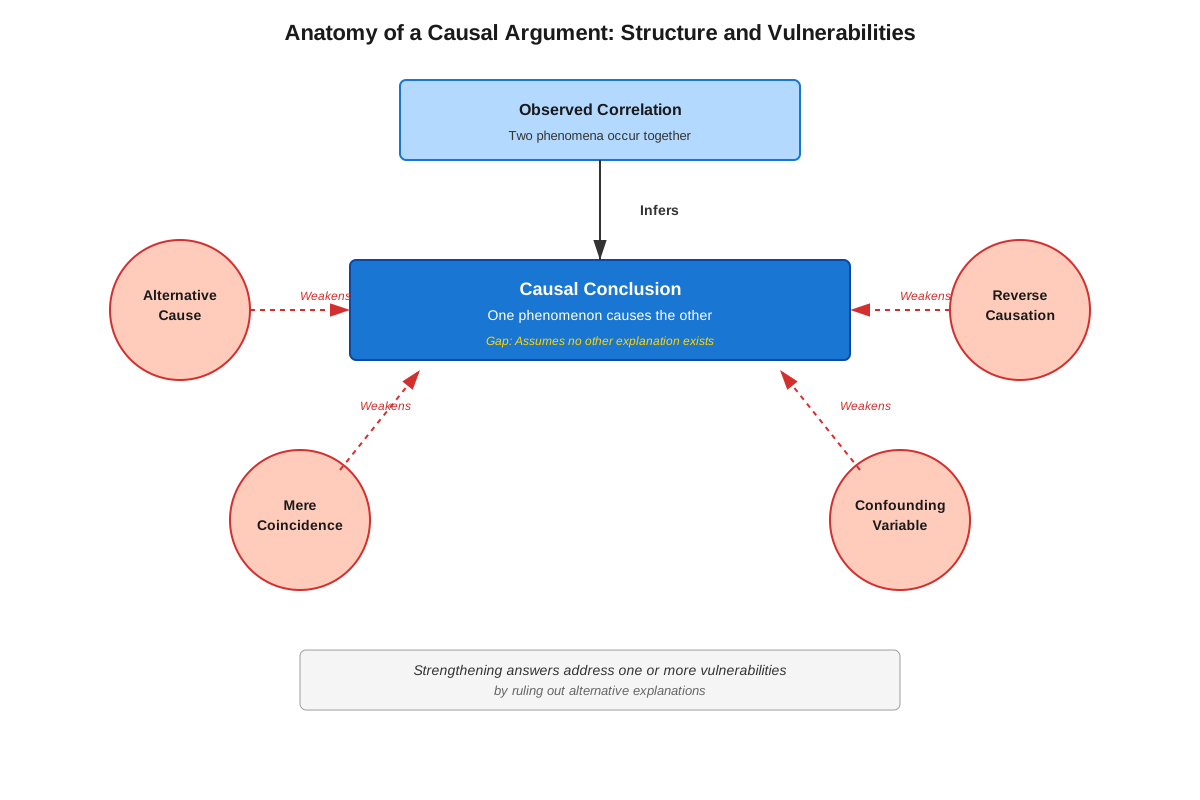
Causal arguments on the LSAT typically follow a pattern where the author observes a correlation between two phenomena and concludes that one causes the other. The fundamental challenge lies in recognizing that correlation does not automatically establish causation—there are always alternative explanations that could account for the observed relationship. When asked to strengthen such arguments, students must identify information that eliminates alternative explanations, establishes the proper temporal sequence, demonstrates a mechanism linking cause and effect, or rules out the possibility of reverse causation.
Within the broader landscape of Logical Reasoning, strengthen and weaken questions form a critical category that tests analytical thinking skills essential for legal reasoning. Strengthening causal arguments specifically connects to fundamental concepts of evidence evaluation, argument structure analysis, and critical thinking. Mastery of this topic provides the foundation for understanding how legal arguments are constructed and defended, making it directly relevant to the skills tested throughout the LSAT and required in law school.
Learning Objectives
- [ ] Identify how strengthening causal arguments appears in LSAT questions
- [ ] Explain the reasoning pattern behind strengthening causal arguments
- [ ] Apply strengthening causal arguments to solve LSAT-style problems accurately
- [ ] Distinguish between different types of causal vulnerabilities in arguments
- [ ] Evaluate answer choices to determine which most effectively addresses the specific weakness in a causal claim
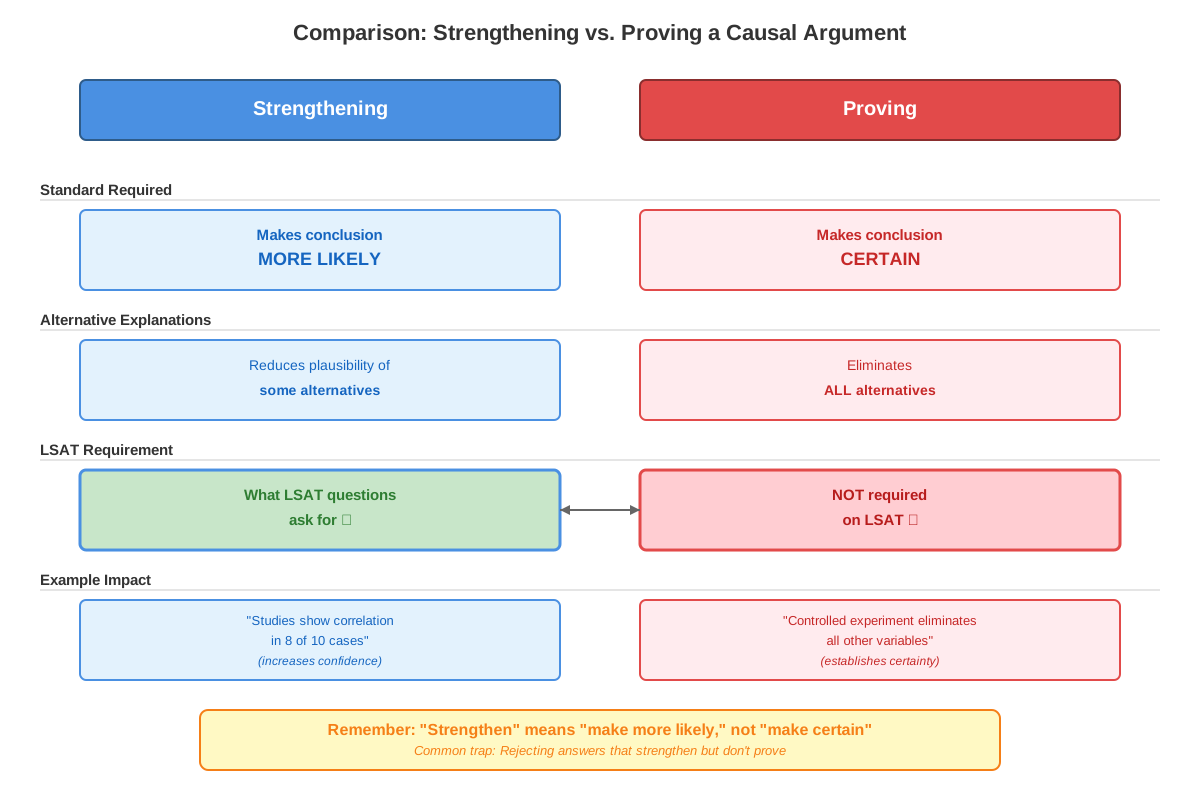
- [ ] Recognize the difference between strengthening a causal argument and proving it conclusively
- [ ] Identify common wrong answer patterns in causal strengthening questions
Prerequisites
- Basic argument structure: Understanding premises, conclusions, and how they connect is essential because strengthening questions require identifying what the argument claims before determining how to support it
- Correlation versus causation: Recognizing that two events occurring together does not prove one causes the other provides the foundation for understanding why causal arguments need strengthening
- Conditional reasoning: Familiarity with sufficient and necessary conditions helps in understanding causal mechanisms and how they can be supported
- Argument analysis skills: The ability to identify assumptions and gaps in reasoning is crucial because strengthening answers typically address these unstated assumptions
Why This Topic Matters
In real-world contexts, causal reasoning underlies policy decisions, scientific research, legal arguments, and everyday decision-making. Lawyers must constantly evaluate whether evidence truly supports causal claims—did the defendant's actions cause the plaintiff's injuries? Did a company's negligence cause environmental damage? The ability to strengthen or challenge causal arguments is fundamental to legal practice, making this topic directly relevant to the skills law schools seek in applicants.
On the LSAT, lsat strengthening causal arguments questions appear with remarkable frequency. Approximately 8-12 questions per test involve strengthening or weakening arguments, and causal reasoning appears in roughly 40-50% of these questions. This translates to 4-6 questions per LSAT that directly test understanding of causal argument structure. Given that each question represents approximately one point on a 180-point scale, mastery of this topic can significantly impact overall scores.
These questions typically appear in several formats: direct "Which one of the following, if true, most strengthens the argument?" questions, "Which one provides the most support for the conclusion?" variations, and occasionally in more subtle forms where strengthening is implied rather than explicitly stated. The arguments themselves often involve scientific studies, policy proposals, historical explanations, or business decisions—any context where one phenomenon is claimed to cause another.
Core Concepts
Understanding Causal Arguments
A causal argument claims that one phenomenon (the cause) brings about or produces another phenomenon (the effect). On the LSAT, these arguments typically present evidence of correlation—two things happening together or in sequence—and conclude that one causes the other. The basic structure follows this pattern:
- Observation: X and Y occur together, or X precedes Y
- Conclusion: Therefore, X causes Y
The fundamental vulnerability in causal arguments stems from the logical gap between correlation and causation. Multiple alternative explanations can account for an observed correlation without a true causal relationship existing.
The Five Major Causal Vulnerabilities
Understanding what weakens causal arguments reveals what strengthens them. Every causal argument on the LSAT is vulnerable to at least one of these five challenges:
| Vulnerability Type | Description | Example |
|---|---|---|
| Reverse Causation | The claimed effect actually causes the claimed cause | Argument claims exercise causes happiness; vulnerability is that happy people exercise more |
| Common Cause | A third factor causes both observed phenomena | Argument claims ice cream sales cause drowning; vulnerability is that summer weather causes both |
| Coincidence | The correlation is merely accidental with no causal connection | Two unrelated trends happen to align temporarily |
| Confounding Variables | Other factors present alongside the claimed cause actually produce the effect | Argument attributes success to a program, but participants were already more motivated |
| Insufficient Mechanism | No plausible way exists for the cause to produce the effect | Claiming that wearing red socks causes test success lacks any reasonable mechanism |
How to Strengthen Causal Arguments
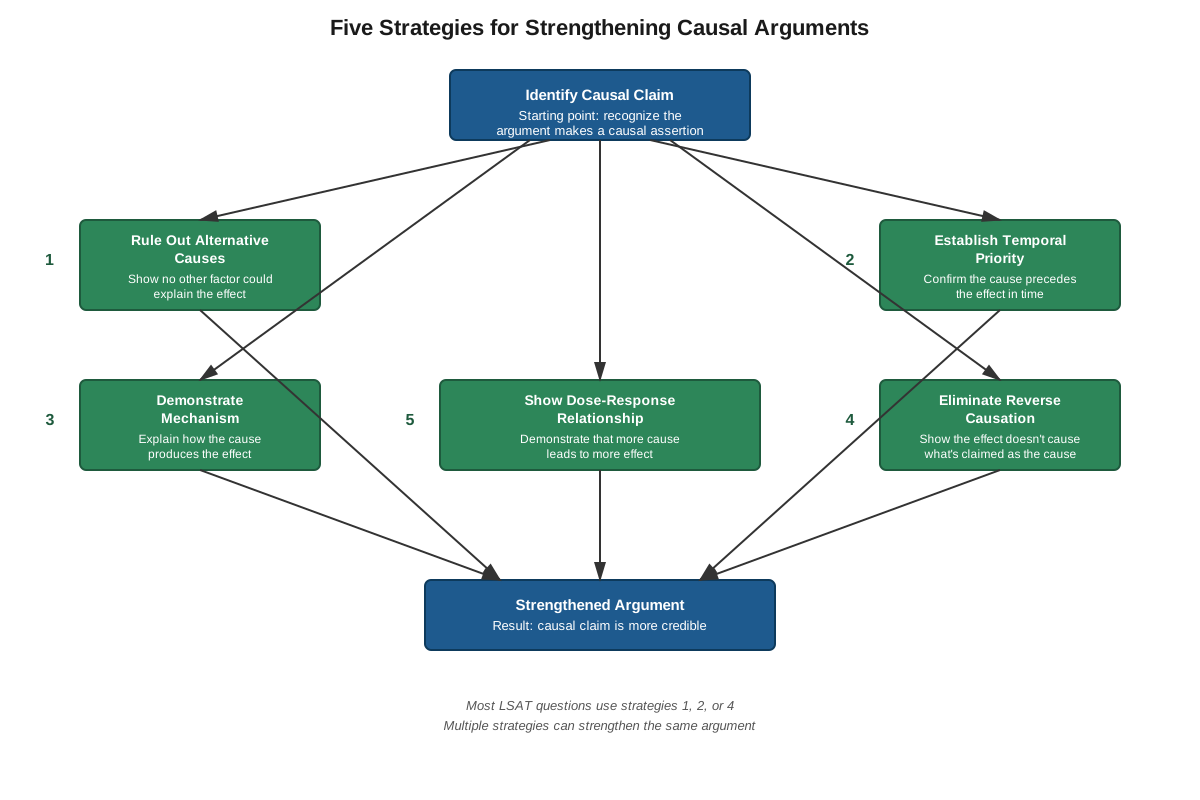
Strengthening a causal argument means providing information that makes the causal claim more likely to be true. This involves addressing one or more of the vulnerabilities listed above. The most effective strengthening strategies include:
1. Eliminating Alternative Explanations: The most common strengthening approach provides information ruling out competing explanations for the observed correlation. If an argument claims A causes B, showing that other potential causes were absent or controlled for strengthens the claim.
2. Establishing Temporal Priority: Demonstrating that the claimed cause preceded the claimed effect strengthens the argument because effects cannot precede their causes. This particularly addresses reverse causation concerns.
3. Showing Dose-Response Relationship: Evidence that greater amounts of the cause produce greater amounts of the effect strengthens causal claims. This pattern suggests genuine causation rather than coincidence.
4. Demonstrating Mechanism: Explaining how the cause produces the effect strengthens the argument by showing a plausible causal pathway. This addresses the insufficient mechanism vulnerability.
5. Providing Comparative Evidence: Showing that the effect occurs when the cause is present but not when it's absent strengthens the causal claim through contrast.
6. Ruling Out Reverse Causation: Explicitly showing that the effect did not or could not have caused what is claimed as the cause strengthens the argument's directionality.
The Strengthening Spectrum
Not all strengthening is equal. LSAT questions ask for the answer that "most strengthens" because different pieces of information provide varying degrees of support:
- Weak strengthening: Provides minor support or addresses only one of several vulnerabilities
- Moderate strengthening: Addresses a major vulnerability or provides substantial evidence for the causal mechanism
- Strong strengthening: Eliminates multiple alternative explanations or provides compelling evidence that the causal relationship exists
The correct answer need not prove the conclusion—it must simply make it more likely to be true than it was based on the original argument alone.
Common Argument Patterns
Pattern 1: Study-Based Arguments
These present research findings showing correlation and conclude causation:
- "Studies show people who drink coffee have lower rates of disease X. Therefore, coffee prevents disease X."
- Vulnerabilities: Maybe healthier people drink more coffee (reverse causation), or perhaps coffee drinkers have other healthy habits (confounding variable)
Pattern 2: Before-and-After Arguments
These observe a change following an intervention:
- "After the city installed speed cameras, accidents decreased. Therefore, the cameras caused the decrease."
- Vulnerabilities: Maybe other factors changed simultaneously, or perhaps the trend was already occurring
Pattern 3: Comparative Arguments
These compare groups with different outcomes:
- "Countries with higher chocolate consumption have more Nobel laureates. Therefore, chocolate consumption increases cognitive ability."
- Vulnerabilities: Likely a common cause (wealth enables both chocolate consumption and education), or pure coincidence
Concept Relationships
The concepts within strengthening causal arguments form an interconnected system. Understanding causal vulnerabilities enables recognition of what information would address those vulnerabilities, which in turn allows identification of strengthening evidence. The relationship flows:
Causal Claim → Identify Vulnerability Type → Determine What Would Address Vulnerability → Recognize Strengthening Information
This topic connects directly to weakening arguments as mirror opposites—what strengthens a causal argument is precisely what a weakening answer would contradict or undermine. Both rely on understanding the same fundamental vulnerabilities in causal reasoning.
The connection to assumption questions is equally strong. The assumptions underlying causal arguments are typically that alternative explanations don't apply, that the temporal sequence is correct, and that a mechanism exists. Strengthening answers often make these implicit assumptions explicit or provide evidence supporting them.
Necessary assumption questions specifically test whether an argument requires certain conditions to hold. In causal arguments, necessary assumptions often involve the absence of alternative causes or confounding variables. Strengthening answers frequently provide evidence that these necessary assumptions are true.
The relationship to sufficient assumption questions differs slightly—while sufficient assumptions guarantee the conclusion, strengthening answers merely make it more likely. Understanding this distinction prevents the error of seeking answers that prove rather than support.
High-Yield Facts
⭐ Strengthening a causal argument does not require proving the conclusion—only making it more likely to be true
⭐ The most effective strengthening answers typically eliminate alternative explanations for the observed correlation
⭐ Reverse causation is one of the most common vulnerabilities in LSAT causal arguments
⭐ Evidence of temporal priority (cause preceding effect) significantly strengthens causal claims
⭐ Dose-response relationships (more cause producing more effect) provide strong support for causation
- Strengthening answers often rule out confounding variables that could explain the observed correlation
- Demonstrating a plausible mechanism connecting cause to effect strengthens causal arguments
- Comparative evidence showing the effect's presence with the cause and absence without it strengthens claims
- Common cause scenarios (third factor causing both phenomena) represent frequent vulnerabilities
- Wrong answers in strengthening questions often address irrelevant issues or actually weaken the argument
- The correct strengthening answer must be relevant to the specific causal claim made in the argument
- Strengthening answers can work by showing the cause is sufficient for the effect or by eliminating necessary conditions for alternative explanations
- Arguments claiming one factor among many contributes to an effect require less strengthening than claims of sole causation
- Statistical correlation, no matter how strong, never by itself establishes causation
- The absence of the effect when the cause is absent provides strong support for causal claims
Quick check — test yourself on Strengthening causal arguments so far.
Try Flashcards →Common Misconceptions
Misconception: Strengthening a causal argument requires proving the conclusion is definitely true.
Correction: Strengthening only requires making the conclusion more likely than it was before. The correct answer provides additional support, not absolute proof. Even after strengthening, the conclusion could still be false.
Misconception: Any information that makes the argument sound better strengthens it.
Correction: Strengthening answers must specifically address the logical gap between premises and conclusion. Information that's generally positive but doesn't address the causal reasoning structure doesn't strengthen the argument. For example, saying "the researchers were well-qualified" doesn't strengthen a causal claim if it doesn't address alternative explanations.
Misconception: Strengthening answers must introduce entirely new information unrelated to what's in the argument.
Correction: Effective strengthening answers directly relate to the argument's reasoning structure. They often elaborate on or provide additional detail about factors already mentioned, ruling out alternatives or confirming assumptions implicit in the original reasoning.
Misconception: If an answer choice is true, it strengthens the argument.
Correction: An answer can be true but irrelevant to the argument's reasoning. Strengthening requires relevance to the specific causal claim and the logical gap in the argument. Truth alone doesn't equal strengthening.
Misconception: Strengthening a causal argument means showing the correlation is strong.
Correction: The strength of correlation is typically already established in the premises. Strengthening addresses why that correlation indicates causation rather than alternative explanations. Showing an even stronger correlation doesn't address the causation question.
Misconception: The longest or most complex answer choice is usually correct in strengthening questions.
Correction: Correct strengthening answers are often concise and directly address a specific vulnerability. Complexity or length doesn't indicate correctness—relevance and logical impact do.
Misconception: Strengthening answers must address all possible vulnerabilities in the argument.
Correction: The correct answer must most strengthen the argument, which often means addressing the most significant vulnerability. It need not address every possible objection.
Worked Examples
Example 1: Medical Study Argument
Argument: "A recent study found that people who regularly consume dark chocolate have significantly lower blood pressure than those who don't. Therefore, consuming dark chocolate causes lower blood pressure."
Question: Which of the following, if true, most strengthens the argument?
Answer Choices:
(A) Dark chocolate contains flavonoids, which have been shown in laboratory studies to relax blood vessels
(B) The study included over 10,000 participants from diverse backgrounds
(C) People with lower blood pressure generally report higher quality of life
(D) The participants who consumed dark chocolate did not differ from non-consumers in exercise habits, diet, or other factors known to affect blood pressure
(E) Dark chocolate consumption has increased significantly over the past decade
Analysis:
First, identify the causal claim: dark chocolate consumption causes lower blood pressure. The evidence is correlation—chocolate consumers have lower blood pressure.
Next, identify vulnerabilities:
- Reverse causation: Could people with lower blood pressure be more likely to consume chocolate? (Less plausible here)
- Common cause: Could a third factor cause both chocolate consumption and lower blood pressure?
- Confounding variables: Could chocolate consumers differ in other ways that actually cause lower blood pressure?
Now evaluate each answer:
(A) Provides a mechanism—this strengthens by showing how chocolate could cause the effect. This is moderate strengthening.
(B) Addresses study quality but doesn't address the causation question. The correlation could still be explained by confounding variables regardless of sample size. This doesn't strengthen the causal claim.
(C) Completely irrelevant to whether chocolate causes lower blood pressure. This discusses consequences of blood pressure, not causes.
(D) Directly eliminates confounding variables—the most common vulnerability in this type of argument. If chocolate consumers don't differ in other relevant ways, alternative explanations are ruled out. This is strong strengthening.
(E) Irrelevant to the causal relationship. Trends in consumption don't address whether consumption causes the effect.
Correct Answer: (D)
This answer most strengthens because it addresses the primary vulnerability—that other factors associated with chocolate consumption might actually cause the lower blood pressure. By ruling out these alternatives, it makes the causal claim significantly more likely to be true.
Example 2: Policy Implementation Argument
Argument: "After Riverside City implemented a ban on plastic bags, the amount of plastic litter in the city's waterways decreased by 40%. This demonstrates that the plastic bag ban caused the reduction in plastic litter."
Question: Which of the following, if true, most strengthens the argument?
Answer Choices:
(A) Plastic bags were among the most common types of litter found in the waterways before the ban
(B) Other cities that implemented similar bans also saw reductions in plastic litter
(C) During the same period, no other anti-litter initiatives were implemented in Riverside City, and weather patterns remained typical
(D) The ban was strictly enforced with significant penalties for violations
(E) Public awareness campaigns about environmental protection increased during the same period
Analysis:
The causal claim: the plastic bag ban caused the 40% reduction in plastic litter. The evidence: temporal sequence (ban followed by reduction).
Key vulnerabilities:
- Alternative causes: Other factors during the same period might have caused the reduction
- Coincidence: The reduction might have occurred regardless of the ban
- Confounding variables: Other changes happening simultaneously might be responsible
Evaluate answers:
(A) Establishes that plastic bags were a significant component of the problem, making it plausible they could account for a 40% reduction. This provides some strengthening but doesn't rule out alternative explanations for the reduction.
(B) Provides supporting evidence from other contexts, suggesting a pattern. This strengthens moderately by showing the relationship isn't unique to Riverside, but doesn't eliminate alternatives in this specific case.
(C) Directly eliminates alternative explanations by confirming no other initiatives occurred and conditions remained normal. This rules out confounding variables and alternative causes, making the ban the most likely explanation for the reduction.
(D) Suggests the ban was actually implemented effectively, which is relevant but doesn't address whether other factors might have caused the reduction.
(E) Actually introduces a potential alternative explanation—awareness campaigns could have caused the reduction instead of or in addition to the ban. This weakens rather than strengthens.
Correct Answer: (C)
This answer most effectively strengthens by eliminating the primary vulnerability in before-and-after arguments: that other changes during the same period actually caused the observed effect. By ruling out alternative initiatives and confirming stable conditions, it makes the causal claim much more likely to be true.
Exam Strategy
Identification Triggers
Watch for these phrases indicating a strengthening question focused on causal reasoning:
- "Which one of the following, if true, most strengthens the argument?"
- "Which one provides the most support for the conclusion?"
- "The argument would be most strengthened by which of the following?"
Within the argument itself, causal language includes:
- "causes," "leads to," "brings about," "produces," "results in"
- "because of," "due to," "as a result of," "is responsible for"
- "contributes to," "influences," "affects," "impacts"
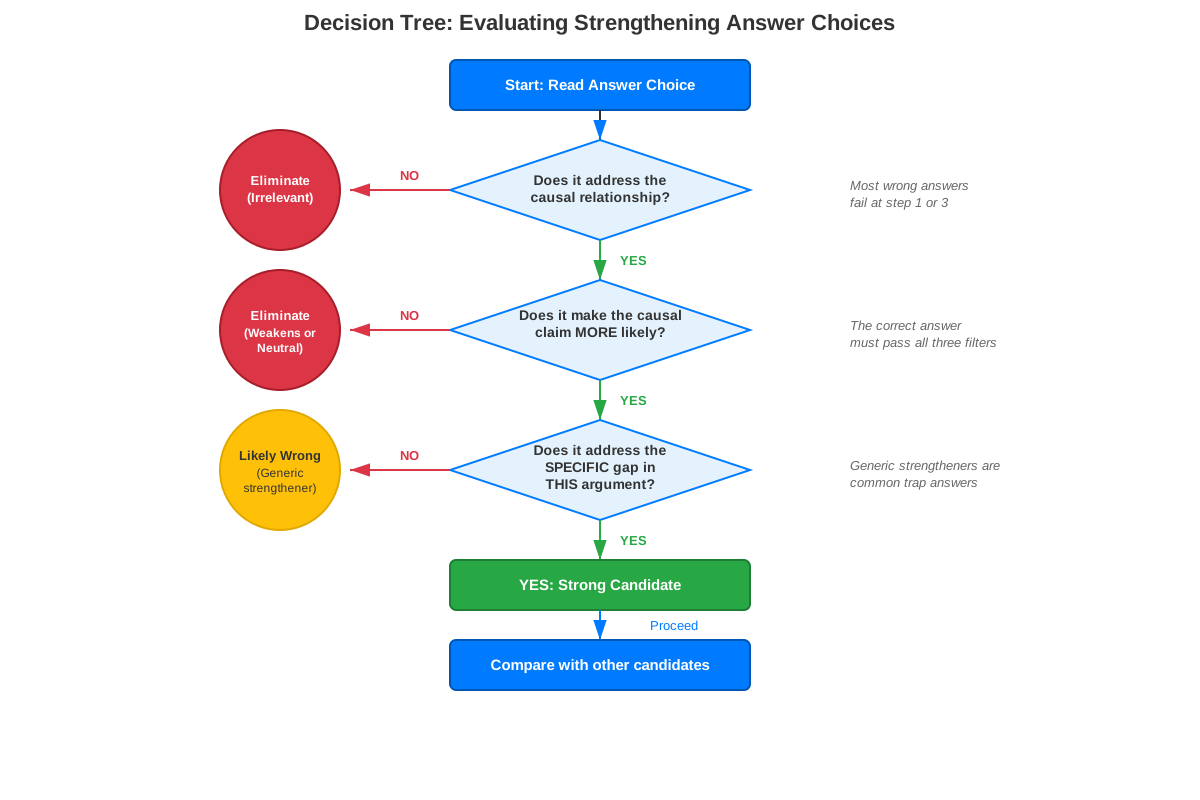
Systematic Approach
- Identify the causal claim (30 seconds): What does the argument claim causes what? Be precise about the direction of causation.
- Identify the evidence (15 seconds): What correlation or observation supports this claim? Usually temporal sequence or statistical association.
- Spot the vulnerability (30 seconds): Which of the five major vulnerabilities (reverse causation, common cause, coincidence, confounding variables, insufficient mechanism) most threatens this argument?
- Predict the strengthener (20 seconds): Before looking at answers, predict what information would address the vulnerability. This prevents wrong answers from seeming attractive.
- Evaluate each answer (90 seconds): Does it address the identified vulnerability? Does it make the causal claim more likely? Eliminate answers that are irrelevant, weaken, or address the wrong issue.
Process of Elimination Tips
Eliminate answers that:
- Discuss consequences of the effect rather than causes
- Address the quality or credibility of the source without addressing the reasoning
- Introduce new alternative explanations (these weaken, not strengthen)
- Are true but irrelevant to the causal relationship
- Strengthen a different claim than the one in the conclusion
Be cautious of answers that:
- Seem to strengthen but actually just restate the premise
- Provide mechanism without addressing alternative explanations (these strengthen weakly)
- Are overly complex—complexity doesn't equal correctness
Favor answers that:
- Directly eliminate alternative explanations
- Rule out confounding variables
- Establish temporal priority clearly
- Show dose-response relationships
- Demonstrate the effect's absence when the cause is absent
Time Management
Allocate approximately 2.5 minutes per strengthening question:
- 30 seconds: Read and understand the argument
- 45 seconds: Identify causal claim and vulnerability
- 90 seconds: Evaluate answer choices
- 15 seconds: Confirm selection
If stuck between two answers, ask: "Which one more directly addresses the gap between correlation and causation?" The answer that eliminates more alternative explanations typically wins.
Memory Techniques
The CREAM Mnemonic
Remember the five major causal vulnerabilities with CREAM:
- Common cause (third factor causes both)
- Reverse causation (effect causes claimed cause)
- Extraneous variables (confounding factors)
- Accidental correlation (coincidence)
- Mechanism missing (no plausible pathway)
The "Rule Out" Visualization
Picture a causal argument as a target with the causal claim at the center. Alternative explanations are arrows pointing at the target from different directions. Strengthening answers are shields that block these arrows. The more arrows blocked, the stronger the support.
The Temporal Priority Principle
Remember: "Causes must come first." Visualize a timeline with the cause on the left and effect on the right. Any strengthening answer that confirms this sequence or rules out reverse causation moves in the correct direction.
The STRENGTH Acronym
What strengthens causal arguments? STRENGTH:
- Show mechanism
- Temporal priority established
- Rule out alternatives
- Eliminate confounders
- No reverse causation
- Greater cause = greater effect (dose-response)
- Test with/without cause
- Hold other factors constant
Summary
Strengthening causal arguments on the LSAT requires understanding the fundamental gap between correlation and causation. Every causal argument claims that one phenomenon causes another based on observed correlation, but correlation alone never proves causation. The five major vulnerabilities—reverse causation, common cause, confounding variables, coincidence, and insufficient mechanism—represent the ways causal claims can fail. Effective strengthening answers address these vulnerabilities by eliminating alternative explanations, establishing temporal priority, demonstrating mechanisms, showing dose-response relationships, or providing comparative evidence. The correct answer need not prove the conclusion but must make it more likely to be true than the original argument alone established. Success on these questions requires systematic analysis: identify the causal claim, recognize the vulnerability, predict what would strengthen, and select the answer that most directly addresses the reasoning gap. This question type appears frequently on the LSAT and tests skills fundamental to legal reasoning—evaluating whether evidence truly supports causal claims.
Key Takeaways
- Strengthening causal arguments means making the causal claim more likely, not proving it conclusively
- The most effective strengthening answers eliminate alternative explanations for observed correlations
- Five major vulnerabilities threaten causal arguments: reverse causation, common cause, confounding variables, coincidence, and insufficient mechanism
- Temporal priority (cause preceding effect) and dose-response relationships provide strong support for causal claims
- Wrong answers often seem relevant but don't address the specific gap between correlation and causation
- Systematic analysis—identifying the causal claim and its vulnerability before evaluating answers—prevents errors
- These questions appear 4-6 times per LSAT, making mastery essential for competitive scores
Related Topics
Weakening Causal Arguments: The mirror image of this topic, focusing on how to undermine causal claims by exploiting the same vulnerabilities. Mastering strengthening provides the foundation for understanding weakening.
Necessary Assumptions in Causal Arguments: Explores what must be true for causal arguments to succeed, directly connecting to the assumptions that strengthening answers often support.
Flaw Questions with Causal Reasoning: Identifies common errors in causal reasoning, helping recognize what makes these arguments vulnerable and therefore what would strengthen them.
Method of Reasoning Questions: Understanding how causal arguments are structured helps identify and describe reasoning patterns when questions ask about argumentative techniques.
Parallel Reasoning with Causal Arguments: Recognizing causal argument structures enables matching them to structurally similar arguments in parallel reasoning questions.
Practice CTA
Now that you understand the principles behind strengthening causal arguments, it's time to apply this knowledge. Work through the practice questions to test your ability to identify causal vulnerabilities and select effective strengthening answers. The flashcards will help reinforce the key concepts and vulnerabilities you need to recognize instantly on test day. Remember: mastery comes through application. Each practice question you analyze strengthens your pattern recognition and builds the analytical skills that will serve you throughout the LSAT and in law school. You've learned the framework—now make it automatic through deliberate practice.
Sign up free to keep reading
Create a free AnvayaPrep account to finish this LSAT guide on Strengthening causal arguments — plus flashcards and practice questions.