Overview
Weakening explanations represent a critical subset of strengthen and weaken questions on the LSAT's Logical Reasoning section. These questions present an argument that attempts to explain a phenomenon, observation, or set of facts, and ask test-takers to identify which answer choice most undermines that explanation. Unlike standard weakening questions that target the logical connection between premises and conclusion, weakening explanation questions specifically challenge the adequacy or plausibility of a proposed causal or interpretive account.
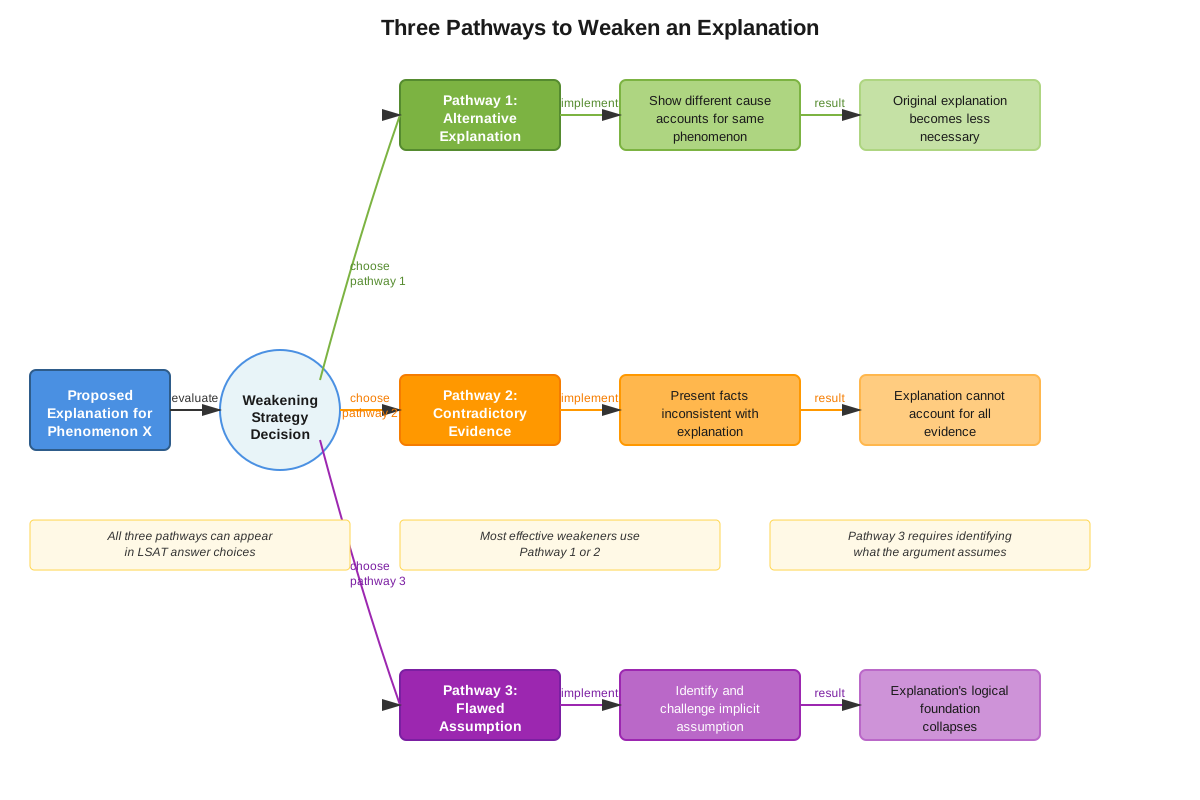
The LSAT frequently tests the ability to evaluate competing explanations for observed phenomena. When an argument offers an explanation for why something occurred or why certain facts exist, it implicitly claims that this explanation is the best or most likely account. To weaken such an explanation, one must either suggest an alternative explanation that better accounts for the evidence, identify evidence that the proposed explanation cannot accommodate, or demonstrate that the explanation's underlying assumptions are flawed. This skill mirrors real-world legal reasoning, where attorneys must evaluate competing narratives and identify weaknesses in opposing counsel's interpretation of events.
Mastering weakening explanations builds directly on foundational skills in causal reasoning, assumption identification, and argument structure analysis. These questions integrate multiple logical reasoning competencies: recognizing argument patterns, understanding the relationship between evidence and conclusions, and evaluating the strength of inferential connections. Success with weakening explanations also prepares students for related question types, including strengthening arguments, resolving paradoxes, and evaluating competing hypotheses—all essential skills for achieving a competitive LSAT score.
Learning Objectives
- [ ] Identify how Weakening explanations appears in LSAT questions
- [ ] Explain the reasoning pattern behind Weakening explanations
- [ ] Apply Weakening explanations to solve LSAT-style problems accurately
- [ ] Distinguish between weakening an explanation and weakening a standard argument
- [ ] Generate alternative explanations that compete with a proposed account
- [ ] Evaluate whether evidence is inconsistent with a given explanation
- [ ] Recognize the implicit assumptions underlying explanatory arguments
Prerequisites
- Basic argument structure: Understanding premises, conclusions, and how they connect is essential because explanatory arguments follow similar structural patterns, though with causal or interpretive claims.
- Causal reasoning fundamentals: Recognizing cause-and-effect relationships matters because most explanations propose causal mechanisms to account for observed phenomena.
- Assumption identification: Detecting unstated assumptions is crucial because explanations rely heavily on implicit claims about what factors are relevant or irrelevant.
- Standard weakening techniques: Familiarity with general weakening strategies provides the foundation upon which explanation-specific weakening builds.
Why This Topic Matters
In legal practice, attorneys constantly evaluate competing explanations for events, behaviors, and evidence. A prosecutor might explain a defendant's actions as indicating guilt, while a defense attorney offers an alternative explanation suggesting innocence. Judges and juries must assess which explanation better accounts for all available evidence. This same evaluative skill—determining whether a proposed explanation adequately accounts for observed facts—appears throughout legal reasoning and makes weakening explanations a high-priority LSAT topic.
Lsat weakening explanations questions appear with significant frequency on every LSAT administration. Approximately 15-20% of Logical Reasoning questions involve strengthening or weakening arguments, and roughly one-third of these specifically target explanatory reasoning. This translates to 3-5 questions per test that directly assess the ability to weaken explanations. Given that Logical Reasoning comprises half of the scored LSAT sections, mastering this question type can substantially impact overall performance.
These questions typically appear in several recognizable formats. The stimulus might present a puzzling observation followed by a proposed explanation, then ask which answer choice "most calls into question" or "most weakens" that explanation. Alternatively, the stimulus might describe a phenomenon and offer a theory about its cause, asking which finding would "cast doubt on" or "undermine" the theory. Some questions present competing explanations implicitly, asking which answer choice "suggests an alternative explanation" or "indicates that the explanation is incomplete." Recognizing these patterns enables efficient question identification and appropriate strategic response.
Core Concepts
The Structure of Explanatory Arguments
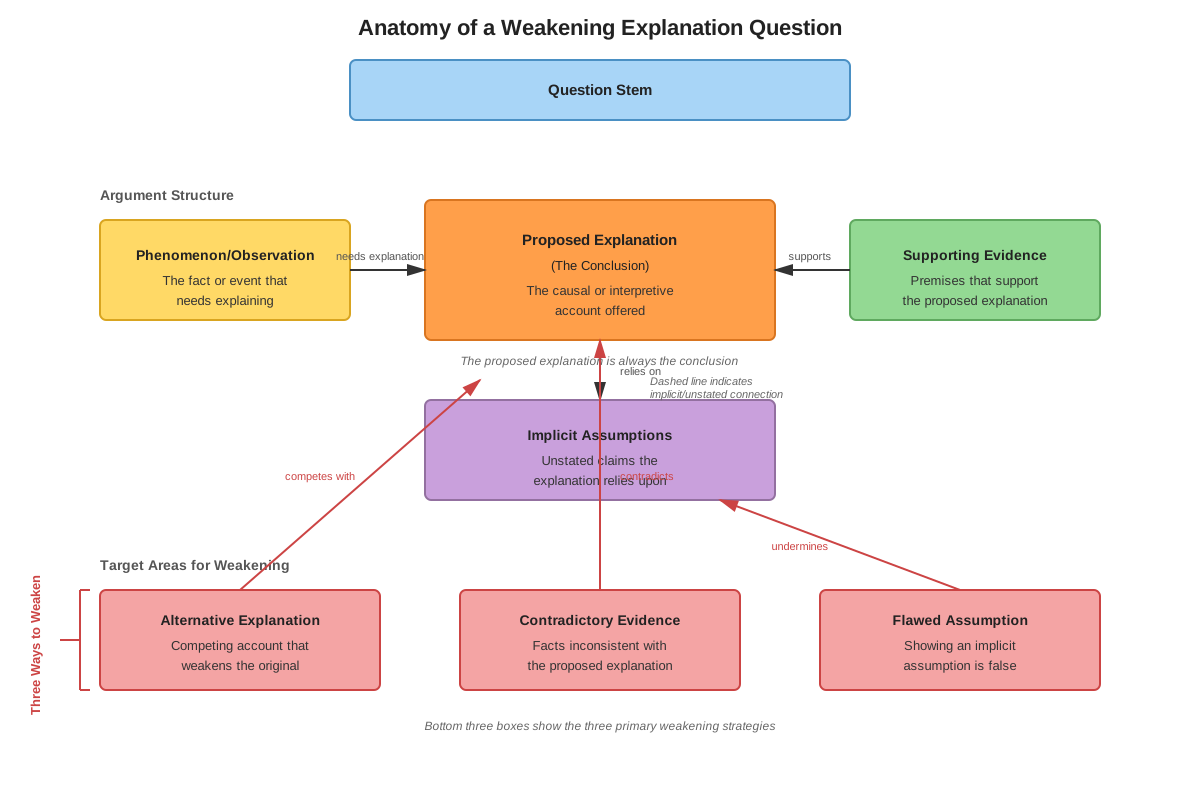
An explanatory argument differs from a standard argument in its fundamental purpose. While standard arguments attempt to prove that something is true or will occur, explanatory arguments attempt to account for why something that has already been observed is the case. The typical structure includes: (1) an observation or phenomenon requiring explanation, (2) a proposed explanation that identifies causes or reasons for the observation, and (3) an implicit or explicit claim that this explanation is adequate or superior to alternatives.
For example: "Sales of umbrellas increased dramatically last month. This increase is explained by the unusually heavy rainfall during that period." The observation is increased umbrella sales; the explanation is heavy rainfall; the implicit claim is that rainfall adequately accounts for the sales increase.
Three Primary Weakening Strategies
Strategy 1: Presenting Alternative Explanations
The most common way to weaken an explanation is to suggest an alternative account that equally or better explains the observed phenomenon. If multiple explanations can account for the same evidence, the original explanation becomes less convincing. The alternative need not be proven correct—merely plausible enough to cast doubt on the original explanation's adequacy.
Consider the umbrella example. An alternative explanation might be: "A major retailer ran a 50%-off sale on umbrellas last month." This alternative explanation accounts for increased sales without reference to rainfall, thereby weakening the rainfall explanation.
Strategy 2: Identifying Inconsistent Evidence
A second approach involves presenting evidence that the proposed explanation cannot easily accommodate. If the explanation were correct, certain facts should or should not be true. Evidence contradicting these expectations undermines the explanation's plausibility.
Returning to the umbrella example: "Umbrella sales in neighboring cities with identical rainfall patterns remained unchanged last month." This evidence is inconsistent with the rainfall explanation, since similar rainfall should produce similar effects if rainfall truly explains the sales increase.
Strategy 3: Undermining Necessary Assumptions
Every explanation rests on assumptions about relevant factors, causal mechanisms, or background conditions. Attacking these assumptions weakens the explanation. This strategy requires identifying what the explanation takes for granted, then showing that assumption is questionable.
For the umbrella example, the rainfall explanation assumes that rainfall influences umbrella purchases. An assumption-attacking weakener might state: "Surveys show that 90% of umbrella purchases are gifts, and gift-givers rarely consider weather conditions when shopping." This undermines the assumed connection between rainfall and purchasing behavior.
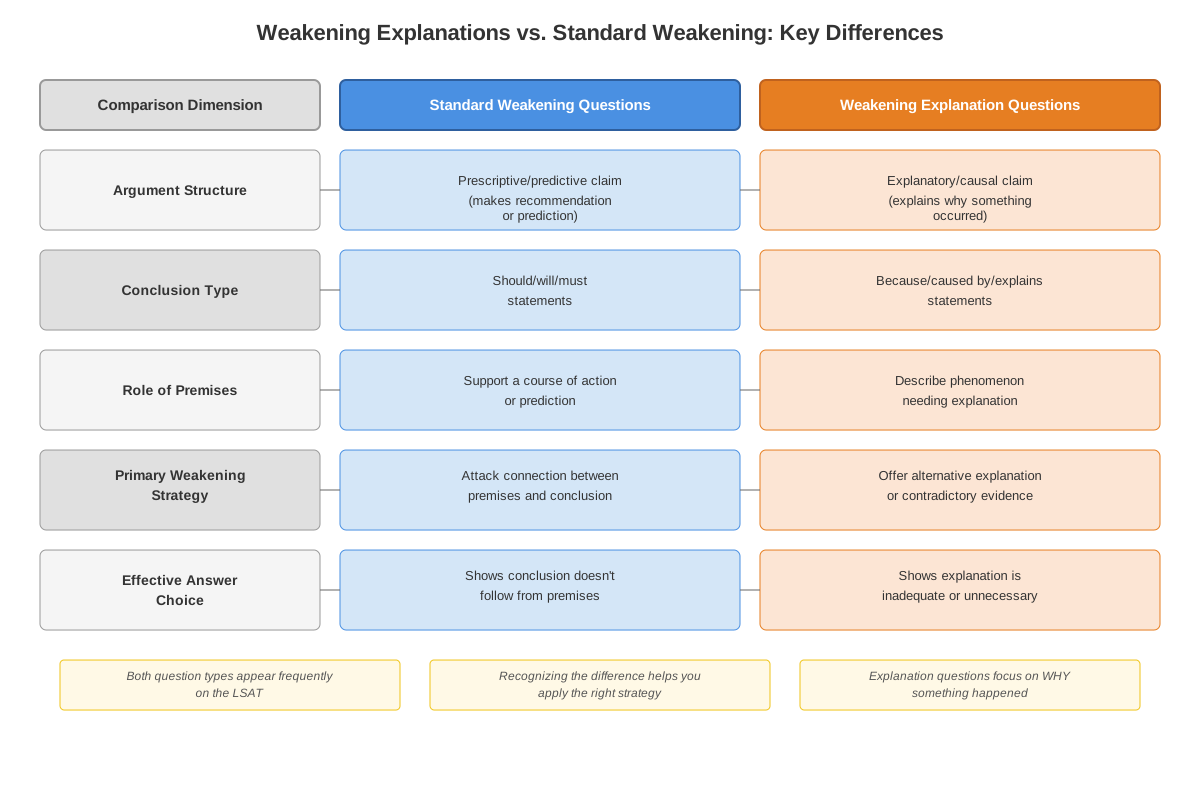
Distinguishing Explanation Weakening from Standard Weakening
| Aspect | Standard Weakening | Explanation Weakening |
|---|---|---|
| Target | Conclusion's truth or likelihood | Explanation's adequacy or completeness |
| Evidence Type | Facts contradicting the conclusion | Alternative accounts or inconsistent patterns |
| Logical Move | Breaks premise-conclusion link | Suggests other factors better explain the phenomenon |
| Question Stem | "Weakens the argument" | "Casts doubt on the explanation" or "Suggests an alternative" |
The Role of Competing Explanations
When multiple explanations can account for the same observations, each explanation's credibility diminishes. The LSAT exploits this principle by presenting answer choices that offer competing accounts. The key is recognizing that an alternative explanation need not disprove the original—it merely needs to be plausible enough that the original explanation no longer seems uniquely compelling.
Strong alternative explanations share certain characteristics: they account for all or most of the observed evidence, they invoke plausible causal mechanisms, and they don't require additional unsupported assumptions. Weak alternatives fail one or more of these criteria—they might explain only part of the evidence, rely on implausible mechanisms, or require accepting dubious claims.
Causal Complexity and Explanation Adequacy
Many explanatory arguments oversimplify causal relationships by proposing single-factor explanations for phenomena that likely have multiple contributing causes. Weakening such explanations often involves highlighting this causal complexity—showing that other factors also play significant roles or that the proposed factor is insufficient by itself.
For instance, an explanation might attribute a company's increased profits solely to a new marketing campaign. A weakener could note that the company also reduced costs, improved product quality, and benefited from competitors' failures during the same period. These additional factors don't necessarily disprove the marketing explanation, but they weaken it by suggesting the explanation is incomplete.
Temporal and Correlational Considerations
Explanations often rely on temporal relationships or correlations between factors. Weakening such explanations may involve disrupting these relationships. If an explanation claims X caused Y, evidence that Y occurred before X, or that X and Y don't consistently correlate, undermines the explanation.
Consider: "The city's crime rate dropped after installing new streetlights, so improved lighting explains the crime reduction." A temporal weakener might note: "Crime rates began declining two months before the streetlight installation." A correlational weakener might state: "Other cities that installed identical lighting systems saw no change in crime rates."
Concept Relationships
The concepts within weakening explanations form an interconnected system. Explanatory argument structure provides the foundation—one must first recognize that an argument is explanatory rather than predictive or evaluative. This recognition enables application of the three primary weakening strategies: alternative explanations, inconsistent evidence, and assumption attacks. Each strategy connects to causal complexity, since most explanations involve causal claims that may oversimplify multifaceted phenomena.
Temporal and correlational considerations intersect with both inconsistent evidence and assumption attacks. Evidence of temporal mismatch or correlation failure represents a specific type of inconsistent evidence, while assumptions about temporal sequence or correlation patterns are common targets for assumption-based weakening.
The relationship to prerequisite knowledge flows as follows: Basic argument structure → enables recognition of → Explanatory argument structure → which allows identification of → Underlying assumptions → which can be attacked using → Weakening strategies → which draw upon → Causal reasoning fundamentals → to evaluate → Explanation adequacy.
This topic also connects forward to related Logical Reasoning skills. Mastering weakening explanations facilitates strengthening explanations (the inverse operation), resolving paradoxes (which often involves choosing between competing explanations), and method of reasoning questions (which may ask test-takers to describe how an explanation is challenged).
High-Yield Facts
⭐ Weakening an explanation requires showing it's inadequate, incomplete, or less plausible—not necessarily proving it false.
⭐ Alternative explanations weaken the original by demonstrating that other accounts can equally explain the observed phenomenon.
⭐ Evidence inconsistent with an explanation's predictions or expectations undermines that explanation's credibility.
⭐ Temporal mismatches (effect preceding proposed cause) strongly weaken causal explanations.
⭐ Explanations that ignore relevant alternative factors or oversimplify complex causation are vulnerable to weakening.
- Explanatory arguments claim to account for observed phenomena rather than predict future events or prove claims.
- Attacking an explanation's necessary assumptions is equivalent to showing the explanation relies on questionable premises.
- Correlation without consistent patterns across similar cases weakens explanations that rely on that correlation.
- Explanations become weaker when they cannot account for all relevant evidence or observations.
- The most effective weakeners often introduce new information rather than merely reinterpreting existing evidence.
- Scope limitations (explanation applies only to narrow circumstances) reduce an explanation's strength.
- Explanations assuming single-factor causation are more vulnerable than those acknowledging multiple contributing factors.
- Evidence that the proposed explanatory factor is absent in similar cases with the same outcome weakens the explanation.
Quick check — test yourself on Weakening explanations so far.
Try Flashcards →Common Misconceptions
Misconception: Weakening an explanation requires proving it completely wrong or impossible.
Correction: Weakening merely requires reducing the explanation's plausibility or showing it's less adequate than alternatives. An explanation can be weakened even if it remains possible or partially correct.
Misconception: Any alternative explanation automatically weakens the original explanation equally.
Correction: Alternative explanations vary in strength. A strong alternative accounts for all the evidence and invokes plausible mechanisms; a weak alternative might explain only some observations or rely on unlikely scenarios. Only plausible alternatives effectively weaken the original.
Misconception: Weakening an explanation is identical to weakening any other argument type.
Correction: Explanatory arguments have distinct features—they account for existing observations rather than predict outcomes or prove claims. Weakening strategies must target the explanation's adequacy and completeness, not just the logical connection between premises and conclusion.
Misconception: Evidence that strengthens an explanation's premises automatically strengthens the explanation itself.
Correction: An explanation can have true premises but still be inadequate. For example, "It rained last month" might be true, but this doesn't mean rainfall explains umbrella sales if other factors (like sales promotions) better account for the increase.
Misconception: Temporal correlation alone establishes that one event explains another.
Correction: Temporal sequence (X before Y) is necessary but insufficient for causal explanation. Many factors might precede an outcome without explaining it. Weakeners often exploit this by showing that the temporal correlation doesn't hold consistently or that other factors with similar timing provide better explanations.
Misconception: If an explanation accounts for most of the evidence, it cannot be significantly weakened.
Correction: An explanation that fails to account for even a small portion of relevant evidence can be substantially weakened, especially if that evidence is particularly significant or if an alternative explanation accounts for all the evidence.
Worked Examples
Example 1: Alternative Explanation
Stimulus: "Archaeological evidence shows that the ancient city of Petra experienced rapid population decline around 363 CE. Historians have explained this decline by noting that a major earthquake struck the region in that year, destroying much of the city's infrastructure and making it uninhabitable."
Question: Which of the following, if true, most weakens the earthquake explanation for Petra's population decline?
Answer Choices:
(A) Other cities in the region affected by the same earthquake recovered their populations within two decades.
(B) Petra's population had already decreased by 40% in the two decades preceding the earthquake.
(C) The earthquake caused significant damage to Petra's water distribution system.
(D) Archaeological evidence of earthquake damage is found throughout the city's ruins.
(E) Earthquakes were relatively common in the region during this historical period.
Analysis:
First, identify the explanatory structure: Observation = Petra's population declined around 363 CE; Explanation = earthquake in 363 CE destroyed infrastructure and made the city uninhabitable.
Now evaluate each answer choice:
(A) This suggests that earthquake damage alone doesn't adequately explain permanent population decline, since other cities recovered. This weakens by showing the explanation is incomplete—other factors must distinguish Petra from cities that recovered. Strong weakener.
(B) This provides an alternative explanation: the population decline began before the earthquake, suggesting other factors (economic changes, trade route shifts, etc.) better explain the decline. The earthquake might have accelerated an existing trend rather than causing it. Strongest weakener.
(C) This strengthens the explanation by providing specific evidence of how the earthquake made the city less habitable. Eliminates.
(D) This strengthens the explanation by confirming the earthquake's severity. Eliminates.
(E) This is irrelevant to whether this particular earthquake explains Petra's decline. Frequency of earthquakes doesn't address whether this specific earthquake caused this specific population decline. Eliminates.
Correct Answer: (B)
This example demonstrates the alternative explanation strategy. Choice (B) weakens by suggesting the population decline had causes predating the earthquake, making the earthquake explanation inadequate. Choice (A) also weakens but less directly—it raises questions about the explanation without providing a clear alternative.
Example 2: Inconsistent Evidence
Stimulus: "A recent study found that students who take notes by hand during lectures perform better on conceptual questions than students who type notes on laptops. Researchers explain this finding by hypothesizing that handwriting requires more cognitive processing than typing, leading to deeper engagement with the material."
Question: Which of the following findings, if true, would most call into question the researchers' explanation?
Answer Choices:
(A) Students who type notes verbatim perform worse than those who type summarized notes.
(B) Students who take no notes at all perform worse than both hand-writers and laptop users.
(C) Brain imaging shows different neural activation patterns during handwriting versus typing.
(D) Students who handwrite notes but are instructed to copy verbatim show no performance advantage over laptop users.
(E) The performance gap between hand-writers and laptop users increases with lecture complexity.
Analysis:
Identify the structure: Observation = hand-writers outperform laptop users on conceptual questions; Explanation = handwriting requires more cognitive processing, causing deeper engagement.
The explanation assumes that the physical act of handwriting itself (requiring more cognitive processing) causes the performance difference.
(A) This is consistent with the explanation—verbatim typing involves less processing than summarizing, which aligns with the cognitive processing hypothesis. Doesn't weaken.
(B) This suggests note-taking generally helps but doesn't address why handwriting specifically outperforms typing. Irrelevant to the specific explanation.
(C) This strengthens the explanation by providing evidence that handwriting and typing involve different cognitive processes. Eliminates.
(D) This is inconsistent with the explanation. If handwriting itself requires more cognitive processing, then handwriting should show advantages even when copying verbatim. The fact that verbatim hand-writers show no advantage suggests the benefit comes from how students process content (summarizing vs. transcribing) rather than from the physical act of handwriting. Strong weakener.
(E) This strengthens the explanation by showing the pattern holds across different conditions. Eliminates.
Correct Answer: (D)
This example illustrates the inconsistent evidence strategy. The explanation predicts that handwriting should always involve more cognitive processing than typing. Evidence that handwriting provides no advantage when the processing type is controlled (verbatim copying) contradicts this prediction, suggesting the explanation misidentifies the causal factor.
Exam Strategy
When approaching lsat weakening explanations questions, begin by clearly distinguishing the observation from the proposed explanation. Underline or mentally note the phenomenon being explained and the account offered for it. This prevents confusion between evidence and explanation—a common source of errors.
Trigger Phrases: Watch for "explains," "accounts for," "is due to," "is caused by," "the reason for," and "this is because." These signal explanatory reasoning. Question stems often use "casts doubt on the explanation," "calls into question," "undermines the hypothesis," or "suggests an alternative account."
Apply a systematic three-step process:
- Identify assumptions: What must be true for this explanation to work? What factors does it assume are relevant or irrelevant?
- Consider alternatives: What other explanations might account for the same observations? Are there competing factors the argument ignores?
- Test predictions: If this explanation were correct, what else should be true? What patterns should appear consistently?
For process of elimination, actively eliminate answer choices that:
- Strengthen the explanation by providing supporting evidence
- Are irrelevant to the explanation's adequacy (even if they relate to the topic generally)
- Address different aspects of the situation without touching the explanatory mechanism
- Merely restate information already in the stimulus
Prioritize answer choices that:
- Offer plausible alternative explanations accounting for the same evidence
- Present evidence inconsistent with the explanation's predictions
- Show the proposed causal factor is absent in similar cases with the same outcome
- Reveal that the effect preceded the proposed cause
- Demonstrate the explanation oversimplifies by ignoring relevant factors
Time allocation: Spend 15-20 seconds identifying the explanatory structure, 30-40 seconds evaluating answer choices, and 10-15 seconds confirming your selection. If stuck between two choices, ask: "Which more directly challenges the explanation's core mechanism?" The correct answer typically targets the explanation's central causal claim rather than peripheral details.
Memory Techniques
AAA Mnemonic for Weakening Strategies:
- Alternative explanations (suggest other accounts)
- Assumptions attacked (undermine what's taken for granted)
- Anomalous evidence (present inconsistent facts)
CITE Framework for Evaluating Explanations:
- Causation: Does the explanation establish a plausible causal mechanism?
- Inconsistencies: Is there evidence the explanation can't accommodate?
- Temporal: Does the timing support the causal claim?
- Exhaustive: Does the explanation account for all relevant evidence?
Visualization Strategy: Picture the explanation as a bridge connecting the observation (one side) to the proposed cause (other side). Weakeners either build an alternative bridge (alternative explanation), show the bridge has gaps (inconsistent evidence), or reveal the bridge rests on unstable foundations (assumption attacks).
The "But What About?" Technique: After reading an explanation, immediately ask "But what about other possible causes?" and "But what if the proposed cause were absent?" This mental habit primes recognition of alternative explanations and inconsistent evidence.
Summary
Weakening explanations constitutes a high-frequency, high-value question type on the LSAT Logical Reasoning section. These questions present arguments that attempt to account for observed phenomena and ask test-takers to identify answer choices that undermine the proposed explanation's adequacy. Success requires distinguishing explanatory arguments from other argument types, recognizing that weakening an explanation means showing it's inadequate or incomplete rather than proving it false, and applying three primary strategies: presenting alternative explanations, identifying inconsistent evidence, and undermining necessary assumptions. The most effective approach involves clearly separating the observation from the explanation, identifying what the explanation assumes or predicts, and systematically evaluating answer choices for their impact on the explanation's plausibility. Mastering this question type requires understanding causal complexity, temporal relationships, and the principle that multiple plausible explanations for the same phenomenon reduce each explanation's individual credibility.
Key Takeaways
- Weakening explanations targets the adequacy and completeness of proposed accounts for observed phenomena, not merely the truth of conclusions
- Alternative explanations weaken by showing other accounts can equally explain the evidence, reducing the original explanation's unique plausibility
- Evidence inconsistent with an explanation's predictions or necessary conditions substantially undermines that explanation
- Temporal mismatches (effect before cause) and absent correlations in similar cases are powerful weakening tools
- Explanations assuming single-factor causation or ignoring relevant alternative factors are particularly vulnerable to weakening
- Distinguishing observations from explanations is the critical first step in analyzing these questions
- The correct answer typically challenges the explanation's core causal mechanism rather than peripheral details
Related Topics
Strengthening Explanations: The inverse of weakening explanations, this topic involves identifying evidence that makes a proposed explanation more adequate or plausible. Mastering weakening explanations provides the foundation for understanding strengthening, since the same structural analysis applies with opposite objectives.
Resolving Paradoxes: These questions present apparently contradictory observations and ask which answer choice explains how both can be true. Success with weakening explanations develops the skill of evaluating competing accounts, which directly transfers to paradox resolution.
Causal Reasoning: A broader category encompassing all arguments about cause-and-effect relationships. Weakening explanations represents a specific application of causal reasoning principles, and deeper study of causation enhances explanation evaluation skills.
Method of Reasoning Questions: These questions ask test-takers to describe how an argument proceeds or how one argument responds to another. Understanding weakening strategies enables accurate description of how explanations are challenged in these meta-level questions.
Practice CTA
Now that you've mastered the core concepts of weakening explanations, it's time to cement your understanding through active practice. Attempt the practice questions associated with this topic, focusing on applying the AAA mnemonic and CITE framework to each question. As you work through problems, pay special attention to distinguishing alternative explanations from inconsistent evidence—this distinction frequently separates correct from tempting wrong answers. Review the flashcards to reinforce high-yield facts and common patterns. Remember: expertise with weakening explanations develops through repeated application, not just passive reading. Each practice question you analyze strengthens your pattern recognition and strategic decision-making, bringing you closer to LSAT mastery.
Sign up free to keep reading
Create a free AnvayaPrep account to finish this LSAT guide on Weakening explanations — plus flashcards and practice questions.