Overview
Comparative author attitude is a critical skill tested in the LSAT's Reading Comprehension section, specifically within Comparative Reading passages. This question type requires test-takers to analyze and contrast the perspectives, tones, and viewpoints of two different authors writing about related topics. Unlike single-passage questions that focus on one author's perspective, comparative author attitude questions demand that students simultaneously track multiple viewpoints, identify subtle differences in tone and opinion, and accurately characterize how each author approaches the shared subject matter.
Mastering comparative author attitude is essential for LSAT success because these questions appear consistently in the Reading Comprehension section and often prove challenging for unprepared test-takers. The LSAT tests this skill because legal professionals must regularly compare competing arguments, distinguish between similar but distinct positions, and accurately represent multiple perspectives—all fundamental lawyering skills. Questions about author attitude require more than surface-level comprehension; they demand careful attention to word choice, rhetorical strategies, and the subtle markers that reveal an author's stance toward their subject matter.
Within the broader landscape of LSAT comparative author attitude questions, this topic connects directly to fundamental reading comprehension skills such as identifying main ideas, recognizing tone, and understanding argumentative structure. However, comparative attitude questions add an additional layer of complexity by requiring students to hold two distinct perspectives in mind simultaneously, compare them along specific dimensions, and select answer choices that accurately capture both similarities and differences. This skill builds upon basic passage comprehension while preparing students for the analytical demands of legal reasoning.
Learning Objectives
- [ ] Identify how Comparative author attitude appears in LSAT questions
- [ ] Explain the reasoning pattern behind Comparative author attitude
- [ ] Apply Comparative author attitude to solve LSAT-style problems accurately
- [ ] Distinguish between subtle gradations of authorial tone (skeptical vs. dismissive, cautious vs. enthusiastic)
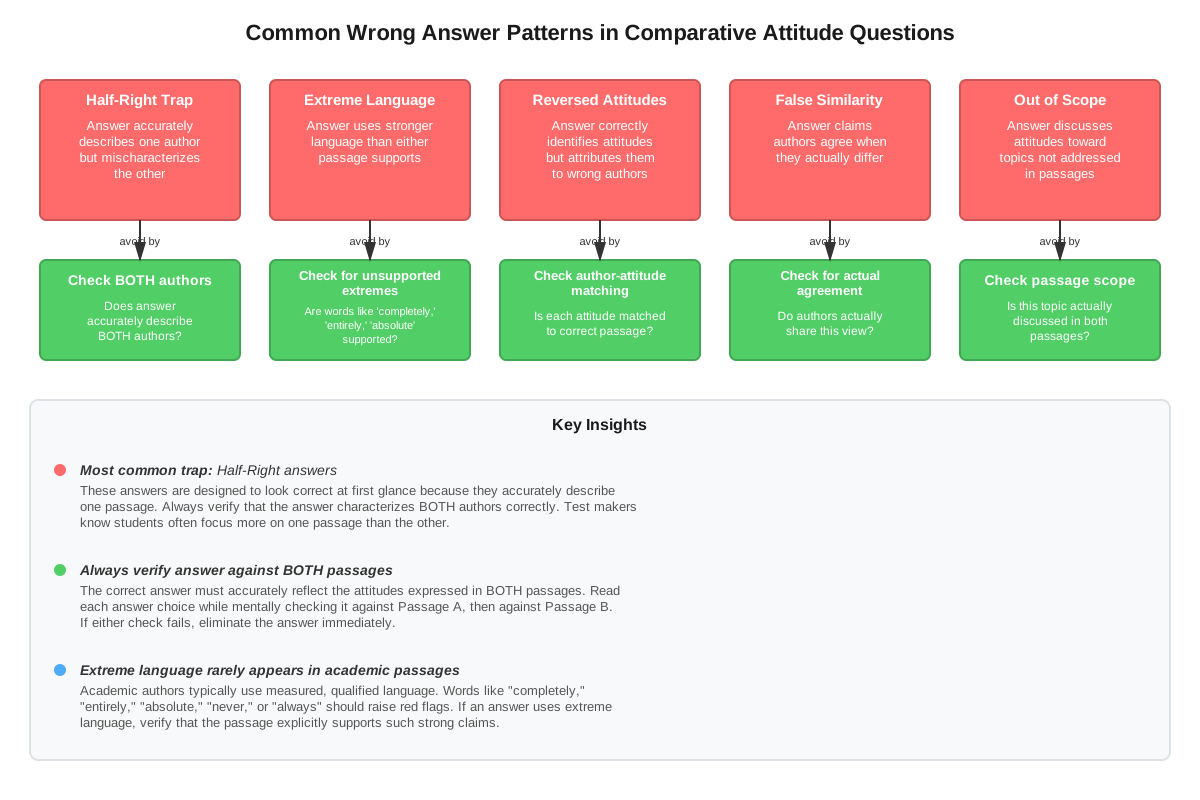
- [ ] Recognize common wrong answer patterns in comparative attitude questions
- [ ] Synthesize textual evidence from both passages to support attitude characterizations
Prerequisites
- Basic tone and attitude vocabulary: Understanding terms like "skeptical," "optimistic," "critical," and "neutral" is essential because these descriptors form the foundation of attitude analysis.
- Single-passage comprehension skills: Students must be able to identify an author's perspective in isolated passages before comparing multiple perspectives.
- Understanding of argumentative structure: Recognizing how authors build arguments helps identify where attitude is most clearly expressed.
- Familiarity with comparative passage format: Knowing that Passage A and Passage B address related topics allows students to focus on differences rather than basic comprehension.
Why This Topic Matters
Comparative author attitude questions test a fundamental legal skill: the ability to distinguish between competing perspectives on the same issue. Attorneys must constantly compare how different parties, judges, or legal scholars view identical facts or legal questions. The capacity to accurately characterize and contrast these viewpoints without conflation or distortion is essential to legal practice, making this a high-value testing area for the LSAT.
In terms of exam statistics, comparative reading passages appear once per Reading Comprehension section, typically comprising 6-8 questions. Of these questions, 1-3 typically focus specifically on comparative author attitude, making this question type appear in approximately 15-20% of all Reading Comprehension questions. This frequency, combined with the difficulty many students experience with these questions, makes mastering comparative author attitude a high-yield investment of study time.
Common manifestations of this topic include questions asking students to identify which statement both authors would agree with, how the authors' attitudes differ, what one author would think of the other's argument, or which characterization best describes each author's tone. These questions may appear straightforward but often include trap answers that accurately describe one author while mischaracterizing the other, or that exaggerate subtle differences into stark contrasts.
Core Concepts
Understanding Author Attitude
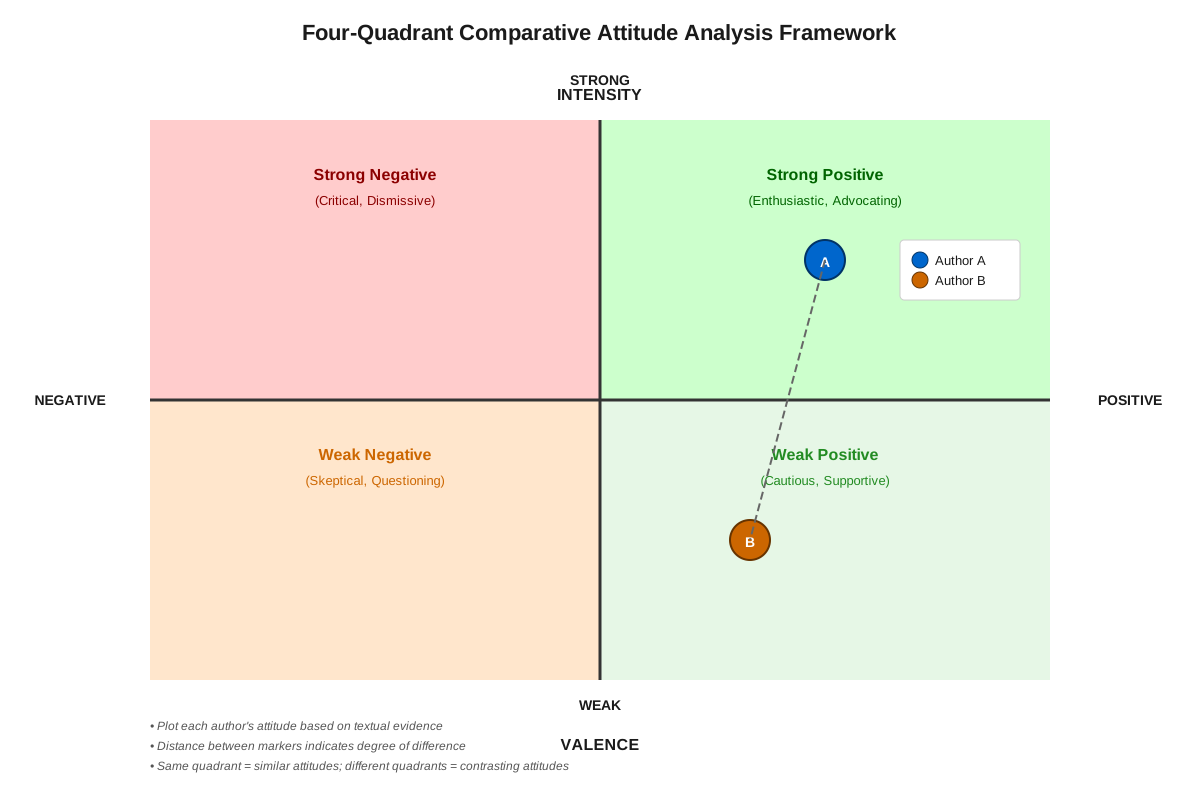
Author attitude refers to the writer's emotional and intellectual stance toward their subject matter, revealed through word choice, tone, emphasis, and argumentative approach. In comparative reading, students must identify not just what each author believes, but how they feel about it—their level of confidence, enthusiasm, skepticism, or concern. Attitude exists on multiple dimensions: positive-to-negative valence, certain-to-uncertain confidence, and engaged-to-detached emotional investment.
The LSAT tests attitude recognition because legal writing demands precise characterization of judicial opinions, opposing counsel's arguments, and scholarly commentary. Mischaracterizing an opponent's position as "hostile" when it's merely "critical," or as "uncertain" when it's "cautiously optimistic," can undermine legal arguments. Therefore, the exam rewards students who can identify subtle gradations of attitude rather than crude categorizations.
Comparative Analysis Framework
When approaching lsat comparative author attitude questions, students should employ a systematic framework. First, identify each author's explicit statements about the topic—do they praise, criticize, question, or remain neutral? Second, examine the language intensity—strong words like "revolutionary" or "disastrous" signal stronger attitudes than moderate terms like "interesting" or "problematic." Third, note what each author emphasizes or omits, as these choices reveal priorities and concerns.
The comparative dimension requires tracking both similarities and differences. Two authors might both support a policy but with different levels of enthusiasm. They might both criticize an approach but for entirely different reasons. The LSAT frequently tests whether students can recognize that authors share a general position while differing in specifics, or conversely, that authors who seem opposed actually share common ground on certain points.
Textual Evidence for Attitude
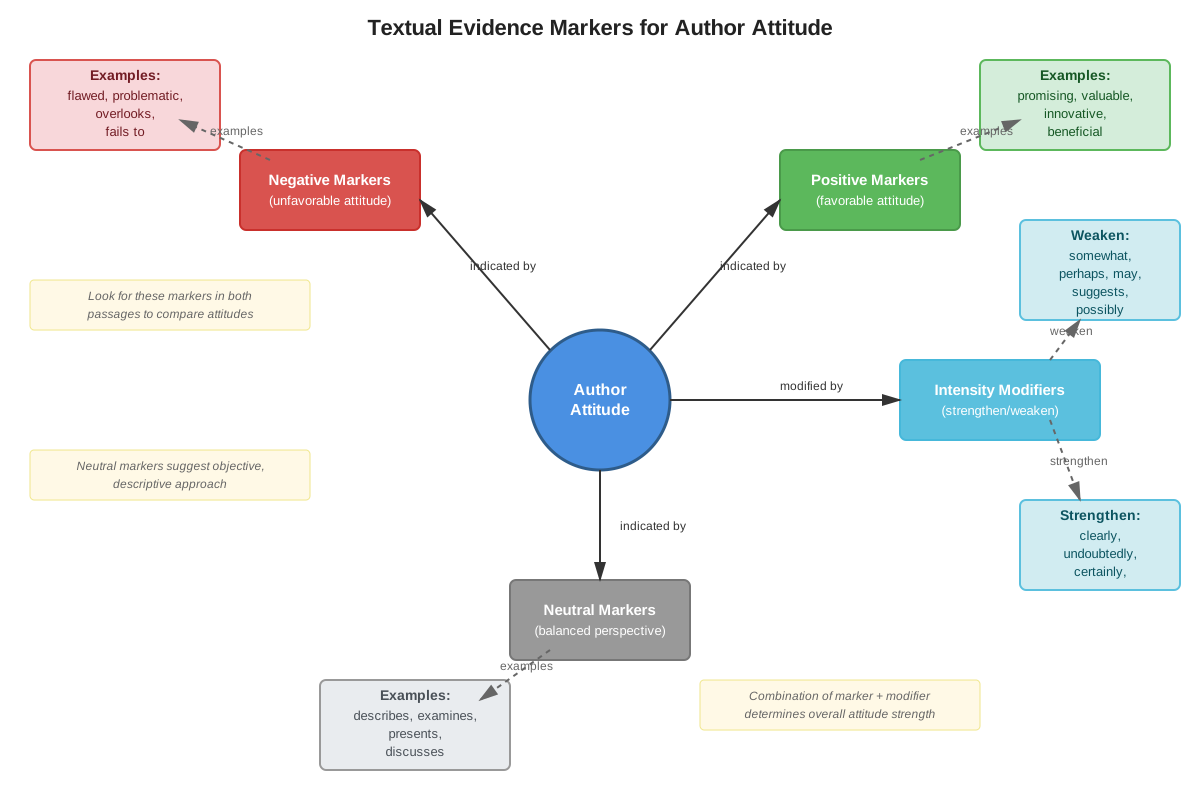
Attitude rarely appears in a single sentence; instead, it accumulates through multiple textual markers. Reading comprehension of attitude requires attention to:
- Evaluative adjectives and adverbs: Words like "unfortunately," "merely," "significantly," or "surprisingly" reveal the author's judgment
- Hedging language: Phrases like "may suggest," "appears to," or "could potentially" indicate uncertainty or caution
- Emphatic constructions: Statements like "clearly demonstrates" or "undeniably proves" show confidence
- Concessions and qualifications: When authors acknowledge limitations or opposing views, this reveals a balanced or measured attitude
- Rhetorical questions: These often signal skepticism or criticism
Common Attitude Patterns in Comparative Reading
The LSAT employs several recurring patterns in comparative passages:
| Pattern Type | Description | Example Scenario |
|---|---|---|
| Agreement with Different Emphasis | Both authors support the same position but stress different aspects | Both favor environmental regulation; A emphasizes economic benefits, B emphasizes moral imperatives |
| Qualified vs. Unqualified Support | One author enthusiastically endorses while the other cautiously approves | A celebrates a new technology; B acknowledges its promise but notes limitations |
| Different Targets of Criticism | Both are critical but focus on different problems | Both critique a theory; A attacks its methodology, B questions its assumptions |
| Optimistic vs. Pessimistic Outlook | Authors agree on current state but differ on future prospects | Both describe a social problem; A sees solutions emerging, B expects deterioration |
| Theoretical vs. Practical Focus | One author takes an abstract approach while the other emphasizes applications | A discusses philosophical implications; B focuses on policy implementation |
Recognizing Attitude Intensity
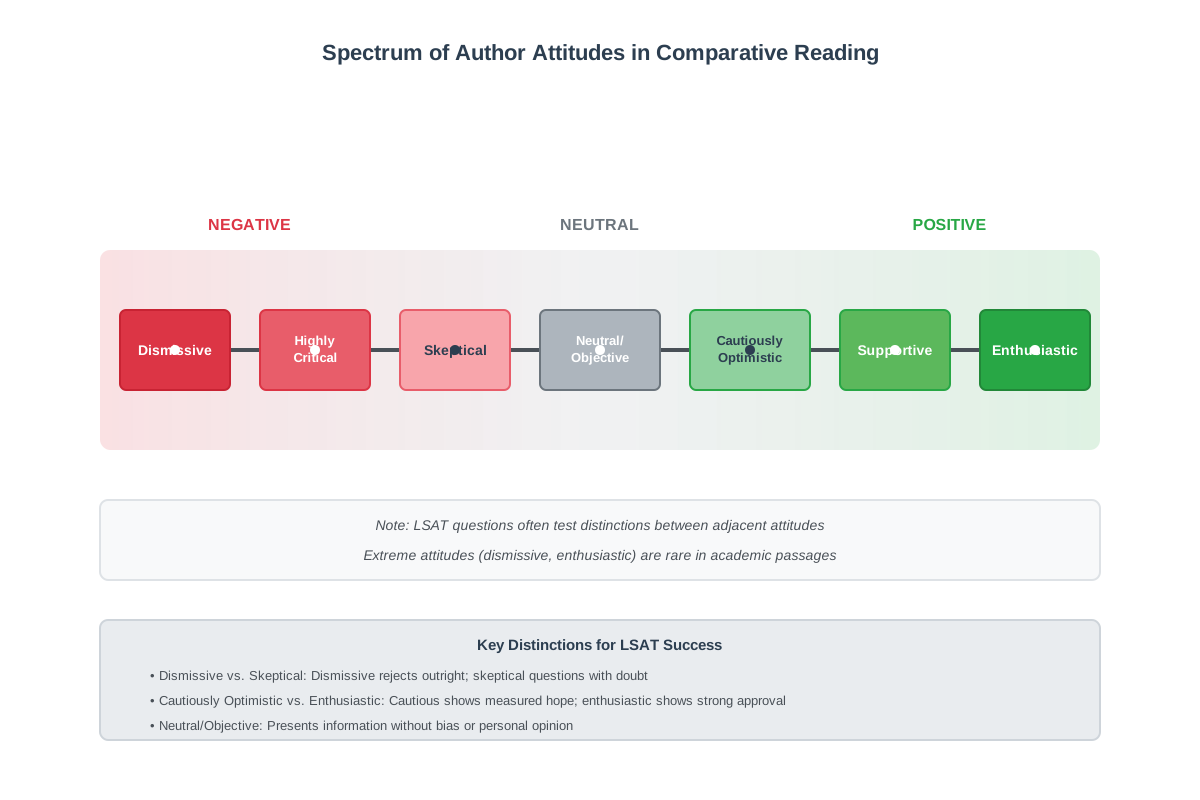
A crucial distinction in comparative reading involves attitude intensity. The LSAT frequently includes wrong answers that correctly identify the direction of an author's attitude (positive or negative) but mischaracterize its strength. An author who "raises concerns" is not the same as one who "vehemently opposes." Similarly, "acknowledging merit" differs significantly from "enthusiastically endorsing."
Students should create a mental spectrum for common attitude descriptors:
Positive attitudes (increasing intensity): mentions favorably → approves → supports → advocates → champions → celebrates
Negative attitudes (increasing intensity): questions → doubts → criticizes → condemns → denounces → ridicules
Neutral/Analytical attitudes: describes → analyzes → examines → evaluates → assesses
Cross-Passage Synthesis
Advanced comparative attitude questions require synthesizing information across both passages to determine what one author would think of the other's argument. This demands understanding not just each author's stated position, but the underlying values, assumptions, and priorities that generate those positions. If Author A prioritizes empirical evidence while Author B emphasizes theoretical consistency, Author A would likely criticize Author B's approach as insufficiently grounded in data, even if both reach similar conclusions.
Concept Relationships
The concepts within comparative author attitude form an interconnected analytical framework. Understanding basic author attitude (tone, perspective, stance) serves as the foundation upon which comparative analysis builds. Students must first master identifying a single author's attitude before attempting to compare two attitudes simultaneously. This single-author skill connects directly to the comparative framework, which provides the systematic approach for tracking multiple perspectives.
The comparative framework then enables recognition of common attitude patterns, which represent recurring relationships between author perspectives that the LSAT tests repeatedly. These patterns inform how students approach textual evidence, knowing which linguistic markers signal which attitude types. Attitude intensity recognition refines this analysis further, preventing the common error of correctly identifying attitude direction while misjudging its strength.
Cross-passage synthesis represents the highest level of this conceptual hierarchy, requiring integration of all previous concepts. To determine what Author A would think of Author B's argument, students must: (1) accurately identify each author's attitude, (2) apply the comparative framework to understand their relationship, (3) recognize which pattern their interaction follows, (4) evaluate textual evidence from both passages, and (5) calibrate the intensity of the predicted response.
This topic connects to prerequisite knowledge of argumentative structure because authors often reveal their attitudes most clearly when presenting their main claims or responding to counterarguments. It also relates to broader Reading Comprehension skills like identifying purpose and function, since understanding why an author includes certain information helps reveal their attitude toward it.
Relationship Map: Basic Attitude Recognition → Comparative Framework → Pattern Recognition → Evidence Analysis → Intensity Calibration → Cross-Passage Synthesis
High-Yield Facts
- ⭐ Comparative attitude questions appear 1-3 times per comparative passage, making them one of the most frequent comparative question types
- ⭐ Wrong answers often correctly characterize one author while misrepresenting the other—always verify the answer describes BOTH authors accurately
- ⭐ Authors can share the same general position (both support/oppose) while differing significantly in their reasons, emphasis, or confidence level
- ⭐ Attitude intensity matters as much as direction—"cautiously optimistic" and "enthusiastically supportive" are not interchangeable
- ⭐ The strongest evidence for attitude typically appears in the author's thesis statement, evaluative language, and treatment of opposing views
- Authors who acknowledge limitations or counterarguments typically have more measured, balanced attitudes than those who present one-sided arguments
- Comparative passages are deliberately chosen to have related but distinct perspectives—if the authors seem to say exactly the same thing, reread more carefully
- Questions asking what "both authors would agree with" require finding common ground that may not be explicitly stated in either passage
- Rhetorical questions, emphatic language, and concessive phrases ("although," "despite," "while") are high-yield markers of attitude
- The LSAT rarely features authors with completely neutral attitudes—even "objective" or "analytical" authors typically reveal subtle preferences or concerns
Quick check — test yourself on Comparative author attitude so far.
Try Flashcards →Common Misconceptions
Misconception: If two authors discuss the same topic and reach similar conclusions, they must have the same attitude.
Correction: Authors can support the same position for different reasons, with different levels of enthusiasm, or with different emphases. The LSAT frequently tests whether students can distinguish between authors who agree on conclusions but differ in their reasoning, confidence, or priorities.
Misconception: Strong language always indicates a strong attitude, while moderate language indicates neutrality.
Correction: Context determines whether language signals attitude intensity. An author using measured language while systematically dismantling an argument may be more critical than one using a few strong words. Additionally, academic or scientific passages may use moderate language as a disciplinary convention rather than as a marker of weak conviction.
Misconception: The author's attitude is always explicitly stated in the passage.
Correction: Attitude often emerges through cumulative textual evidence rather than direct statements. Authors reveal their perspectives through word choice, emphasis, what they include or omit, and how they frame issues. Students must infer attitude from these markers rather than expecting explicit declarations like "I am skeptical of this theory."
Misconception: If an author criticizes something, they must oppose it entirely; if they praise something, they must support it completely.
Correction: Sophisticated arguments often involve qualified positions. An author might criticize certain aspects of a theory while supporting its overall framework, or praise an initiative's goals while questioning its implementation. The LSAT rewards recognition of these nuanced positions.
Misconception: Comparative attitude questions always ask about differences between authors.
Correction: Many comparative attitude questions focus on similarities, asking what both authors would agree with or how their perspectives align. Students who focus exclusively on differences may miss these questions or select answers that exaggerate disagreements.
Misconception: The author's attitude toward the passage topic is the same as their attitude toward all elements discussed in the passage.
Correction: Authors may have different attitudes toward different aspects of their subject. An author might be enthusiastic about a scientific discovery while skeptical about its proposed applications, or supportive of a policy's goals while critical of its implementation strategy.
Worked Examples
Example 1: Identifying Comparative Attitude
Passage A (abbreviated): "The recent developments in renewable energy technology represent a promising step toward addressing climate change. While challenges remain in scaling these solutions, the progress made in solar efficiency and battery storage suggests that a transition away from fossil fuels is increasingly feasible. Policymakers should view these advances as an opportunity to accelerate investment in clean energy infrastructure."
Passage B (abbreviated): "Renewable energy technologies have indeed improved, but the enthusiasm surrounding them often obscures significant obstacles. The intermittency problem remains unsolved, and the rare earth minerals required for batteries pose environmental and geopolitical challenges. A realistic assessment suggests that fossil fuels will remain necessary for decades, and policy should focus on improving their efficiency rather than pursuing an unrealistic rapid transition."
Question: The authors' attitudes toward renewable energy technology can best be described as:
(A) Author A is enthusiastic; Author B is dismissive
(B) Author A is cautiously optimistic; Author B is skeptical
(C) Author A is neutral; Author B is critical
(D) Author A is supportive; Author B is hostile
(E) Author A is uncertain; Author B is confident
Analysis:
Step 1: Identify Author A's attitude markers
- "promising step" = positive but measured
- "While challenges remain" = acknowledges limitations
- "increasingly feasible" = optimistic about future
- "should view...as an opportunity" = supportive but not extreme
Author A's attitude: Cautiously optimistic—positive but acknowledging challenges
Step 2: Identify Author B's attitude markers
- "indeed improved" = acknowledges progress (not dismissive)
- "enthusiasm...obscures significant obstacles" = critical of others' optimism
- "realistic assessment" = positions self as balanced
- "unrealistic rapid transition" = skeptical of aggressive timelines
Author B's attitude: Skeptical—questions feasibility while acknowledging some merit
Step 3: Evaluate answer choices
- (A) "Enthusiastic" overstates A; "dismissive" overstates B's negativity
- (B) Accurately captures A's measured optimism and B's doubt ✓
- (C) A is clearly positive, not neutral
- (D) "Hostile" is too strong for B's measured criticism
- (E) A shows confidence in feasibility; B is confident in skepticism
Answer: (B)
This example demonstrates how attitude intensity matters. Both wrong answers (A) and (D) correctly identify the direction of each author's attitude but exaggerate its strength. The correct answer recognizes that Author A is positive but measured, while Author B is negative but not extreme.
Example 2: Cross-Passage Synthesis
Passage A (abbreviated): "Historical linguistics demonstrates that language change follows predictable patterns driven by cognitive and social factors. The regularity of sound changes across unrelated languages suggests universal principles governing linguistic evolution. This scientific approach has transformed our understanding of language history."
Passage B (abbreviated): "While systematic patterns exist in language change, the role of individual speakers' creativity and social dynamics introduces unpredictability that resists purely scientific modeling. Language evolution involves complex interactions between structure and agency that cannot be reduced to universal laws. A more humanistic approach recognizes this irreducible complexity."
Question: Based on their respective arguments, Author A would most likely respond to Author B's emphasis on "irreducible complexity" by:
(A) Agreeing that complexity exists but arguing it doesn't preclude scientific analysis
(B) Dismissing the concept as unscientific and therefore irrelevant
(C) Acknowledging that linguistic science has failed to account for this factor
(D) Suggesting that humanistic approaches are incompatible with pattern recognition
(E) Conceding that universal principles may not exist after all
Analysis:
Step 1: Understand Author A's core position
- Emphasizes "predictable patterns" and "universal principles"
- Values "scientific approach"
- Claims this approach "transformed our understanding"
- Confident in systematic analysis
Step 2: Understand Author B's challenge
- Acknowledges patterns exist ("While systematic patterns exist")
- Argues "unpredictability...resists purely scientific modeling"
- Emphasizes complexity that "cannot be reduced to universal laws"
- Not denying patterns, but questioning their sufficiency
Step 3: Predict Author A's response
- A wouldn't deny complexity exists (too extreme)
- A would likely argue complexity doesn't invalidate scientific approach
- A's confidence suggests they wouldn't concede their main point
- A acknowledges patterns are "predictable," suggesting they account for complexity
Step 4: Evaluate answers
- (A) Fits A's confident but not dismissive tone; acknowledges B's point while maintaining position ✓
- (B) Too hostile; A doesn't show dismissive attitude
- (C) A shows confidence in linguistic science, wouldn't concede failure
- (D) A doesn't attack humanistic approaches, just advocates scientific ones
- (E) Would contradict A's entire argument
Answer: (A)
This example illustrates cross-passage synthesis. The correct answer requires understanding not just what each author explicitly states, but how Author A's underlying values and argumentative approach would lead them to respond to Author B's specific challenge. Author A would likely acknowledge the point (showing intellectual engagement) while maintaining their core position (consistency with their argument).
Exam Strategy
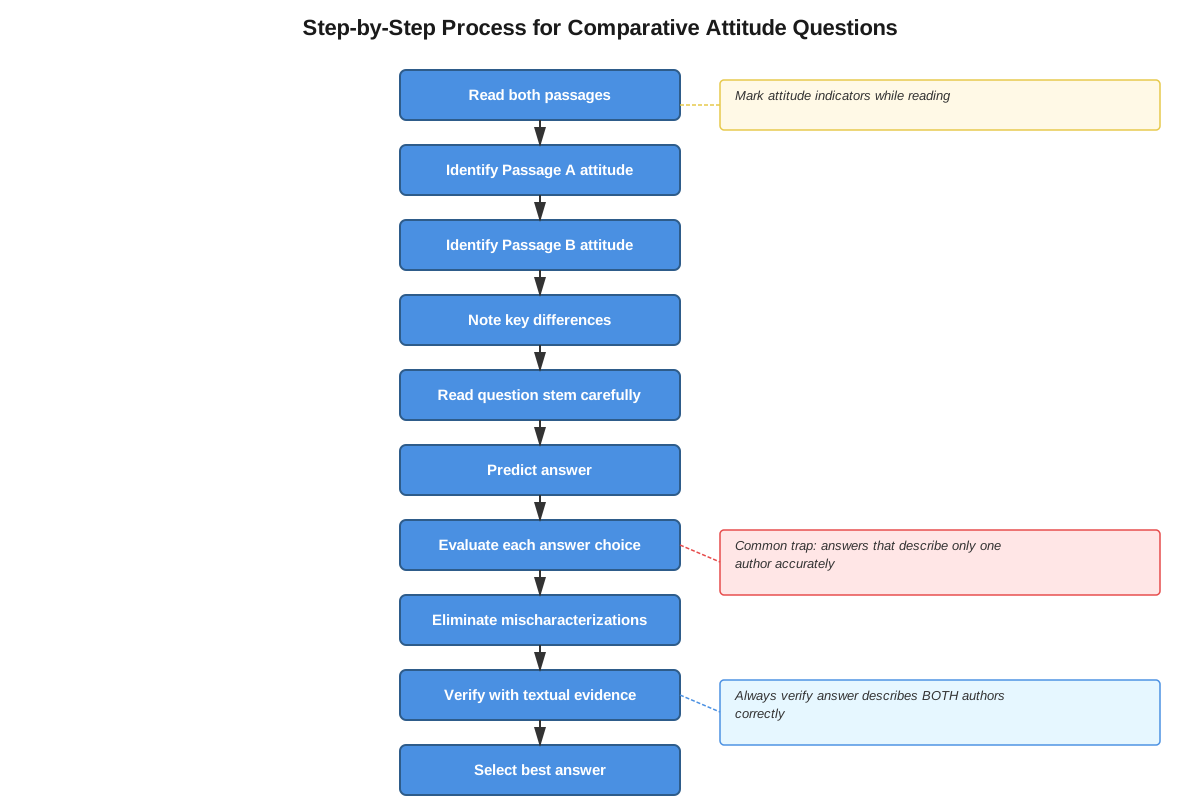
When approaching comparative author attitude questions, employ this systematic process:
Step 1: Pre-read for attitude markers (30-45 seconds per passage)
Before diving into questions, quickly identify each author's thesis and note 2-3 key phrases that reveal attitude. Look especially at opening and closing paragraphs, where authors often state their positions most clearly.
Step 2: Create a mental attitude profile (10-15 seconds)
For each author, mentally note: (1) Are they positive, negative, or neutral? (2) How strong is their position? (3) What are they most concerned about? This profile serves as your reference point for all attitude questions.
Step 3: Identify question type (5 seconds)
Determine whether the question asks about:
- Both authors' attitudes (requires characterizing each)
- Differences between attitudes (focus on contrasts)
- Similarities/agreement (focus on common ground)
- One author's likely response to the other (requires synthesis)
Step 4: Predict before looking at answers (10-15 seconds)
Based on your attitude profiles, predict what the correct answer should say. This prevents trap answers from seeming attractive.
Step 5: Eliminate systematically (20-30 seconds)
For questions about both authors, verify each answer choice describes BOTH accurately. Eliminate any answer that mischaracterizes either author. For difference questions, eliminate answers that exaggerate or minimize the actual contrast.
Exam Tip: Trigger words to watch for in questions include "attitude," "perspective," "tone," "view," "would likely," "would agree," and "characterization." These signal that you need to focus on how authors feel about their subject, not just what they say about it.
Exam Tip: Wrong answers often use attitude descriptors that are one or two steps too strong or too weak on the intensity spectrum. If an author "questions" something, wrong answers might say they "dismiss" it (too strong) or "mention" it (too weak).
Time allocation: Spend slightly more time on comparative attitude questions than on simple detail questions (60-75 seconds vs. 45-60 seconds) because they require synthesizing information from both passages. However, if you've created good attitude profiles during your initial reading, you can often answer these questions more quickly than complex inference questions.
Process of elimination tips specific to this topic:
- Eliminate answers where the attitude descriptor contradicts explicit textual evidence
- Eliminate answers that make both authors sound identical unless the question specifically asks about similarities
- Eliminate answers using extreme language (always, never, completely, entirely) unless the passage attitude is genuinely extreme
- For "both authors would agree" questions, eliminate answers that go beyond what's stated or clearly implied in both passages
Memory Techniques
CITE Mnemonic for Attitude Analysis:
- Choice of words (evaluative language, adjectives, adverbs)
- Intensity markers (hedging vs. emphatic language)
- Treatment of opposing views (dismissive, respectful, engaged)
- Emphasis and omissions (what the author stresses or ignores)
Attitude Intensity Spectrum Visualization:
Picture a thermometer with three zones:
- Hot zone (top): enthusiastic, champions, celebrates, denounces, ridicules
- Warm/Cool zone (middle): supports, approves, criticizes, questions
- Neutral zone (bottom): describes, analyzes, examines
When reading, mentally place each author on this thermometer to avoid confusing intensity levels.
The "Two Lawyers" Analogy:
Think of Passage A and Passage B as two lawyers arguing related cases. Even if they're on the same side, they might emphasize different precedents, use different rhetorical strategies, or show different levels of confidence. This analogy helps remember that agreement on conclusions doesn't mean identical attitudes.
COMPARE Acronym for Systematic Analysis:
- Common ground (what do they agree on?)
- Opposing points (where do they disagree?)
- Main emphasis (what does each prioritize?)
- Position strength (how confident is each?)
- Argument style (theoretical vs. practical, abstract vs. concrete)
- Reasons given (why does each hold their position?)
- Evidence type (what kind of support does each use?)
Summary
Comparative author attitude questions test the ability to identify, characterize, and contrast the perspectives of two authors writing about related topics. Success requires moving beyond surface-level comprehension to recognize subtle markers of attitude including word choice, tone, emphasis, and treatment of opposing views. The LSAT rewards students who can distinguish between attitude direction (positive/negative) and intensity (strong/moderate/weak), recognize that authors may agree on conclusions while differing in reasoning or confidence, and synthesize information across passages to predict how one author would respond to another's argument. Systematic analysis using frameworks like CITE and COMPARE helps students avoid common traps such as exaggerating differences, conflating similar but distinct positions, or mischaracterizing attitude intensity. The key to mastery lies in creating accurate attitude profiles during initial reading, verifying that answer choices correctly describe both authors, and recognizing recurring patterns in how the LSAT constructs comparative relationships. With practice, students develop the nuanced reading skills necessary to handle these high-value questions efficiently and accurately.
Key Takeaways
- Comparative attitude questions appear 1-3 times per comparative passage and test the ability to distinguish between similar but distinct perspectives
- Attitude intensity matters as much as direction—always verify that descriptors match the strength of the author's position, not just its positive or negative valence
- Authors can agree on conclusions while differing significantly in their reasoning, emphasis, confidence level, or priorities
- The strongest evidence for attitude appears in thesis statements, evaluative language, treatment of opposing views, and emphatic or hedging constructions
- Wrong answers frequently characterize one author correctly while misrepresenting the other—always verify both halves of the answer
- Cross-passage synthesis questions require understanding underlying values and assumptions, not just explicit statements
- Systematic frameworks (CITE, COMPARE) prevent overlooking crucial attitude markers and help organize complex comparative analysis
Related Topics
Single-Passage Author Attitude: Mastering comparative attitude builds directly on the ability to identify a single author's perspective, tone, and stance. Students who struggle with comparative questions should reinforce their single-passage attitude recognition skills first.
Comparative Passage Structure: Understanding how the LSAT constructs relationships between paired passages (complementary, opposing, different aspects) helps predict what kinds of attitude questions will appear and how authors' perspectives will relate.
Inference Questions in Comparative Reading: Many comparative attitude questions require inference rather than explicit textual support. Strengthening general inference skills enhances the ability to predict how one author would respond to another's argument.
Main Point and Purpose in Comparative Reading: An author's main point and purpose reveal their priorities and concerns, which directly inform their attitude. These question types work synergistically with attitude questions.
Argument Structure and Reasoning: Understanding how authors construct arguments helps identify where attitude is most clearly expressed—typically in thesis statements, responses to counterarguments, and conclusions.
Practice CTA
Now that you've mastered the conceptual framework for comparative author attitude questions, it's time to apply these skills to actual LSAT passages. The practice questions and flashcards will help you internalize the systematic approach outlined in this guide, recognize common patterns, and build the speed and accuracy necessary for test day success. Remember that comparative attitude questions reward careful, methodical analysis—take your time during practice to build good habits that will become automatic with repetition. Each practice question is an opportunity to refine your ability to distinguish subtle gradations of tone and perspective, skills that will serve you throughout the Reading Comprehension section and beyond. You've got this!
Sign up free to keep reading
Create a free AnvayaPrep account to finish this LSAT guide on Comparative author attitude — plus flashcards and practice questions.