Overview
Comparative social science passages represent a unique and challenging component of the LSAT Reading Comprehension section. Introduced in 2007, comparative reading tasks present two shorter passages (Passage A and Passage B) that address related topics from different perspectives, methodologies, or conclusions. When these passages focus on social science content—including sociology, psychology, anthropology, economics, political science, and related disciplines—they create a complex analytical challenge that tests multiple skills simultaneously. Students must not only comprehend each passage independently but also identify points of agreement and disagreement, recognize methodological differences, and synthesize information across both texts.
The significance of comparative social science passages for LSAT success cannot be overstated. These passages typically appear once per Reading Comprehension section, accounting for approximately 6-8 questions out of the 26-27 total reading questions on the exam. The social sciences provide particularly fertile ground for comparative analysis because scholars in these fields frequently debate research methods, interpret data differently, or reach contrasting conclusions from similar evidence. Understanding how to navigate these passages efficiently and accurately can provide a substantial advantage, as many test-takers struggle with the dual-text format and the nuanced relationship questions that accompany it.
Within the broader reading comprehension framework, comparative social science passages integrate skills from traditional single-passage reading with additional analytical demands. Students must master standard comprehension skills—identifying main ideas, understanding author's purpose, recognizing supporting evidence—while simultaneously tracking parallel structures, contrasting viewpoints, and evaluating how two authors might respond to each other's arguments. This topic serves as a bridge between basic passage comprehension and the more sophisticated analytical reasoning required throughout the LSAT, making it essential preparation for both the Reading Comprehension section and the logical reasoning skills tested elsewhere on the exam.
Learning Objectives
- [ ] Identify how comparative social science passages appear in LSAT questions
- [ ] Explain the reasoning pattern behind comparative social science passages
- [ ] Apply comparative social science passages to solve LSAT-style problems accurately
- [ ] Distinguish between points of agreement and disagreement across paired passages
- [ ] Analyze the structural and methodological differences between two social science approaches
- [ ] Synthesize information from both passages to answer relationship-based questions
- [ ] Evaluate how authors would likely respond to each other's claims and evidence
Prerequisites
- Basic reading comprehension skills: The ability to identify main ideas, supporting details, and author's tone in single passages forms the foundation for comparative analysis
- Understanding of passage structure: Recognizing how arguments are constructed, including claims, evidence, and conclusions, enables tracking parallel or contrasting structures across two texts
- Familiarity with social science terminology: Basic knowledge of research methods, data interpretation, and disciplinary perspectives helps navigate content efficiently
- Standard LSAT question types: Experience with main idea, inference, function, and application questions provides the baseline for understanding comparative-specific question variations
Why This Topic Matters
Comparative social science passages hold particular significance both within the LSAT and in the broader context of legal education and practice. In legal settings, attorneys regularly encounter competing expert testimonies, conflicting research findings, and divergent interpretations of social phenomena. The ability to analyze multiple perspectives on social issues, identify methodological strengths and weaknesses, and synthesize competing viewpoints directly parallels the analytical work required in legal practice, particularly in cases involving social science evidence, policy analysis, or expert witnesses.
From an exam perspective, comparative passages appear with remarkable consistency on the LSAT. Statistical analysis of recent exams reveals that approximately 25% of all Reading Comprehension passages follow the comparative format, with social science topics representing roughly 40-50% of these comparative sets. This translates to a high probability—approximately one in every two or three LSAT administrations—that test-takers will encounter a comparative social science passage. The questions accompanying these passages tend to emphasize relationship analysis (30-40% of questions), comparative inference (20-30%), and application questions that require synthesizing both passages (15-25%).
The most common manifestations of this topic include: passages comparing quantitative versus qualitative research approaches to the same social phenomenon; contrasting theoretical frameworks for understanding social behavior; presenting different interpretations of historical or contemporary social trends; examining policy proposals from competing ideological or methodological perspectives; and analyzing how different disciplines approach similar questions. These passages frequently feature debates about research validity, discussions of causation versus correlation, examinations of cultural or historical context, and evaluations of social interventions or policies.
Core Concepts
Structure of Comparative Passages
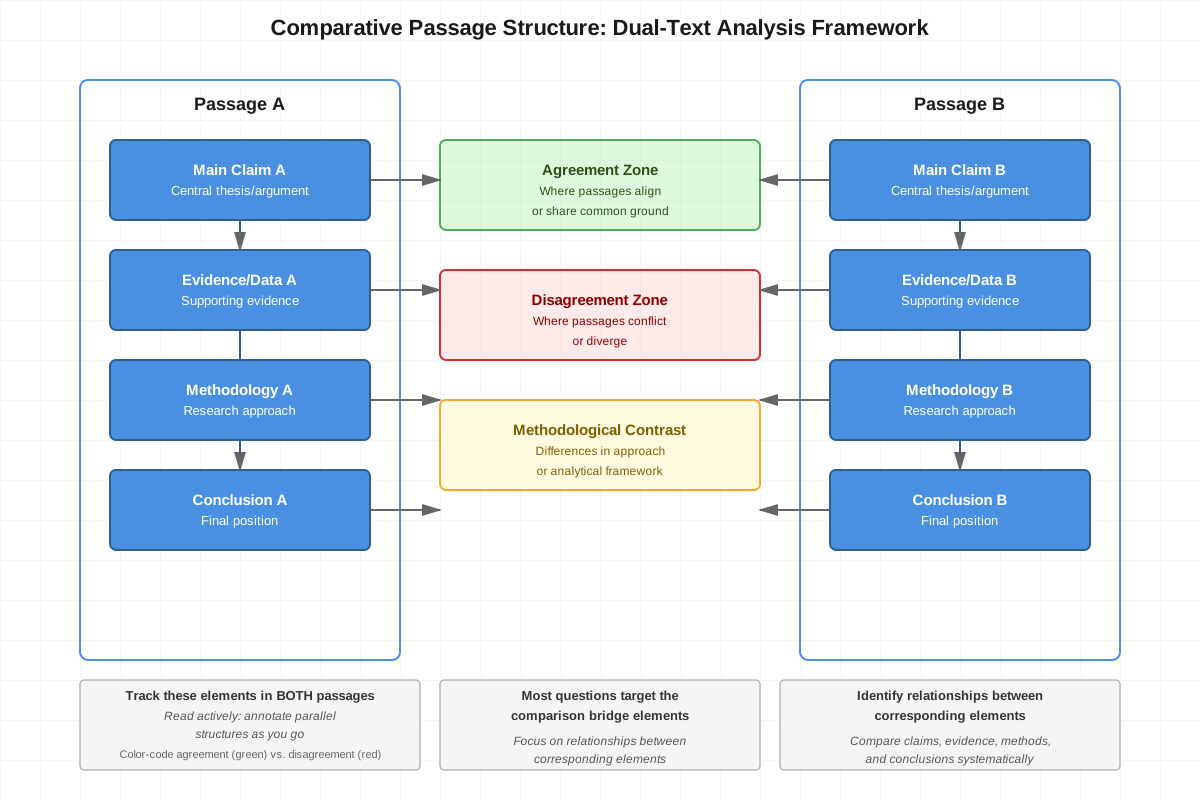
Lsat comparative social science passages follow a distinctive structural format that differs from traditional single-passage reading. Each comparative set consists of two shorter passages, typically ranging from 200-350 words combined, compared to the 450-550 words of a standard single passage. Passage A always appears first and establishes an initial perspective, methodology, or argument. Passage B follows and may support, challenge, extend, or provide an alternative to Passage A's content. The relationship between passages exists on a spectrum from complete agreement to direct opposition, with most falling somewhere in the middle—partial agreement with key differences in emphasis, methodology, or conclusions.
The structural patterns most frequently encountered include: parallel structure (both passages address the same question using similar organizational frameworks but reach different conclusions), response structure (Passage B directly responds to or critiques claims made in Passage A), complementary structure (each passage addresses different aspects of a broader topic), and contrasting methodology structure (both passages examine the same phenomenon but employ different research approaches or theoretical frameworks).
Types of Relationships Between Passages
Understanding the relationship between paired passages represents the most critical skill for success with comparative reading. These relationships can be categorized along several dimensions:
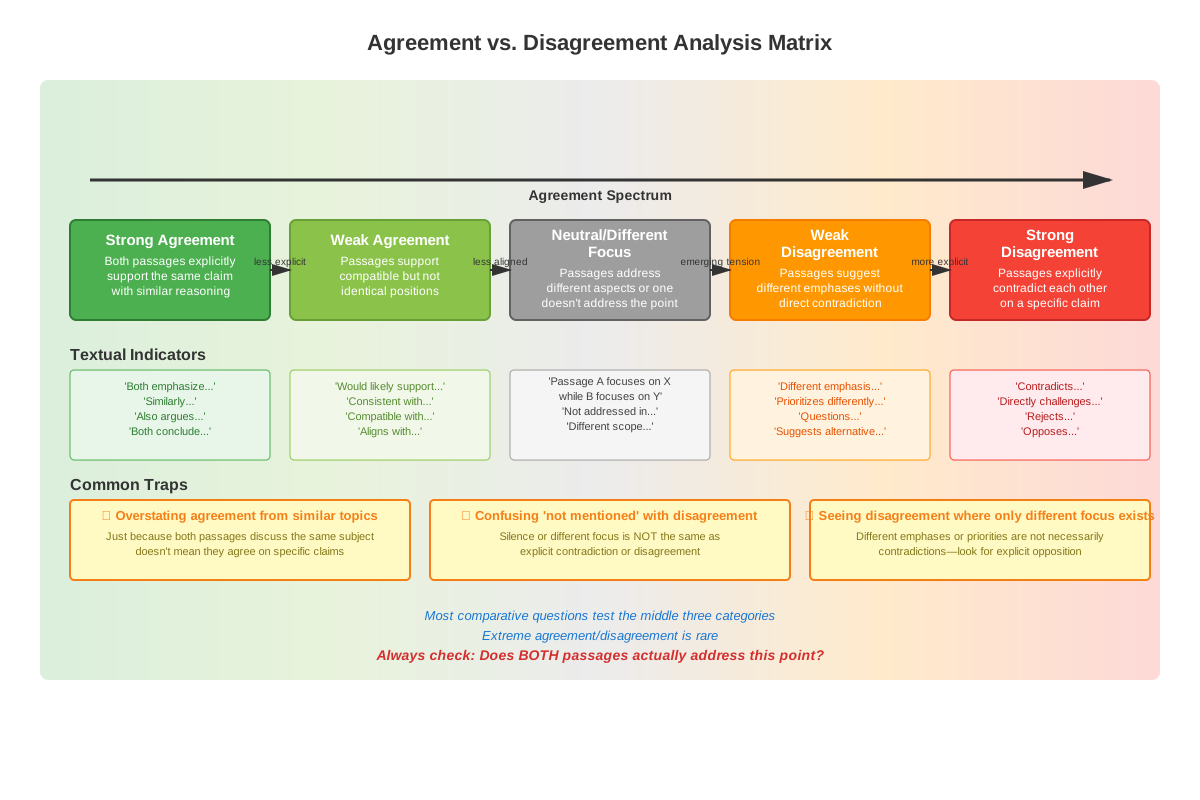
Agreement/Disagreement Spectrum: Passages may completely agree (rare), partially agree with nuanced differences (common), remain neutral or address different aspects without direct conflict (moderate frequency), partially disagree while sharing some common ground (very common), or completely oppose each other (uncommon). Most LSAT comparative passages fall into the "partial agreement with significant differences" or "partial disagreement with some common ground" categories, as these create the richest opportunities for nuanced questions.
Methodological Relationships: Social science passages frequently differ in their research approaches. One passage might present quantitative research (statistical analysis, large-scale surveys, experimental data) while the other employs qualitative methods (case studies, ethnographic observation, textual analysis). Alternatively, one might take a theoretical approach (developing conceptual frameworks, philosophical analysis) while the other emphasizes empirical evidence (observational data, experimental results). These methodological differences often explain divergent conclusions even when authors examine the same phenomenon.
Scope and Focus Relationships: Passages may differ in their breadth of analysis. One might take a macro-level perspective (examining broad social trends, large populations, systemic factors) while the other adopts a micro-level focus (analyzing individual behavior, specific cases, local contexts). Similarly, one passage might emphasize historical context while the other focuses on contemporary applications, or one might stress theoretical implications while the other highlights practical consequences.
Question Types Specific to Comparative Reading
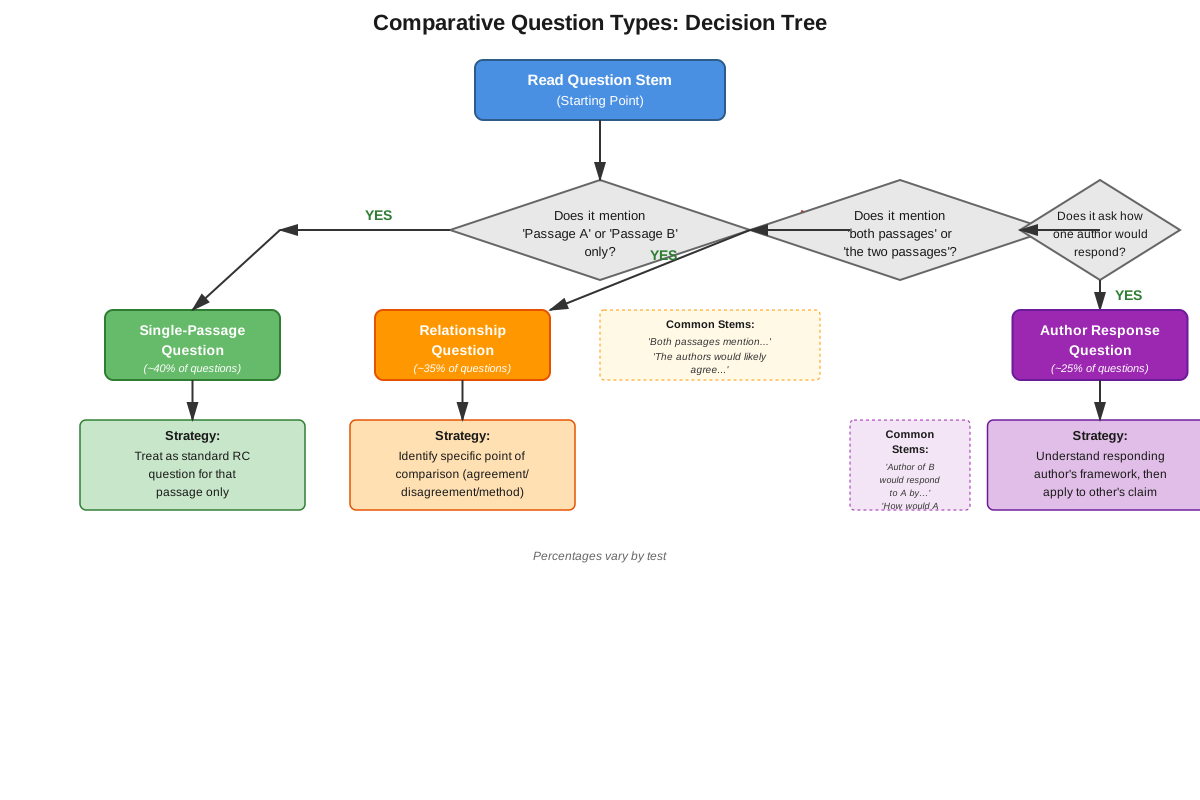
Comparative passages generate several distinctive question types that rarely or never appear with single passages:
Relationship Questions directly ask about how the passages relate to each other: "Which one of the following most accurately describes the relationship between the two passages?" or "The author of Passage B would most likely respond to the claim in lines 12-15 of Passage A by..." These questions require synthesizing both passages and identifying the precise nature of their connection.
Comparative Inference Questions ask what can be inferred about one passage based on information in the other: "Based on Passage B, the author would most likely regard the methodology described in Passage A as..." or "The evidence presented in Passage A most strongly supports which one of the following criticisms that could be made of Passage B's argument?"
Agreement/Disagreement Questions explicitly test whether authors would agree or disagree on specific claims: "The authors of both passages would be most likely to agree with which one of the following statements?" or "On which one of the following points would the authors most likely disagree?"
Dual Application Questions require applying concepts or principles from both passages to new situations: "Which one of the following scenarios would both authors consider most problematic?" or "The approaches described in both passages would be most useful for addressing which one of the following situations?"
Reading Strategy for Comparative Passages
Effective navigation of comparative social science passages requires a modified reading approach. The two-pass method proves most effective: first, read Passage A completely while noting its main claim, supporting evidence, methodology (if applicable), and tone. Before moving to Passage B, briefly predict how it might relate to Passage A—will it likely agree, disagree, extend, or provide an alternative? Then read Passage B while actively comparing it to Passage A, noting points of agreement, disagreement, and methodological or focus differences.
Active annotation becomes particularly important with comparative passages. Mark parallel claims (where both authors address the same point), contrasting claims (where authors disagree), and unique claims (addressed by only one author). Use consistent notation—for example, "A+" for Passage A's positive claims, "B-" for Passage B's criticisms, "=" for points of agreement, and "≠" for points of disagreement.
Common Social Science Content Areas
Certain social science topics appear with notable frequency in comparative passages. Research methodology debates often feature prominently, with passages contrasting experimental versus observational studies, quantitative versus qualitative approaches, or laboratory versus field research. Policy analysis passages frequently present competing perspectives on social interventions, economic policies, or regulatory approaches. Historical interpretation passages may offer different explanations for social changes, cultural developments, or historical events. Theoretical frameworks passages contrast different schools of thought within psychology, sociology, economics, or political science.
Understanding these common content patterns helps with efficient reading and prediction. For instance, when encountering a passage describing an experimental study's findings, anticipate that Passage B might critique the experimental methodology, present contradictory observational data, or question the generalizability of laboratory results to real-world settings.
Concept Relationships
The concepts within comparative social science passages form an interconnected analytical framework. Passage structure serves as the foundation, determining how information is organized and presented. This structure directly influences relationship identification, as parallel structures often signal point-by-point comparison while response structures indicate direct engagement between passages. The relationship type (agreement/disagreement, methodological difference, scope variation) then determines which question types will appear and how they should be approached.
Reading strategy connects to all other concepts, as the two-pass method and active annotation enable efficient identification of both passage structure and relationships. The strategy must adapt based on content area—methodology debates require careful attention to research design details, while policy analyses demand focus on underlying assumptions and values. Question types circle back to relationship identification, as most comparative questions test understanding of how passages connect, differ, or would interact.
The progression flows: Passage Structure → Reading Strategy → Relationship Identification → Question Type Recognition → Answer Selection. However, this is not strictly linear; recognizing question types during initial reading can sharpen focus on relevant relationships, creating a feedback loop that enhances comprehension efficiency.
Connections to prerequisite knowledge include: basic reading comprehension skills enable understanding of each individual passage, which is necessary before comparative analysis can occur; familiarity with passage structure helps identify parallel or contrasting organizational patterns; and experience with standard question types provides the foundation for understanding comparative-specific variations.
High-Yield Facts
⭐ Comparative passages appear exactly once per Reading Comprehension section, typically consisting of 6-8 questions
⭐ Approximately 40-50% of comparative passages focus on social science topics, making this the most common comparative passage type
⭐ The most frequently tested relationship is "partial agreement with significant methodological or focus differences," not complete agreement or complete disagreement
⭐ Questions asking about both passages collectively ("both authors would agree...") typically have answers that are more general or abstract than passage-specific details
⭐ When passages present different research methodologies, at least one question will test understanding of these methodological differences
- Passage B is typically slightly longer than Passage A, averaging 55-60% of the total word count
- Relationship questions constitute approximately 30-40% of all questions accompanying comparative passages
- Wrong answers on comparative questions frequently confuse which passage made which claim or incorrectly attribute agreement where disagreement exists
- The correct answer to "both authors would agree" questions must be supported by explicit or clearly inferable information from both passages, not just one
- Comparative passages in social sciences most commonly address research methodology, policy debates, or theoretical frameworks rather than purely descriptive content
Quick check — test yourself on Comparative social science passages so far.
Try Flashcards →Common Misconceptions
Misconception: Passage B always disagrees with or critiques Passage A → Correction: While Passage B often provides a contrasting perspective, the relationship can range from supportive extension to complete opposition, with most passages showing partial agreement and partial disagreement. Assuming automatic opposition leads to misreading nuanced relationships.
Misconception: Questions about "both passages" require finding information explicitly stated in both texts → Correction: These questions often require inference and synthesis. The correct answer might involve a principle that both authors would accept based on their arguments, even if neither explicitly states it. The key is logical consistency with both passages, not explicit mention.
Misconception: Longer passages are more important or contain more testable information → Correction: Both passages receive equal attention in questions. In fact, Passage A, despite often being shorter, frequently generates more questions because Passage B questions often ask about its relationship to Passage A, requiring understanding of both.
Misconception: Comparative passages are simply two separate passages that happen to appear together → Correction: The passages are deliberately paired to create analytical opportunities. Reading them in isolation misses the relational dimension that generates most questions. The relationship itself is content that must be comprehended and analyzed.
Misconception: Methodological differences between passages are minor details → Correction: In social science comparative passages, methodological differences often explain divergent conclusions and generate multiple questions. Whether one passage uses quantitative versus qualitative methods, experimental versus observational approaches, or theoretical versus empirical analysis frequently becomes central to understanding the passages' relationship.
Misconception: If passages discuss different aspects of a topic, they don't really relate to each other → Correction: Even when passages address different dimensions of a broader topic, they maintain a relationship—often complementary or providing different perspectives on a shared concern. Questions will test understanding of how these different aspects connect to the larger issue.
Worked Examples
Example 1: Methodology Contrast Passage
Passage A (abbreviated): A recent large-scale survey of 10,000 employees across 200 companies found a strong correlation between workplace flexibility policies and reported job satisfaction. Statistical analysis revealed that companies offering remote work options showed 23% higher satisfaction scores. The quantitative data suggests that flexibility directly improves employee well-being and should be adopted broadly.
Passage B (abbreviated): While statistical correlations between workplace policies and satisfaction are informative, they cannot capture the nuanced reality of workplace dynamics. My ethnographic study of three companies implementing flexibility policies revealed that success depended heavily on organizational culture and management practices. In one company, remote work increased satisfaction; in another, it created feelings of isolation and disconnection. Context matters more than policy alone.
Question: The author of Passage B would most likely respond to the statistical findings in Passage A by:
Analysis Process:
- Identify Passage A's main claim: Quantitative data shows flexibility improves satisfaction; this should be broadly adopted
- Identify Passage B's main claim: Context and culture matter more than policy alone; quantitative data misses important nuances
- Determine relationship: Passage B doesn't reject Passage A's findings but questions their interpretation and generalizability
- Predict answer: Passage B's author would likely acknowledge the correlation but emphasize that it doesn't account for contextual factors
Correct Answer Type: "acknowledging the correlation but noting that it doesn't account for the role of organizational culture and management practices in determining outcomes"
Why this works: This answer recognizes that Passage B doesn't dismiss quantitative findings entirely (avoiding extreme opposition) but emphasizes the limitation that aligns with Passage B's focus on context and nuance. It synthesizes both passages' perspectives rather than forcing complete agreement or disagreement.
Common wrong answer types:
- "rejecting the statistical findings as methodologically flawed" (too extreme; Passage B doesn't attack the methodology, just its limitations)
- "agreeing that flexibility policies should be broadly adopted" (contradicts Passage B's emphasis on context-dependence)
- "arguing that qualitative research is superior to quantitative research" (Passage B doesn't make this hierarchical claim)
Example 2: Theoretical Framework Contrast
Passage A (abbreviated): Economic behavior is fundamentally rational. Individuals assess costs and benefits, then act to maximize their utility. While people occasionally make errors, these are random deviations from rational decision-making. Market outcomes reflect the aggregate of these rational choices, making markets efficient information-processing mechanisms.
Passage B (abbreviated): Behavioral economics has demonstrated systematic patterns in human decision-making that deviate from rational choice models. Loss aversion, framing effects, and present bias are not random errors but predictable patterns. These cognitive biases significantly influence economic behavior and market outcomes, suggesting that traditional rational choice models require substantial revision.
Question: Both authors would be most likely to agree with which of the following statements?
Analysis Process:
- Identify common ground: Both passages acknowledge that people sometimes deviate from perfectly rational decision-making (Passage A: "occasionally make errors"; Passage B: acknowledges traditional models exist but need revision)
- Identify differences: Passage A sees deviations as random and insignificant; Passage B sees them as systematic and significant
- Find overlap: What must be true for both perspectives? Both recognize that economic behavior can be studied and analyzed; both acknowledge that actual behavior sometimes differs from theoretical predictions
- Evaluate answer choices for universal support: The correct answer must be consistent with both the rational choice and behavioral economics perspectives
Correct Answer Type: "Understanding economic behavior requires examining the relationship between theoretical models and observed outcomes"
Why this works: This statement is abstract enough to encompass both perspectives. Passage A examines this relationship and concludes models are largely accurate; Passage B examines it and concludes models need revision. Both engage in the activity described, even though they reach different conclusions.
Common wrong answer types:
- "Cognitive biases play a significant role in economic decision-making" (only Passage B supports this)
- "Market outcomes generally reflect rational decision-making" (only Passage A supports this)
- "Traditional economic models accurately predict behavior" (contradicts Passage B)
- "Random errors in decision-making are insignificant" (contradicts Passage B's emphasis on systematic patterns)
Exam Strategy
Initial Reading Approach
When encountering comparative social science passages, allocate approximately 3-4 minutes for reading both passages and 4-5 minutes for questions (assuming 7 questions). Read Passage A first with full attention, identifying its main claim, key evidence, and methodology if applicable. Before moving to Passage B, pause for 5-10 seconds to predict the relationship—this priming enhances active reading of Passage B.
While reading Passage B, constantly compare to Passage A. Use margin notation to mark: agreements (=), disagreements (≠), methodological differences (M), and scope differences (S). This active comparison during initial reading dramatically improves efficiency when answering questions, as you've already identified key relationships rather than searching for them later.
Trigger Words and Phrases
Certain language signals important relationships between passages:
Agreement indicators: "similarly," "likewise," "also," "in addition," "supporting this view"
Disagreement indicators: "however," "in contrast," "on the other hand," "challenges this view," "overlooks," "fails to account for"
Methodological signals: "quantitative," "qualitative," "empirical," "theoretical," "experimental," "observational," "case study," "statistical analysis"
Scope signals: "broadly," "specifically," "in general," "in particular cases," "systemic," "individual"
Nuance indicators: "while," "although," "despite," "nevertheless" (these often signal partial agreement/disagreement)
Question-Specific Strategies
For relationship questions: Eliminate extreme answers first. Complete agreement or complete opposition is rare. Look for answers that acknowledge both commonalities and differences. The correct answer typically includes qualifying language like "partially," "in some respects," or "while agreeing on X, differs regarding Y."
For "both authors would agree" questions: The correct answer is usually more general or abstract than passage-specific details. Test each answer against both passages explicitly—if you can imagine either author objecting, eliminate it. These questions often require inference rather than explicit textual support.
For "author of Passage B would respond to Passage A" questions: Focus on Passage B's main perspective and methodology. The correct answer typically applies Passage B's framework or concerns to Passage A's claims. Avoid answers that make Passage B's author more extreme or dismissive than the passage supports.
For comparative inference questions: These require synthesizing information across passages. The correct answer often involves recognizing implications that neither passage explicitly states but both support. Look for logical consequences of combining both perspectives.
Process of Elimination Tips
Wrong answers in comparative questions frequently:
- Attribute claims to the wrong passage (always verify which passage made which claim)
- Exaggerate agreement or disagreement (making relationships more extreme than they are)
- Introduce outside information not supported by either passage
- Confuse methodological differences with substantive disagreements
- Treat partial agreement as complete agreement or partial disagreement as complete opposition
When stuck between two answers, return to the passages and verify each claim in the answer choices. For comparative questions, this verification must occur for both passages—an answer that perfectly describes Passage A but contradicts Passage B is wrong.
Time Management
If running short on time, prioritize relationship questions and "both authors" questions, as these test the core comparative skill and are often worth the investment. Passage-specific questions (those asking only about Passage A or only about Passage B) can be answered using standard single-passage techniques and may be faster to complete.
Memory Techniques
COMPARE acronym for reading strategy:
- Claim: Identify each passage's main claim
- Organization: Note structural similarities and differences
- Methodology: Mark research approaches or analytical frameworks
- Points of agreement: Flag where authors align
- Areas of disagreement: Note where authors diverge
- Relationship: Determine overall connection between passages
- Evidence: Track what supports each author's position
The Spectrum Visualization: Picture agreement/disagreement as a spectrum from -5 (complete opposition) to +5 (complete agreement), with 0 as neutral/addressing different aspects. Most LSAT comparative passages fall between -2 and +2 (partial disagreement to partial agreement). This mental model prevents treating nuanced relationships as extreme positions.
The Three M's for social science passages: Methodology (how they study), Main claim (what they conclude), Magnitude (scope and generalizability). Tracking these three elements for each passage provides a framework for comparison.
Question Type Mnemonic - RAID:
- Relationship questions (how passages connect)
- Agreement questions (what both authors accept)
- Inference questions (what follows from combining passages)
- Disagreement questions (where authors diverge)
Summary
Comparative social science passages represent a high-stakes component of LSAT Reading Comprehension, appearing once per section and testing the ability to analyze relationships between paired texts addressing related social science topics. Success requires mastering both individual passage comprehension and the additional analytical layer of identifying agreements, disagreements, methodological differences, and scope variations between passages. The most effective approach involves a two-pass reading strategy: first comprehending Passage A independently, then actively comparing Passage B to Passage A while reading. Most comparative relationships fall into the nuanced middle ground of partial agreement with significant differences, rather than complete agreement or opposition. Questions emphasize relationship analysis, comparative inference, and synthesis across both passages. The key to accuracy lies in avoiding extreme interpretations, carefully attributing claims to the correct passage, and recognizing that "both authors would agree" answers typically involve more general principles than passage-specific details. Understanding common social science content patterns—methodology debates, policy analyses, theoretical frameworks—enables efficient prediction and comprehension. With systematic practice applying the COMPARE framework and recognizing the distinctive question types that accompany these passages, students can transform comparative reading from a challenging obstacle into a reliable source of points.
Key Takeaways
- Comparative social science passages appear exactly once per Reading Comprehension section and account for approximately 6-8 questions, making them high-value targets for focused preparation
- The relationship between passages typically involves partial agreement with significant methodological, scope, or focus differences—not complete agreement or complete opposition
- Active comparison during initial reading (using the two-pass method and margin notation) dramatically improves efficiency and accuracy on relationship-based questions
- "Both authors would agree" questions require answers supported by both passages and typically involve more general principles than passage-specific details
- Methodological differences in social science passages (quantitative vs. qualitative, experimental vs. observational, theoretical vs. empirical) frequently explain divergent conclusions and generate multiple questions
- Wrong answers commonly attribute claims to the wrong passage, exaggerate relationships, or confuse methodological differences with substantive disagreements
- Success requires synthesizing information across passages rather than treating them as independent texts that happen to appear together
Related Topics
Single-Passage Social Science Reading: Mastering comparative passages builds on and reinforces skills for analyzing individual social science passages, including identifying research methodology, evaluating evidence, and understanding theoretical frameworks. The comparative format simply adds the relational dimension to these foundational skills.
Comparative Natural Science Passages: The analytical framework developed for social science comparative passages transfers directly to natural science comparisons, though content knowledge differs. Understanding how to identify methodological differences and synthesize competing perspectives applies across disciplines.
Logical Reasoning - Strengthen/Weaken Questions: The skill of evaluating how evidence supports or undermines claims, central to comparative passage analysis, directly parallels strengthen and weaken questions in Logical Reasoning. Both require understanding argument structure and evidential relationships.
Logical Reasoning - Point at Issue Questions: These questions ask what two speakers disagree about, mirroring the disagreement identification required in comparative passages. The analytical process—finding precise points of divergence while recognizing areas of agreement—is nearly identical.
Advanced Inference Questions: Comparative passages develop sophisticated inference skills by requiring synthesis across multiple texts. This advanced inference ability enhances performance on complex single-passage inference questions throughout Reading Comprehension.
Practice CTA
Now that you've mastered the conceptual framework for comparative social science passages, it's time to apply these strategies to actual LSAT questions. Work through the practice questions accompanying this guide, focusing on implementing the two-pass reading method and actively identifying relationships between passages. Use the COMPARE framework to structure your analysis, and pay special attention to question types that initially challenge you—these represent your highest-yield opportunities for improvement. Review the flashcards to reinforce high-yield facts and common patterns. Remember that comparative reading is a skill that improves dramatically with deliberate practice. Each passage you analyze strengthens your ability to efficiently identify relationships and synthesize information across texts—skills that will serve you throughout the LSAT and in law school. You've built the foundation; now apply it with confidence!
Sign up free to keep reading
Create a free AnvayaPrep account to finish this LSAT guide on Comparative social science passages — plus flashcards and practice questions.