Overview
Introductions in LSAT Reading Comprehension passages serve as the critical gateway to understanding the author's purpose, scope, and argumentative direction. The opening paragraph or sentences of an LSAT passage are strategically crafted to establish the framework within which all subsequent information will be presented. Mastering the analysis of passage fundamentals through careful attention to introductions enables test-takers to predict passage structure, identify the main point efficiently, and navigate questions with greater accuracy. Unlike casual reading where introductions might be skimmed, LSAT introductions demand active, strategic engagement because they contain high-density information that directly impacts performance on multiple question types.
The importance of introductions extends beyond mere comprehension—they function as roadmaps that reveal the author's attitude, signal upcoming contrasts or developments, and establish the central tension or question the passage will address. Strong performance on reading comprehension questions correlates directly with the ability to extract maximum value from these opening sentences. Test-takers who develop systematic approaches to analyzing introductions consistently outperform those who treat all sentences equally, as introductions disproportionately contain information tested in main point, primary purpose, and structure questions.
Within the broader context of passage fundamentals, introductions work in concert with other structural elements like topic sentences, transitions, and conclusions to create a coherent argumentative architecture. Understanding how introductions set up the passage's trajectory allows students to anticipate where the author will go next, recognize when new perspectives are being introduced, and distinguish between background information and the author's central claim. This foundational skill supports success across all Reading Comprehension question types and serves as the bedrock upon which more advanced analytical techniques are built.
Learning Objectives
- [ ] Identify how Introductions appears in LSAT questions
- [ ] Explain the reasoning pattern behind Introductions
- [ ] Apply Introductions to solve LSAT-style problems accurately
- [ ] Distinguish between background information and thesis statements in opening paragraphs
- [ ] Predict passage structure and development based on introduction analysis
- [ ] Recognize common introduction patterns across different passage types (science, law, humanities, social sciences)
- [ ] Evaluate the author's tone and attitude as established in introductory sentences
- [ ] Connect information from introductions to specific question types that test this content
Prerequisites
- Basic reading comprehension skills: The ability to understand complex sentences and extract explicit information is necessary before analyzing strategic elements like introductions.
- Familiarity with passage structure: Understanding that LSAT passages have deliberate organization helps contextualize why introductions matter.
- Awareness of question types: Knowing the difference between main point, primary purpose, and detail questions clarifies why introduction analysis yields strategic advantages.
- Active reading habits: The capacity to engage with text critically rather than passively enables the focused attention introductions require.
Why This Topic Matters
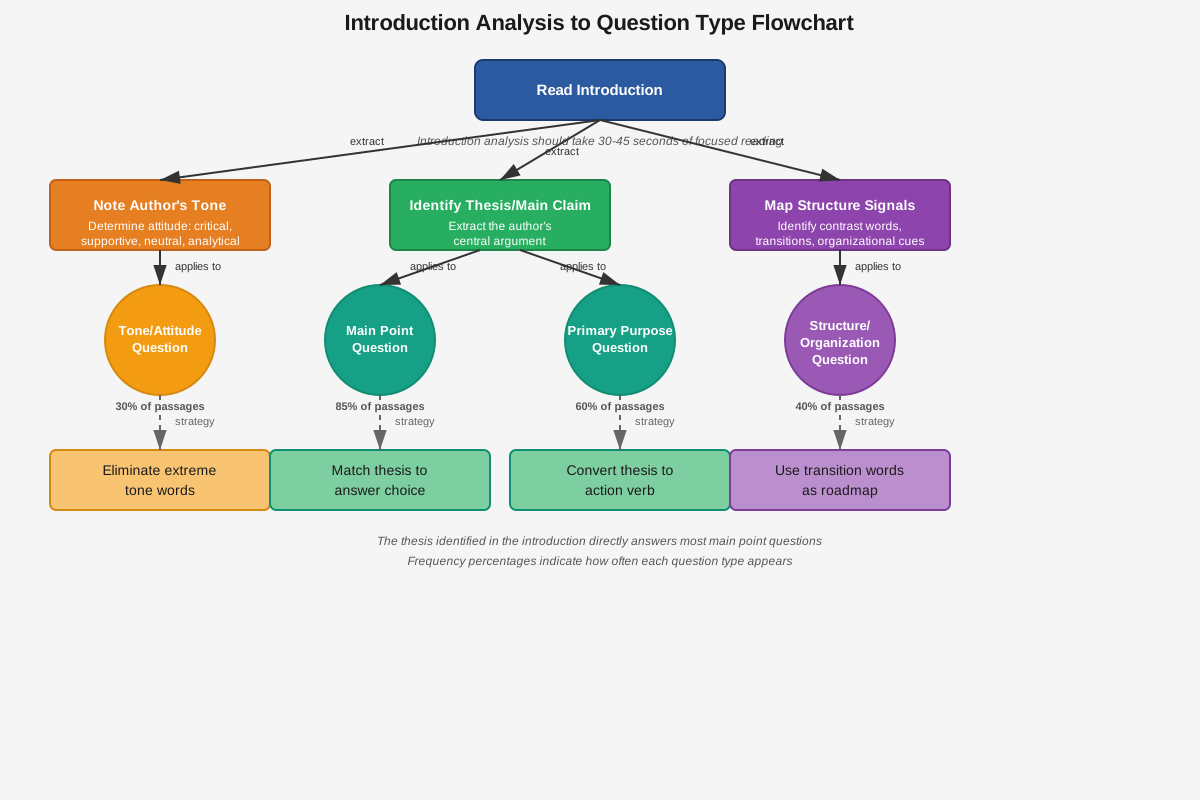
Introductions appear in every single LSAT Reading Comprehension passage, making this topic universally relevant with 100% frequency across all test administrations. The opening paragraph directly informs answers to main point questions (appearing in approximately 85% of passage sets), primary purpose questions (appearing in roughly 60% of passage sets), and structure/organization questions (appearing in about 40% of passage sets). Additionally, introductions often contain information that eliminates wrong answers in inference and detail questions, making them among the highest-yield elements to master.
In real-world applications, the skill of rapidly extracting key information from introductions translates directly to legal practice, where attorneys must quickly grasp the central issues in case briefs, statutes, and legal memoranda. Academic research, policy analysis, and professional writing all rely on the same principle: introductions signal what matters most and establish the framework for everything that follows.
Common manifestations of introductions in LSAT passages include: traditional thesis statements that explicitly state the author's main claim; question-posing introductions that present a puzzle or controversy the passage will address; historical or contextual setups that provide background before pivoting to the author's focus; contrasting viewpoints where the introduction presents a conventional view the author will challenge; and phenomenon descriptions that introduce a scientific or social observation requiring explanation. Recognizing these patterns enables test-takers to categorize passages quickly and activate appropriate reading strategies.
Core Concepts
The Anatomy of LSAT Introductions
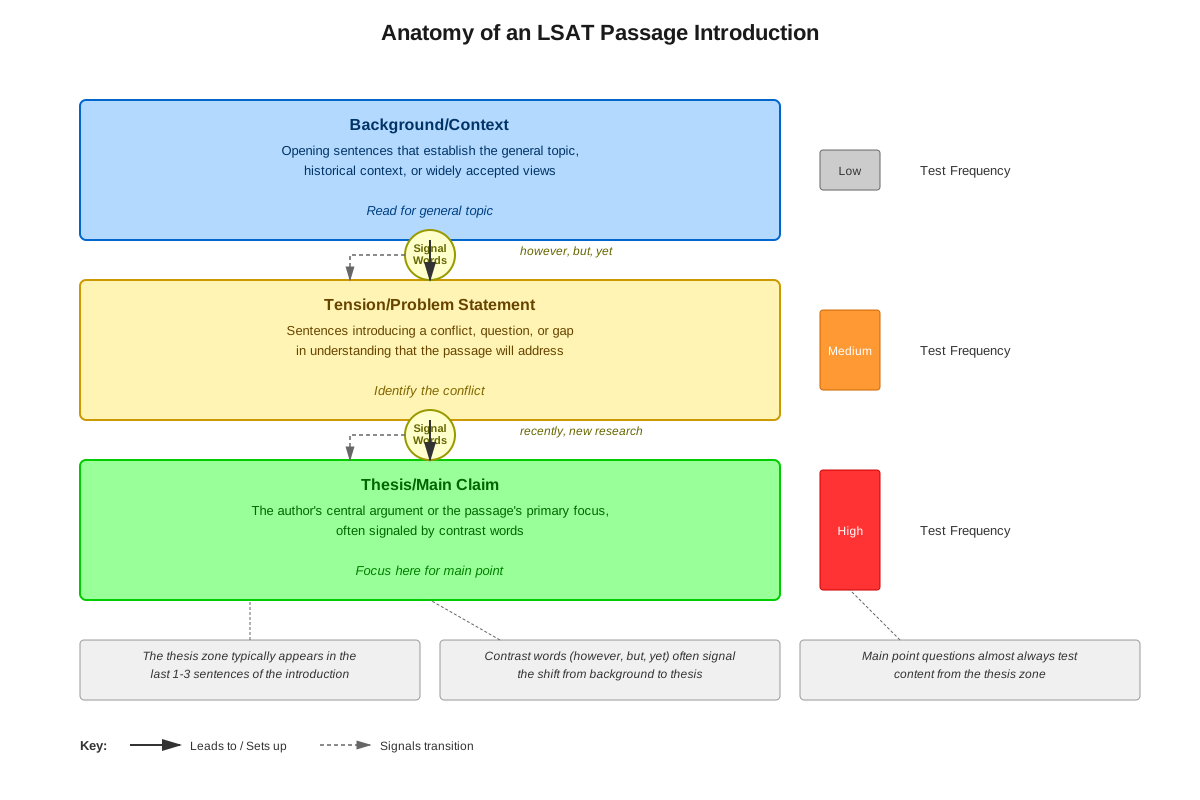
LSAT introductions typically span the first 2-5 sentences of a passage, though occasionally the entire first paragraph serves this function. These opening sentences perform multiple simultaneous functions: establishing topic (what the passage is about), scope (the specific aspect being addressed), purpose (why the author is writing), and often tone (the author's attitude toward the subject). Understanding this multi-layered functionality prevents the common error of treating introductions as mere warm-up text.
The topic represents the broad subject matter—for example, "judicial interpretation" or "evolutionary biology." The scope narrows this to the specific angle: "how textualist judges approach ambiguous statutes" or "the role of sexual selection in peacock plumage evolution." The purpose might be to argue, explain, compare, critique, or synthesize. The tone could be neutral/objective, critical, enthusiastic, cautious, or advocating. Skilled readers extract all four elements from introductions, creating a mental framework that guides comprehension of subsequent paragraphs.
Common Introduction Patterns
| Pattern Type | Characteristics | Strategic Approach |
|---|---|---|
| Direct Thesis | Author states main claim immediately | Underline/note the thesis; expect supporting evidence in body |
| Question-Driven | Poses a question or puzzle | Anticipate the answer/resolution in later paragraphs |
| Background-to-Thesis | Provides context before pivoting to main point | Distinguish setup information from the actual claim |
| Conventional View Challenge | Presents common belief, then signals disagreement | Watch for contrast keywords; author's view comes after the pivot |
| Phenomenon Description | Describes an observation requiring explanation | Look for competing theories or the author's preferred explanation |
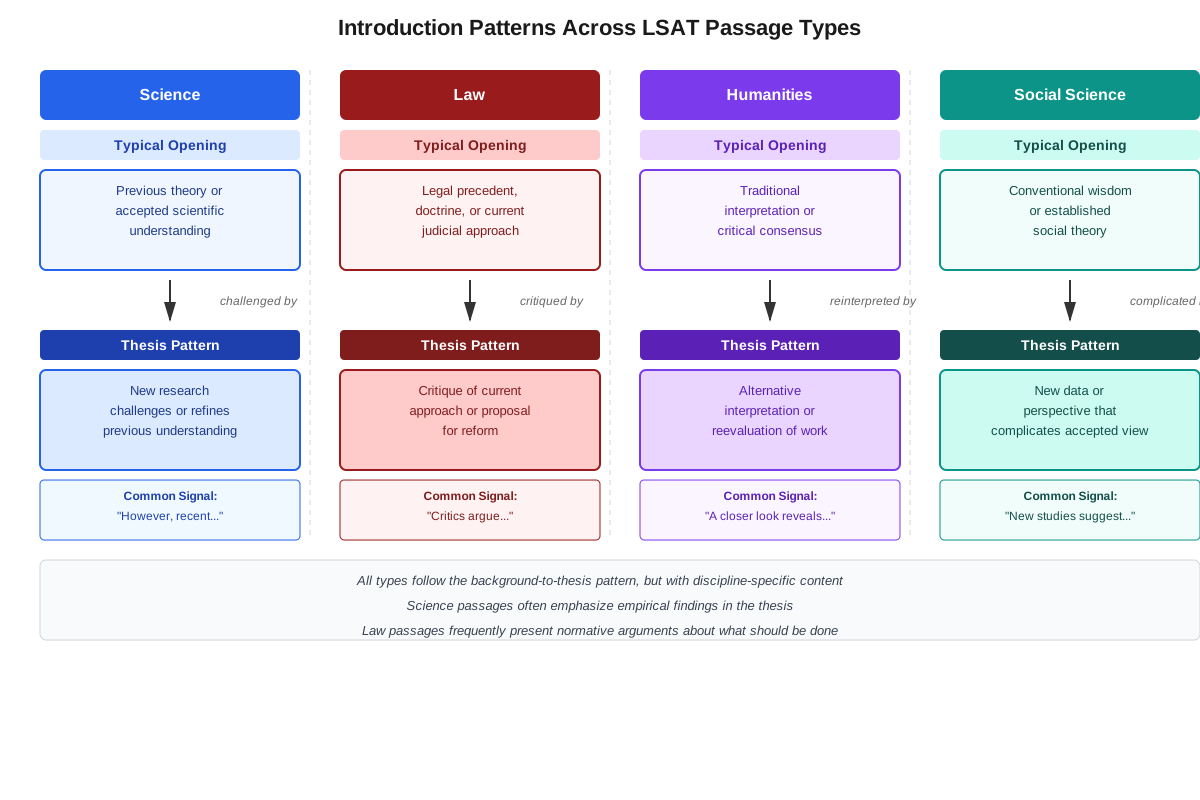
The Direct Thesis pattern appears frequently in humanities and law passages, where authors state their interpretive claim or legal argument upfront. For example: "The conventional reading of Justice Holmes's dissent in Lochner v. New York misunderstands his commitment to judicial restraint." This immediately tells readers the author will challenge an existing interpretation.
The Question-Driven pattern is common in science passages: "Why do certain species exhibit altruistic behavior that appears to contradict evolutionary self-interest?" This signals the passage will present theories or evidence addressing this puzzle.
The Background-to-Thesis pattern often begins with historical context or established facts before introducing the author's novel contribution: "For decades, scholars accepted the traditional dating of the manuscript. Recent technological advances, however, suggest a much earlier origin." The pivot word "however" marks the transition from background to thesis.
Pivot Points and Transition Signals
Within introductions, pivot points mark crucial shifts in direction or emphasis. These transitions signal when the author moves from background to thesis, from conventional view to challenge, or from general to specific. Key transition words include: "however," "yet," "but," "nevertheless," "recently," "in fact," "actually," and "although." Missing these pivots causes readers to confuse background information with the author's actual position—a critical error that leads to wrong answers on main point questions.
Consider this example: "Traditional economic models assume rational actors making optimal choices. Behavioral economists, however, have demonstrated systematic deviations from rationality in decision-making contexts." The word "however" signals that the author's focus is on the challenge to traditional models, not the traditional models themselves. Test-takers who miss this pivot might incorrectly identify the passage's main point as being about traditional economic models rather than behavioral economics.
Author's Attitude Indicators
Introductions frequently contain subtle (and sometimes explicit) indicators of the author's attitude or stance toward the subject matter. Evaluative language, even single words, provides crucial information. Phrases like "unfortunately," "surprisingly," "importantly," "merely," "significantly," or "problematically" reveal the author's perspective. Recognizing these attitude markers helps answer tone questions and eliminates wrong answers that mischaracterize the author's viewpoint.
For instance, if an introduction states: "The court's reasoning, while superficially appealing, rests on a fundamental misunderstanding of precedent," the phrase "superficially appealing" and "fundamental misunderstanding" clearly indicate critical disapproval. This eliminates answer choices suggesting the author is neutral or supportive of the court's reasoning.
Scope Limitations
Effective introductions establish not only what the passage will discuss but also what it will not discuss. Recognizing scope limitations prevents test-takers from selecting answers that are too broad or that introduce topics outside the passage's focus. Phrases like "this essay focuses specifically on," "limiting our analysis to," or "within the context of" explicitly narrow the scope. Even without such explicit markers, the specific details mentioned in the introduction define boundaries.
If an introduction discusses "the impact of the 1965 Voting Rights Act on Southern state election procedures," answers about voting rights in Northern states or about other civil rights legislation would exceed the established scope. Scope awareness, established through careful introduction analysis, is particularly valuable for eliminating wrong answers in primary purpose and main point questions.
Concept Relationships
The concepts within introduction analysis form an interconnected system where each element reinforces the others. Topic identification → leads to → scope recognition → which enables → purpose determination → which combines with → tone analysis → to produce → comprehensive passage prediction. This sequential yet integrated process means that missing any single element weakens the entire analytical framework.
Introduction analysis connects directly to prerequisite knowledge of passage structure because introductions establish the organizational pattern that subsequent paragraphs will follow. A question-driven introduction predicts that body paragraphs will present possible answers or evidence. A conventional-view-challenge introduction predicts a structure where the author first elaborates the conventional view before presenting counterarguments.
The relationship between introductions and main point questions is particularly direct: approximately 70% of correct main point answers can be predicted or strongly anticipated from introduction analysis alone. Similarly, introductions connect to primary purpose questions by establishing whether the author's goal is to argue, explain, compare, critique, or synthesize. This connection means that time invested in careful introduction analysis yields returns across multiple question types, making it among the most efficient strategic investments test-takers can make.
High-Yield Facts
⭐ Every LSAT Reading Comprehension passage contains an introduction that establishes topic, scope, purpose, and often tone within the first 2-5 sentences.
⭐ Pivot words like "however," "yet," and "but" within introductions signal crucial transitions from background to thesis or from conventional view to the author's challenge.
⭐ Main point questions can be answered correctly approximately 70% of the time based primarily on careful introduction analysis.
⭐ The author's attitude toward the subject matter is frequently established through evaluative language in the introduction, directly informing tone and attitude questions.
⭐ Scope limitations established in introductions eliminate wrong answers that are too broad or that introduce out-of-scope topics.
- Question-driven introductions predict that the passage will present theories, explanations, or evidence addressing the posed question.
- Background-to-thesis introductions require distinguishing between setup information and the author's actual claim, with the thesis typically following a pivot word.
- Direct thesis introductions, common in humanities and law passages, state the main claim immediately and predict that body paragraphs will provide supporting evidence.
- Conventional-view-challenge introductions signal a two-part structure: elaboration of the conventional view followed by the author's counterargument.
- Introductions that describe phenomena or observations predict that the passage will offer explanations, compare competing theories, or present new evidence.
- Approximately 85% of passage sets include a main point question, and introduction analysis is the primary tool for answering these questions efficiently.
- Time spent analyzing introductions (typically 30-45 seconds) yields returns across multiple question types, making it a high-efficiency strategic investment.
Quick check — test yourself on Introductions so far.
Try Flashcards →Common Misconceptions
Misconception: The introduction is just background information that can be skimmed quickly to get to the "real content" in later paragraphs.
Correction: Introductions contain the highest-density strategic information in the passage, establishing the framework that determines how all subsequent information should be understood. Skimming introductions leads to misidentifying main points and misunderstanding passage structure.
Misconception: The first sentence always contains the main point or thesis.
Correction: While some passages use direct thesis introductions where the main claim appears early, many passages use background-to-thesis or question-driven patterns where the thesis emerges after several sentences of setup. Readers must distinguish between background and thesis rather than assuming the first sentence is always most important.
Misconception: All information in the introduction is equally important and should be remembered with equal attention.
Correction: Within introductions, certain elements (thesis statements, pivot points, scope limitations, attitude indicators) carry more strategic weight than background details. Effective readers prioritize extracting these high-value elements rather than trying to memorize every detail.
Misconception: If the introduction presents two viewpoints, the author agrees with whichever is mentioned first.
Correction: In conventional-view-challenge introductions, the first viewpoint presented is often the one the author will disagree with. Pivot words signal when the author transitions to their own position, which typically comes after the conventional view is presented.
Misconception: Introductions in science passages are always objective and neutral, so tone analysis is unnecessary.
Correction: Even science passages contain author attitude indicators, such as describing a theory as "elegant," a finding as "surprising," or a methodology as "flawed." These subtle evaluative markers inform tone questions and help eliminate wrong answers.
Misconception: Once you've read the introduction, you don't need to refer back to it when answering questions.
Correction: Effective test-takers frequently reference the introduction when answering main point, primary purpose, and tone questions, using it as an anchor to evaluate answer choices. The introduction serves as a touchstone throughout the question-answering process.
Worked Examples
Example 1: Background-to-Thesis Introduction
Passage Introduction:
"For most of the twentieth century, art historians attributed the distinctive style of the Ghent Altarpiece primarily to Jan van Eyck, whose signature appears prominently on the work. Recent technical analysis of the painting's underdrawn layers, however, reveals significant stylistic differences between various panels, suggesting that Jan's brother Hubert, previously dismissed as a minor contributor, may have played a more substantial role in the altarpiece's creation than traditionally acknowledged."
Analysis:
Step 1 - Identify the structure pattern: This is a classic background-to-thesis introduction. The first sentence presents the conventional view (attribution primarily to Jan van Eyck), while the second sentence, introduced by the pivot word "however," presents the author's focus (evidence for Hubert's greater role).
Step 2 - Extract topic and scope:
- Topic: Attribution of the Ghent Altarpiece
- Scope: Specifically the role of Hubert van Eyck based on technical analysis
Step 3 - Determine purpose: The author's purpose is to challenge the traditional attribution and argue for reconsidering Hubert's contribution.
Step 4 - Identify tone: The phrase "previously dismissed" suggests the author believes Hubert's role has been undervalued, indicating a corrective or revisionist tone.
Step 5 - Predict passage structure: Expect body paragraphs to present the technical evidence mentioned (underdrawn layers analysis) and possibly discuss specific panels showing Hubert's distinctive style.
Application to questions: If asked "The primary purpose of the passage is to," the correct answer will involve challenging traditional attribution or presenting new evidence for Hubert's role. Answers focusing on Jan van Eyck's techniques or general discussion of altarpiece creation would be too broad or miss the specific scope established in the introduction.
Example 2: Question-Driven Introduction
Passage Introduction:
"Why do certain bacterial colonies exhibit coordinated behavior that benefits the group at the expense of individual reproductive success? This phenomenon, known as quorum sensing, has puzzled evolutionary biologists because it appears to contradict the principle that natural selection favors traits enhancing individual fitness. Recent research into the genetic mechanisms underlying quorum sensing, however, suggests that the apparent altruism may actually serve individual genetic interests in ways previously unrecognized."
Analysis:
Step 1 - Identify the structure pattern: This is a question-driven introduction that poses a puzzle (coordinated bacterial behavior that seems evolutionarily paradoxical) and signals that the passage will present a resolution (genetic mechanisms that reconcile the behavior with individual fitness).
Step 2 - Extract topic and scope:
- Topic: Bacterial quorum sensing
- Scope: Specifically how this behavior is compatible with evolutionary theory despite appearing altruistic
Step 3 - Determine purpose: The author's purpose is to explain how recent research resolves the apparent paradox between quorum sensing and evolutionary theory.
Step 4 - Identify tone: The phrase "suggests that the apparent altruism may actually serve individual genetic interests" indicates the author is presenting a resolution to the puzzle, with a tone of scientific explanation rather than advocacy or criticism.
Step 5 - Predict passage structure: Expect body paragraphs to explain the genetic mechanisms mentioned and demonstrate how they reconcile quorum sensing with individual fitness principles.
Application to questions: If asked "Which one of the following most accurately expresses the main point of the passage," the correct answer will involve explaining how quorum sensing is compatible with evolutionary theory through genetic mechanisms. Answers that simply describe quorum sensing without addressing the evolutionary puzzle, or that claim quorum sensing contradicts evolutionary theory, would miss the resolution signaled in the introduction.
Exam Strategy
When approaching LSAT Reading Comprehension passages, allocate approximately 30-45 seconds to careful introduction analysis before proceeding to the body paragraphs. This upfront investment pays dividends across multiple question types and prevents the need to re-read extensively when answering questions.
Trigger words to watch for in introductions:
- Contrast/pivot words: "however," "yet," "but," "nevertheless," "although," "despite," "while" → Signal shifts from background to thesis or from conventional view to author's position
- Emphasis markers: "importantly," "significantly," "crucially," "primarily," "especially" → Highlight what the author considers most relevant
- Limitation phrases: "focusing specifically on," "within the context of," "limited to" → Define scope boundaries
- Attitude indicators: "unfortunately," "surprisingly," "merely," "problematically," "elegantly" → Reveal author's stance
- Temporal markers: "recently," "traditionally," "for decades," "until now" → Often signal shifts between old and new views
Process-of-elimination strategy specific to introductions:
When answering main point or primary purpose questions, immediately eliminate answer choices that:
- Are broader than the scope established in the introduction
- Focus on background information rather than the thesis
- Mischaracterize the author's tone or attitude as revealed in opening sentences
- Introduce topics not mentioned or implied in the introduction
- Confuse the conventional view with the author's actual position in challenge-pattern introductions
Time allocation advice:
If pressed for time, never skip careful introduction analysis. Instead, skim body paragraphs more quickly, as the introduction provides the framework for understanding how details fit together. Test-takers who rush through introductions but read body paragraphs carefully often perform worse than those who do the opposite, because they lack the organizational framework needed to process information efficiently.
Exam Tip: After reading the introduction, pause for 3-5 seconds to mentally articulate: "This passage is about [topic], specifically focusing on [scope], and the author's purpose is to [purpose]." This brief synthesis ensures you've extracted the essential framework before proceeding.
Memory Techniques
STOP Mnemonic for Introduction Analysis:
- Scope: What specific aspect is being addressed?
- Tone: What's the author's attitude?
- Organization: What structure pattern does this introduction predict?
- Purpose: Why is the author writing this?
Visualization Strategy:
Picture the introduction as a funnel: broad topic at the top, narrowing to specific scope, with the author's thesis as the focused output at the bottom. This visual reinforces the movement from general to specific that characterizes many LSAT introductions.
Pivot Word Acronym - "HANDY":
- However
- Although
- Nevertheless
- Despite
- Yet
These five words account for the majority of pivot points in LSAT introductions. Training yourself to slow down and pay special attention when encountering HANDY words prevents missing crucial transitions.
The "Two-View Test":
When an introduction presents two perspectives, ask: "Which view comes AFTER the pivot word?" The answer is almost always the author's actual position. This simple test prevents the common error of confusing background with thesis in conventional-view-challenge introductions.
Summary
Introductions in LSAT Reading Comprehension passages function as high-density strategic roadmaps that establish topic, scope, purpose, and tone within the opening 2-5 sentences. Mastering introduction analysis requires recognizing common patterns (direct thesis, question-driven, background-to-thesis, conventional-view-challenge, and phenomenon description), identifying pivot points that signal crucial transitions, and extracting attitude indicators that reveal the author's stance. The introduction directly informs answers to main point, primary purpose, and tone questions while also providing scope limitations that eliminate wrong answers across all question types. Effective test-takers allocate 30-45 seconds to careful introduction analysis, using this framework to predict passage structure and guide comprehension of body paragraphs. The ability to distinguish between background information and thesis statements, recognize when the author is presenting a view they will challenge, and identify the specific scope boundaries established in opening sentences separates high-performing test-takers from those who treat all sentences as equally important. Introduction analysis is not merely a preliminary step but rather the foundation upon which all subsequent reading comprehension and question-answering strategies are built.
Key Takeaways
- Introductions establish topic, scope, purpose, and tone—the four essential elements for understanding any LSAT passage—within the first few sentences
- Pivot words like "however," "yet," and "but" signal crucial transitions from background to thesis or from conventional view to author's position
- Approximately 70% of main point questions can be answered primarily through careful introduction analysis, making this the highest-yield reading strategy
- Common introduction patterns (direct thesis, question-driven, background-to-thesis, conventional-view-challenge, phenomenon description) predict passage structure and guide reading expectations
- Scope limitations established in introductions eliminate wrong answers that are too broad or introduce out-of-scope topics
- Author attitude indicators in introductions directly inform tone questions and help eliminate answer choices that mischaracterize the author's stance
- Allocating 30-45 seconds to systematic introduction analysis yields returns across multiple question types and prevents time-consuming re-reading
Related Topics
Topic Sentences and Paragraph Structure: Building on introduction analysis, this topic explores how each body paragraph's opening sentence functions as a mini-introduction that signals the paragraph's role in the overall passage architecture. Mastering introductions provides the framework for understanding how topic sentences advance the author's argument.
Main Point Questions: This question type directly tests the skills developed through introduction analysis, as the correct answer typically synthesizes the thesis and scope established in the opening paragraph. Strong introduction analysis skills translate immediately to improved performance on main point questions.
Primary Purpose Questions: These questions ask test-takers to identify why the author wrote the passage—information almost always signaled in the introduction through purpose indicators and structural patterns. Introduction mastery is prerequisite to efficiently answering primary purpose questions.
Passage Structure and Organization: Understanding how introductions predict the organizational pattern of body paragraphs enables test-takers to navigate passages more efficiently and answer structure questions accurately. Introduction analysis serves as the foundation for recognizing overall passage architecture.
Practice CTA
Now that you understand the strategic importance of introductions and have learned systematic approaches to analyzing them, it's time to apply these skills to actual LSAT passages. The practice questions and flashcards will reinforce your ability to identify introduction patterns, extract scope and purpose, recognize pivot points, and use introduction analysis to answer questions efficiently. Remember: every minute invested in mastering introduction analysis yields returns across multiple question types and passages. Approach the practice materials with the same careful attention you've learned to apply to passage introductions, and you'll see measurable improvement in both accuracy and timing. Your success on Reading Comprehension begins with those crucial opening sentences—make them count!
Sign up free to keep reading
Create a free AnvayaPrep account to finish this LSAT guide on Introductions — plus flashcards and practice questions.